Unknown's avatar

About shadflyguy

Owner/ operator of Shadfly Antiques.

An amateurs guide to moving small buildings, or how we got our out- buildings for almost nothing

A couple of years after moving to the church, about 1984, Jeanine noticed a small ad in the local paper advertising an auction of cottages in Port Dover.  The Arbour cottages had provided many families a cheap and fun summer home at the beach since their construction in the mid 1940’s, but they were small, and basic, and had fallen out of favor after forty years of service so it was decided by the owners to get rid of them and build a super miniature golf course in their place.
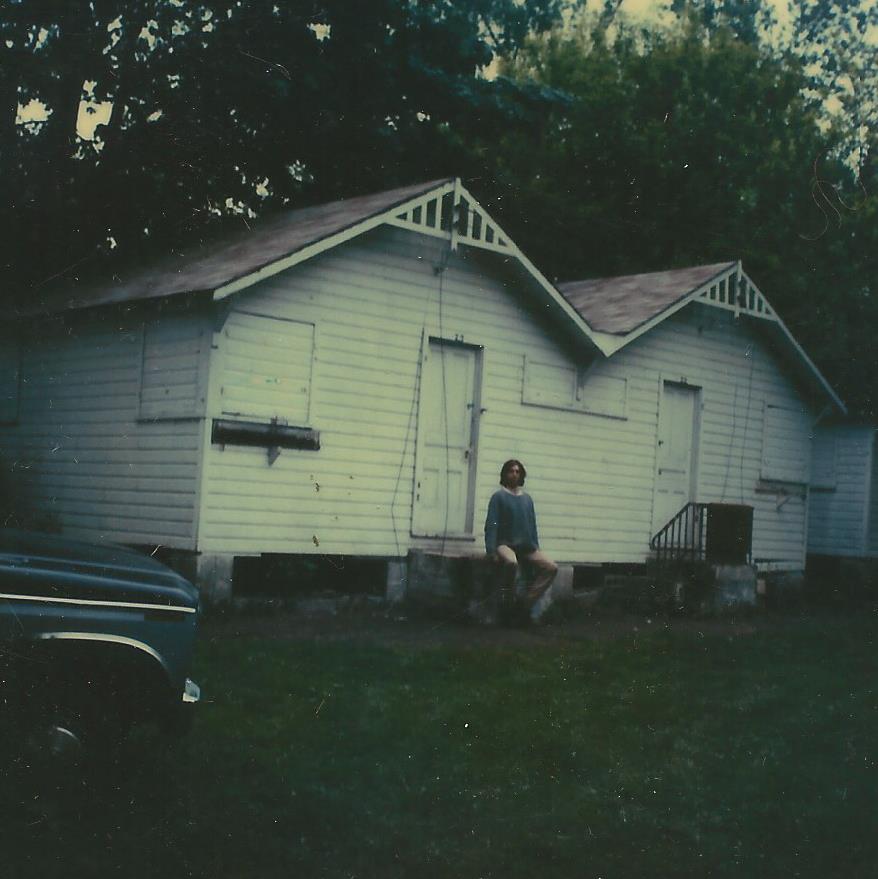
the "workshop" cabins in their original location

the “workshop” cabins in their original location

Well, it just so happened that we needed out buildings.  When we bought the place there was a very rudimentary workshop, and a sad little chicken coop not worth saving, and so we were planning to spend a bit to build a good workshop, with storage, and a building for the lawn mower, etc. So this seemed like a possibility to buy premade if the prices didn’t go too high.

The auction was set for 10 a.m. Saturday morning and I had to be at another country auction to buy stock, so Jeanine went to see if she might buy one, or with any luck two.  We knew that they were well made, and several were smaller, about 10’x10’ so in theory they should be easy to move.  Small enough to go under hydro lines. There was about twenty of them in all spread along two rows.

Jeanine got there about 9:30 and after having a good look decided which one’s she would try for.  The bidding started precisely at 10, and the auctioneer must have had somewhere else to go because basically he just walked down the row, saying “O.K. you’ve had a chance to see them and remember they come with all the contents, but by that by buying one you are agreeing to have it removed completely from the premises within 30 days.  Let’s begin.  Do I have $300.  Do I see $300.  Anyone in at $250.  Do I see $200.  Come on folks get me started here. Let’s go.”  Jeanine put up her hand.  I’ll bid $50.  “SOLD.   O.k. folks that’s the way it’s done, so now cabin #2. Do I here $300.”  Jeanine again.  I’ll give you $50.  “SOLD.  O.K. we move on to #3. “. And so it went on for another 20 minutes or so, and when the dust had cleared at Cabin #20 Jeanine had bought a total of 6 cabins from $50 to $150 each, complete with contents, and with this one little problem in that they all had to be moved within thirty days.
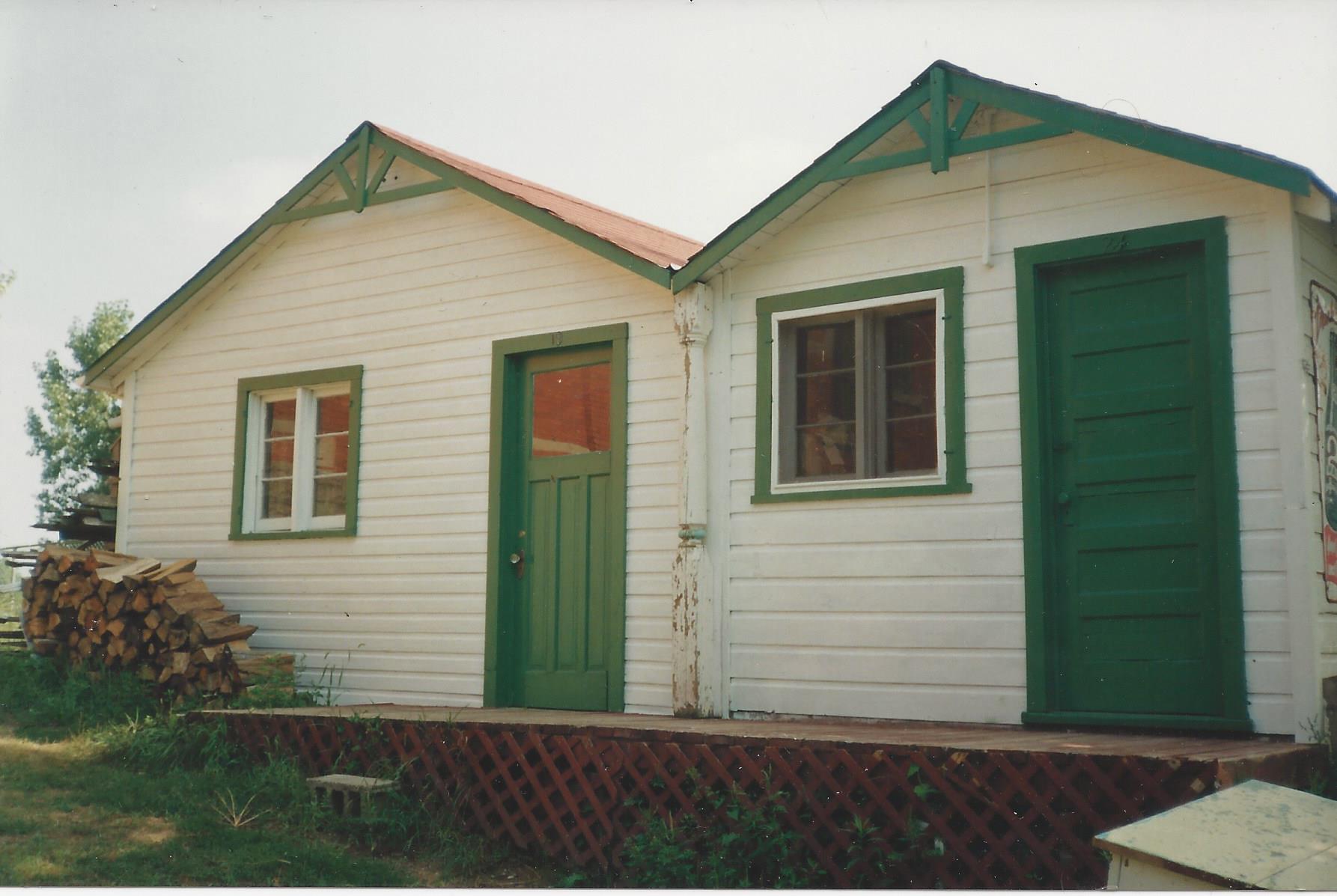
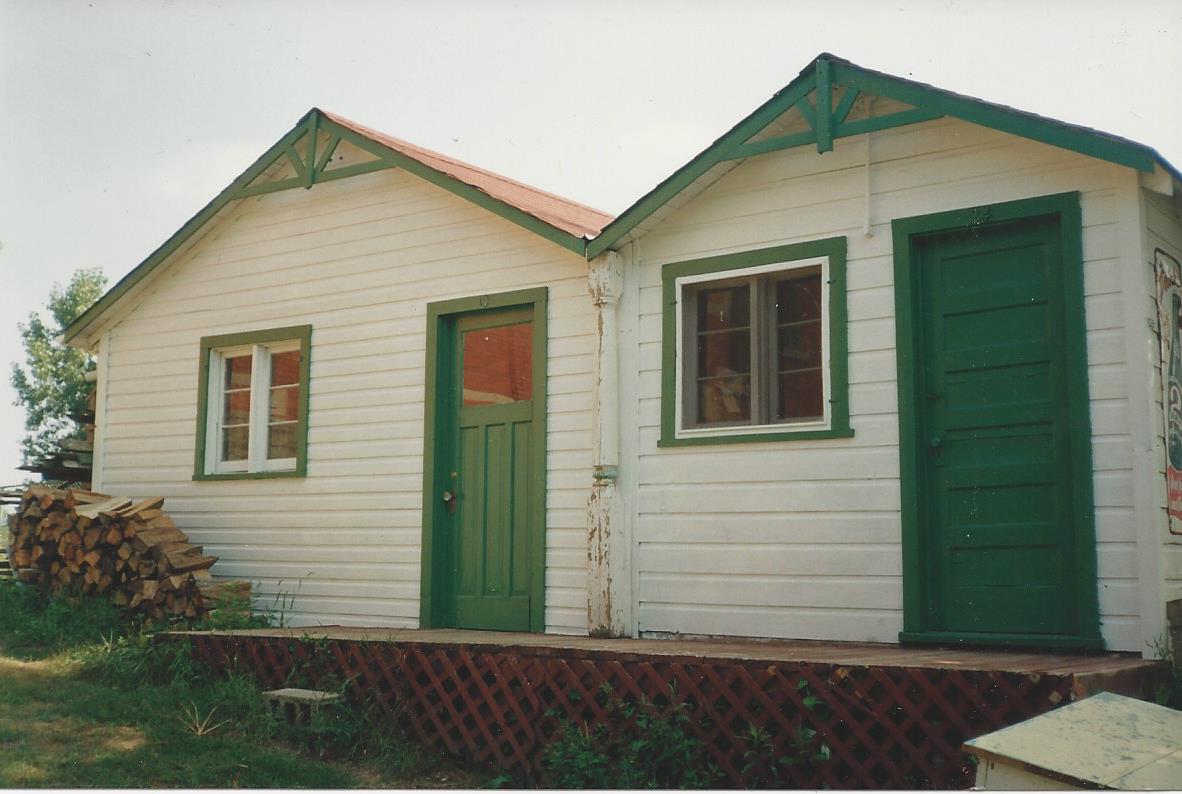
The cabins installed on our property

The cabins installed on our property

We were very do-it-yourself oriented in those days so after examining the situation we settled on a plan of borrowing our apple farmer friend Sergio’s large, low lying, flat-bed trailer.  We would jack the cabins up onto a tower of blocks high enough to drive the trailer very carefully underneath, between the concrete pylons.  Then it was simply the case of dropping the building onto the trailer and driving it the 40 kilometer distance to our place.   Our farmer friend and neighbor Dave offered to help and he had a big 8-cylinder heavy duty pick-up truck he thought we could use to drive them over.  What could go wrong?

I’m here to tell you that jacking up a building one side at a time and slipping in concrete blocks before going to the other side and repeating the process, is a pretty hairy business.  It seemed that it was always teetering on the brink and just about ready to drop, so you were super prepared to jump out of the way to save life and limb.  But somehow we were able to accomplish it with a lot of encouragement from Dave, who was rough and tumble and did this sort of thing all the time.

So we arrived at the moment when Dave, being our expert driver, very slowly lined up the trailer in front of the first cottage, and with his window open, cigarette dangling from his lips, looking back and forth between his two mirrors, managed to back it right up to the back of the cottage without touching the pillars on either side.  This was a masterful performance considering he had less than 3 inches grace on either side to play with.  Well done Dave.

Dropping it on the trailer was no problem, and after securing it we were ready to take our first cabin out of the park and over to the church.  No permits of course, but if they stopped us we were prepared to see just how far we could get with the argument that we had farm plates. Dave said you can do practically anything if you have farm plates. We did have a car in front with the blinkers flashing after all, and someone behind as well.

It went pretty well at first.  The truck seemed to be struggling a bit to get it moving, but we managed to pull out onto to the road and make a quick right, which was when we discovered that the Port Dover hill is a lot steeper than it looks.  The truck was in it’s lowest gear and it only took a couple of seconds to realize it just didn’t have the power to get this baby up the hill.  Yikes. Nothing to do but retreat.  One of us had stopped the traffic behind, so Dave was able to back into the Cabin park again and pull it a bit out of the way.  Hmm.  We needed a bigger gun.  So it was decided to call a friend of Dave’s who had a tow truck.  Within an hour he was there and hooked up, and with the extra power we had no problem getting up the hill and down the back roads to our place in Wyecombe. He charged us $75 for the trip.  We had a system.  Now all we had to do is get the thing off the trailer and go for number two.

As it turns out that was the tough part.  Not the lifting it up so the trailer could come out so much as the bringing it back down without tipping it part.  I think we managed to drop every one of them at least a little bit, but they landed roughly were we wanted them to with no damage and no one’s foot underneath.

We managed the 10’x10’ cabins well but there was a larger one about 16’ x 16’ that was too large for the trailer.  I went about trying to line up a couple of longer I beams to move it on, but nobody had any available so we had to resort to plan “B”.  Plan “B” was to simply take a chain saw and cut right down the corners of the building allowing us to lay down the individual sides on the trailer.  We just tore off the roof and trashed it. Worked like a charm.  We reconstructed the building by reinforcing the corners and built a new roof and it was as good as new.

Within the thirty days we managed to move the two buildings which went together to form our workshop and storage, a play cabin for our daughter Cassandra, a garden tool cabin, and we gave one to Dave for his helping us.  Realizing we didn’t need any more we sold the remaining one to a gent who had turned up too late for the auction and dearly wanted one.  We had a lot of refrigerators, stoves and funky furniture which disappeared pretty quickly as the local tobacco farmers were always looking to cheaply equip their summer help cabins.  We managed to recoup the cost of purchase from selling the contents, and in the end had four great outbuildings for less than $500.  Plus, we ended up with all our toes and fingers.  Bonus.cabin3


The Fifth Annual Outsider Art Fair – Discovering the work of James Castle

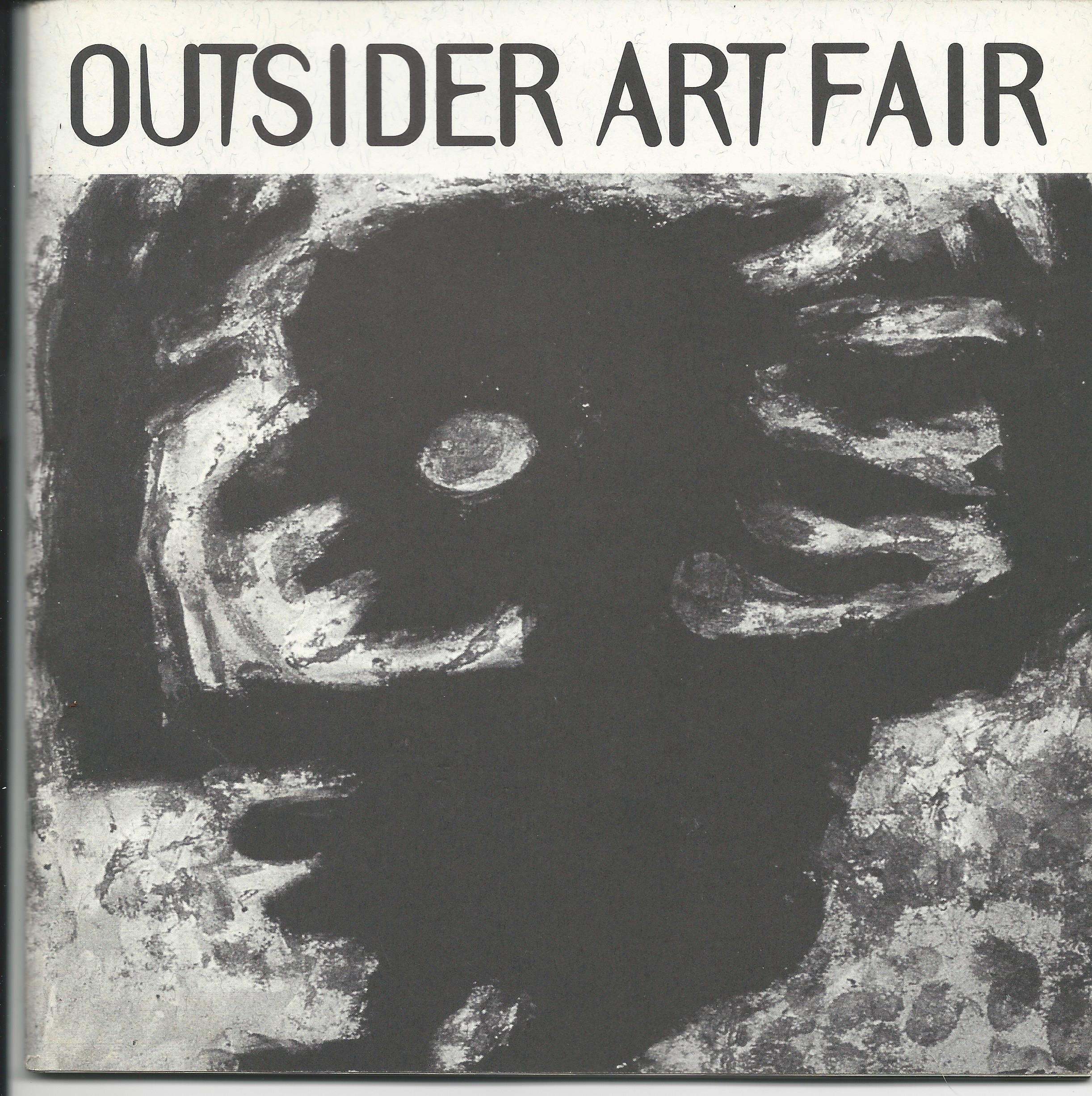
catalogue cover for the 1997 Outsider Art fair

catalogue cover for the 1997 Outsider Art fair

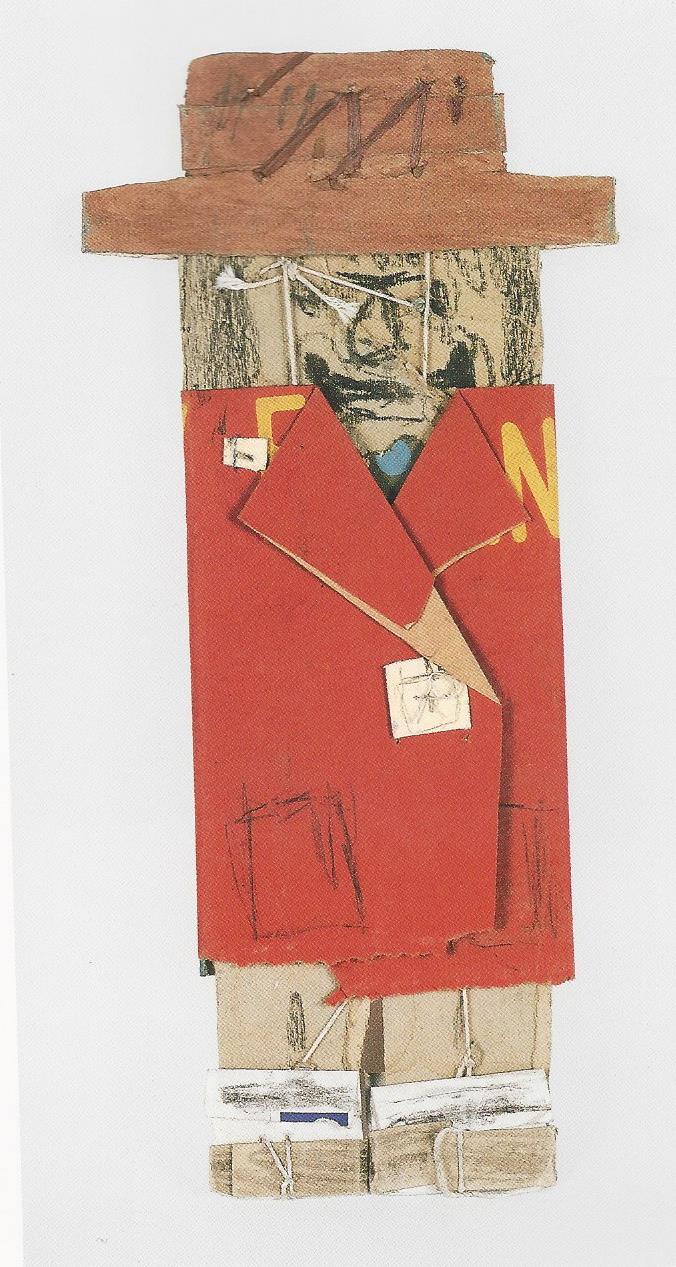
Coming back into the Puck building on the cold afternoon of January 23rd I started to feel that wonderful buzz that one feels before the opening of a big marketing event. A combination of excitement, and expectation, mixed with a touch of anxiety realizing that in a couple of hours the throngs would be pouring in, and we would be off and running, either making it, or breaking it.  The booth was set up and looked good, so I had a couple of hours to check out the show.  The first thing I did was cross the aisle to have a closer look at some work which I had been noticing which was deceptively simple in it’s construction but very compelling.  The entire booth of J Crist from Boise, Idaho was filled with the yet unknown work of James Castle (1900- 1977).

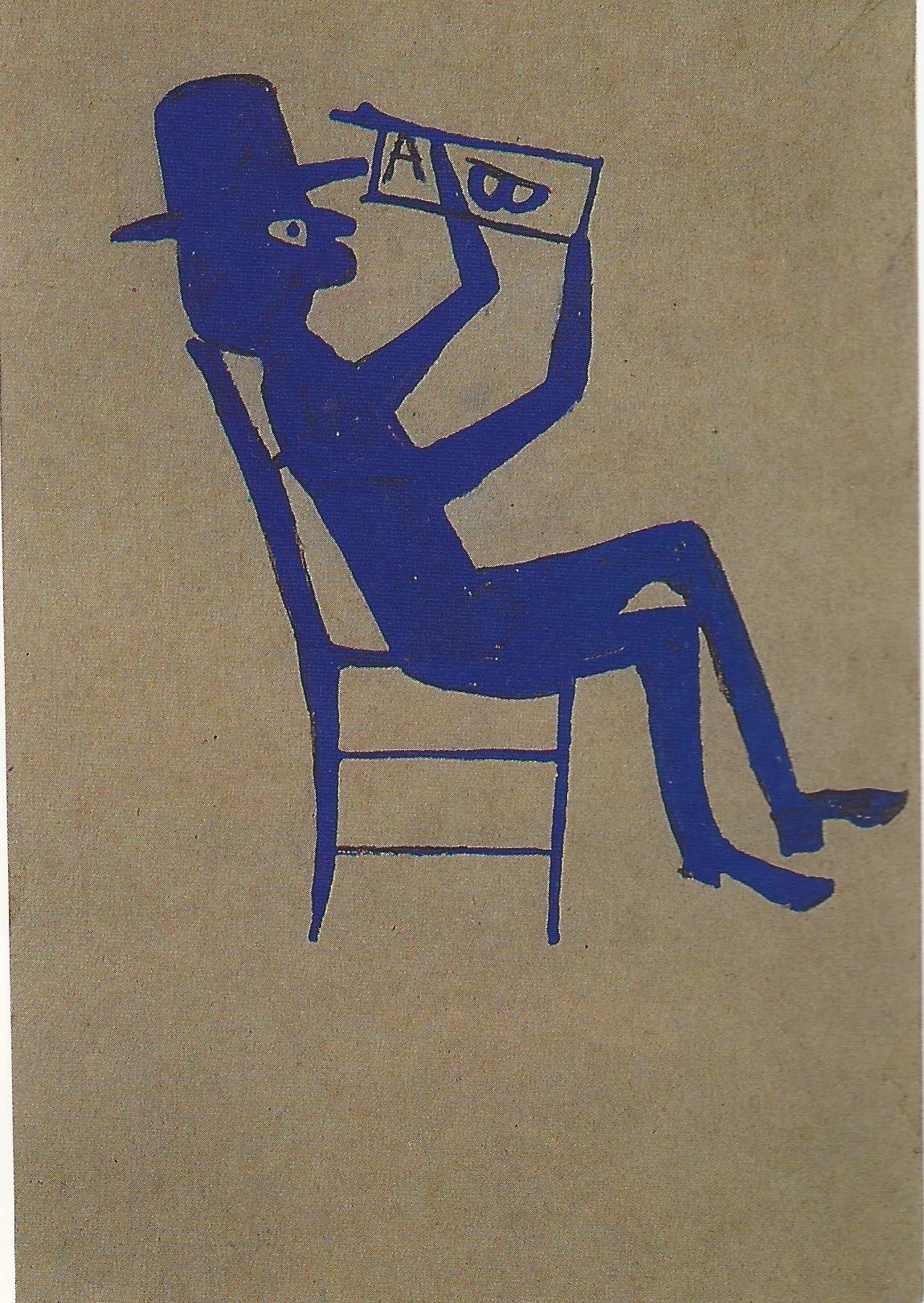
out2Jacqueline Crist who runs the gallery acts as agent for the artist’s estate and her gallery houses a considerable body of this particularly driven and prolific artist’s work. On this occasion she put “all of her eggs in one basket” and just brought works by Castle.  Getting up close to the work, I became more and more enamored.  Put together with spit, and soot and cardboard etc, the quantity and variety of his output is astonishing.  I came to find out that he devoted himself virtually full time to his art for nearly seven decades. His drawings, assemblages, and handmade books are compellingly mysterious, and contain a confounding sophistication.  Perhaps this quality is the essence of what attracts me to “outsider art”.  In the case of James Castle I was an immediate fan.  The tagged prices seemed fair.  Asking in the upper hundreds on up for the, in most cases, diminutive drawings and constructions.  Hmmm.   I began to think that I may score one of these beautiful little pieces to take home but of course I had to check out the rest of the show first, just in case there was another Bill Traylor drawing for low money.  Still feeling tough that I had missed out the year before.

a drawing by James Castle

a drawing by James Castle

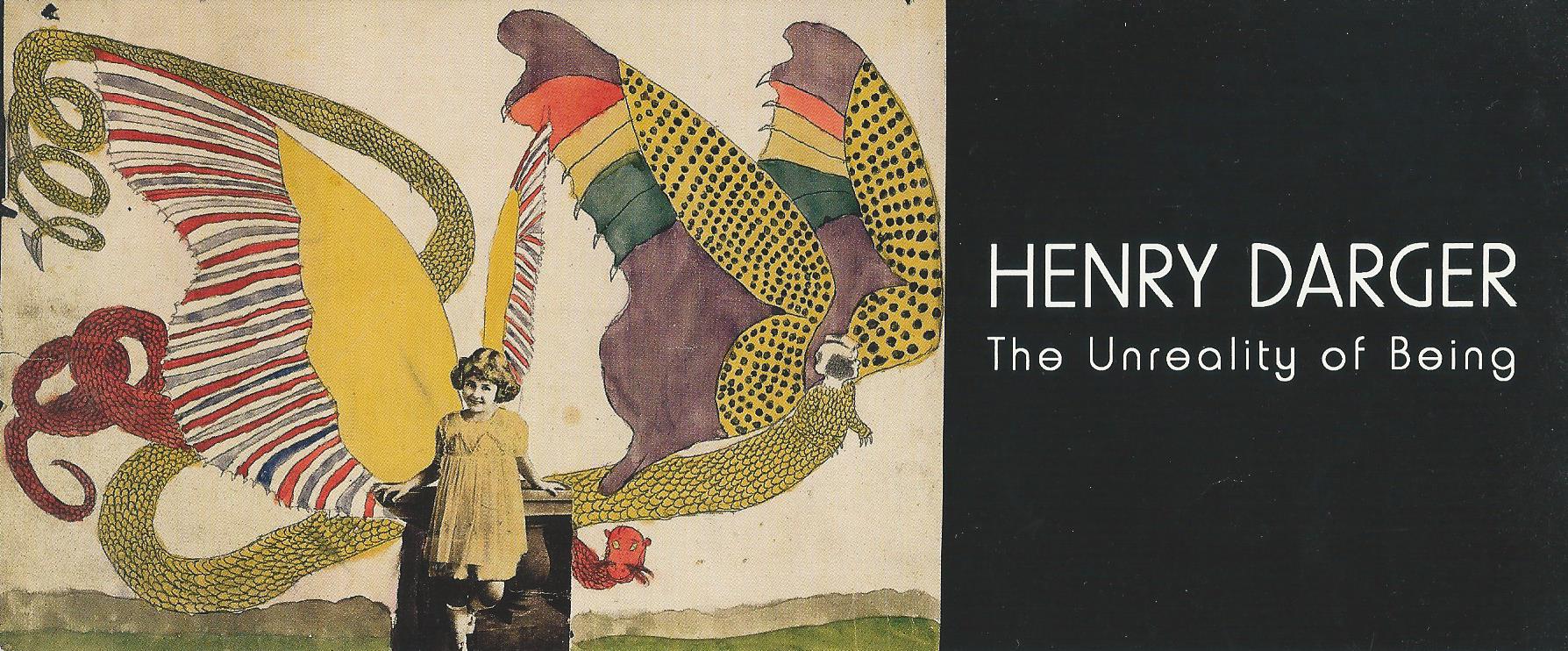
I noticed the Traylor drawing I had missed out on was present and priced up by a few more thousand dollars. Way to go, Phil.  Then I noticed that Carl Hammer’s booth was this year graced by two large, magnificent scrolls by Henry Darger.  This was the year to promote Darger, as there was running simultaneously with the show, a Museum of American Folk Art exhibition of more than 60 of his paintings called “the Unreality of Being”.  I was interested to note but not surprised that the prices of his work had gone up considerably.

invitation to the Henry Darger exhibit at the Museum of American Folk Art

invitation to the Henry Darger exhibit at the Museum of American Folk Art

So I made my way from booth to booth growing more determined by the second that a small James Castle drawing was in my future.  I wasn’t going to miss out like last year by hesitating and calling home for a conference.  No, I was going to head right back and make my selection.  But what’s this?  As I approach I see a group of the top dogs including Carl hammer leaving the booth.  My heart began to sink a little, but I told myself to relax, it’s o.k.  So the selection process may be a little bit easier.  I hadn’t set my sites on any work in particular.  I slid up to Jacqueline whom I had become quite friendly with during set up and asked her “what’s up”.  “It’s the craziest thing.  Those big wigs just came over, and bought my entire booth. Lock, stock and barrel. I’m finished here before it opens.  I guess I could just pack up and go home, but I want to stay because I was so looking forward to being a part of the show.”  Nice problem to have.  Well there you go.

A James Castle construction

A James Castle construction

Are you beginning to sense a theme here when it comes to me buying, or should I say not buying at art shows?  Well in this case she had plenty more work at home so I could have theoretically ended up with something else, but I chose to just let it pass, get on with the show, and concentrate on just doing my best to sell, sell, sell, for my friend Joy.  The show went even better than the year before, and we were all very happy with the experience.  Well, except for the missing out on the James Castle thing, but there you go.

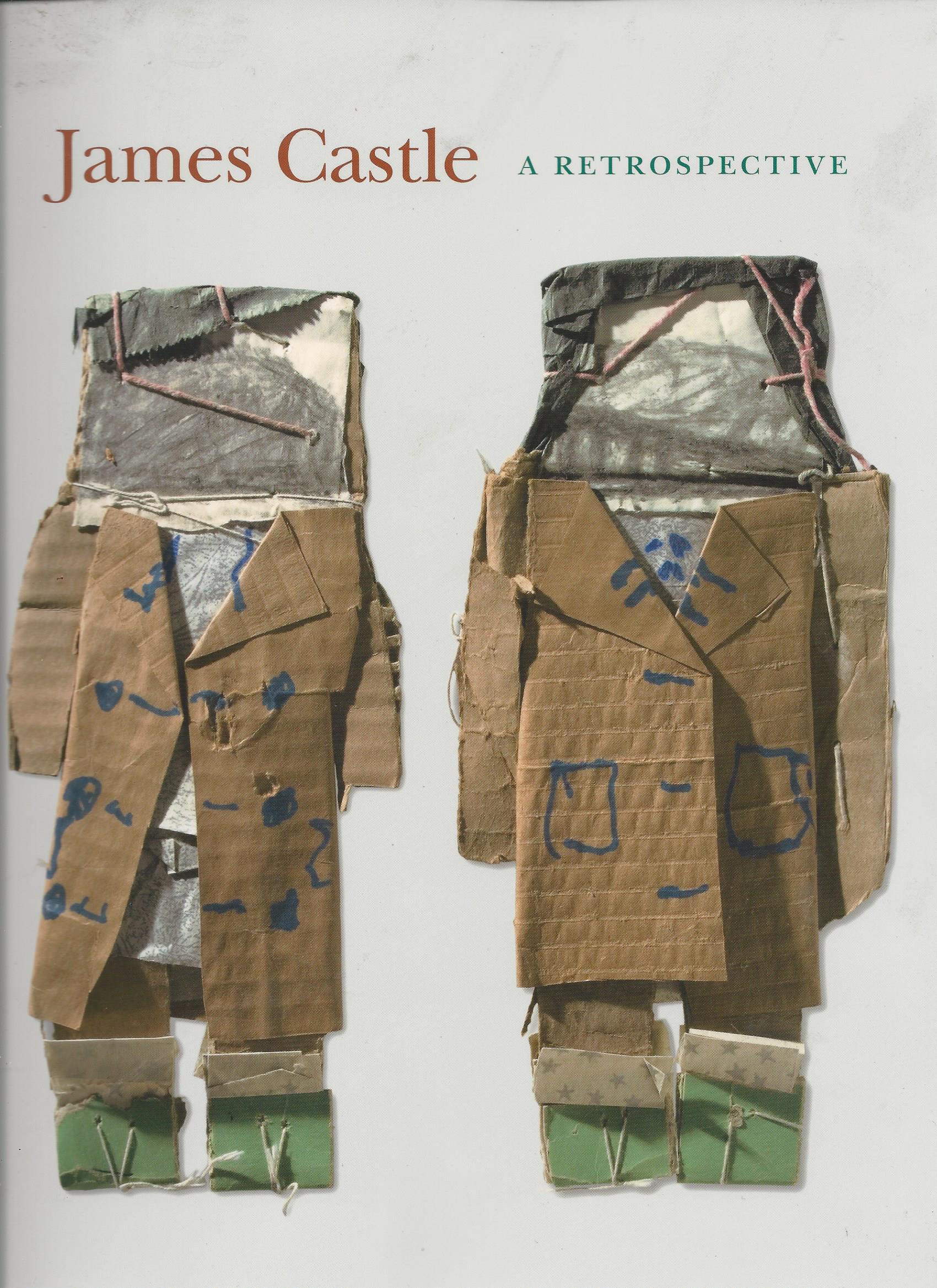
Since then a splendid book on Castle has come out in 2009, coinciding with the exhibition at the Philadelphia Museum of Art entitled “James Castle, a Retrospective”.  I highly recommend it.  I’ve got a copy.  I love looking through it.  It sits in place for the one that got away.

cover of the James Castle book

cover of the James Castle book

An Outsider, Inside at the Outsider Art Fair

out1 We met Canadian born, Miami based art dealer Joy Moos in 1994 at the one-time Canadian Contemporary Folk Art Festival, where we sold her some pieces, and both discovered and bought for the first time the paintings of Woodstock, Ontario artist Barbara Clark-Fleming.  Joy is a character and we hit it off immediately.   Then in the fall of 1995 Joy came to see us at the Church and picked out several other pieces she was interested in purchasing.  That was when she proposed that if she were to purchase a half dozen or so pieces, would I be willing to bring them to the Outsider Art Fair in New York city the following January.  She asked me to help man her booth, and be her on- site “expert” on Canadian Folk Art.  She offered to cover my costs and would allow me to bring a few pieces to sell at the show of my own.  Hmmm, a chance to go to New York and see the Outsider Art Fair from the inside, and hopefully make a few bucks.  “I’m in”.  So early on January 24th under sunny skies I drove to New York with a van full of Canadian folk art and arrived about 3 in the afternoon at the famous Puck building at the corner of Lafayette and Houston Streets in the Soho District.  She had a couple of assistance come in from Miami and it didn’t take us long to set up the booth.  I then checked in to our favorite downtown hotel, The Leo House, ($75 a night at the time and clean), and then met up for dinner and an evening’s debauchery with an old pal, the Oklahoma born artist Don Bonham who lived and worked at the time in a studio in Brooklyn, situated right under the Brooklyn bridge.

Joy Moos in her display at the 1996 Outsider Art Fain

Joy Moos in her booth at the 1996 Outsider Art Fain

In spite of the late night, I arrived early Friday morning, well in advance of the 5:30 preview because I wanted the chance to look at everything before it was time to work.  My show badge allowed me easy entrance, and I was immediately delighted to soak up the excitement of the pre-show set up.   Lots of New York and New jersey accents coming from the workers as they scurried around setting up the lighting, carpets, curtains, etc. and a chance to see all the famous gallery owners that I’d read about for years, never thinking that I would ever have a chance to meet them, let alone participate in a show together.  Three large rooms of side by side exhibits encompassing 35 dealers.  Right across from us Dean Jensen had an expansive display of 1920’s-30’s tattoo flash that both shocked and delighted. Across from them was the wonderful booth of Aarne Anton of the American Primitive Gallery.  A man who was immediately welcoming and friendly, as well as informative. I moved slowly up and down the rows taking in everything.  Each booth was chock a block with fabulous work.  Sometimes inspiring and beautiful beyond belief, at other times dark and disturbing.  It was overwhelming. Then I moved into the next room where I could see Carl Hammer from Chicago installing paintings by the yet relatively unknown recluse Henry Darger, whose work I found both beautiful in the way a fine Japanese watercolour is beautiful, and simultaneously disturbing in that the content is what seems to be children at war, with impaling, and death, and all that war entails.  My emotions were beginning to run high.  I was a couple hours in and already needing a little break.

A work by Henry Darger

A work by Henry Darger

So after a nice lunch in the on- site canteen, I took a bit of time to look through the expansive book store, and noticed among other things a book about Bill Traylor, who had been born a slave on an Alabama farm in 1856.  He remained on the farm until the 1930’s, when at the age of 80 he settled in Montgomery.  Impoverished and homeless he spent his days sitting on a box on a downtown street drawing scenes of the life which surrounded him, and from his memories.  I was deeply affected by the simplicity and directness of his exquisite drawings.  I put down my $16 and bought the book.out8

Not ten minutes later I was looking in a small booth, and low and behold there was a little 5” x 7” framed drawing by Traylor of a walking man with a top hat and cane, just being hung and labeled by the dealer.  I noted the price was $750 U.S.  I had brought a thousand Canadian in case I found something I felt would be good to purchase, although my thinking was that there may be some Canadian folk art turn up which may be under priced due to the location. It had never occurred to me that I may want to buy something American.  I was stopped in my tracks.  I had no idea what the value of a small, simple line drawing by the artist may be worth, but I was completely drawn to it, and so asked if the dealer would hold it for me for fifteen minutes while I reflected and called home to discuss it with Jeanine.  The dealer was nice enough about it but refused saying that the preshow was when he did some of his best business and it was a fair price.  “O.K. I understand, but I am serious and I will be right back.”  I went out back of the building to get a cell signal and happily Jeanine answered.  Upon describing the situation, she expressed that she had no idea what the work was like, and yes $750 U.S. seems like a lot for a small line drawing, but if I felt strongly about it that I should go for it.  I ran back into the show to witness Carl Hammer walking away with the drawing, as the dealer counted out the cash.  Damn it.  Another example of “you snooze, you lose”, and learn to trust your damn instincts.  Hammer put it in his booth at $14,000 which I have come to learn is still a good price for a Traylor.  Here is a link to an article in Art News which describes the rise of Traylor’s prices   http://www.artnews.com/2006/01/17/prices-climb-for-the-art-of-bill-traylor/

out10

A Bill Traylor drawing


So I only kicked myself for an hour or so before realizing that at least my instincts are good, and it was time to get on with the show.  I found it fascinating to watch the wheeling and dealing going down American style.  These boys and girls meant business and were frankly ruthless in comparison to my much more conservative and polite Canadian compatriots.  Some of them were very open and welcoming to me like top New York dealer Phyllis Kind who closed her shop and retired in 2009 after 40 years of dedication to the cause of Outsider art.  She showed interest in the photographs I brought of Billie Orr’s work and suggested I come by her gallery on Saturday when she would be in attendance.  I enthusiastically complied and spent a wonderful hour talking to her.  Billie, as stated in a previous blog was not interested so nothing came of it, but I cherish the memory of the meeting.  Some dealers were highly competitive and not nice at all.  Ricco, of Ricco/Maresca Gallery was totally dismissive suggesting he didn’t think there was any art in Canada worth bringing to the American market.  All in all, I learned a lot by being the fly on the wall.  Observing the “big guns” getting together and discussing who they “mutually agreed” would be the artists most favored and promoted that year.

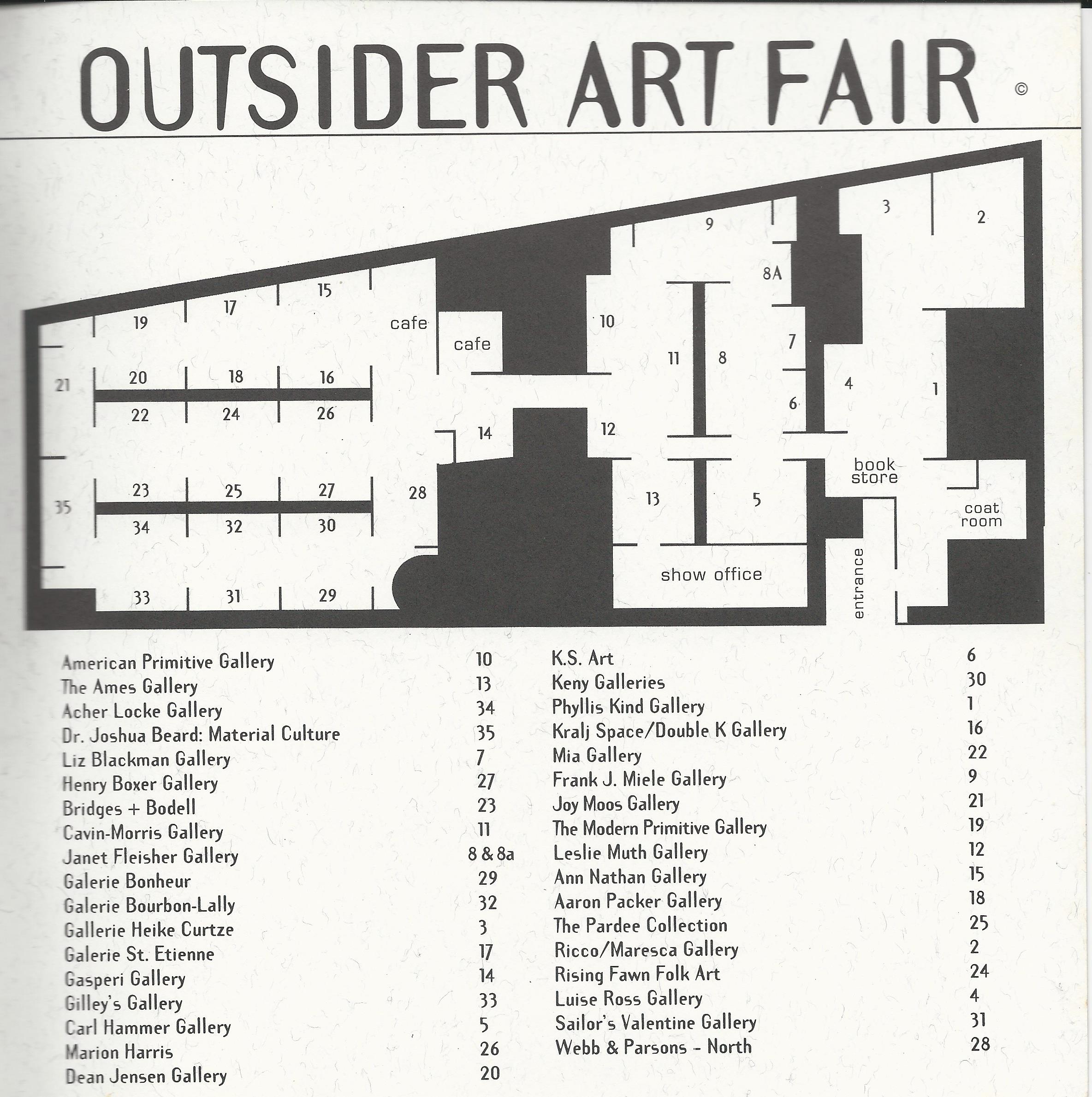
map of booths at the 1996 Outsider Art Fair

map of booths at the 1996 Outsider Art Fair


The preview was packed right up until 8:30 closing and when not selling, I was conscious of how glamourous a New York art opening really is.  The stars were out.  Oh look, there’s Bette Midler (very nice and much shorter than you would think).  And there’s Marisa Tomei.  And look it’s Mathew Broderick and Sarah Jessica Parker.  Etc.  The number of sales was amazing.  Over the three days, Joy sold out at least half of her booth.  I sold everything I brought.   When I packed up and headed out for the 8 hour drive back home at 6 p.m. on Sunday, I was a happy man.  I had witnessed a great amount of inspiring art, enjoyed experiencing a major American Art Event from the inside, and I had a few bucks in my pocket to take home.  Joy was happy with the amount of art I sold for her, and I decided then and there to take her up on her offer to come back in January of 1997.  Blog to follow.

I’ll close with a quote from Phyllis Kind from the Maine Antique Digest coverage of the show.  I think it sums it up.  “The whole concept of Outsider Art is the notion that it is rare when genius, and total lack of knowing what one is doing marry”

1996 Outsider Art Fair catalogue

1996 Outsider Art Fair catalogue

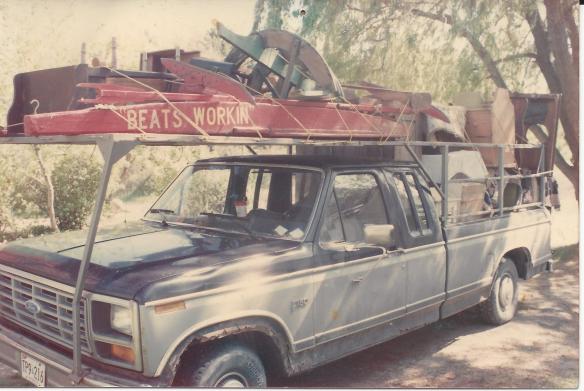
YOUR TRUCK IS ON FIRE!!!

truckIt had been a successful Odessa show.   On Saturday at opening we had just arrived due to a flat en route , and were bringing things off the truck as people came in.  Turns out people get excited by getting first crack at things, and several pieces were selling as they hit the ground.  The mood was jovial and spirited.  Dan Ackroyd and his wife came by and they were attracted to a two piece painted cupboard that they could see glimpses of on the still tied down load.  She told him to stay there until it was unloaded while she went on down the line, and he was good enough to suggest helping me unload rather than just standing there watching me.  Nice guy.  It turned out not to be the cupboard for them, but regular Toronto customers bought it right after, so this combined with other sales indicated a strong start.  It’s a great feeling to sell enough in the first hour that you have “made your table” as the expression goes, and you can relax a little knowing that even if nothing else sells you have had a good show.  It didn’t happen that often even then in the heyday of the nineties.
The day continued to go well in spite of the sweltering August heat, and we even had a few sales on Sunday. So, when five o’clock closing came, we were happy not to have a lot to load back on, although the Toronto couple needed the cupboard delivered to their home, and I bought a few things in the rough to take home.  By about seven we were loaded and on the 401 heading west.  We checked the radio for traffic and found out that things were moving slowly all the way to Toronto due to an accident and so decided to pull off at Belleville for dinner at a place we like down by the marine.  We felt a bit celebratory, and content to relax, sip wine, and eat seafood while looking out over the boats in the harbor, so by the time we finished our espresso it was probably pushing ten before we were back on the road to complete the five hour (in total) drive.  Feeling good and awake thanks to the espresso.   Of course we were younger then and able to stay up past ten.

So everything was going swimmingly. Traffic was clipping along, the CBC was playing an interesting documentary, the windows were down and the breeze was cool.  We hit Toronto about midnight and I was enjoying the fact that all four express lanes seemed almost empty.  Occasionally a big transport would go whooshing past me in spite us traveling at 120 Km per hour.  I was “in the zone” and enjoying the oddly luminescent mercury vapor lighting and passing cityscape when suddenly there is a pick-up right behind me flashing his lights, and hitting his horn.  “Alright already.  Go by me there’s another three lanes.”   What is with this guy?  Next thing he has pulled up right beside me, and a guy leans out the window and screams “Your truck is on fire!!”  Whaaat?  Looking in the rear view I see flames flaring up into the night off the top of my load and realized he’s right. Yikes! It was several minutes before I could pull off safely, all the while watching the flames get higher due to the combination of plenty of oxygen , and all that dry 100 year old wood.  I jumped out and surveyed the scene.  Indeed, I could see that at least three things were on fire and several blankets had ignited, and of course all this was tightly secured by ropes which are also on fire by this point. The situation looked dire. First things first.  Jeanine was by this point sleeping, and was not at all pleased to be woken up with the news that it was time to abandon ship and run for your life.  We both ran down into the ditch thinking that at any moment the thing may blow just like in the movies.  Then slowly reason supplanted panic, and we realized that the pieces on fire were up on top and we would have to stand there and watch it burn for a long time before it came anywhere near the gas tank.  Let alone heat up the steel of the truck bed enough to ignite anything, so we got busy and started untying things as fast as we could, throwing the burning blankets and ropes into the ditch and stomping them out.  My kingdom for a fire extinguisher.  I have always carried one thereafter, and so there’s a cautionary tale for you.  Other than gloves, all we had to fight the fire was a couple of large bottles of water which we saved to pour right on the burning wood parts of the furniture that had ignited. We unloaded and stomped and smothered for about fifteen minutes which seemed an eternity and before you knew it, the flames were out. The fire was mostly in the blankets as it turns out, and we quickly assessed that only three pieces of furniture were seriously damaged.  Unfortunately, one of them was the sold and paid for cupboard to be delivered to Toronto.  We sat in the ditch for several minutes making sure all the fire was out, as the traffic roared by quite oblivious to our drama.  Nobody stopped and the half expected police never showed up.  We settled our nerves, and tried to figure out how such a thing could happen.  Our best guess was that a trucker had thrown out a lit cigarette and it had landed in among the blankets.  A close call, but half an hour later we were reloaded and back on the road heading home, feeling grateful that things had not gotten worse.  The insurance paid for some of the damage.  Giving us the money we had paid for the cupboard before restoring it, and not the amount we had just sold it for.  However, something is better than nothing.  The hard part of course was phoning our good clients in Toronto and having to inform than that their beloved cupboard had met a deathly fate on the road home and we were tearing up their cheque.  Very nice folks, they were quite understanding although they didn’t entirely believe that we hadn’t sold the cupboard for more money and then made up the story, so they accepted our invitation to come out and see for themselves.  They were quite reassured when they saw it and marveled that the fire had not spread further to destroy more of the load.  We felt the same.  We were able to come up with another cupboard for them, and no one got hurt so I guess you can say that all’s well that ends well. Still, I would advise that get yourself a fire extinguisher, especially if you carry furniture on an open truck. The moment may arrive when you would give your left arm to have one, God forbid.

The “spontaneous” vision of Quebec carver Andre Laporte

Andre's Montreal Canadien goalie

Andre’s Montreal Canadien goalie

About 30 years ago we were rooting around in Alain Chauvette’s pickers barn near Victoriaville Quebec when we happened upon a wonderful carving of a Montreal Canadien goalie.  A serious dude with a square head and a look of determination which would intimidate even the most veteran opponent.  We loved it and bought it for our own collection.  I’m looking at him right now and I’m still impressed with the expressiveness of his rough cut features, and the immediacy of the carving.  Problem was, he wasn’t signed.  We asked Alain if he knew the carver, and he did not so we had to be content to have found this one great piece by an unknown carver with the possibility of never knowing the maker, or seeing other work by him.  Then about six months later we found a carving that was obviously made by the same hands of a group of four cows, carved all in one piece in the round.  The same roughness and directness as the goalie.  This time it had the signature A Laporte on the bottom.  The picker still did not know the carver, but at least we had a name to go on.

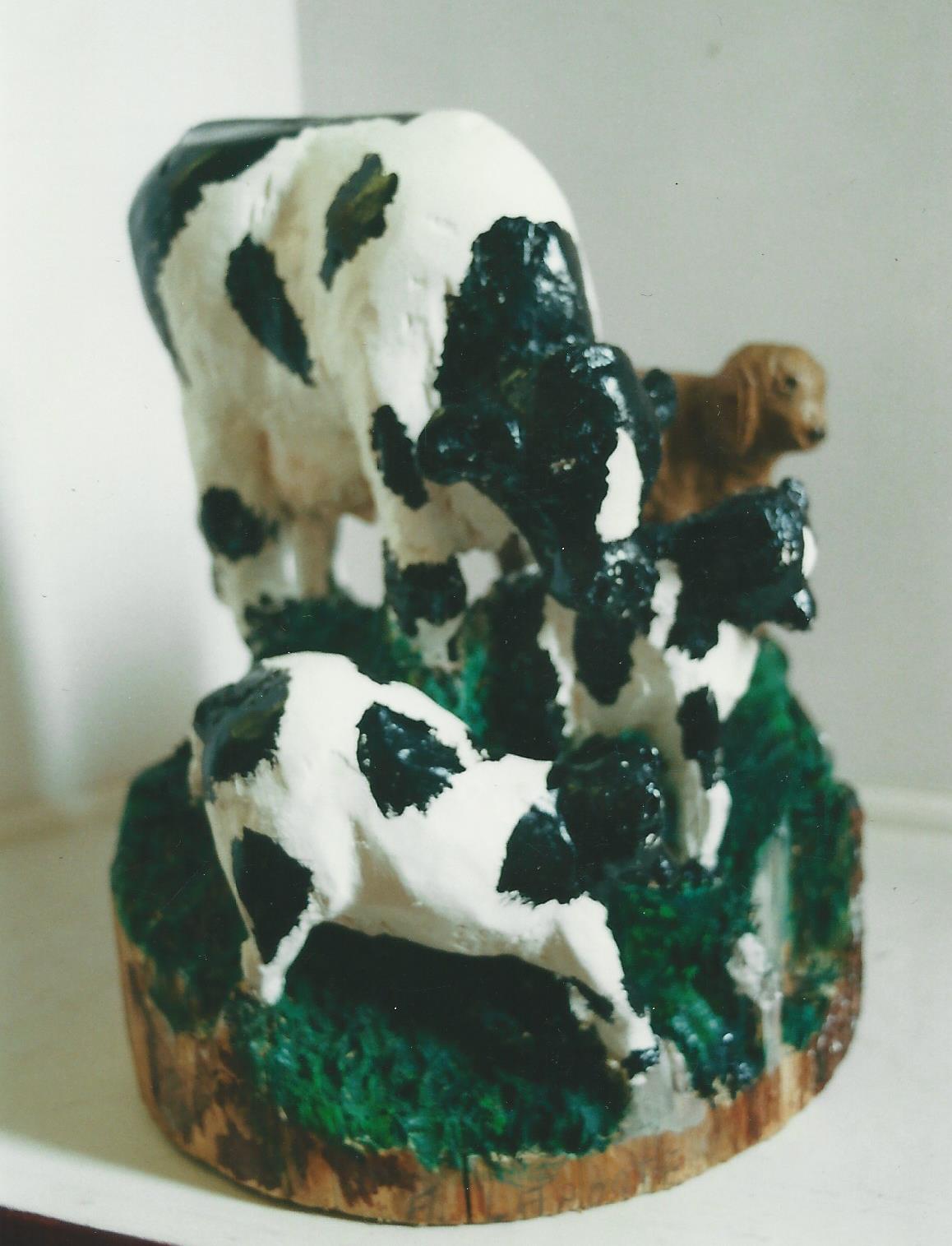
a group of cows by Andre Laporte

a group of cows by Andre Laporte

So fast forward about fifteen years later.  We have found and bought another half dozen pieces by Mr. Laporte, all with the same strength and spontaneity of our goalie.  Still no one knew, or admitted to knowing anything about the artist.  Remember that any picker is extremely reluctant to put you in touch with a carver because then you buy from the artist and not them, so it is counterproductive.  Still, we were happy just to find the pieces and realize that the artist was most likely still active.

Andre sits on his front bench with his first carving

Then came that lucky day when by going through the phone book in La Prairie, and we found and met the carver Leo Fournier.  We were enjoying our conversation with Leo when his wife came into the room and said “Leo, Andre Laporte just phoned and I told him I would have you phone him back after you are finished here.” Eureka!  “Would your friend Andre Laporte be a carver by any chance?”  Why yes he is, a carver and an antique picker.  He lives a few miles from here in the town of Verdun.” “Would you mind giving us his phone number”. “Not at all.  I’m sure he would be happy to meet you”.  So before we left Leo called Andre back, gave him the scoop and put us on the phone.  It was late in the day, so we made arrangements to arrive at his place at 9 the next morning.  After getting directions Andre said “No one has ever wanted to meet me before.  I don’t have a lot of work to show you so I hope you are not disappointed. “.  “Not to worry Andre, we love your work and will be delighted just to meet you , and if you have anything to show us, that’s good too.

Next morning after a hearty breakfast we arrived at Andre’s little house by the railway tracks precisely at 9, and there was Andre waiting on a bench by his front door.  You could see he was both excited and a little anxious. After exchanging greetings, we went inside and met his wife Lucie.  The place was small but filled with nice things including several of Andre’s carvings which were brought out and put on the dining room table.

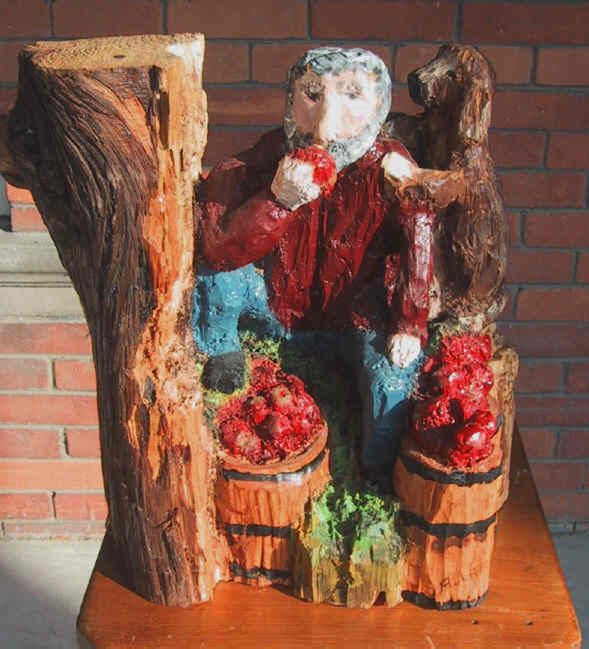
A man enjoys an apple while his faithful dog looks on

A man enjoys an apple while his faithful dog looks on

Leo had briefed him on who we were and he was excited to think that we would be interested in him.  “So you actually like my work?”.  Why yes, we like it a lot. You have a unique style and energy which we find very attractive.”  “The other pickers who come by tell me my works too rough and nobody will want it, but that’s the only way I can work. “You see this horse there.”  We focused our attention on a very strong and expressive work horse. “That was my first carving.  They took down some hydro poles about seven years ago and left them across the street.  I cut up one of them into various sized “stumps”, and brought them home to burn, but then I started to look at them and after a while I saw this horse inside one of the stumps.  I thought about it for a long time, and then one day in 1984 I  just started chipping away at it, and after about ten hours this horse had emerged. That was it.  I was hooked. That’s the way I’ve worked ever since.  I see the form in the log, and then I carve, until I get it all out”.  I don’t glue pieces together or sand them more than I have to.  I like them rough and close to the way I see them in my head.” I can only work when I see the piece in the wood first, and then I can’t stop working until it is finished.  At this point Lucie jumps in.  “that’s right.  Once Andre starts to carve I know I’ve lost him until he is finished.  I drew the line when one night he put an old quilt on our bed and started to carve right there.”

Andre's bust of Quebec strongman Louis Cyr

Andre’s bust of Quebec strongman Louis Cyr

Andre represents what it is to be a natural, instinctive carver.  With no training or even having much experience of other work, his work is truly inspired and highly individual. His work deals with what is the pure essentials of his subject.  There is always a sense of vitality and movement.

We bought several pieces that day including his first carving of the horse which remains in our collection.  We continued to go by Andre’s place a couple of times a year for the many years that we continued to travel to Quebec, buying most of his output each time.  Even after we stopped going we would talk on the phone occasionally and he would describe what he had been working on.  Often we would send him a cheque and he would mail us pieces sight unseen.  Andre and Lucie have a hard life.  He was born in Verdun on May 20th, 1948 and has lived there all his life.  He has barely eked out a living being an antique picker of the door knocker variety.  For a while things went well for him when collector Pierre Laplante was buying almost everything he picked, but then they had a falling out and that stopped.  Andre and Lucie have three daughters and one grandchild.

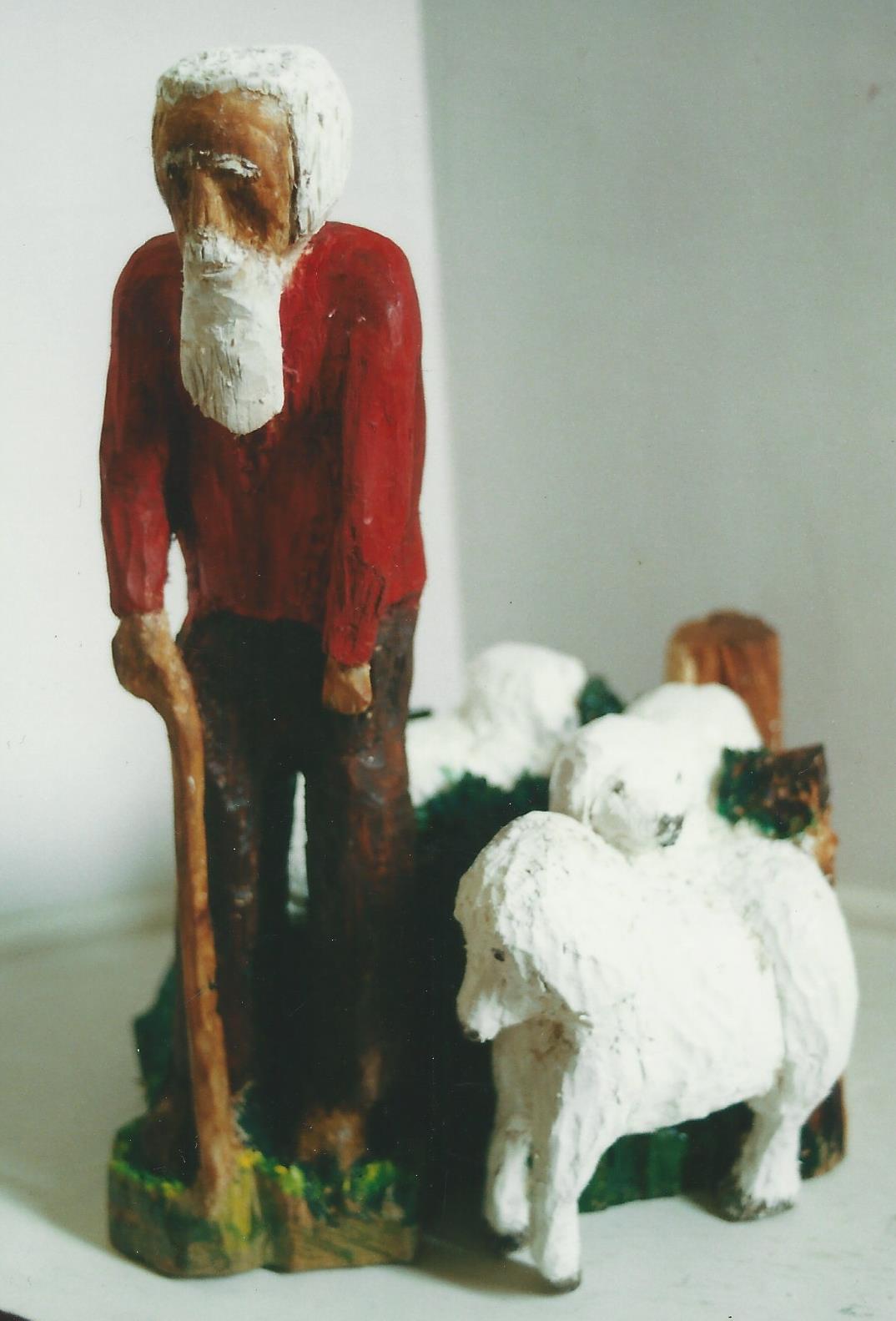
an old man and his sheep by Andre Laporte

an old man and his sheep by Andre Laporte

A few years ago I called to see how he and Lucie were doing and he informed me that sadly one of their daughters had been in a terrible car accident was grievously injured, and that now he had to take her every day to the hospital for treatment. There was never enough money in what Andre does to make a happy and secure life, and I’m sure that without the love and support of Lucie and his family he would not be able to survive. The last time I called was in 2007 when our mutual friend Leo Fournier died. We had a great chat about Leo.  How he was his own man, and Andre laughed and summarized it like this “I have always admired Leo.  He lived exactly as he wanted to, and never cared what anybody thought. He loved to drink and he died drunk.  It couldn’t have been better for him”.  I don’t know how things have gone for Leo since.  I should phone him.  That last time we spoke he said he hadn’t made any new work in a couple of years and he was still mainly preoccupied with helping his daughter to get back to a happy and productive life.  He and Lucie are the salt of the earth.  I really hope that things are getting easier for them.  He has real talent that in a better world would be enough to provide him and his family with a happy and secure life. Unfortunately, it rarely works out like that for artists in the world we live in today.

Andre surrounded by his creations

Andre surrounded by his creations

More about Billie Orr

Bill loved visitors

Bill loved visitors

Throughout the nineties I continued to visit Bill when I would get to the Muskoka region.  This was fairly often because at the time I was getting a lot of fresh picked stock from Scott Beasley and a couple of other guys in the region.  Over repeated visits I was able to buy more of his carvings, just a few at a time, and I got to know more of Bill’s story.

Billie Orr was born in Tyrone, Ireland in 1912, but he came to Canada with his parents when he was six months old. The family settled in Muskoka, and when Bill was sixteen he went to work for the railroad. Then in 1936 he started to work at the Muskoka Sanatorium in Gravenhurst where he was employed for several years as chief engineer.

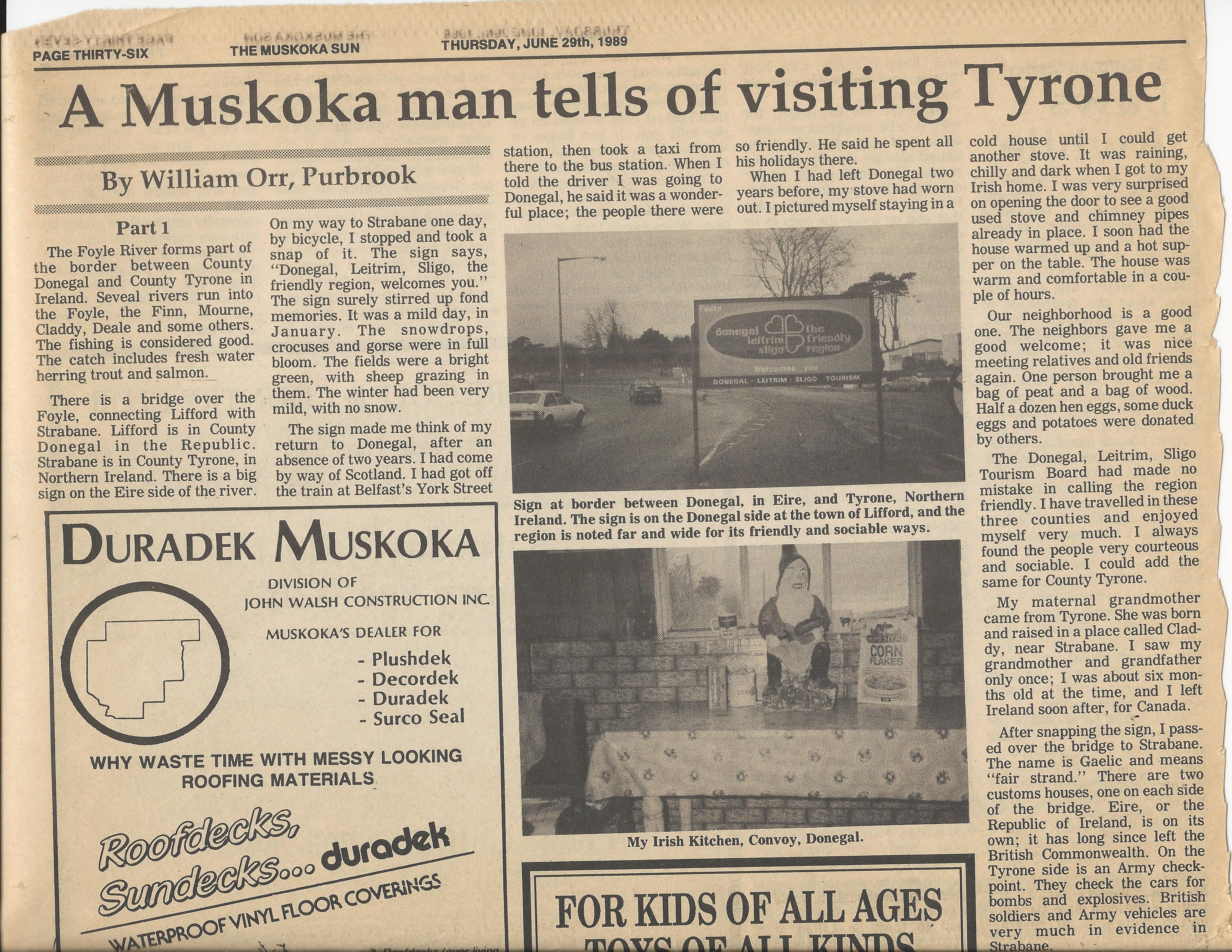
Bill continued to live on the family homestead in a log cabin all his life until shortly before his death in 1998.  About fifty years ago Billie planted a tree circle behind his house and started to make Irish and Zodiac figures in cement. He placed his figures within this “magical” circle. He said he did it for the amusement of the moose. He made friends with and tamed many wild animals. He loved Ireland, and would return many times on his own to travel by bicycle and hike throughout the countryside. When he returned he would publish accounts of his travels in the Muskoka paper.

a copy of Bill's article

a copy of Bill’s article

In the fall of 1997 I dropped by Bill’s unannounced, and for the first time he wasn’t home.  I thought I had just missed him and he had gone into town, so I left a note and thought nothing more about it.  A couple of weeks later I got a letter from Billie.  Sadly, he explained that he had fallen ill with a bad heart and that after a stay in the hospital he was forced to move from his beloved cabin into Orillia, where he had a sister in law who helped look after him.  He gave me his new address and phone number.  It was sad talking to him, because although he remained up-beat, he stated that he would now have to stay in Orillia near his doctor and that he would never again see his cherished home in Purbrook. He ended sounding upbeat, and he told me that before the attack he had finished a half dozen new carvings and if I could get up to see him he would sell me a couple. This was in February of 1998.  I  said I would be up to see him, as soon as the good weather came in the spring.

Bill's last letter

Bill’s last letter

Well, one thing lead to another, and spring came and went and I think it was mid-summer before I was ready to head up north. I called Bill’s number to tell him I was coming. Billy’s sister in law answered. I was shocked to learn that Billie had died not long after I talked to him.   I was too late.  I felt terrible for missing my chance to have one last visit, but I had convinced myself that he was on the mend.  His sister in law told me that the property sold right away and was being developed. I knew this meant the end of the circle of trees, and the magical world of zodiac and Irish creatures. When I had expressed my condolences and hung up the phone, I felt I should rush up there immediately and try to save the concrete menagerie as I feared they would likely get bulldozed into the ground the minute they got in the way.  Then I thought about it a bit more and I didn’t go.  I knew in my heart that it was too late, and decided I would rather remember it the way it was.  I once brought along a VHS camera and taped a visit with Bill.  What I must do before it deteriorates is get it transferred to digital and have it as a record. Bill was a special man, and in his own right an inspired artist, both in what he created, and the way he lived.  When I did the Outsider Art fair in New York City, I brought pictures of Bill’s place, along with many other examples of Canadian folk art, and showed them to the renowned art dealer, Phyllis Kind. She passed over much of what I showed her, but paused and really had a hard look at Billie’s work. She said “This is interesting.  I’d like to know more about this artist.”  When I got home I sent her photos, a bio, etc, and after a couple of weeks she phoned me to  say that she would be interested if Bill would sell all of the work and she could show it as a reconstruction of Bill’s installation. Naturally she was concerned about the cost of moving all that concrete to New York.   I got in touch with Bill but he wasn’t at all interested. I could tell that for him it would be like selling his family.  Still, Phyllis is no slouch when it comes to art, and her interest reaffirmed my belief that Bill Orr was an exceptional individual and artist; and he was a lovely man to boot.bob4

One last little story.  I got back from a Muskoka trip once and in going over my finances I realised that I have inadvertently underpaid Bill by ten bucks. I can be a real idiot with numbers sometimes.  In any case, I wrote him a letter of apology, and sent him it along with some photos I took of his pieces, and the ten bucks I owed him. I received the following note by return mail:

Dear Phillip,

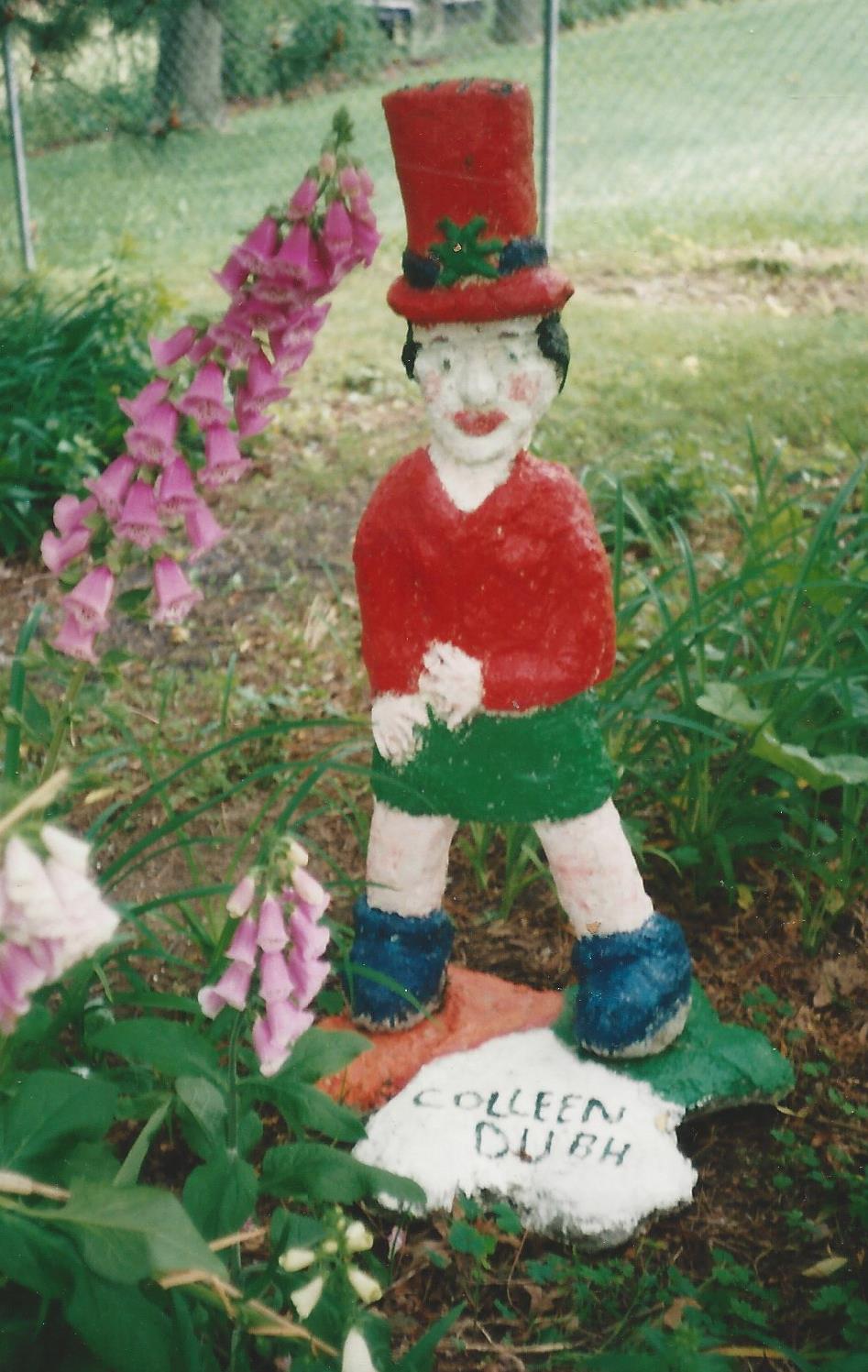
Thank you very much for the letter and the photos. The Colleen Dubh takes a good photo due a lot to the surroundings, especially the honeysuckle bush.  Thanks for the ten dollars. I noticed the error but didn’t want to say anything.  Thanks a lot for the correction.

What a guy.bo1

Remembering Billie Orr and his Muskoka folk art Paradise

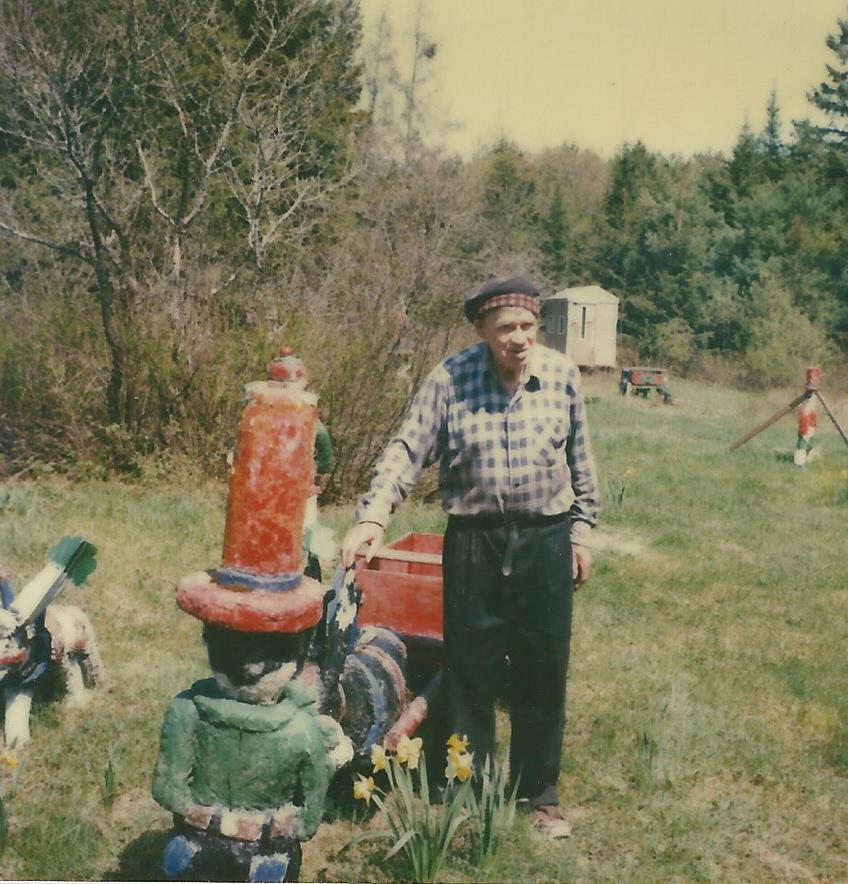
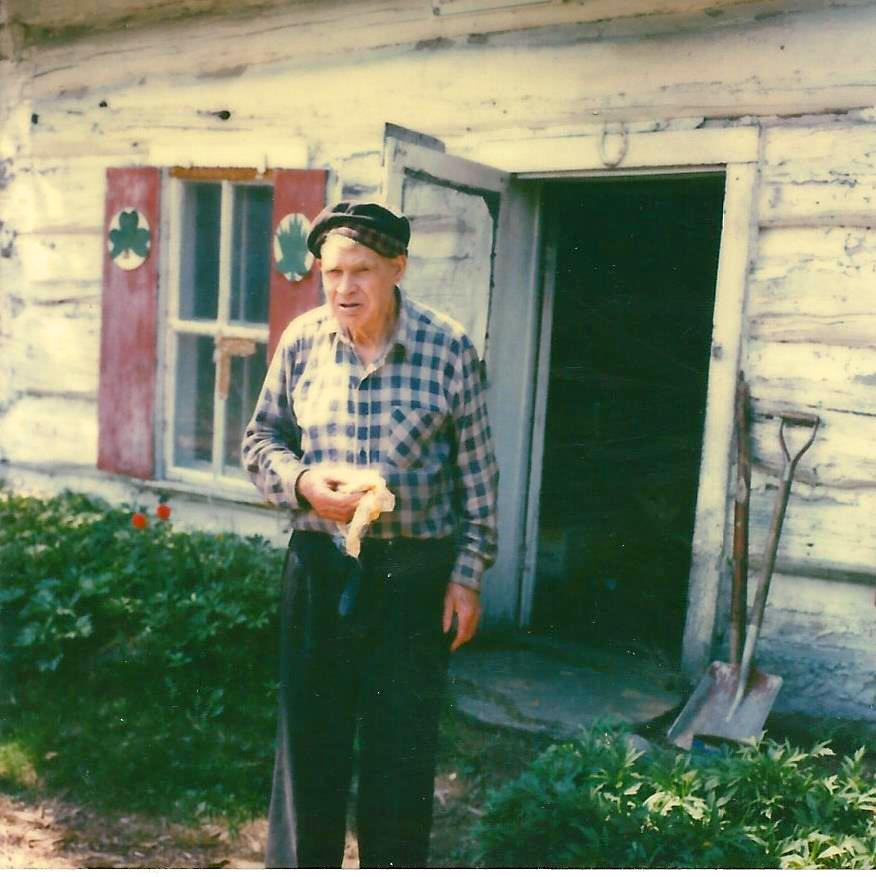
Billy in front of his cabin

Billy in front of his cabin

Back in the nineties, Billie Orr was a familiar figure in Bracebridge, Ontario.  My friend Scott Beasley would see him at least once a week, shuffling along the street carrying his bags of groceries and supplies, as he headed out towards his property which lay about three miles out of town on an isolated craggy, wooded acreage overlooking a river.

With his perpetual Irish cap, and lower lip which seemed in danger of dragging on the ground, Billy was well known, and universally liked by the locals. Scott took to talking to him, and found out that Billie lived on his own on the property he was raised on, and having a good picker’s instinct, he eventually got Billie to invite him for a visit. What he found was fascinating. A bit later, I happened to be in the area and was interested, so Scott and I headed out one fine summer morning for a visit.bo2

Billie lived in a log cabin with no running water and one electrical outlet on a large remote acreage not far from town.  It was a pretty funky set up.  He had to go down the hill to fetch water, and the cabin looked like nothing had been done to it in several years.  We came down the long lane to the cabin and there was Billy standing in the open front door.  Although old, and obviously used to living alone, he was welcoming and articulate.  He started right in telling us about his upbringing.  His father was an inspector on the railroad, and had built the cabin in the first quarter of the century for his wife and Billie and his sister.  Billie’s sister moved away.  Bill never left.  He never married, and never drove a car.  He would walk into Bracebridge once a week and get what he needed, which wasn’t much.  Bill still cut all his own wood, fetched his water, and grew a large garden so he was practically self-sufficient.  bo5

We were chatting away in the main room of the cabin when suddenly a large mother raccoon appeared at the door.  Billie excused himself.  “Good morning little mother.  As you can see I have guests but I have your breakfast ready for you.”  At this he disappears into the kitchen and comes back with a granite plate full of table scraps, and sets it down outside the front door.  Mother raccoon made a friendly, grateful noise and set at it.   We continued the tour.

bo7

Billie’s carved Irish little people

At the side of the room here was a steep set of stairs which led to the second floor.  You could see that the top steps were completely covered in soot, and Billie explained that he had had a fire up there a couple of years back, but had managed to get it out before it destroyed the place. Obviously he was no longer using the upstairs as it had never been cleaned.  On the steps there were several small carvings of Irish people and little wheelbarrows which Billy had made some years back with a view to selling them to tourists.  I guess he never found a venue for selling them because he had several of them in a row, all covered in a layer of soot from the fire.  “These are cool Billie.  Any chance you would sell us a couple of them.”  “Well, I could sell you one or two I suppose. If you want to buy more, you will have to come back”.  I realised that this was Billie’s technique for assuring a future visit. He obviously enjoyed conversation, and “human” visitors were rare.

cement leprechaun

cement leprechaun

Next he took us out back to show us his other work.  There among the trees stood several hand formed cement figures depicting Irish Leprechauns, and Colleens (young women) and several figures depicting the signs of the Zodiac.  Billy explained that he made these free form by placing metal armatures (or skeletal forms) in the sand and then building them up with cement.   They were all wonderful folk art, and a vision to see in this natural setting.  Just behind them Billy had years before planted a circle of trees which grew to a great height and were meant to depict Stonehenge.   What an amazing creation.  I was awe struck.

There is so much more to say about Billie and my subsequent visits that I will continue the story next week in my Friday Blog.   Billie was a true “outsider” in every sense of the word, and I am honored and privileged to have known him.   bo4

The manufactured “folk art” of Pierre et Claire Inc.

the cover of our mail order brochure

the cover of our mail order brochure

Last Saturday at Christie in anticipation of this article, I looked to see how many animals I could find which were manufactured by this small Quebec company.  Although it was too hot to cover the entire field, I did manage about ½ of it, and in that area I found five.  I noted that we as Old Church Trading had painted three of the five.  This gives you an idea of the scope of production of this company.

Rene Beaudoin was one of the original, and possibly the most successful of the Quebec pickers which started up in the 1960’s in the Victoriaville region of Quebec.  There were several small farms in the region, and everyone seemed inclined to keep all the old furniture and accessories as it was replaced in the barns, basements, and attics on the property.  The popularization of antiques brought in part by Expo 67 signaled the start of the antique picking industry, and Rene, although reportedly not able to read or write, had a keen understanding of business and quickly became the main man, hiring several men to go out and knock on doors, and they fetched all and everything available, bringing it back daily to his large farm near Defoy.  After becoming enormously successful in the antique trade, in 1978 he decided to create a small manufacturing business, employing some of the wonderfully talented wood workers of the region to create high quality reproductions of antiques, and copies of wood carvings which were prevalent in the area.  In 1983 his daughter Claire, who is married to Pierre Trudel, bought the company from Rene, and thus Pierre et Claire Inc. was formed.

unfinished order arriving from Pierre et Claire

unfinished order arriving from Pierre et Claire

The company exists to this day at its original location of 1197 Rue Principale, St. Anne Du Sault (Defoy), Quebec, and continues to manufacture reproductions of antiques and animal carvings with about five full time employees.  When we discovered them back in the early 80’s we decided to set up a mail order business for the animals which we called Old Church Trading.  We advertised in Harrowsmith magazine in Canada, and Country Home magazine in the States.  We offered many different animals both in the sanded, unfinished state that we bought them in, and varnished or painted which we did ourselves. We sold hundreds of them both through mail order, and at the Harbourfront market in Toronto, which we attended every Sunday.  At the time it seemed everyone wanted a nice pine, carved goose or swan to sit on their harvest table or cupboard.

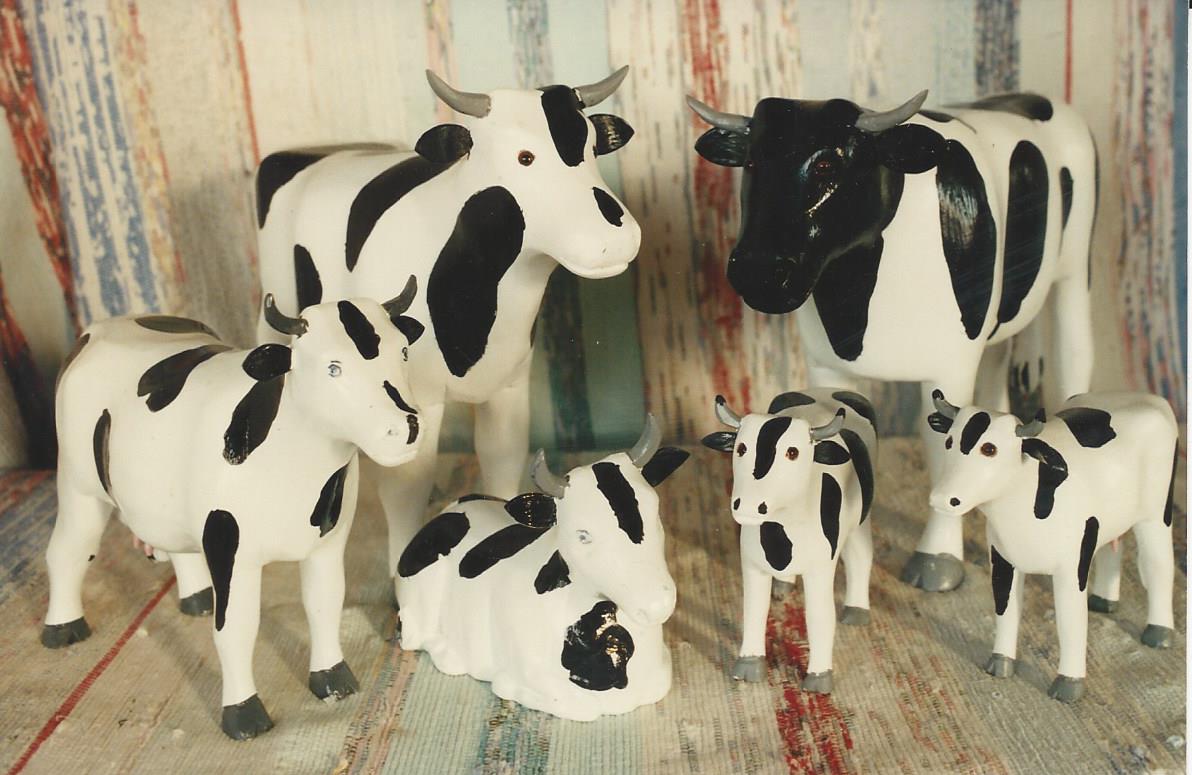
various cow models

various cow models

We would stop in every other week or so and fill out our orders, going through the bins of carvings and picking out the nicest ducks, geese, swans, loons, roosters, and other animals.  We were always interested to see what new models they would come up with.  Penguins, buffalo, bears etc. would appear.  The prices were always reasonable.  I recall the standard size goose would cost about $16 each.  Although there was some variation in quality, (sometimes they would have large knots, or be slightly malformed) overall they were very nicely done.  Initially, all the models were cut out from solid pine, but sometimes these pieces would crack with time, especially if they were not adequately finished, so eventually they started to offer laminated models at a slightly higher price.  This solved the cracking problem, but didn’t look as nice and natural in varnish.  Of course they were the best ones to buy for painting.

inside the factory. Note the pile of geese in the background

inside the factory. Note the pile of geese in the background

As far as I know this small company was, and is the only North American company to “manufacture” folk art type carvings.   Although by the fact that they are manufactured and mass produced they cannot truly be considered as folk art.  And yet you cannot really call them reproductions either because in many cases they are an original design.  For folk art collectors it is important to know of these carvings, and be able to spot them.   They are fine for decoration when bought at the right price, but should not be confused with “real” folk art, which are items of individual expression, and not mass produced.  Although we must also acknowledge that many folk artists, Maud Lewis springs to mind, would repeat favored images over and over again, it is quite different than banging out 100’s of identical ducks using templates and modern wood working tools.   Ironically, I think their market has been effected when the Chinese started to reproduce copies of their work.  I’ve seen lots of these too.

the very popular rooster, and hen with our paint jobs

the very popular rooster, and hen with our paint jobs

note how this is modeled after the Black Horse Beer display

note how this is modeled after the Black Horse Beer display

Pierre et Claire continue to be in business, and have a web site at www.pierreetclaireinc.com, but it is in French only, and does not show many of their available carvings.

Our painted versions of Pierre et Claire animals

Our painted versions of Pierre et Claire animals

If it’s 1985 you’ll find us in the workshop – keeping the customers satisfied

Our workshop

Our workshop

As I sit here with my shoulders aching after just an hour of gardening, it is good to remember that there was a time when we were young, and healthy, and resilient, and happening on all cylinders.  From the mid 80’s to the start of the nineties more or less, we moved enough “product” that we employed from one to three people daily to keep up with the demand.  Both from sales at the Harbourfront Antique market in Toronto, and through our folk art mail order business.

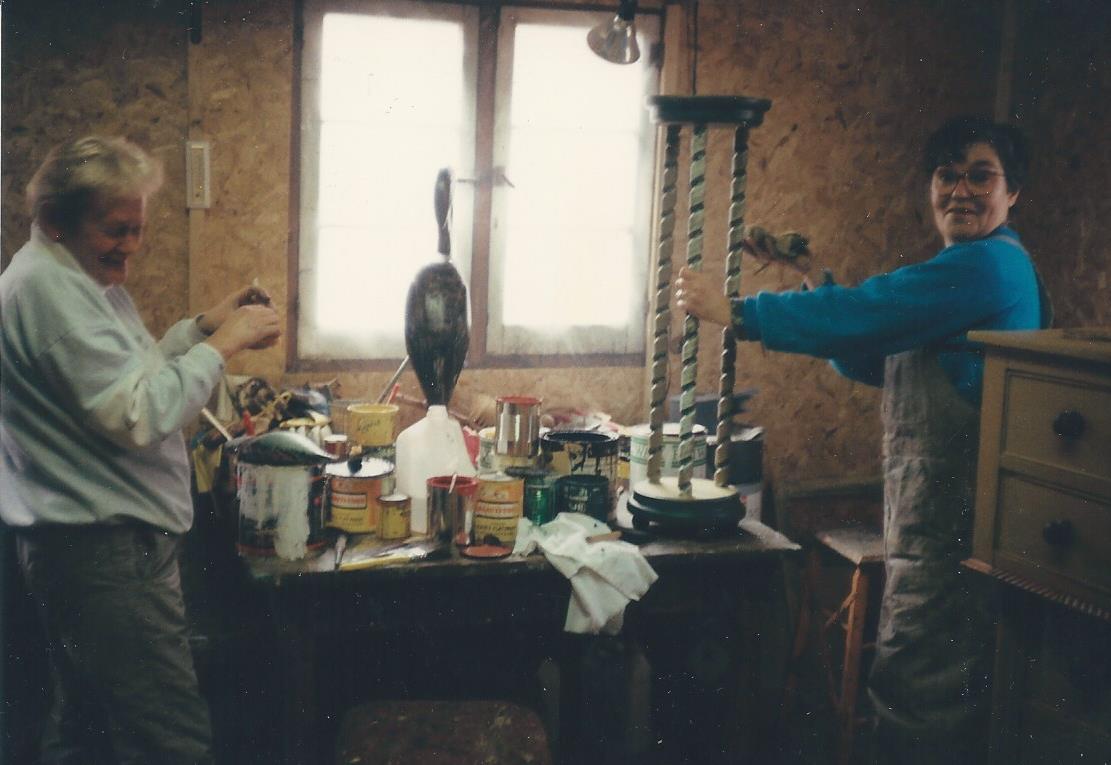
Edith and Jeanine at work

Edith and Jeanine at work

Antiques brought back from Quebec needed to be cleaned, and/or stripped and refinished.  Now don’t get excited, we never stripped good paint, but the reality was that there was a lot more people looking for a nicely refinished pine piece than there was looking for good paint, and good paint was hard to find so we played to our market.  The kids understandingly wanted to eat, and for quite a while there you could count on selling any refinished pine, or butternut bonnet chest you would bring to the market.  The good thing in this was that the Americans didn’t like bonnet chests so they were always cheap and available in Quebec.  But I digress.  Besides the antiques, we discovered that there was a good market for a reproduction pine armoire we found in Quebec that was deep enough to house those giant honking t.v.’s that everybody had back then, and still look reasonably good among your other antiques. Of course very few old cupboards were of the proportion to do this, and there was a demand so it filled a niche.

A refinshed TTrudel entertainment unit

A refinished Trudel entertainment unit

At the peak we could expect up to a half dozen orders per week.  We bought them in the rough from Pierre and Claire Trudel, who had a small factory near the pickers barns in the Victoriaville area (future blog).  They also made the carved wooden ducks, birds, and animals that we sold at the market and on mail order.  So after picking the antiques from the region I would swing by Pierre and Claire, and fill the truck with our order of new cupboards and animals.

Once home, besides the work on the antiques we had to refinish or paint the repro cupboards as ordered, and similarly paint or varnish the wooden animals, so it very quickly became more than Jeanine and I could handle on our own.  Albert who I have mentioned before and will undoubtedly mention again came first, and then a neighbor lady named Edith joined us who felt lonely at home while her husband delivered the mail and who enjoyed the work and the extra income.  Then as was necessitated by increasing sales we would hire a local high school student or two to keep up.  The place was hoping from 8:30 until about 5:30 every weekday, and I would quite often go back in the evenings and work until late, especially if it was getting close to Sunday, and the Toronto market, or we had a large order to fill.

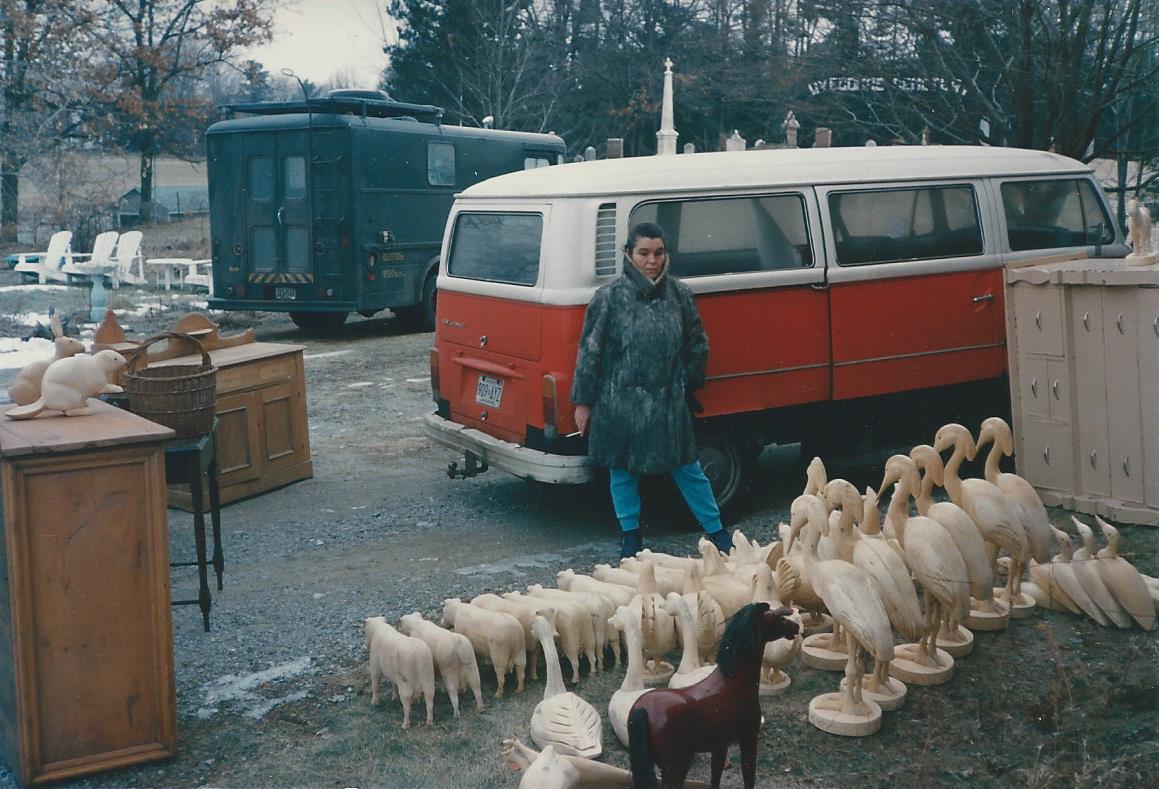
A load of Trudel animals

A load of Trudel animals

I know there are a lot of collectors who look down on selling reproductions along side antiques, but at Harbourfront in those days it was perfectly acceptable as long as they were sold as what they are, which is a reproduction.   There was a lot of people looking for entertainment units, and I’d much rather provide a new one that did the job and was well made, than cutting the middle post out of an actual antique cupboard or some other such none sense. It also really helped with the bottom line.

Edith

Edith

Similarly, the carved animals, were attractive to heaps of folks who didn’t necessarily want to spend much, or deal with a challenging piece of original folk art.  These folks were looking for a nicely carved and finished pine goose to go along with the rest of their “country pine” décor. I think back on this period as our “manufacturing” phase, and it was a lot of work,  but it was lucrative at the time, and it gave us and a few other people some relatively interesting and rewarding work. We played it until the demand died out, and when the “craze” subsided we quit reproductions, and focused entirely on original finish antiques and “real” folk art.  To everything there is a season.

Jeanine and I with ordered cupboards

Jeanine and I with ordered cupboards

My Afternoon with Eddie Mandaggio

EMandaggioEddie Mandaggio was born in Manitoba in 1927. He spent his early years working in Northern Manitoba and Ontario as a trapper, and as a hunting and fishing guide. He came to Nova Scotia in 1951 and settled in Camperdown, Queen’s Country, where he lived until his death in 2003.

He initially worked for the railroad for eight years, and then worked in the logging camps. Eddie started carving in 1974 out of a desire to make decorations for his cabin. He followed with painting in 1976. His subjects are geese, roosters, cows, horses and also some human heads. His carved pieces greatly outnumber his painted works.

Eddie's famous white goose

Eddie’s famous white goose

In the mid -nineties I had the occasion to meet Mr. Mandaggio, and although I was trying to take in as many artists as I could in a short stay, and had intended to just stay for an hour, we became so engaged in conversation that I ended up spending the entire afternoon.  I missed out on meeting a few others but my time with Eddie remains close to my heart.

I flew to Nova Scotia to view and consider purchasing a major folk art collection which belonged to a friend of a friend named Iris Newman.  Iris is a lovely person. who got bit early by the folk art bug,and had the means, space,  and desire to build a major collection, purchasing major works directly from the artists.  She is featured in the NFB film “folk art found me”, and she is generally acknowledged as one of the main promotors and supporters of the Nova Scotia folk art community. We had a lovely lunch and fell into talking like old friends for a couple of hours before she took me around her large home and showed me the extent of the collection. Although amazing in quality and scope It turned out to be too many massive pieces which I knew would be hard to place, and she was strictly committed to an “all or nothing” deal so it didn’t work out, but I learned a lot from her and we did remain friends.  Of this vast collection, one of the most impressive things for me was two very large paintings of tiny cows in a big field by Eddie Mandaggio.  It was the first Mandaggio paintings I had seen and there is something about those giant fields with those tiny cows that hit all my buttons. She was keeping them and I completely understand why.  So after an afternoon of talking, and documenting the collection it was time for me to go.  As I was leaving I told Iris that the following day before I had to catch the evening flight home, I was going to go to the Lunenburg area to meet the Naugler brothers, Garnet Macphail, and Eddie Mandaggio who was already one of my favourite Nova Scotia folk artists.   “Oh that’s great Phil. You’ll have a wonderful time, but I must ask one thing of you.”  O.K.?  “When you get to Eddie’s you will see that he has recently carved a very large moose head trophy, and I have decided to buy it, so don’t you go and buy it.”  Ouch.  I hated to agree but Iris is a lovely and determined person, and I was still considering her collection so I reluctantly agreed.

One of Eddie's cow paintings

One of Eddie’s cow paintings

After a delightful morning with the Nauglers which will be the subject of another blog, and after a delicious bowl of chowder at a roadside restaurant, I got to Eddie’s place.  Immediately we hit it off. Eddie was very kind and open, and wonderfully generous in his description of his past careers.  He was particularly articulate about his love of carving, and stated that although he had been painting for the past few years, most of these paintings remained in the basement of the Houston gallery in nearby Lunenburg, and not many had sold, so he reckoned that he must not be a very good painter.  “Au contraire, mon Ami” “I think you are a fabulous painter. I was knocked out by the paintings in Iris’ living room.”  “Really.  Well thank you for telling me.  I don’t get much feed- back and most people just want me to keep making my “hits” like the big white geese.  It’s not much fun doing the same thing over and over again, and actually not why I started carving in the first place. I’ve started to refuse the large orders that have kept me doing the same thing for the past few years.  For me carving is a wonderful therapy to counter my jumpy nerves, but I have to be free to experiment or it becomes too much like a regular job.”  “I absolutely agree with you Eddie.  You must be free to let your imagination roam. Have fun with it, and whatever you do, don’t give up painting.”  Eddie smiled that winning smile of his. “Thanks for saying.”

Of course there in the background the entire time we are talking hung the extraordinarily beautiful massive moose head on a red heart shaped crest which Iris had forbidden me to buy.  Tagged $750.  I would have given him the cash in a second if I was not bound to my word.  What can you do?

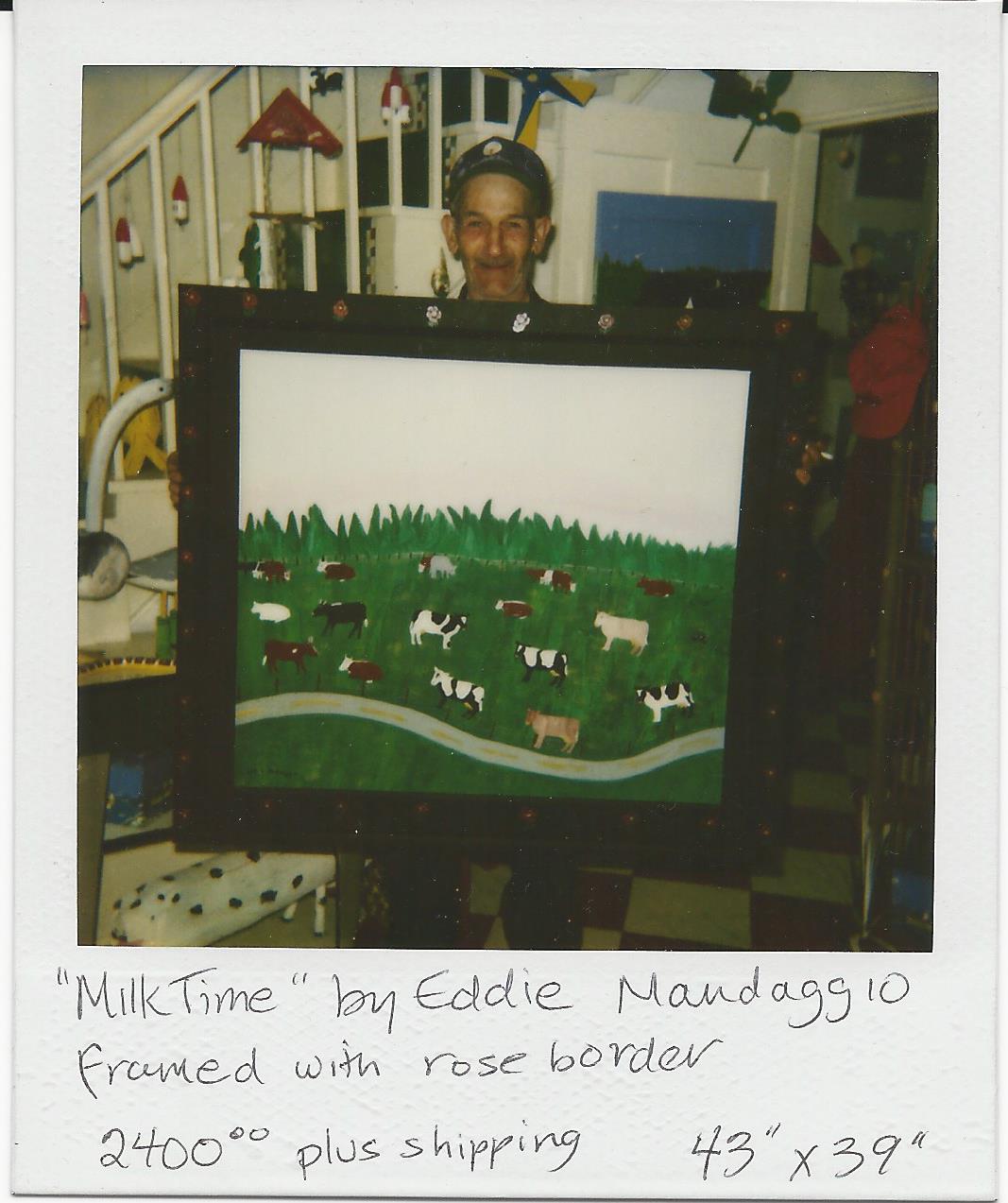
That was the one and only time I met Eddie, and he became quite ill and stopped carving soon after.  I never did get on to see Garnet MacPhail, but I don’t regret a minute of the time I spent there with Eddie in Camperdown. A few months later I received the following polaroid of Eddie with a new cows in the field painting.  Unfortunately I didn’t move quickly enough and missed it.  If you would like to know more about Eddie, the Black Sheep Gallery has posted a wonderful series of You tube videos you can look up.Scaned