Remembering the Pierre Laplante auction- a vast collection of Quebec folk art and antiques

We first met Pierre Laplante when he participated for one time in the 1997 Bowmanville Spring Folk Art and Antique show.  We set up just down the aisle from him and before the show was over we had gotten to know each other through many friendly exchanges, and also he bought a giant lumberjack that was our show stopper to put in his indoor pool area at his rural home.  Nice fellow.

It was announced at the show that Bill Dobson was managing an auction of Pierre’s collection on May 17 and 18th, with auctioneers Tim Potter and Cec Knight in Kingston.  It was exciting news as Pierre had a reputation as a very serious collector of Quebec folk art.   We had heard many stories from the pickers in Quebec of the dentist from Montreal that would buy almost everything that they would bring to him.  Often this was said in the form of an apology for not having anything to offer us.

cigar store Indian marked “Illinois”, late 19th cent. – $5,000

If you have the money and the will this is a very effective way to collect.  Once a few pickers know they can rely on you to buy almost anything they bring you, they will put in a special effort, offer everything to you first, and as they say be happy to “make hay while the sun shines”.  It was rumored that after a few years of collecting this way, the barn and out buildings at his weekend farm in the La Prairie region south of Montreal were chock full of wonderful stuff.   Folk art was still a very strong market in 1997 so when the auction came, we broke open our piggy bank, and went loaded for bear.
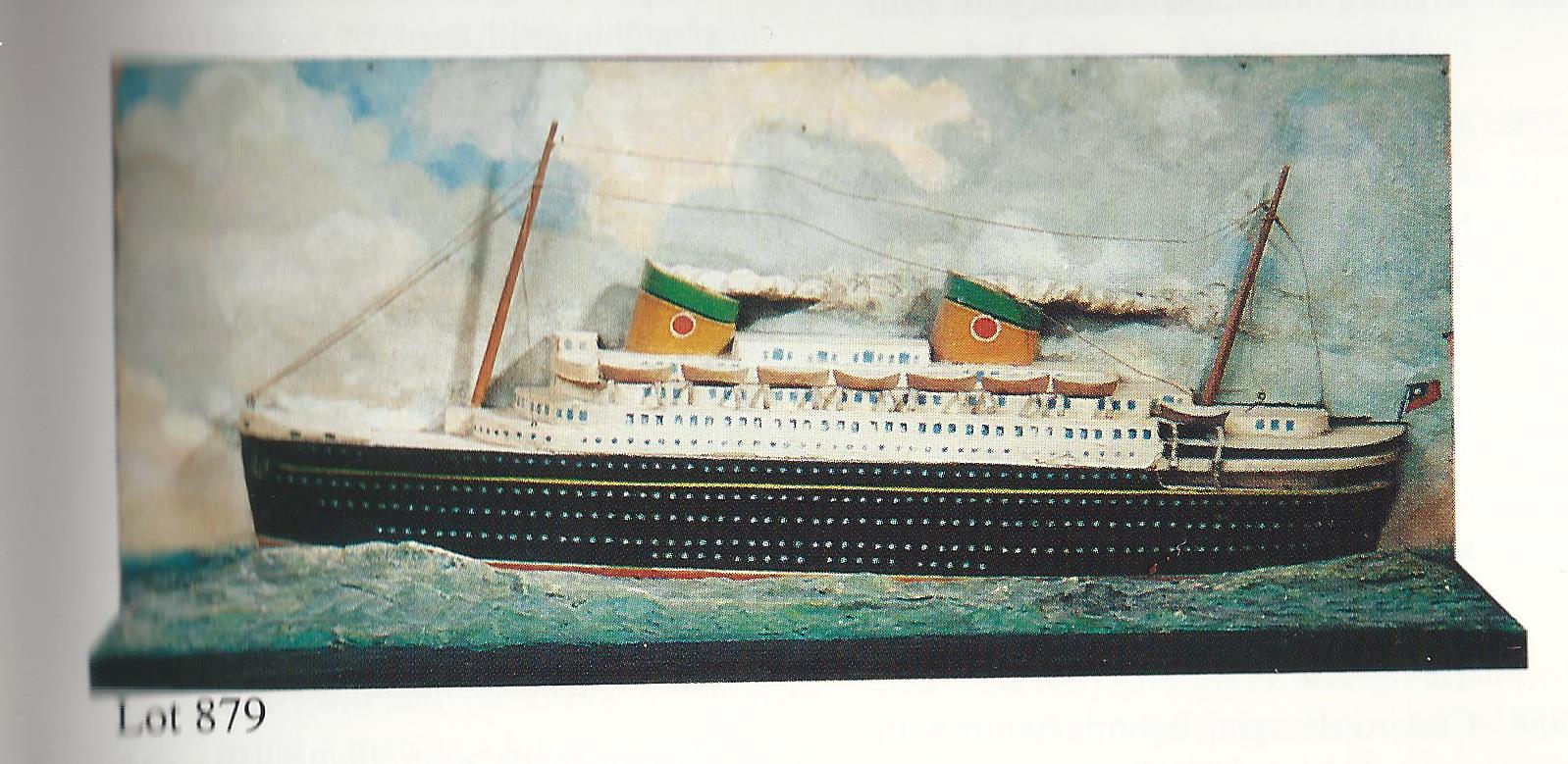
mounted wooden model of a steamship,early 20th cent. – $750

The catalogue has an interesting two page introduction by Pierre which explains his interest.  It begins:

“The wellspring of folk art lies in the heart, not the wallet.  It is an audacious mix of techniques and materials; a multiplicity of themes and genres.  Folk artists are not artists in the conventional understanding of that word, rather they are ordinary folk without pretense or grand artistic ambitions. Through Quebec folk art, we can glimpse the geographical, historical, social, and religious character of the province, and in that sense, the heritage of Quebec folk art ranks along with its architectural and technological history.”  He goes on to discuss the many factions of folk art and concludes; “ I have collected folk art for over 30 years.  It’s a past time – even a passion – that gives me the opportunity to meet people who live anonymously but have many things to say, and they do speak, in their own way.  Many of these talented people are not considered artists.  They should be. Perhaps if they had lived in another place or another time, they would be considered such. There’s so much great folk art there that deserves a place of honour in all art collections.”

Well said Pierre, and the massive, well organized, two day auction saw many such pieces make their way into some important collections, while realizing some pretty phenomenal sale prices.

Lucien Legare horse, buggy and rider

We were able to buy a lot of stuff. We paid relatively big money for some things like this Lucien legare horse, buggy and driver at $750, but with so much on offer we were able to scoop up many bargains as well.  Like this Felicien Levesque tableau of the Titanic sinking at $625. Well under the money.

The Titanic by Felicien Levesque

Things started out modestly with maple sugar molds, and smaller carvings and accessories going in the expected $200 t0 $400 range, and then people started paying attention when lot 161, a painted whirligig Mountie which is illustrated on the cover went for $900. Soon after a tin rooster weather vane in old white paint realized $1,250.  Then lot 195, a knife with carved wooden handles in the form of a fleurde lis with a man’s head brought $1,900.  Things were moving.

There were a few gasps when a beautiful Nova Scotia document box from 1914 with interlocking hands, hearts, stars, and leaves went for $1,900. Followed shortly after by an oil on glass painting of tugboats on the Saint Lawrence attributed to Captain P. Carbonneau which saw $2,500. An Alcide St Germain hanging flying goose achieved $1,000, and the tone was set.  Here’s a couple of the highlights.  There were many more.

We went on to establish a relationship with Pierre after the auction and were invited to visit him and his wife at their farm.  We had a wonderful evening of laughter,  good conversation and an excellent meal, and we even enjoyed the adventure of climbing up the tiny ladder to the second floor guest room of the century old farm house.  I made sure my bladder was empty though because I didn’t fancy climbing down in the dark to find the washroom.  We realized that for as much was sold at the auction, he had twice as much great stuff still in his collection.   We even had a chance to say a quick hello to our lumberjack friend in his new residence by the pool.

large pulpit decor from Grosse Island where Irish immigrants were held in quarantine, made as a greetings from French Canadians. – $3,100

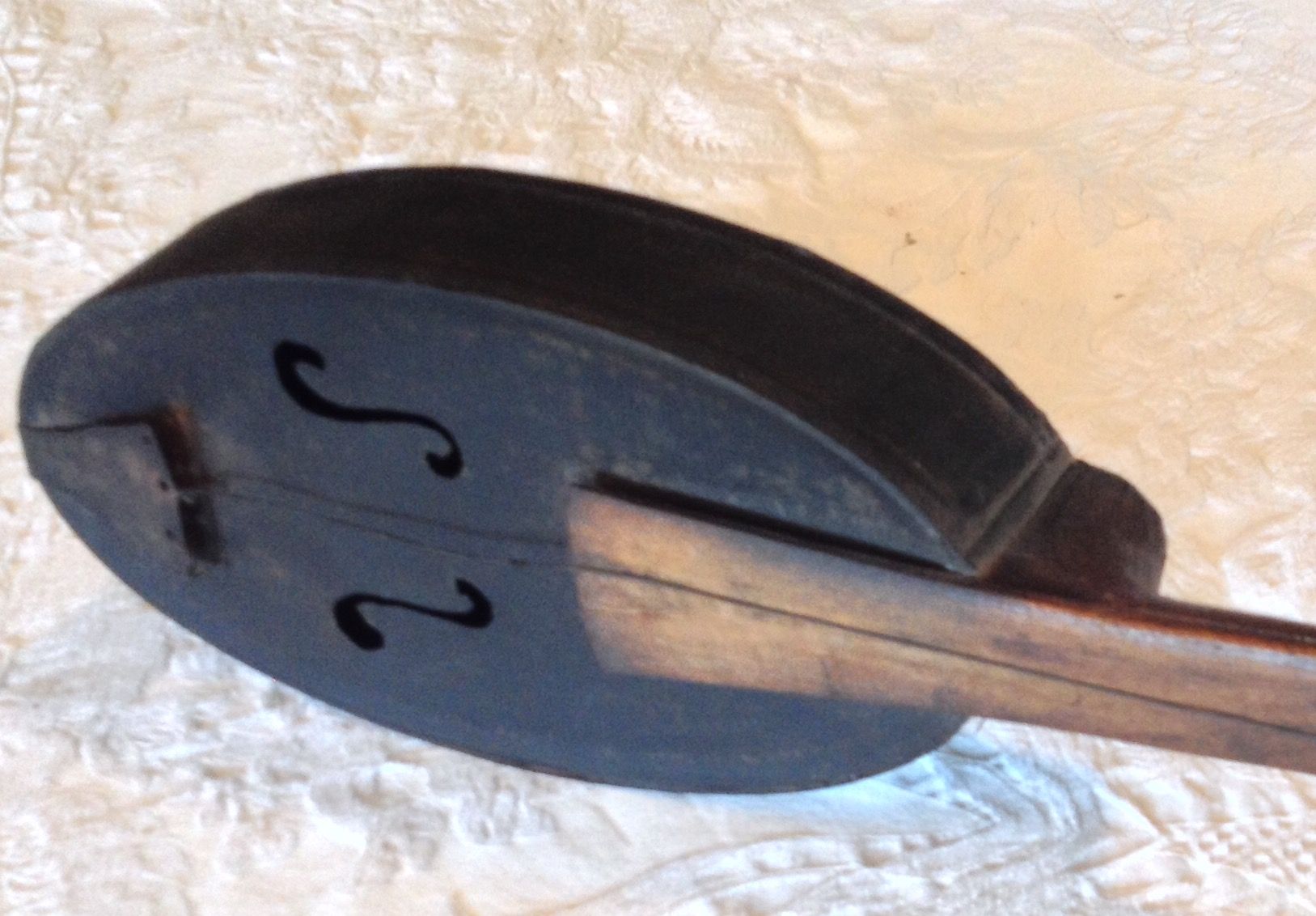
Antiques I love, and why I love them – part 2, a tiny tin fiddle

 A friend and fellow folk art enthusiast came by yesterday, and while we were enjoying a nice cup of coffee the conversation lead to an exchange questioning what is it about certain objects that make us like them more than other objects?   Any conversation about personal aesthetics is at best subjective, and at times downright obscure, but it is better than talking about the weather.  So as an attempt to get down to defining the source of the desire to possess I asked my friend, “Hypothetically, If I were to let you take home one item from our collection that you can see from where you currently sit , What would it be”.  After a pause and some reflection he said, “I would take that tiny fiddle hanging on the wall over there”. This surprised me, because we have a lot of flashier, obviously more expensive items around, but yet I understood, and might likely to have answered in the same way.

It is unclear if this 18” long, 4 string fiddle made from an old herring tin and carved wood was ever meant to be played, but my guess is it was playable when it was made.  When I study it, I imagine that it may have been created as a gift to a child to encourage musicianship, but it is equally possible that it was created as a “gag” instrument to be pulled out for surprise at a strategic moment in a performance.  Maybe the guy or gal just wanted to make something to put on the wall, or to give as a gift.  It’s fun to think about, but in the end you get back to the object. 

I remember finding it under a big pile of junk in Alan Chauvette’s  pickers barn near Victoriaville Quebec back in the early eighties.  Alan was standing nearby writing down what we were buying and the prices.  I held it up and said “how much for this”  Alan glanced up and said “$45”.  “O.K. write it down”.  I don’t think he looked closely, or maybe he doesn’t share my aesthetic because I felt it was a steal.  But then again I have come to realize that things of great esthetic value do not always get recognized monetarily.

Some people, or I would imagine many people would think that even $45 is too much for a rusty old tin can fiddle, but they are different from me.  I love the thing.  I brought it home from Quebec.  I hung it on the wall, and to quote the late, great Charlton Heston, “ to get it, you will have to wrench it out of my cold, dead, hands. “ So what is it?  Obviously, the colour and untouched patina are superb, and the form and hand carved neck and machine heads are beautifully executed in a functional, yet slightly primitive sort of way.  The “F” holes are beautifully cut out, and the construction of tin, wire, and wood is wonderful.  All these elements hit  the pleasure buttons in my  brain, but I think it Is the fact of the herring tin body that puts me over the top.  I looked for a long while half consciously wondering how they got the herrings out of the tin which looks original and undisturbed save for the “F” holes, before I investigated and saw that there is a neat row of nails around the bottom attaching it back to the sides.  Great care was taken to create this.  A real labor of love. I love the way it is, but when I imagine it with it’s bridge intact, and the other three strings, I wonder what type of sound it would have made.  One would assume, tinny.

I found my “sunshine” tractor in a little shop north of London, Ontario a long time ago.  Again it was an item which went straight to my heart, and as I purchased it I knew it was something for me.  Something I would never want to give up.  I’ve bought and sold hundreds of hand-made toys, many more impressive in construction and scale, and yet it is this tractor which continues to sit in a glazed cupboard overlooking my work desk.   I love it’s construction and form and colour, but the element that takes it into my top drawer is the little “sunshine” sign.  I’m not an armchair psychiatrist per say, but it doesn’t take Freud to understand that my love probably has a direct route back to my mother singing me “You are my sunshine, my only sunshine” while I lay sick in bed with the measles at the age of ten.  That song is such a bittersweet tour de force isn’t it?  I get emotional just thinking about it.

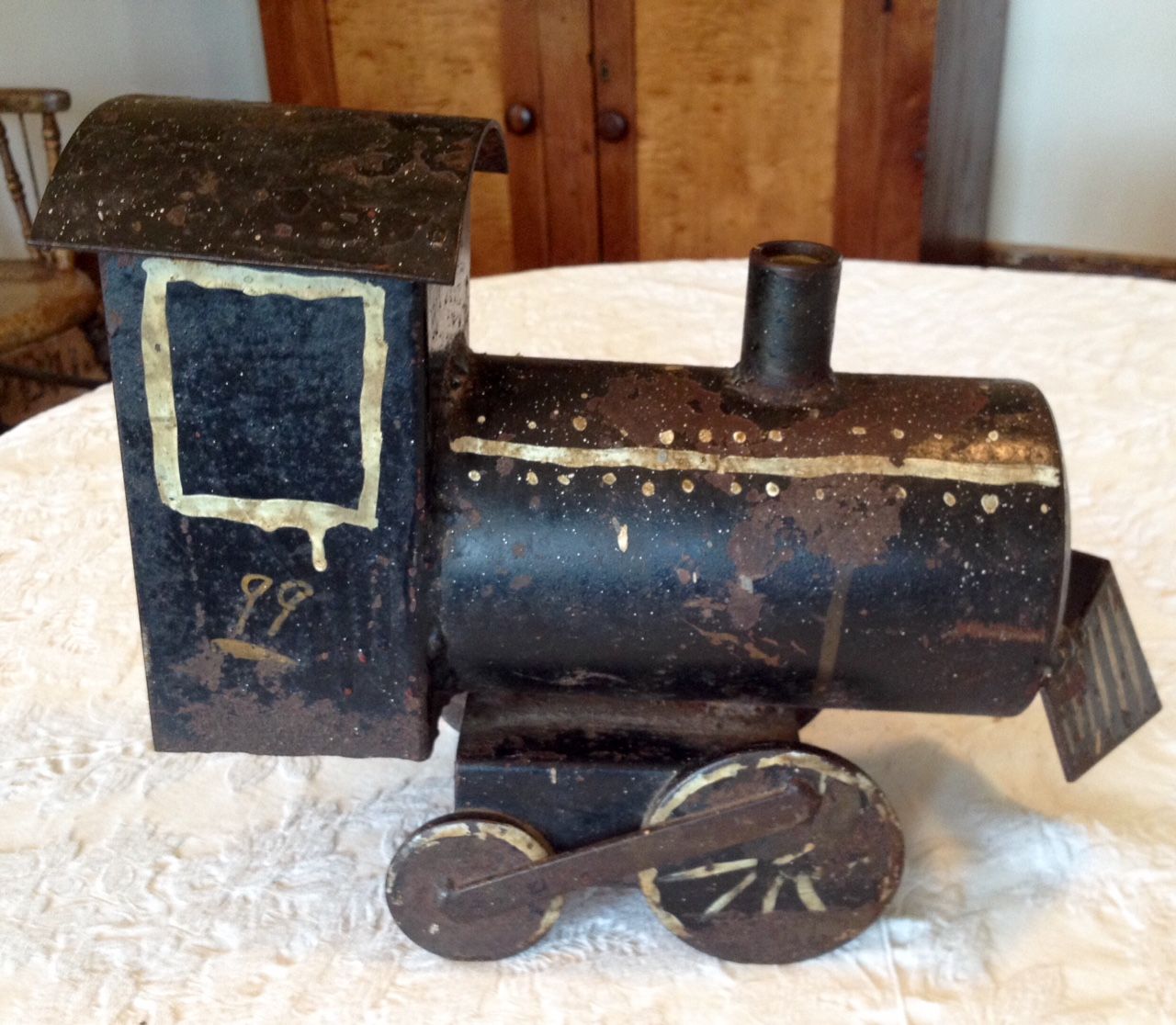
Lastly, we come to “Old 99” (see 99 painted on the door). To be honest I don’t love it nearly as much as I love the tin fiddle or “Sunshine”, but I do love the fact that someone with welding ability, probably a professional welder, took the time and effort to make his or her child an indestructible toy locomotive, with a space at the back to put an engineer.  Is that an old bullet used to make the smokestack?  I hope not.  The poor kid could blow up.

Les Patenteux du Quebec, the “bible” of Quebec folk art

In 1972 three young Quebecoise, Louise de Grosbois, Raymonde Lamothe, and Lise Nantel began research on Les Patenteux du Quebec.  Patenteux is an idiomatic Quebec word that roughly translates into Inventor or Creator.  The book was published by in 1978 with assistance from the Quebec Ministry of Cultural Affairs, and The Canada Arts Council.  For six years, the women sought out “Patenteux” across Quebec, documenting their words, locations and creations for posterity and to as they suggest in the introduction,  to be a “monument to our culture”.  You know how certain books become “the Bible” of a subject? Well this is “the Bible” of Quebec folk art.  A work of great importance now, and in the future for anyone interested in understanding and appreciating Quebec culture.

In the introduction they state, “We started research in 1972 at a moment when our culture interest was to return to the source, born from a feeling of sharp Nationalism which succeeded a long period when we were easily dazzled by everything foreign. We perceived that the Quebecois people, who had survived 300 years of systematic humiliation and dispossession,  was not a people without culture and history. The ingenuity that our ancestors applied to adapt to the climate, and to conquer their isolation testifies to this. They had to survive.  They had to reinvent their architecture, their tools, their ways of feeding and clothing themselves, as well as their celebrations.  This process of rehabilitation of our history and culture, which was an attempt at decolonization has given us a new image of ourselves, and brought us to search for our identity.”

 The book records seventy five artists broken into nine geographical regions.  It is a treasure of information which is out of print and now hard to find. It has never been translated into English.   There’s a Canada 150 project I would like to see.  A hardcover version in both official languages.  But it seems the money is going to fireworks and giant rubber ducks.  But I digress.

I love this book even though I struggle to understand the accurate recording of the patois of the subjects.  There’s lots of wonderful pictures.    In my February 18, 2013 blog  “My happy time with Mr. Joly’s whirligig” I recall our first encounter.  “Fast forward to the next summer and we are enjoying a weekend in Quebec, our favourite North American city.  We had heard of a bookstore where it was possible to buy a rare book, Les Patenteux du Quebec,  which we knew to be the “bible” of Quebec folk art.  Published in 1978, it is the work of three young Quebec women who spent  a summer or so traveling all over Quebec documenting, and recording the stories of every Quebec folk artist they could trace.  We found the shop and bought the book, and when we cracked it open, it opened to page 19, and behold there was our whirligig. With a picture of it in it’s original location, and a statement by the artist.  Extraordinary.”

The love and respect shown to the artists is clear by “ the letter to the Patenteux”  which begins the book

“You encouraged us to make this book by telling us that you would like to know what the others are doing.

We wanted everyone to recognize you.

We hope that we have been faithful to what you have told us, and that you will recognize yourself. We apologize in advance for the errors which may have crept into the information we give.

A wonderful memory of you is guarded. Your great vitality has given us the taste to live for a hundred years, to get to do things as extraordinary as you do. “

Over the years I have been able to identify the unsigned works of many artist by thumbing through this book.  Every time this happens I thank the authors, and I inevitably linger, trying my best to decipher the comments, and just letting myself imagine meeting and experiencing the environments the artists create.  It has also helped us track down many artists who  continued to live and work in the places they were recorded.  Folk artists tend to stay put.

For all these reasons I salute and give a heartfelt thank you to the authors for their dedication over the six years it took to produce this book.  You have made a valuable contribution to the Quebec cultural identity, and further to our Canadian Identity.  A book worth having. Try to find yourself a copy.

Remembering the first major unreserved auction of Canadian Folk Art – the Sutherland/ Amit Collection

As with most cultural expressions, the Interest in folk art waxes and wanes over the years.  In 1994 when the announcement for the auction of the Ann Sutherland and Zalman Amit folk art collection came out, the market was hot.  The couple’s reputation as collectors, both doctors who ran a busy behavior therapy and research clinic in Westmount Quebec, was well known primarily  by their many published articles on folk art. They owned a seven bedroom house in Nova Scotia which they filled with a large, eclectic collection of folk art, assembled on collecting trips to Ontario, Quebec, and the Maritimes.

Blake McKendry wrote in the catalogue “recently, when Ann and Zalman added another piece of folk art, Zalman had to put it in the wine cellar, saying that not another piece could be stored even in the basement. Much soul searching was required before a solution could be rationalized. The collection had become too large and valuable to be managed by two busy psychologists who wished to move to a much smaller house.  On the other hand, there was no desire to suppress the shared desire to collect.  A solution evolved: disperse the entire collection by auction and divert the collecting urge to a different but related field – Canadian drawings.  The result is the first major unreserved auction of Canadian folk art in all its forms.”    Mr. McKendry went on to say about the collection, “ The entire collection is in the auction.  More than forty identified Canadian folk artists, sculptors and/ or painters are represented, some by several pieces. A large number of these works are by Nova Scotia folk artists and no doubt these will be highlighted by auctioneer Chris Huntingdon’s witty and insightful remarks.”  Lord knows, that be true.  All who attended will remember the high level of theatricality not only in Mr. Huntington’s lively commentary, but also in the evening gowns and over the elbow elegant gloves worn by  the lady presenters, complete with hand gestures, making the whole affair feel a bit like “the Price is Right”.

The auction was managed by Bill Dobson. It took place in two sessions at the Bowmanville sports complex, where the Bowmanville Spring Antiques and Folk Art sale takes place annually. 196 items were auctioned off Friday, January 21 at 6 p.m. , the remaining 336 items went up at 10 a.m on Saturday.

We were very excited to attend. We made a little family vacation out of it when our teen age daughter Cassandra who was beginning to develop an interest in folk art, decided to come along. With Chris Huntington’s commentary and all those competing collectors, it was bound to be an education. I remember as we walked into the complex to the preview Friday at 3, that she looked over everything and landed her attention on a stunning, large mechanized sculpture of a hawk by Ralph Boutilier.  Then she said, “ I know you will be wanting to be buying things for resale, but if you want to know my opinion, I would just spend whatever is necessary to buy that hawk, take it home, keep it; and forget about the rest of it.”  I took her point, but as she observed,  we were primarily interested in buying as much as we could to resell.  We created a list of all the pieces that we were  interested in, and after consideration noted our top bid in each case.   When the auction started at six, we were ready with catalogues in hand ready to write down all the prices realized. We noted that Item # 14, a painting of an Ox team by Maud Lewis sold for $550, which was about what I was paying for them at auction at Waddington’s  in those days.  An erotic drawing by Collins Eisenhauer (1898-1979 )item #18 , which we have owned once, and appeared again at this year’s Bowmanville, sold for a very reasonable $175.  A nice early Merganser (#37) went for $850.  Chip carved crooked knives went in a range from $100 to $500.   We bought a very nice watercolour and ink drawing of the the ship Mauritania by Albert Lohnes (1895-1977) which still hangs in our living room. Also a hooked rug of confronting roosters and  three different roosters by different artist.  We were quite pleased with our take that first night, but knew that the bulk of what we wanted would be offered on Saturday.

Saturday morning the place was packed. Things started slowly with a lot of glass and decorative items.  You know that a Limoges dinner service for eight, nine pieces per setting is in the wrong place when it only brings $150.  People were there to buy folk art and early furniture. It started to get exciting when some early Quebec carvings by the likes of Louis Jobin (1845-1928) started to bring in four figures.  Then the  Boutilier hawk (#317) hammered down at $2,750.  We were the underbidder much to Cassandra’s disappointment, and yes, our almost immediate regret.  I like to say when people are himming and hawing about buying a piece, “You’ll never regret what you buy.  You only think about the pieces you let slip away.”  This hawk is a perfect example. 

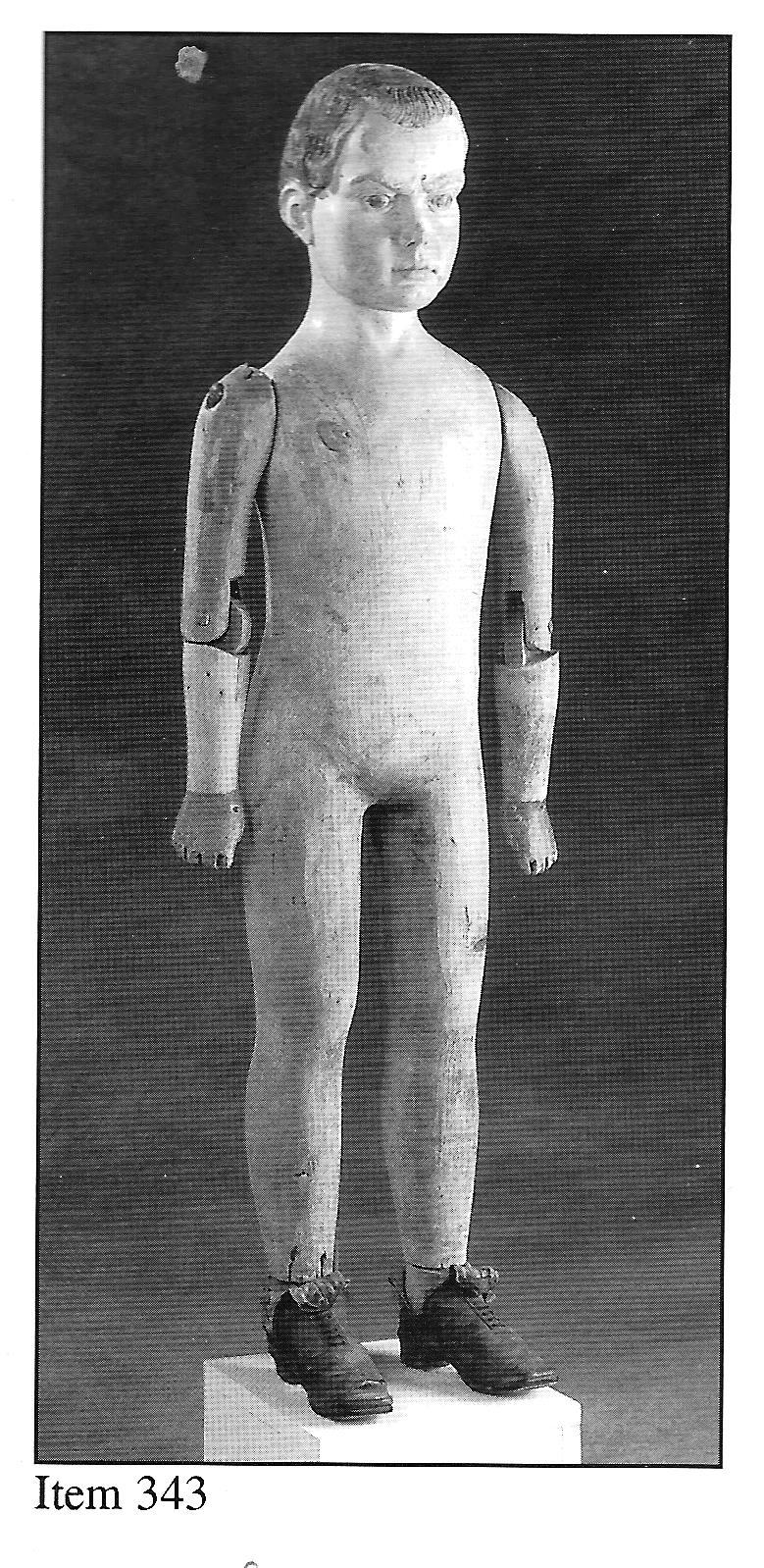
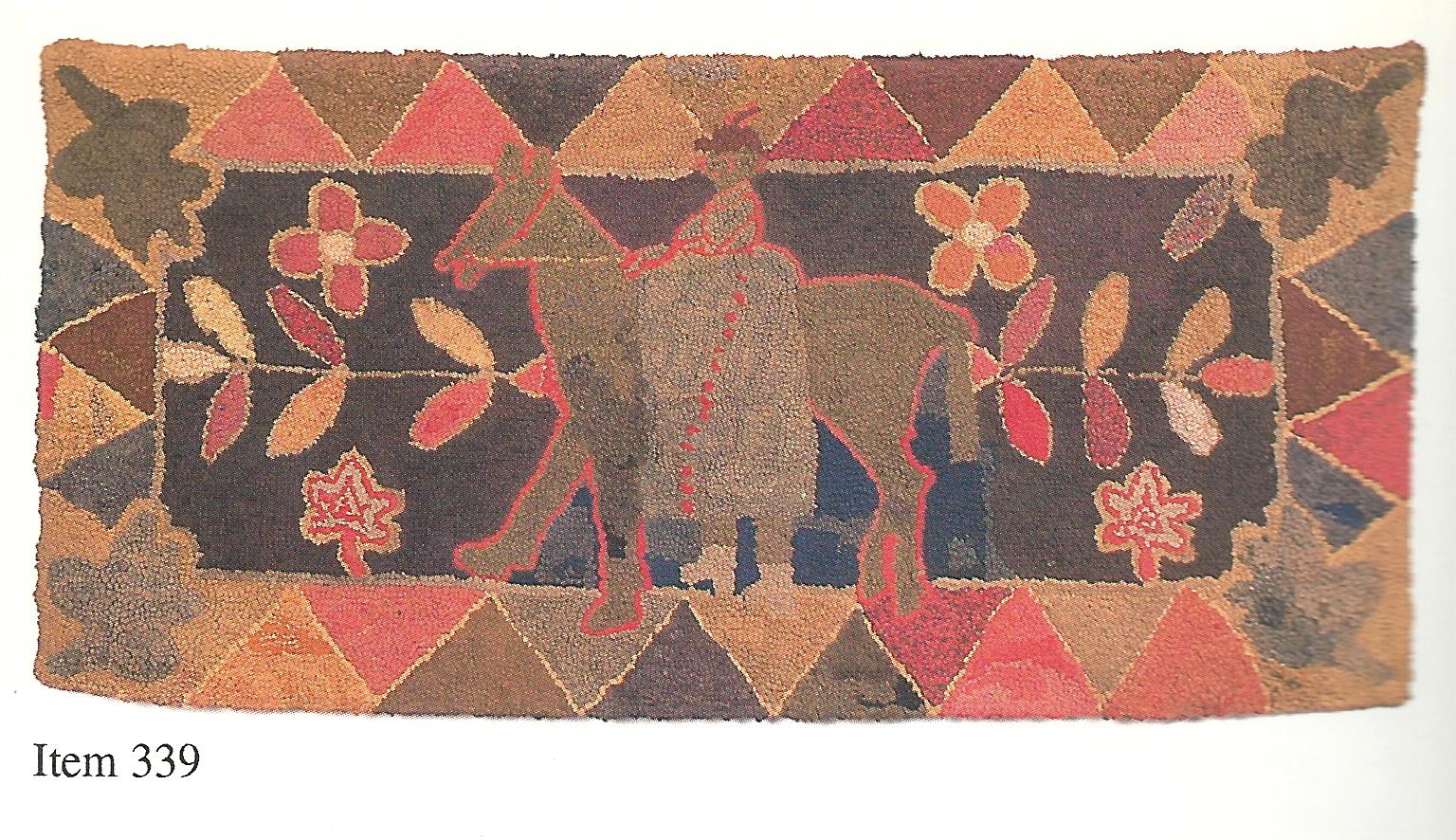
Then we hit #343, a carved figure of a youth, polychromed and articulated, mid 19th century. Found in Nova Scotia.  A few jaws dropped when it realized $9,000. Some of the furniture was strong. A painted and paneled Wilno box (#357) went for $6,500. A hooked rug of a woman on horseback (#339) realized $3,400.  A continuous Windsor armchair (#353) saw $2,750.

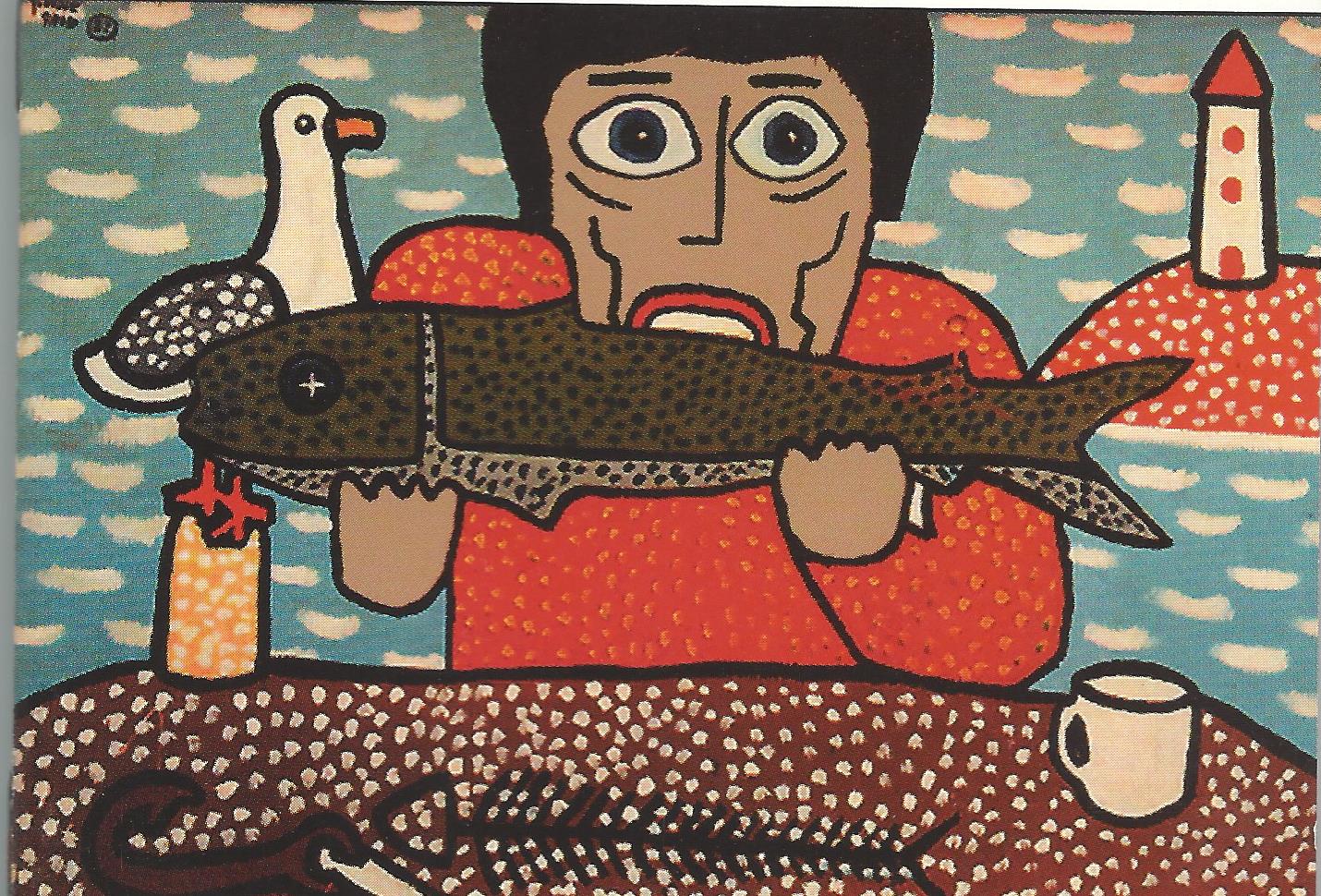
And so it progressed, slowly. Very slowly.   Chris Huntington’s dialogue although informative and entertaining initially, eventually started to draw things out to the point where most were wishing for a more conventional, let’s get it done style of auctioneering.  Eventually, item # 384 arrived.  A large 205 x 143 cm painting described as a fisherman’s village by the legendary Lorne Reid (1954-1992). Our second most coveted item after the Boutilier hawk, and we won it at $850.  A lot more than we had hoped to pay, but it was ours.   We owned it for several years and loved it in spite of the fact  it was not an “easy’ subject to live with. What appears to be a starving man staring at a fish skeleton is not all that cheerful. There is a bigger story there. One which I will go into another time.

After a couple of more small purchases we packed it in and left for home, about 4 in the afternoon if I remember correctly. There was still about another 100 items to be offered, but we had spent a whack of money, bought a lot of stuff, and were grateful for the experience.  I still wake up occasionally thinking about that mechanical hawk.  What a thing that is.  I wish it were mine.

For the Birds

As I have mentioned before in this blog, my wife Jeanine collects folk art carved birds.  Our kitchen is full of them.  I miss them when we are away.

Birds, for the most part are a pleasant and relaxing part of our natural environment.  Except of course when they are dive bombing you for being too close to their nest, and then they’re not so relaxing.  Otherwise, we enjoy watching them fly, and chirp, and hop around the back yard looking for bugs. They are entertaining.  I suggest that this is the reason that it is one of the most commonly carved species, and often the first carving an artist will undertake.  Birds makes for an interesting collection because there are so many approaches and attitudes to the subject.  Some strive for accuracy.  Others a stylized approach.  Some are abstracted, while others are barely recognizable.  I tend to admire skill and craftsmanship, but it’s the crazy and primitive ones that turn my crank.  After my morning coffee I took a look around the room and photographed a few of my favourites .   With some little notations attached.

I hope that you enjoy looking at them.  I do.  Every morning.

sparrows in flight

Jeanine is keen on finding more of these little carved sparrows.  We may because I have the feeling that these although hand carved, were commercially produced and sold in gift shops.  Perhaps a little cottage industry item from Eastern Canada, where we found them.  Or even possibly overseas. If so, I would think Europe or England as opposed to Asian.

Red-winged blackbird by Yvon Cote

a Cote decal. Not used on every carving.

This Cote red-winged blackbird is typical of the Gaspe artist.  I will make him the subject of a future blog, but for now suffice to say that his work is easy to recognize because he used pencil crayons for colour and then lacquered over top, and even when a piece doesn’t have his decal, you can tell it is him by the form, colour, and little wire legs.

Here’s a new addition to the family.  this friendly little Carolina Wren was created by C. Bodley of Toronto.  He was good enough to name and sign it on the bottom.  It’s a good example of a work that looks like the species, but also contains personality.  He also created this wonderful diminutive owl

Owl bu C. Bodley, Toronto

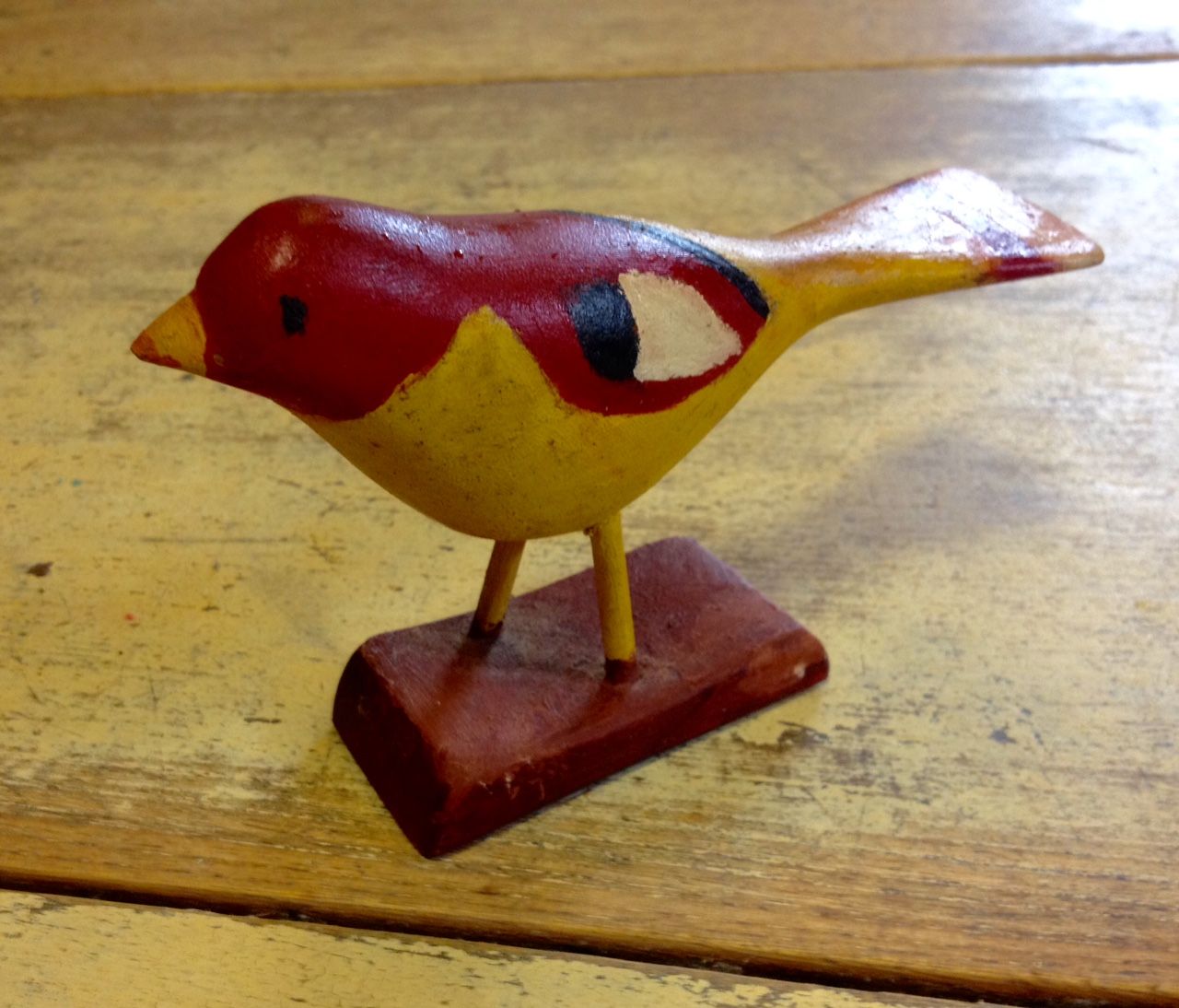
What follows is a bunch of little birds with different approaches, by different artists at different times.  Most of them are from Quebec.  You can see run the gamut in terms of approach.  Although it is perhaps the piece that looks the least like an actual bird, I love the little beige bird by Cadieux.  His name is stamped on the bottom.  I also love the little blue bird which looks almost like a cartoon.  it is made very carefully. Those wings are thin wood, not metal.

Which one of these do you like the most?

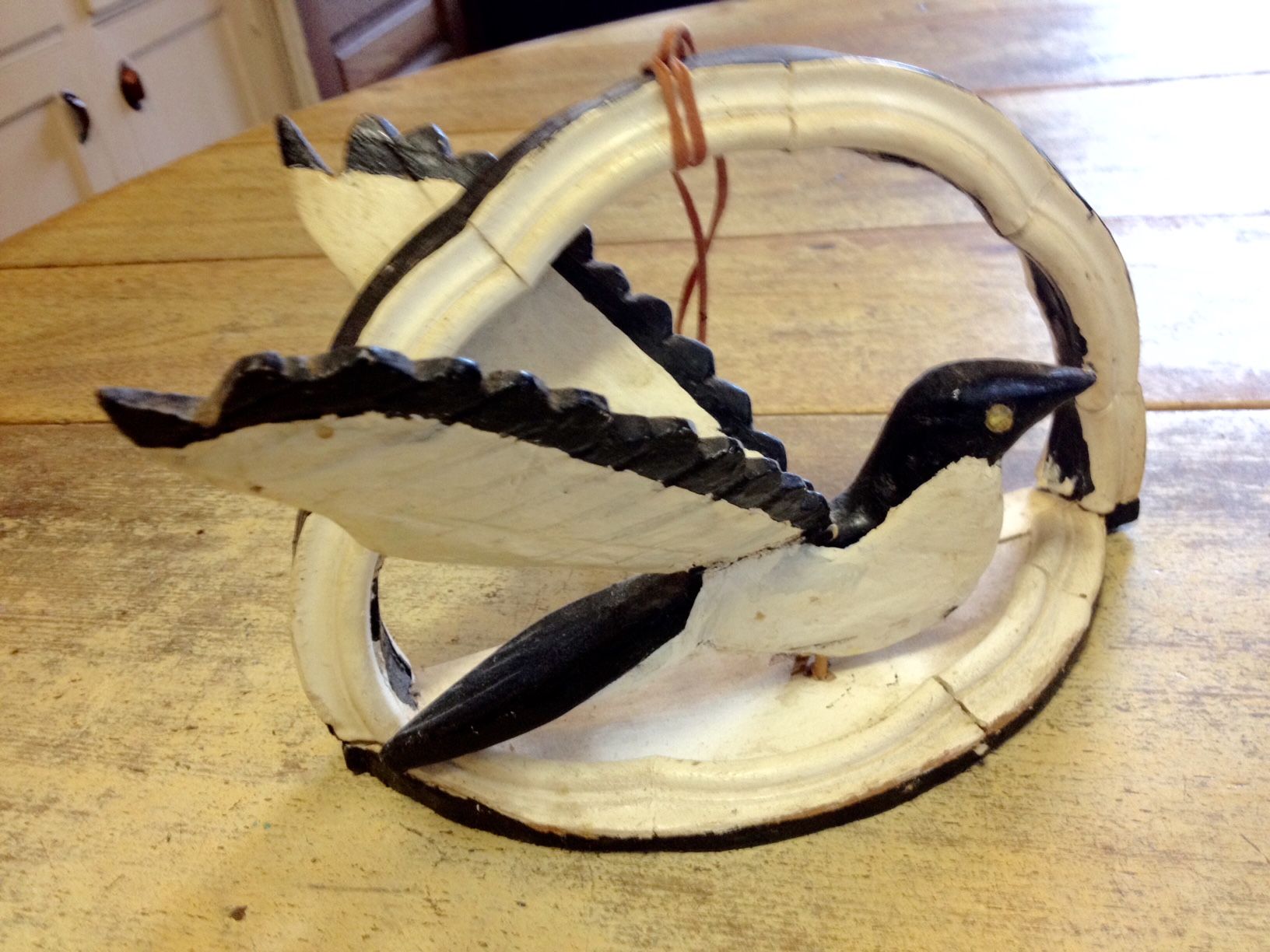
Someone even decided to make a little bird using wicker. This little fellow somehow comes across as looking quite mad.  And last but not least we have this hanging black and white bird on a perch.  Interesting construction, and can anyone figure out why his wings are on backwards?   Could this really be intentional?  Perhaps dyslectic?  Go figure.

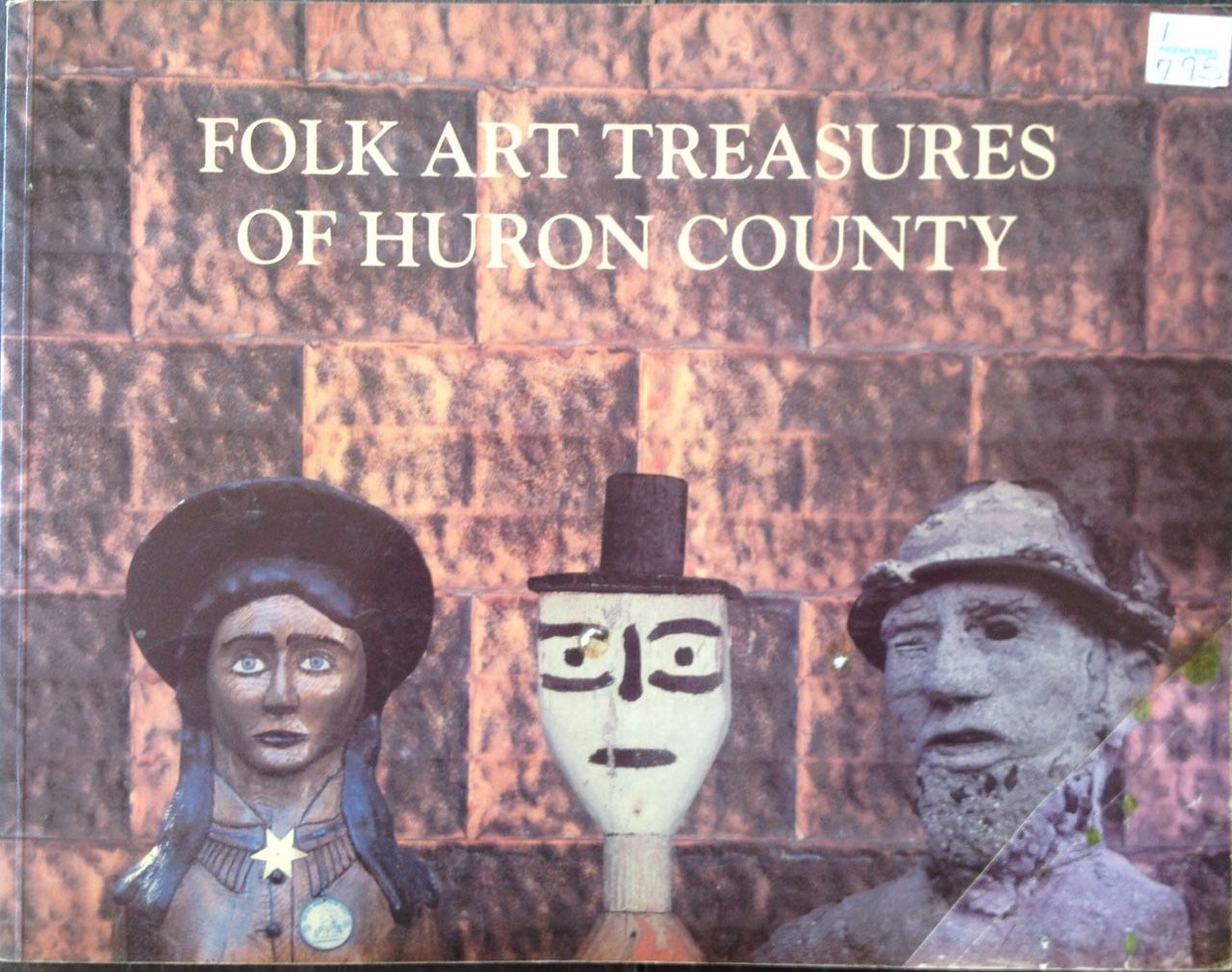
Folk Art Treasures of Huron County

It is a significant, and useful contribution to the appreciation of folk art, when an inspired and knowledgeable individual or individuals  put in the enormous effort necessary to survey and document the folk art and artists of a region. It doesn’t happen all that often.  Especially outside of Nova Scotia where folk art has become established, and is promoted as a significant part of the cultural mosaic. Read, tourist dollars. Follow the money.

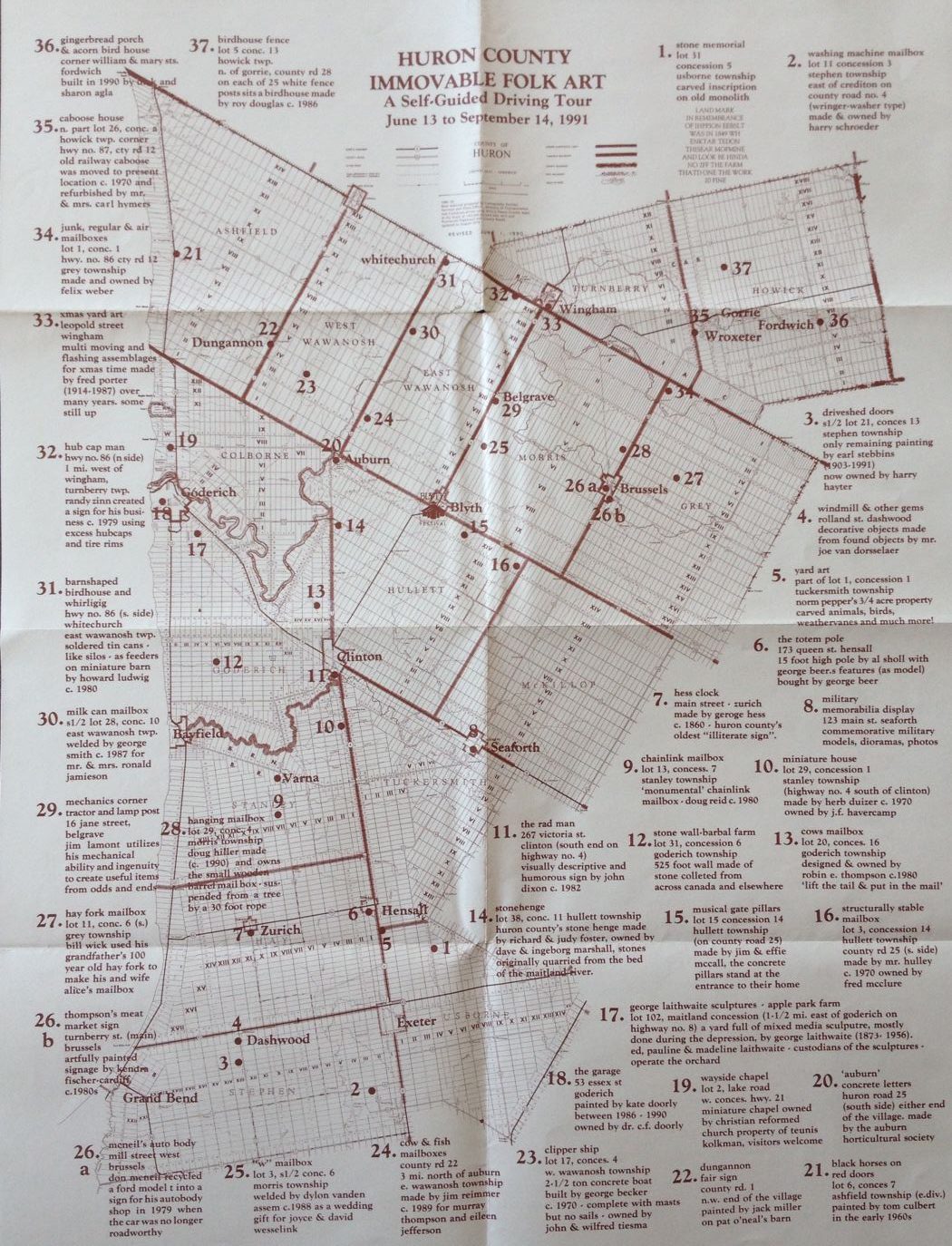
So I was delighted a few years back to find in a used book store, a copy of the catalogue for the “Folk Art Treasures of Huron County” Exhibition, which took place in 1991 as a part of that county’s sesquicentennial celebrations.  The event had three components;  Contemporary  Folk Art at the Blyth Festival Gallery, coordinated by Bev Walker , Historical Folk Art at the Huron County Museum, coordinated by director Claus Breede , and as a third component  documentation and a map of the Immovable Folk Art of Huron County, coordinated by John Rutledge.  You can imagine it was a monumental task to pull all this together, but this group did an excellent job.  In the acknowledgements coordinator  Bev Walker thanks over 25 people for their contributions. She also thanks the Folk and Native Section of the Ontario Arts Council for generous financial support.  I hope the province can still find a few bucks for such things, what with the deficit and overspending, and all.

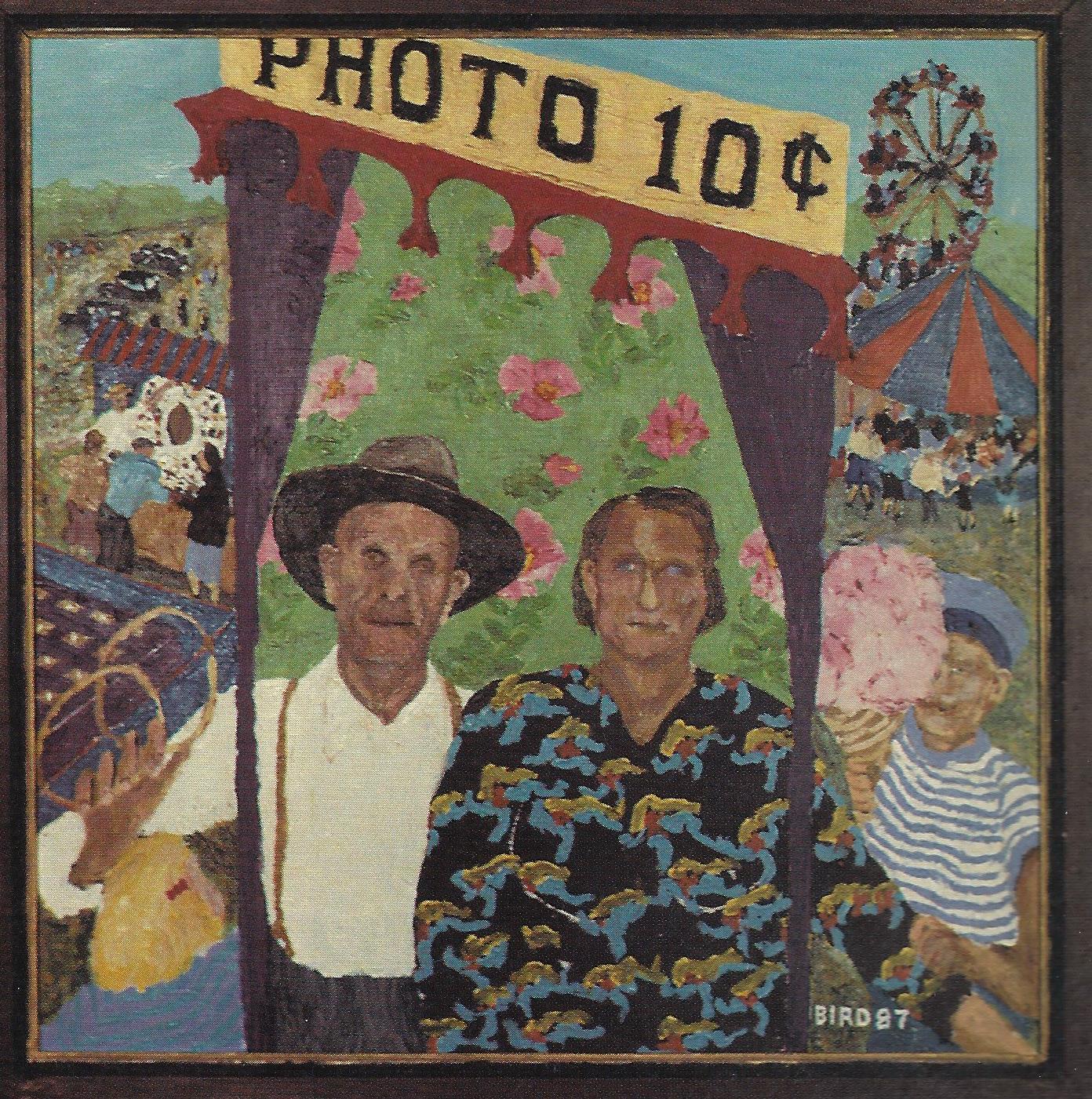
Mom and Dad at the Russell Fair
by Ray Bird

The Painter
by Bud Oke

The contemporary section along with several examples of the work, has three pages of artist’s bio’s  which is a great reference tool. I have bought many pieces by Bud Oke over the years and always appreciated his particular humor and talent, so I was delighted to know his story and see his picture.  I think Ray Bird’s “Mom and Dad at the Russell Fair” is somewhat of a masterpiece and I would love to see more by this artist.  His address is listed as RR#2 Brussels so he shouldn’t be that hard to find, but it also states he was born in 1929 so he’s 88 if he’s still kickin’. Could well be for that matter, and maybe painting better than ever. I’m pretty certain that Stuart Taylor, born in 1908 isn’t available for comment, but my goodness isn’t his Annie Oakley just the best? Yikes!

Annie Oakley
by Stuart Taylor

The historical folk art section of the catalogue  is also full of wonderful things dating back to the 1850’s. Of particular interest  are many working “models” depicting the lifestyle and technology of an earlier generation by Herbert J. Neill.  These “gems” are in the permanent collection of the museum, and so still available to be seen today.  It’s on my list.

Butter Churning
by J. Herbert Neill

However, I’ve got to say that of all these wonderful things Janis and Peter Bisback’s early 20th century weathervane really pushes all my buttons. Happy face on one side.  Sad on the other.   Peter and Janis still have a big barn full of wonderful antiques in Huron County, and are serious collectors. Worth a visit when you are in those parts.

For me, perhaps the most interesting and unusual part of this publication is the third section “Immovable Folk Art”. For the most part, we take outdoor folk art for granted.  Look at the picture of Tom Culbert’s Black Horses on Red Doors. If you drove by there every day it would pretty much look the same, but go away for twenty years, and you may come back to bare wood. Huron County winters are harsh.

Black horses on Red Doors
painted on his barn by Tom Culbert

You can see that Mother Nature has already erased about 40% of the paint.  In the photo notes it says that he painted the doors first in the 1960’s “even before I married my wife”, and has repainted them about five times. Remember this was 1991.  Is Tom still around and willing to put on a fresh coat?  Of course for many of us the wear is an integral part of the appeal.  That’s another reason photo documentation is so important.  Things fade away.  It’s either that, or you manage to buy  them from Tom and have a room big enough to display them in, and then of course you are completely taking them out of their original context.

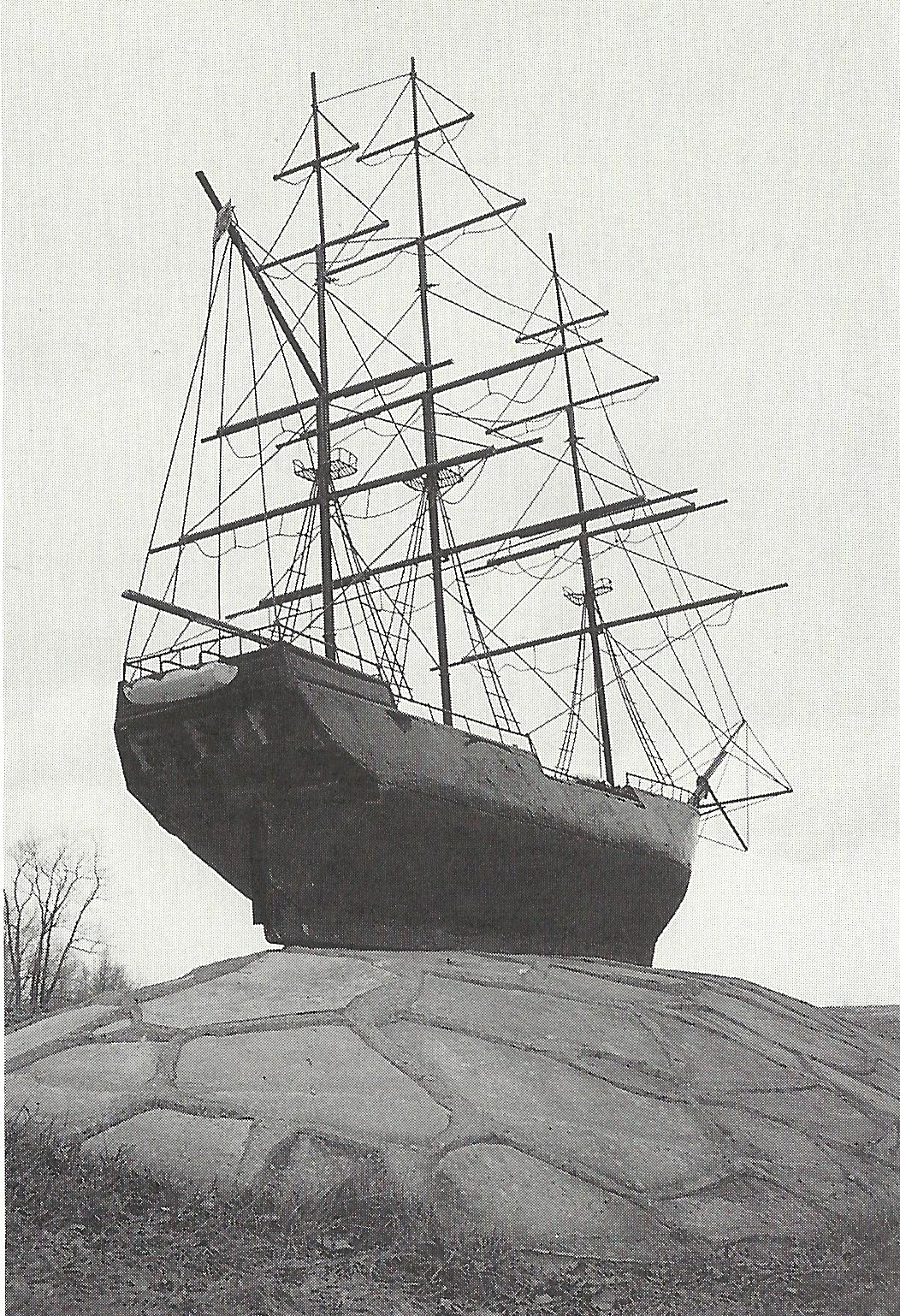
Clipper ship
concrete sculpture by George Becker

Just look at that 2 ½ ton concrete clipper ship built by George Becker in the 1970’s, and owned by John and Wilfred Tiesma.  It stands at the end of their farm laneway, permanently dry-docked atop a fieldstone mound.   (12’x 3’ x 15’)  You don’t expect to see that when driving down a country lane.  It’s on the map along with 35 other points of interest.  And then, of course, inevitably we come to the cement work of farmer George Laithwaite (1873-1956). The Laithwaite Apple Park Farm near Goderich has, for three generations fascinated visitors with it’s many sculptures fashioned from cement, metal, fieldstone, and found materials, made mostly during the depression.   It’s still open to this day.  For the serious folk art devotee it is Mecca.  Admission is free and there is a farm market.

Do I hear “Road Trip”?

Man and Donkey
by George Laithwaite

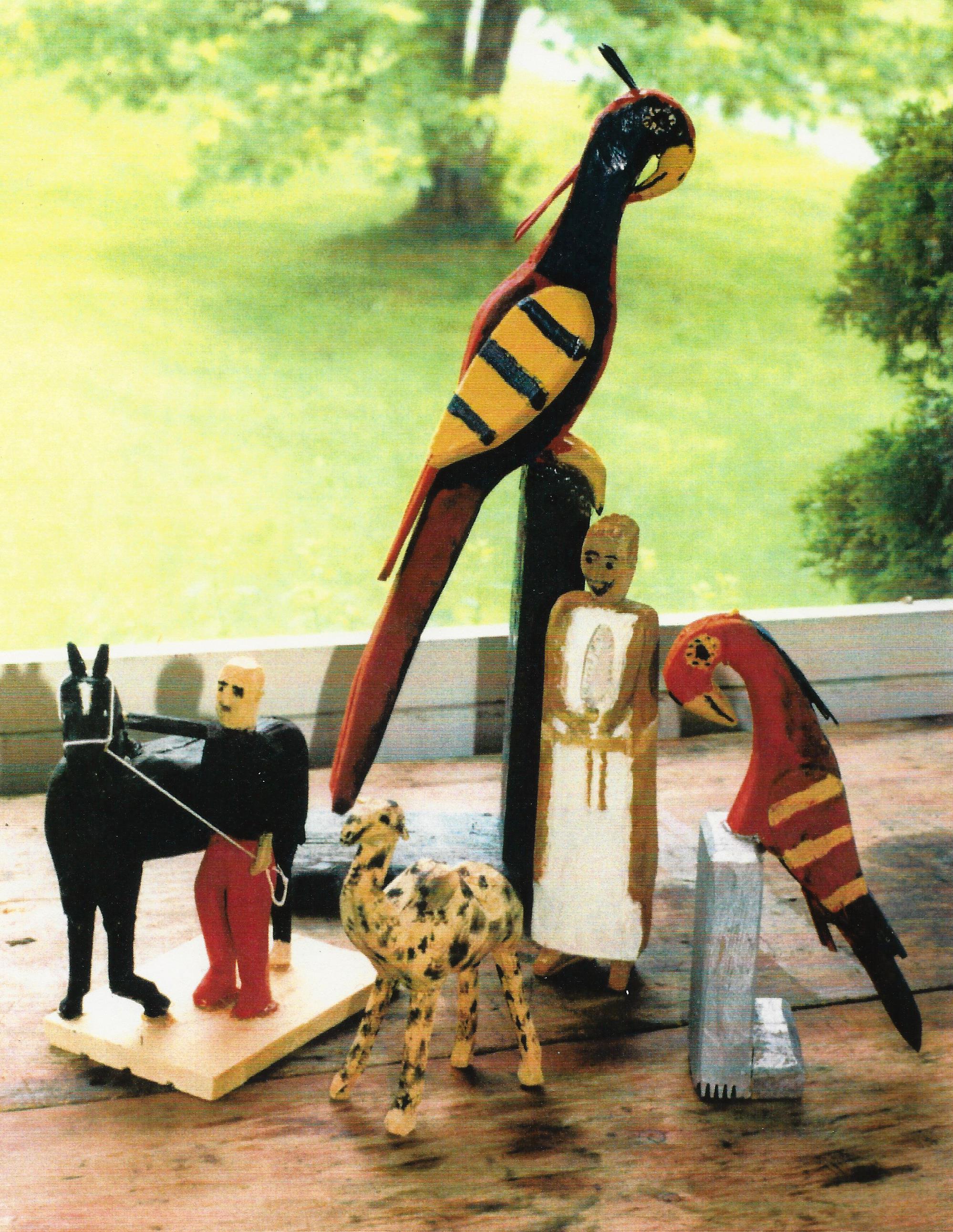
The last known works by Rosario Gautier

This handsome fellow lives in our living room.  He is a favorite of ours, and we have come to find out that he was made by Rosario Gautier, late of St. Charles de Bourget, Lac St. Jean Quebec,.  We didn’t know who made it when we bought him about 25 years ago,  and it didn’t matter so much because we loved the piece, but it was satisfying to eventually put a name on it.

Over the years we have found and bought several pieces by the same hand.  The chunky, colorful style is unique and easily recognizable, but all we encountered were unsigned, save for a few initialed “RG”.  Not a lot to go on.  Then one day, some picker, I can’t recall who, said ”Oh, yes that’s Rosario Gautier from Lac St. Jean.  He’s been carving for years.   Now at least we had a name and place to ask about.

The next big break  came in Quebec city when walking back late one night to our hotel after a particularly memorable meal and lots of good wine with friends who are lucky enough to live there.  We passed in front of a closed antique shop and there in the street light was a photo in the window of Mr. Gautier, along with several of his pieces, and a short hand written bio.  We were able to find a pen and paper and copy out the bio, and take this slightly blurry picture through the glass.  We were up and out in the morning and never got back there.

Here’s what we were able to record about him that night. “Rosario Gautier was born and lived all his life at St. Charles de Bourget, Lac St. Jean, Quebec.  Father of a large family (12 children of whom 9 are still living), he was a farmer and a blacksmith in logging camps. He started carving after retiring in 1971, and produced a large body of work. Most of his pieces are in the medium size range, but he also produced life sized animals, as well as an eight foot crucifix. The muse de la Civilization du Quebec owns 350 of his pieces, and he is represented in many major collections in Canada and the Unites States.”

By this time we had bought many pieces of his work.  We kept some, and sold most to Quebec collectors.  All the while we love his funky, choppy versions of birds and animals.  All of them rough, and not self-conscious, but also showing a fineness and understanding of form.

We were in the habit those days to try to meet as many folk artists as we could in our travels, but as much as we admired Mr. Gautier’s work and would love to have met him, we were unwilling to make the 3 hour drive north of Quebec city, on spec.  Not even knowing at this point if he was still alive.  I google mapped St. Charles de Bourget just now, and it appears to be a charming little village of 690 souls set on a beautiful northern lake, but it is well on the way to nowhere.  With very few villages en route,  it would mean three hours of looking at trees, and then if we didn’t connect, three more hours of trees coming back.  We didn’t feel like risking it.

We continued to see and buy his work from time to time, then in the mid-nineties we bought the Mongeau collection, and it included about forty small pieces that Mrs. Mongeau described to us as Mr. Gautier’s last works,  which he made just before passing away at the age of 80 in 1994.  I’ve included pictures of some of this work here.  I love the directness of this work, and even though you can see it is not as accomplished as some of his earlier pieces like our 3 ½’ long bull,  it contains a mighty spirit.

I’d still like to make it up that way just to see if I could find that eight foot crucifix.  Even if it turned out to be fruitless, it’s close to Saguenay which from the pictures seems like a pretty interesting place to check out.  I love Quebec.  Quebec J’taime.  Maybe this fall.

Nova Scotia or bust

One summer, back in the late nineties we decided to take a quick trip eastward combining some antique picking and vacation activities as a fun time together with our daughter Cassandra before she left high school to go to university.  The objective was to have no specific plan, and wander eastward as we saw fit buying along the way, with the ultimate goal of reaching Nova Scotia.  Even if we didn’t have the time on this trip to explore further once we got there. We put about $4,000 in an envelope for purchases, packed out bags and food hamper into a full size cargo van we borrowed from our son Brodie, leaving him our pick-up to use while we were gone.  We were not looking for furniture on this trip, and felt it safer to leave our small sized purchases locked up inside a van at night.  We got a good, early start and made it to our regular stomping grounds around Victoriaville in time to do a quick circuit of the picker’s barns there before settling in for the night at our regular spot, the Motel Marie -Dan in St. Eulalie.  We didn’t buy much, wanting to save our money for buying in the previously untraveled regions to the east.

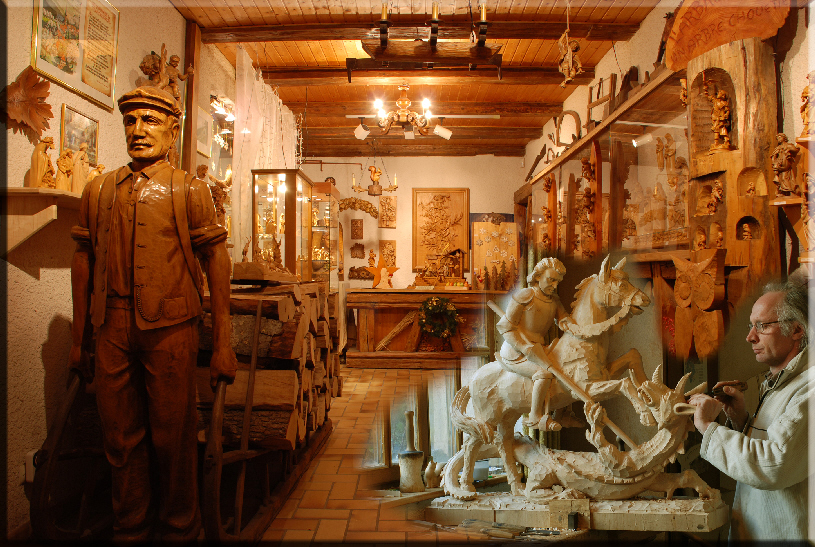
Day two, after a hearty breakfast we shot down #20 expressway past Quebec city until the village of St. Jean Port Jolie.  This pleasant little village on the banks of the St. Lawrence river is the home of the Bourgault brothers, who founded the “École de sculpture de Saint-Jean-Port-Joli” in 1940 with the support of the Quebec government.  The carvings became very popular with tourists and locals alike, and still today the village is chock a block with wood carvers.  To be honest although we greatly respect this form of carving, we were hoping to find  a unique folk artist more towards the lunatic fringe of the spectrum who might be hanging out there.   We had a great time looking at the museum and several shops but didn’t find what we were looking for.

After a nice lunch we made our way along the coast on the two lane Hwy # 132 past Riviere-du-Loup  as far as Trois Pistoles, a trip which would ordinarily take about an hour, but in our case took over four due to several stops at yard sales, markets, and shops. We hadn’t expected it, but we found a lot of wonderful stuff and by the time we stopped for a coffee in Trois Pistoles the cargo area of the van was almost full, and our envelope was over half empty.  We had a little conference, and thinking of Nova Scotia decided that instead of going further into the Gaspe we would turn back to Riviere-du-Loup, hang a left on Hwy #85 which becomes Hwy#2 as soon as you cross over into New Brunswick  and on a good day with steady driving will get you to Amherst, Nova Scotia in about eight and a half hours.  Our goal was to sleep in New Brunswick.

It was dark and raining by the time we had made our way past the endless forests of this part of Quebec and then we hit the construction.  On a 1 to 10 scale of “hairy” driving this was a solid eight. Pounding rain, mud, and lots of starting and stopping. We white knuckled it for about another hour and finally made it to Grand Falls, New Brunswick.  It was pushing ten o’clock, and we really needed to stop.  Turns out there was a convention in town and we were turned away at every motel, and feeling quite desperate before we got the advice that the only room we could get would be at a bed and breakfast in a recently converted old nunnery a few miles out of town.  We’re not big B and B fans but great.  We’ll take any port in this storm, and after a call ahead to confirm they had a room, we went off with the little hand drawn map we were provided.

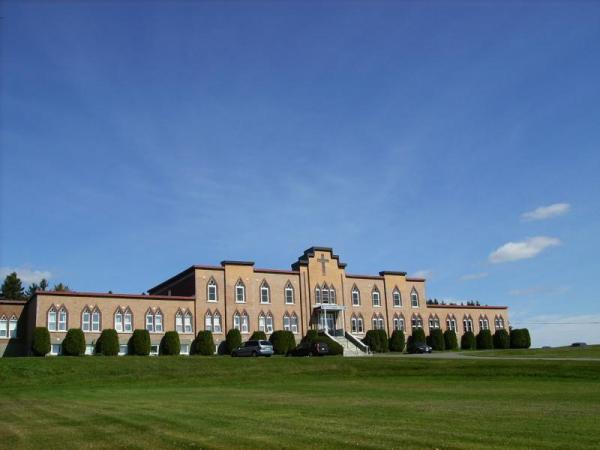
The storm grew stronger, and the thunder and lightning more brutal, as we wound our way up into the surrounding hills, until there in a flash of lightning worthy of Alfred Hitchcock, the huge, old, Victorian Gothic Institution appeared, with a giant cross above the entrance;  and we drove up the hill and pulled into a parking space, wondering what we had gotten ourselves in to.

I can’t recall, but I’m sure we were greeted by a perfectly nice night attendant, although in my imagination he was someone akin to Igor.  We were lead down a long, dark, corridor to a pair of rooms which seemed to remain untouched from their former life.  I remember the institutional green walls and old steel beds.  They were small, and basic, but a blessing in our situation.  In bed, with the lights out, and the still frequent flashes of lightning and thunder I began to hear people moaning in the distance. It kinda freaked me out, but I had no desire to investigate.  I put the pillow over my ears and did my best to fall asleep.  It was a long night.

Next morning, we met Cassandra in the canteen, and after coffee and hot chocolate decided to get the heck out of there.  “Did you hear all that moaning” Cassandra said.  “It really freaked me out”.  “  “Me two.”  “Me three” said Jeanine.  We saw the caretaker on the way out, and he explained that it had become a B and B, slash old people’s home, and that some of the old dears were restless.  The place didn’t look all that spooky in the daylight.

In town, we sat in a little mom and pop restaurant, finishing breakfast and discussing our plan.  We had learned that the construction which we had only experienced about an hour of, continued for several more hours ahead as they were making the highway into a divided four lane.  Desperately need by this point especially with all the summer tourists.  We sat there for a while discussing our progress, and what lay ahead.  We were grateful for the use of Brodie’s van, but it was noisy and fairly uncomfortable.  We realized we had a full day of crappy driving ahead just to reach Nova Scotia, and then we would only have a couple of days to look around before heading back.  Then our conversation turned to how much we loved Quebec City, and we could be there by late afternoon if we turned back.  It was an easy decision for us.  We called our favorite, cheap hotel in old Quebec, Le Manoir des Remparts and made a reservation for three nights.   We had a wonderful time, and felt happy and relaxed on the twelve hour drive home.  Resolving to make it to Nova Scotia another time.  Perhaps, looking into air fares.

Bob MacDonald and the fantasy cities

I can’t remember how we met Bob MacDonald.  It’s most likely that he found us.  Bob was a full time antique picker who would pull in unexpectedly from time to time in whatever old wreck of a car he happened to be driving.  I don’t think he ever paid over $100 for a car, and he spent all his time in them, so they didn’t last long.  Bob was the type of character that kept me interested in this antique business, come lifestyle.

Bob was charming, intelligent, well read, and knowledgeable in the arts, and literature; but he also liked the bottle, and survived on almost nothing, occasionally being reduced to living in his car.  When he came by, we would make sure he got some food in him, along with his beloved black coffee.

Bob spent all of his time following up leads, and beating the bushes for valuable artwork and rare books.  He was good at it and would occasionally score big time. Then eventually the money would be gone and he may have to suffer through a fallow period.  Those where the ropes. When he found something in folk art, like a Maud Lewis painting or the like he would come to see us.  Sometimes to convince us to put some money up front, so he could actually purchase the object he had found.  We trusted Bob, and he always delivered. 

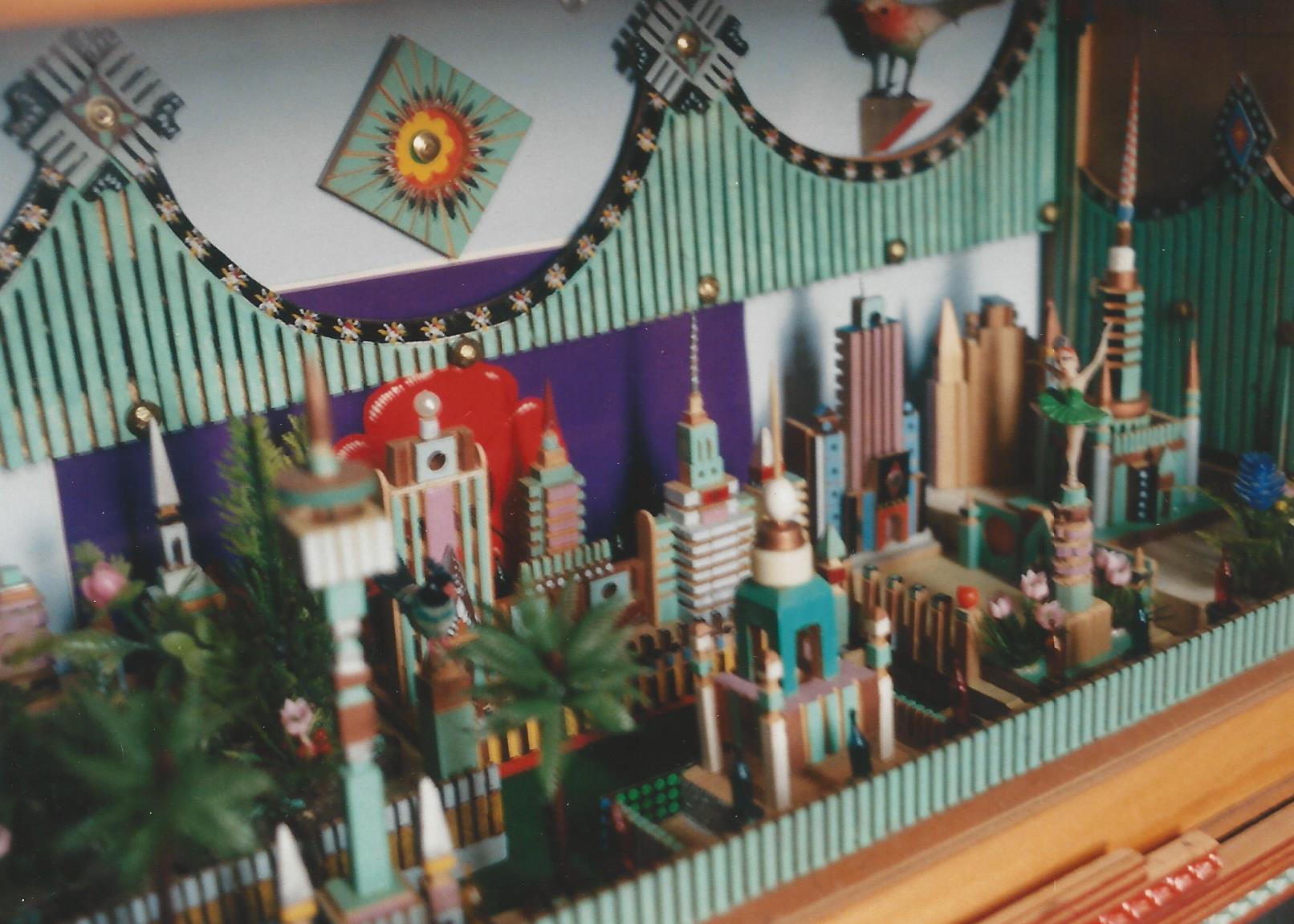
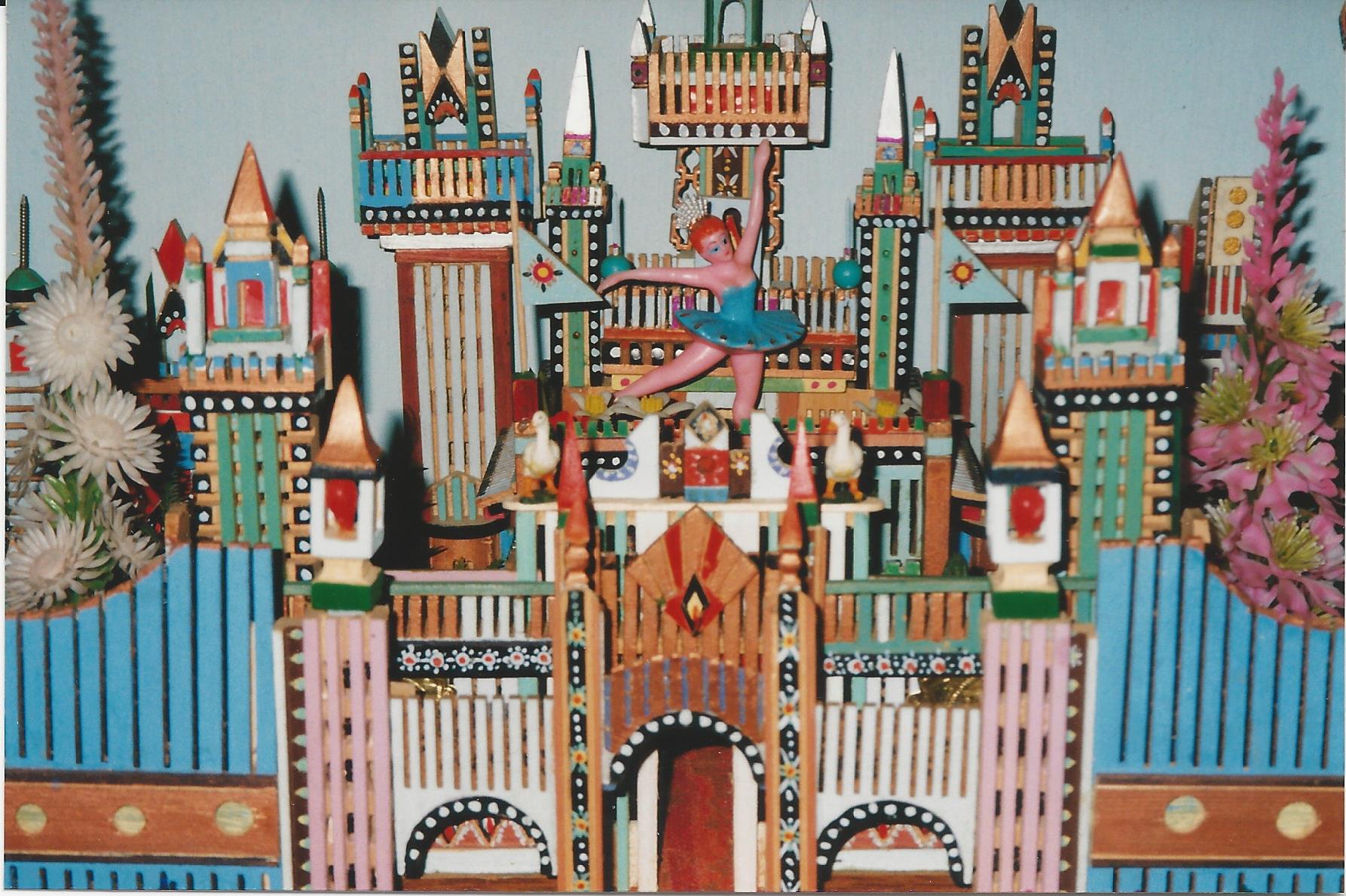
I was working in the garden on a fine summer day in the late eighties when Bob came roaring up the driveway, a big smile on his face, and a car full of what appeared to be aquariums. On closer inspection I could see that they were hand-made display boxes with plexiglass on the top and front.   There was a half dozen on the back seat and two beside him on the passenger seat. He popped the trunk and there were another four large ones in there.  “You’ll never guess what I’m bring you today”.  He could hardly contain himself.  “ I was up in Goderich and stopped in to the Chinese restaurant there for some lunch.  I got talking to the owners and came around to telling them I was looking for art and books, and the young woman there said “Well, I don’t know if you will consider them art, but my father when he wasn’t busy cooking would get out a key-hole saw, and spend hours making these fantasy city landscapes.  Would you like to see them?”  Of course he was delighted to look.  There in the back storage room were dozens of these boxes of various size and configuration. Every one similar with many layers of carefully cut out and painted balsa wood walls, towers, balconies; and courtyards adorned with little plastic trees and flowers. Most of them had a boarder of mini Christmas lights around the front, and occasionally there would be a plastic figure of a ballerina, or chicken, or duck perched atop a column making it appear to be  a giant statue in the courtyard.  The overall effect was mesmerizing.  I know Bob would play it cool, but I bet his eyes were popping out.  She explained that for a time her father would display them in the front window and occasionally someone would buy one, but eventually he became discouraged.  The family had all kept their favorites, and so when Bob expressed interest, they sold the rest of them to him for a song.  Really just wanting to find them a good home and free up the storage space I suppose.  Bob drove directly to us.

What can I tell you.  Jeanine and I both really liked them and felt they were strong examples of original folk art from a vivid imagination. Perhaps one looking nostalgically back on a childhood spent in China, although a China of the “crouching tiger, hidden dragon” variety.  We felt and would continue to argue that they contained magic .   We weren’t sure if anyone would feel the same and we now had a dozen of them.  It’s the question you ask yourself when you invest your hard earned money in something that most people would find clearly crazy.  If you see it, and can recognize it, I think you are under some obligation to act.  Otherwise, why are you a folk art dealer, and not working at the bank. Or something else that rewards you with a pension, benefits and a regular “Johnny Paycheck”. 

We took them to a few Ontario shows where they were pretty much ignored, or met with a polite curiosity, or in some cases they produced downright hostility.   What is it about some folk art which actually makes people angry? I think it’s a combination of seeing something you revile with a big price tag.  It makes one question the value of money, which can lead to questioning one’s values in general, which can lead to all sorts of problems.  In any case, it soon looked like we would be owning them for a long while to come.  We didn’t have a lot of money wrapped up in them as Bob had passed them on to us very reasonably so we were happy enough to set them all up in  the showroom and plug them all in.  Then turn out the lights and enjoy  the feeling of being transported.  An exciting Friday evening out on the ranch.

Fortunately, the next January we found ourselves doing a show in New York city, and within ten moments of opening a man came rushing up to us needing to know everything about them.  He listened to the story and we soon settled on a price for all of them with the understanding that if any more were to become available he had first dibs.  Also, we were to find out anything more that we could about the artist.  Bob died not too long after, and we didn’t get a chance to ask him to go back.  Our lifestyle was such that I couldn’t take the time to drive to Goderich to see what I could find out, but it’s something I still think about from time to time. The trails pretty cold at this point.

La Malbaie, part two – Bringing it all back home

malbaie2When our offer to purchase a small barn’s worth of antiques near La Malbaie, Quebec was accepted, we recognized we had two main problems to solve; getting it all back to our place, and having somewhere to put it when we got it there.  The church showroom was already quite full, as was our little storage sheds, so we talked to our friend and neighbor Dave who had a farm around the corner with some unused out buildings, and arranged to rent them at a reasonable rate.

There were many items in the lot that were outside our regular inventory; commercial products mostly like old beer bottles, tins, etc., so our plan was to sell most of this as quickly as possible to realize back some of our investment, and allow us to focus on what we normally sell.  We knew a lot of dealers by this point so we invited them all to come when all the stock had arrived, to have a first pick of it.  This generated a bit of excitement that we all shared.  It felt like Christmas was coming when you were ten, and you couldn’t wait to see what will be under the tree for you.  A date was set in three weeks time.

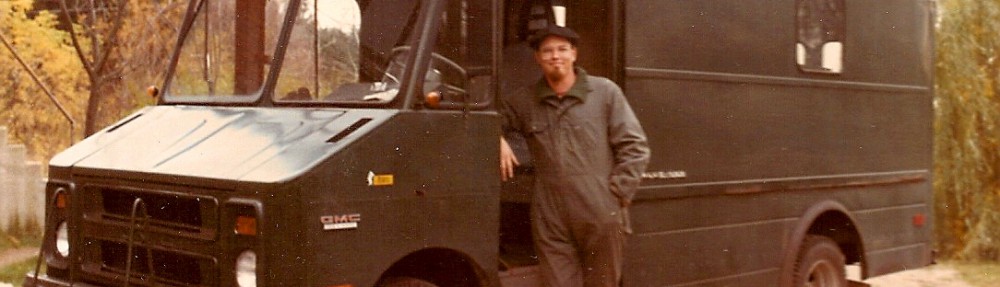
I rented the largest moving truck they would allow me with my license which was really, really  big.  If I’m not mistaken the box was 20’ long, and 10’ high.  A good friend named Sergio who ran a nearby apple farm offered to ride shotgun.  When I talked to the seller in Quebec I asked if he could hire four strong men to load, and he said it was no problem.  He knew such men who would be happy for the work.  He said he had a motel room waiting for us. Things were shaping up.

Sergio and I set out about 5 am the next morning. A time which allowed us to cross Toronto before morning rush hour, and which barring delays would put us in La Malbaie about 3 in the afternoon.  The  trip, although long, passed pleasantly enough as we chatted about anything and everything and occasionally munched away at our packed lunch.  Sergio is Italian so we spent a fair amount of time with him teaching me swear words, and street sign language. Did you know that if you are walking down the street with an Italian friend and he holds his hand straight out about belt level and waves it front to back it means “I’m hungry. Let’s go get something to eat”?  I didn’t either.

malbaie3We pulled into the farm about 3 as expected and drove directly to the barn.  There was our man with a team of 4 very large men behind him looking tough, and ready for action.  We only took about fifteen minutes to stretch and get our bearings, and then the trucks ramp was lowered and we got started. I stayed in the barn and pointed at the items to be loaded, and Sergio stayed in the truck and arranged the placement.  We started with the big, boxy pieces like cupboards, dressers and sideboards, stuffing smaller items like bicycles, signs, wall cupboards, etc. in all the little spaces.  The guys were amazing. Strong and careful and we filled the truck form front to back in less than three hours. As we rolled down the door you could see that we had taken approximately half on the contents.  We then all went down into La Malbaie where we had a delicious dinner and a few celebratory brews at our host’s motel.  His treat.  What a guy. Then we settled in for an early night and slept the sleep of the dead until about 7 the next morning. We grabbed some breakfast and headed west.  Pulled in at home about 7 pm and went straight to bed.

It was all hands on deck the next morning at 9 am.  It took us about five hours to unload in such a way that everything could be accessed.  We spent the rest of the afternoon looking at all the small treasures that were stuffed in the various drawers and boxes.  I had an early dinner and went straight to bed so that I would be ready to head out with Sergio at 5 the following morning for round two.

Essentially it was the same routine but with the added fun of the scrap metal dealer arriving to haul off all the recent and thus rejected cash registers and the like.  Where did this guy get all those cash registers? He must have bought out a local supplier.  When the truck was full again there was still a small pile of things left.  I said I would probably be back for them with my pick-up, but if I couldn’t make it back, I’d phone and he could call the local junk guy to come and get it.  I wasn’t sure if I had another trip in me.  Turns out I did, and Jeanine and I left a couple of days later in our faithful old pick-up.

Well that small pile turned out to completely fill the poor old thing, and I’ve never seen it sit lower on it’s chassis due to the large number of cast iron pots and pans which dominated the load.  The wheels were practically rubbing on the fenders and I thought I was going to run out of gears and have to back up some of the sharp inclines you need to pass to get out of the region.  Somehow she hung in there and we made it home.  I was so impressed I almost wrote Ford a letter.  We got home and had a few days to prepare for the pick.   We pulled out all the things that we wanted for ourselves and got them back to the church.

When the dozen or so dealers arrived we explained that the procedure would be for them to go through everything and make a pile of the things they would like to purchase.  We explained that as we had known them all for years and had done good business we would trust them to tell us what they would pay based on a reasonable, but not outlandish profit.  In other words “We trust you to be fair”.  Unless we felt we were totally being screwed we would go along with the price.  You know, it worked amazingly well.  Almost everyone was completely fair and the few who were not stood out like a sore thumb. “Oh, so this 100 year old, unopened bottle of Molson Ale in mint condition is only worth $15. I would have thought more, but if you say so.”  There were a couple moments of “I saw it first” tension but they got resolved without fist fights.  Everyone felt encouraged to share in our good fortune and grab what they could use.  At the end of the day we had reduced the load by about a quarter, and the venture was paid for.  A hellish amount of effort, but we continued to make money from that load for years, but I have to say that the best part for me really was the joy of opening everything up and discovering all the treasures inside.  World of Wonder.malbaie5