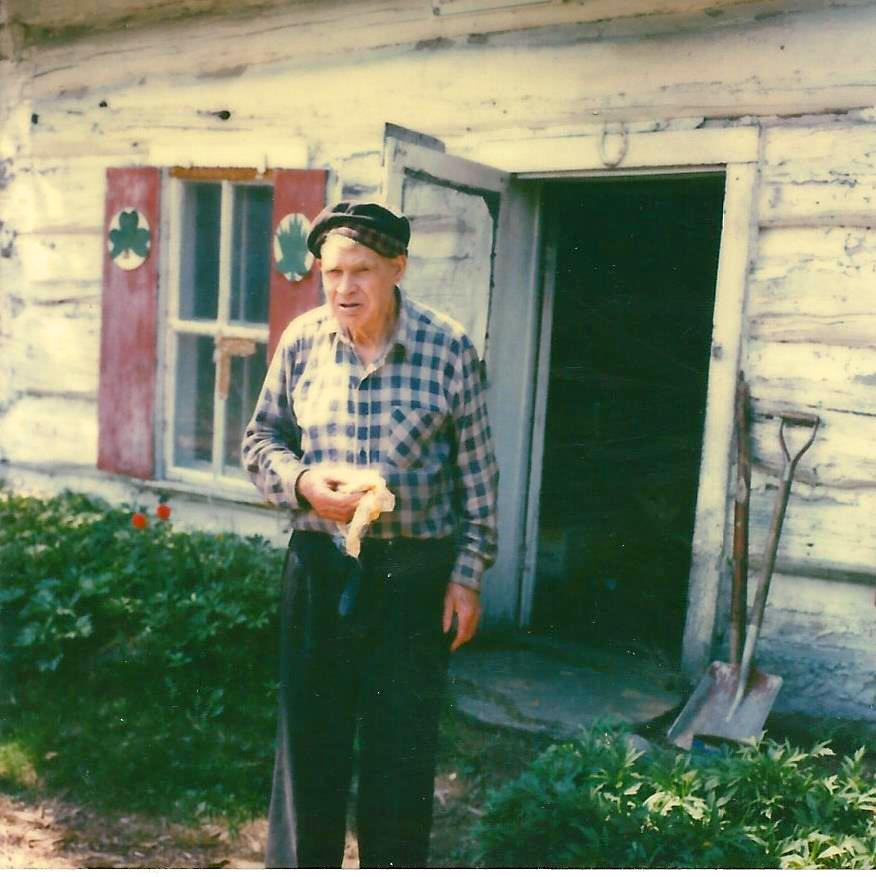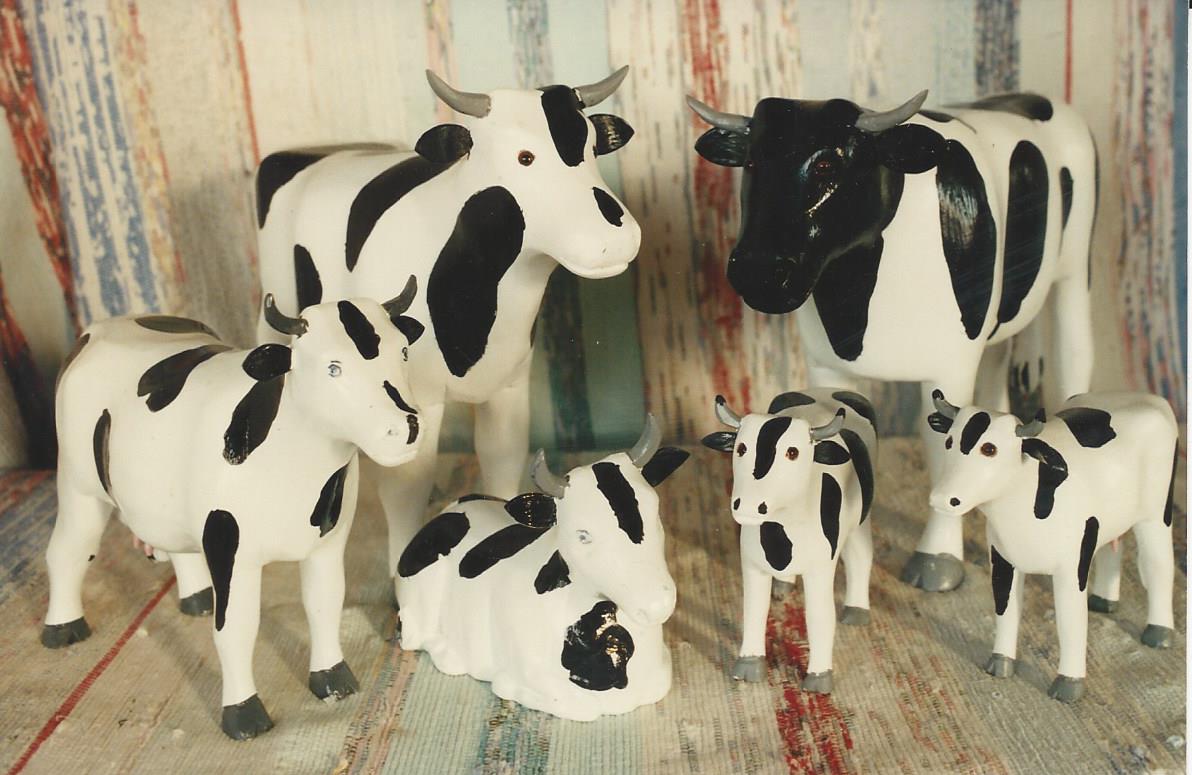
Our times at The North Hatley Antique and Folk Art Show

northhat3

a giant moose head that came along for the ride.

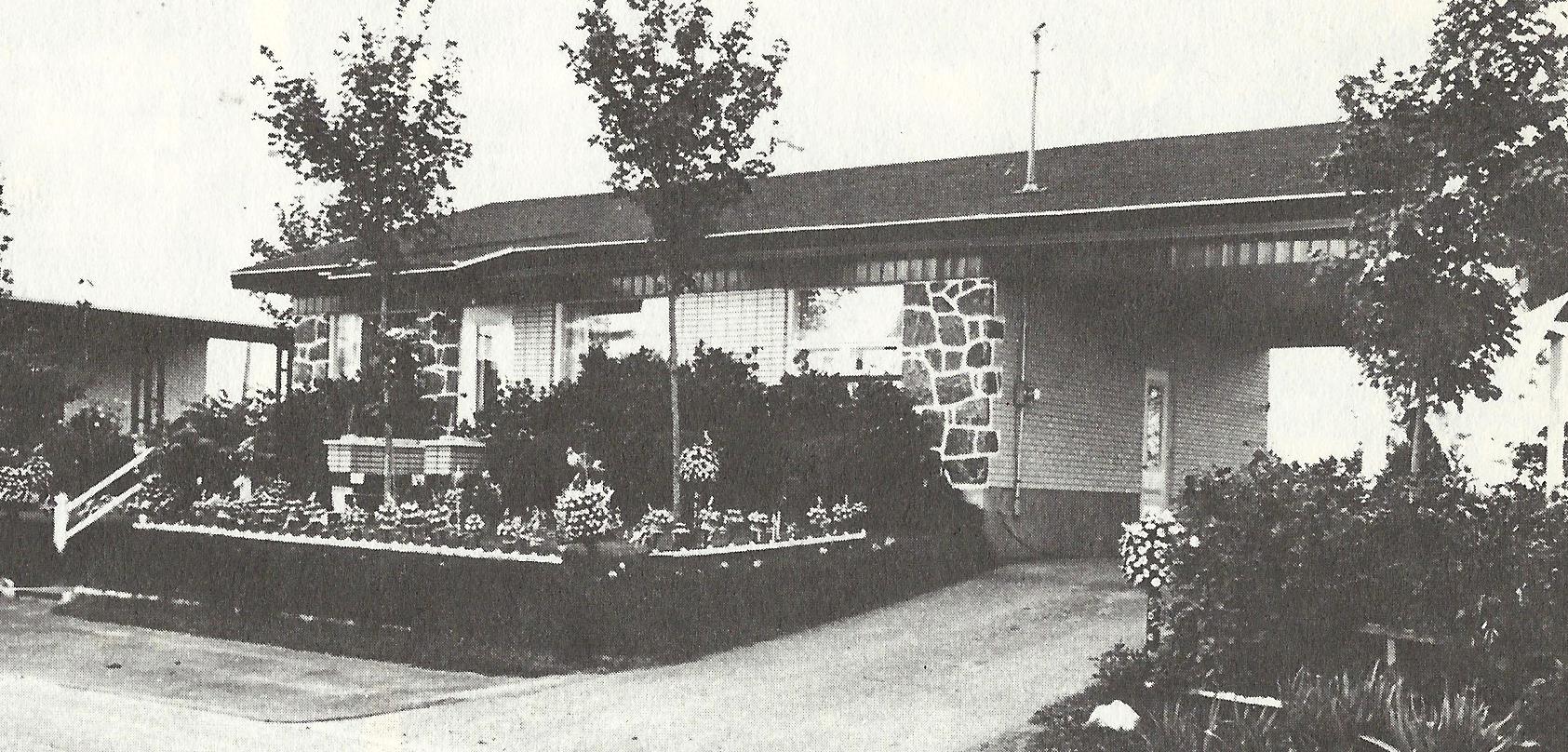
When, in about 1986 we decided to expand our show calendar beyond the weekly Toronto Harbourfront Market and the spring and fall Christie shows, we decided that we would like to include the North Hatley Antique and Folk Art Show, held annually in early July in the beautiful Eastern Townships region of Quebec. Known as Canada’s oldest antique show, it also had and still has a deserved reputation for presenting top quality antique and folk art to an exclusive and appreciative clientele.  North Hatley is a picturesque charmer of a small town on the banks of Lake Massawippi, and a playground to the affluent and powerful of Montreal and surrounding areas. The show, put on by the local Recreational Society is held in the old curling club with about fifteen dealers set up where the ice would be, and another 6 or so set up in the onlooking lounge.  For the years we attended, until his death in 2007 it was run by the legendary Sam Pollock, who among many other things was the manager of the Montreal Canadians for 14 years, during which they won the Stanley Cup nine times.  As you can imagine, Sam ran a tight ship. Every year he, and his loyal fellow volunteers would do everything from planning and preparing, to set up, and everything else involved in running a top notch show right down to the  making of the delicious home-made egg salad sandwiches at the lunch bar. They may have been up in years, but those ladies knew their way around a good egg salad sandwich. northhat4
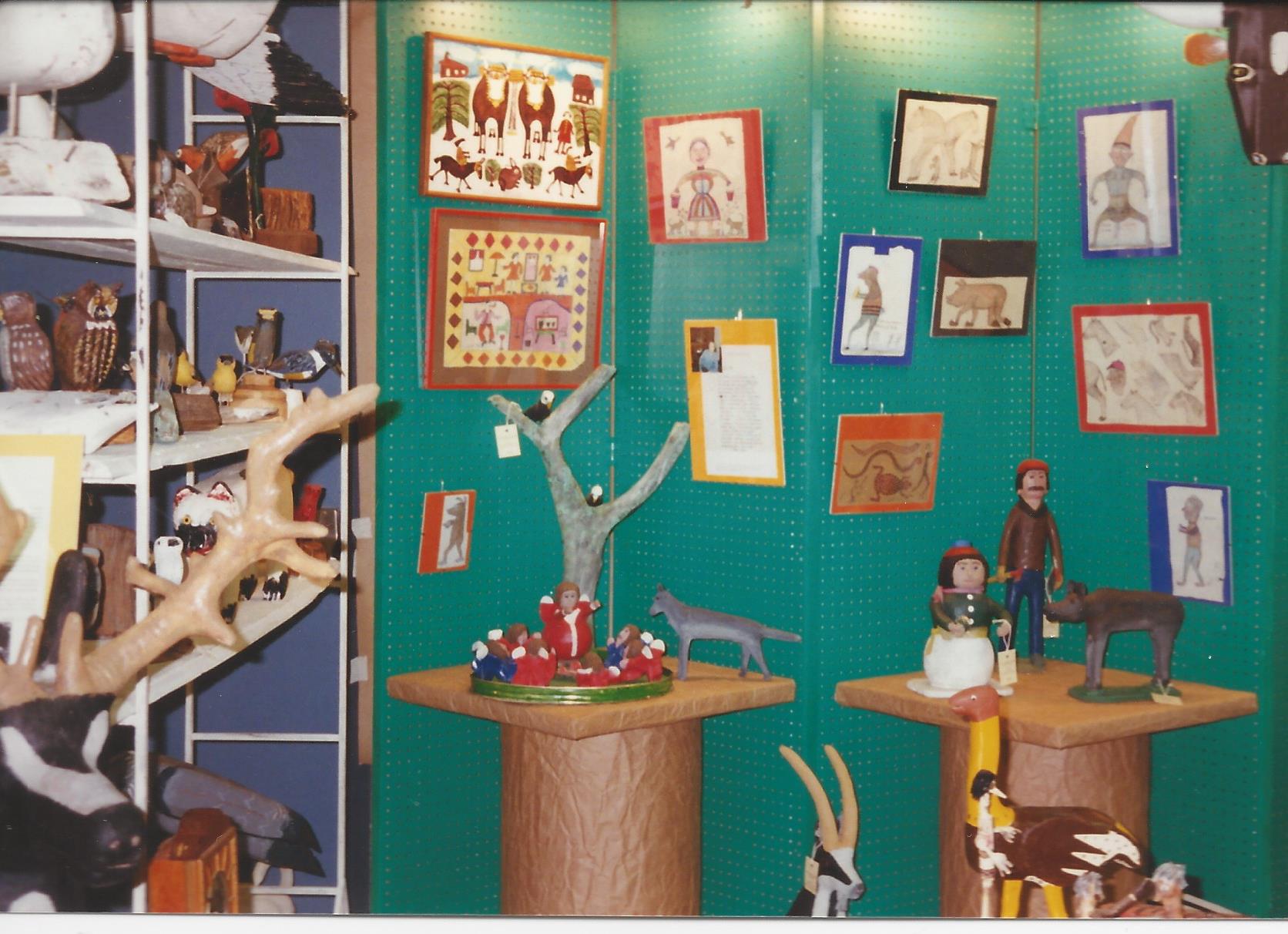
In those days, it was not easy to get invited to do the show.  We were lucky to have friends like Peter Baker and Gerry Marks who had been doing the show for years to recommend us.  The first year we had a tiny 10’ x 10’ booth wedged into a corner of the lounge area, which was mostly dedicated to book, pottery, and silver sellers, with the furniture dealers all being in the main room.  We didn’t mind because being an unknown in terms of results, the rent was cheaper and we came with a smaller truck. We focused mainly on folk art, which was what the promoters wanted from us because it was becoming increasingly popular with this crowd. It went very well, and we had a great time to boot.  Good sales, lovely people, and a stunning area to explore.

An interesting feature of the show is the gala Friday night opening.  From 6:30 to 9:00 on the Friday night a $30 ticket buys you first crack at the stuff, and all the delicious hors-d’oeuvres, and wine you want. Lovely young waiters and waitresses passing amongst the crowd with trays. The experienced dealers warned us that opening night it is packed, and it may seem that all they do is talk to each other, and glance over your stuff.  It is a big social event after all.  But not to despair because when they see something they like they are in a good and competitive mood to buy.  Also, they may go home and discuss it, and come back Saturday morning to buy.  It worked out pretty much just like that.  A few sales Friday night, then good sales all day Saturday, and even a few more on Sunday.

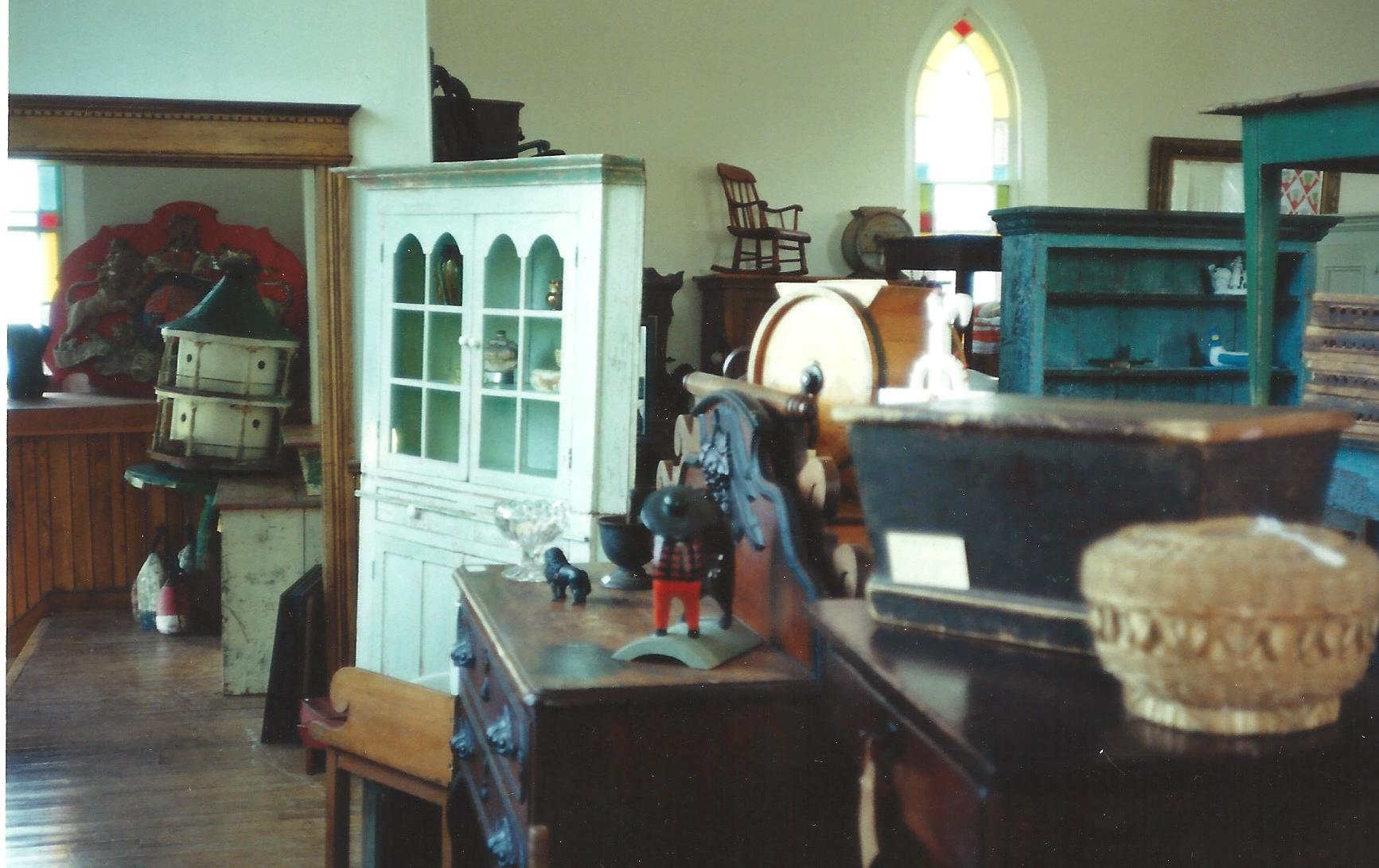
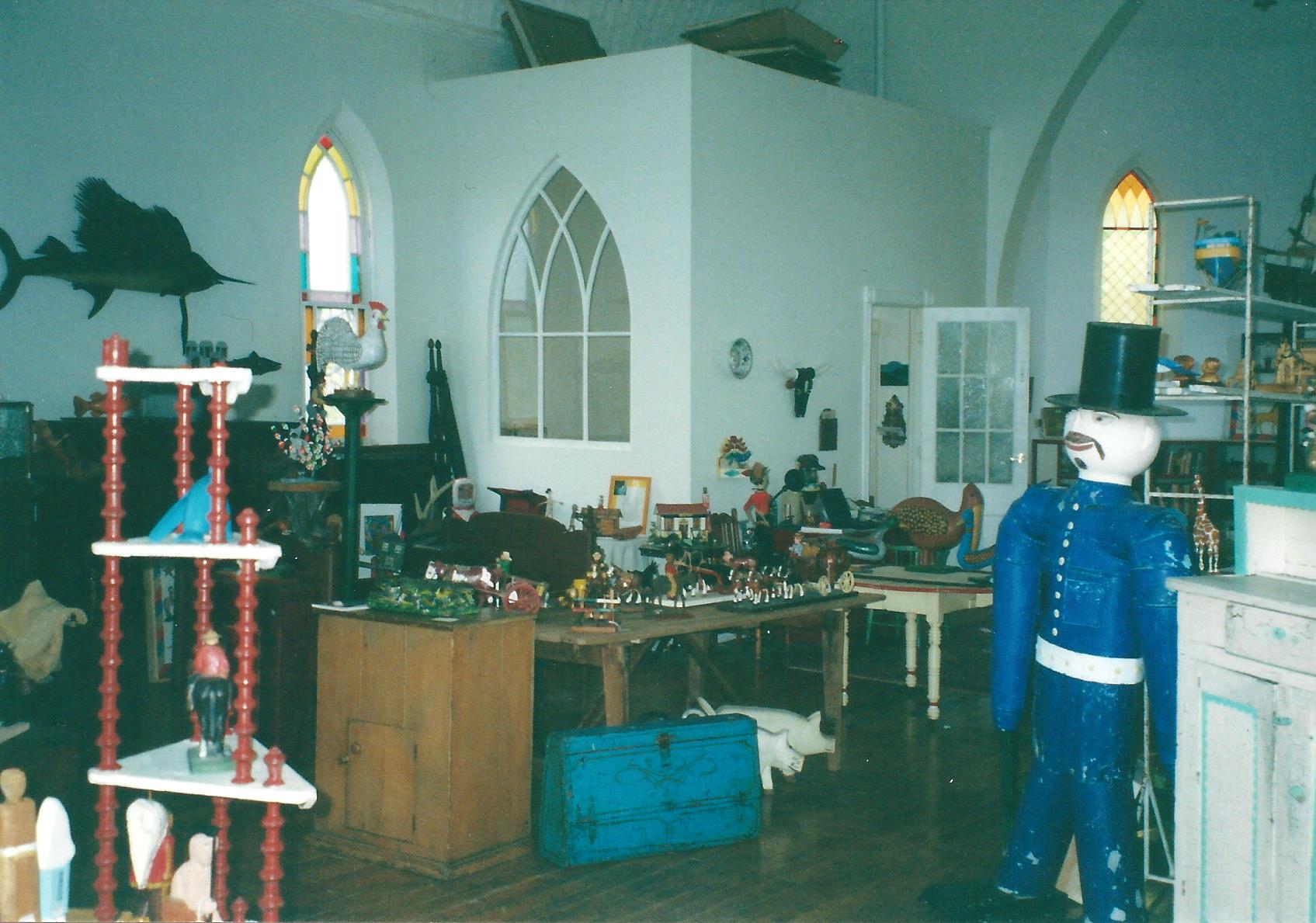
We kept the same booth for a couple of years and then moved to a bigger one in the same room when it became available. Then one year when I was doing the show by myself; I can’t remember when exactly, it must have been the late nineties, Sam came up to me and asked me if I would be interested in taking over a large room upstairs they had for the same price.  He pitched “You can spread out the art and make it like a gallery.  I think you can do well up there.”  I knew the space.  It was a big space, about 20’ x 30’ with two front facing windows which brought in a lot of natural light.  It must have been used for meetings.

my "gallery"  at the North Hatley show

my “gallery”
at the North Hatley show

“Well, yes Sam the space is great, but not to mention that everything has to go up and down the fire escape, I will be on my own up there, apart from the show. It might get pretty lonely”.  “Ah, but don’t forget Phil, that’s where the woman’s washroom is.  All the ladies will pass by eventually, and they’ll drag their husband’s up”.  I thought about it for a minute and decided he was probably right.  It just might work, and if it did the price was right. So I agreed, and started to haul everything up the steep fire escape that led directly to the room. A big task, but much easier than dragging everything through the inside.  It took the whole afternoon to set up, but in the end it looked like a gallery. I even had a table and chairs in front of the window where I could sit and do business, or read the paper in slow times. Not to mention eating egg salad sandwiches. So close. So tasty. So affordable.  I put up a little sign with an arrow pointing up at the base of the inside staircase announcing “Folk Art Upstairs”. I hoped that somebody might see it.

looking into my "gallery" from the hall

looking into my “gallery”
from the hall

6:30 arrived and at first I wondered if I had made a horrible mistake because I could hear the people coming in, chatting and having fun for a full thirty minutes before anyone showed their face.  But then it started.   The first lady poked her nose in, and was surprised to find me and my offerings.  Fortunately she was a folk art enthusiast and went directly to several pieces of carvers she recognized.   She bought three things right then and there, and I was off to the races.  It was out of the way, but when the folk art people found me, they really connected, and would not only buy, but go down and drag their friends up.   I met several people that year that became long -time friends and customers.  It was already a great show by Saturday at noon and then Pierre Riverin walked in.  I’d heard about the “collecting” mayor of the town of Eastman for several years but we had never crossed paths. We talked for over an hour, he bought several pieces, and it was the beginning of a wonderful friendship.  It is a rare and precious moment when you find yourself in the right place, at the right time, with the right stuff.   Even with all the effort of getting everything up and down those stairs, it was worth it many times over. I had a wonderful show and I was happy up there.  I repeated this for a few more years before the hauling up and down began to outweigh the benefit, so when a bigger booth on the main floor became available I grabbed it.

myself and Tom DeVolpi enjoying a beverage

myself and Tom DeVolpi enjoying a beverage

Over the years we got to know several of the Quebec dealers, designers, and collectors who frequent this unique annual show.  For a time many of us participating dealers would get together on Saturday night and enjoy the evening together at some wonderful local Inn or restaurant.  There are several to choose from.  Then through our friend Tom De Volpi, and our friends Jim and Ilona Fleming, we were invited to an annual Saturday night dealer’s dinner held at the nearby summer home of a lovely Montreal designer named Valery.  It was always a wonderful, warm get together, not to mention a delicious dinner; and we were grateful for her hospitality and the chance to spend some happy time with our fellows.

Eventually, as in all stories, the pages turn, and times change, and so it was that by 2008, (I remember it because, although still a good show, it just didn’t feel the same without Sam being there), along with slumping sales, we reached the point and age where we just couldn’t justify the ten hour drive to and from home, and all the work that doing the show entailed.  Mind you this was part of a larger retreat from doing shows altogether.  We truly don’t miss the work, but we do miss the people.  They were some very good times.
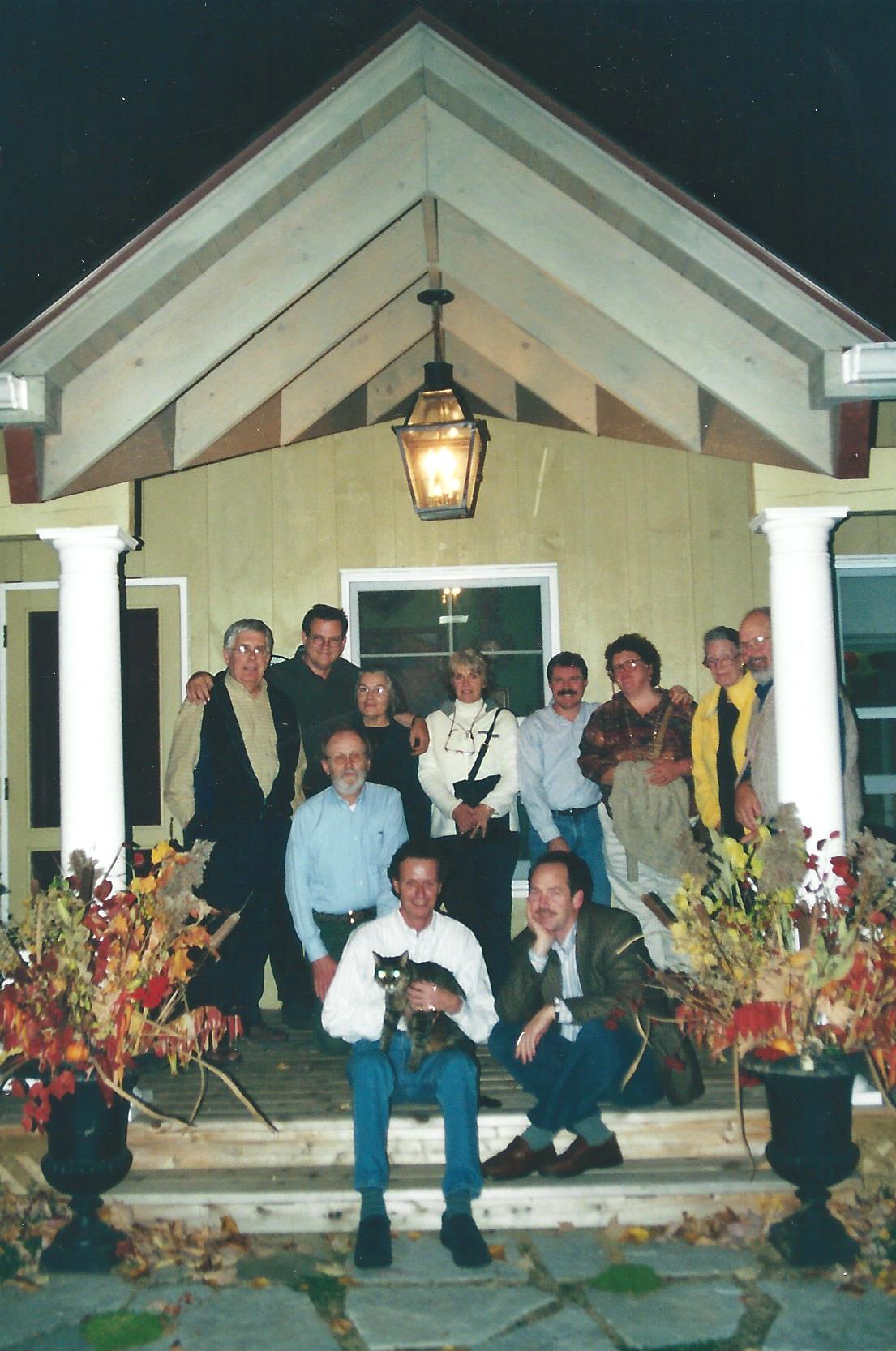
the "gang"  at Valerie and Henri's

the “gang”
at Valerie and Henri’s

“It’s not saleable!! It doesn’t get made in a minute” – The art of Edmund Chatigny

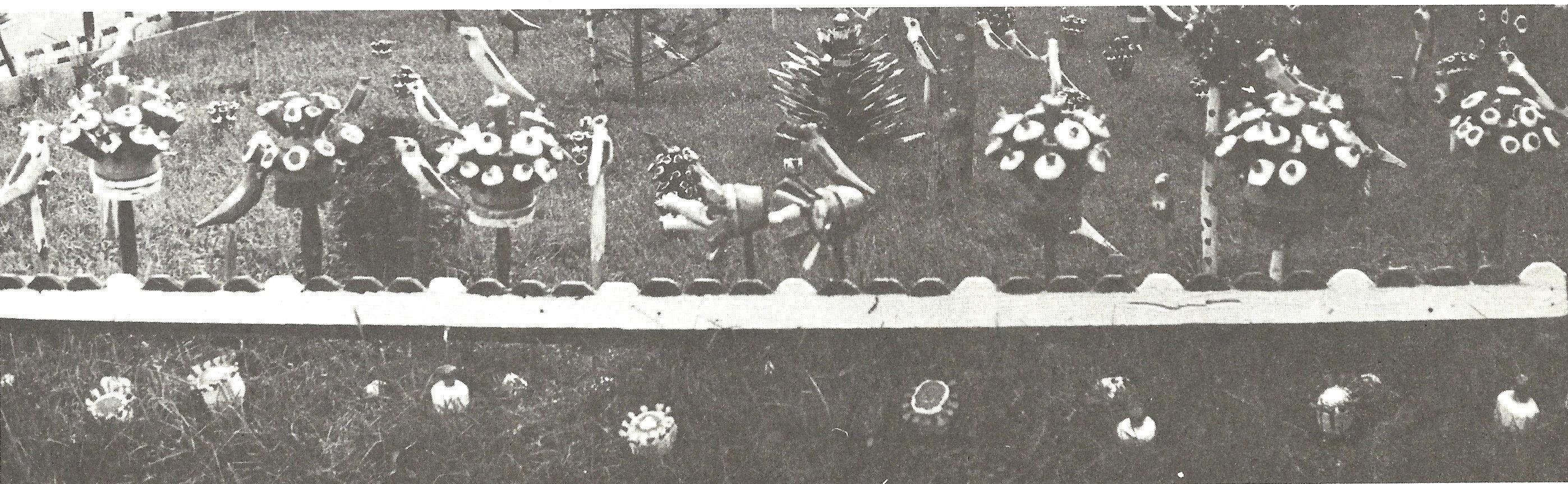
chat4We unfolded ourselves slowly out of the truck after the grueling ten-hour drive from our home in Wyecombe Ontario to Alan Chauvette’s picking barn near Victoriaville, Quebec.  We were met by a particularly animated Alan. He was excited, even for Alan who tends to run a little hot.  “What perfect timing.  I’ve got something exciting to show you.  Follow me to my house and we’ll come back here after”.   Ten minutes later we are entering Alan’s back yard and everywhere you look there are chip carved, splatter painted, flowers, birds, and other wildlife generally with a large figure at the center and a multitude of smaller components coming off in every direction.  Wild.   The total affect was that of a fantasy garden.  We were mesmerized. chat5

“They were all made by this crazy old guy in St. Isidore de Beauce who covered his yard completely. He’s gone into the retirement home and the family is selling the house, so I got them all.”  We were still looking around trying to take it all in.  “As you can see there are hundreds of pieces and I am selling them all as one lot. None of this picking the best, and leaving the rest.”  I was almost afraid to ask the price, but had to.  Alan gave me a serious look and a number in the high four figures. It was pretty much what I expected due to the quantity, but the first thing that sprang to mind was “We think it’s wonderful, but I wonder if anybody else will.  This is pretty eccentric stuff.”   We looked at each other for a moment, then I said to Alan.  “We’ll discuss it on the way back to the barn and give you an answer there.”  That was a pretty intense ten minutes that followed. We both loved the work, and “got” that his complex assemblages which could be reconfigured in different ways and still ‘work” was an exciting concept.chat1  Still, it was a lot of money to put down on an unknown horse. We talked it out and as we pulled in we concluded “What the hell. Let’s trust our instincts and do what we are here to do, so it was all big smiles and laughter, as we concluded the deal.  There were a couple of pickers standing nearby that we saw regularly, and they laughed at us.  “They’ll be burying you with that stuff”.  We didn’t care.  We owned the entire contents of Mr. Chatigny’s yard, and although we had never heard of him, we knew that it spoke to us as so few things do in this life.  We were half way home, somewhere around Brockville before we started to question ourselves.  We needn’t have.  Within a month we had sold enough to pay back our investment, and there was still a good half left.chat2

Edmond Chatigny was born in 1895 in St. Isidore de Beauce, Quebec. He was creative from an early age. “When I was young I used to take a knife and whittle.  My mother used to say “I think you could end up making something”.  He became a farmer. Married and had thirteen children.  Then the day came when he retired.  “When I was on the farm I used to work hard, then when I retired I had nothing to do and I became bored. That’s what decided me to start making little things – wooden flowers, birds, then all kinds of things. I do it with a little saw and a pocket knife.chat7 Sell them? They are not sellable. They are not made in a minute. It’s all green, white and red with a little brown. This year I think I am going to put a lot of green and white.  In the summer when I cut the grass, I clear them all off, then I put them all back.  It takes two days.” chat3

Although I never met M. Chatrigny, I am sure that it would bemuse him to hear me say that I think he was a uniquely innovative, and an important artist in his own right; and since I first laid eyes on his work, until present day, he remains one of my favourites.chat8

“living the dream”, a church full of great stuff in the middle of nowhere

int5

later on when most of the furniture was gone and it was largely folk art

I can remember standing in the partially dilapidated main hall of the old Wyecombe Methodist church for the first time, and thinking “this would make a fabulous antique store.”  It’s 1981 and Jeanine has read a classified ad in the London Free Press about a church for sale in Norfolk County for $21,000.  We decided to take a ride in the country and have a look just for the fun of it. Seemed harmless enough.  Well damned if we didn’t fall in love with the vaulted, 28’ patterned tin ceiling, and surrounding 14’ Gothic windows.  We loved the size, exposure and location of the place and saw the potential; and so in spite of all our friends and family advice against it, we bought the dream.  Thus along with our new alternative life style we began several years of hard labor renovating and maintaining the joint.  We soon discovered why these church halls are typically taken on by a community, and not individuals.  Everything is large scale.  Thirty gallons of paint rather than four.  We loved the challenge. We could see the phoenix rising from the ashes.int6

As life demands, simultaneous to the renovation we began to buy and sell antiques, to meet our needs, and so our main concern was to sell every weekend at the Toronto Harbourfront market. We didn’t think many would find us in the outback and we were happy with the income from the market.  But it wasn’t long before dealers and other customers started to make the trip out to see what we had at home.  At first it was more of a warehouse than a show room, but over the years we refined and added showcases, and shelving and by about 1990 it was usually quite full and fairly organized.  Of course everything had to be dragged up and down the wide, front steps, but we were young and stupid; and didn’t care.  Like many of us at that time who found themselves being full-time antique dealers, it was the alternative lifestyle thing that attracted us. It was more out of an aesthetic interest than any well thought out business plan that the sales room of Old Church Trading came about.  That and the natural tendency for things to pile up as you continue in this business, and thus the need to find some place to keep them.int4

In the fall of 1996 a Quebec dealer friend of ours started to bring huge loads of mediocre stuff to a Guelph auction every other week, and proposed that he also bring along some good things for us to sell for him. Things were changing in Quebec.  We had the room, and had done good business together over the years so we said yes.  It was great.  He kept bringing us wonderful things.  Not a lot at a time, but excellent quality.  We loved to see him pull in.  It was like Christmas.

Our Harbourfront days were now behind us, but with some good dealer trade and with a schedule of about twelve shows a year we continued to go through a lot of stock.  People who had not been by for a while often commented that it was amazing how much the stock kept changing.  That, and it just kept getting fuller.  Cupboards were now in rows and stacked one on top of the other.  I felt proud that it was looking like a Quebec picker’s barn. I loved to stand at the front of the big room and look over the variety of interesting things.  Although visitors were few and sometimes far between, those who made the trip usually were serious and went home with something, or often with lots of things.  We really didn’t advertise all that much, or encourage passing trade.  There was a small sign at the road but that was all.  Most who came were people we knew from shows.  Or people who learned about us through them.  I guess we could have pushed harder, but we like staying a bit out of the way.  Mysterious and a bit aloof.  Not in a “pearls before swine sort of way”, but just by saying “here it is.  We think it’s great.  If you think it’s great and want to take it home, we are happy to help you carry it out. Otherwise, we hope you had a nice time and it was worth the drive.”  You could be that cocky back then.int3

Late in 1997 our Quebec pal’s arrangement with the auction house ended and he stopped coming, so we bought about half the stock we had, and sent the rest home with him.  The market was changing, and so were we.  We were becoming more interested in the folk art, and although I loved the furniture, my back was just about pooched, and the furniture market was slowing, so we decided to downsize and focus on smalls. Oh how dismissive a young me and my colleagues had been watching the “smalls” dealers bringing in their boxes, and now I was one of them.  Less and less furniture came up those stairs.int2

Our daughter Cassandra had left for Queens a few years earlier, so by the year 2000 we started to think about ourselves in the not too distant future being old, and a bit crazy, rambling around the church in old patched sweaters, so we decided that a move into town and a new scene was the next project.  It took us three years to wind down the church and move on to Port Dover, and don’t get me wrong.  We’re happy we did.  But for a while there we were living our dream.  A great shop, in the middle of nowhere, which almost nobody knows about.   Looking back, I can see that it was almost like building a folly.int1

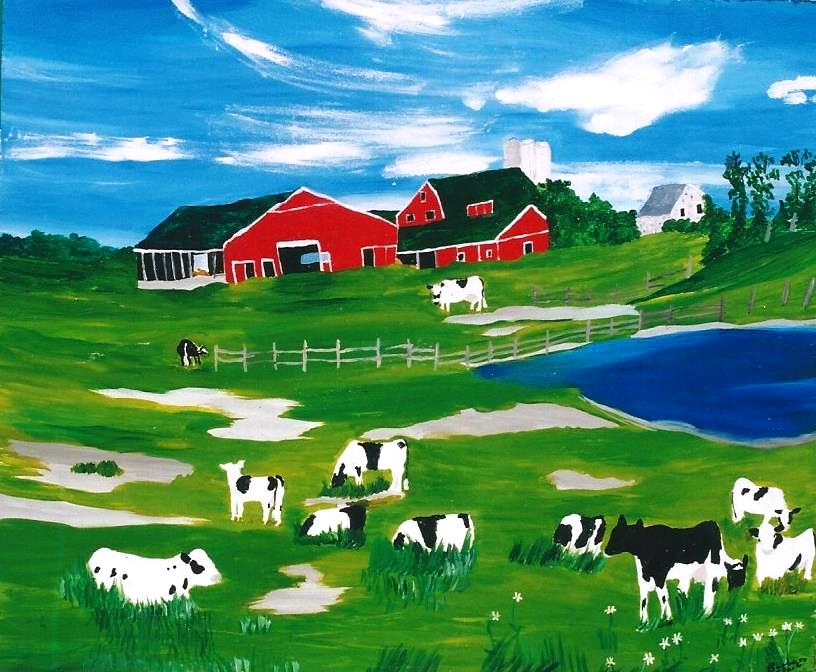
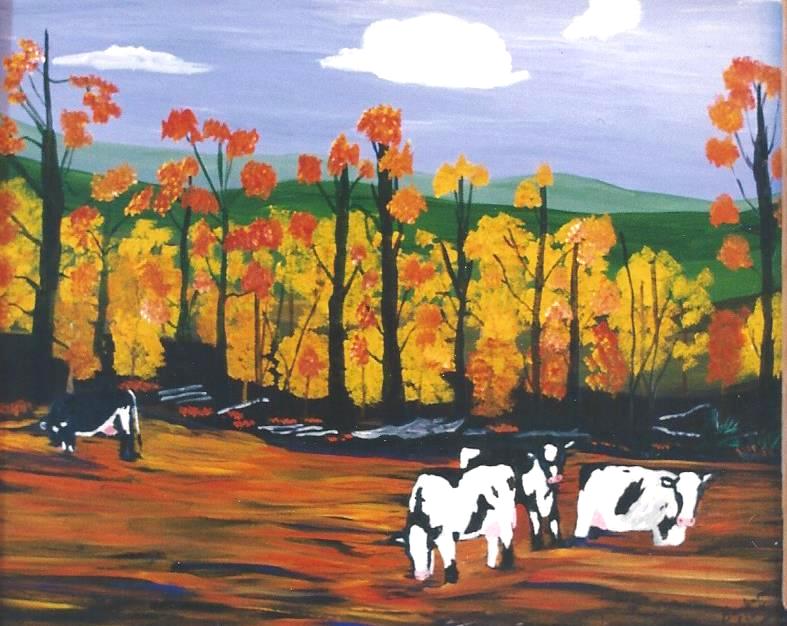
The paintings of Barbara Clark Fleming

bcf1Artist’s Statement:

“All of my paintings reflect upon my country life. Paintings of rural landscapes and different animals, all of which are a link to my past. I was born in 1939 on a 150 acre farm in East Zorra, Ontario, where my father farmed with horses. My mom and dad had no boys, so I became my dad’s helper. As a result of these memories my paintings frequently reflect scenes of haying, threshing, fetching cows, and scenes of country villages.

I never took lessons in painting. I just wanted to put my feelings on canvas. I don’t like painting straight lines, I prefer curves and waves. I do all my painting at home in the country, and I use many different colours. I started painting in 1977 as I realized I had no pictures of my dad’s farm. To keep memories of that farm alive my first picture was painted, and it was entered into the Oxford County Juried Exhibition and won an award of merit. It still have that painting. I did not take my painting seriously until 1989 when an accident prevented me from working full time. I hope that everyone who views my paintings receives as much pleasure as I receive painting them.”

Barbara Clark-Fleming

As mentioned in my previous blog about the Canadian Contemporary Folk Art Festival, it was here in 1994 that we first encountered the work of Barbara Clark Fleming.   Shortly after we contacted her and made our first trip to her home near Woodstock, Ontario.

The first thing we noticed when we arrived at her neat little hobby farm was the pony in a paddock at the rear.  Barbara met us at the door and although obviously very shy was none the less welcoming and told us about her pet horse and her love for all animals.  We then went in to the house to discover a turtle crawling across the kitchen floor, a couple of cats lounging about, and a little white bunny who would hide behind the furniture and hop by occasionally.  We were introduced to her husband Stan, who was stretched out in a recliner chair in the living room.  A very nice man who was by this point very ill and requiring her full time care.  She took us into a little room beside which was her studio. Here she painted on a flat school desk over which hung a large combination lamp/ magnifying glass.  Barbara explained that she is very near sighted and required this set up for the details. She said that the painting was a great escape for her, as she was required to be at home, indoors most of the time. She essentially remembers happy scenes from her childhood and paints them spontaneously. Although she is not conscious of it, this method was and is the essence of what gives her work it’s spontaneous energy,  strength and beauty.. She paints because she loves to paint with no concern for conventional form or perspective. She is fearless and direct and simply works until she is happy with the painting. We love this about her work. We bought about twelve paintings that day and thus began a long relationship with Barbara and her art.bcf3

She looked after Stan at home until his death a couple of years later, after which she got out and traveled around the nearby countryside, observing and documenting those elements of rural life that she still related to her upbringing.  Thus she began to paint Mennonite farms, and old feed mills that reminded her of her youth.bcf4

We believe that the first rule of dealing with folk artists is “Do not influence”.  It is always tempting to “suggest” painting more paintings in a style which you find to be most commercial, but ultimately it is this type of influence which kills the natural wonder and instincts which nurtures an artist’s development. If an artist starts to paint to please you, it is not long before they grow bored and resentful.bcf5

In 1995 we took fourteen of Barbara’s paintings to the summer Muskoka Antique Show and sold all fourteen on the opening night.  I seriously considered driving home that night to fetch more, but it was eight hours round trip so didn’t.  Barbara’s paintings sold well at every show including Muskoka the following year, and continued to be very popular for about another five years before interest waned.  Interest and sales have gone up and down since, but nothing like when we first introduced them to the Canadian market at that time.  She continues to paint excellent paintings. bcf6

The Fifth Annual Outsider Art Fair – Discovering the work of James Castle

catalogue cover for the 1997 Outsider Art fair

catalogue cover for the 1997 Outsider Art fair

Coming back into the Puck building on the cold afternoon of January 23rd I started to feel that wonderful buzz that one feels before the opening of a big marketing event. A combination of excitement, and expectation, mixed with a touch of anxiety realizing that in a couple of hours the throngs would be pouring in, and we would be off and running, either making it, or breaking it.  The booth was set up and looked good, so I had a couple of hours to check out the show.  The first thing I did was cross the aisle to have a closer look at some work which I had been noticing which was deceptively simple in it’s construction but very compelling.  The entire booth of J Crist from Boise, Idaho was filled with the yet unknown work of James Castle (1900- 1977).

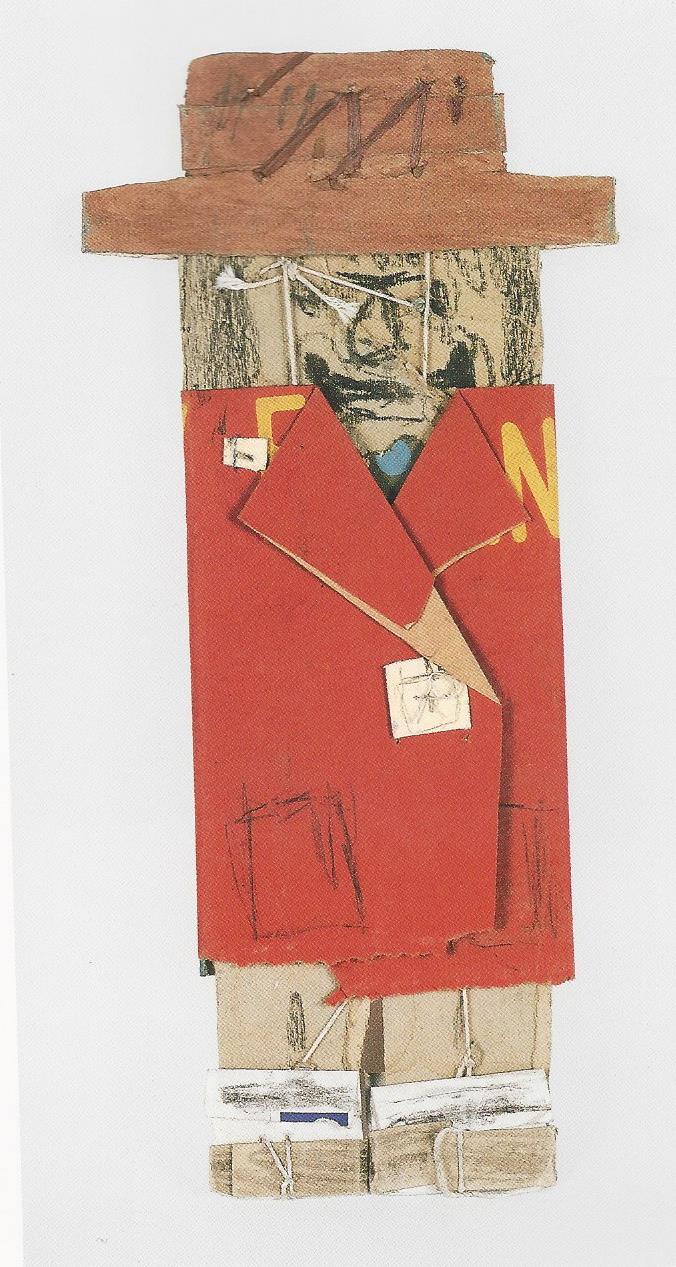
out2Jacqueline Crist who runs the gallery acts as agent for the artist’s estate and her gallery houses a considerable body of this particularly driven and prolific artist’s work. On this occasion she put “all of her eggs in one basket” and just brought works by Castle.  Getting up close to the work, I became more and more enamored.  Put together with spit, and soot and cardboard etc, the quantity and variety of his output is astonishing.  I came to find out that he devoted himself virtually full time to his art for nearly seven decades. His drawings, assemblages, and handmade books are compellingly mysterious, and contain a confounding sophistication.  Perhaps this quality is the essence of what attracts me to “outsider art”.  In the case of James Castle I was an immediate fan.  The tagged prices seemed fair.  Asking in the upper hundreds on up for the, in most cases, diminutive drawings and constructions.  Hmmm.   I began to think that I may score one of these beautiful little pieces to take home but of course I had to check out the rest of the show first, just in case there was another Bill Traylor drawing for low money.  Still feeling tough that I had missed out the year before.

a drawing by James Castle

a drawing by James Castle

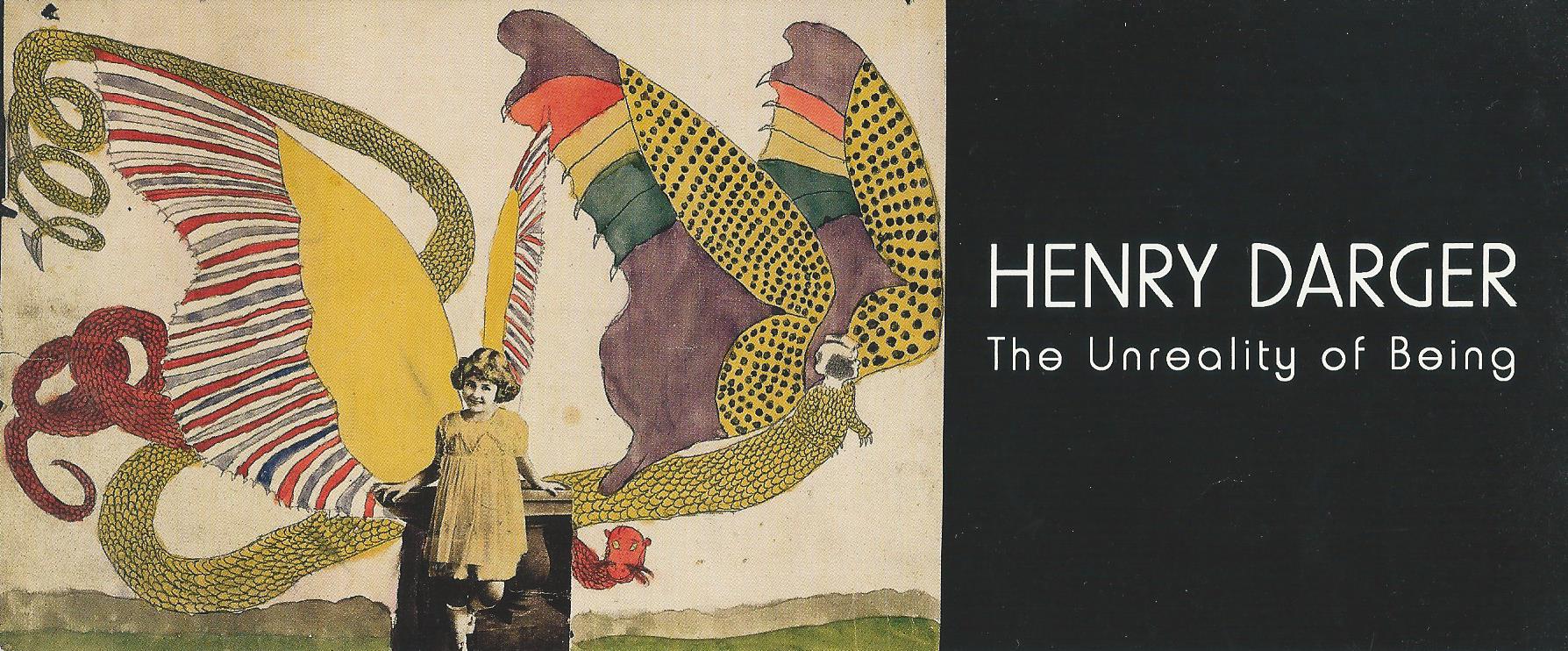
I noticed the Traylor drawing I had missed out on was present and priced up by a few more thousand dollars. Way to go, Phil.  Then I noticed that Carl Hammer’s booth was this year graced by two large, magnificent scrolls by Henry Darger.  This was the year to promote Darger, as there was running simultaneously with the show, a Museum of American Folk Art exhibition of more than 60 of his paintings called “the Unreality of Being”.  I was interested to note but not surprised that the prices of his work had gone up considerably.

invitation to the Henry Darger exhibit at the Museum of American Folk Art

invitation to the Henry Darger exhibit at the Museum of American Folk Art

So I made my way from booth to booth growing more determined by the second that a small James Castle drawing was in my future.  I wasn’t going to miss out like last year by hesitating and calling home for a conference.  No, I was going to head right back and make my selection.  But what’s this?  As I approach I see a group of the top dogs including Carl hammer leaving the booth.  My heart began to sink a little, but I told myself to relax, it’s o.k.  So the selection process may be a little bit easier.  I hadn’t set my sites on any work in particular.  I slid up to Jacqueline whom I had become quite friendly with during set up and asked her “what’s up”.  “It’s the craziest thing.  Those big wigs just came over, and bought my entire booth. Lock, stock and barrel. I’m finished here before it opens.  I guess I could just pack up and go home, but I want to stay because I was so looking forward to being a part of the show.”  Nice problem to have.  Well there you go.

A James Castle construction

A James Castle construction

Are you beginning to sense a theme here when it comes to me buying, or should I say not buying at art shows?  Well in this case she had plenty more work at home so I could have theoretically ended up with something else, but I chose to just let it pass, get on with the show, and concentrate on just doing my best to sell, sell, sell, for my friend Joy.  The show went even better than the year before, and we were all very happy with the experience.  Well, except for the missing out on the James Castle thing, but there you go.

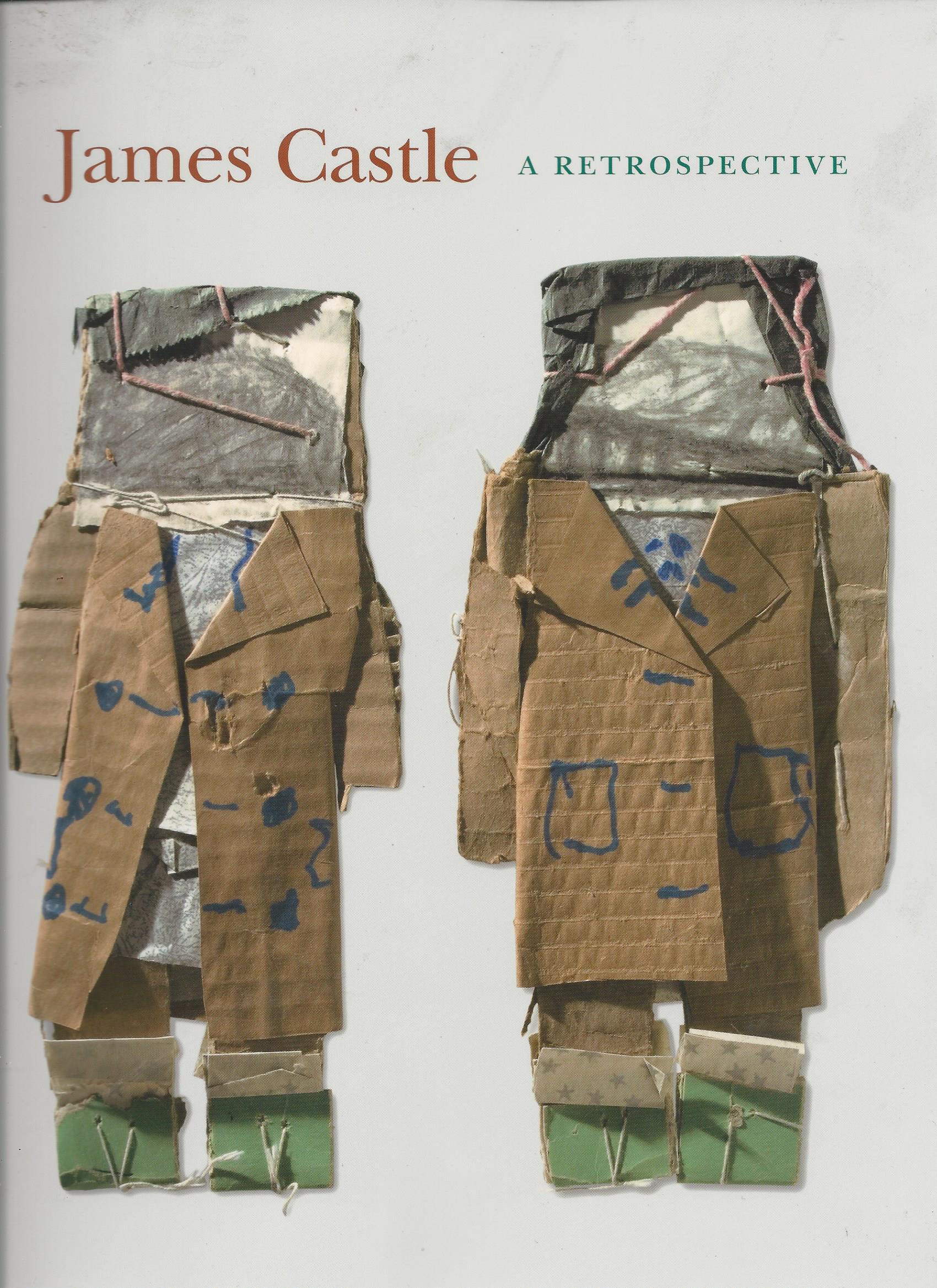
Since then a splendid book on Castle has come out in 2009, coinciding with the exhibition at the Philadelphia Museum of Art entitled “James Castle, a Retrospective”.  I highly recommend it.  I’ve got a copy.  I love looking through it.  It sits in place for the one that got away.

cover of the James Castle book

cover of the James Castle book

The “spontaneous” vision of Quebec carver Andre Laporte

Andre's Montreal Canadien goalie

Andre’s Montreal Canadien goalie

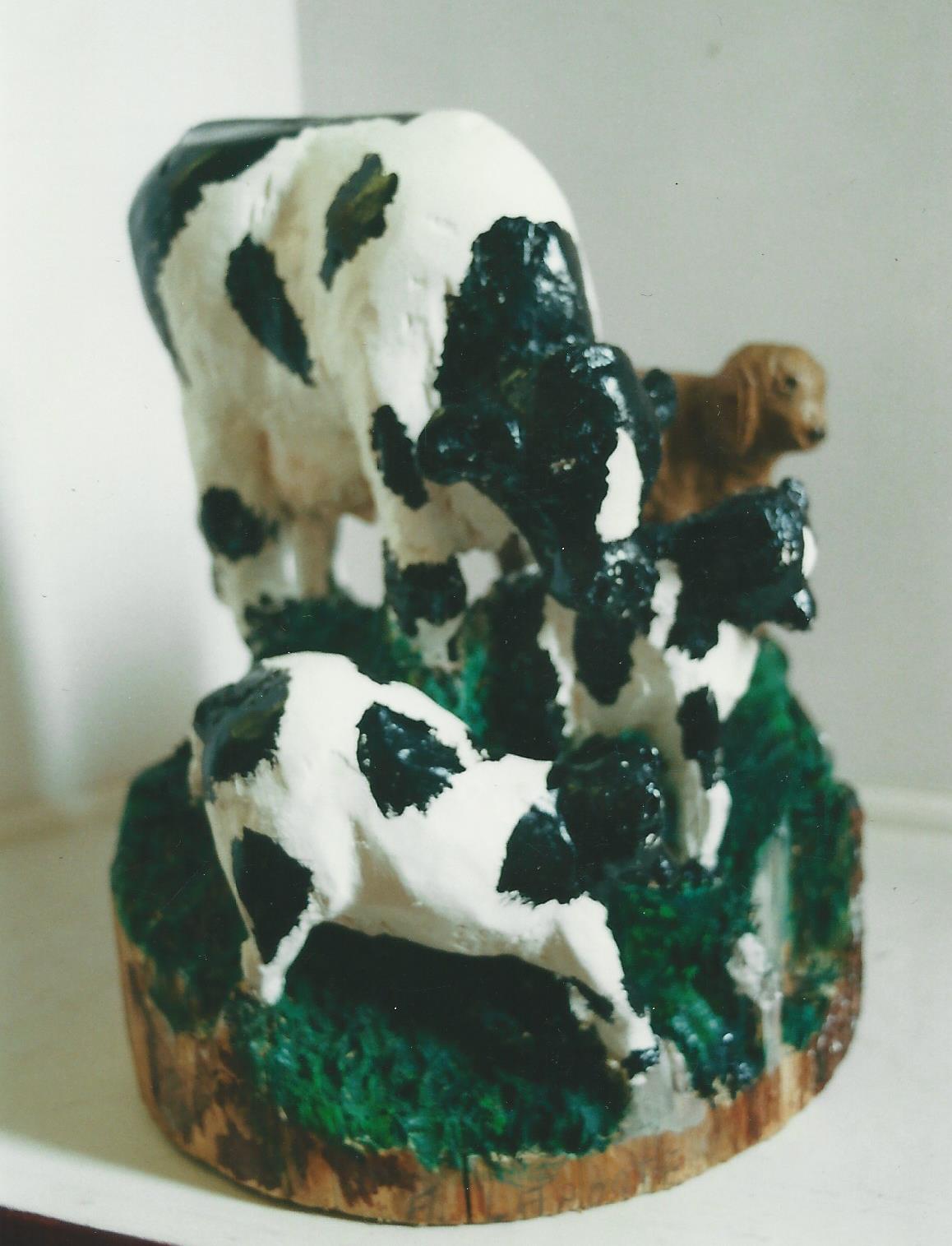
About 30 years ago we were rooting around in Alain Chauvette’s pickers barn near Victoriaville Quebec when we happened upon a wonderful carving of a Montreal Canadien goalie.  A serious dude with a square head and a look of determination which would intimidate even the most veteran opponent.  We loved it and bought it for our own collection.  I’m looking at him right now and I’m still impressed with the expressiveness of his rough cut features, and the immediacy of the carving.  Problem was, he wasn’t signed.  We asked Alain if he knew the carver, and he did not so we had to be content to have found this one great piece by an unknown carver with the possibility of never knowing the maker, or seeing other work by him.  Then about six months later we found a carving that was obviously made by the same hands of a group of four cows, carved all in one piece in the round.  The same roughness and directness as the goalie.  This time it had the signature A Laporte on the bottom.  The picker still did not know the carver, but at least we had a name to go on.

a group of cows by Andre Laporte

a group of cows by Andre Laporte

So fast forward about fifteen years later.  We have found and bought another half dozen pieces by Mr. Laporte, all with the same strength and spontaneity of our goalie.  Still no one knew, or admitted to knowing anything about the artist.  Remember that any picker is extremely reluctant to put you in touch with a carver because then you buy from the artist and not them, so it is counterproductive.  Still, we were happy just to find the pieces and realize that the artist was most likely still active.

Andre sits on his front bench with his first carving

Then came that lucky day when by going through the phone book in La Prairie, and we found and met the carver Leo Fournier.  We were enjoying our conversation with Leo when his wife came into the room and said “Leo, Andre Laporte just phoned and I told him I would have you phone him back after you are finished here.” Eureka!  “Would your friend Andre Laporte be a carver by any chance?”  Why yes he is, a carver and an antique picker.  He lives a few miles from here in the town of Verdun.” “Would you mind giving us his phone number”. “Not at all.  I’m sure he would be happy to meet you”.  So before we left Leo called Andre back, gave him the scoop and put us on the phone.  It was late in the day, so we made arrangements to arrive at his place at 9 the next morning.  After getting directions Andre said “No one has ever wanted to meet me before.  I don’t have a lot of work to show you so I hope you are not disappointed. “.  “Not to worry Andre, we love your work and will be delighted just to meet you , and if you have anything to show us, that’s good too.

Next morning after a hearty breakfast we arrived at Andre’s little house by the railway tracks precisely at 9, and there was Andre waiting on a bench by his front door.  You could see he was both excited and a little anxious. After exchanging greetings, we went inside and met his wife Lucie.  The place was small but filled with nice things including several of Andre’s carvings which were brought out and put on the dining room table.

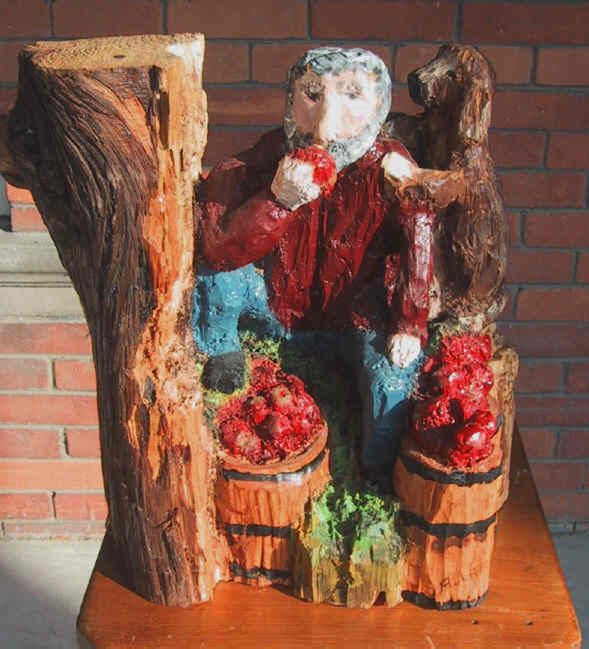
A man enjoys an apple while his faithful dog looks on

A man enjoys an apple while his faithful dog looks on

Leo had briefed him on who we were and he was excited to think that we would be interested in him.  “So you actually like my work?”.  Why yes, we like it a lot. You have a unique style and energy which we find very attractive.”  “The other pickers who come by tell me my works too rough and nobody will want it, but that’s the only way I can work. “You see this horse there.”  We focused our attention on a very strong and expressive work horse. “That was my first carving.  They took down some hydro poles about seven years ago and left them across the street.  I cut up one of them into various sized “stumps”, and brought them home to burn, but then I started to look at them and after a while I saw this horse inside one of the stumps.  I thought about it for a long time, and then one day in 1984 I  just started chipping away at it, and after about ten hours this horse had emerged. That was it.  I was hooked. That’s the way I’ve worked ever since.  I see the form in the log, and then I carve, until I get it all out”.  I don’t glue pieces together or sand them more than I have to.  I like them rough and close to the way I see them in my head.” I can only work when I see the piece in the wood first, and then I can’t stop working until it is finished.  At this point Lucie jumps in.  “that’s right.  Once Andre starts to carve I know I’ve lost him until he is finished.  I drew the line when one night he put an old quilt on our bed and started to carve right there.”

Andre's bust of Quebec strongman Louis Cyr

Andre’s bust of Quebec strongman Louis Cyr

Andre represents what it is to be a natural, instinctive carver.  With no training or even having much experience of other work, his work is truly inspired and highly individual. His work deals with what is the pure essentials of his subject.  There is always a sense of vitality and movement.

We bought several pieces that day including his first carving of the horse which remains in our collection.  We continued to go by Andre’s place a couple of times a year for the many years that we continued to travel to Quebec, buying most of his output each time.  Even after we stopped going we would talk on the phone occasionally and he would describe what he had been working on.  Often we would send him a cheque and he would mail us pieces sight unseen.  Andre and Lucie have a hard life.  He was born in Verdun on May 20th, 1948 and has lived there all his life.  He has barely eked out a living being an antique picker of the door knocker variety.  For a while things went well for him when collector Pierre Laplante was buying almost everything he picked, but then they had a falling out and that stopped.  Andre and Lucie have three daughters and one grandchild.

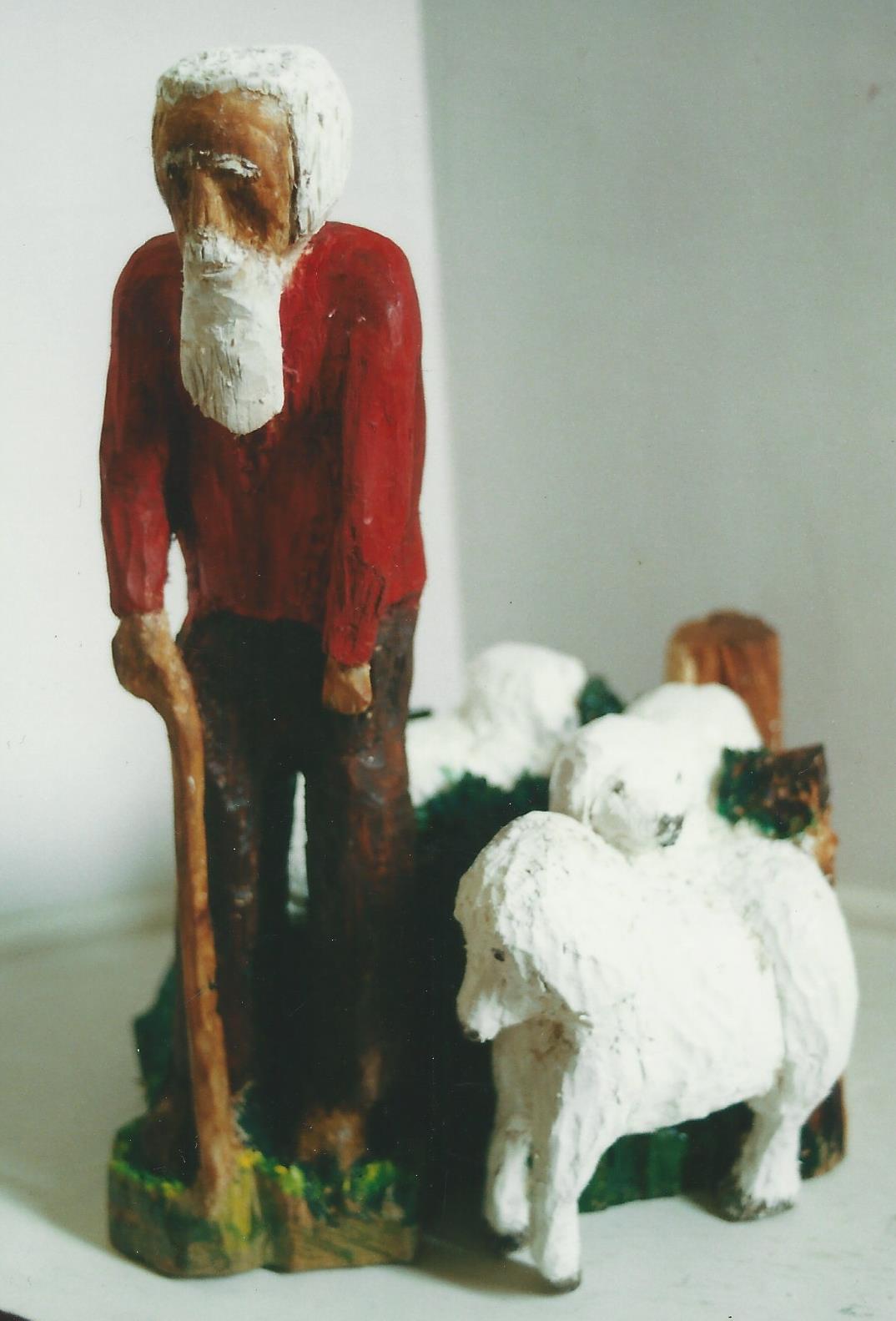
an old man and his sheep by Andre Laporte

an old man and his sheep by Andre Laporte

A few years ago I called to see how he and Lucie were doing and he informed me that sadly one of their daughters had been in a terrible car accident was grievously injured, and that now he had to take her every day to the hospital for treatment. There was never enough money in what Andre does to make a happy and secure life, and I’m sure that without the love and support of Lucie and his family he would not be able to survive. The last time I called was in 2007 when our mutual friend Leo Fournier died. We had a great chat about Leo.  How he was his own man, and Andre laughed and summarized it like this “I have always admired Leo.  He lived exactly as he wanted to, and never cared what anybody thought. He loved to drink and he died drunk.  It couldn’t have been better for him”.  I don’t know how things have gone for Leo since.  I should phone him.  That last time we spoke he said he hadn’t made any new work in a couple of years and he was still mainly preoccupied with helping his daughter to get back to a happy and productive life.  He and Lucie are the salt of the earth.  I really hope that things are getting easier for them.  He has real talent that in a better world would be enough to provide him and his family with a happy and secure life. Unfortunately, it rarely works out like that for artists in the world we live in today.

Andre surrounded by his creations

Andre surrounded by his creations

Remembering Billie Orr and his Muskoka folk art Paradise

Billy in front of his cabin

Billy in front of his cabin

Back in the nineties, Billie Orr was a familiar figure in Bracebridge, Ontario.  My friend Scott Beasley would see him at least once a week, shuffling along the street carrying his bags of groceries and supplies, as he headed out towards his property which lay about three miles out of town on an isolated craggy, wooded acreage overlooking a river.

With his perpetual Irish cap, and lower lip which seemed in danger of dragging on the ground, Billy was well known, and universally liked by the locals. Scott took to talking to him, and found out that Billie lived on his own on the property he was raised on, and having a good picker’s instinct, he eventually got Billie to invite him for a visit. What he found was fascinating. A bit later, I happened to be in the area and was interested, so Scott and I headed out one fine summer morning for a visit.bo2

Billie lived in a log cabin with no running water and one electrical outlet on a large remote acreage not far from town.  It was a pretty funky set up.  He had to go down the hill to fetch water, and the cabin looked like nothing had been done to it in several years.  We came down the long lane to the cabin and there was Billy standing in the open front door.  Although old, and obviously used to living alone, he was welcoming and articulate.  He started right in telling us about his upbringing.  His father was an inspector on the railroad, and had built the cabin in the first quarter of the century for his wife and Billie and his sister.  Billie’s sister moved away.  Bill never left.  He never married, and never drove a car.  He would walk into Bracebridge once a week and get what he needed, which wasn’t much.  Bill still cut all his own wood, fetched his water, and grew a large garden so he was practically self-sufficient.  bo5

We were chatting away in the main room of the cabin when suddenly a large mother raccoon appeared at the door.  Billie excused himself.  “Good morning little mother.  As you can see I have guests but I have your breakfast ready for you.”  At this he disappears into the kitchen and comes back with a granite plate full of table scraps, and sets it down outside the front door.  Mother raccoon made a friendly, grateful noise and set at it.   We continued the tour.

bo7

Billie’s carved Irish little people

At the side of the room here was a steep set of stairs which led to the second floor.  You could see that the top steps were completely covered in soot, and Billie explained that he had had a fire up there a couple of years back, but had managed to get it out before it destroyed the place. Obviously he was no longer using the upstairs as it had never been cleaned.  On the steps there were several small carvings of Irish people and little wheelbarrows which Billy had made some years back with a view to selling them to tourists.  I guess he never found a venue for selling them because he had several of them in a row, all covered in a layer of soot from the fire.  “These are cool Billie.  Any chance you would sell us a couple of them.”  “Well, I could sell you one or two I suppose. If you want to buy more, you will have to come back”.  I realised that this was Billie’s technique for assuring a future visit. He obviously enjoyed conversation, and “human” visitors were rare.

cement leprechaun

cement leprechaun

Next he took us out back to show us his other work.  There among the trees stood several hand formed cement figures depicting Irish Leprechauns, and Colleens (young women) and several figures depicting the signs of the Zodiac.  Billy explained that he made these free form by placing metal armatures (or skeletal forms) in the sand and then building them up with cement.   They were all wonderful folk art, and a vision to see in this natural setting.  Just behind them Billy had years before planted a circle of trees which grew to a great height and were meant to depict Stonehenge.   What an amazing creation.  I was awe struck.

There is so much more to say about Billie and my subsequent visits that I will continue the story next week in my Friday Blog.   Billie was a true “outsider” in every sense of the word, and I am honored and privileged to have known him.   bo4

The manufactured “folk art” of Pierre et Claire Inc.

the cover of our mail order brochure

the cover of our mail order brochure

Last Saturday at Christie in anticipation of this article, I looked to see how many animals I could find which were manufactured by this small Quebec company.  Although it was too hot to cover the entire field, I did manage about ½ of it, and in that area I found five.  I noted that we as Old Church Trading had painted three of the five.  This gives you an idea of the scope of production of this company.

Rene Beaudoin was one of the original, and possibly the most successful of the Quebec pickers which started up in the 1960’s in the Victoriaville region of Quebec.  There were several small farms in the region, and everyone seemed inclined to keep all the old furniture and accessories as it was replaced in the barns, basements, and attics on the property.  The popularization of antiques brought in part by Expo 67 signaled the start of the antique picking industry, and Rene, although reportedly not able to read or write, had a keen understanding of business and quickly became the main man, hiring several men to go out and knock on doors, and they fetched all and everything available, bringing it back daily to his large farm near Defoy.  After becoming enormously successful in the antique trade, in 1978 he decided to create a small manufacturing business, employing some of the wonderfully talented wood workers of the region to create high quality reproductions of antiques, and copies of wood carvings which were prevalent in the area.  In 1983 his daughter Claire, who is married to Pierre Trudel, bought the company from Rene, and thus Pierre et Claire Inc. was formed.

unfinished order arriving from Pierre et Claire

unfinished order arriving from Pierre et Claire

The company exists to this day at its original location of 1197 Rue Principale, St. Anne Du Sault (Defoy), Quebec, and continues to manufacture reproductions of antiques and animal carvings with about five full time employees.  When we discovered them back in the early 80’s we decided to set up a mail order business for the animals which we called Old Church Trading.  We advertised in Harrowsmith magazine in Canada, and Country Home magazine in the States.  We offered many different animals both in the sanded, unfinished state that we bought them in, and varnished or painted which we did ourselves. We sold hundreds of them both through mail order, and at the Harbourfront market in Toronto, which we attended every Sunday.  At the time it seemed everyone wanted a nice pine, carved goose or swan to sit on their harvest table or cupboard.

various cow models

various cow models

We would stop in every other week or so and fill out our orders, going through the bins of carvings and picking out the nicest ducks, geese, swans, loons, roosters, and other animals.  We were always interested to see what new models they would come up with.  Penguins, buffalo, bears etc. would appear.  The prices were always reasonable.  I recall the standard size goose would cost about $16 each.  Although there was some variation in quality, (sometimes they would have large knots, or be slightly malformed) overall they were very nicely done.  Initially, all the models were cut out from solid pine, but sometimes these pieces would crack with time, especially if they were not adequately finished, so eventually they started to offer laminated models at a slightly higher price.  This solved the cracking problem, but didn’t look as nice and natural in varnish.  Of course they were the best ones to buy for painting.

inside the factory. Note the pile of geese in the background

inside the factory. Note the pile of geese in the background

As far as I know this small company was, and is the only North American company to “manufacture” folk art type carvings.   Although by the fact that they are manufactured and mass produced they cannot truly be considered as folk art.  And yet you cannot really call them reproductions either because in many cases they are an original design.  For folk art collectors it is important to know of these carvings, and be able to spot them.   They are fine for decoration when bought at the right price, but should not be confused with “real” folk art, which are items of individual expression, and not mass produced.  Although we must also acknowledge that many folk artists, Maud Lewis springs to mind, would repeat favored images over and over again, it is quite different than banging out 100’s of identical ducks using templates and modern wood working tools.   Ironically, I think their market has been effected when the Chinese started to reproduce copies of their work.  I’ve seen lots of these too.

the very popular rooster, and hen with our paint jobs

the very popular rooster, and hen with our paint jobs

note how this is modeled after the Black Horse Beer display

note how this is modeled after the Black Horse Beer display

Pierre et Claire continue to be in business, and have a web site at www.pierreetclaireinc.com, but it is in French only, and does not show many of their available carvings.

Our painted versions of Pierre et Claire animals

Our painted versions of Pierre et Claire animals

My Afternoon with Eddie Mandaggio

EMandaggioEddie Mandaggio was born in Manitoba in 1927. He spent his early years working in Northern Manitoba and Ontario as a trapper, and as a hunting and fishing guide. He came to Nova Scotia in 1951 and settled in Camperdown, Queen’s Country, where he lived until his death in 2003.

He initially worked for the railroad for eight years, and then worked in the logging camps. Eddie started carving in 1974 out of a desire to make decorations for his cabin. He followed with painting in 1976. His subjects are geese, roosters, cows, horses and also some human heads. His carved pieces greatly outnumber his painted works.

Eddie's famous white goose

Eddie’s famous white goose

In the mid -nineties I had the occasion to meet Mr. Mandaggio, and although I was trying to take in as many artists as I could in a short stay, and had intended to just stay for an hour, we became so engaged in conversation that I ended up spending the entire afternoon.  I missed out on meeting a few others but my time with Eddie remains close to my heart.

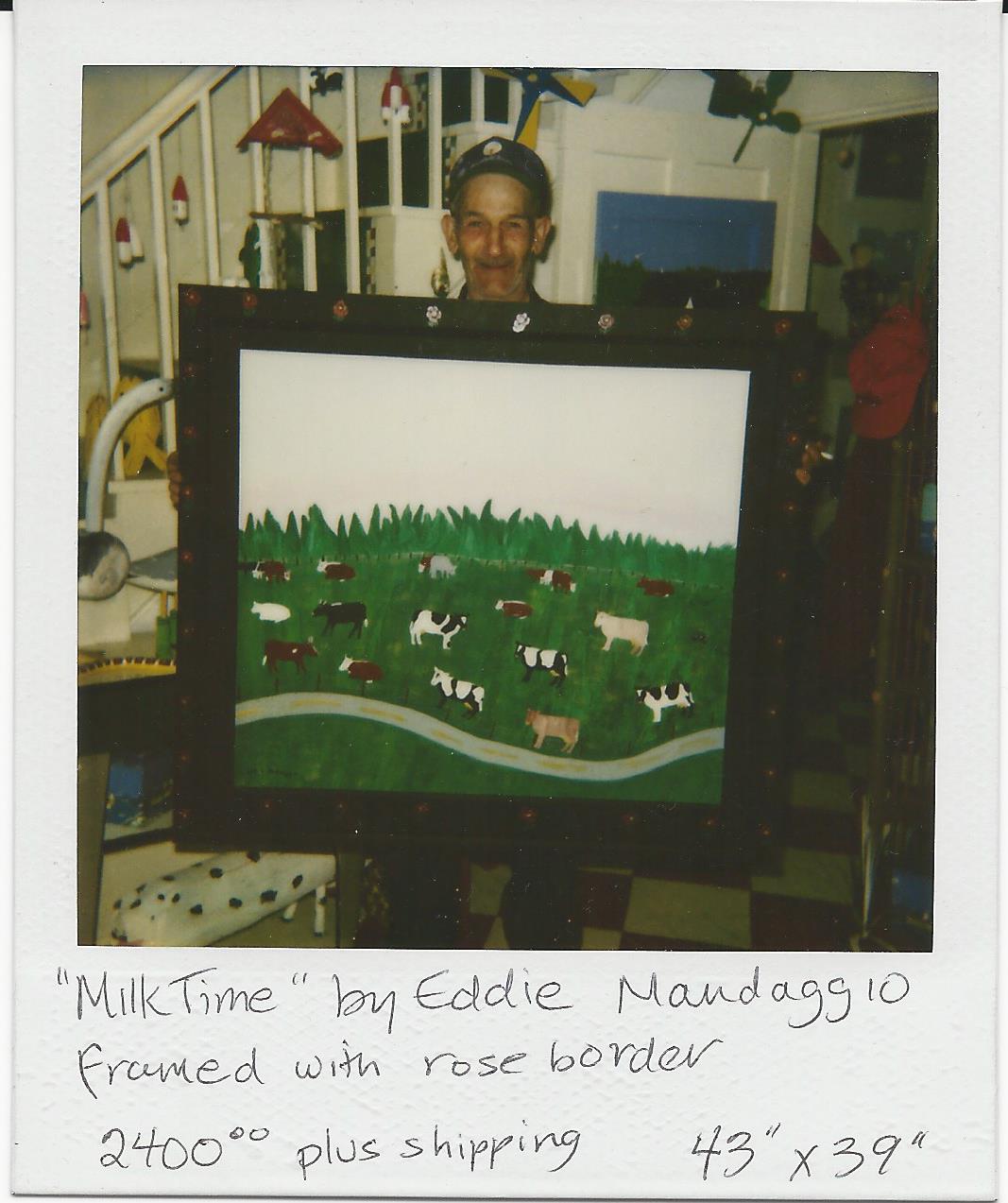
I flew to Nova Scotia to view and consider purchasing a major folk art collection which belonged to a friend of a friend named Iris Newman.  Iris is a lovely person. who got bit early by the folk art bug,and had the means, space,  and desire to build a major collection, purchasing major works directly from the artists.  She is featured in the NFB film “folk art found me”, and she is generally acknowledged as one of the main promotors and supporters of the Nova Scotia folk art community. We had a lovely lunch and fell into talking like old friends for a couple of hours before she took me around her large home and showed me the extent of the collection. Although amazing in quality and scope It turned out to be too many massive pieces which I knew would be hard to place, and she was strictly committed to an “all or nothing” deal so it didn’t work out, but I learned a lot from her and we did remain friends.  Of this vast collection, one of the most impressive things for me was two very large paintings of tiny cows in a big field by Eddie Mandaggio.  It was the first Mandaggio paintings I had seen and there is something about those giant fields with those tiny cows that hit all my buttons. She was keeping them and I completely understand why.  So after an afternoon of talking, and documenting the collection it was time for me to go.  As I was leaving I told Iris that the following day before I had to catch the evening flight home, I was going to go to the Lunenburg area to meet the Naugler brothers, Garnet Macphail, and Eddie Mandaggio who was already one of my favourite Nova Scotia folk artists.   “Oh that’s great Phil. You’ll have a wonderful time, but I must ask one thing of you.”  O.K.?  “When you get to Eddie’s you will see that he has recently carved a very large moose head trophy, and I have decided to buy it, so don’t you go and buy it.”  Ouch.  I hated to agree but Iris is a lovely and determined person, and I was still considering her collection so I reluctantly agreed.

One of Eddie's cow paintings

One of Eddie’s cow paintings

After a delightful morning with the Nauglers which will be the subject of another blog, and after a delicious bowl of chowder at a roadside restaurant, I got to Eddie’s place.  Immediately we hit it off. Eddie was very kind and open, and wonderfully generous in his description of his past careers.  He was particularly articulate about his love of carving, and stated that although he had been painting for the past few years, most of these paintings remained in the basement of the Houston gallery in nearby Lunenburg, and not many had sold, so he reckoned that he must not be a very good painter.  “Au contraire, mon Ami” “I think you are a fabulous painter. I was knocked out by the paintings in Iris’ living room.”  “Really.  Well thank you for telling me.  I don’t get much feed- back and most people just want me to keep making my “hits” like the big white geese.  It’s not much fun doing the same thing over and over again, and actually not why I started carving in the first place. I’ve started to refuse the large orders that have kept me doing the same thing for the past few years.  For me carving is a wonderful therapy to counter my jumpy nerves, but I have to be free to experiment or it becomes too much like a regular job.”  “I absolutely agree with you Eddie.  You must be free to let your imagination roam. Have fun with it, and whatever you do, don’t give up painting.”  Eddie smiled that winning smile of his. “Thanks for saying.”

Of course there in the background the entire time we are talking hung the extraordinarily beautiful massive moose head on a red heart shaped crest which Iris had forbidden me to buy.  Tagged $750.  I would have given him the cash in a second if I was not bound to my word.  What can you do?

That was the one and only time I met Eddie, and he became quite ill and stopped carving soon after.  I never did get on to see Garnet MacPhail, but I don’t regret a minute of the time I spent there with Eddie in Camperdown. A few months later I received the following polaroid of Eddie with a new cows in the field painting.  Unfortunately I didn’t move quickly enough and missed it.  If you would like to know more about Eddie, the Black Sheep Gallery has posted a wonderful series of You tube videos you can look up.Scaned

Meeting Aime Demeules , folk artist from St. Paul-de-la-Croix, Quebec

aime6

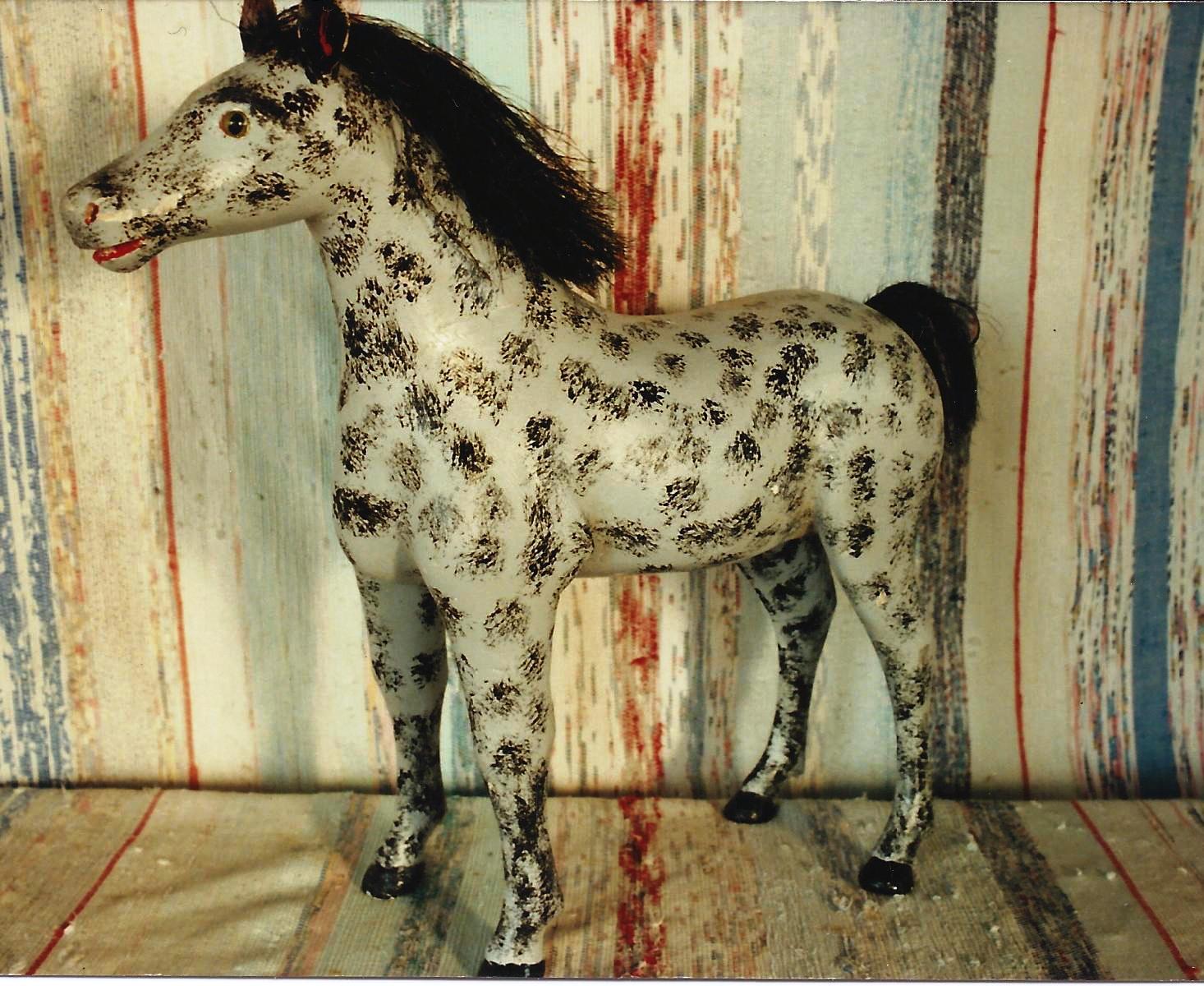
Speckled horse by Aime Desmeules

In an earlier post I recall our meeting Felicien Levesque in the early nineties while touring the Bas -St. -Laurent region of Quebec.  Well, the very next day we rose early and made the half hour drive From Cacouna to St Paul de-la-Croix, knowing it was the hometown of the well-know carver Aime Desmeules.  We had been buying his animals for years from Victoriaville picker Marcel Gosselin, and we had always wanted to meet him.  It was not hard to get directions to his house in this small town of 367 people, and we were soon pulling in to the driveway of a neatly kept, small ranch style home.

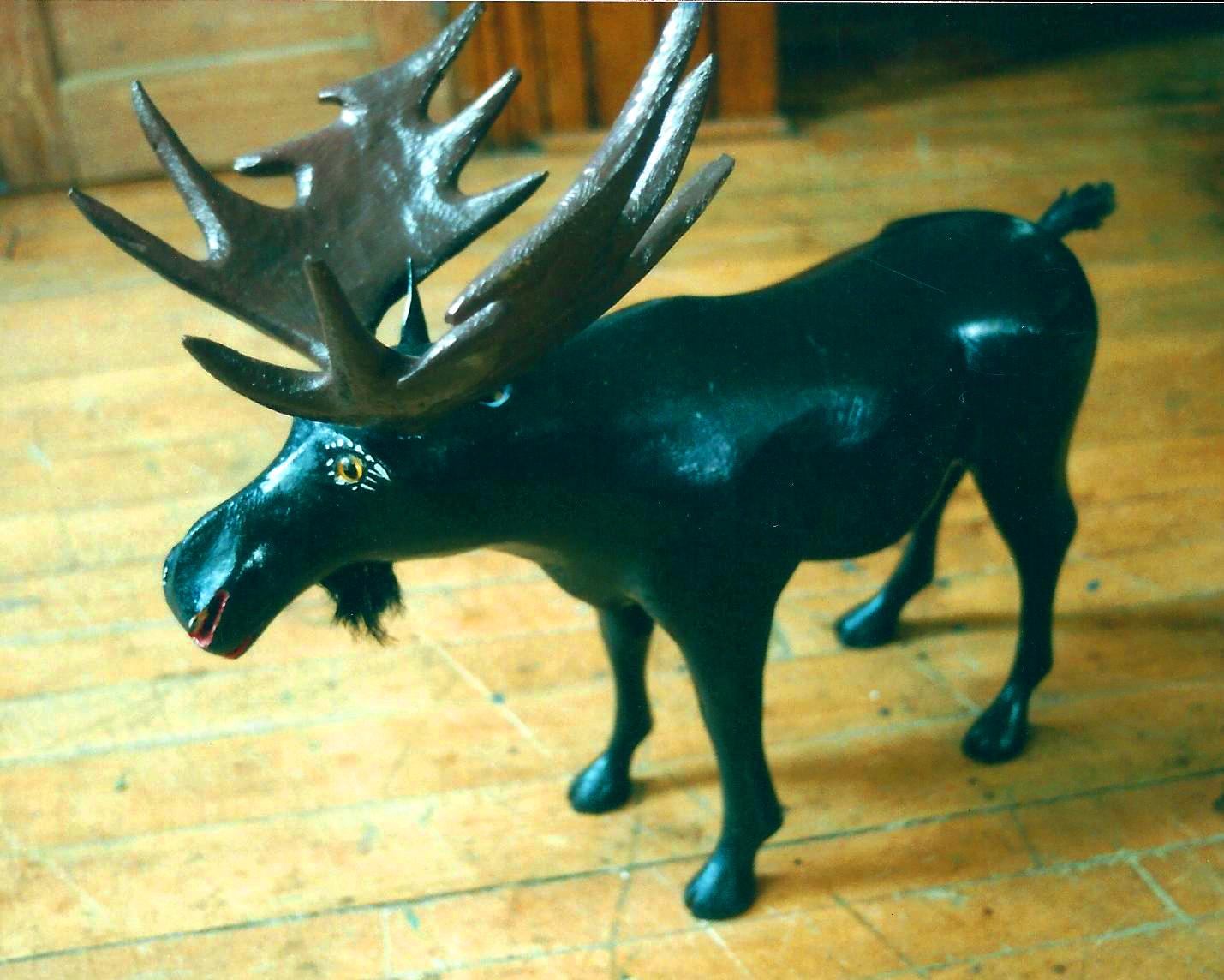
moose by Aime Desmeules

moose by Aime Desmeules

Jeanine and I rang the bell, and were soon greeted by a puzzled looking older lady we took to be his wife.   We explained that we had come from Ontario and being big fans of Mr Desmeule’s work, we had made the trek to their home with the hopes of meeting him.  “Oh no, that will not be possible.  He doesn’t like to meet new people, and he has no work for sale in any case. No, I’m afraid you’ve wasted your time.”Just as she was about to slam the door in our faces, Jeanine added sweetly, “Well we don’t mind if there is no work for sale,  but please we have come a long way and we would be very grateful just to have the opportunity to make his acquaintance.”  She looked us up and down.  Long pause. “Very well, he’s not here right now as he is fetching wood, but I suppose if you come back in an hour he may be willing to talk to you.”  Whew, nice work Jeanine.  “Great, thanks, we’ll be back.”  So we went into town and had a delicious big breakfast, and lingered over our coffee to fill in the time.

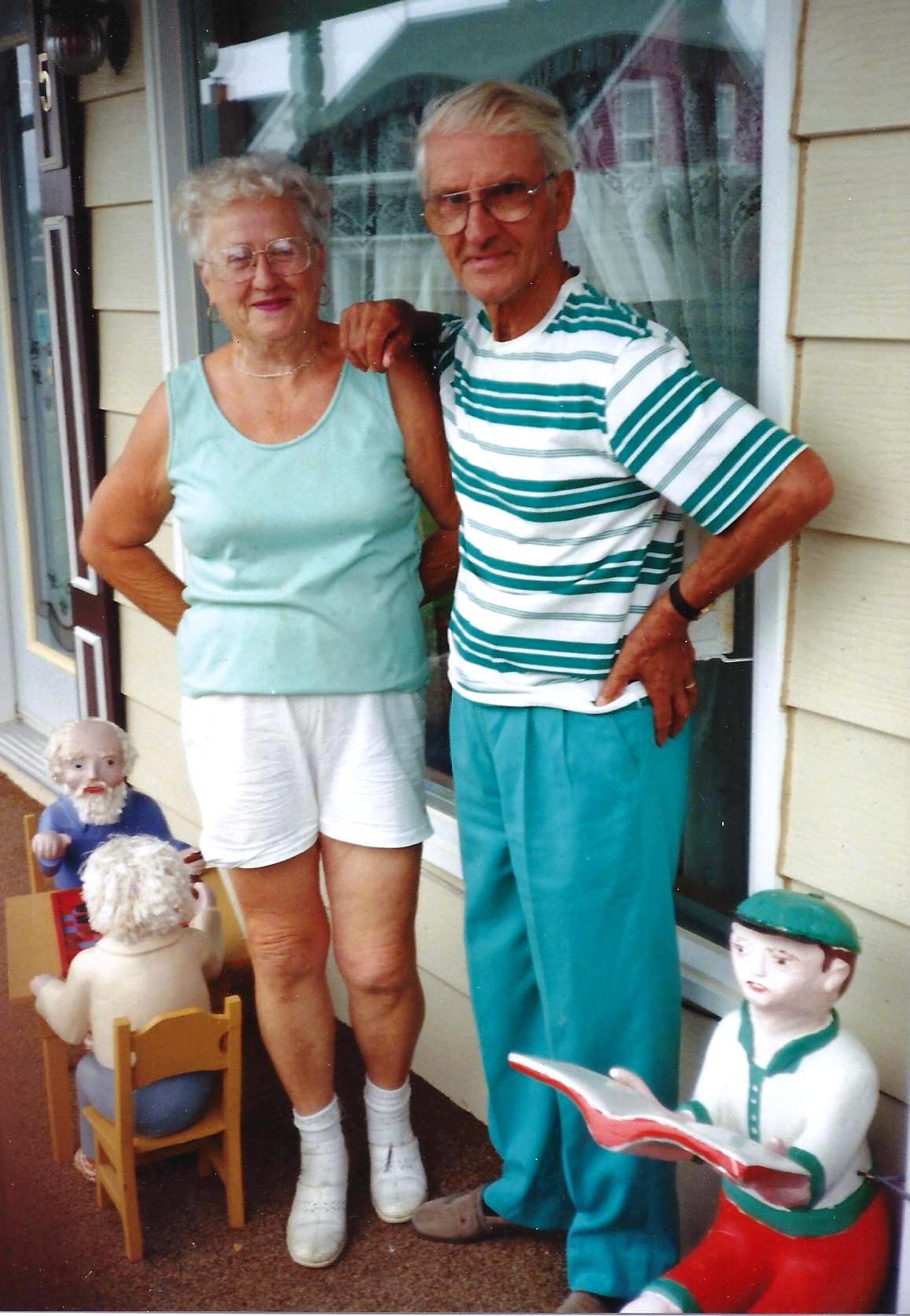
Aime and his wife Marie-Jeanne at their home in 1993

Aime and his wife Marie-Jeanne at their home in 1993

One hour later we were greeted at the door by Aime.  Surprisingly, he was as friendly as can be, and invited us in to his work shop which was fairly full of finished carvings.  “Pardon us for saying, but your wife gave us the impression that you had no work for sale, so I suppose these pieces are commissioned.”  He Laughed.  “No these pieces are for sale, it’s just that when you arrived unexpectedly with your accents, she was worried that you may be from the tax department.”  I was starting to think that this would be the standard greeting we could expect arriving unannounced at Quebec carver’s homes, and upon reflection, I understand where they are coming from.

The next hour was pleasantly filled by Aime telling us the story of how he was 64 years old before he took up carving and at that time he was taught by his father to create the various animals in his father’s repertoire to be precisely like his father’s work.  It was only after his father’s death in 1986 at 95 years of age that Aime developed a few new animals of his own, along with some pieces depicting people such as the blacksmith shown here.

"Blacksmith" by Aime Desmeules

“Blacksmith” by Aime Desmeules

Mrs. Demeules joined us after awhile and expressed that she was sorry for the rude greeting, but that she could see now that we were truly fans and not inspectors, and she was happy that we came.  We bought a lot of his work, about twenty pieces or so, and we spent a pleasant morning getting to know each other, before loading up and heading out of town.

What I find interesting about Aime, is how he was content, to the point of taking pride in creating exact copies of his father’s work.  He even signed the pieces with a stylized “A” “D” with the “A” looking very much like a “G” as his father had signed.  It is quite difficult to distinguish the father’s work from the son’s, and you are pretty much dependent on patina and provenance. My understanding is that George quit working in the early 70’s, but then Aime only lived on until 1997.

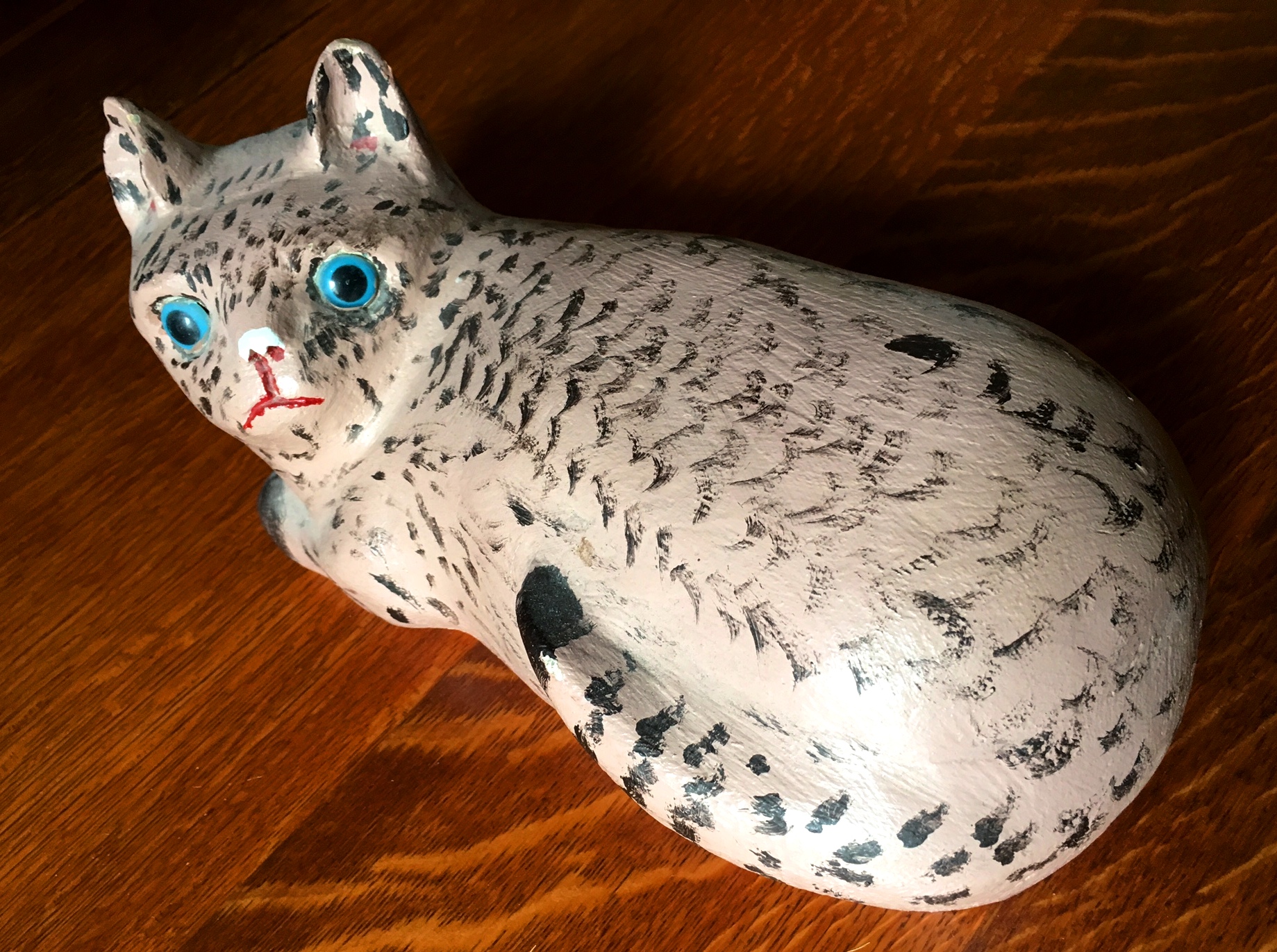
Aime's signature on cat

Aime’s signature on cat

aimecat

I

f you consider other carving families, such as Damase Richard and his son Wilfred; although there is a similarity to their work, when you study them closely you can see quite a few differences which make them easy to distinguish.   When considering father and son carvers, Aime and George’s bond seems unique.

"brown Cow" by Aime Desmeules

“brown Cow” by Aime Desmeules