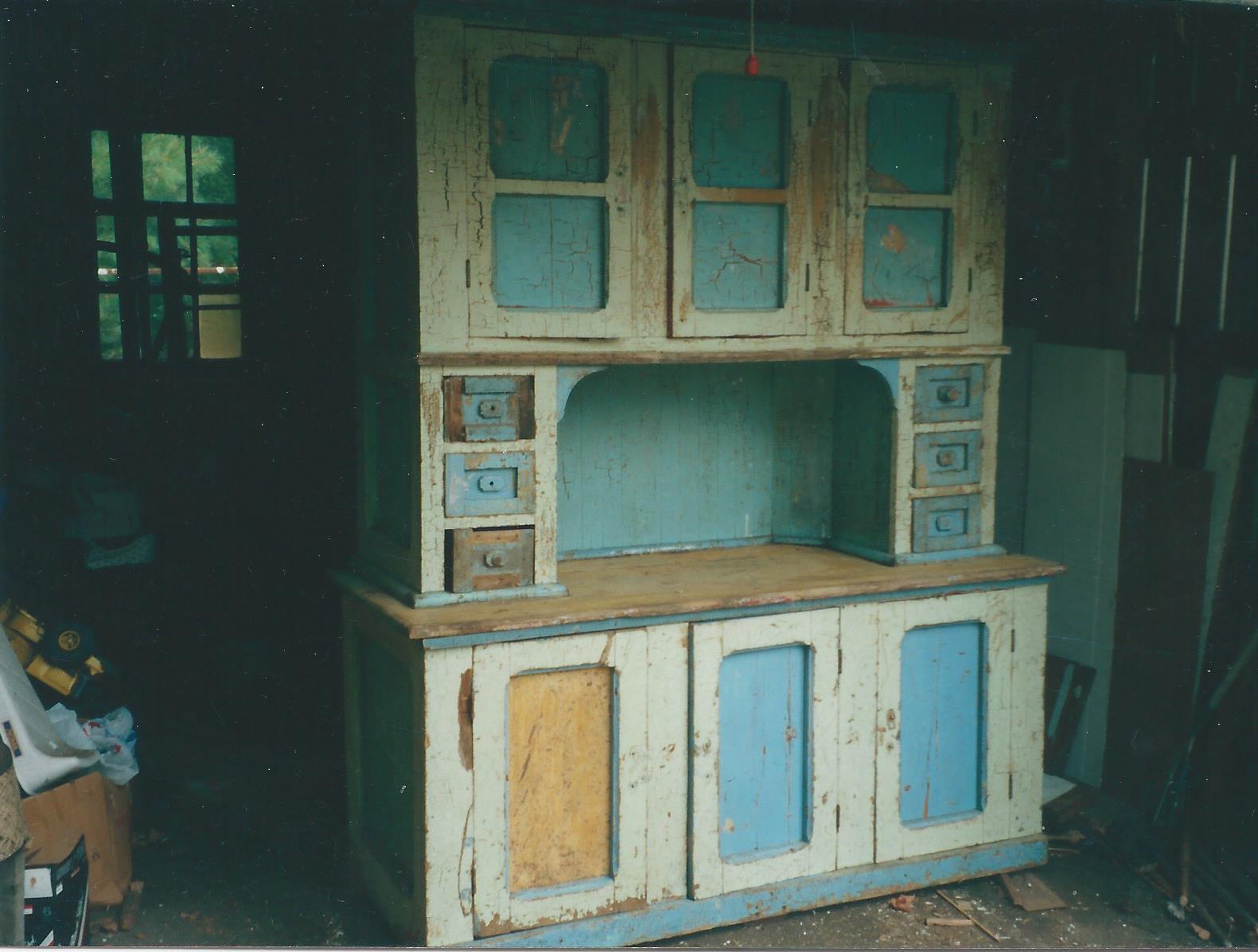
Door knocking – picking from the source

cupboard found in back kitchen

cupboard found in back kitchen

People, including myself will refer to a day of going to shops, and other dealer and collector’s homes for the purpose of finding stock as “picking”, but the origins of the word “picker”, and the true meaning of the word “picking” more correctly refers to the activities of the foot soldiers of the antique trade.  The guy or gal who goes out, and “cold call” knocks on doors of people they do not know, in an attempt to buy from the source.  There is a technique to the process of door knocking which can be learned in theory, but the success of a “door knocker” is determined by personality, communication skills and an ability to be rejected over and over again without becoming morose.

The trick is to get inside. If you knock and after a pleasant good day simply ask if they have something for sale, most people will send you packing.  The trick is to engage in some casual conversation and let them get to know you a little before you ask about buying anything.  You need to develop trust.  One technique pickers use is to say that they are a hobby collector of old bottles just out for a drive and they thought you’d just drop by and ask if there might be any old bottles in the basement.   Who doesn’t have old bottles in the basement, so if you seem trustworthy enough you are in. Once down there you can look around and casually notice the old flat to the wall cupboard holding old preserves.  It’s best to start small.  Get them to sell you anything easy to part with. Offer them $10 for something you know is not worth more than $2, to start the process and a little enthusiasm, and you may come away with a full truck.  It sounds easy, but it’s not.  You knock on a heck of a lot of doors before there is even a slight hope of success.  A lot of people these days are not that happy to be disturbed, and if you go to the wrong place, it can even be dangerous.  You need nerve and a thick skin to be a picker.

she's rough but she's a survivor

she’s rough but she’s a survivor

When I started in the business over thirty years ago, there were many of these “door-knocking pickers”.  In Quebec, all the Antique distribution barns had several associated pickers who would head out each day, returning late with their finds. Some pickers developed long standing relationships and sold everything to the same person. Others, acted independently and would make the rounds. Meanwhile, the pickers from Ontario, seemed for the most part to work independently, making the rounds to dealer’s shops, but also turning up with their fresh picked stock at outdoor shows, and markets.  Times and attitudes have changed and now this type of picker is almost extinct.  Another endangered species which is moving quickly towards extinction.

But even thirty years ago, most of the great door to door picking was behind us.  You need to go back to the fifties and sixties to hear stories of the almost endless bounty those first door knockers could come up with.  Rural people, especially on the smaller, less prosperous farms saved everything.  New kitchen table in, save the old one in case you need it to butcher chicken’s on it one day, and so forth.  So, when those pioneer pickers would turn up with a pick-up truck, a smile, and a pocket full of cash, there was enthusiasm to sell them whatever they wanted.  No Antiques Roadshow to fill people’s heads with big ideas.  Here comes a guy who is willing to give me twenty bucks for that old table in the back of my barn. No problem. Here, let me help you load it.  There are even stories of pickers bringing along one of those shiny new, easy to clean Arbourite and chrome tables, and very kindly swapping for that nasty old eight foot pine harvest table that had come with the family from the old house.  It took a while, but eventually word got out after somebody went to town and looked in the windows of the antique shop. Then pickers had to work harder, and pay more.
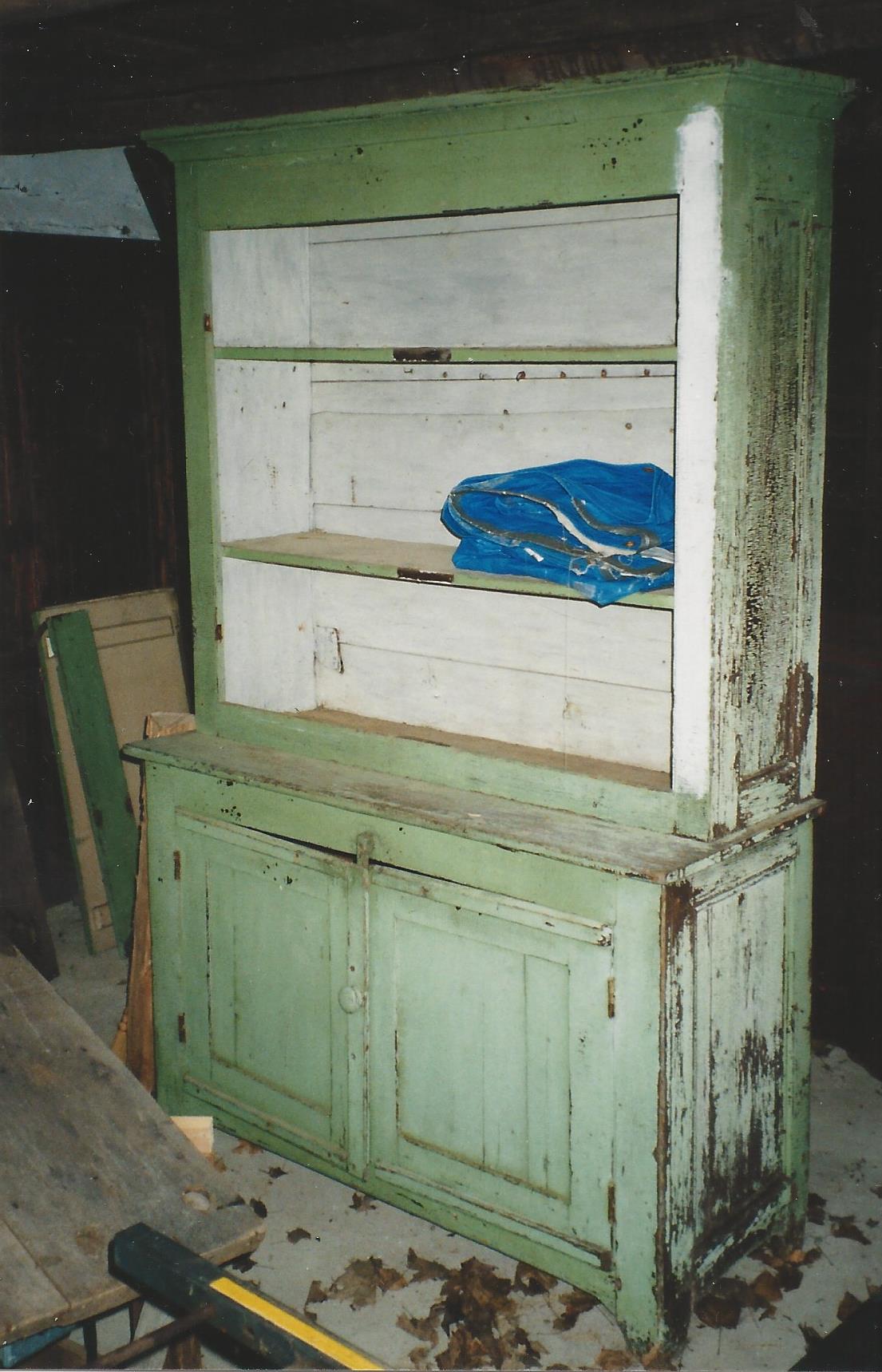
used to hold old paint until it was found in a garage

used to hold old paint until it was found in a garage

Today, as I said, there is only a small fraction of these ground level pickers in our midst.  People are savvy, or they think they are, and somebody told them that old book was worth $1,000.   You may know that it’s worth $400 so you try to buy it for $300 from them. Good luck. That’s how it is today. Also, people don’t inherently trust one another anymore so if someone they don’t know comes up the driveway and knocks, they are just as likely to phone the security company as they are to answer.  Not to mention the price of gas.

There are some legendary picker’s stories out there, some which I will recall here in the future, but there are many, many more which have disappeared with the breed.  There’s still a few people around who could entertain you for hours with their picking recollections, but they are getting up there.  Best to ask them to tell you some stories soon before they forget.
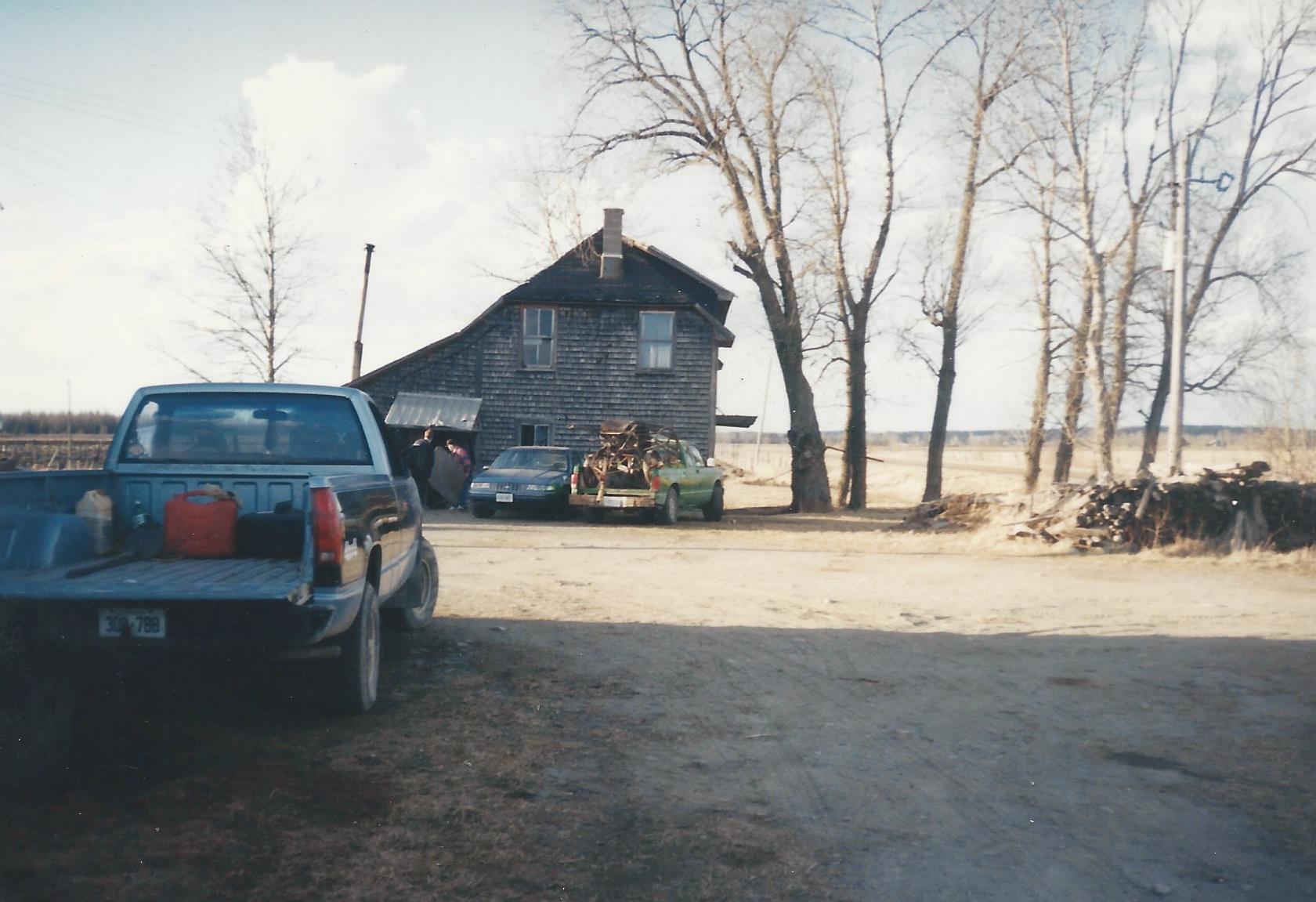
picker's truck pulled up to an old northern farm
picker’s truck pulled up to an old northern farm

Frozen hard boiled eggs – Recollections of Quebec in the winter

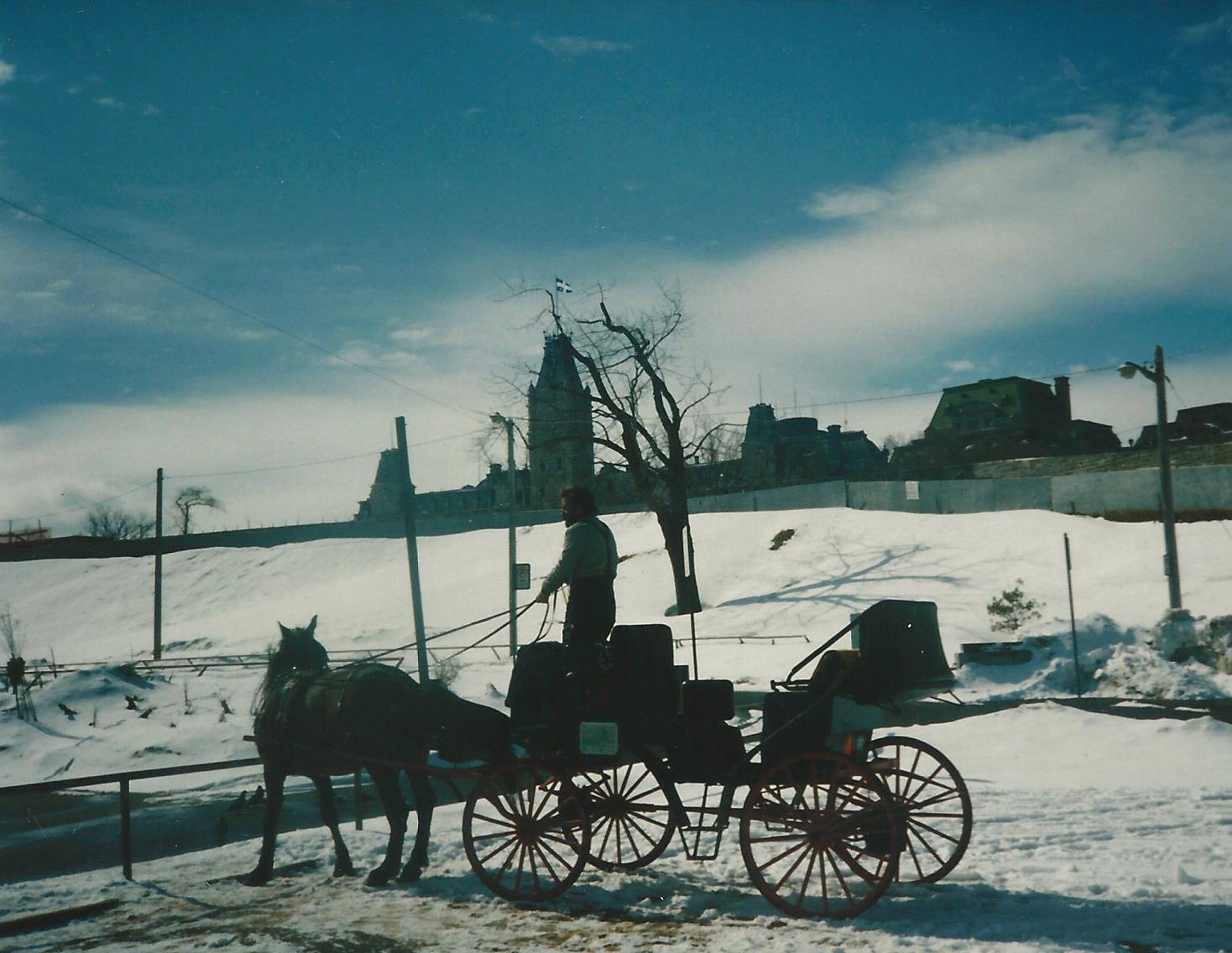
nice day for a buggy ride in old Quebec

nice day for a buggy ride in old Quebec

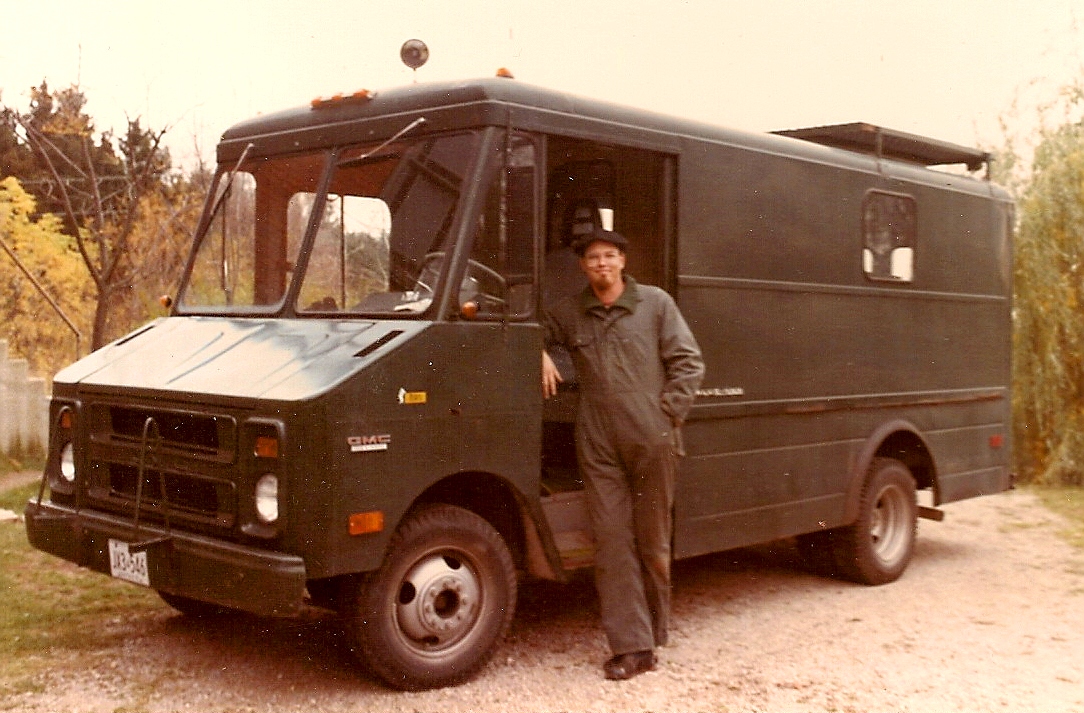
It is December 1st and we are still enjoying mild temperatures and no snow here in Port Dover on the “south coast” of Ontario, which is how they promote the region around here.  In actuality, it is not a coast at all but rather the north shore of Lake Erie.  You need an ocean to have a coast, and I bring this up because I am not about supporting the deterioration of the language. In any case, the forecast is for temperatures to drop at the weekend to normal values and then if we believe what we are told we are in for a rough winter.  I was looking at the old Bell line van pictured at the top of every blog and thinking about how cold I used to get traveling in that van to Quebec in the winter.winter1

I did my best to fit trips in between snow events, but it goes to say that when you are back and forth every couple of weeks you are going to get caught.  I can remember white outs on the four lane #20 highway when looking out the windshield was like looking into a snow globe. Everything is white snow swirling and dancing in the headlights; everything is hypnotic and there is no hint of an edge to the road, or white line to guide you.  You are lost, and afraid to stop for fear that a transport will run straight over you, but also afraid to pull over because you have no idea where the highway ends and the ditch begins. A total white knuckle scenario which lasts for minutes that feels like hours.

You know those “bridge freezes over before highway” signs you sometimes see on northern bridges.  Well I can attest to that being true.  Late one December night I headed through Montreal, and on to the south shore with the temperature dropping steadily, and the rain starting to glaze up and turn to snow. By the time I reach the Drummondville bridge it was cold enough that indeed the road before the bridge was fine, but the second I hit the bridge that big old truck thought itself a figure skater and decided to pirouette the entire length of the bridge, spinning gracefully all the way across until it hit the dry pavement on the far end, and miraculously I had completed a turn and  the wheels were aligned so I just stabilized and kept going as if nothing had happened.  Good thing I bring a change of underwear.winter6

Another time when I picked up Jeanine at Mirabelle airport after her spending a few weeks in France, we were so happy to see each other and getting caught up that we hardly noticed the ever increasing magnitude of the snow storm which was coming in.  It just kept getting heavier and heavier but we continued to crawl along in the tracks of the transport ahead of us. We made it like this as far as the Ontario boarder before the front bumper of the van was literally plowing snow and that’s when we decided to call it a night.

The old Bell line van held a lot of gear and you could rely on the 350 Chevy engine to start and get you there and back, but the body wasn’t built for traveling for a long time in sub- zero weather, with it’s non insulated sliding side doors. It was meant to be a delivery van after all   I would wrap up in long johns, two pairs of pants, a pair of insulated cover-alls, and a blanket over my legs but even with the heater blasting full it could get damn cold.  I remember one -30 degree morning when surprisingly the engine fired up after turning over so slowly you would think it was being hand cranked.  After leaving it to heat up for 15 minutes I set off to get on with my day of visiting the picker’s barns with my lunch box on the engine cover.  I got hungry about an hour later and decided to have a hard- boiled egg, only to find that it was frozen as hard as a rock.  It’s amazing what you will put up with when you are young and have lots of blood flowing through your veins.  I could not believe the feeling of absolute luxury when the old van finally died and I started traveling in a pick-up truck.  What was I thinking?winter5

Of course the flip side to this potential discomfort and hardship is just how wonderful and special it is to be in Quebec on a , crisp sunny morning with the snow piled as high as the rooftops. Quebec city in particular is absolutely magical in the winter. To look out your hotel window and see the people below hustling along narrow paths between buildings, with every other inch of space being covered with deep,deep snow is unforgettable, and quintessentially Canadian. “”Mon pays, c’est l’hiver” or “My country. It is winter” is more than a popular Quebec expression. It’s a concept to understand and cherish.

I leave you with one last recollection. That of the Northern lights dancing magnificently overhead as I drive the lonely distance between Quebec city and Trois Riviere late at night listening to the CBC, and thinking about what my loved ones were doing at home.  Loving what I was experiencing with the light show and all, but also thinking about my family and bed and wishing I was home.  winter4

Breakfast in Quebec

One thing that I look forward to when on the road, especially in Quebec, is having breakfast at a little, local restaurant.   Typically, we look for the mom and pop place in a small town with a lot of cars in the parking lot.  That’s a sure sign because the locals know best. I love walking into a lively room full of morning light and people, talking, laughing, and generally getting on with things.  It’s that happy time when you are full of hope and energy before the day has a chance to complicate things and wear you down.  It’s all about that first cup of coffee, filling that empty stomach, and getting your communication skills working.  In Quebec, on a good day, these places are full of noise and merriment, and most often delicious food.

At least I can now by Creton at our local Food Basics

At least I can now buy Creton at our local Food Basics

I like to go with the traditional Quebec big breakfast, a couple of eggs, sausage, toast, baked beans, and a little container full of Creton.  What is Creton you may ask.  Well it’s basically pork fat mixed with bread crumbs, and a little onion and spice, and it is delicious spread on toast. Just the thing if you are going to go out in sub- zero weather to cut down trees.  Maybe a few more calories than you need to drive around and search out antiques, but a great way to start the day none the less. I know a lot of people at this point are crying out “cholesterol alert”, but I have a well-researched theory that a small amount of this type of heavy fat is actually good for you. The operative word being a “small” amount, and provided you are active enough to burn it off. Because you are satiated it cuts down on snacking, and your stomach recognizes the fat and puts out the proper enzymes to digest it. Something that doesn’t happen with “low fat” foods, most of which are filled with dangerous chemicals.  But I digress.

I also love that a lot of these places, although clean, have not been professionally decorated or modernized.   It is one of my greatest pleasures to sit, sipping my coffee, anticipating my food and just taking in the local scene.  Randomly tuning in on conversations of people you do not know and will never see again makes me feel energized, and connected. At one with the world.

When on an antique hunt you are basically driving from place to place, and walking through barns with occasional moments of lifting and loading.  So after a big breakfast we then go through the day snacking on things out of a cooler we bring along.  This is not only cost saving but satisfying because even the little grocery stores in Quebec have a wonderful selection of fruits, bread, meats and cheese that can be munched on between stops, or if we feel like a break at a rest stop.  Not to forget those little packages of delicious cheese curds left out on the counter of almost every little country variety so that they are the right temperature to get every little bit of “squeaky” texture and flavor out. This was then.  I hear that now the powers that be have forced the store owners to refrigerate for fear of us becoming sick. Ridiculous. It takes days for curds to go bad.  It’s like buttermilk.  You can leave it out on the counter and it just continues to be buttermilk for days.  The restrictions on raw milk cheese are also ridiculous,  but don’t get me started.

Finally, at the end of the day it was our pleasure to drive around and seek out a simple meal at some place that looked good and not too expensive. Now days we do a little trip advisor research in advance.  It works and saves some gas, but it takes some of the fun out of it.  Over the years we have found our favourite spots and we look forward to revisiting them.

Eventually we took to carrying two coolers, one for the day to day use, and one for bringing back all the products that we discovered and came to love, and can find only in Quebec.

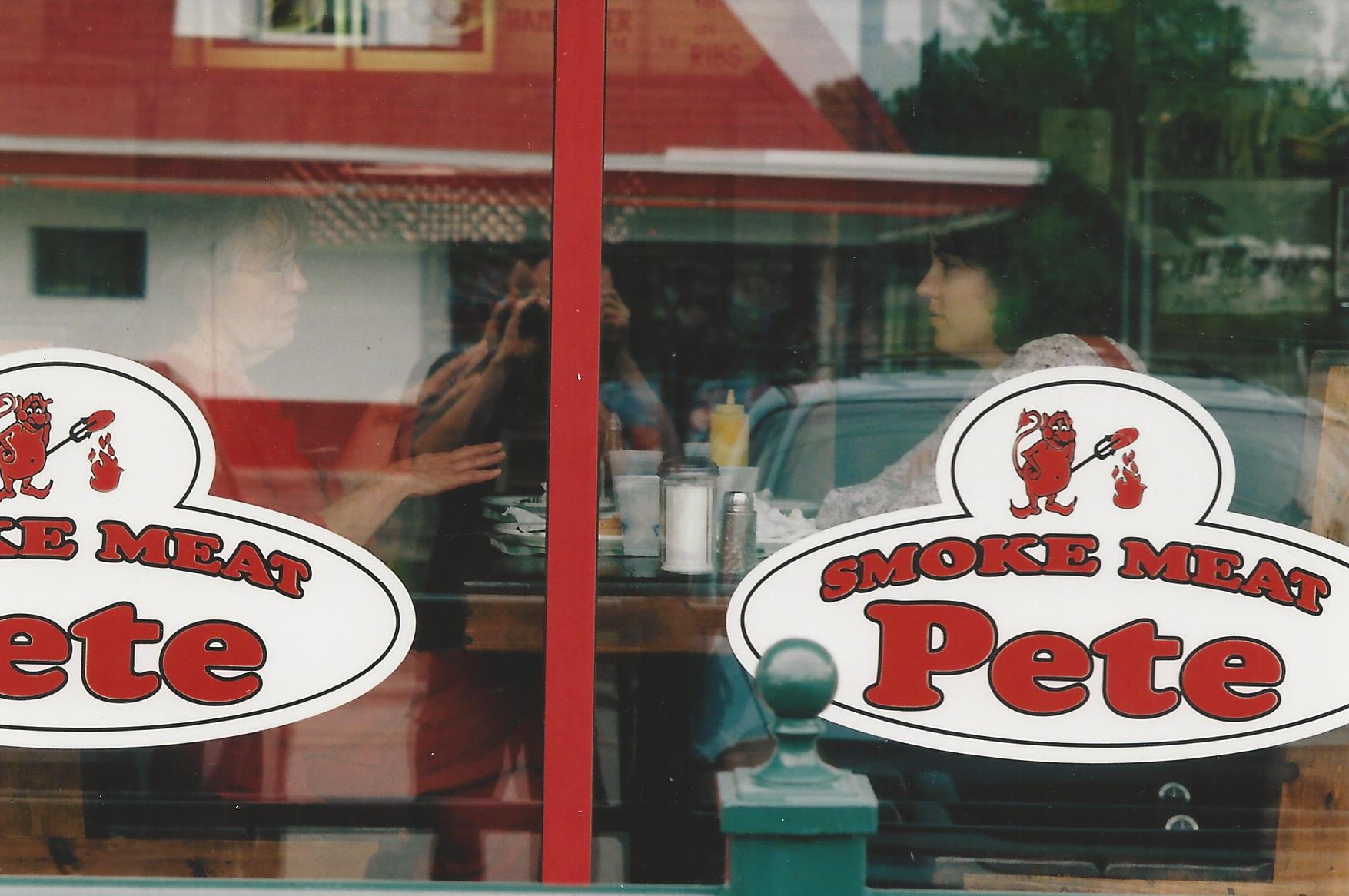
We always make our first stop at a little place on L’Isle Perrot when coming into Montreal on Highway 20.  It used to be a dairy Freeze but then one happy day it became Smoke Meat Pete.  Their slogan is “you can’t beat Pete’s meat” and I heartily agree.  Pete smokes his own, and it is super delicious.  Second only to Schwartz’s in Montreal and even that may be because Schwartz has the advantage of being the traditional favourite.  We always arrive hungry.  Have a huge sandwich, and leave super full with a big brisket in the cooler to take home.  Yes, gratefully they sell full briskets to go.

Jeanine, full and happy leaving Smoke Meat Pete's

Jeanine, full and happy leaving Smoke Meat Pete’s

Next on the tour near the picturesque town of Knowlton lies the giant Lac Brome duck producers.  A great source for packaged duck confit legs.  Duck confit is a traditional food from Jeanine’s home in the south/west of France and is one of our favourite things, so we usually buy ten or twelve packages containing two legs each, and put them in the freezer when we get home.

Then it’s a short drive over to  the Abbaye De St-Benoit-Du-Lac, a picturesque monastery on the top of a hill which produces and sells many award winning cheeses.  Nearby Magog has a couple of excellent bakeries and specialty shops.  You can buy every kind of pate imaginable from rabbit and duck, to elk and you name it.  In Magog you can buy over a dozen types of pates while here in rural Ontario you are lucky to find anything other than a basic pork pate with pepper corns.  Why is this?

Once while doing the Eastman show we found out about a little bakery about six kilometers south of town on Rte 12 that is locally famous for making the most delicious tourtiere you will ever encounter, and the clincher is they sell them for between $12 to $16 each depending on the type.  We put as many as we can cram into the cooler for freezing back home. Excellent.

When you think of Quebec food, you may think of meat pies, baked beans, poutine, sugar pie and those $2“vapor” hotdog stands with those funny little buns, but increasingly you must also think of world standard cheeses, meats and produce.  All this talk is making me hungry.  It’s time for me to wrap this baby up and go downstairs, and make myself a sandwich. Bon Appetit.food1

An outhouse full of bird houses

brdhous4I think that it is accurate to suggest that a high percentage of what we define as folk art is made by energetic people who reach retirement, and find they need to produce something to keep their interest in life alive, and burn off creative energy.  Some of these people turn to enhancing their immediate environment. Edmund Chatigny comes to mind who spent his working day creating a yard full of spotted flowers, animals, and birds, all in a similar style.  What he made innocently has great artistic strength, and integrity. His intention was not for profit, but rather to decorate his yard. Here’s a link to my blog about him,  https://shadflyguy.com/2016/09/16/its-not-saleable-it-doesnt-get-made-in-a-minute-the-art-of-edmund-chatigny/

And then there are other folk artists who seek to create a product.  Something saleable which will bring in cash. A craftsman’s approach. Some of these people are uniquely talented, and the work becomes very popular in spite of their lack of professional training, or intent.  Maud Lewis is a good example.

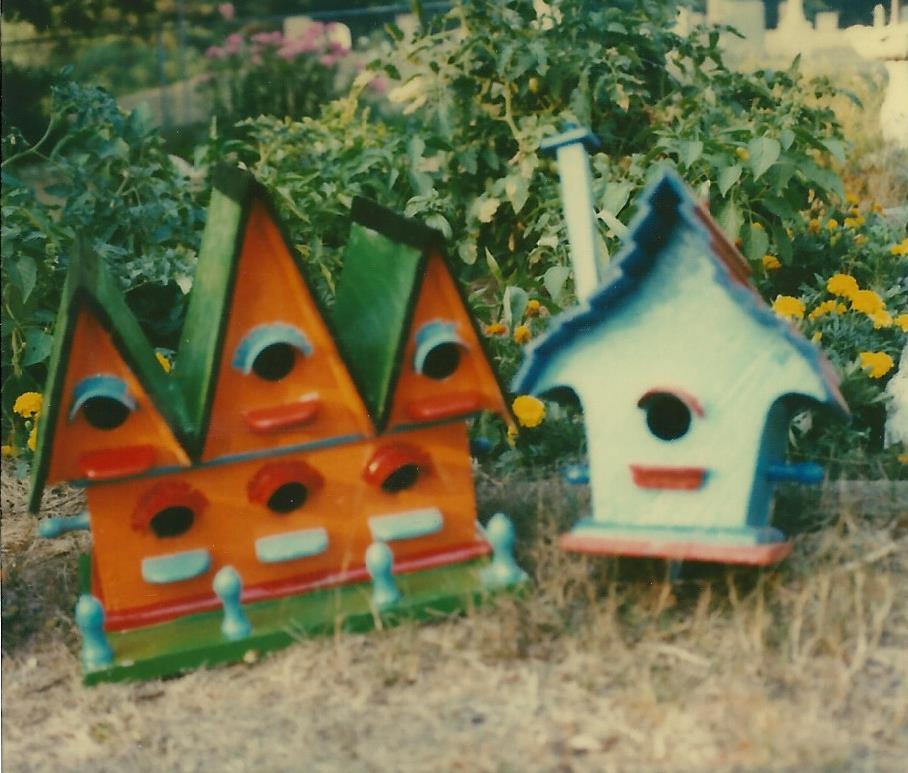
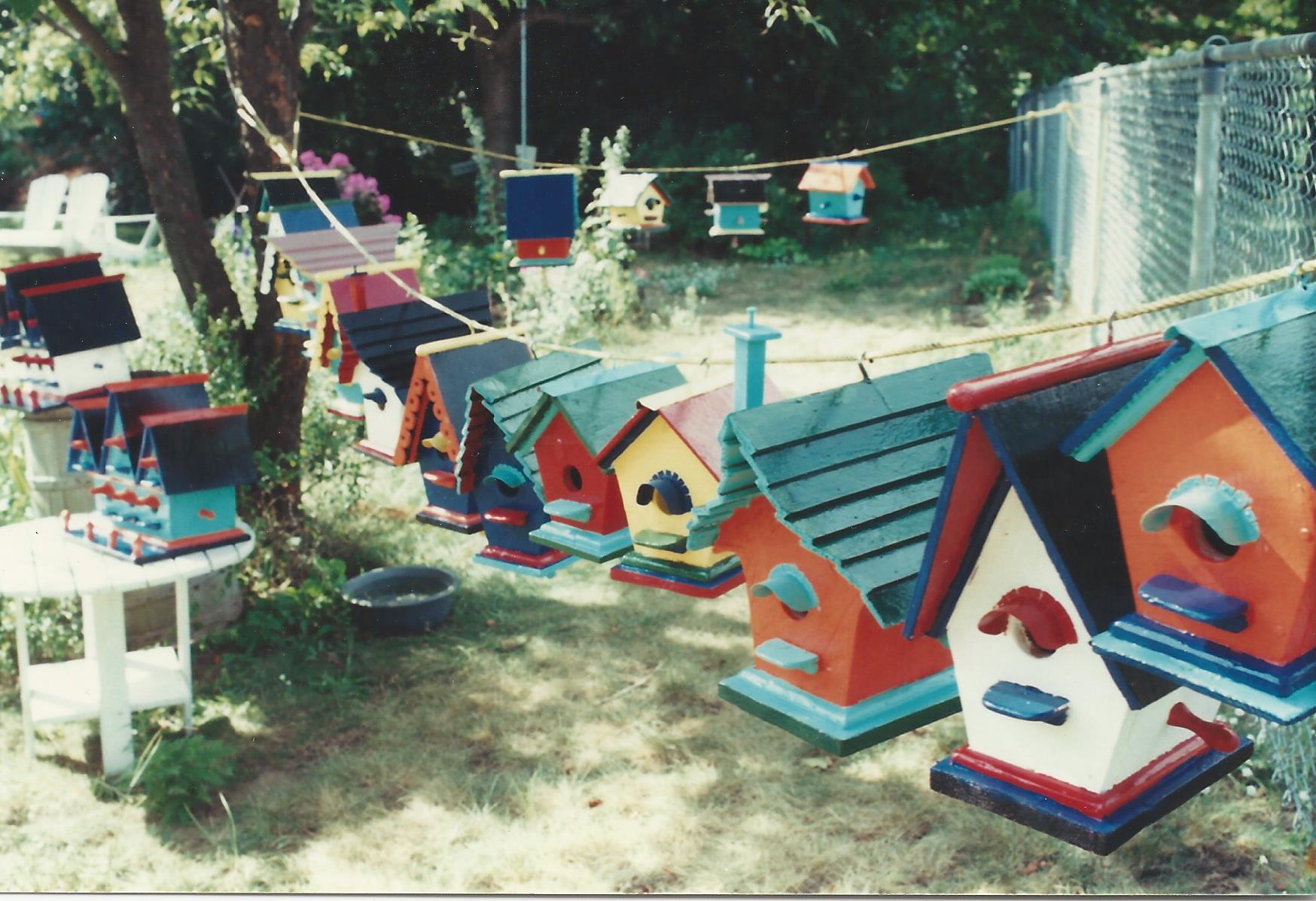
We were driving along Rte 138 on the north shore of the St Lawrence near Trois Rivieres Quebec, when we spotted a sign for a yard sale.   We are talking about the 1980’s when it was a good idea to check out all yard sales.  It was early on and there were still lots of good things coming to light. So we pulled in and became immediately drawn to a few odd looking, hand-made bird houses sitting under a tree.  Really cool, looking like something out of Dr. Seuss. They were unpainted and a little rough around the edges, but you could see the potential.   Jeanine asked in French, “Can you tell us something about the birdhouses please.”  An elderly gentleman came over to us and explained that he had made them in his little shop out back just to keep himself busy. Then he started quoting prices, all of which were reasonable.  “I see you have six out here on display.  Do you have others?”.  He smiled and said “come with me”. We found ourselves in his back yard, behind a small barn and there sat what looked to be an old two-seater outhouse.  Door latched shut with a stick of wood.  He swung open the door, and taa daa, the entire space from floor to ceiling was stuffed with birdhouses.   There had to be 100 or so in there.  He grinned, “You see I have more.  How many would you like?”   We excused ourselves for a moment so we could have a quick huddle, and then Jeanine asked “Well what do you want for all of them?”  His eye’s lit up and he said without hesitation “Take them all and pay so much a piece no matter what the model.”  I honestly can’t remember the exact price, but it was extremely reasonable, say $15 each.  Deal.brdhous3

I drove the pick up right to the outhouse and we began the arduous task of unloading and reloading all those birdhouses. They filled up every bit of space we had left, and when we were finished there was so much rope holding everything in place that it looked like a spider’s web.   We were full at this point so we headed home, feeling quite giddy.

It was summertime, and our daughter and three of her friends had just discovered what a drag picking strawberries was as a summer job, so we offered them the job to sand, prime, and paint all those birdhouses.  They set up at the picnic table under a big tree, cranked up the radio, and started to work. We provided paint, brushes, sandwiches and beverages and paid them by the piece.  They were happy, and we were happy with the excellent job they did both in the quality of the work, and their choices of bright colours.  We loved to look out and see more and more brightly coloured bird houses hanging from the cloths line, and hearing the happy chatter from the work team.  It lasted over several weeks and we sold them just about as fast as they became available.  Eventually they all had new homes and we contemplated a return trip to see if more had been made, but never got around to it.  We thought that with all that space available in the old outhouse and after such a successful sale, our maker friend would probably get right back to it.  We never did find out.   I still see them from time to time at antique shows.brdhous2

Driving the Vatican to Montreal

we loved bringing something big to Bowmanville

we loved bringing something big to Bowmanville

When it comes to selling folk art, something you learn pretty quickly is that size matters.  In this case, small being better than large, because not many collectors have a large amount of space to dedicate to their interest, and so although they may be delighted to see a large piece, not many of them are going to take it home.  The exception being things like totem poles or other vertical forms that don’t take up too much floor space., or can go outdoors.  Even then it has to have a lot going for it, or you risk hauling the thing around from show to show like a giant albatross around your neck.  That being said, it’s good to have something  spectacular for a show like Bowmanville, where you focus on building a reputation as well as sales, and big and flashy gets them into your booth.  This is why on the rare occasion when I did find something large that made my heart skip, I found myself drifting from ”isn’t this an interesting thing. I’m so happy to have experienced it and now I have it to remember”, to “I wonder if I can Squeeze this thing into the truck and when I get home convince Jeanine it is a good idea.”  It’s a feeling recognized by elements of excitement and danger coming rapidly in equal amounts.

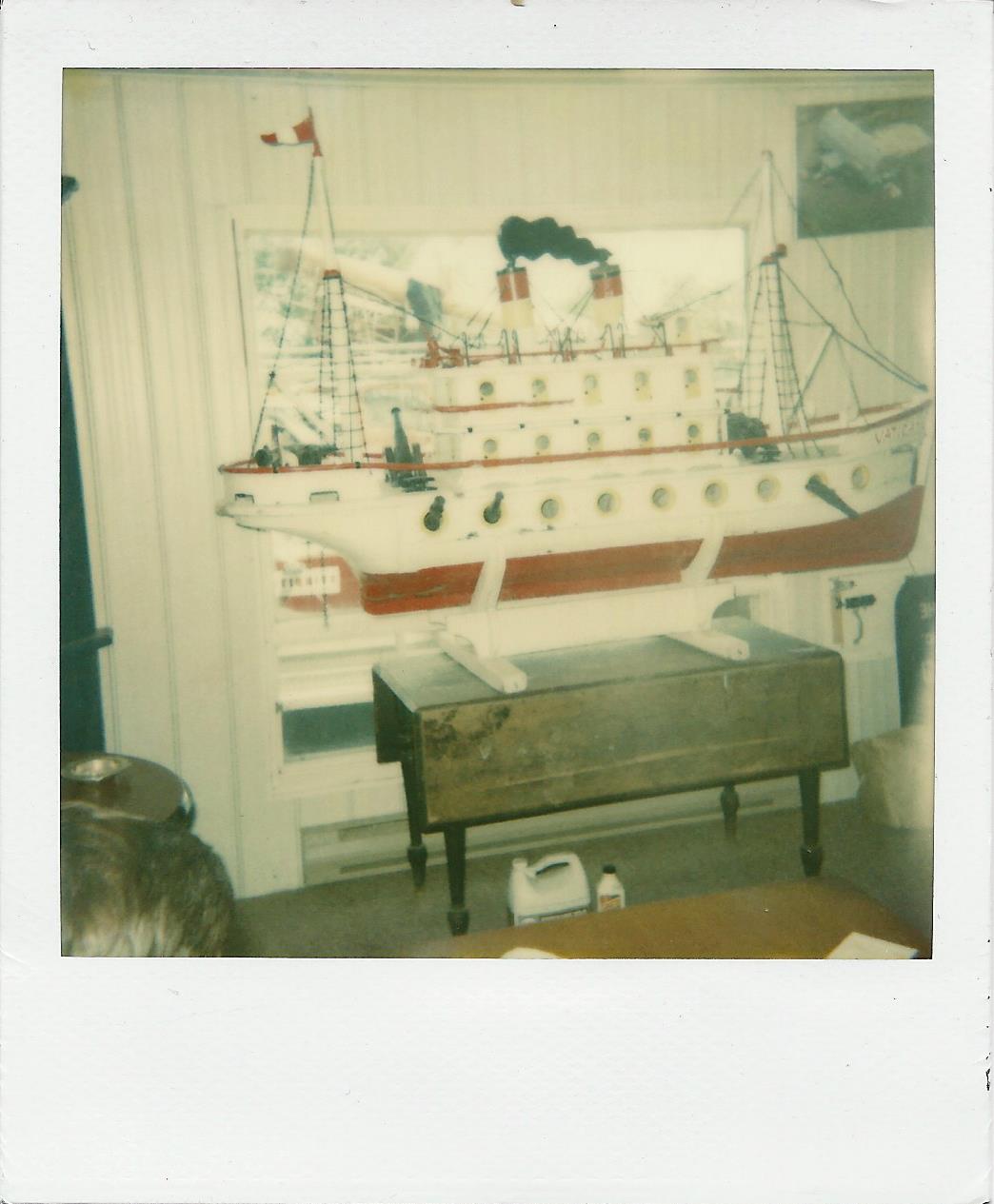
It was early spring and the hope brought on by new life and growth was thick in the air as I pulled in to Jean Deshaies or as he is known “Kojak’s”.   I was flying solo and with a full truck, so it was a last look in case of an interesting small or something worth putting aside for next time.  I could see that Kojak was excited when I walked in, and he jumped right up and hurried towards me, “ Phil, you’ve got to see what just came in. It’ll blow your mind”.  He brought me into his small front room where he kept his special things and there perched on a table in front of the window was a spectacular 7 foot long, 4’ tall, red and white, three tiered birdhouse in the form of a ship.  The name “Vatican” painted prominently on the bow.  Wow.  What a thing.  Double masted, with twin funnels spewing black smoke asthe French flag overlooked all from high above.  You could see that great care had gone into the creation.  Every piece was carved lovingly from wood or shaped from metal, and it was built to last.

The Vatican in Kojak's front room

The Vatican
in Kojak’s front room

It was made in the late 1940’s by two priests who taught and lived at the seminary near the town of Lobiniere, situated on the south shore of the St Lawrence river.   It took them over two years to make it, and then they mounted it outdoors under a sheltering roof where it served as the home for many birds over the next thirty years or so until the seminary closed.  By then the brothers had died, and it was bought by a local. Fortunately, he looked after it well, keeping it painted and maintained and under a roof as the brothers had, so when Kojak bought it, it was just a question of giving it a really good cleaning.  This was the state it arrived in hours before I pulled in.

It hit all my buttons, had great provenance, and was definitely top drawer folk art, but it was also a lot of money, and huge, not to mention massively heavy.  My mind kept telling me to “avoid” “just move away and nobody gets hurt” but when Jean told me he had already called a couple of Quebec city dealers, and they had not committed but would be coming to look at it, I started to panic.  Something about it spoke to me.   I’m not naturally inclined, but it felt almost Holy.   I wanted it, and I had to think fast. “Can I have a hold on it for 24 hours, and take a couple of pictures.  I’ve got a guy in mind.”  He hesitated.  “Well, I don’t want you shopping it around to everyone, but if you have somebody in mind I’ll give you until closing time tomorrow.”  Great.  That may be all I need.

As it happened this was a time when I was selling a lot of folk art to a new, high end interior décor and furniture shop setting up over two floors of a converted warehouse in an up-scale neighborhood in Montreal.  The owner, a Mr. Camelot, (how do you forget a name like Camelot), was very progressive and pushing hard to come up with the very best.  Today I would have phoned him and sent him the picture, but in the day, after he had expressed interest over the phone, there was nothing left to do but drive to Montreal and show him the pictures. The next morning at 8 am we met at the store and he quickly decided based on the two polaroids, and my description that he had to have it, and so it just became a matter of driving the two hours back to Kojak’s and fetching it.

I had to pile up the things I already had on my truck at Jean’s because the ship took up the entire box of the truck from front to back.  I roped it in place and started out for Montreal.   I can remember it as vividly as if it happened yesterday, cruising at 120 klm down Hwy 40 headed for Montreal when suddenly the sky turned black and a torrential summer rainfall let loose.  Looking in the rear view mirrors it looked like the Vatican was sailing her way through heavy seas.  I was concerned but she was built to take it and there was nothing to do but sail on.   As Mr. Camelot’s workers unloaded it and brought it up in the lift, I was thinking that although I was happy the ship had found it’s new dock, the only unfortunate part was that I would have loved to make it the center piece of our Bowmanville booth that year.  Still, a bird in the hand.   fullsizerender4

Something about seeing that ship in those rear view mirrors left a big mark on me, and a little while later I was messing around and found myself painting in a decorative old mirror frame I found, a rendering of the Vatican floating on a cloud off into a starry night  . It’s still hanging there on the wall over my left shoulder, and every once in a while I notice it and I think about the two priests staying up late, and using all their leisure time to create such a wonderful home for the little birds.

Ironically, about twenty years later, I walked into set up for the Bownmanville show and there it was. A Quebec dealer had brought it on consignment.  The Vatican was looking for a new dock.  It did not sell.  As I watched them load it back onto the truck for the trip home I said to myself, “that could be me.”vat2

Buying my “wreck” from Kojak

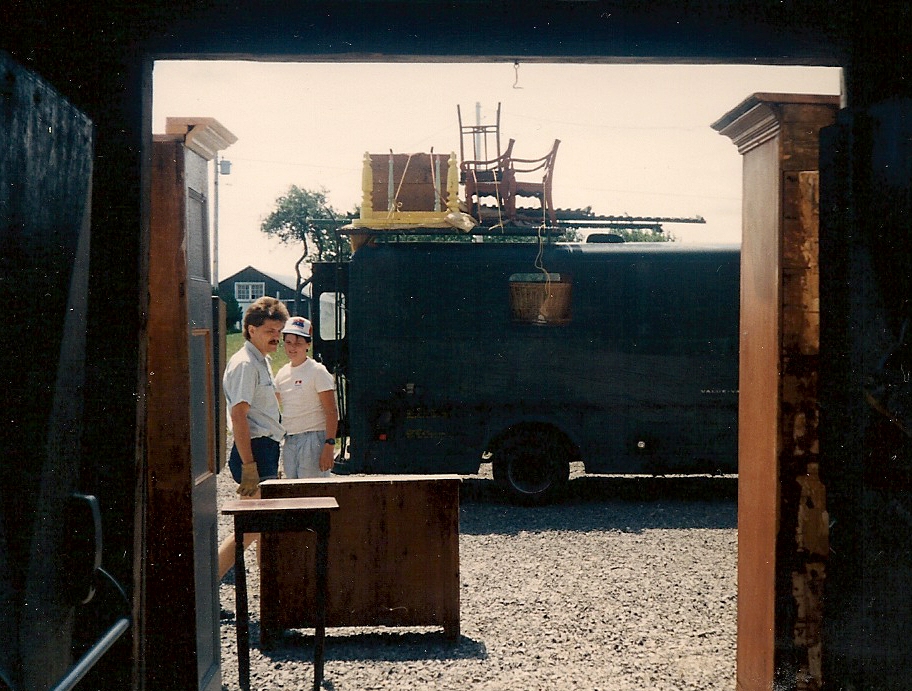
A loaded truck ready to go.

A loaded truck ready to go.

Kojak’s barn was located on the outskirts of Victoriaville.  You may be acquainted with Kojak from my previous blog “discovering the picker’s barns around Victoriaville”.  Jean (Kojak) Deshaies was thus nicknamed because he was bald and had a rough voice.  He also had a disarmingly direct way of expressing himself which reminded me of the t.v. detective.  Across the road from Kojak was an Esso station with a good little roadside restaurant.  All the pickers used to gather there about 7 am to have breakfast and exchange tips and gossip.  It was a good place to be to find out what had come in, and what was going on.

One particular summer morning Jeanine and I arrived to find an unusually high level of

excitement amongst the natives.  It was 7 am and the boys were drinking brandy, giving high fives, and generally celebrating.  What’s up?  Kojak who seemed to be the center of attention answered, “have a brandy on me.  We’re celebrating the delivery of my new truck.  There she is out front.  Isn’t she a beauty.”  Sure enough a massive, brand new, chrome covered, custom painted one ton, four door Chevy sat glistening in the sun.   “It’s a little early for us for Brandy, but congratulations Jean, that’s a real beauty.”   We took our place at our usual table and ordered breakfast.

This was at a time when I was becoming known as a “regular”, and the boys liked me in spite of my beat up old pickup with the simple bolted together oak board rack.  Actually, I could tell that they laughed a bit behind my back as theirs was an “express my macho through my big truck culture.”  That and the big roll of cash which they would pull out of their pants is what made them impressive to their clients and each other.  They could not imagine why someone would come from so far which such a small potential for hauling things back.  The first time I tried to tie down a load, they stopped me and taught me how to do it properly.  Making a loop at one end of the rope and then pulling the other end through and pulling hard to cinch with a reef knot and the load was in place.  I was getting pretty good at piling the stuff up a little past the height of the cab and onto the lowered tailgate to maximize my load.

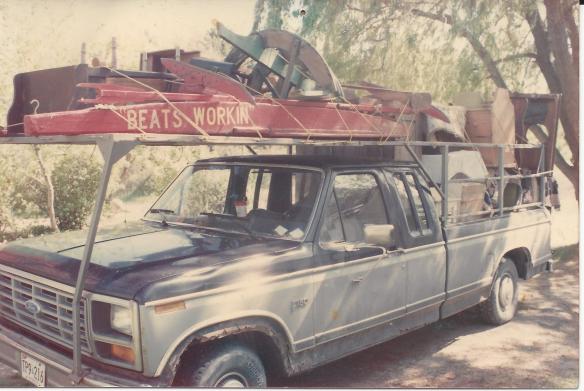
So we were enjoying the laughter and light heartedness of the moment, along with some bacon and eggs, when Kojak slid onto the bench next to us.   “Hey Phil, you should buy mon wreck.”  Pause. “Buy your wreck” ???  It was first thing in the morning and I was struggling to find meaning in Jean’s “Franglaise”.  Perhaps the shot of brandy would have helped.  “Yea, mon wreck.  Mon wreck from my old truck.  It didn’t fit the new truck because my last truck had the small back space like yours so I had a new one made. But it would work great for you, and then you would have a real rig for hauling a decent load.”  The fog lifted.  “Well what are you asking for it?”  At this Jean looked me directly in the face and held up five fingers.  Let’s see; another puzzler.  I knew that it could have originally cost $5,000 because it was beautifully made with a deck over the cab which had a metal mesh walking surface that came right out to the front bumper, and handy sailboat type rope tie downs all along the sides.  But it seemed too high, so I ventured, “how much Jean?”  “Five hundred.”  “Give me five hundred and we can go to the welder’s place right after breakfast and he will put it on for you. That’s included in the price”.  I looked at Jeanine.  She gave me a wink, and so I said “Sure. Sounds good”.  Thanks Jean.  We’ll go for it.”  Jean’s big smile displayed his satisfaction with this.  His old rack was sold and he knew I could buy a lot more from him with this new equipment.  It was a good investment on his part.

We finished our breakfasts and followed Jean about five clicks out of town to the home and shop of his welder buddy.  Jean had called ahead so by the time we arrived he had it suspended up above the bay ready for us to drive in.  Twenty minutes later our old oak rack was on the burn pile, and our new front to back rack was bolted into place along the sides and on to the front bumper.  The old truck dropped about two inches under the new weight, but it drove fine, and we were off on the hunt with oodles of more space for purchases.  The rack survived two new trucks and served me well for the rest of my time hauling big loads out of Quebec.  I was happy that we had been there for breakfast the day Kojak’s new truck had arrived.

My new metal rack bought from Kojak.

My new metal rack bought from Kojak.

YOUR TRUCK IS ON FIRE!!!

truckIt had been a successful Odessa show.   On Saturday at opening we had just arrived due to a flat en route , and were bringing things off the truck as people came in.  Turns out people get excited by getting first crack at things, and several pieces were selling as they hit the ground.  The mood was jovial and spirited.  Dan Ackroyd and his wife came by and they were attracted to a two piece painted cupboard that they could see glimpses of on the still tied down load.  She told him to stay there until it was unloaded while she went on down the line, and he was good enough to suggest helping me unload rather than just standing there watching me.  Nice guy.  It turned out not to be the cupboard for them, but regular Toronto customers bought it right after, so this combined with other sales indicated a strong start.  It’s a great feeling to sell enough in the first hour that you have “made your table” as the expression goes, and you can relax a little knowing that even if nothing else sells you have had a good show.  It didn’t happen that often even then in the heyday of the nineties.
The day continued to go well in spite of the sweltering August heat, and we even had a few sales on Sunday. So, when five o’clock closing came, we were happy not to have a lot to load back on, although the Toronto couple needed the cupboard delivered to their home, and I bought a few things in the rough to take home.  By about seven we were loaded and on the 401 heading west.  We checked the radio for traffic and found out that things were moving slowly all the way to Toronto due to an accident and so decided to pull off at Belleville for dinner at a place we like down by the marine.  We felt a bit celebratory, and content to relax, sip wine, and eat seafood while looking out over the boats in the harbor, so by the time we finished our espresso it was probably pushing ten before we were back on the road to complete the five hour (in total) drive.  Feeling good and awake thanks to the espresso.   Of course we were younger then and able to stay up past ten.

So everything was going swimmingly. Traffic was clipping along, the CBC was playing an interesting documentary, the windows were down and the breeze was cool.  We hit Toronto about midnight and I was enjoying the fact that all four express lanes seemed almost empty.  Occasionally a big transport would go whooshing past me in spite us traveling at 120 Km per hour.  I was “in the zone” and enjoying the oddly luminescent mercury vapor lighting and passing cityscape when suddenly there is a pick-up right behind me flashing his lights, and hitting his horn.  “Alright already.  Go by me there’s another three lanes.”   What is with this guy?  Next thing he has pulled up right beside me, and a guy leans out the window and screams “Your truck is on fire!!”  Whaaat?  Looking in the rear view I see flames flaring up into the night off the top of my load and realized he’s right. Yikes! It was several minutes before I could pull off safely, all the while watching the flames get higher due to the combination of plenty of oxygen , and all that dry 100 year old wood.  I jumped out and surveyed the scene.  Indeed, I could see that at least three things were on fire and several blankets had ignited, and of course all this was tightly secured by ropes which are also on fire by this point. The situation looked dire. First things first.  Jeanine was by this point sleeping, and was not at all pleased to be woken up with the news that it was time to abandon ship and run for your life.  We both ran down into the ditch thinking that at any moment the thing may blow just like in the movies.  Then slowly reason supplanted panic, and we realized that the pieces on fire were up on top and we would have to stand there and watch it burn for a long time before it came anywhere near the gas tank.  Let alone heat up the steel of the truck bed enough to ignite anything, so we got busy and started untying things as fast as we could, throwing the burning blankets and ropes into the ditch and stomping them out.  My kingdom for a fire extinguisher.  I have always carried one thereafter, and so there’s a cautionary tale for you.  Other than gloves, all we had to fight the fire was a couple of large bottles of water which we saved to pour right on the burning wood parts of the furniture that had ignited. We unloaded and stomped and smothered for about fifteen minutes which seemed an eternity and before you knew it, the flames were out. The fire was mostly in the blankets as it turns out, and we quickly assessed that only three pieces of furniture were seriously damaged.  Unfortunately, one of them was the sold and paid for cupboard to be delivered to Toronto.  We sat in the ditch for several minutes making sure all the fire was out, as the traffic roared by quite oblivious to our drama.  Nobody stopped and the half expected police never showed up.  We settled our nerves, and tried to figure out how such a thing could happen.  Our best guess was that a trucker had thrown out a lit cigarette and it had landed in among the blankets.  A close call, but half an hour later we were reloaded and back on the road heading home, feeling grateful that things had not gotten worse.  The insurance paid for some of the damage.  Giving us the money we had paid for the cupboard before restoring it, and not the amount we had just sold it for.  However, something is better than nothing.  The hard part of course was phoning our good clients in Toronto and having to inform than that their beloved cupboard had met a deathly fate on the road home and we were tearing up their cheque.  Very nice folks, they were quite understanding although they didn’t entirely believe that we hadn’t sold the cupboard for more money and then made up the story, so they accepted our invitation to come out and see for themselves.  They were quite reassured when they saw it and marveled that the fire had not spread further to destroy more of the load.  We felt the same.  We were able to come up with another cupboard for them, and no one got hurt so I guess you can say that all’s well that ends well. Still, I would advise that get yourself a fire extinguisher, especially if you carry furniture on an open truck. The moment may arrive when you would give your left arm to have one, God forbid.

Remembering Billie Orr and his Muskoka folk art Paradise

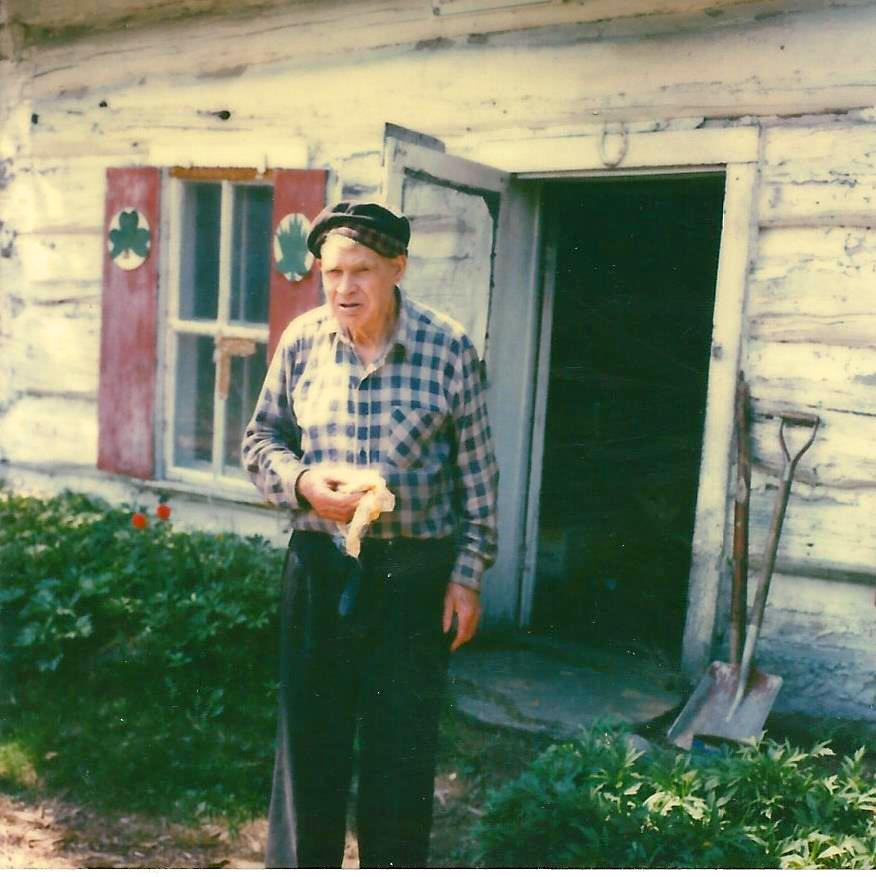
Billy in front of his cabin

Billy in front of his cabin

Back in the nineties, Billie Orr was a familiar figure in Bracebridge, Ontario.  My friend Scott Beasley would see him at least once a week, shuffling along the street carrying his bags of groceries and supplies, as he headed out towards his property which lay about three miles out of town on an isolated craggy, wooded acreage overlooking a river.

With his perpetual Irish cap, and lower lip which seemed in danger of dragging on the ground, Billy was well known, and universally liked by the locals. Scott took to talking to him, and found out that Billie lived on his own on the property he was raised on, and having a good picker’s instinct, he eventually got Billie to invite him for a visit. What he found was fascinating. A bit later, I happened to be in the area and was interested, so Scott and I headed out one fine summer morning for a visit.bo2

Billie lived in a log cabin with no running water and one electrical outlet on a large remote acreage not far from town.  It was a pretty funky set up.  He had to go down the hill to fetch water, and the cabin looked like nothing had been done to it in several years.  We came down the long lane to the cabin and there was Billy standing in the open front door.  Although old, and obviously used to living alone, he was welcoming and articulate.  He started right in telling us about his upbringing.  His father was an inspector on the railroad, and had built the cabin in the first quarter of the century for his wife and Billie and his sister.  Billie’s sister moved away.  Bill never left.  He never married, and never drove a car.  He would walk into Bracebridge once a week and get what he needed, which wasn’t much.  Bill still cut all his own wood, fetched his water, and grew a large garden so he was practically self-sufficient.  bo5

We were chatting away in the main room of the cabin when suddenly a large mother raccoon appeared at the door.  Billie excused himself.  “Good morning little mother.  As you can see I have guests but I have your breakfast ready for you.”  At this he disappears into the kitchen and comes back with a granite plate full of table scraps, and sets it down outside the front door.  Mother raccoon made a friendly, grateful noise and set at it.   We continued the tour.

bo7

Billie’s carved Irish little people

At the side of the room here was a steep set of stairs which led to the second floor.  You could see that the top steps were completely covered in soot, and Billie explained that he had had a fire up there a couple of years back, but had managed to get it out before it destroyed the place. Obviously he was no longer using the upstairs as it had never been cleaned.  On the steps there were several small carvings of Irish people and little wheelbarrows which Billy had made some years back with a view to selling them to tourists.  I guess he never found a venue for selling them because he had several of them in a row, all covered in a layer of soot from the fire.  “These are cool Billie.  Any chance you would sell us a couple of them.”  “Well, I could sell you one or two I suppose. If you want to buy more, you will have to come back”.  I realised that this was Billie’s technique for assuring a future visit. He obviously enjoyed conversation, and “human” visitors were rare.

cement leprechaun

cement leprechaun

Next he took us out back to show us his other work.  There among the trees stood several hand formed cement figures depicting Irish Leprechauns, and Colleens (young women) and several figures depicting the signs of the Zodiac.  Billy explained that he made these free form by placing metal armatures (or skeletal forms) in the sand and then building them up with cement.   They were all wonderful folk art, and a vision to see in this natural setting.  Just behind them Billy had years before planted a circle of trees which grew to a great height and were meant to depict Stonehenge.   What an amazing creation.  I was awe struck.

There is so much more to say about Billie and my subsequent visits that I will continue the story next week in my Friday Blog.   Billie was a true “outsider” in every sense of the word, and I am honored and privileged to have known him.   bo4

Finding Fournier – how we met the acclaimed Quebec folk artist, Leo Fournier

Leo and Jeanette Fournier at home

Leo and Jeanette Fournier at home

Leo Fournier has always been one of our all time, favorite folk artist for his whimsy, elegance and balance. Leo’s sculptures cover a wide range of subjects from the religious to the erotic, as well as animals and everyday life scenes.  The work is composed mostly of figures and animals in various forms of shared or confrontational activities.  .

pig, by Leo Fournier

pig, by Leo Fournier

He had a keen eye for detail, a great sense of fun and a love of life.  You can recognize a Fournier from across the room, and we would purchase the work when we came across it, in picker’s barns, shows, or auction.  It was always our desire to find and meet Leo, but of course the pickers were not anxious to have us contact him directly so would not provide information, and his address was not listed in the reference books.   All we had to go on was that  he lived in the town of La Prarie (pop 23,000), on the south side of the St. Lawrence River, across from Montreal.

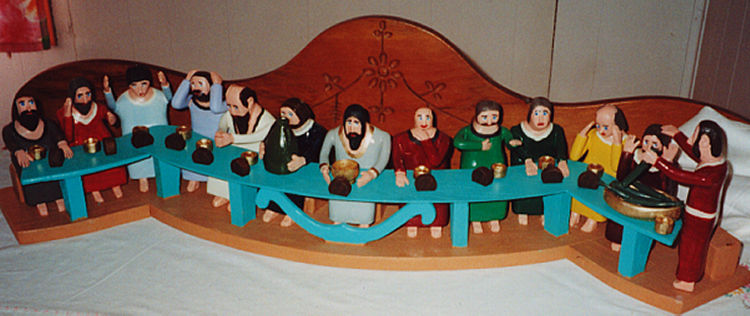
last supper, by Leo Fournier

last supper, by Leo Fournier

Sometimes our trips to Quebec were straight there and back affairs, but on other occasions we would take a few days to meander and explore, and it was on one such occasion in the early nineties that we found ourselves in La Prarie late in the afternoon with some time to kill before we hit one of our favored road side motels.  I pulled up to a phone booth, and said to Jeanine “let’s see if we can find Leo Fournier in the book.  Maybe we’ll get lucky.”  Our hearts sank a little when we realized there were over thirty Fourniers listed in town and only one L. Fournier.  Of course we tried this number first and it was not Leo, and furthermore they did not know of him, but we were not so easily discouraged and just started with the first listing and kept dialing.  Jeanine was getting a little tired after about a dozen dead ends, with not everyone being delighted to participate in our little search, but she persevered, and low and behold after about another six calls she spoke to someone who was a relative, and she was happy to provide his number.  “Well that was sort of easy.” I quipped. “O.K. well not that easy, and yes it was you doing all the calling”. In any case we dialed him up directly. and spoke to his wife Jeanette who said he was out momentarily but would be home soon, and he would be happy to meet us.  She gave us good directions to their house which we soon found on a quiet little street right across from a Depanneur , or variety store.

Old man fantasy by Leo Fournier

Old man fantasy by Leo Fournier

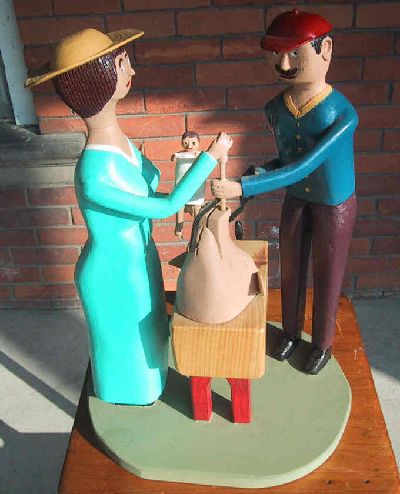
Leo met us at the door and warmly invited us in to the sunporch, where he liked to entertain visitors.  Leo was a very charismatic storyteller, and he launched right into some great stories while sit ting in his rocking chair sipping on a big can of Molson Export.  “ I like my beer but I only buy them one at a time.  That’s why I’m happy there is a depanneur right across the street” he laughed.” I noticed there were four empty cans next to his chair, but then again it was getting on in the day.  Jeanette arrived directly with some coffee for us and we spent a very pleasant hour or so listening to his stories.  He was a retired auto body man of good reputation, and was involved in the scrap business.  He told us about and showed us his first carving which was a crucifix done  in 1967 when he was 43 yrs. old.  Since that time until his death in 2007 he continued to be a prolific carver, selling to friends and the occasional picker, Nettie Sharpe among others who would come by to see what he had been up to..  He was aware that his work was included in books and exhibits, but he never felt he was really appreciated until sometime in the nineties when the Quebec government commissioned him to produce a series of about a dozen sculptures on food production.(See the butcher with hog’s head below) With this big pay cheque he chose to go to Leningrad on his own where he spent two weeks at the Hermitage studying the art there, rather than fix the roof on the house which was what the rest of the family was pushing for.  Leo was that kind of guy.  He lived his life the way he wanted to and never thought twice about convention.  We bought the six or seven pieces he had available that day and his house became a favorite stop on subsequent trips.  We always took the time to stop and listen to his stories. According to his pal Andre Laport who phoned to tell us of his death in 2007 “he lived his life just the way he wanted to right to the end, with no lingering illness, and a beer in his hand”.  Like so many others who knew him, we really miss him , and his infectious spirit.  One of the greats.

one of the works commissioned by the Quebec government

one of the works commissioned by the Quebec government

Discovering the picker’s barns around Victoriaville

Our old Bell van which served us well for several years.

To continue were I left off in my last entry, after visiting Marcel Gosselin we went on to a large picker’s barn we had noticed on the way into Victoriaville which is where we met Jean (Kojak) Deshaies.  As we arrived , the place was buzzing with activity as several pickers clamored for the attention of a completely bald man; pointing at, and demanding prices of items still being unloaded from his pickup truck. Not being used to this type of “pressure’ buying we went inside and started to peruse the rows of furniture and items there.  Nothing was priced.  We made note of several things of interest, and waited.  After several minutes the bald man came in and approached us introducing himself in a distinctive, low raspy voice as Kojak, and stated simply “how can I help you”. I was slightly taken aback by the intensity of his voice, abrupt manner, powerful short build, and the fact  that he had absolutely no facial hair including eyebrows. He seemed slightly hostile. We explained that we were dealers from Ontario, and that this was our first trip to Quebec.  He immediately broke into a big smile and grabbed my hand and gave it a firm shake, and after introductions asked us what we found interesting.  As we pointed out several pieces of early furniture, rugs, carvings, etc, he would offer a short description and then bark out the prices.  As we said yes to an item, a young helper would grab the piece and haul it off to a place by the entrance where he started to make a pile.  Kojak wrote the prices on a scrap of paper.  He warmed with every item chosen and before long would sometimes follow up the price quoted with a second lower price he called “prix d’ami” or friend’s price.   After covering the first floor he took us upstairs to an equally large space covered with inexpensive lesser, or incomplete furniture and items.  We found many more things there and again they were taken out as soon as we chose them.

By the time we came downstairs I was quite shocked by the large pile we had accumulated.  I expressed my concern that I might not have enough cash for everything , but he said not to worry because a cheque would be fine.  I was surprised at this sign of trust but he joked that he knew I would be back, and besides if the cheque was not good he would soon be at my door to collect, and I wouldn’t want that to happen. He told us that he and a few of the other local dealers were just back from New York city were they had marched unannounced into the office of a downtown lawyer who had bought several items in the area with bad cheques, and had not answered their calls.  “we just waked into his office, grabbed him by the neck and told him we wanted our stuff back.  We didn’t have to do more.  He took us right to the warehouse.  We were back home ten hours later.”  This was the code he explained. If you had trouble covering a cheque it was fine as long as you were up front about it, and made it right. No problem.  Getting all that stuff into my truck was another thing but we managed.

Jeanine looking for fabrics in Michel Prince's basement.

Even though we had very little room left we felt we had to go on to Defoy to see the other picker’s barns there.  We stopped in at the three Boudin brothers barns which were almost side by side along the main route.  Rene, the oldest brother we had read about was off drinking in a nearby town when we arrived so we did not meet him this trip, but we managed to pick up a few smalls in his brother’s places.  Then we called a number we had for a new picker named Michel Prince who was still operating out of the basement of his house.  We were surprised when his wife said he was not yet home but to come anyway.  We did, and were delighted by the warmth and friendly manner of Pierrette, who tended to us while her little children ran in and out of the furniture piles.  Soon Michel arrived and enthusiastically showed us the things that he had picked that day.  It was all quite magical and exciting.  We bought a lot of hooked rugs and fabrics because there was little room left for anything else. Our money was spent, our truck was full,  and it was time to make the twelve hour trip back home.

A full truck. Even the top rack was loaded. Time to go home.