The graphic appeal of old games boards

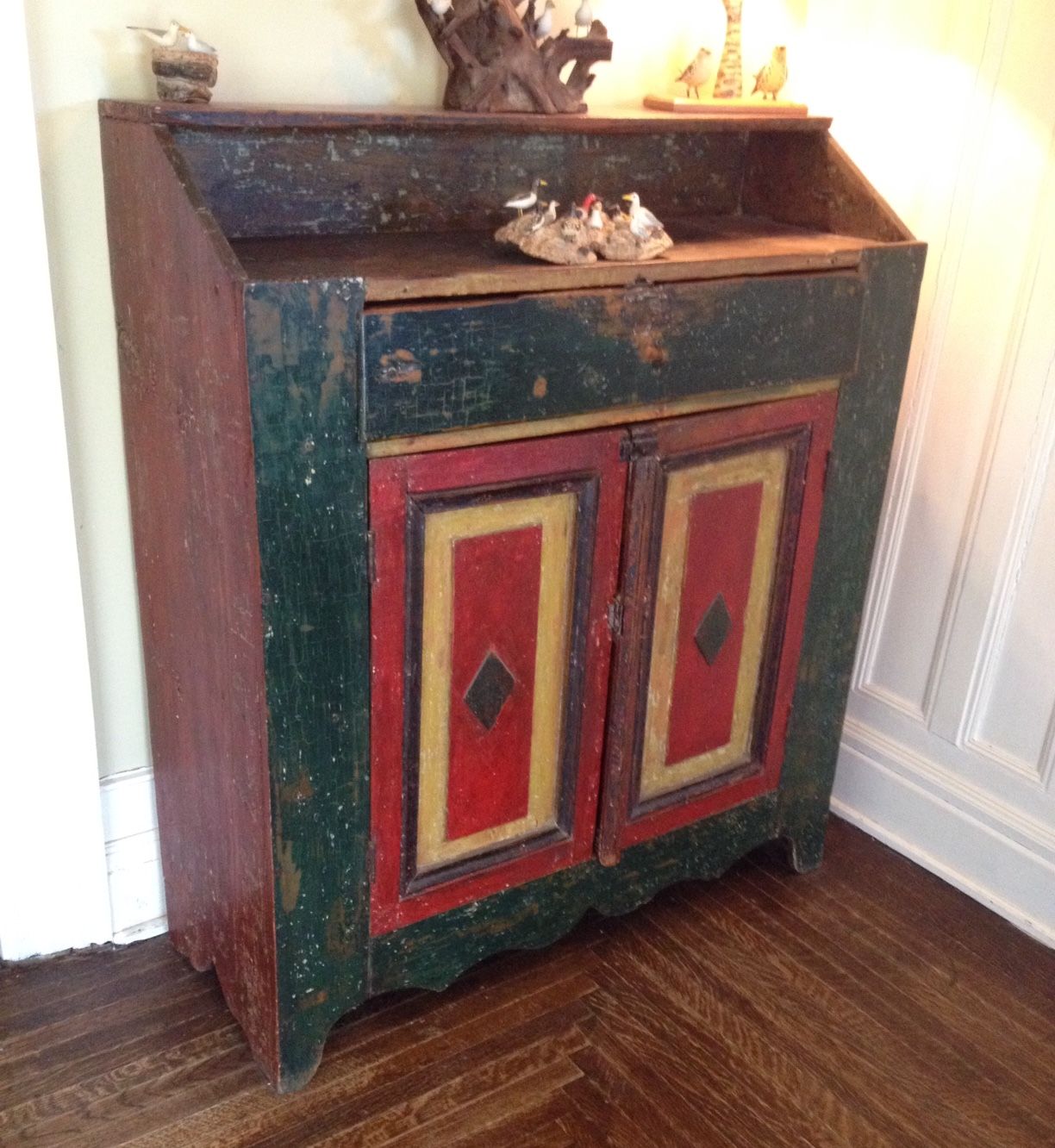
Quebec game board, 2nd quarter, 20th cent. offered by Martin Osler on the Collectivator site

The board game called “Checkers” in North America and “Draughts” (pronounced as “drafts”) in Europe is one of the oldest games known to man. The history of checkers can be traced to the very cradle of civilization, where vestiges of the earliest form of the game was unearthed in an archeological dig in the ancient city of Ur in southern Mesopotamia, which is now modern day Iraq.

Draughts (British English), or checkers (American English) is a group of strategy board games for two players which involve diagonal moves of uniform game pieces and mandatory captures by jumping over opponent pieces.

Octagonal sided game board, late 19th cent.,Waterloo, Ontario, offered by Wendy Hamilton on the Collectivator site.

The most popular forms are English draughts, also called American checkers, is played on an 8×8 checkerboard; Russian draughts, also played on an 8×8; and international draughts, played on a 10×10 board. There are many other variants played on 8×8 and 12×12 boards. Canadian checkers and Singaporean/Malaysian checkers (also locally known as dum) are played on a 12×12 board.  I have found that what is referred to as Canadian checkers, might better be called Quebec, or French Canadian checkers, because after years of buying and selling both 8, 10 and 12 square variations of the board, I have found that it is pretty much accepted that if a board has 12 squares across it is from French Quebec.  With 8 or 10 spaces, it is assumed to be Ontario or other “English” culturally based province.  How did this variation get started? Maybe folks in Quebec just liked a bit longer game.  After all, the winters are cold in Quebec so what’s the rush to get outdoors.

Circa 1820, Lunenburg Cty, Nova Scotia Parcheesi board, illustrated on page 216 of Canadian folk art to 1950, by John A. Fleming, and Micheal J. Rowan.

Chess may be considered the game of kings, but Pachisi is the game of emperors. Long before the American game of Parcheesi was first played in the late 1860s in North America, Pachisi, the Royal Game of India, had made its way around the world.

You won’t find nearly as many parcheesi boards out there, which illustrates that many more people went for the simpler game of checkers, but the boards are particularly sought after for their more complex graphic pattern.  And let’s face it, not a lot of people are buying old game boards to occupy their time on a Friday night.  For the most part, People buy old game boards to put them up on the wall as a graphic focus.  And who can blame them.  A checker board  is  inherently interesting.  We like looking at contrasting squares.   The orderly rows of squares suggest discipline, and harmony.  It’s peaceful and it draws the eye.

Quebec, mid 19th century Parcheesi board, illustrated on page 40 of the Price’s book “Twas ever thus”

I have bought and sold many game boards over the years although we have never added one to our collection.  I’ve found many that attracted me, but I think the reason I am happy to appreciate them and then find them a good home is because we like paintings so much that we want to donate all our wall space to them.  It’s the same reason we don’t collect old advertising.  I love looking at a great old sign, and some of it is as exciting visually  as a good painting, but they rarely turn my crank like a good painting will.  It’s true that some boards and ads do transcend into the realm of fine art, but they are few and far between, and such a thing has never fallen into my hands.

late 19th cent checkers board, Waterloo, Ont, offered by Wendy Hamilton on the Collectivator site.

Unlike most antique furniture or accessories, a game board can fit into many room décors be it traditional, or modern because of it’s graphic nature.   They also look fabulous grouped together.  We have friends with about 14 game boards placed carefully  over a very tall and wide wall in their living room and the overall effect is breath taking.   They are all different, while also being similar in that they all have the graphic checkerboard as the main component.  Some are primitive.  Some refined.  They all say something about who made them.  And of course patina can be a large factor.  The wear on some old game boards can beautifully tell the story of usage and age.  You are struck visually with the pattern, and at the back of your head you can’t help thinking about all the happy hours spent talking and playing the game together by countless individuals over the years.  You think about how when these boards were being used regularly, there were no game boys, television, or U-Tube to occupy your “down” time.  You could read when you wanted to be solitary, or if you wanted to have some entertainment and commute with others you would  find the local checkers or parcheesi game.  Or I suppose if you wanted a bit more of an intellectual work out you may play chess.  You still needed the board.

Because gameboards offer many interesting variations on a similar theme they are a natural and fun thing to collect.  I love looking at them.   If only we had more wall space.
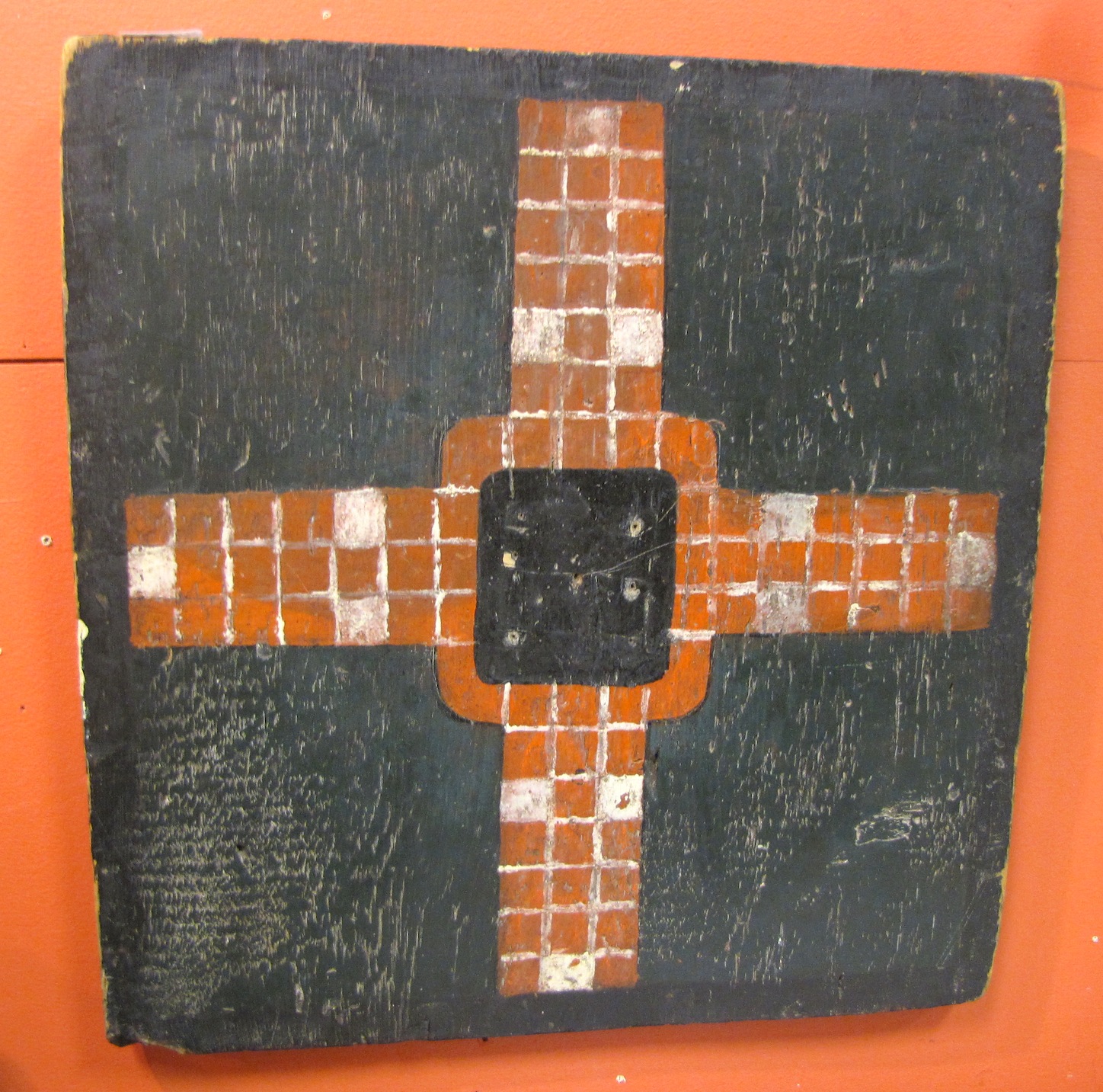
Circa 1880 Quebec Parcheesi board, offer on Collectivator by Croyden House.

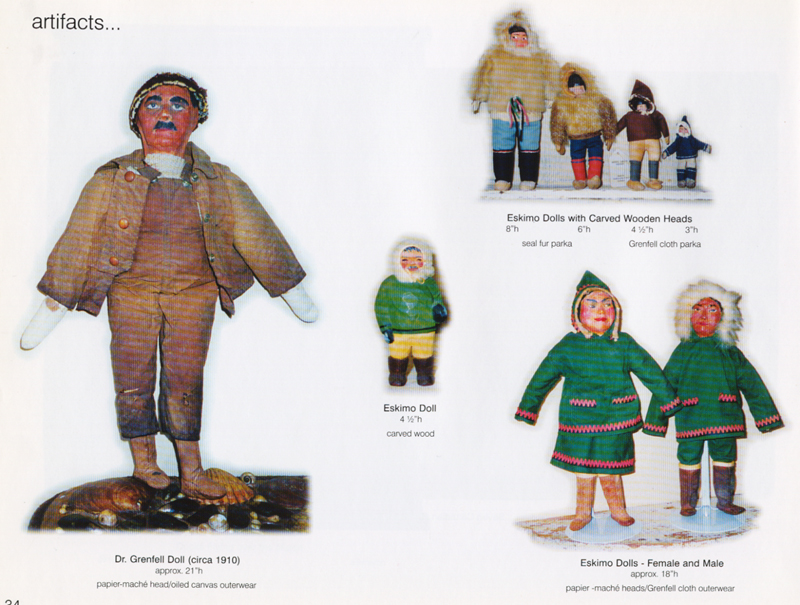
The Art of the Grenfell Mission

The April  2000, Bowmanville Antiques and Folk Art show was a special year in that it featured the show and sale of a large collection of the work created by artisans of the Grenfell Mission of Newfoundland.  The collection of about two hundred pieces was accomplished over a twenty year period of dedicated searching by Ontario collector Robin Moore, and the sale was organized by her friend and mentor, quilt and fabric specialist Carol E. Telfer.  A beautifully illustrated, 45 page catalogue “art of the Grenfell Mission, the Robin Moore collection” accompanied the show.  The collection was offered to be sold only in its entirety.

In her opening comments Robin Moore suggests “ Michael Rowan, an old antiques buddy, has always maintained that antiques are on loan to us – we are their custodians for a period of time.  It has been my pleasure to have been the custodian of this truly marvelous legacy of the people of northern Newfoundland and Labrador, which I humbly refer to as “my Grenfell collection.” The time has come to pass it on to the next custodian – to love cherish, and preserve.  My dream?- to have my collection return to St. Anthony, Newfoundland where it all began 100 years ago. Wouldn’t that be wonderful?  Well, wonderful things do happen, as the entire collection was sold on opening night to a Newfoundland museum.  A prime example of the importance and contribution to our national heritage that a dedicated collector can make.

There is quite a bit of information about Grenfell on line.  What follows are quotes from the heritage Newfoundland and Labrador site:

“The Grenfell Mission provided some of the earliest permanent medical services in Labrador and northern Newfoundland. Before the mission opened its first hospital at Battle Harbour in 1893, almost no health-care resources existed in the area – hospitals were nonexistent. Alongside its medical endeavours, the mission sought to make other social changes, specifically in the areas of education, agriculture, and industrial development. To this end, mission workers built schools and helped establish lumber mills, community farms, co-operative stores, and a commercial handicraft industry to create alternative sources of income.

British medical missionary Wilfred Grenfell arrived at Labrador in 1892 to investigate living conditions among local fishers for the United Kingdom’s National Mission to Deep Sea Fishermen. Shocked by the area’s widespread poverty and almost complete absence of medical resources, Grenfell spent the next year raising money at St. John’s and England to establish regular health-care services in Labrador. The mission opened a hospital at Battle Harbour and began construction on another at Indian Harbour. It also acquired a second hospital boat, the Princess May, to help medical personnel service fishing stations and coastal communities.

Alongside providing medical services, the Grenfell Mission sought to improve living conditions in general for people in Labrador and northern Newfoundland. To stimulate industrial development, the mission established a series of co-operative stores near many of its medical stations. Mission workers helped to create a local handicraft industry that allowed residents to sell hooked mats, knitted goods and other items at North American retail shops.”

From Wikipedia we learn “The Grenfell Mission established a Village Industry Department prior to 1930. Artists came from abroad to support the artistic endeavors of the residents of northern Newfoundland and Labrador.

The Grenfell Mission was famous for its burlap rugs, which were sold to hospitals in the United States and Britain. Encouraged and promoted by Dr. Grenfell, the rugmakers of the mission sometimes used designs created by Mrs. Grenfell. Beginning in the early 20th century, the International Grenfell Association (IGA) hired Jessie Luther of Providence, Rhode Island, to set up and direct the Grenfell Industrial Department. Grenfell established retail shops in England and in several U.S. cities. These shops were staffed by volunteers and augmented by travelling salesmen. Following the death of Dr. Grenfell and the surge in machine-made rug production, the business gradually failed.”

Carol Telfer did an excellent job of summarizing the Grenfell history in the catalogue with her two page essay “a brief history of the Grenfell Mission”.  I suggest you buy the catalogue which is still available, but if you want to learn the complete history in precise detail you can go to http://www.grenfellassociation.org/who-we-are/history/   the international Grenfell Association site.

The dedication to the catalogue reads “Dr. Wilfred Grenfell arrived on the north shore of Newfoundland more than a century ago.  He was greeted by a shy, yet industrious people who inhabited a beautiful, but isolated land. They led a harsh existence.  This catalogue- a visual tribute- is dedicated to the men and women of northern Newfoundland and Labrador, for the incredible works of art which they produced through the Grenfell Mission.  May their legacy continue.

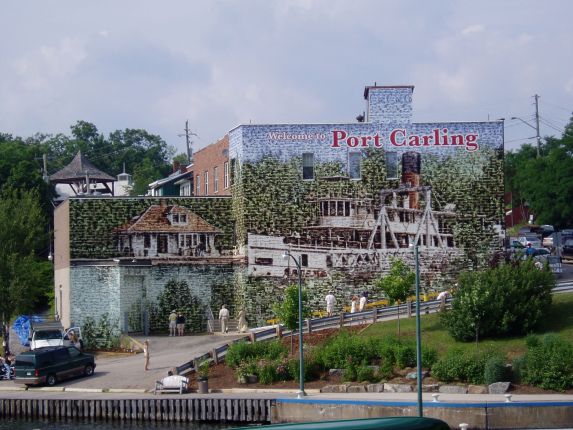
Amongst the stars in Port Carling

There were many reasons to look forward to doing the Port Carling antique show in the early nineties. It was very well run and promoted by the Gadsden’s. Unlike today, the town and area had very few antique shops and there were a lot of rich people building and buying cottages. In those days they would actually trust their own taste and come to the show looking to furnish their cottages themselves.  Nowadays they don’t trust their judgement and not wanting to embarrass themselves with something that would have their friends questioning their taste, they bring along their decorators who tell them what they should buy.

Also, in those days the show opened Thursday night and ran Friday and Saturday, which was not only great from the perspective of getting home on a day when the southbound traffic was light, but also worked well because many wives would stay at the cottage with the kids during the week while hubby worked in the city.  These wives would come to the opening and buy as they wished, or make notes of what they wanted and then drag their husbands in on the Friday or Saturday.  It held the potential in those days of being our most profitable show, and we were always looking for “cottagy” things to take to the show.   Canoes, rustic furniture, folk art, and all things you associate with a vacation home were almost certain to sell.  The Thursday night opening was a feeding frenzy, and as soon as the doors opened and the line-up filled in you had to be on your toes because it was common to have more than one person wanting to buy something at the same time.  You had to be careful, especially with two sellers operating the booth that you didn’t sell the same thing twice, to two different people.  There’s your potential for some nasty exchanges.  Things would settle down a bit after that initial hour, but  sales would remain strong over the next two days.   And then there was the additional excitement of exchanges with movie stars. 

During set up on Thursday all the talk would be on whether Kurt and Goldie were in town, and which famous friends they might bring along to the opening.  Nancy Short, Martin’s wife could be counted on.  She came every year and would buy a lot.  She would also bring along friends and encourage them to buy.  She was also a very nice woman, so we definitely looked forward to seeing her.  I enjoyed selling a pyrotechnic decorated rocking chair to Mary Tyler Moore one year, who was as nice as you would imagine her to be.  When Joanna Cassidy bought a piece of folk art from me, I have to admit that the scene in Blade Runner of her running away from Harrison Ford and eventually being shot and falling through panes of glass, kept running in my head.  Quite distracting.   It was always a delight when the wonderful Catherine O’Hara would turn up looking like an un-made bed and trying to rope in two or three unruly children.  She was always funny and friendly, and would treat you like her neighbor.

It was the talk of the show one year when on the opening night,  Kurt and Goldie decided to buy a little side table from us. At the time, I was helping to load a dresser we had sold in the parking lot, but I heard all about it before I got back into the hall.  Jeanine does not know, or for that matter much care who Kurt Russell is. I don’t think she was into “Escape from New York’ the way I was. “Snake” didn’t mean anything to her.  She recognized Goldie Hawn of course, but she is not particularly impressed with stardom in any case, and tends to treat stars like anyone else. I think that for the most part most stars actually appreciate this, but they do get used to being treated as “special”. It started when she questioned Kurt about his visa card.  “well, I can assure you it’s good”.  “I’m not worried about that, it’s just that I’ve never seen a card like that before”.  It wasn’t that she mistrusted him, but it was from a bank she had never heard of.  “O.K., can you bring the table to the loading door, and I’ll get my car.”  “Well as you can see I am on my own here, so if you can wait until my husband returns he will do it, or otherwise might I suggest that you seem like a fit and strong man, perhaps you can carry it yourself. “  He looked surprised, and somewhat taken aback, but then smiled, and said “Of course I can.”   Our neighboring dealer could hardly contain herself.  She immediately rushed over. “Don’t you know who that was.  That’s Kurt Russell, he’s a movie star and married to Goldie Hawn”.  “Oh really.  How nice for him, but still I am right that he was perfectly capable of carrying that table himself”.  That’s the way Jeanine calls them.  I love that. Everything I hear suggests that Kurt’s a regular guy, he just forgot how it felt to be treated like one.  I think he enjoyed it.

our booth at Port Carling, one year in the early nineties

Remembering the Pierre Laplante auction- a vast collection of Quebec folk art and antiques

We first met Pierre Laplante when he participated for one time in the 1997 Bowmanville Spring Folk Art and Antique show.  We set up just down the aisle from him and before the show was over we had gotten to know each other through many friendly exchanges, and also he bought a giant lumberjack that was our show stopper to put in his indoor pool area at his rural home.  Nice fellow.

It was announced at the show that Bill Dobson was managing an auction of Pierre’s collection on May 17 and 18th, with auctioneers Tim Potter and Cec Knight in Kingston.  It was exciting news as Pierre had a reputation as a very serious collector of Quebec folk art.   We had heard many stories from the pickers in Quebec of the dentist from Montreal that would buy almost everything that they would bring to him.  Often this was said in the form of an apology for not having anything to offer us.

cigar store Indian marked “Illinois”, late 19th cent. – $5,000

If you have the money and the will this is a very effective way to collect.  Once a few pickers know they can rely on you to buy almost anything they bring you, they will put in a special effort, offer everything to you first, and as they say be happy to “make hay while the sun shines”.  It was rumored that after a few years of collecting this way, the barn and out buildings at his weekend farm in the La Prairie region south of Montreal were chock full of wonderful stuff.   Folk art was still a very strong market in 1997 so when the auction came, we broke open our piggy bank, and went loaded for bear.

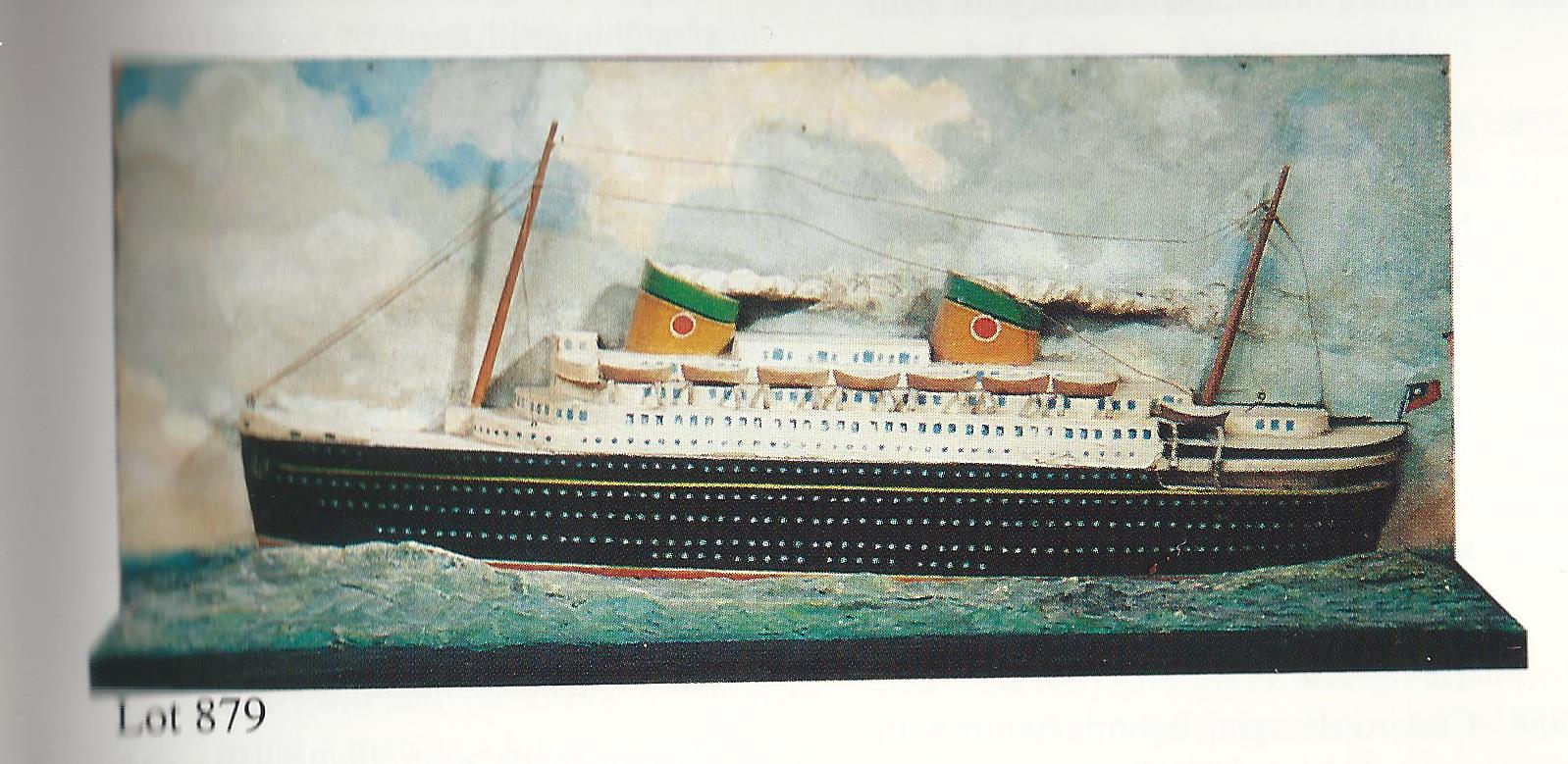
mounted wooden model of a steamship,early 20th cent. – $750

The catalogue has an interesting two page introduction by Pierre which explains his interest.  It begins:

“The wellspring of folk art lies in the heart, not the wallet.  It is an audacious mix of techniques and materials; a multiplicity of themes and genres.  Folk artists are not artists in the conventional understanding of that word, rather they are ordinary folk without pretense or grand artistic ambitions. Through Quebec folk art, we can glimpse the geographical, historical, social, and religious character of the province, and in that sense, the heritage of Quebec folk art ranks along with its architectural and technological history.”  He goes on to discuss the many factions of folk art and concludes; “ I have collected folk art for over 30 years.  It’s a past time – even a passion – that gives me the opportunity to meet people who live anonymously but have many things to say, and they do speak, in their own way.  Many of these talented people are not considered artists.  They should be. Perhaps if they had lived in another place or another time, they would be considered such. There’s so much great folk art there that deserves a place of honour in all art collections.”

Well said Pierre, and the massive, well organized, two day auction saw many such pieces make their way into some important collections, while realizing some pretty phenomenal sale prices.

Lucien Legare horse, buggy and rider

We were able to buy a lot of stuff. We paid relatively big money for some things like this Lucien legare horse, buggy and driver at $750, but with so much on offer we were able to scoop up many bargains as well.  Like this Felicien Levesque tableau of the Titanic sinking at $625. Well under the money.

The Titanic by Felicien Levesque

Things started out modestly with maple sugar molds, and smaller carvings and accessories going in the expected $200 t0 $400 range, and then people started paying attention when lot 161, a painted whirligig Mountie which is illustrated on the cover went for $900. Soon after a tin rooster weather vane in old white paint realized $1,250.  Then lot 195, a knife with carved wooden handles in the form of a fleurde lis with a man’s head brought $1,900.  Things were moving.

There were a few gasps when a beautiful Nova Scotia document box from 1914 with interlocking hands, hearts, stars, and leaves went for $1,900. Followed shortly after by an oil on glass painting of tugboats on the Saint Lawrence attributed to Captain P. Carbonneau which saw $2,500. An Alcide St Germain hanging flying goose achieved $1,000, and the tone was set.  Here’s a couple of the highlights.  There were many more.

We went on to establish a relationship with Pierre after the auction and were invited to visit him and his wife at their farm.  We had a wonderful evening of laughter,  good conversation and an excellent meal, and we even enjoyed the adventure of climbing up the tiny ladder to the second floor guest room of the century old farm house.  I made sure my bladder was empty though because I didn’t fancy climbing down in the dark to find the washroom.  We realized that for as much was sold at the auction, he had twice as much great stuff still in his collection.   We even had a chance to say a quick hello to our lumberjack friend in his new residence by the pool.
large pulpit decor from Grosse Island where Irish immigrants were held in quarantine, made as a greetings from French Canadians. – $3,100

Antiques I love, and why I love them – part 2, a tiny tin fiddle

 A friend and fellow folk art enthusiast came by yesterday, and while we were enjoying a nice cup of coffee the conversation lead to an exchange questioning what is it about certain objects that make us like them more than other objects?   Any conversation about personal aesthetics is at best subjective, and at times downright obscure, but it is better than talking about the weather.  So as an attempt to get down to defining the source of the desire to possess I asked my friend, “Hypothetically, If I were to let you take home one item from our collection that you can see from where you currently sit , What would it be”.  After a pause and some reflection he said, “I would take that tiny fiddle hanging on the wall over there”. This surprised me, because we have a lot of flashier, obviously more expensive items around, but yet I understood, and might likely to have answered in the same way.

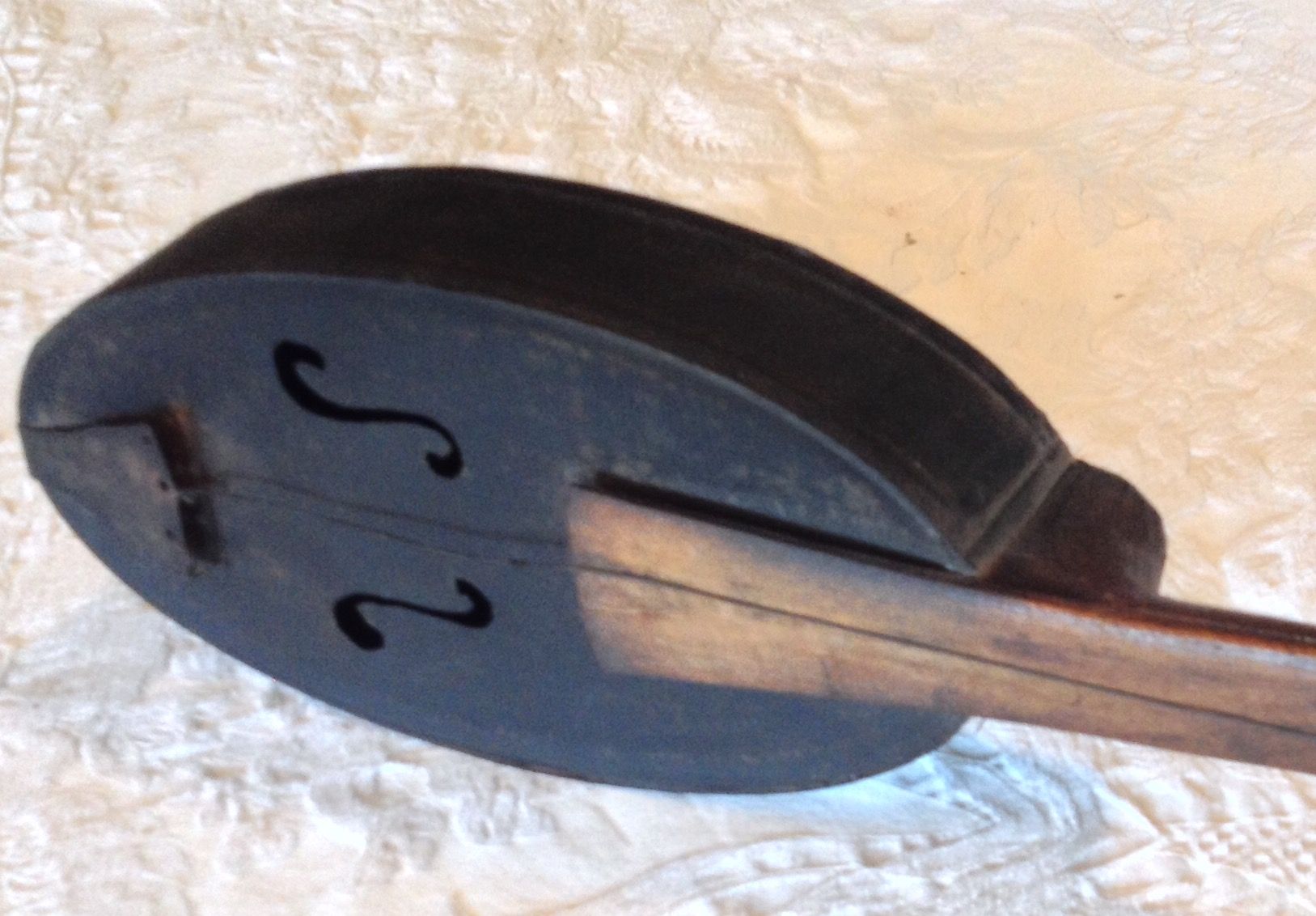
It is unclear if this 18” long, 4 string fiddle made from an old herring tin and carved wood was ever meant to be played, but my guess is it was playable when it was made.  When I study it, I imagine that it may have been created as a gift to a child to encourage musicianship, but it is equally possible that it was created as a “gag” instrument to be pulled out for surprise at a strategic moment in a performance.  Maybe the guy or gal just wanted to make something to put on the wall, or to give as a gift.  It’s fun to think about, but in the end you get back to the object. 

I remember finding it under a big pile of junk in Alan Chauvette’s  pickers barn near Victoriaville Quebec back in the early eighties.  Alan was standing nearby writing down what we were buying and the prices.  I held it up and said “how much for this”  Alan glanced up and said “$45”.  “O.K. write it down”.  I don’t think he looked closely, or maybe he doesn’t share my aesthetic because I felt it was a steal.  But then again I have come to realize that things of great esthetic value do not always get recognized monetarily.

Some people, or I would imagine many people would think that even $45 is too much for a rusty old tin can fiddle, but they are different from me.  I love the thing.  I brought it home from Quebec.  I hung it on the wall, and to quote the late, great Charlton Heston, “ to get it, you will have to wrench it out of my cold, dead, hands. “ So what is it?  Obviously, the colour and untouched patina are superb, and the form and hand carved neck and machine heads are beautifully executed in a functional, yet slightly primitive sort of way.  The “F” holes are beautifully cut out, and the construction of tin, wire, and wood is wonderful.  All these elements hit  the pleasure buttons in my  brain, but I think it Is the fact of the herring tin body that puts me over the top.  I looked for a long while half consciously wondering how they got the herrings out of the tin which looks original and undisturbed save for the “F” holes, before I investigated and saw that there is a neat row of nails around the bottom attaching it back to the sides.  Great care was taken to create this.  A real labor of love. I love the way it is, but when I imagine it with it’s bridge intact, and the other three strings, I wonder what type of sound it would have made.  One would assume, tinny.

I found my “sunshine” tractor in a little shop north of London, Ontario a long time ago.  Again it was an item which went straight to my heart, and as I purchased it I knew it was something for me.  Something I would never want to give up.  I’ve bought and sold hundreds of hand-made toys, many more impressive in construction and scale, and yet it is this tractor which continues to sit in a glazed cupboard overlooking my work desk.   I love it’s construction and form and colour, but the element that takes it into my top drawer is the little “sunshine” sign.  I’m not an armchair psychiatrist per say, but it doesn’t take Freud to understand that my love probably has a direct route back to my mother singing me “You are my sunshine, my only sunshine” while I lay sick in bed with the measles at the age of ten.  That song is such a bittersweet tour de force isn’t it?  I get emotional just thinking about it.

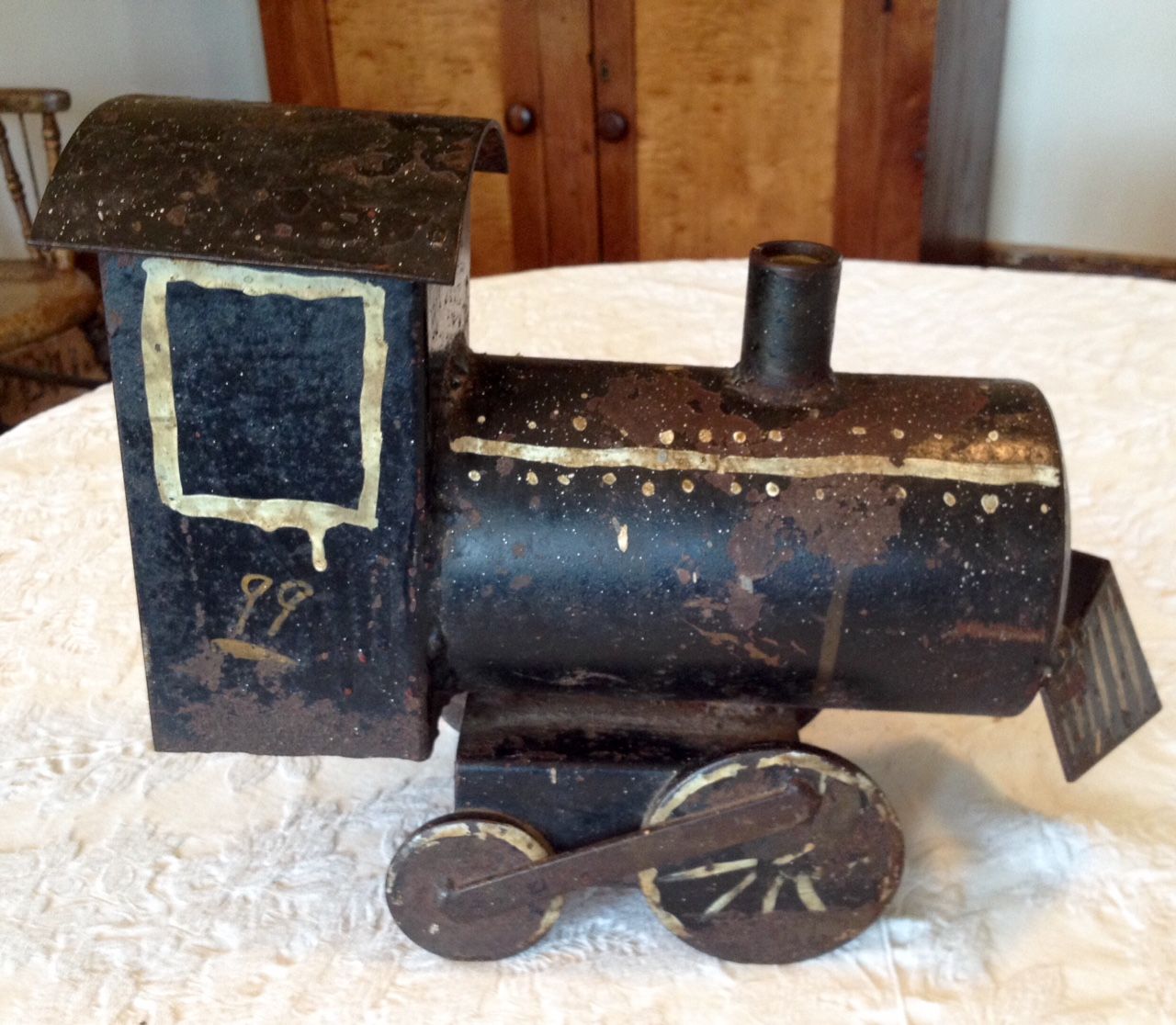
Lastly, we come to “Old 99” (see 99 painted on the door). To be honest I don’t love it nearly as much as I love the tin fiddle or “Sunshine”, but I do love the fact that someone with welding ability, probably a professional welder, took the time and effort to make his or her child an indestructible toy locomotive, with a space at the back to put an engineer.  Is that an old bullet used to make the smokestack?  I hope not.  The poor kid could blow up.

Les Patenteux du Quebec, the “bible” of Quebec folk art

In 1972 three young Quebecoise, Louise de Grosbois, Raymonde Lamothe, and Lise Nantel began research on Les Patenteux du Quebec.  Patenteux is an idiomatic Quebec word that roughly translates into Inventor or Creator.  The book was published by in 1978 with assistance from the Quebec Ministry of Cultural Affairs, and The Canada Arts Council.  For six years, the women sought out “Patenteux” across Quebec, documenting their words, locations and creations for posterity and to as they suggest in the introduction,  to be a “monument to our culture”.  You know how certain books become “the Bible” of a subject? Well this is “the Bible” of Quebec folk art.  A work of great importance now, and in the future for anyone interested in understanding and appreciating Quebec culture.

In the introduction they state, “We started research in 1972 at a moment when our culture interest was to return to the source, born from a feeling of sharp Nationalism which succeeded a long period when we were easily dazzled by everything foreign. We perceived that the Quebecois people, who had survived 300 years of systematic humiliation and dispossession,  was not a people without culture and history. The ingenuity that our ancestors applied to adapt to the climate, and to conquer their isolation testifies to this. They had to survive.  They had to reinvent their architecture, their tools, their ways of feeding and clothing themselves, as well as their celebrations.  This process of rehabilitation of our history and culture, which was an attempt at decolonization has given us a new image of ourselves, and brought us to search for our identity.”

 The book records seventy five artists broken into nine geographical regions.  It is a treasure of information which is out of print and now hard to find. It has never been translated into English.   There’s a Canada 150 project I would like to see.  A hardcover version in both official languages.  But it seems the money is going to fireworks and giant rubber ducks.  But I digress.

I love this book even though I struggle to understand the accurate recording of the patois of the subjects.  There’s lots of wonderful pictures.    In my February 18, 2013 blog  “My happy time with Mr. Joly’s whirligig” I recall our first encounter.  “Fast forward to the next summer and we are enjoying a weekend in Quebec, our favourite North American city.  We had heard of a bookstore where it was possible to buy a rare book, Les Patenteux du Quebec,  which we knew to be the “bible” of Quebec folk art.  Published in 1978, it is the work of three young Quebec women who spent  a summer or so traveling all over Quebec documenting, and recording the stories of every Quebec folk artist they could trace.  We found the shop and bought the book, and when we cracked it open, it opened to page 19, and behold there was our whirligig. With a picture of it in it’s original location, and a statement by the artist.  Extraordinary.”

The love and respect shown to the artists is clear by “ the letter to the Patenteux”  which begins the book

“You encouraged us to make this book by telling us that you would like to know what the others are doing.

We wanted everyone to recognize you.

We hope that we have been faithful to what you have told us, and that you will recognize yourself. We apologize in advance for the errors which may have crept into the information we give.

A wonderful memory of you is guarded. Your great vitality has given us the taste to live for a hundred years, to get to do things as extraordinary as you do. “

Over the years I have been able to identify the unsigned works of many artist by thumbing through this book.  Every time this happens I thank the authors, and I inevitably linger, trying my best to decipher the comments, and just letting myself imagine meeting and experiencing the environments the artists create.  It has also helped us track down many artists who  continued to live and work in the places they were recorded.  Folk artists tend to stay put.

For all these reasons I salute and give a heartfelt thank you to the authors for their dedication over the six years it took to produce this book.  You have made a valuable contribution to the Quebec cultural identity, and further to our Canadian Identity.  A book worth having. Try to find yourself a copy.

Remembering the first major unreserved auction of Canadian Folk Art – the Sutherland/ Amit Collection

As with most cultural expressions, the Interest in folk art waxes and wanes over the years.  In 1994 when the announcement for the auction of the Ann Sutherland and Zalman Amit folk art collection came out, the market was hot.  The couple’s reputation as collectors, both doctors who ran a busy behavior therapy and research clinic in Westmount Quebec, was well known primarily  by their many published articles on folk art. They owned a seven bedroom house in Nova Scotia which they filled with a large, eclectic collection of folk art, assembled on collecting trips to Ontario, Quebec, and the Maritimes.

Blake McKendry wrote in the catalogue “recently, when Ann and Zalman added another piece of folk art, Zalman had to put it in the wine cellar, saying that not another piece could be stored even in the basement. Much soul searching was required before a solution could be rationalized. The collection had become too large and valuable to be managed by two busy psychologists who wished to move to a much smaller house.  On the other hand, there was no desire to suppress the shared desire to collect.  A solution evolved: disperse the entire collection by auction and divert the collecting urge to a different but related field – Canadian drawings.  The result is the first major unreserved auction of Canadian folk art in all its forms.”    Mr. McKendry went on to say about the collection, “ The entire collection is in the auction.  More than forty identified Canadian folk artists, sculptors and/ or painters are represented, some by several pieces. A large number of these works are by Nova Scotia folk artists and no doubt these will be highlighted by auctioneer Chris Huntingdon’s witty and insightful remarks.”  Lord knows, that be true.  All who attended will remember the high level of theatricality not only in Mr. Huntington’s lively commentary, but also in the evening gowns and over the elbow elegant gloves worn by  the lady presenters, complete with hand gestures, making the whole affair feel a bit like “the Price is Right”.
The auction was managed by Bill Dobson. It took place in two sessions at the Bowmanville sports complex, where the Bowmanville Spring Antiques and Folk Art sale takes place annually. 196 items were auctioned off Friday, January 21 at 6 p.m. , the remaining 336 items went up at 10 a.m on Saturday.

We were very excited to attend. We made a little family vacation out of it when our teen age daughter Cassandra who was beginning to develop an interest in folk art, decided to come along. With Chris Huntington’s commentary and all those competing collectors, it was bound to be an education. I remember as we walked into the complex to the preview Friday at 3, that she looked over everything and landed her attention on a stunning, large mechanized sculpture of a hawk by Ralph Boutilier.  Then she said, “ I know you will be wanting to be buying things for resale, but if you want to know my opinion, I would just spend whatever is necessary to buy that hawk, take it home, keep it; and forget about the rest of it.”  I took her point, but as she observed,  we were primarily interested in buying as much as we could to resell.  We created a list of all the pieces that we were  interested in, and after consideration noted our top bid in each case.   When the auction started at six, we were ready with catalogues in hand ready to write down all the prices realized. We noted that Item # 14, a painting of an Ox team by Maud Lewis sold for $550, which was about what I was paying for them at auction at Waddington’s  in those days.  An erotic drawing by Collins Eisenhauer (1898-1979 )item #18 , which we have owned once, and appeared again at this year’s Bowmanville, sold for a very reasonable $175.  A nice early Merganser (#37) went for $850.  Chip carved crooked knives went in a range from $100 to $500.   We bought a very nice watercolour and ink drawing of the the ship Mauritania by Albert Lohnes (1895-1977) which still hangs in our living room. Also a hooked rug of confronting roosters and  three different roosters by different artist.  We were quite pleased with our take that first night, but knew that the bulk of what we wanted would be offered on Saturday.

Saturday morning the place was packed. Things started slowly with a lot of glass and decorative items.  You know that a Limoges dinner service for eight, nine pieces per setting is in the wrong place when it only brings $150.  People were there to buy folk art and early furniture. It started to get exciting when some early Quebec carvings by the likes of Louis Jobin (1845-1928) started to bring in four figures.  Then the  Boutilier hawk (#317) hammered down at $2,750.  We were the underbidder much to Cassandra’s disappointment, and yes, our almost immediate regret.  I like to say when people are himming and hawing about buying a piece, “You’ll never regret what you buy.  You only think about the pieces you let slip away.”  This hawk is a perfect example. 
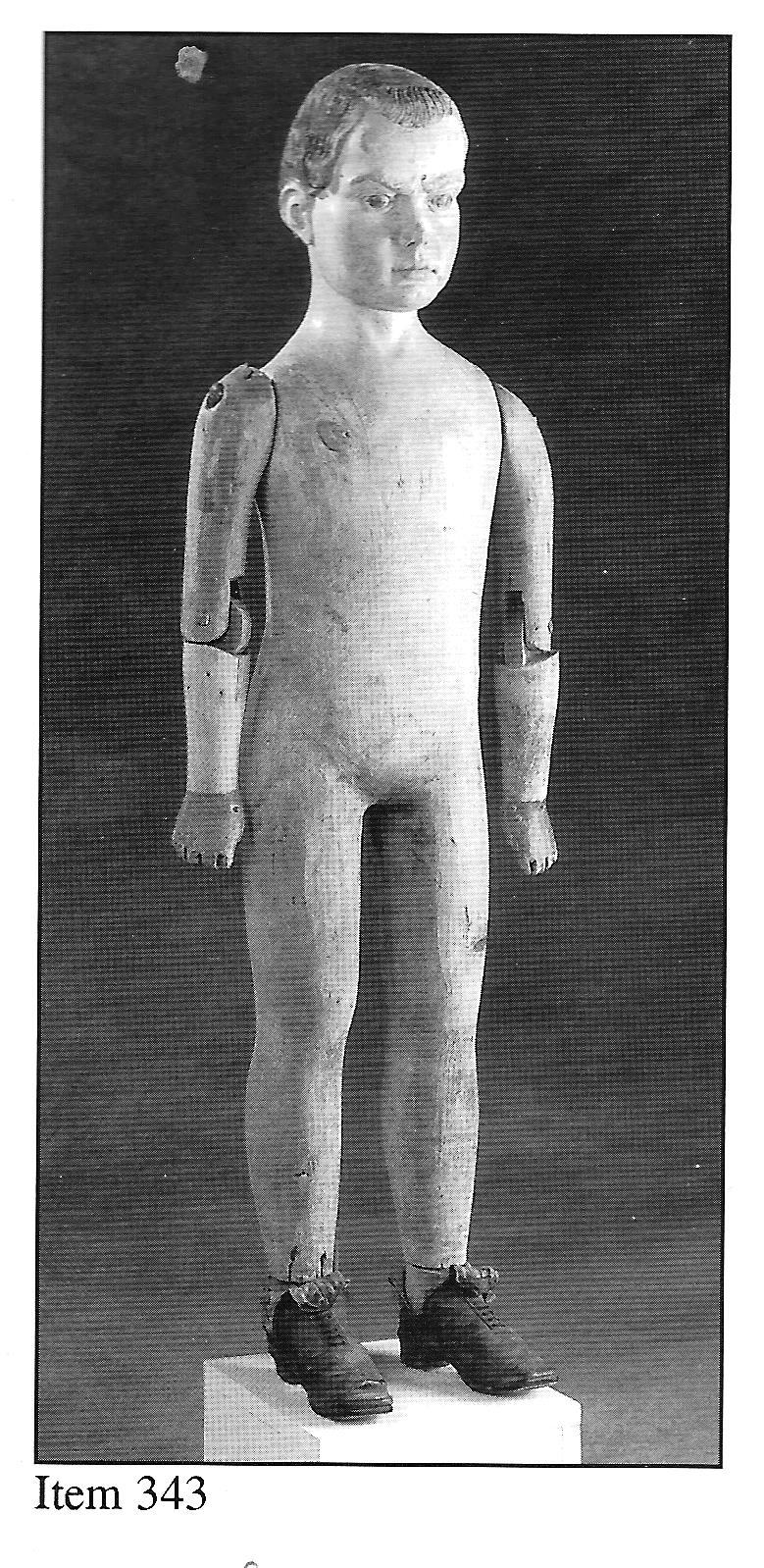
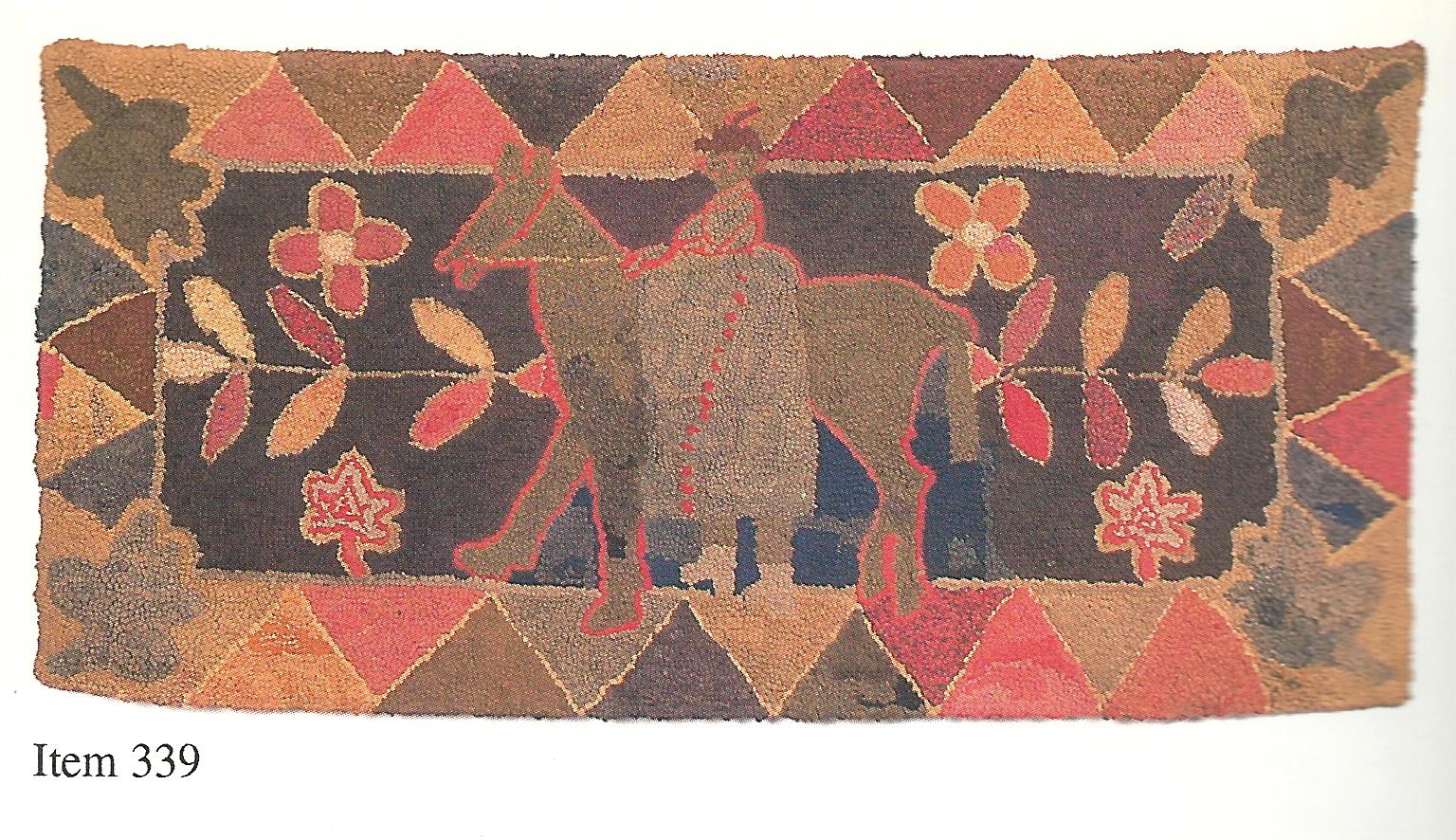
Then we hit #343, a carved figure of a youth, polychromed and articulated, mid 19th century. Found in Nova Scotia.  A few jaws dropped when it realized $9,000. Some of the furniture was strong. A painted and paneled Wilno box (#357) went for $6,500. A hooked rug of a woman on horseback (#339) realized $3,400.  A continuous Windsor armchair (#353) saw $2,750.

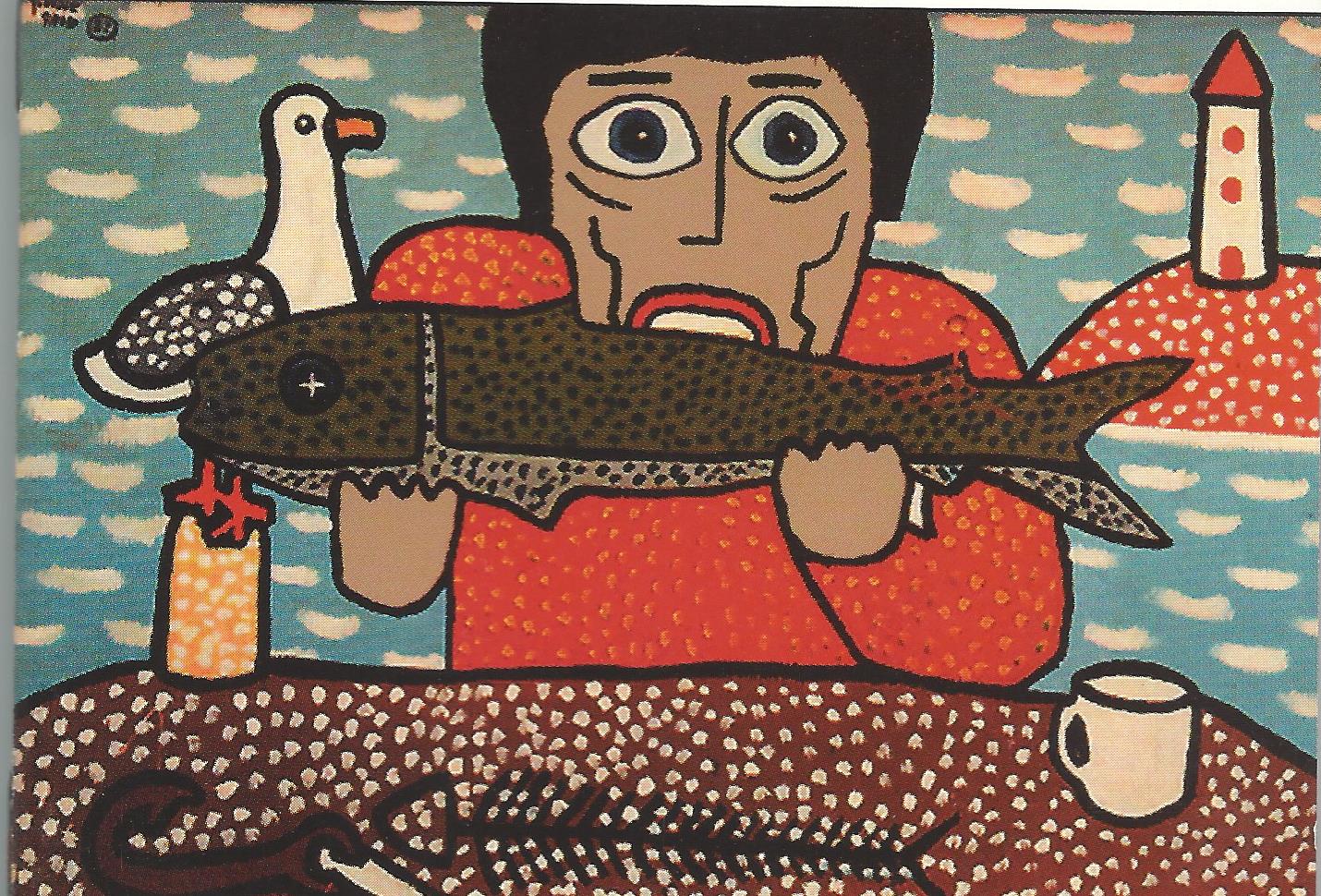
And so it progressed, slowly. Very slowly.   Chris Huntington’s dialogue although informative and entertaining initially, eventually started to draw things out to the point where most were wishing for a more conventional, let’s get it done style of auctioneering.  Eventually, item # 384 arrived.  A large 205 x 143 cm painting described as a fisherman’s village by the legendary Lorne Reid (1954-1992). Our second most coveted item after the Boutilier hawk, and we won it at $850.  A lot more than we had hoped to pay, but it was ours.   We owned it for several years and loved it in spite of the fact  it was not an “easy’ subject to live with. What appears to be a starving man staring at a fish skeleton is not all that cheerful. There is a bigger story there. One which I will go into another time.

After a couple of more small purchases we packed it in and left for home, about 4 in the afternoon if I remember correctly. There was still about another 100 items to be offered, but we had spent a whack of money, bought a lot of stuff, and were grateful for the experience.  I still wake up occasionally thinking about that mechanical hawk.  What a thing that is.  I wish it were mine.

Fond remembrances of participating in L’ Exposition et Vente d’Antiquités d’Eastman

In the late nineties, it was common knowledge that the two finest country antique shows in Quebec were the North Hatley show held in July, and The Eastman show which ran in late September.  The two towns are situated about 30 kms apart in the beautiful Eastern townships region,  and so you would think that many of the same people would attend both shows, but the reality is these shows reflect the “two solitudes” of Quebec, with the North Hatley show being attended mostly by local, English-speaking home and cottage owners, while Eastman is predominantly attended by local Francophones.   In those days at least, not many of the English dealers who participated in North Hatley would consider doing Eastman. They believed that unless you were recognizably French Quebecois with good language skills you would be overlooked.  We heard this over and over for a few years before we decided to test the theory.  I get by fairly well with my high school French, and of course Jeanine being from France, speaks the language beautifully.  The thing is although neither of us were Quebecois,  we determined that we could overcome this by just being welcoming, open, and good natured.  We also liked the town and would go through from time to time to visit a good shop there,  Antiquities Rosalie.  A family place where we often found good folk art and early smalls. 

Antiquities Rosalie

We knew also that the mayor there,  Mr. Pierre Riverin was one of the biggest collectors of Quebec folk art in the country.  He had “made” our show in North Hatley the previous year and suggested that we come to Eastman.   So we contacted the show promoters and were happy when they welcomed us to come, and gave us a space in the main salon which was in the basement of the church at that time.  This original space only held 15 dealers and as this was 1999 it was the first year that the show had been expanded to a second salon in a “Golden Years” club a couple of blocks away, bringing the total to 30 dealers.  Of course people checked out both locations.

Unloading through the back door into the basement we definitely felt like the “new kids’ at school, but everyone was friendly and helpful and it didn’t take long to set up and feel quite at home.   We discovered that Tom Devolpe,  a dealer friend of ours from Montreal was doing the show as well, and we were staying at the same motel so we suggested that after setting up he come to our room for a glass of wine and a snack before going to the dealer welcome night, being held that evening in the restaurant of the same motel.  What a nice idea to have all the dealers get together for dinner before the show.  Dealers love to be fed. 

Tom DeVolpe and me having a glass on another occasion

We stopped in a local depanneur, or convenience store to pick up a bottle of red and some cheese and bread to share with Tom in the room.  This is one of the wonderful things about this region.  Even the smallest local stores have a good selection of wine and cheese, not to mention pates.  We bought a great baguette, and a soft ripened cow cheese from France  called Chaource which we had never encountered but which immediately became one of our favorites.  I remember that it was 40% off because it was quite ripe, but this of course made it even more delicious.  We should have had to pay more because it was perfect.  It could have been that we were just really hungry from setting up and skipping lunch, but that snack of fresh baguette, Chaource, and a few olives  with Tom in the motel room remains one of my favorite all time eating experiences. 

I recall we were a little tipsy walking over to the restaurant for our 7 p.m. seating.  When we arrived we were taken directly upstairs to a private room just large enough to hold the 60 or so people participating in the show. We were all assigned a table and presented with the menu, and a program. A program of all things.  We sat next to our old friend Alan Chauvette who owned a pickers barn near Victoriaville.  It was his first year as well. 

The meal was excellent, and surprisingly we still had a bit of appetite after all that bread and cheese.  The place was soon hopping, and quite noisy with all those ramped up dealers.   Then came desert, and along with it a few friendly greetings and encouragements from the promoters, followed by a sing along.  Yes. I didn’t see that one coming. There in the program were the words and tune to follow for three or four special antique dealers songs.  Everybody now, let’s sing,  “Nous sommes les Antiquaires”  set to the tune  of  “Les Miserable “ or some such thing.  I forget exactly but it was hilarious, and good natured, and friendly, and everybody sang along. 

This was followed by the announcement of who had won the “best booth” award which was a prize of a free ad in a local trade magazine were you could announce your honor I suppose.   Being newbies we had no expectation of winning, and it was no surprise when a local couple won who not only had a beautifully set up booth, but also wore (get this) period costumes.  I looked over to Alan, and said “ah that’s it Alan, next year, –  Costumes!”  We just about fell out of chairs.  The festivities and merriment continued well into the night, but we soon made our good-nights and left to get a good night’s sleep. 

The show was great. People were friendly and interested, and sales were brisk.   Contrary to the fears of our fellow Anglophone dealers we were made to feel most welcome and accepted.  We went back for another four or five years until we changed policy and only did shows close to home.  It’s still going on today but has been moved to a larger facility “La Grillade” where there are 50 dealers in one space.  Well worth a trip to this region, especially in the fall. 

us setting up in Eastman

The last known works by Rosario Gautier

This handsome fellow lives in our living room.  He is a favorite of ours, and we have come to find out that he was made by Rosario Gautier, late of St. Charles de Bourget, Lac St. Jean Quebec,.  We didn’t know who made it when we bought him about 25 years ago,  and it didn’t matter so much because we loved the piece, but it was satisfying to eventually put a name on it.

Over the years we have found and bought several pieces by the same hand.  The chunky, colorful style is unique and easily recognizable, but all we encountered were unsigned, save for a few initialed “RG”.  Not a lot to go on.  Then one day, some picker, I can’t recall who, said ”Oh, yes that’s Rosario Gautier from Lac St. Jean.  He’s been carving for years.   Now at least we had a name and place to ask about.

The next big break  came in Quebec city when walking back late one night to our hotel after a particularly memorable meal and lots of good wine with friends who are lucky enough to live there.  We passed in front of a closed antique shop and there in the street light was a photo in the window of Mr. Gautier, along with several of his pieces, and a short hand written bio.  We were able to find a pen and paper and copy out the bio, and take this slightly blurry picture through the glass.  We were up and out in the morning and never got back there.

Here’s what we were able to record about him that night. “Rosario Gautier was born and lived all his life at St. Charles de Bourget, Lac St. Jean, Quebec.  Father of a large family (12 children of whom 9 are still living), he was a farmer and a blacksmith in logging camps. He started carving after retiring in 1971, and produced a large body of work. Most of his pieces are in the medium size range, but he also produced life sized animals, as well as an eight foot crucifix. The muse de la Civilization du Quebec owns 350 of his pieces, and he is represented in many major collections in Canada and the Unites States.”

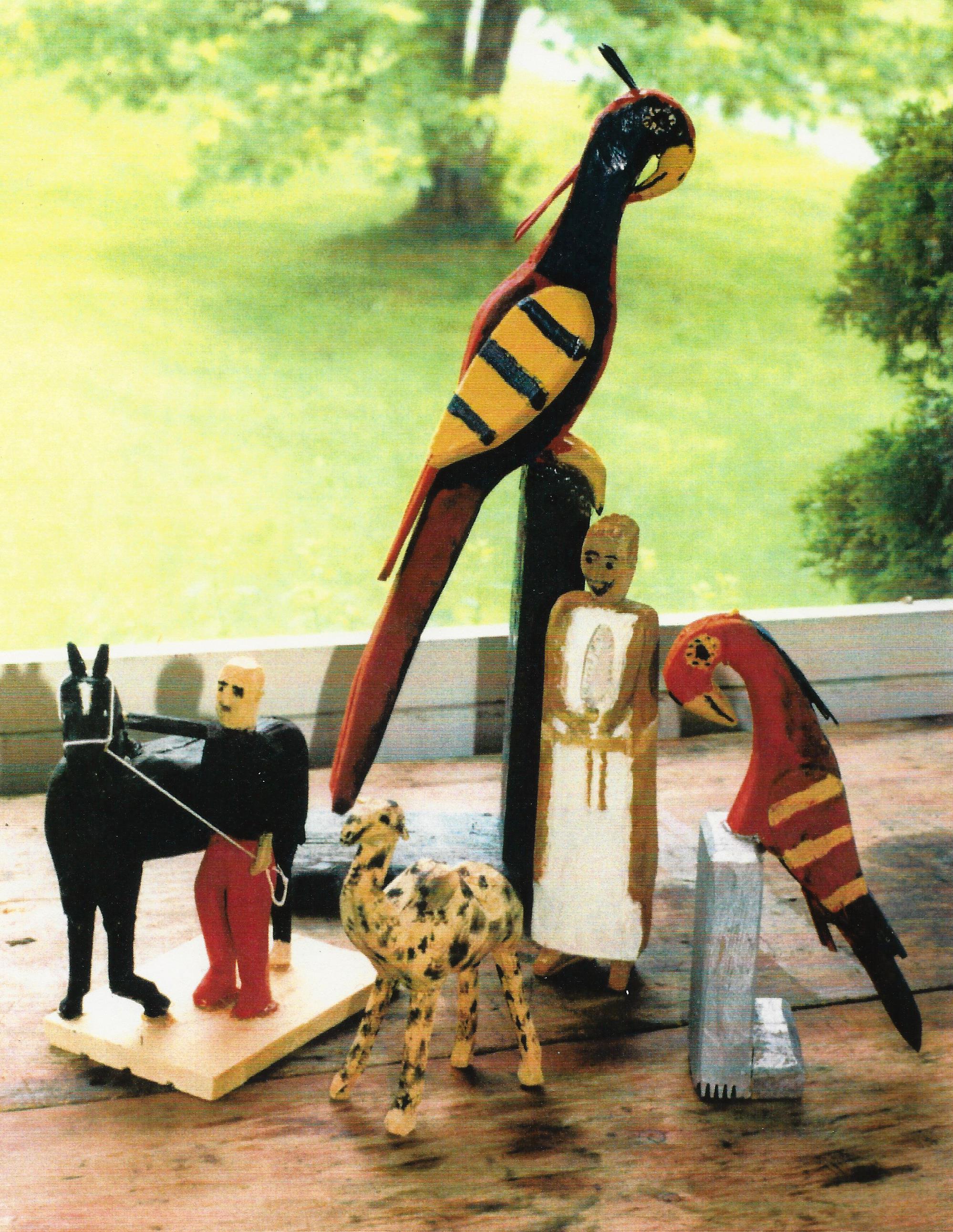
By this time we had bought many pieces of his work.  We kept some, and sold most to Quebec collectors.  All the while we love his funky, choppy versions of birds and animals.  All of them rough, and not self-conscious, but also showing a fineness and understanding of form.

We were in the habit those days to try to meet as many folk artists as we could in our travels, but as much as we admired Mr. Gautier’s work and would love to have met him, we were unwilling to make the 3 hour drive north of Quebec city, on spec.  Not even knowing at this point if he was still alive.  I google mapped St. Charles de Bourget just now, and it appears to be a charming little village of 690 souls set on a beautiful northern lake, but it is well on the way to nowhere.  With very few villages en route,  it would mean three hours of looking at trees, and then if we didn’t connect, three more hours of trees coming back.  We didn’t feel like risking it.

We continued to see and buy his work from time to time, then in the mid-nineties we bought the Mongeau collection, and it included about forty small pieces that Mrs. Mongeau described to us as Mr. Gautier’s last works,  which he made just before passing away at the age of 80 in 1994.  I’ve included pictures of some of this work here.  I love the directness of this work, and even though you can see it is not as accomplished as some of his earlier pieces like our 3 ½’ long bull,  it contains a mighty spirit.

I’d still like to make it up that way just to see if I could find that eight foot crucifix.  Even if it turned out to be fruitless, it’s close to Saguenay which from the pictures seems like a pretty interesting place to check out.  I love Quebec.  Quebec J’taime.  Maybe this fall.

Discovering the stash

Most people are happy enough to keep their money in the bank but some folks, be it because they have lived through a time of bank failures, or shortages such as the war; or just because they have a general mistrust of institutions, and prefer to keep their money in their sock:  Or hidden in a cupboard, or buried in the back yard, etc.  People can be very imaginative when it comes to squirreling away money.

We live in Norfolk county, where if you ask around, you will hear lots of stories of lost and found money. This is perhaps due to the large contingent of Belgian, Dutch, and other European farmers who immigrated here to develop the tobacco industry. A lot of these people had experienced unstable financial times. Or maybe it’s the same everywhere.

Friends who bought a local farm decided to wash and put back the existing curtains, only to find that when they opened the washing machine to add softener, the drum was full of curtains and floating money.  The old couple had sewn hundreds of dollars into the hem of the curtains.  They had died without telling anyone.  Thus it was just dumb luck which averted their fortune being thrown into the dumpster.  I know a family that spent weeks digging up the back yard when they realized that dear old dad, before the Alzheimer’s had set in, had been burying money in canning jars back there over the years.   It makes you wonder how much money is swept away and forgotten.  The problem with secrets is that they are quite often buried with their creators.

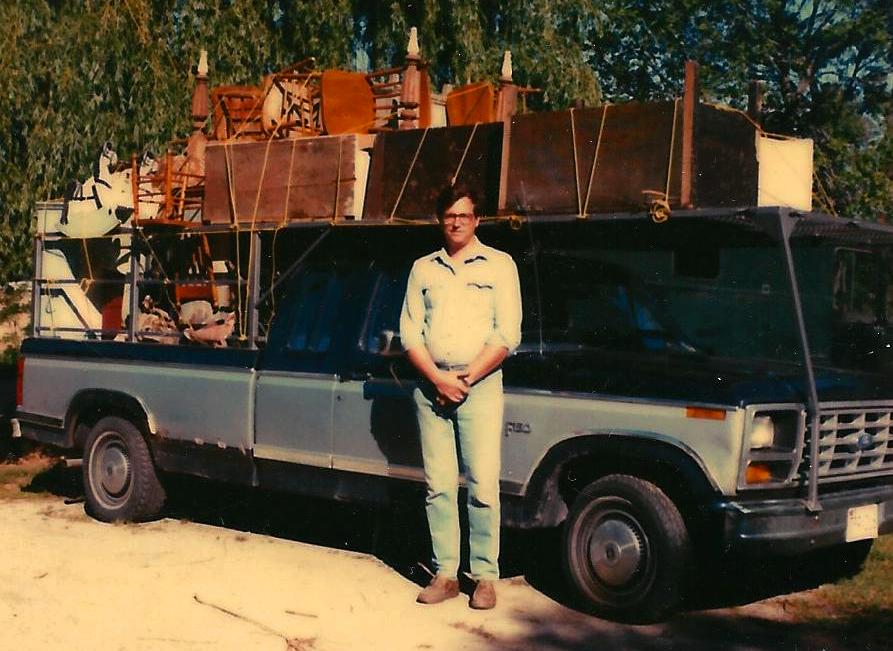
It was on a late fall trip to the pickers barns in Quebec in the early nineties that I had my brush with dumb luck.  I was solo on a quick two day, there and back run to pick up more stock for the then active Harbourfront Antique market in Toronto.  During this period I would often leave our house at 4 a.m. make the ten hour drive to Victoriaville; then see three or four pickers that afternoon and evening before crashing.  In the morning I would make a few more stops before heading home about noon, which meant I would arrive home  about 2 or 3 a.m. if all went well.

On this particular trip I ran into some particularly nice western furniture at the barn of Alan Chauvette.  It turns out that the rumors were true.  One of the local pickers had family in Manitoba, and in spite of not speaking much English, he had returned home with a huge load of western pieces.  Many interesting  Ukrainian and Dukhobor pieces as well as furniture from early French  settler’s homes.  I bought five or six excellent cupboards, and chests,  feeling happy to have arrived at the right moment to have a crack at it.  I also spent a lot of money. More than I had budgeted.  Jeanine has always kept the books, (thank goodness as I am a disaster), and my method was to simply spend all the money I had, and write a couple of cheques if necessary.  I didn’t keep a running balance, but had an intuitive sense of when to stop.  Well, I threw that sense right out the window this time, for the opportunity to buy some good Western pieces. I knew I was pushing it.  We kept a tight operating budget in those days, so if we didn’t want to dip into savings  a big buying trip meant I really had to have a good Sunday at the market.   I wasn’t sure how, but I knew it would work out.

Phil with Marcel Gosselin

I was feeling pretty satiated when I arrived at picker Marcel Gosselin’s barn about 10 a.m. as a last stop before returning home.  I was still picking up a half dozen stoneware wash sets from him every trip, because they were still popular at the market and he was still finding lots of them. He was also my source for Aime Desmeulle’s folk art, which was selling well at the time.  As I finished filling in the last remaining little spaces in the load with smalls, I was about to write the cheque when Marcel piped in “Are you sure that’s all Phil? I’ll sell you that small cottage chest for $175.  You know you’ll get about $400 for it.”  It was a tidy, little 4 drawer pine cottage chest from Nova Scotia which were very popular at the time.  I looked at my full truck and thought about the cheque book.  “Thanks for the offer Marcel, but look, I don’t have room for it.”  The load was already well above my racks. “ Look there Phil, on the right side of your tailgate.  I can put it on its side and tie it on right up there.”  Sure enough, I could see he was right. “O.K. Marcel, throw it on and give me the total.”

I got home very late, and went straight to bed.    Next morning, going into the kitchen for coffee, there sat Jeanine looking at the cheque book, and looking worried.   “I understand this was a great opportunity, but it’s going to have to be one heck of a good market on Sunday, or we’re going to have to dip into the savings to cover ourselves.”

By the time we got all the wonderful pieces upstairs we were feeling good about it, even if it meant cutting it close.   We still have a wonderful four colour Ukrainian  sideboard from that load that I fell in love with while scraping it down.  We had a good dinner,  and I decided to go upstairs to look over the stuff one more time before hitting the sack.  I was excited by the pieces, but also feeling concerned about so completely blowing the budget. I continued to open the cupboards to inspect the interiors, and  when I finally came to the little pine chest I had bought from Marcel, I opened the top drawer to see how well it travelled in and out. What’s this?   I was amazed to see a small plastic wallet lying there in the middle of the drawer.  How did that get there?  It wasn’t there when I looked at it in Quebec.  Then I remembered that we had put the drawer on it’s side to fit it into the load, and sure enough, when I felt up inside under the top, someone had built a little open shelf up there.  The wallet was full of crisp, old issue Canadian cash.  $1,300 in all.   I couldn’t believe the luck.  I could easily imagine that had I continued to carry it upright I would have sold it  full of cash as it were, and maybe even then it would go into a home upright,  and never be discovered.

Jeanine was having one last coffee before going to bed.  Yes, she can do that. She looked puzzled when I handed her the little wallet.  “ I know you are concerned that I spent so much, and I thought this may help”.  It took her awhile to believe my story, and our good fortune.

When I saw Marcel a week later, he was surprised when I shoved a folded hundred in his shirt pocket.  “What’s this for?”

“Never mind.  Just take it and don’t ask any questions.”