Unknown's avatar

About shadflyguy

Owner/ operator of Shadfly Antiques.

This is all – the work of Steve Sutch

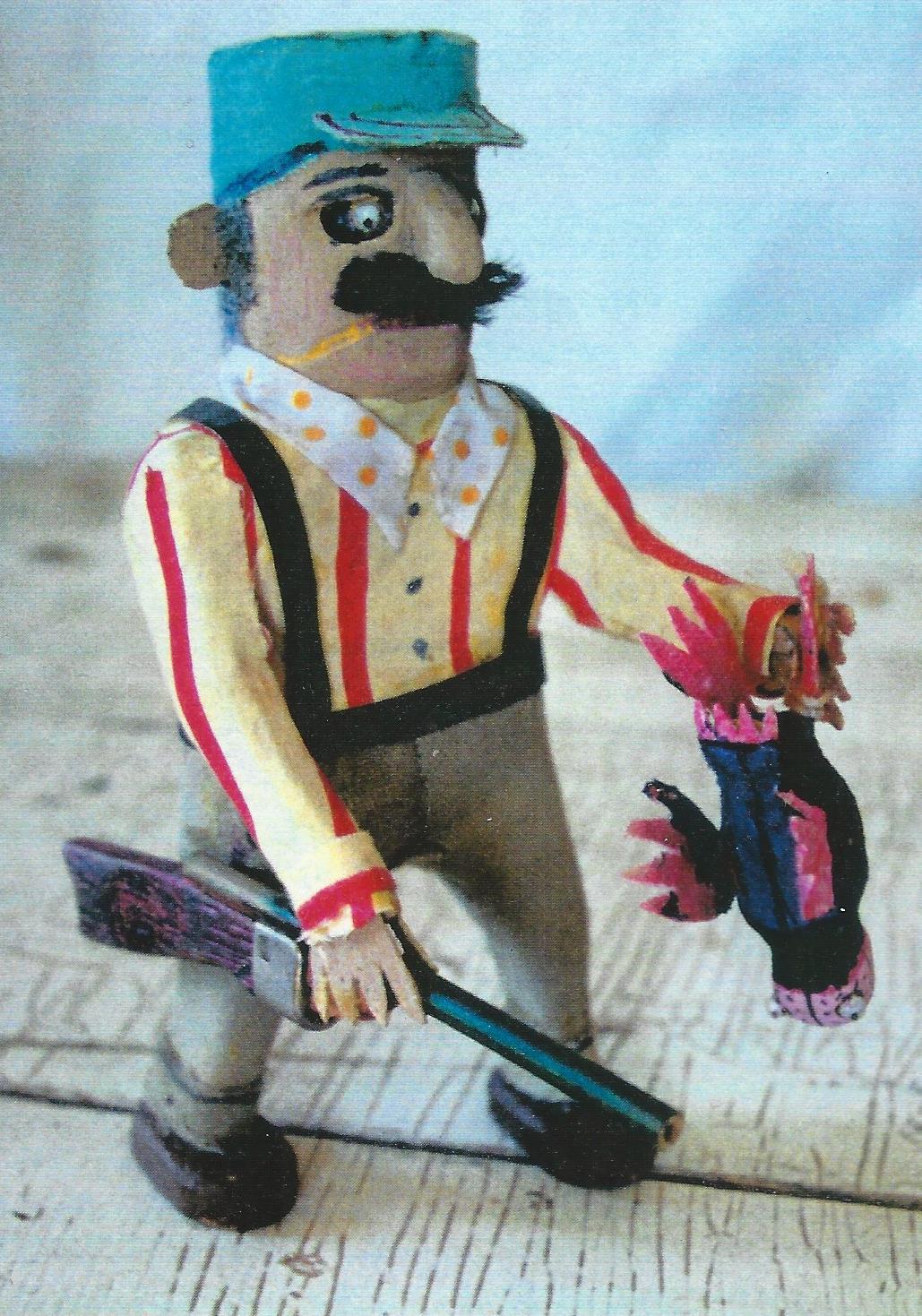
We first encountered the works of Steve Sutch in the late 1980’s at the tobacco museum in Delhi, Ontario.  It came as a total surprise.  Although we lived nearby we had never visited the museum as we were busy setting up house, and when we finally got to it one sunny summer afternoon we were amazed to find a large display of delightful carved/constructed work by this self-taught local artist. It was a show/sale and sadly for us, most of the pieces had already been bought.  It was easy to see why considering the quality and charm of the pieces presented, all at relatively low prices.  We bought everything that was left.
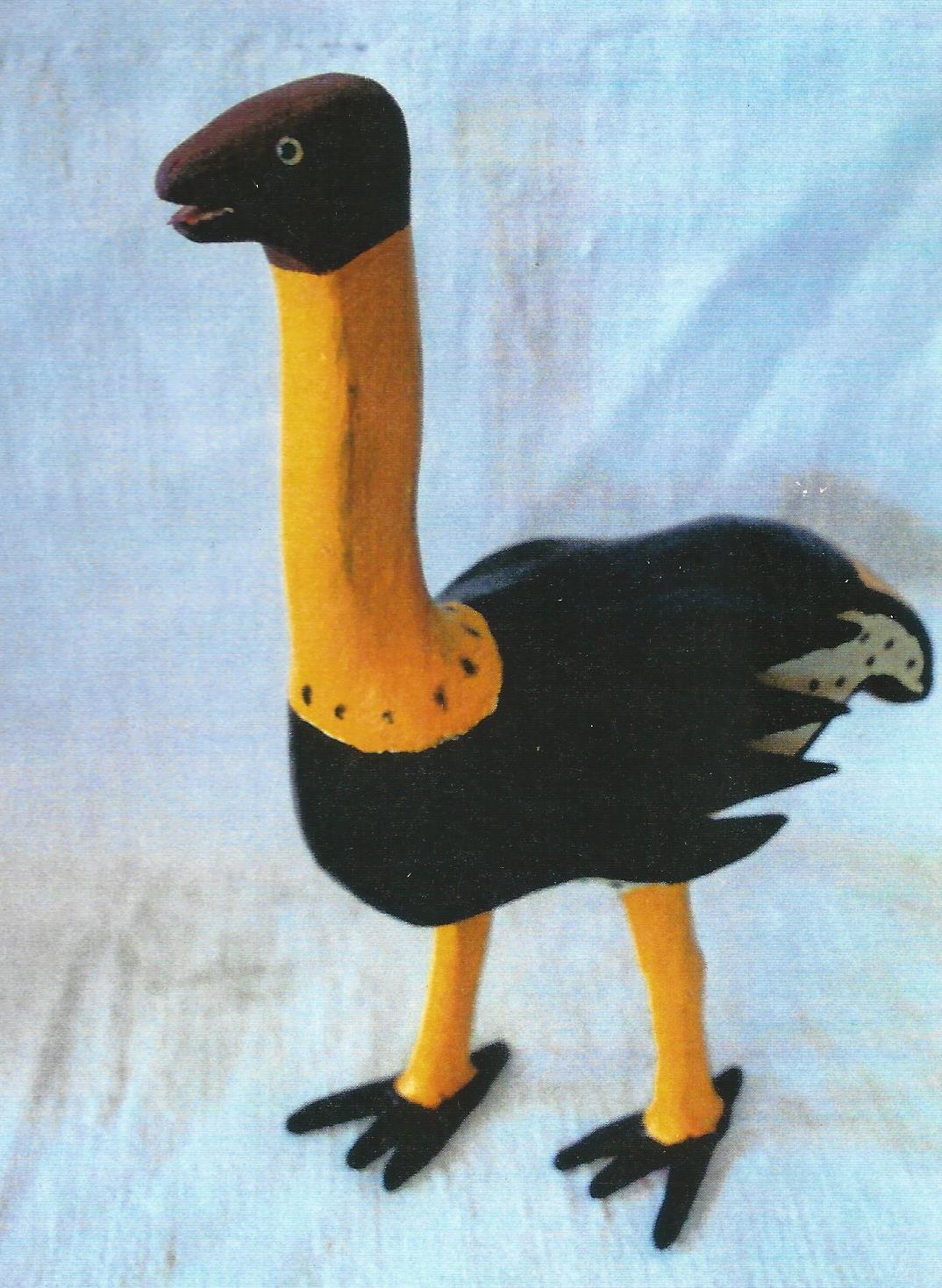
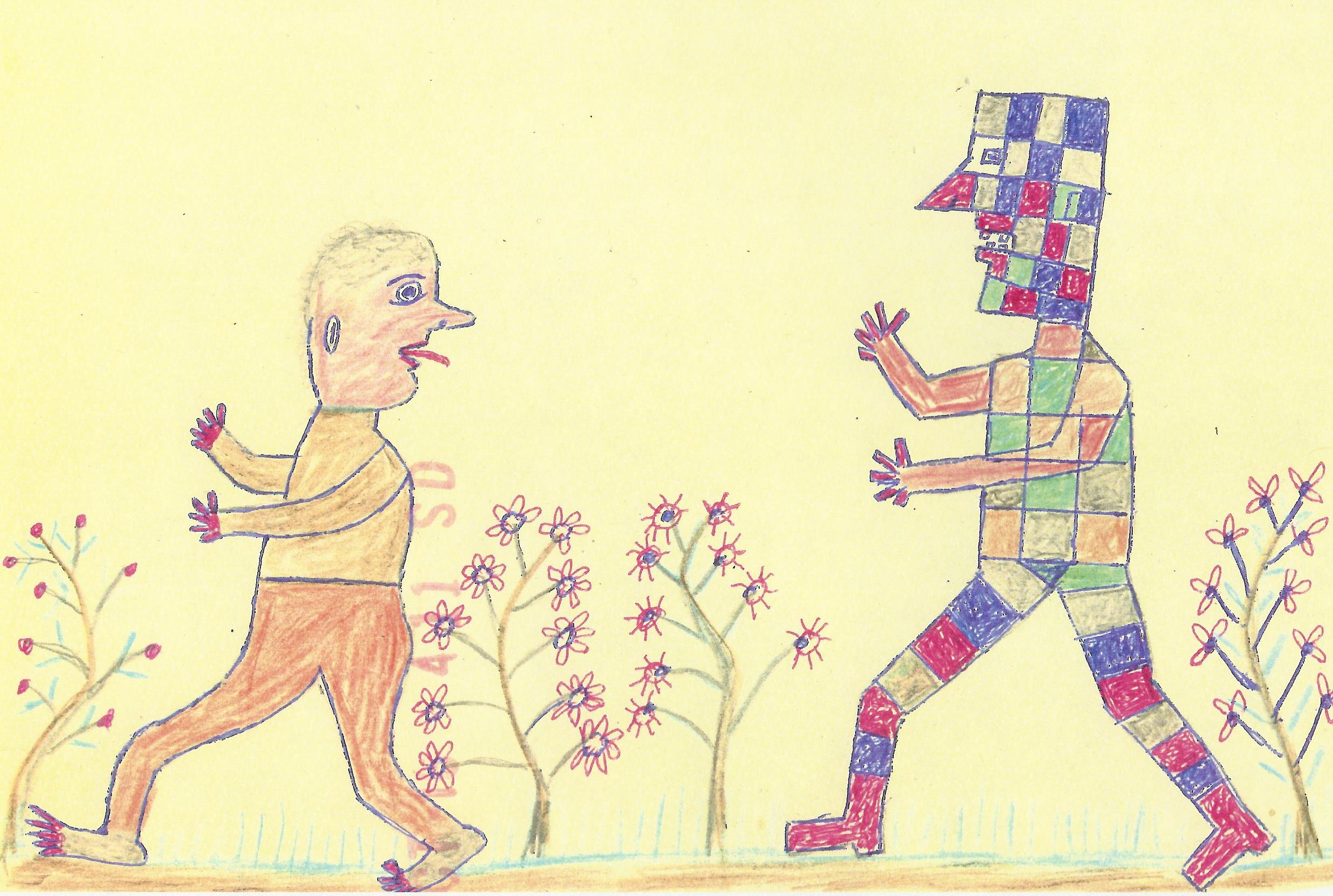
His sense of humour and invention was evident in all of the works presented, but the show did not include any drawings.  Over the next few years we occasionally ran across another construction, but it wasn’t until 1995 when we bought Barbara Brown’s collection that we were delighted to discover a package of about thirty Steve Sutch drawings. His constructions, and occasional piece of original furniture are good, but his drawings are amazing.

Steve Sutch’s Hungarian parents emigrated to Canada in 1905, and homesteaded in Saskatchewan where Steve was born in 1907, near Regina. He also homesteaded in that province, near Spiritwood, where he made a living working in logging camps and sawmills.

In 1937 he moved to Ontario, eventually settling down in Brantford where he remained until his death in 1992. He found employment in various areas of industry and agriculture, working on the railroad, factories, and tobacco fields. It is only after he retired from his very laborious life, raising two sons and three daughters, that he took up carving and drawing.

table designed and made by Steve Sutch

As stated, Steve Sutch did not limit himself to the carving and painting of wood. Most of his sculptures incorporate some mixed media feature, such as clothes made of actual pieces of fabric, and yarn used for hair. His pieces are constructed as much as carved. In his last few years Steve Sutch concentrated more on his drawings, which are mostly crayon and markers on the back of cereal boxes, or any scrap of paper or cardboard available. It is in the drawings that he let his imagination run wild, very often writing captions to explain the contents. These captions, if she judged too daring, were erased by his wife. She missed a few. 
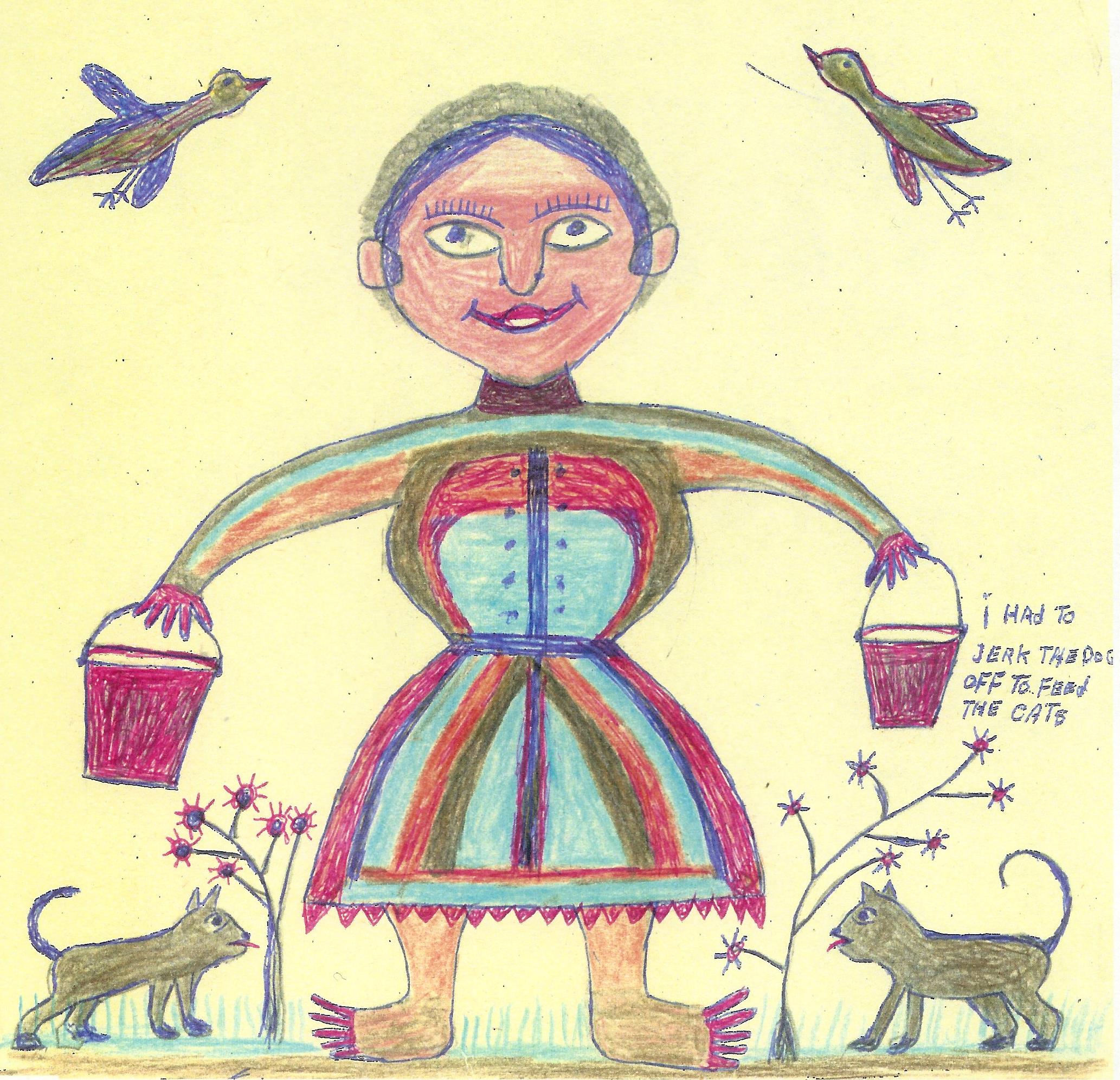
We framed and took the drawings we bought from Barbara to the April Bowmanville show, and the following January to the Outsider Art Fair in New York. They sold like hot cakes and were bought by many serious collectors.  This confirmed our belief that Sutch was a top drawer artist of the cartoon persuasion.  His drawings are edgy, sometimes outrageous and even at times profound. They all contain humour and insight.  A lot of them deal with fate, and the food chain. “Make all chicken’s happy, eat pork” etc.  In the May/June 1992c edition of the Upper Canadian, folk art collector and scholar Michael J Hennigan wrote an excellent and insightful four page essay on Sutch’s drawings. If I can gain permission to do so,I will post it here in a future blog. 

Steve Sutch’s work demonstrates a very strongly individualistic interpretation of a full life’s experience; a commentary on relevant current events (such as portraits of political figures), as well as imaginative tellings of fantastic and sometimes wicked or naughty stories. Steve Sutch approached his work with a great sense of humour which permeates every piece.  I will close by reproducing a short autobiography written in his own hand which Barbara Brown had the insight to ask him to produce in 1989, shortly before his death in 1992.    As Steve says there, “This is all.”
The discovered drawings of Maggie Lounsbury

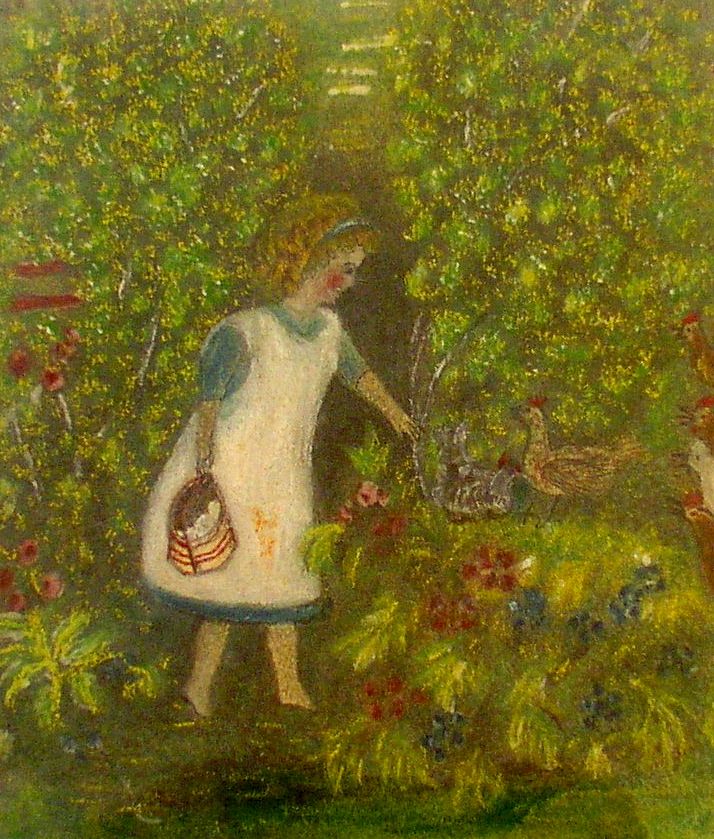
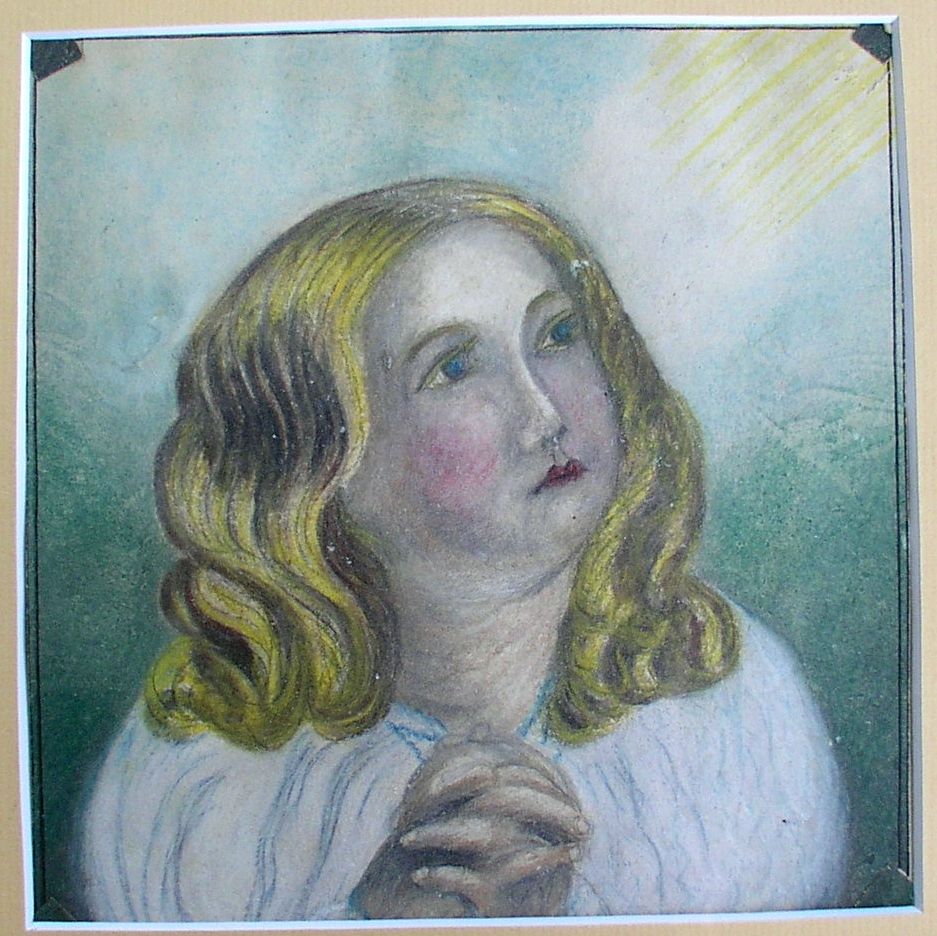
In the fall of 2011 I paid a visit to friends Kim and Dan Davies of Tattered and Torn Antiques.  Over coffee Kim mentioned that she had just procured something that I might like to see.  Why of course I would. So she brought out a worn and falling apart old Nature study portfolio which contained many drawings, and poems along with some mementos such as old Christmas cards.  It only took flipping through a few pages to see that this was a very interesting collection of folk art drawings from the 1st quarter of the 20th Century, and so I didn’t play coy by appearing disinterested (we’ve known each other far too long for that) and came right out and asked her “ Well, before I fall further in love with this thing you’ve got to tell me if you might be willing to sell it.” “Oh sure, I am.  I figured it was your type of thing so you might as well have it.”  She quoted a reasonable price.  I said yes without even looking further, and so I went happily ahead to discover what a treasure I had just purchased.  Co-operation between dealers can be a wonderful thing. 
Turning the pages I was as happy as a six year old opening his Christmas presents.  Each page offered  clues as to the identity and story of its creator.  Here is how I described it when I offered the works at the 2012 Bowmanville Spring Folk Art and Antiques show.

“ The drawings presented here are taken from the scrap book of Miss Maggie J. Lounsbury, who lived near Warner, in the Niagara Peninsula on the banks of the Chippewa River.  Along with the drawings, the book contains poetry, most of which was printed using rubber stamp letters, and some mementos such as Christmas cards.  Also, a little, bound book entitled “The swim in the Chippewa” by Maggie J Lounsbury, and dedicated in loving memory of little Judson Erskine Lounsbury, whom we assume was related, and drowned in the Chippewa sometime around the turn of the century.  Newspaper clippings and one dated drawing imply that the book was created in the first quarter of the 20th Century, but we believe the ink drawings used as illustrations in small book are older, and were created by a different hand, and were chosen by Lounsbury to illustrate her poem.  There is nothing in the book to attribute these earlier works, but three of the original drawings from the book were mounted in the portfolio so we speculate that it may have been a relative.  Because the binding of the book was in such a sorry state, we decided to separate and offer the individual works properly framed and mounted on acid free paper.”

We separated about 50 of the best drawings and had them mounted and matted, and sold the bulk of them at the show, and then a bit later I sold the rest of the book including the small booklet “The Swim in the Chippewa” to a local historian.  Given the time and the money, it would have been great to restore and keep it all together, but the fact is that it was a scrap book, and so was never intended to hold together as whole, and of course the economics of selling off the individual drawings is much more interesting.  I could not bring myself to break apart an antique book of drawings in good condition, but this was not the case here. 

The poetry which is rubber stamped across many pages of the book seems almost to be a flow of consciousness.  It is quite hard to follow, and there are no personal notes or labeling of the drawings so it is hard to pin down the details, but when you spend enough time with the material you get a strong sense of the Maggie Lounsbury’s personality and sensibilities.  Obviously a creative and sensitive young woman, she has had a great tragedy occur very near her, and  amongst her sunnier observations of flower gardens and children’s games, there are also images of cemetery’s, and angels, and ominous black snakes.  Ultimately, the little booklet is very revealing.  It is basically a ten page poem called “The Swim” in which Little Jack has trouble persuading anyone to go swimming with him in the Chippewa.  Eventually his mother takes him and he very happily goes swimming until suddenly he is aware of several big black snakes swimming towards him.  He rushes to the shore and escapes, and he and his mother go home.  A happy ending.  However the booklet is accompanied by 1912 newspaper clippings of the unfortunate drowning of little Erskine Lounsbury, the boy the booklet is dedicated to.  I will end by reprinting Maggie’s poem which begins the book.

“The Chippewa, with it’s traditional wolf, Indian, robber, esteemed by the little folk who roamed the lovely banks – the hunting par excellence. The enemy,  of equal beauty and hideousness , mottled gray, they speedily captured, dragged, wounded and fighting, out of their pretty waters. Away from the dreams they had so labouriously and painstakingly builded, where silvery fish kicked and swimming holes beckoned, across which old Bob White called, whip-poor-wills uttered their plaintive cry: tragedy, lurking silent and grim just where it was deepest – the beautiful Chippewa. “

A World populated with animals – The work of Wilfred Richard and his family sculptors

Damase and family in front of their house about 1910

Bernard Genest’s  excellent 109 page booklet on the four generations of the Richard family carvers, published in 1986 by the Museum of Civilization begins with a quote from the French poet Alphonse de Lamartine -“Inanimate objects do you have a soul which attaches itself to our soul and forces it to love”.  A quote which applies in spades to the work of the Richard family.

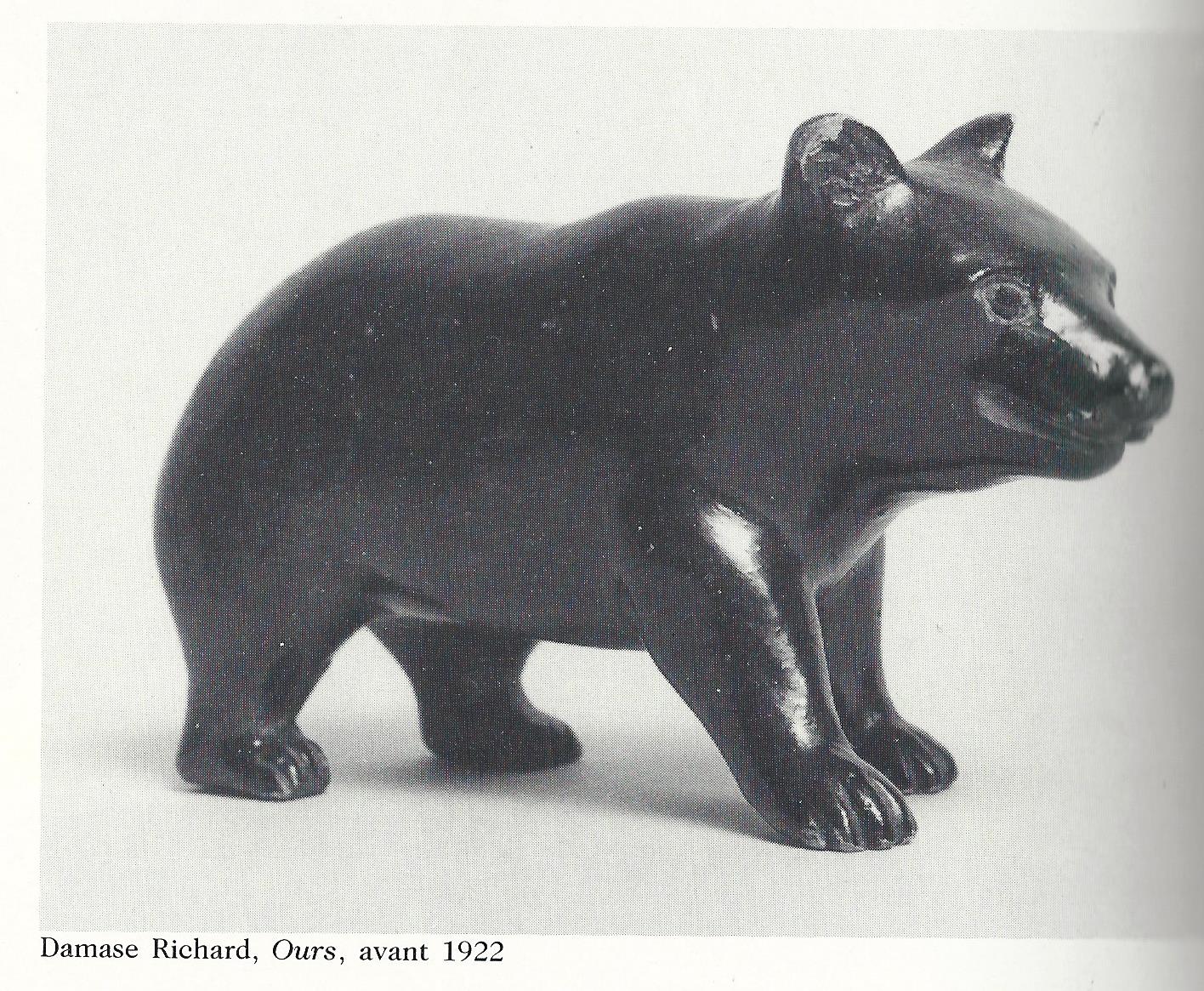
a bear by Damase Richard,

The Richard family has lived in Quebec since Pierre Richard arrived from France in 1670. Six generations later Damase Richard was born in 1852.  Although he lived on a farm, Damase was not interested in farming.  He was interested in art, so as a young man he left home to seek work as an artist.  His natural talents landed him a job painting carriages, first in Quebec city and then in the U.S., and eventually in Montreal. Then he got a job with a furniture manufacturer carving and painting decorations on the finer pieces of furniture.  It was during this time, about 1871, that he met and was influenced by master carver, Louis Jobin.  He continued for about ten years before buying a piece of  wooded land near Saint-Ubalde de Portneuf. It was ten years before he had cleared the land and built a house.  At 39, in 1891 he married Elmire Frenette, and they went on to produce seven children.  As stated, Damase was not a farmer by nature so when his oldest son Wilfred became twelve he passed much of the responsibly of the day to day farm work on to Wilfred and he began to sculpt seriously.  He started with pipes, sugar molds, ashtrays and other small items that he could sell easily.  One of his sculpted pipes would sell for 60 cents, about ten cents more than a regular one.  He did not often repeat a pattern, preferring to invent designs.  He also produced toys for the children, and crucifixes and other religious articles for family members.

He used very few tools. Three gouges, two pocket knives, a plane and an axe.  He was very talented and precise. After a while he became interested in sculpting the animals and birds he saw around him.  He not only carved them, but unheard of at the time, painted them in polychrome colours. At this time there really wasn’t a market for these pieces, but he continued to produce them to satisfy his creative urge.  Of course as is often the case, nowadays  these are his most sought after and valuable pieces.  He was prolific and carried on until his  death at the age of seventy in 1922.

Of Damase’s seven children, three became carvers. Wilfred, Alfred and Joseph all carved animals and birds as their father had before them, but only Wilfred sold his work. Although he was smart, and quick to learn Wilfred only got about five years of schooling due to his family obligation. But he seemed to readily accept this destiny, and thereafter rarely left the family property.

horse by Wilfred Richard

Like his father, Wilfred showed a natural affinity to carving.  He became his father’s apprentice at an early age and was soon producing work alongside his father during the long winter months when he was not busy with farm work. He stated that he was never really interested in commercializing his work, and would actually discourage people from coming to buy.“Me. I’m not proud. When the pride was passed out I was not there. I’ll say one thing though that pride in the work has a good place. I have always been proud of this. but to dress me up fancy, to go to a formal service, or that kind of business,  I would go dressed as I am now. It would do me nothing, absolutely nothing. I’m like that. “

owl by Wilfred Richard

Wilfred married Marie Darveau, and they lived their lives together in the home Damase had built. They had fifteen children, but only six survived, and of these six, three have become carvers – Marie Jeanne, Fernand, and Maurice.  Marie Jeanne married Lucien Lavallee, and they produced two sons, Paul-Emile and Dominique who also became carvers, and carry on the tradition to this day.

Wilfred Richard was born in 1894 and he died in 1996.

Wilfred Richard in his kitchen

The graphic appeal of old games boards

Quebec game board, 2nd quarter, 20th cent. offered by Martin Osler on the Collectivator site

The board game called “Checkers” in North America and “Draughts” (pronounced as “drafts”) in Europe is one of the oldest games known to man. The history of checkers can be traced to the very cradle of civilization, where vestiges of the earliest form of the game was unearthed in an archeological dig in the ancient city of Ur in southern Mesopotamia, which is now modern day Iraq.

Draughts (British English), or checkers (American English) is a group of strategy board games for two players which involve diagonal moves of uniform game pieces and mandatory captures by jumping over opponent pieces.

Octagonal sided game board, late 19th cent.,Waterloo, Ontario, offered by Wendy Hamilton on the Collectivator site.

The most popular forms are English draughts, also called American checkers, is played on an 8×8 checkerboard; Russian draughts, also played on an 8×8; and international draughts, played on a 10×10 board. There are many other variants played on 8×8 and 12×12 boards. Canadian checkers and Singaporean/Malaysian checkers (also locally known as dum) are played on a 12×12 board.  I have found that what is referred to as Canadian checkers, might better be called Quebec, or French Canadian checkers, because after years of buying and selling both 8, 10 and 12 square variations of the board, I have found that it is pretty much accepted that if a board has 12 squares across it is from French Quebec.  With 8 or 10 spaces, it is assumed to be Ontario or other “English” culturally based province.  How did this variation get started? Maybe folks in Quebec just liked a bit longer game.  After all, the winters are cold in Quebec so what’s the rush to get outdoors.

Circa 1820, Lunenburg Cty, Nova Scotia Parcheesi board, illustrated on page 216 of Canadian folk art to 1950, by John A. Fleming, and Micheal J. Rowan.

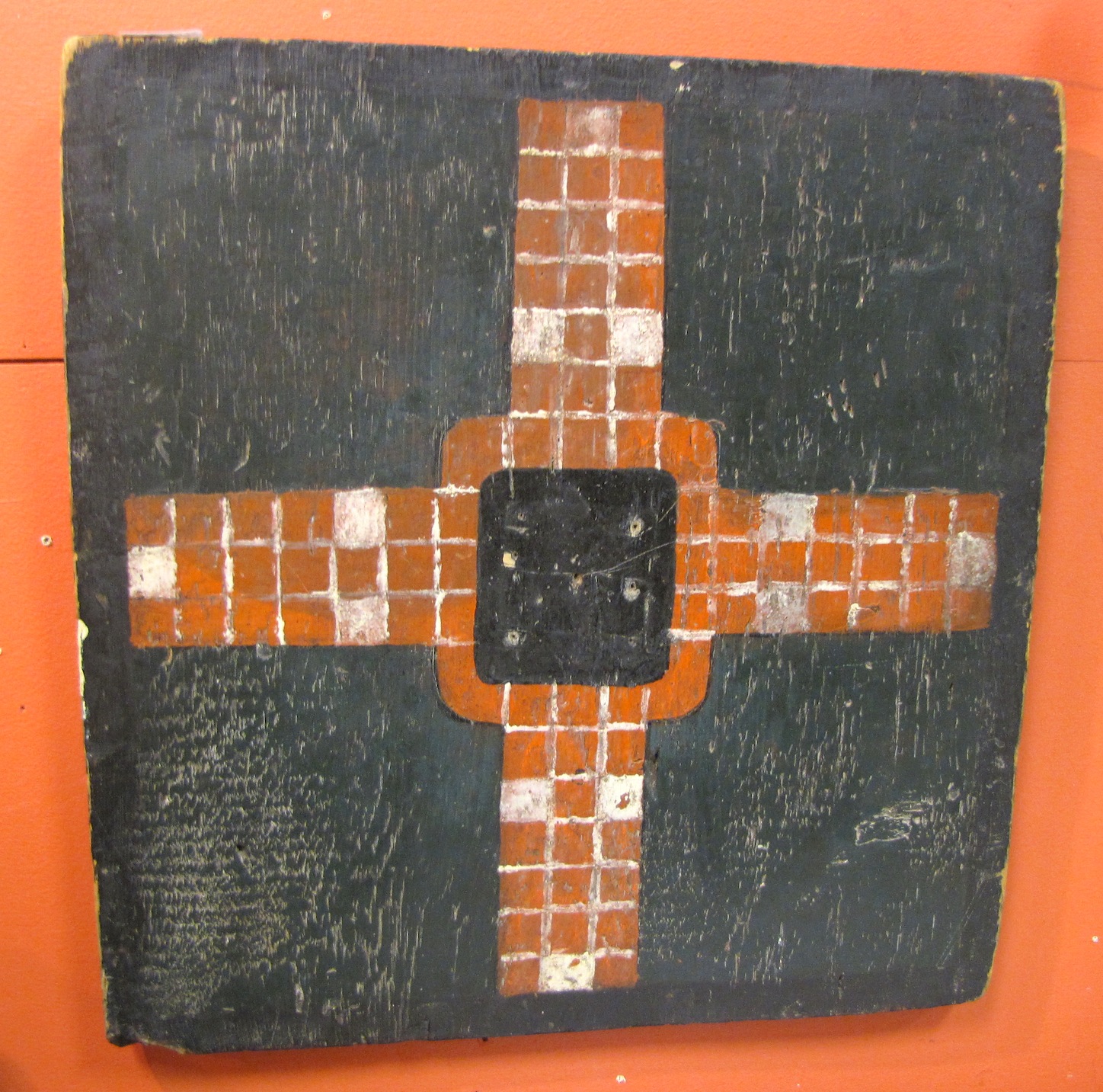
Chess may be considered the game of kings, but Pachisi is the game of emperors. Long before the American game of Parcheesi was first played in the late 1860s in North America, Pachisi, the Royal Game of India, had made its way around the world.

You won’t find nearly as many parcheesi boards out there, which illustrates that many more people went for the simpler game of checkers, but the boards are particularly sought after for their more complex graphic pattern.  And let’s face it, not a lot of people are buying old game boards to occupy their time on a Friday night.  For the most part, People buy old game boards to put them up on the wall as a graphic focus.  And who can blame them.  A checker board  is  inherently interesting.  We like looking at contrasting squares.   The orderly rows of squares suggest discipline, and harmony.  It’s peaceful and it draws the eye.

Quebec, mid 19th century Parcheesi board, illustrated on page 40 of the Price’s book “Twas ever thus”

I have bought and sold many game boards over the years although we have never added one to our collection.  I’ve found many that attracted me, but I think the reason I am happy to appreciate them and then find them a good home is because we like paintings so much that we want to donate all our wall space to them.  It’s the same reason we don’t collect old advertising.  I love looking at a great old sign, and some of it is as exciting visually  as a good painting, but they rarely turn my crank like a good painting will.  It’s true that some boards and ads do transcend into the realm of fine art, but they are few and far between, and such a thing has never fallen into my hands.

late 19th cent checkers board, Waterloo, Ont, offered by Wendy Hamilton on the Collectivator site.

Unlike most antique furniture or accessories, a game board can fit into many room décors be it traditional, or modern because of it’s graphic nature.   They also look fabulous grouped together.  We have friends with about 14 game boards placed carefully  over a very tall and wide wall in their living room and the overall effect is breath taking.   They are all different, while also being similar in that they all have the graphic checkerboard as the main component.  Some are primitive.  Some refined.  They all say something about who made them.  And of course patina can be a large factor.  The wear on some old game boards can beautifully tell the story of usage and age.  You are struck visually with the pattern, and at the back of your head you can’t help thinking about all the happy hours spent talking and playing the game together by countless individuals over the years.  You think about how when these boards were being used regularly, there were no game boys, television, or U-Tube to occupy your “down” time.  You could read when you wanted to be solitary, or if you wanted to have some entertainment and commute with others you would  find the local checkers or parcheesi game.  Or I suppose if you wanted a bit more of an intellectual work out you may play chess.  You still needed the board.

Because gameboards offer many interesting variations on a similar theme they are a natural and fun thing to collect.  I love looking at them.   If only we had more wall space.

Circa 1880 Quebec Parcheesi board, offer on Collectivator by Croyden House.

Changes

I’ve just looked on my Word Press home page and this is my 107th blog entry.   I promised myself 100 entries.  Tiny drum roll please.   I’m enjoying it, so I’ll keep on going.  My goal has been to write something once a week about an aspect of my life spent in the antique trade, and the pursuit of Canadian folk art in particular. Beyond this my intension has been to go beyond the technical, and take a look at a life spent as I suggest “seeking authentic”. What is it in an item that catches me, and keeps me interested? Why do I care?   Actually, I am more interested in the expression of beauty, and the preservation of it, than I am in the industry per se, but I have also made a living from my full time involvement, so the industry part affects me.  Today I’m thinking about that.

We listen to a lot of NPR in this house.  Jeanine tries to clear her agenda every day at three to listen to Terry Gross on Fresh Air.  I’ve become a fan as well.  It’s too much politics these days, but it’s still intelligent radio. On Wednesday in the morning I was listening to a business review as I was doing up the breakfast dishes, and a report came on about changes in the antique business since the introduction of on-line shopping about the year 2000.  The program confirmed that as those of us in the industry know, the antique industry has taken a hard punch, and is now greatly reduced in size.  I think it suggested over-all the industry is down 60%, but I could have that figure muddled, and after spending a half hour searching the NPR site I could not find the interview to check it.  In any case it’s dramatic.  They had a quote from one of the appraisers from the Antiques Road Show on how half of the shops in his home town of Houston, Texas had already closed down, and the others were in trouble.  The thesis suggested that the value of dark furniture, china, pottery, etc. dropped dramatically as these items became more easily available on-line.  Basic consumerism. Why drive around when you can sit at your desk and order exactly what you are looking for?  This situation is essentially true for all retail, and with rising costs for a bricks and mortar location, it just takes a trip through the down town of a small city to see the results of this situation.  We have big box stores on the edges of towns but less and less independent little shops in the core. It’s a shame really for those of us who live to dig around in crowded, interesting spaces, but it is entirely understandable.

They chose the antique industry as an example because it has suffered the double whammy of changing retail structure, and of changing cultural tastes.  There are now more Millennials than there are baby boomers.  It’s a fact, and so far the kids don’t want their grandparents finely made dining room suites, or their knick-knacks.  Nor do they want their Great-Grandparents diamond point armoire or harvest table as difficult as that is to comprehend.  At this point the show tried to be up-beat by suggesting that the day may come when the children of the Millennials will decide they want fine mahogany furniture again instead of Ikea, and the cycle will begin again;  but I doubt it will be as simple as that.  And what dramatic changes would need to take place in the economy for the rents of commercial space in busy markets to drop significantly so that an antique shop could start to open up again.  I’m not looking to bring everybody down here although the program did not make me feel chipper.  I believe that by looking at the reality of the situation, and acknowledging the changes , we might better be able to make the best of it.  There is no question that the industry has diminished, but there is still a lot going on.

Pickers are still dropping furniture off the back of their pick-up trucks at various antique shows. A lot of the  co-ops, on-line sites, and surviving shops continue to do good business.  Facebook groups, and magazines continue to support and bolster the ideas behind collecting, and at the heart of it all, yes, I still believe that many people will potentially come to grow tired of mass consumerism, and will come to “seek authentic” for themselves.  To everything, change, change, change.

O.K. next week I will be back to tell a humorous story about my truck catching fire or some such thing, but this week I really wanted to acknowledge the effect that radio report had on me.  It can’t all be happy face, and I believe in facing these realities head on to understand and move beyond them.  And the one thing I know for certain is that  some unforeseen thing,  or event will come along that will totally change everything.  We have to remain positive to make  that positive change.  We have to keep at it.  Support and encourage, and enjoy what you love.  It’s still the best game in town.

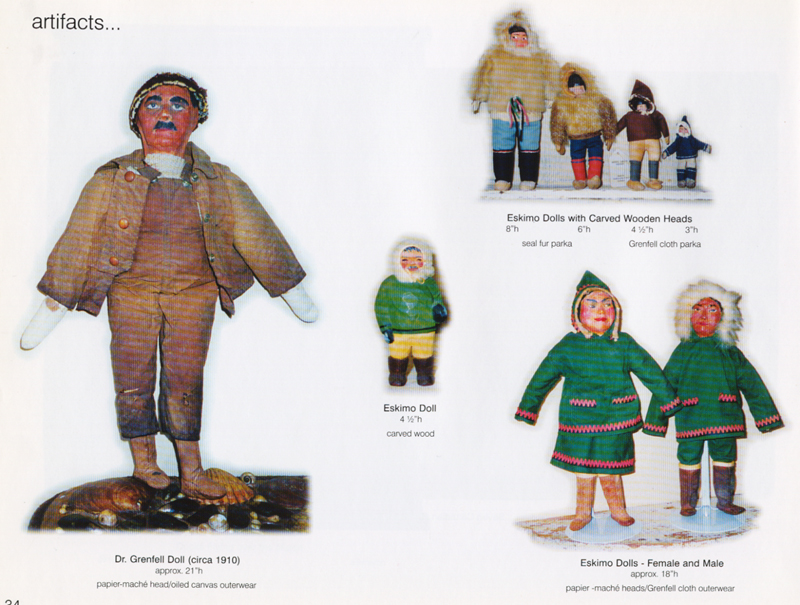
The Art of the Grenfell Mission

The April  2000, Bowmanville Antiques and Folk Art show was a special year in that it featured the show and sale of a large collection of the work created by artisans of the Grenfell Mission of Newfoundland.  The collection of about two hundred pieces was accomplished over a twenty year period of dedicated searching by Ontario collector Robin Moore, and the sale was organized by her friend and mentor, quilt and fabric specialist Carol E. Telfer.  A beautifully illustrated, 45 page catalogue “art of the Grenfell Mission, the Robin Moore collection” accompanied the show.  The collection was offered to be sold only in its entirety.

In her opening comments Robin Moore suggests “ Michael Rowan, an old antiques buddy, has always maintained that antiques are on loan to us – we are their custodians for a period of time.  It has been my pleasure to have been the custodian of this truly marvelous legacy of the people of northern Newfoundland and Labrador, which I humbly refer to as “my Grenfell collection.” The time has come to pass it on to the next custodian – to love cherish, and preserve.  My dream?- to have my collection return to St. Anthony, Newfoundland where it all began 100 years ago. Wouldn’t that be wonderful?  Well, wonderful things do happen, as the entire collection was sold on opening night to a Newfoundland museum.  A prime example of the importance and contribution to our national heritage that a dedicated collector can make.

There is quite a bit of information about Grenfell on line.  What follows are quotes from the heritage Newfoundland and Labrador site:

“The Grenfell Mission provided some of the earliest permanent medical services in Labrador and northern Newfoundland. Before the mission opened its first hospital at Battle Harbour in 1893, almost no health-care resources existed in the area – hospitals were nonexistent. Alongside its medical endeavours, the mission sought to make other social changes, specifically in the areas of education, agriculture, and industrial development. To this end, mission workers built schools and helped establish lumber mills, community farms, co-operative stores, and a commercial handicraft industry to create alternative sources of income.

British medical missionary Wilfred Grenfell arrived at Labrador in 1892 to investigate living conditions among local fishers for the United Kingdom’s National Mission to Deep Sea Fishermen. Shocked by the area’s widespread poverty and almost complete absence of medical resources, Grenfell spent the next year raising money at St. John’s and England to establish regular health-care services in Labrador. The mission opened a hospital at Battle Harbour and began construction on another at Indian Harbour. It also acquired a second hospital boat, the Princess May, to help medical personnel service fishing stations and coastal communities.

Alongside providing medical services, the Grenfell Mission sought to improve living conditions in general for people in Labrador and northern Newfoundland. To stimulate industrial development, the mission established a series of co-operative stores near many of its medical stations. Mission workers helped to create a local handicraft industry that allowed residents to sell hooked mats, knitted goods and other items at North American retail shops.”

From Wikipedia we learn “The Grenfell Mission established a Village Industry Department prior to 1930. Artists came from abroad to support the artistic endeavors of the residents of northern Newfoundland and Labrador.

The Grenfell Mission was famous for its burlap rugs, which were sold to hospitals in the United States and Britain. Encouraged and promoted by Dr. Grenfell, the rugmakers of the mission sometimes used designs created by Mrs. Grenfell. Beginning in the early 20th century, the International Grenfell Association (IGA) hired Jessie Luther of Providence, Rhode Island, to set up and direct the Grenfell Industrial Department. Grenfell established retail shops in England and in several U.S. cities. These shops were staffed by volunteers and augmented by travelling salesmen. Following the death of Dr. Grenfell and the surge in machine-made rug production, the business gradually failed.”

Carol Telfer did an excellent job of summarizing the Grenfell history in the catalogue with her two page essay “a brief history of the Grenfell Mission”.  I suggest you buy the catalogue which is still available, but if you want to learn the complete history in precise detail you can go to http://www.grenfellassociation.org/who-we-are/history/   the international Grenfell Association site.

The dedication to the catalogue reads “Dr. Wilfred Grenfell arrived on the north shore of Newfoundland more than a century ago.  He was greeted by a shy, yet industrious people who inhabited a beautiful, but isolated land. They led a harsh existence.  This catalogue- a visual tribute- is dedicated to the men and women of northern Newfoundland and Labrador, for the incredible works of art which they produced through the Grenfell Mission.  May their legacy continue.

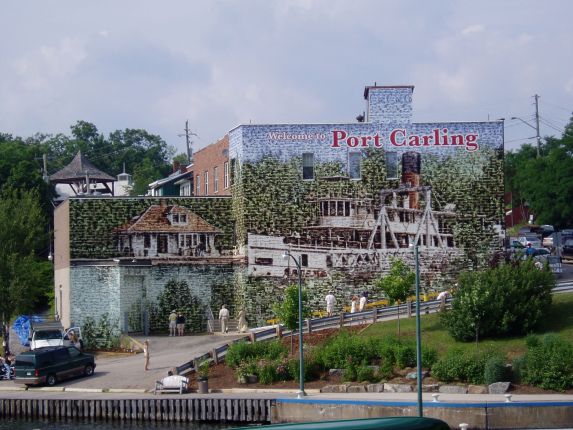
Amongst the stars in Port Carling

There were many reasons to look forward to doing the Port Carling antique show in the early nineties. It was very well run and promoted by the Gadsden’s. Unlike today, the town and area had very few antique shops and there were a lot of rich people building and buying cottages. In those days they would actually trust their own taste and come to the show looking to furnish their cottages themselves.  Nowadays they don’t trust their judgement and not wanting to embarrass themselves with something that would have their friends questioning their taste, they bring along their decorators who tell them what they should buy.

Also, in those days the show opened Thursday night and ran Friday and Saturday, which was not only great from the perspective of getting home on a day when the southbound traffic was light, but also worked well because many wives would stay at the cottage with the kids during the week while hubby worked in the city.  These wives would come to the opening and buy as they wished, or make notes of what they wanted and then drag their husbands in on the Friday or Saturday.  It held the potential in those days of being our most profitable show, and we were always looking for “cottagy” things to take to the show.   Canoes, rustic furniture, folk art, and all things you associate with a vacation home were almost certain to sell.  The Thursday night opening was a feeding frenzy, and as soon as the doors opened and the line-up filled in you had to be on your toes because it was common to have more than one person wanting to buy something at the same time.  You had to be careful, especially with two sellers operating the booth that you didn’t sell the same thing twice, to two different people.  There’s your potential for some nasty exchanges.  Things would settle down a bit after that initial hour, but  sales would remain strong over the next two days.   And then there was the additional excitement of exchanges with movie stars. 

During set up on Thursday all the talk would be on whether Kurt and Goldie were in town, and which famous friends they might bring along to the opening.  Nancy Short, Martin’s wife could be counted on.  She came every year and would buy a lot.  She would also bring along friends and encourage them to buy.  She was also a very nice woman, so we definitely looked forward to seeing her.  I enjoyed selling a pyrotechnic decorated rocking chair to Mary Tyler Moore one year, who was as nice as you would imagine her to be.  When Joanna Cassidy bought a piece of folk art from me, I have to admit that the scene in Blade Runner of her running away from Harrison Ford and eventually being shot and falling through panes of glass, kept running in my head.  Quite distracting.   It was always a delight when the wonderful Catherine O’Hara would turn up looking like an un-made bed and trying to rope in two or three unruly children.  She was always funny and friendly, and would treat you like her neighbor.

It was the talk of the show one year when on the opening night,  Kurt and Goldie decided to buy a little side table from us. At the time, I was helping to load a dresser we had sold in the parking lot, but I heard all about it before I got back into the hall.  Jeanine does not know, or for that matter much care who Kurt Russell is. I don’t think she was into “Escape from New York’ the way I was. “Snake” didn’t mean anything to her.  She recognized Goldie Hawn of course, but she is not particularly impressed with stardom in any case, and tends to treat stars like anyone else. I think that for the most part most stars actually appreciate this, but they do get used to being treated as “special”. It started when she questioned Kurt about his visa card.  “well, I can assure you it’s good”.  “I’m not worried about that, it’s just that I’ve never seen a card like that before”.  It wasn’t that she mistrusted him, but it was from a bank she had never heard of.  “O.K., can you bring the table to the loading door, and I’ll get my car.”  “Well as you can see I am on my own here, so if you can wait until my husband returns he will do it, or otherwise might I suggest that you seem like a fit and strong man, perhaps you can carry it yourself. “  He looked surprised, and somewhat taken aback, but then smiled, and said “Of course I can.”   Our neighboring dealer could hardly contain herself.  She immediately rushed over. “Don’t you know who that was.  That’s Kurt Russell, he’s a movie star and married to Goldie Hawn”.  “Oh really.  How nice for him, but still I am right that he was perfectly capable of carrying that table himself”.  That’s the way Jeanine calls them.  I love that. Everything I hear suggests that Kurt’s a regular guy, he just forgot how it felt to be treated like one.  I think he enjoyed it.

our booth at Port Carling, one year in the early nineties

Remembering the Pierre Laplante auction- a vast collection of Quebec folk art and antiques

We first met Pierre Laplante when he participated for one time in the 1997 Bowmanville Spring Folk Art and Antique show.  We set up just down the aisle from him and before the show was over we had gotten to know each other through many friendly exchanges, and also he bought a giant lumberjack that was our show stopper to put in his indoor pool area at his rural home.  Nice fellow.

It was announced at the show that Bill Dobson was managing an auction of Pierre’s collection on May 17 and 18th, with auctioneers Tim Potter and Cec Knight in Kingston.  It was exciting news as Pierre had a reputation as a very serious collector of Quebec folk art.   We had heard many stories from the pickers in Quebec of the dentist from Montreal that would buy almost everything that they would bring to him.  Often this was said in the form of an apology for not having anything to offer us.

cigar store Indian marked “Illinois”, late 19th cent. – $5,000

If you have the money and the will this is a very effective way to collect.  Once a few pickers know they can rely on you to buy almost anything they bring you, they will put in a special effort, offer everything to you first, and as they say be happy to “make hay while the sun shines”.  It was rumored that after a few years of collecting this way, the barn and out buildings at his weekend farm in the La Prairie region south of Montreal were chock full of wonderful stuff.   Folk art was still a very strong market in 1997 so when the auction came, we broke open our piggy bank, and went loaded for bear.

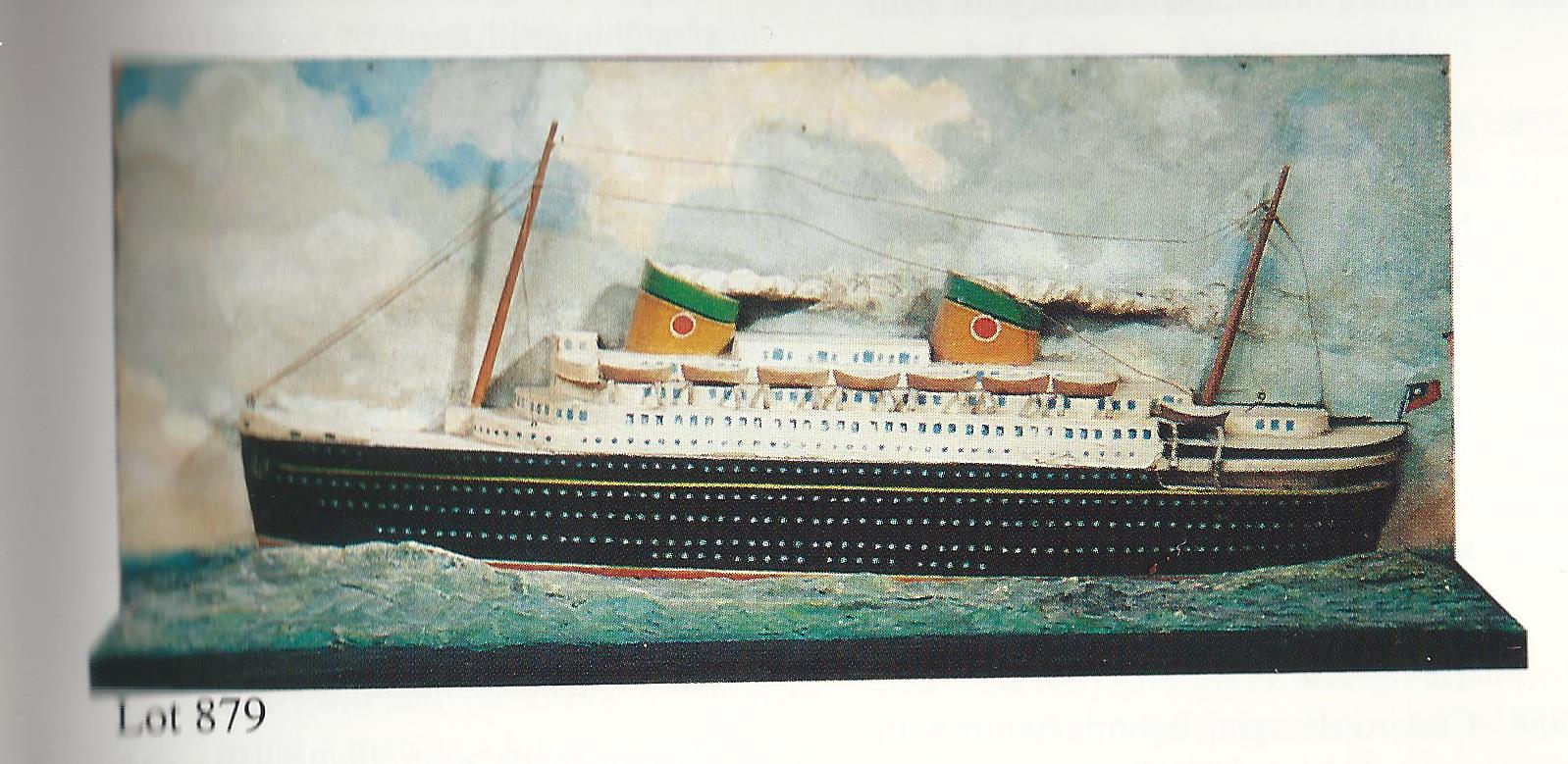
mounted wooden model of a steamship,early 20th cent. – $750

The catalogue has an interesting two page introduction by Pierre which explains his interest.  It begins:

“The wellspring of folk art lies in the heart, not the wallet.  It is an audacious mix of techniques and materials; a multiplicity of themes and genres.  Folk artists are not artists in the conventional understanding of that word, rather they are ordinary folk without pretense or grand artistic ambitions. Through Quebec folk art, we can glimpse the geographical, historical, social, and religious character of the province, and in that sense, the heritage of Quebec folk art ranks along with its architectural and technological history.”  He goes on to discuss the many factions of folk art and concludes; “ I have collected folk art for over 30 years.  It’s a past time – even a passion – that gives me the opportunity to meet people who live anonymously but have many things to say, and they do speak, in their own way.  Many of these talented people are not considered artists.  They should be. Perhaps if they had lived in another place or another time, they would be considered such. There’s so much great folk art there that deserves a place of honour in all art collections.”

Well said Pierre, and the massive, well organized, two day auction saw many such pieces make their way into some important collections, while realizing some pretty phenomenal sale prices.

Lucien Legare horse, buggy and rider

We were able to buy a lot of stuff. We paid relatively big money for some things like this Lucien legare horse, buggy and driver at $750, but with so much on offer we were able to scoop up many bargains as well.  Like this Felicien Levesque tableau of the Titanic sinking at $625. Well under the money.

The Titanic by Felicien Levesque

Things started out modestly with maple sugar molds, and smaller carvings and accessories going in the expected $200 t0 $400 range, and then people started paying attention when lot 161, a painted whirligig Mountie which is illustrated on the cover went for $900. Soon after a tin rooster weather vane in old white paint realized $1,250.  Then lot 195, a knife with carved wooden handles in the form of a fleurde lis with a man’s head brought $1,900.  Things were moving.

There were a few gasps when a beautiful Nova Scotia document box from 1914 with interlocking hands, hearts, stars, and leaves went for $1,900. Followed shortly after by an oil on glass painting of tugboats on the Saint Lawrence attributed to Captain P. Carbonneau which saw $2,500. An Alcide St Germain hanging flying goose achieved $1,000, and the tone was set.  Here’s a couple of the highlights.  There were many more.

We went on to establish a relationship with Pierre after the auction and were invited to visit him and his wife at their farm.  We had a wonderful evening of laughter,  good conversation and an excellent meal, and we even enjoyed the adventure of climbing up the tiny ladder to the second floor guest room of the century old farm house.  I made sure my bladder was empty though because I didn’t fancy climbing down in the dark to find the washroom.  We realized that for as much was sold at the auction, he had twice as much great stuff still in his collection.   We even had a chance to say a quick hello to our lumberjack friend in his new residence by the pool.

large pulpit decor from Grosse Island where Irish immigrants were held in quarantine, made as a greetings from French Canadians. – $3,100

Antiques I love, and why I love them – part 2, a tiny tin fiddle

 A friend and fellow folk art enthusiast came by yesterday, and while we were enjoying a nice cup of coffee the conversation lead to an exchange questioning what is it about certain objects that make us like them more than other objects?   Any conversation about personal aesthetics is at best subjective, and at times downright obscure, but it is better than talking about the weather.  So as an attempt to get down to defining the source of the desire to possess I asked my friend, “Hypothetically, If I were to let you take home one item from our collection that you can see from where you currently sit , What would it be”.  After a pause and some reflection he said, “I would take that tiny fiddle hanging on the wall over there”. This surprised me, because we have a lot of flashier, obviously more expensive items around, but yet I understood, and might likely to have answered in the same way.

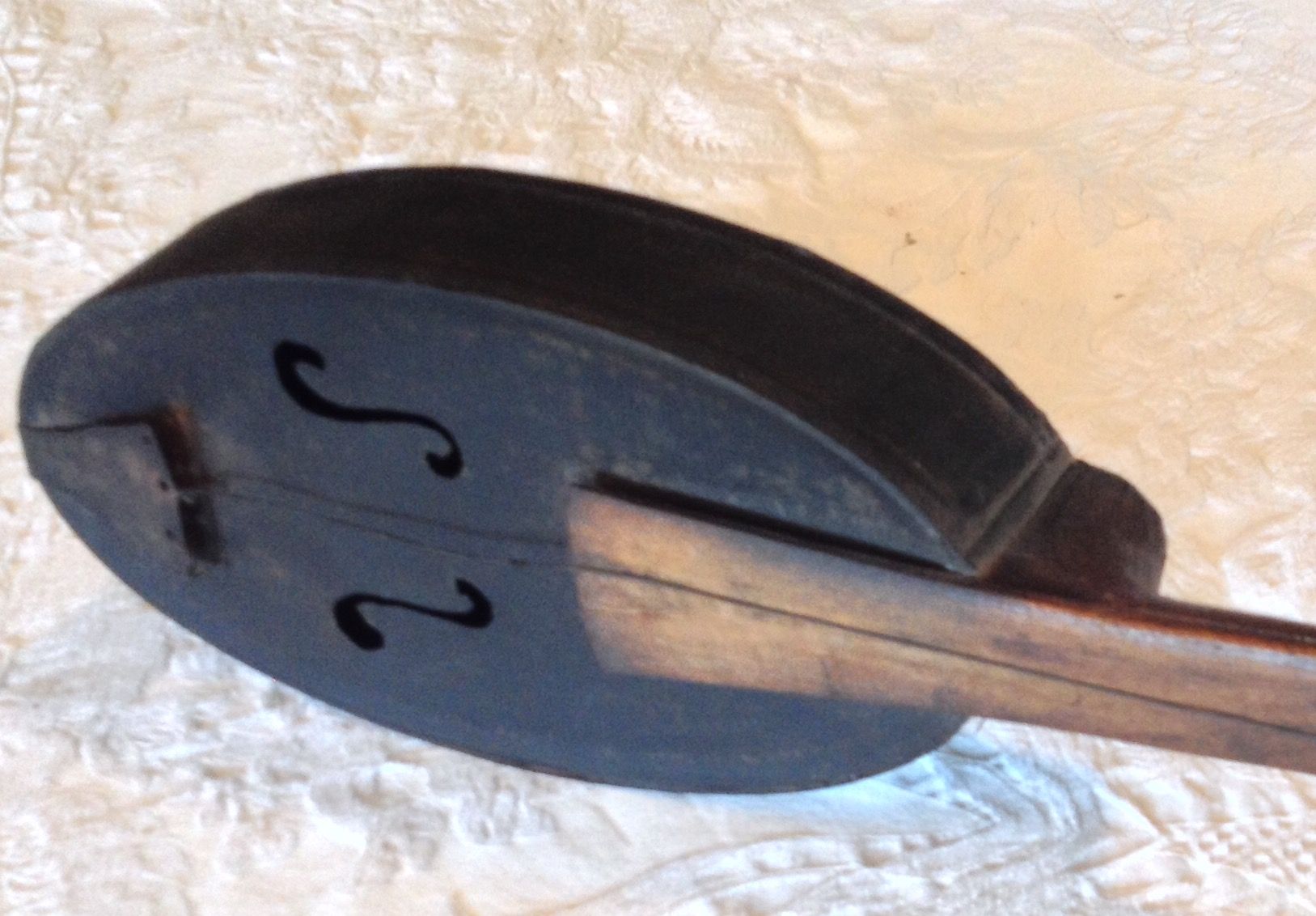
It is unclear if this 18” long, 4 string fiddle made from an old herring tin and carved wood was ever meant to be played, but my guess is it was playable when it was made.  When I study it, I imagine that it may have been created as a gift to a child to encourage musicianship, but it is equally possible that it was created as a “gag” instrument to be pulled out for surprise at a strategic moment in a performance.  Maybe the guy or gal just wanted to make something to put on the wall, or to give as a gift.  It’s fun to think about, but in the end you get back to the object. 

I remember finding it under a big pile of junk in Alan Chauvette’s  pickers barn near Victoriaville Quebec back in the early eighties.  Alan was standing nearby writing down what we were buying and the prices.  I held it up and said “how much for this”  Alan glanced up and said “$45”.  “O.K. write it down”.  I don’t think he looked closely, or maybe he doesn’t share my aesthetic because I felt it was a steal.  But then again I have come to realize that things of great esthetic value do not always get recognized monetarily.

Some people, or I would imagine many people would think that even $45 is too much for a rusty old tin can fiddle, but they are different from me.  I love the thing.  I brought it home from Quebec.  I hung it on the wall, and to quote the late, great Charlton Heston, “ to get it, you will have to wrench it out of my cold, dead, hands. “ So what is it?  Obviously, the colour and untouched patina are superb, and the form and hand carved neck and machine heads are beautifully executed in a functional, yet slightly primitive sort of way.  The “F” holes are beautifully cut out, and the construction of tin, wire, and wood is wonderful.  All these elements hit  the pleasure buttons in my  brain, but I think it Is the fact of the herring tin body that puts me over the top.  I looked for a long while half consciously wondering how they got the herrings out of the tin which looks original and undisturbed save for the “F” holes, before I investigated and saw that there is a neat row of nails around the bottom attaching it back to the sides.  Great care was taken to create this.  A real labor of love. I love the way it is, but when I imagine it with it’s bridge intact, and the other three strings, I wonder what type of sound it would have made.  One would assume, tinny.

I found my “sunshine” tractor in a little shop north of London, Ontario a long time ago.  Again it was an item which went straight to my heart, and as I purchased it I knew it was something for me.  Something I would never want to give up.  I’ve bought and sold hundreds of hand-made toys, many more impressive in construction and scale, and yet it is this tractor which continues to sit in a glazed cupboard overlooking my work desk.   I love it’s construction and form and colour, but the element that takes it into my top drawer is the little “sunshine” sign.  I’m not an armchair psychiatrist per say, but it doesn’t take Freud to understand that my love probably has a direct route back to my mother singing me “You are my sunshine, my only sunshine” while I lay sick in bed with the measles at the age of ten.  That song is such a bittersweet tour de force isn’t it?  I get emotional just thinking about it.

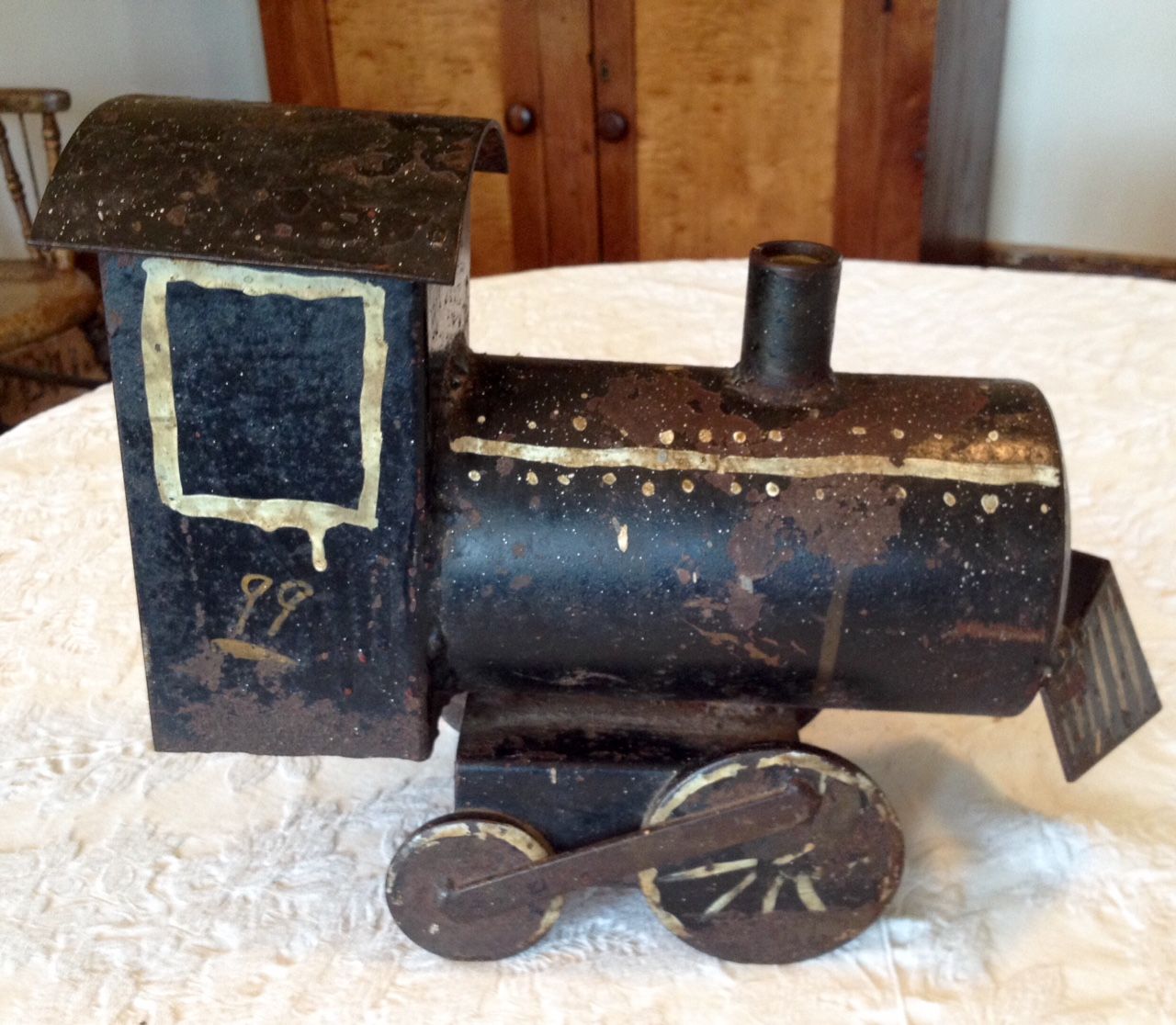
Lastly, we come to “Old 99” (see 99 painted on the door). To be honest I don’t love it nearly as much as I love the tin fiddle or “Sunshine”, but I do love the fact that someone with welding ability, probably a professional welder, took the time and effort to make his or her child an indestructible toy locomotive, with a space at the back to put an engineer.  Is that an old bullet used to make the smokestack?  I hope not.  The poor kid could blow up.

Les Patenteux du Quebec, the “bible” of Quebec folk art

In 1972 three young Quebecoise, Louise de Grosbois, Raymonde Lamothe, and Lise Nantel began research on Les Patenteux du Quebec.  Patenteux is an idiomatic Quebec word that roughly translates into Inventor or Creator.  The book was published by in 1978 with assistance from the Quebec Ministry of Cultural Affairs, and The Canada Arts Council.  For six years, the women sought out “Patenteux” across Quebec, documenting their words, locations and creations for posterity and to as they suggest in the introduction,  to be a “monument to our culture”.  You know how certain books become “the Bible” of a subject? Well this is “the Bible” of Quebec folk art.  A work of great importance now, and in the future for anyone interested in understanding and appreciating Quebec culture.

In the introduction they state, “We started research in 1972 at a moment when our culture interest was to return to the source, born from a feeling of sharp Nationalism which succeeded a long period when we were easily dazzled by everything foreign. We perceived that the Quebecois people, who had survived 300 years of systematic humiliation and dispossession,  was not a people without culture and history. The ingenuity that our ancestors applied to adapt to the climate, and to conquer their isolation testifies to this. They had to survive.  They had to reinvent their architecture, their tools, their ways of feeding and clothing themselves, as well as their celebrations.  This process of rehabilitation of our history and culture, which was an attempt at decolonization has given us a new image of ourselves, and brought us to search for our identity.”

 The book records seventy five artists broken into nine geographical regions.  It is a treasure of information which is out of print and now hard to find. It has never been translated into English.   There’s a Canada 150 project I would like to see.  A hardcover version in both official languages.  But it seems the money is going to fireworks and giant rubber ducks.  But I digress.

I love this book even though I struggle to understand the accurate recording of the patois of the subjects.  There’s lots of wonderful pictures.    In my February 18, 2013 blog  “My happy time with Mr. Joly’s whirligig” I recall our first encounter.  “Fast forward to the next summer and we are enjoying a weekend in Quebec, our favourite North American city.  We had heard of a bookstore where it was possible to buy a rare book, Les Patenteux du Quebec,  which we knew to be the “bible” of Quebec folk art.  Published in 1978, it is the work of three young Quebec women who spent  a summer or so traveling all over Quebec documenting, and recording the stories of every Quebec folk artist they could trace.  We found the shop and bought the book, and when we cracked it open, it opened to page 19, and behold there was our whirligig. With a picture of it in it’s original location, and a statement by the artist.  Extraordinary.”

The love and respect shown to the artists is clear by “ the letter to the Patenteux”  which begins the book

“You encouraged us to make this book by telling us that you would like to know what the others are doing.

We wanted everyone to recognize you.

We hope that we have been faithful to what you have told us, and that you will recognize yourself. We apologize in advance for the errors which may have crept into the information we give.

A wonderful memory of you is guarded. Your great vitality has given us the taste to live for a hundred years, to get to do things as extraordinary as you do. “

Over the years I have been able to identify the unsigned works of many artist by thumbing through this book.  Every time this happens I thank the authors, and I inevitably linger, trying my best to decipher the comments, and just letting myself imagine meeting and experiencing the environments the artists create.  It has also helped us track down many artists who  continued to live and work in the places they were recorded.  Folk artists tend to stay put.

For all these reasons I salute and give a heartfelt thank you to the authors for their dedication over the six years it took to produce this book.  You have made a valuable contribution to the Quebec cultural identity, and further to our Canadian Identity.  A book worth having. Try to find yourself a copy.