Remembering Billie Orr and his Muskoka folk art Paradise

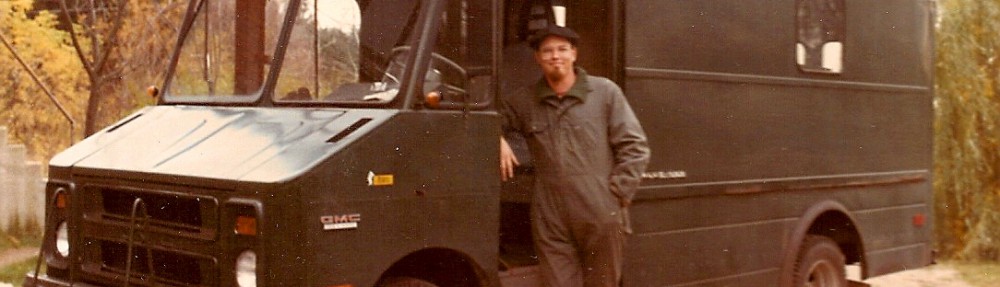
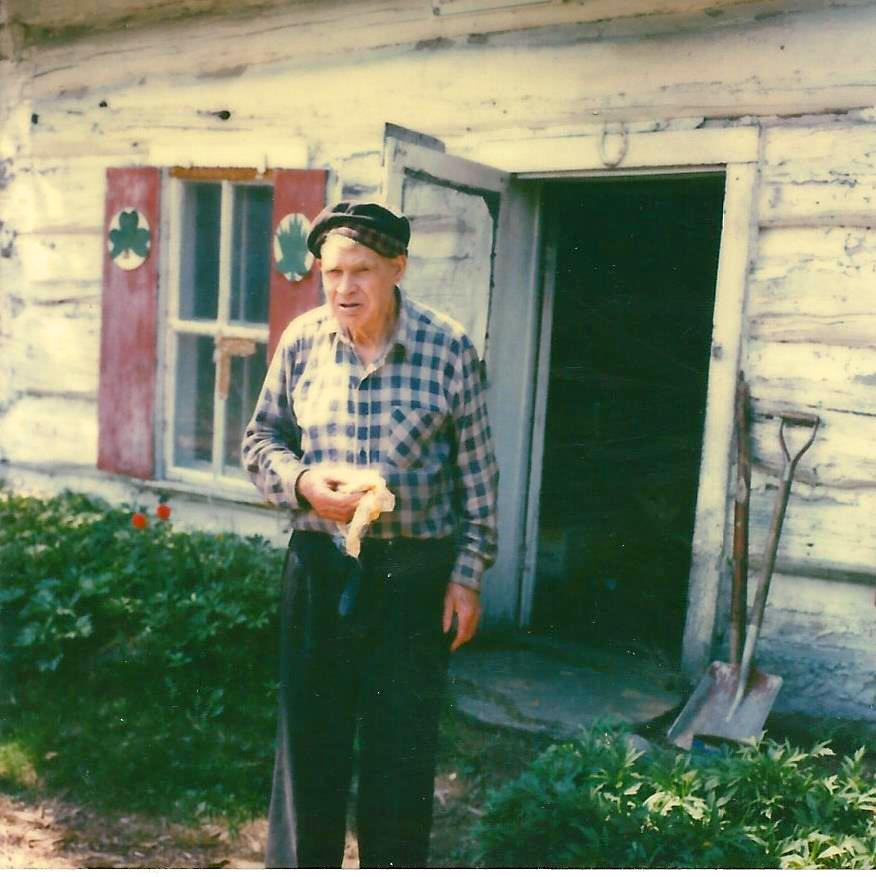
Billy in front of his cabin

Billy in front of his cabin

Back in the nineties, Billie Orr was a familiar figure in Bracebridge, Ontario.  My friend Scott Beasley would see him at least once a week, shuffling along the street carrying his bags of groceries and supplies, as he headed out towards his property which lay about three miles out of town on an isolated craggy, wooded acreage overlooking a river.

With his perpetual Irish cap, and lower lip which seemed in danger of dragging on the ground, Billy was well known, and universally liked by the locals. Scott took to talking to him, and found out that Billie lived on his own on the property he was raised on, and having a good picker’s instinct, he eventually got Billie to invite him for a visit. What he found was fascinating. A bit later, I happened to be in the area and was interested, so Scott and I headed out one fine summer morning for a visit.bo2

Billie lived in a log cabin with no running water and one electrical outlet on a large remote acreage not far from town.  It was a pretty funky set up.  He had to go down the hill to fetch water, and the cabin looked like nothing had been done to it in several years.  We came down the long lane to the cabin and there was Billy standing in the open front door.  Although old, and obviously used to living alone, he was welcoming and articulate.  He started right in telling us about his upbringing.  His father was an inspector on the railroad, and had built the cabin in the first quarter of the century for his wife and Billie and his sister.  Billie’s sister moved away.  Bill never left.  He never married, and never drove a car.  He would walk into Bracebridge once a week and get what he needed, which wasn’t much.  Bill still cut all his own wood, fetched his water, and grew a large garden so he was practically self-sufficient.  bo5

We were chatting away in the main room of the cabin when suddenly a large mother raccoon appeared at the door.  Billie excused himself.  “Good morning little mother.  As you can see I have guests but I have your breakfast ready for you.”  At this he disappears into the kitchen and comes back with a granite plate full of table scraps, and sets it down outside the front door.  Mother raccoon made a friendly, grateful noise and set at it.   We continued the tour.

bo7

Billie’s carved Irish little people

At the side of the room here was a steep set of stairs which led to the second floor.  You could see that the top steps were completely covered in soot, and Billie explained that he had had a fire up there a couple of years back, but had managed to get it out before it destroyed the place. Obviously he was no longer using the upstairs as it had never been cleaned.  On the steps there were several small carvings of Irish people and little wheelbarrows which Billy had made some years back with a view to selling them to tourists.  I guess he never found a venue for selling them because he had several of them in a row, all covered in a layer of soot from the fire.  “These are cool Billie.  Any chance you would sell us a couple of them.”  “Well, I could sell you one or two I suppose. If you want to buy more, you will have to come back”.  I realised that this was Billie’s technique for assuring a future visit. He obviously enjoyed conversation, and “human” visitors were rare.

cement leprechaun

cement leprechaun

Next he took us out back to show us his other work.  There among the trees stood several hand formed cement figures depicting Irish Leprechauns, and Colleens (young women) and several figures depicting the signs of the Zodiac.  Billy explained that he made these free form by placing metal armatures (or skeletal forms) in the sand and then building them up with cement.   They were all wonderful folk art, and a vision to see in this natural setting.  Just behind them Billy had years before planted a circle of trees which grew to a great height and were meant to depict Stonehenge.   What an amazing creation.  I was awe struck.

There is so much more to say about Billie and my subsequent visits that I will continue the story next week in my Friday Blog.   Billie was a true “outsider” in every sense of the word, and I am honored and privileged to have known him.   bo4

The manufactured “folk art” of Pierre et Claire Inc.

the cover of our mail order brochure

the cover of our mail order brochure

Last Saturday at Christie in anticipation of this article, I looked to see how many animals I could find which were manufactured by this small Quebec company.  Although it was too hot to cover the entire field, I did manage about ½ of it, and in that area I found five.  I noted that we as Old Church Trading had painted three of the five.  This gives you an idea of the scope of production of this company.

Rene Beaudoin was one of the original, and possibly the most successful of the Quebec pickers which started up in the 1960’s in the Victoriaville region of Quebec.  There were several small farms in the region, and everyone seemed inclined to keep all the old furniture and accessories as it was replaced in the barns, basements, and attics on the property.  The popularization of antiques brought in part by Expo 67 signaled the start of the antique picking industry, and Rene, although reportedly not able to read or write, had a keen understanding of business and quickly became the main man, hiring several men to go out and knock on doors, and they fetched all and everything available, bringing it back daily to his large farm near Defoy.  After becoming enormously successful in the antique trade, in 1978 he decided to create a small manufacturing business, employing some of the wonderfully talented wood workers of the region to create high quality reproductions of antiques, and copies of wood carvings which were prevalent in the area.  In 1983 his daughter Claire, who is married to Pierre Trudel, bought the company from Rene, and thus Pierre et Claire Inc. was formed.

unfinished order arriving from Pierre et Claire

unfinished order arriving from Pierre et Claire

The company exists to this day at its original location of 1197 Rue Principale, St. Anne Du Sault (Defoy), Quebec, and continues to manufacture reproductions of antiques and animal carvings with about five full time employees.  When we discovered them back in the early 80’s we decided to set up a mail order business for the animals which we called Old Church Trading.  We advertised in Harrowsmith magazine in Canada, and Country Home magazine in the States.  We offered many different animals both in the sanded, unfinished state that we bought them in, and varnished or painted which we did ourselves. We sold hundreds of them both through mail order, and at the Harbourfront market in Toronto, which we attended every Sunday.  At the time it seemed everyone wanted a nice pine, carved goose or swan to sit on their harvest table or cupboard.

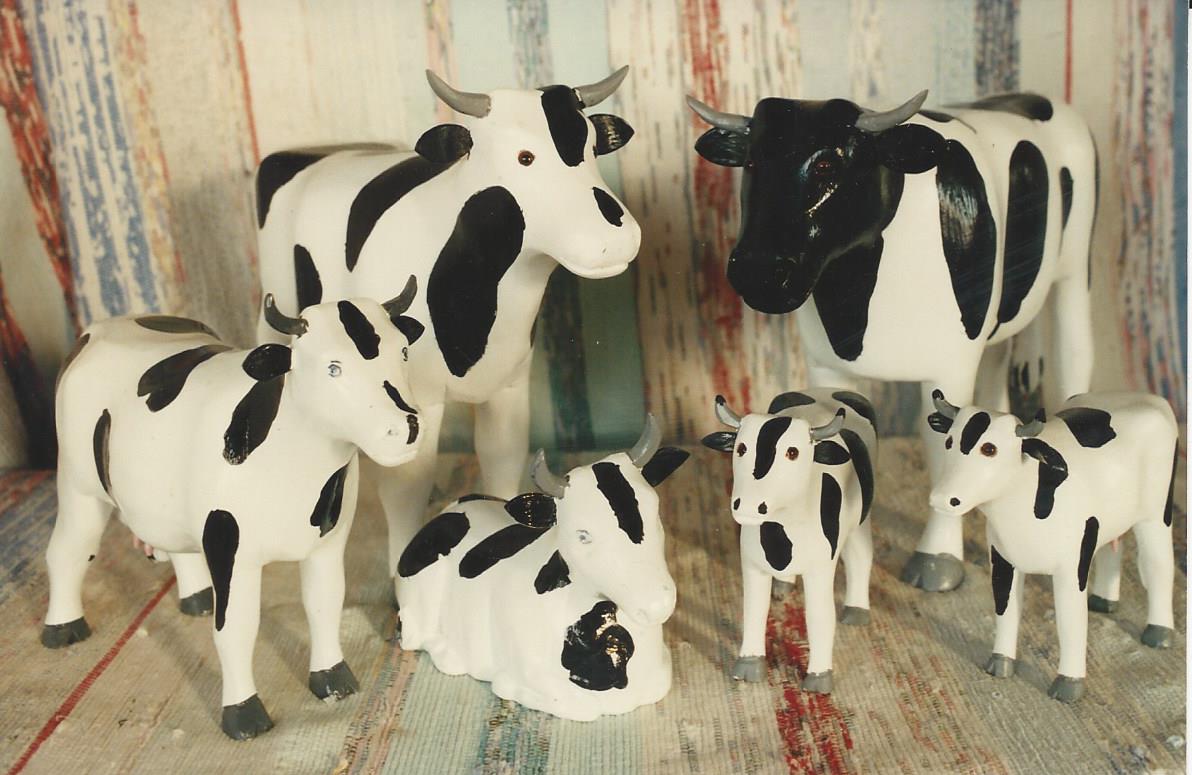
various cow models

various cow models

We would stop in every other week or so and fill out our orders, going through the bins of carvings and picking out the nicest ducks, geese, swans, loons, roosters, and other animals.  We were always interested to see what new models they would come up with.  Penguins, buffalo, bears etc. would appear.  The prices were always reasonable.  I recall the standard size goose would cost about $16 each.  Although there was some variation in quality, (sometimes they would have large knots, or be slightly malformed) overall they were very nicely done.  Initially, all the models were cut out from solid pine, but sometimes these pieces would crack with time, especially if they were not adequately finished, so eventually they started to offer laminated models at a slightly higher price.  This solved the cracking problem, but didn’t look as nice and natural in varnish.  Of course they were the best ones to buy for painting.

inside the factory. Note the pile of geese in the background

inside the factory. Note the pile of geese in the background

As far as I know this small company was, and is the only North American company to “manufacture” folk art type carvings.   Although by the fact that they are manufactured and mass produced they cannot truly be considered as folk art.  And yet you cannot really call them reproductions either because in many cases they are an original design.  For folk art collectors it is important to know of these carvings, and be able to spot them.   They are fine for decoration when bought at the right price, but should not be confused with “real” folk art, which are items of individual expression, and not mass produced.  Although we must also acknowledge that many folk artists, Maud Lewis springs to mind, would repeat favored images over and over again, it is quite different than banging out 100’s of identical ducks using templates and modern wood working tools.   Ironically, I think their market has been effected when the Chinese started to reproduce copies of their work.  I’ve seen lots of these too.

the very popular rooster, and hen with our paint jobs

the very popular rooster, and hen with our paint jobs

note how this is modeled after the Black Horse Beer display

note how this is modeled after the Black Horse Beer display

Pierre et Claire continue to be in business, and have a web site at www.pierreetclaireinc.com, but it is in French only, and does not show many of their available carvings.

Our painted versions of Pierre et Claire animals

Our painted versions of Pierre et Claire animals

My Afternoon with Eddie Mandaggio

EMandaggioEddie Mandaggio was born in Manitoba in 1927. He spent his early years working in Northern Manitoba and Ontario as a trapper, and as a hunting and fishing guide. He came to Nova Scotia in 1951 and settled in Camperdown, Queen’s Country, where he lived until his death in 2003.

He initially worked for the railroad for eight years, and then worked in the logging camps. Eddie started carving in 1974 out of a desire to make decorations for his cabin. He followed with painting in 1976. His subjects are geese, roosters, cows, horses and also some human heads. His carved pieces greatly outnumber his painted works.

Eddie's famous white goose

Eddie’s famous white goose

In the mid -nineties I had the occasion to meet Mr. Mandaggio, and although I was trying to take in as many artists as I could in a short stay, and had intended to just stay for an hour, we became so engaged in conversation that I ended up spending the entire afternoon.  I missed out on meeting a few others but my time with Eddie remains close to my heart.

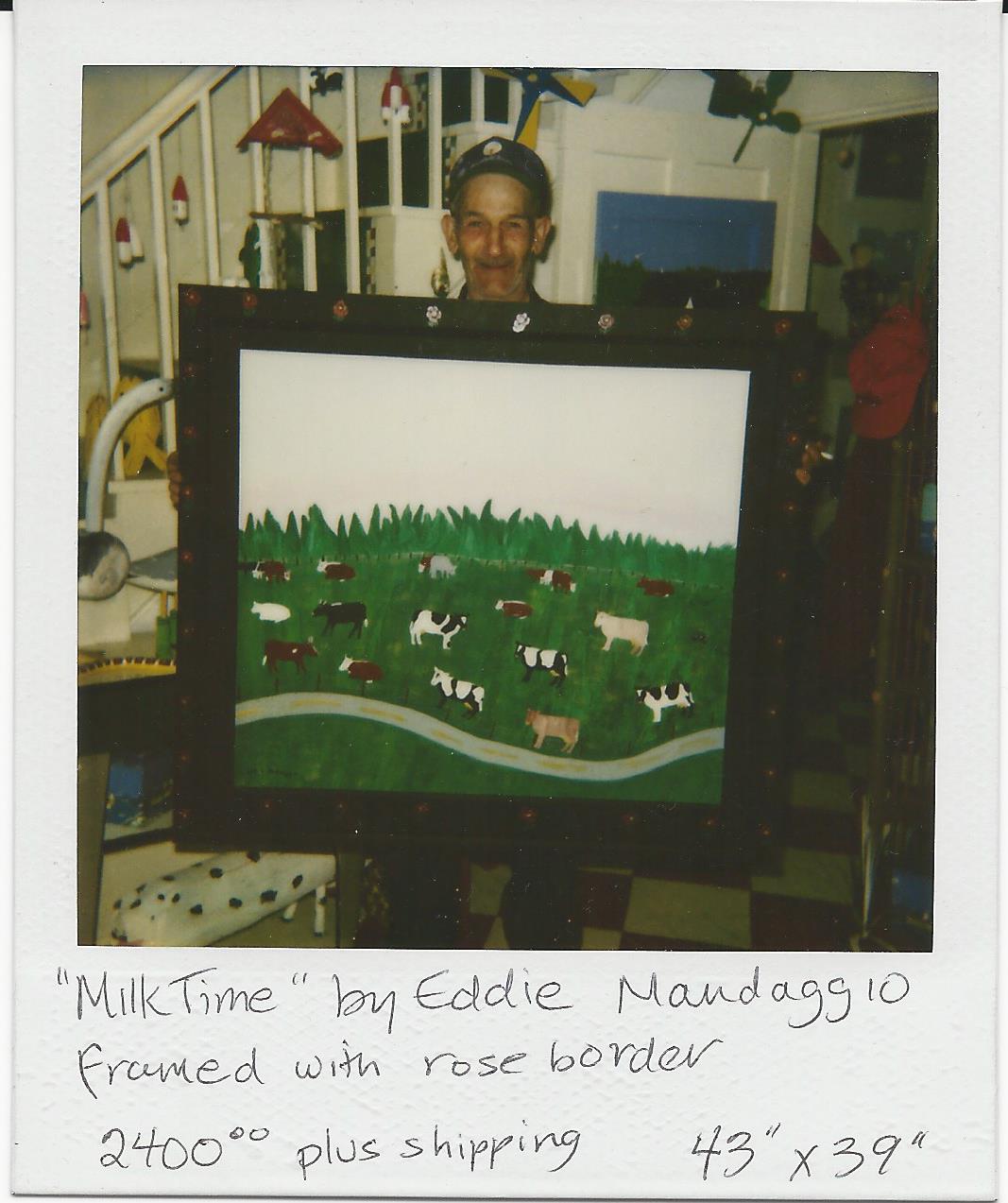
I flew to Nova Scotia to view and consider purchasing a major folk art collection which belonged to a friend of a friend named Iris Newman.  Iris is a lovely person. who got bit early by the folk art bug,and had the means, space,  and desire to build a major collection, purchasing major works directly from the artists.  She is featured in the NFB film “folk art found me”, and she is generally acknowledged as one of the main promotors and supporters of the Nova Scotia folk art community. We had a lovely lunch and fell into talking like old friends for a couple of hours before she took me around her large home and showed me the extent of the collection. Although amazing in quality and scope It turned out to be too many massive pieces which I knew would be hard to place, and she was strictly committed to an “all or nothing” deal so it didn’t work out, but I learned a lot from her and we did remain friends.  Of this vast collection, one of the most impressive things for me was two very large paintings of tiny cows in a big field by Eddie Mandaggio.  It was the first Mandaggio paintings I had seen and there is something about those giant fields with those tiny cows that hit all my buttons. She was keeping them and I completely understand why.  So after an afternoon of talking, and documenting the collection it was time for me to go.  As I was leaving I told Iris that the following day before I had to catch the evening flight home, I was going to go to the Lunenburg area to meet the Naugler brothers, Garnet Macphail, and Eddie Mandaggio who was already one of my favourite Nova Scotia folk artists.   “Oh that’s great Phil. You’ll have a wonderful time, but I must ask one thing of you.”  O.K.?  “When you get to Eddie’s you will see that he has recently carved a very large moose head trophy, and I have decided to buy it, so don’t you go and buy it.”  Ouch.  I hated to agree but Iris is a lovely and determined person, and I was still considering her collection so I reluctantly agreed.

One of Eddie's cow paintings

One of Eddie’s cow paintings

After a delightful morning with the Nauglers which will be the subject of another blog, and after a delicious bowl of chowder at a roadside restaurant, I got to Eddie’s place.  Immediately we hit it off. Eddie was very kind and open, and wonderfully generous in his description of his past careers.  He was particularly articulate about his love of carving, and stated that although he had been painting for the past few years, most of these paintings remained in the basement of the Houston gallery in nearby Lunenburg, and not many had sold, so he reckoned that he must not be a very good painter.  “Au contraire, mon Ami” “I think you are a fabulous painter. I was knocked out by the paintings in Iris’ living room.”  “Really.  Well thank you for telling me.  I don’t get much feed- back and most people just want me to keep making my “hits” like the big white geese.  It’s not much fun doing the same thing over and over again, and actually not why I started carving in the first place. I’ve started to refuse the large orders that have kept me doing the same thing for the past few years.  For me carving is a wonderful therapy to counter my jumpy nerves, but I have to be free to experiment or it becomes too much like a regular job.”  “I absolutely agree with you Eddie.  You must be free to let your imagination roam. Have fun with it, and whatever you do, don’t give up painting.”  Eddie smiled that winning smile of his. “Thanks for saying.”

Of course there in the background the entire time we are talking hung the extraordinarily beautiful massive moose head on a red heart shaped crest which Iris had forbidden me to buy.  Tagged $750.  I would have given him the cash in a second if I was not bound to my word.  What can you do?

That was the one and only time I met Eddie, and he became quite ill and stopped carving soon after.  I never did get on to see Garnet MacPhail, but I don’t regret a minute of the time I spent there with Eddie in Camperdown. A few months later I received the following polaroid of Eddie with a new cows in the field painting.  Unfortunately I didn’t move quickly enough and missed it.  If you would like to know more about Eddie, the Black Sheep Gallery has posted a wonderful series of You tube videos you can look up.Scaned

Meeting Aime Demeules , folk artist from St. Paul-de-la-Croix, Quebec

aime6

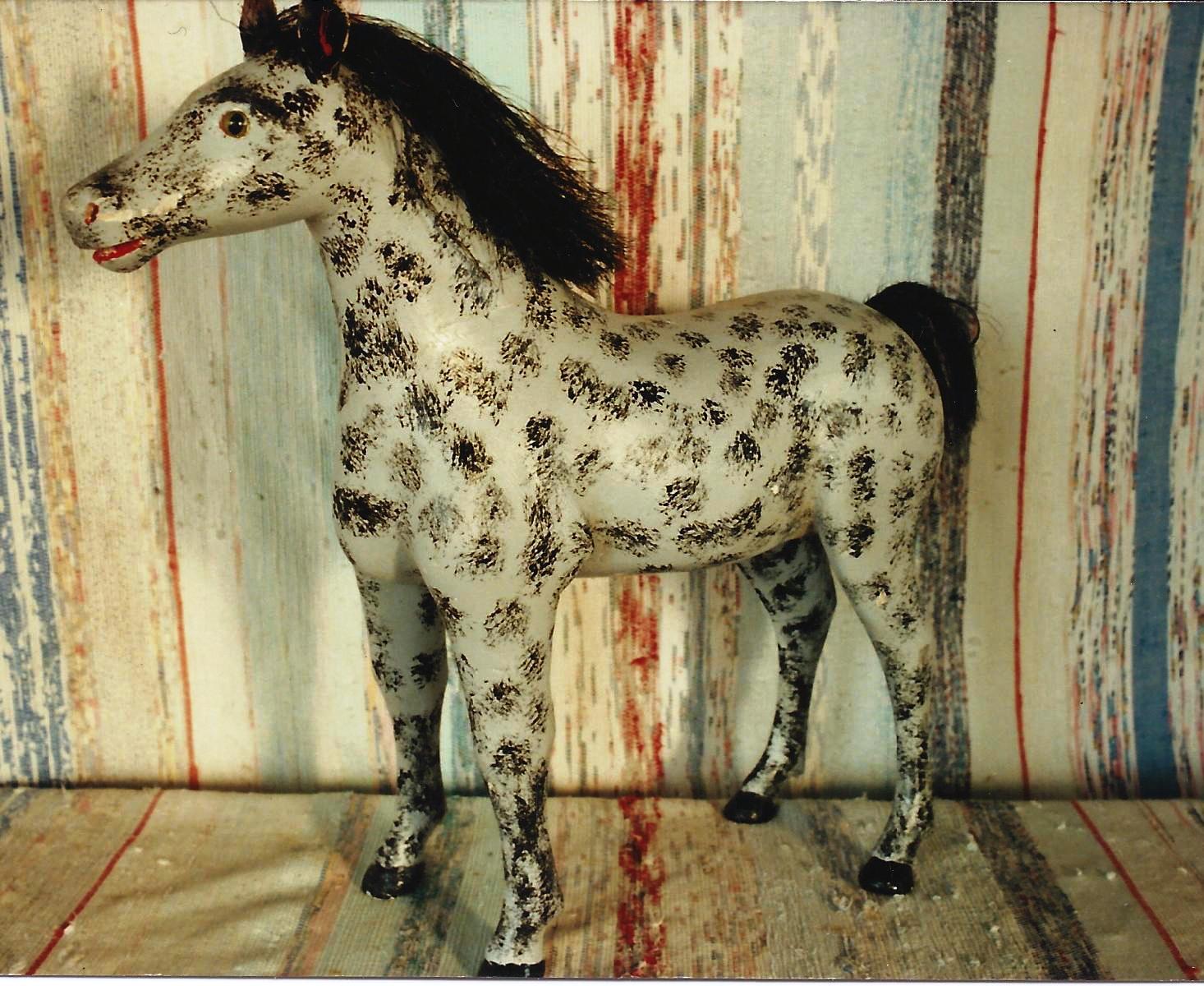
Speckled horse by Aime Desmeules

In an earlier post I recall our meeting Felicien Levesque in the early nineties while touring the Bas -St. -Laurent region of Quebec.  Well, the very next day we rose early and made the half hour drive From Cacouna to St Paul de-la-Croix, knowing it was the hometown of the well-know carver Aime Desmeules.  We had been buying his animals for years from Victoriaville picker Marcel Gosselin, and we had always wanted to meet him.  It was not hard to get directions to his house in this small town of 367 people, and we were soon pulling in to the driveway of a neatly kept, small ranch style home.

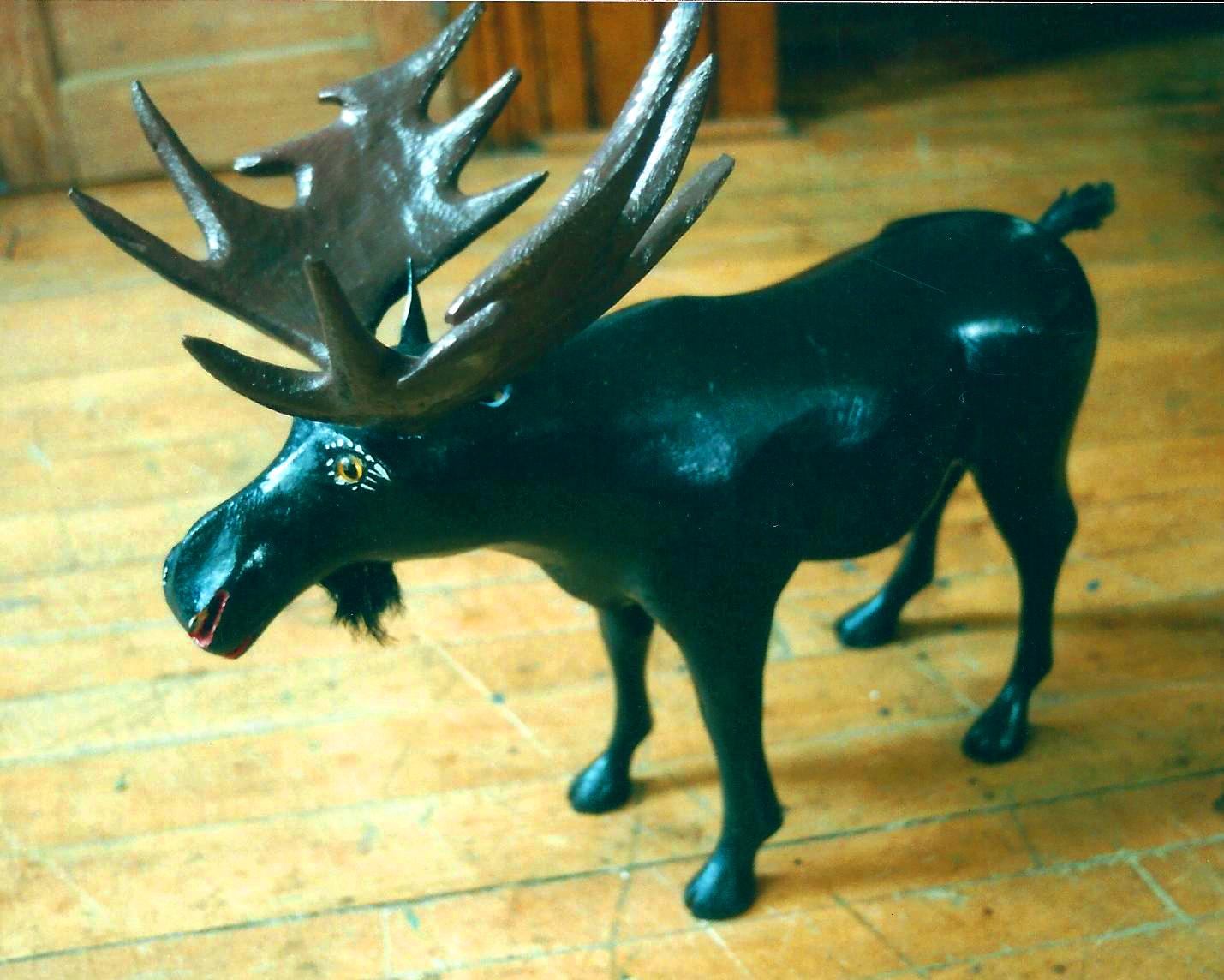
moose by Aime Desmeules

moose by Aime Desmeules

Jeanine and I rang the bell, and were soon greeted by a puzzled looking older lady we took to be his wife.   We explained that we had come from Ontario and being big fans of Mr Desmeule’s work, we had made the trek to their home with the hopes of meeting him.  “Oh no, that will not be possible.  He doesn’t like to meet new people, and he has no work for sale in any case. No, I’m afraid you’ve wasted your time.”Just as she was about to slam the door in our faces, Jeanine added sweetly, “Well we don’t mind if there is no work for sale,  but please we have come a long way and we would be very grateful just to have the opportunity to make his acquaintance.”  She looked us up and down.  Long pause. “Very well, he’s not here right now as he is fetching wood, but I suppose if you come back in an hour he may be willing to talk to you.”  Whew, nice work Jeanine.  “Great, thanks, we’ll be back.”  So we went into town and had a delicious big breakfast, and lingered over our coffee to fill in the time.

Aime and his wife Marie-Jeanne at their home in 1993

Aime and his wife Marie-Jeanne at their home in 1993

One hour later we were greeted at the door by Aime.  Surprisingly, he was as friendly as can be, and invited us in to his work shop which was fairly full of finished carvings.  “Pardon us for saying, but your wife gave us the impression that you had no work for sale, so I suppose these pieces are commissioned.”  He Laughed.  “No these pieces are for sale, it’s just that when you arrived unexpectedly with your accents, she was worried that you may be from the tax department.”  I was starting to think that this would be the standard greeting we could expect arriving unannounced at Quebec carver’s homes, and upon reflection, I understand where they are coming from.

The next hour was pleasantly filled by Aime telling us the story of how he was 64 years old before he took up carving and at that time he was taught by his father to create the various animals in his father’s repertoire to be precisely like his father’s work.  It was only after his father’s death in 1986 at 95 years of age that Aime developed a few new animals of his own, along with some pieces depicting people such as the blacksmith shown here.

"Blacksmith" by Aime Desmeules

“Blacksmith” by Aime Desmeules

Mrs. Demeules joined us after awhile and expressed that she was sorry for the rude greeting, but that she could see now that we were truly fans and not inspectors, and she was happy that we came.  We bought a lot of his work, about twenty pieces or so, and we spent a pleasant morning getting to know each other, before loading up and heading out of town.

What I find interesting about Aime, is how he was content, to the point of taking pride in creating exact copies of his father’s work.  He even signed the pieces with a stylized “A” “D” with the “A” looking very much like a “G” as his father had signed.  It is quite difficult to distinguish the father’s work from the son’s, and you are pretty much dependent on patina and provenance. My understanding is that George quit working in the early 70’s, but then Aime only lived on until 1997.

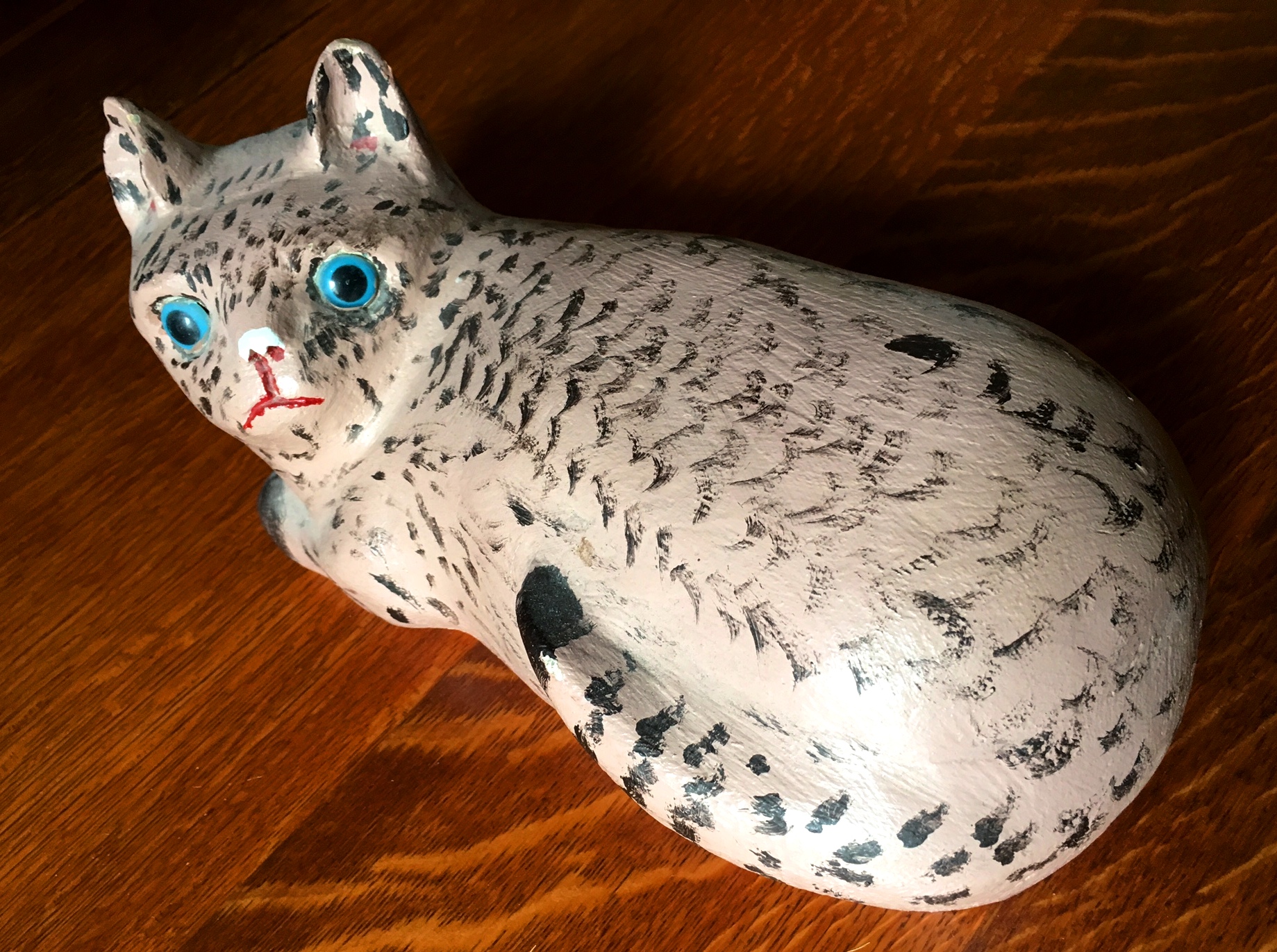
Aime's signature on cat

Aime’s signature on cat

aimecat

I

f you consider other carving families, such as Damase Richard and his son Wilfred; although there is a similarity to their work, when you study them closely you can see quite a few differences which make them easy to distinguish.   When considering father and son carvers, Aime and George’s bond seems unique.

"brown Cow" by Aime Desmeules

“brown Cow” by Aime Desmeules

Finding Fournier – how we met the acclaimed Quebec folk artist, Leo Fournier

Leo and Jeanette Fournier at home

Leo and Jeanette Fournier at home

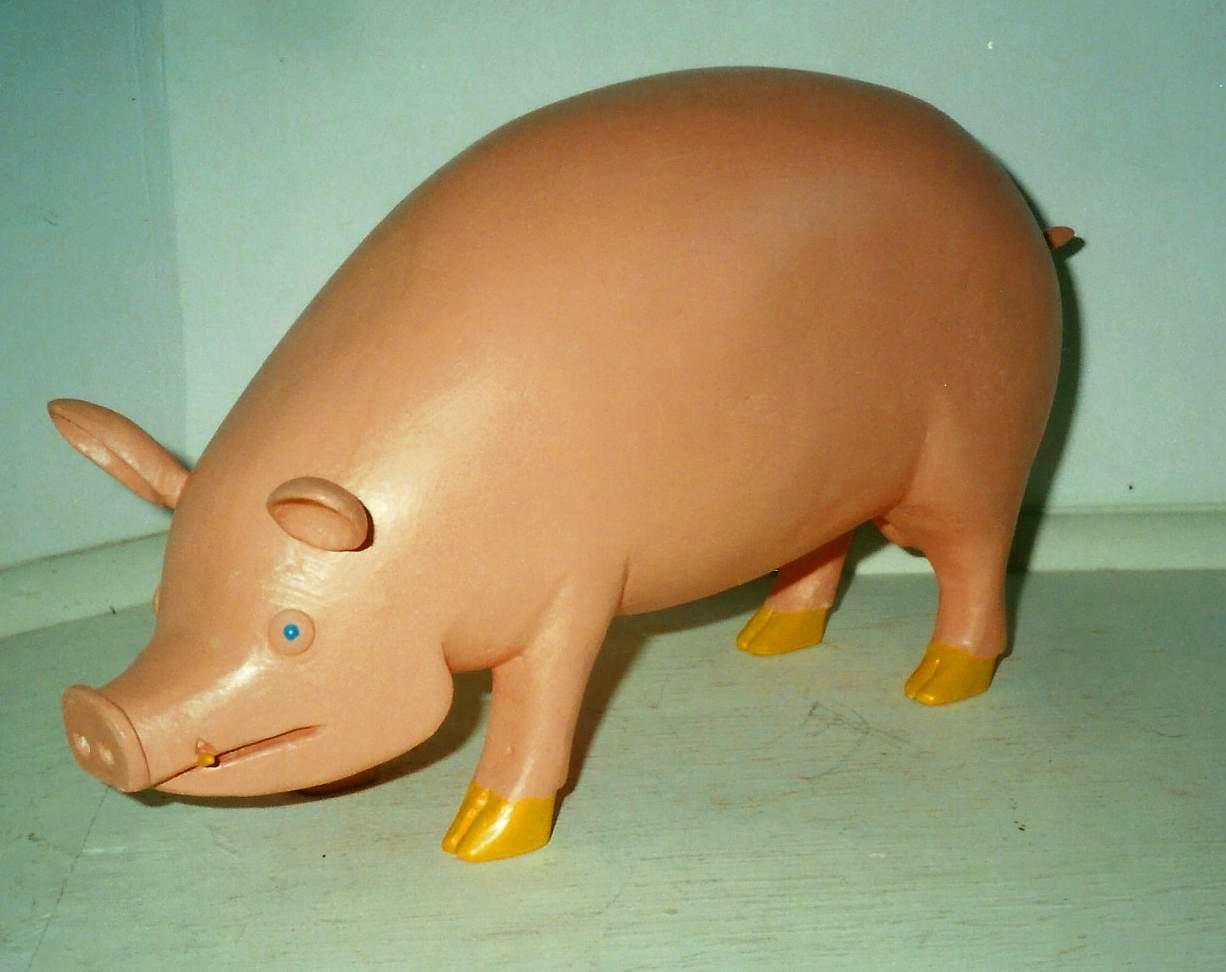
Leo Fournier has always been one of our all time, favorite folk artist for his whimsy, elegance and balance. Leo’s sculptures cover a wide range of subjects from the religious to the erotic, as well as animals and everyday life scenes.  The work is composed mostly of figures and animals in various forms of shared or confrontational activities.  .

pig, by Leo Fournier

pig, by Leo Fournier

He had a keen eye for detail, a great sense of fun and a love of life.  You can recognize a Fournier from across the room, and we would purchase the work when we came across it, in picker’s barns, shows, or auction.  It was always our desire to find and meet Leo, but of course the pickers were not anxious to have us contact him directly so would not provide information, and his address was not listed in the reference books.   All we had to go on was that  he lived in the town of La Prarie (pop 23,000), on the south side of the St. Lawrence River, across from Montreal.

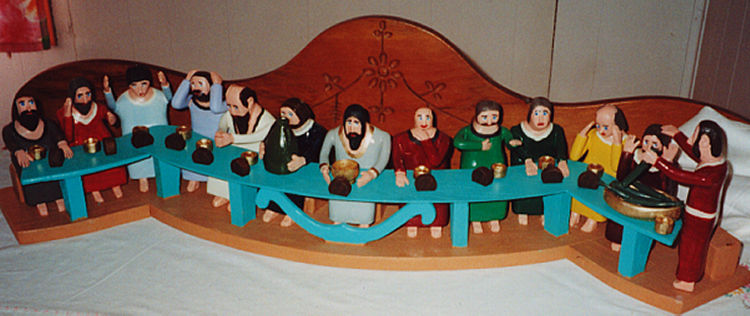
last supper, by Leo Fournier

last supper, by Leo Fournier

Sometimes our trips to Quebec were straight there and back affairs, but on other occasions we would take a few days to meander and explore, and it was on one such occasion in the early nineties that we found ourselves in La Prarie late in the afternoon with some time to kill before we hit one of our favored road side motels.  I pulled up to a phone booth, and said to Jeanine “let’s see if we can find Leo Fournier in the book.  Maybe we’ll get lucky.”  Our hearts sank a little when we realized there were over thirty Fourniers listed in town and only one L. Fournier.  Of course we tried this number first and it was not Leo, and furthermore they did not know of him, but we were not so easily discouraged and just started with the first listing and kept dialing.  Jeanine was getting a little tired after about a dozen dead ends, with not everyone being delighted to participate in our little search, but she persevered, and low and behold after about another six calls she spoke to someone who was a relative, and she was happy to provide his number.  “Well that was sort of easy.” I quipped. “O.K. well not that easy, and yes it was you doing all the calling”. In any case we dialed him up directly. and spoke to his wife Jeanette who said he was out momentarily but would be home soon, and he would be happy to meet us.  She gave us good directions to their house which we soon found on a quiet little street right across from a Depanneur , or variety store.

Old man fantasy by Leo Fournier

Old man fantasy by Leo Fournier

Leo met us at the door and warmly invited us in to the sunporch, where he liked to entertain visitors.  Leo was a very charismatic storyteller, and he launched right into some great stories while sit ting in his rocking chair sipping on a big can of Molson Export.  “ I like my beer but I only buy them one at a time.  That’s why I’m happy there is a depanneur right across the street” he laughed.” I noticed there were four empty cans next to his chair, but then again it was getting on in the day.  Jeanette arrived directly with some coffee for us and we spent a very pleasant hour or so listening to his stories.  He was a retired auto body man of good reputation, and was involved in the scrap business.  He told us about and showed us his first carving which was a crucifix done  in 1967 when he was 43 yrs. old.  Since that time until his death in 2007 he continued to be a prolific carver, selling to friends and the occasional picker, Nettie Sharpe among others who would come by to see what he had been up to..  He was aware that his work was included in books and exhibits, but he never felt he was really appreciated until sometime in the nineties when the Quebec government commissioned him to produce a series of about a dozen sculptures on food production.(See the butcher with hog’s head below) With this big pay cheque he chose to go to Leningrad on his own where he spent two weeks at the Hermitage studying the art there, rather than fix the roof on the house which was what the rest of the family was pushing for.  Leo was that kind of guy.  He lived his life the way he wanted to and never thought twice about convention.  We bought the six or seven pieces he had available that day and his house became a favorite stop on subsequent trips.  We always took the time to stop and listen to his stories. According to his pal Andre Laport who phoned to tell us of his death in 2007 “he lived his life just the way he wanted to right to the end, with no lingering illness, and a beer in his hand”.  Like so many others who knew him, we really miss him , and his infectious spirit.  One of the greats.

one of the works commissioned by the Quebec government

one of the works commissioned by the Quebec government

Folk art arrives at the door – The Barbara Browne Collection

BBrown5

drawing by Liz Barrett-Milner

It was a sunny, August day in 1995, and we had just finished our lunch when there came a knock on the back door.  We weren’t expecting anyone, and it was rare for anyone to visit without calling ahead.  This, because we were so often on the road that our friends knew to give us the heads up before coming by.  We opened to find a small elderly lady standing there with a big smile and a portfolio under her arm.  “Are you the folks who buy folk art?”  “Well yes, we have been known to do so.  How can we help you?” “My name is Barbara Browne, and I live down the road in Port Rowan, and I have a collection of folk art which I would like to sell.”  “Come right in and tell us about it.”

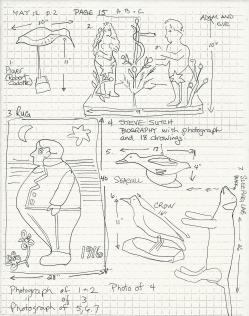
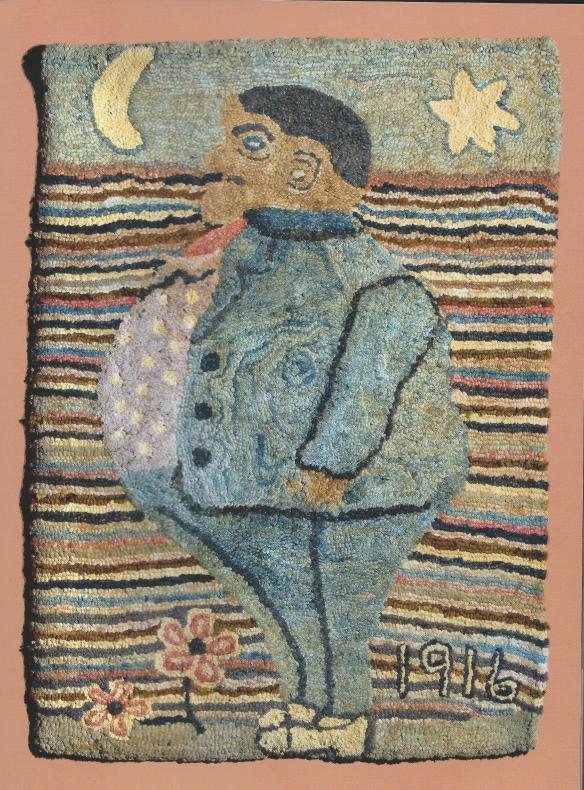
She explained that she was an artist who had collected Canadian folk art for the past twenty years, and she was about to buy a smaller house in Simcoe, and thus needed to downsize, and recoup her investment to help with the purchase.  “What is the nature of your collection?”  She reached into her portfolio and produced a twenty-page booklet of meticulously hand drawn illustrations of folk art with dimensions, which we later learned were produced for her by her niece, well-know Norfolk artist Liz Barrett-Milner.  “It’s all in here.  There are 185 pieces all told, and I am only interested in sell the whole thing.  No picking and choosing.”  There was some mind blowing stuff, including works by Nova Scotia artists Charlie Atkinson, Charlie Tanner, and Everett Lewis; as well as many Ontario artists such as Clarence Webster, Joe Lloyd, Steve Sutch, and Robert McCairns.  Most pieces were smaller in nature, but there was also a big wall-mounted cow’s head, a couple of 8’ totem poles, a full size deer, and last but not least, the best folk art hooked rug I had ever set eyes on, depicting a fat man and dated 1916.

BBrown2

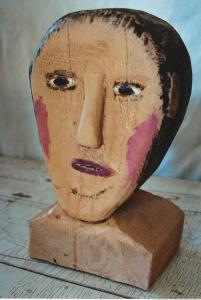
head by Robert McCairns

“We won’t beat around the bush.  It’s all of interest, but of course it depends on your expectations” She then produced an itemized price list of what she felt would be current list prices.  “I understand you need to make money, so this is what I think it is worth, and I would therefore expect half”.  “In principle that sounds fair so let us go over it and get back to you.”

What followed was four or five meetings at her house where we viewed the items and discussed the prices.  It became a bit complicated as each time we arrived we she had decided that there were a few more items that she felt she needed to keep, but it came to pass that we arrived at a final list and a final price, and so a date was set to complete the deal and pick up the pieces.

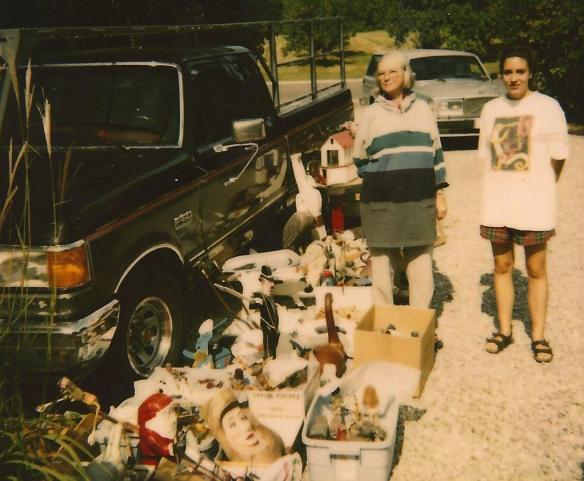
On that day, she informed us that she didn’t want to be there as we removed the pieces as it would be sad for her, so she wanted to go for a walk and return when we were finished.  We weren’t at all comfortable with this, but agreed on the condition that we would line up the pieces outside by the truck, and she would review the load before we left, and that’s how we did it.

BBrown1

Barbara Browne and Cassandra by the truck

Barbara was an excellent artist in herself, and continued to be a friend and inspiration until her death several years later.  The collection sold well, and the fat man rug was featured prominently in the John Fleming/ Michael Rowan book on Canadian folk art.

fatmanrug

the fat man rug

Canadian Contemporary Folk Art Festival -part 2

digby ferry

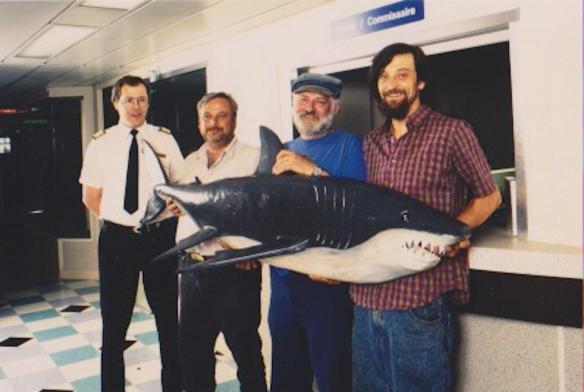
June 1994. Stephen Outhouse (middle with cap), Mark Robichaud (right), and David Stephens standing with the purser on the Digby ferry – on our way to Paris! We had this shark – a carving by Stephen – mounted to the top of the the truck cab.
I received this photo and note from Nova Scotia artist David Stephens shortly after last weeks post was published. Thanks David for permitting me to post it here. It’s a long drive from Nova Scotia for a one day show. This illustrates the dedication of all involved to this unique folk art event.
In looking over my support material, I came across some interesting definitions of folk art in the initial correspondence from promoter Michael Hennigan.  I include them here to add to the dialogue which we as collectors and enthusiasts continue to have on what constitutes folk art; and what of this art is worthy of study and preservation.
“The working definition of folk art for this show is: “the personal or naive expression of untutored creators”.  You will note that this definition deviates from those presented by folklorists and material culturalists which tend to emphasize context and tradition over aesthetics and individuality.  Rather it adheres to the connoisseurs or Art Historian’s definition with emphasis on form, line, and color.”
“I am trying to avoid ethnically based arts and crafts such as knife making, canoe building, basketry, newly made fish and duck decoys, or any mass produced craft lacking creative inspiration.  For the purposes of this show, Craft involves head and hand, while art involves head, and hand and heart.”
“I am also avoiding highly commercialized or slick assembly line work, or neo-folk art.  Which is defined as work made by self taught artists who get their ideas from seeing folk art elsewhere such as in books or museums. For purposes of the show such art is not folk art, but rather is about folk art.”
“Also, I am avoiding faux naif art, which is defined as art produced in a naif style by fine artists. Finally I am avoiding amateur or so called “Sunday” painting, as difficult as it may occasionally be to distinguish such art from folk art.  Folk Craft is also not allowed.  Folk craft is the folksy, cutesy pie, overly sentimentalized stuff seen at craft shows.”
With the inclusion of contemporary folk art at such distinguished shows as Cabin Fever, coming up February 6 and 7, 2016 in Kingston, Ontario, and the Bowmanville show which every year is on Good Friday, we have an opportunity to compare the work presented there to these definitions. I think that you will find that for the most part these shows rise to these standards.  I wish I could say the same for the field shows, but perhaps they will be inspired to improve as the knowledge of what constitutes folk art is understood by more and more people.   Here’s hoping.
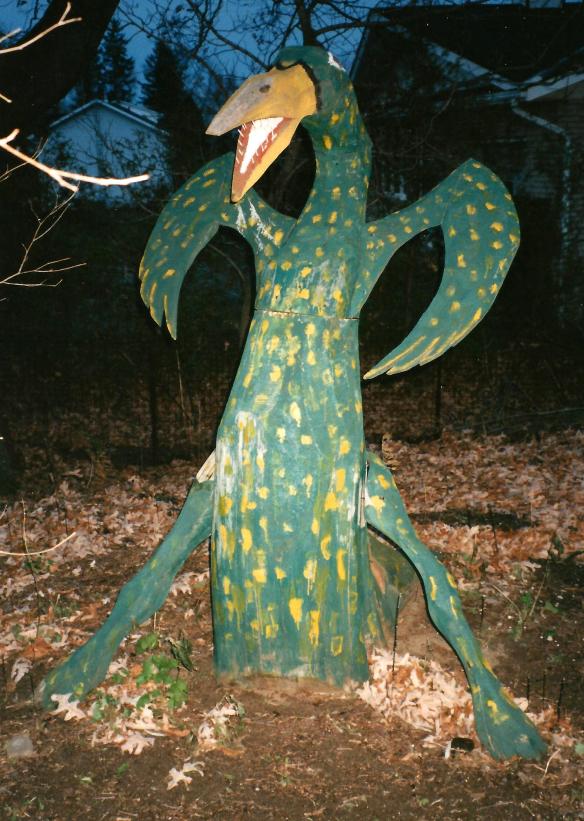
I went through my photos and found a picture of one of the dinosaurs we brought to the show.  Imagine being greeted by two of these 9′ monsters.
dinosaur

9′ dinosaur by Roger Raymond

Canadian Contemporary Folk Art Festival- remembering a significant, one time, folk art happening

CCFAFposterBack on Sunday, June 26, 1994,  my wife Jeanine and I as Old Church Trading participated in an ambitious, extensive, and ultimately one time special event that was, and remains the largest and most exciting folk art festival ever to take place in Ontario, if not all of Canada.  Acknowledging here the annual Nova Scotia Folk Art Festival.  It included 2 lectures, displays by a half a dozen folk art dealers, and the work of about 25 Contemporary Canadian Folk Artists, many who were in attendance. It all took place  on one glorious summer day from 7 a.m. until 7 p.m. at the Paris Ontario fairgrounds. It was an extraordinary opportunity for collectors, dealers, and folk artists to interact and network and to honor and support Canadian Folk Artists.  I remain enormously  grateful for having been included in this great event; and we sold a lot of folk art too.

The whole thing was conceived, organized, executed and financed by Canadian Folk Art collectors Michael and Peggy Hennigan, of Grosse Pointe, Michigan, and it was a giant undertaking.  Not only for the set-up, and extensive promotion associated with a first time show, but also for organizing and paying for many artists to come from as far away as Alberta, and Nova Scotia. Many folk artists chipped in to help get the word out.  I remember Michael’s gratitude to Joe Lloyd of Brantford who made up and distributed signs. We brought 25 of our best pieces by Ewald Rentz, Edmond Chatigny, Aime, Desmeules, Jacob Roth, and others, and were particularity happy to bring along two recently acquired six foot tall dinosaurs created by Quebec folk artist, Roger Raymond.  They looked fantastic gracing each side of the entrance walk.  Looking back it felt like it was over in a flash, but at the time it was a long day of exciting exchanges, sales, connecting with new (to us) artists, and last but not least, education.  We met and started to carry the work of Woodstock area artist Barbara Clark-Fleming, and I was delighted with the opportunity to meet and hang out with the likes of Joe Lloyd, Garnet McPhail, Stephen Outhouse, and Mark Robichaud, not to mention all of those passionate collectors.

It was well attended  for a first time event.  A few hundred people as I recall, and most of those being driven and engaged;  but it was less than anticipated, and less than required for the Hennigans to consider doing it again when weighed against the enormous workload, and expense. No one could blame them, as they certainly gave it their all, and none of this diminishes the fact that this event lives on in the memories of those involved as a unique and exciting day for collectors, dealers and artists alike, and a prime example of just how rich, fun, and informative a folk art festival can be.

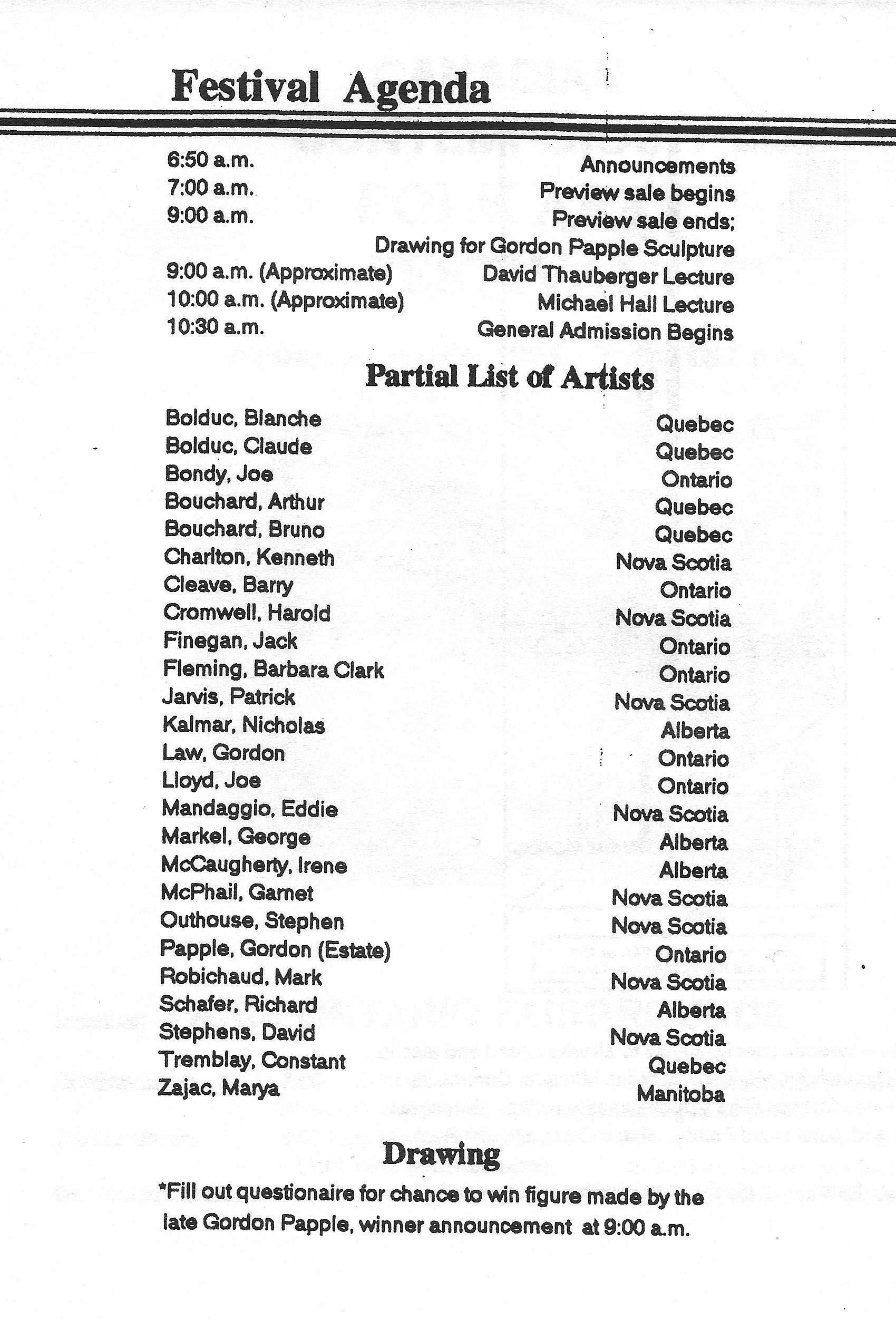
I am reproducing the program here, and next Friday I will post a further look at some exciting and defining ideas about folk art brought about by this event.  I am even going to look through my old photos and see if I can find a shot of those dragons.  No promises  I’ll do my best.

CCFAF3CCFAF2

Albert Hoto – 1953 Toronto newspaper article

Jack Knife Sculpture is authentic Canadian Folk Art: – Wins CNE Prize


DUNNVILLE (Special) – Sincere expressions of artistic talent may often flower off the beaten track and it is in this way that what many feel is a genuine contribution to Canadian folk art has been made in the Stromness   a few miles south and east of Dunnville.

In this quiet hamlet off the main routes of travel J.A.Hoto a retired farmer has created in the past three years a gallery wood carvings that may stand in their own right any comparisons with the best of the more celebrated French Canadian art.

Colored with an unerring eye and a bright and refreshing taste, and carved with an unselfconscious feeling for animal and human form, the little figures have an almost irresistible appeal to young and old.

Using only a bone handled jack knife and a hand coping saw Mr. Hoto, who has never had any formal art education, has peopled a miniature world with diminutive representations of rural life

Mr. Hoto who calls his creative impulse merely a hobby has been a farmer all his life in the township of Sherbrooke  in which he lives now. He recalls that as a youth he was talented with a jack- knife and at sketching, but when he took up the profession of farming he laid his artistic gift to one side  for lack of time.

With his retirement five years ago this thoughts turned once more to the interest of his youth butit was not until three years ago that he once more took up wood carving.

Since that time he has completed a collection of carved figures, animal and human, that include a stagecoach and train, a racing Roman chariot being pulled at a gallop by a span of four dabbled horses and a tableau of 40 native Canadian birds in their exact colours and stances.

Partial recognition of his talent was received by Mr. Hoto at this year’s CNE when he took the exhibitions second prize in the hobby class for the three dimensional representation of a brewery wagon pulled by a team of six horses.

The work is complete with miniature barrels ready for delivery and a driver sawing at the reins as he controls the team.  The work was completed during spare moments in about a month’s time.

A specialty of Mr Hoto’s are carvings of game birds in flight. These include Canada geese, pheasant and ducks colored naturally and carved with an amazing feeling for movement.

Many of these are to be seen in the homes of district people . U.S. tourists have been quick to recognize the originality of Mr. Hoto’s carvings and have purchased many of the plaques.

The larger groups which consist of wagons and horses in action plyus human figures and an occasional dog running pell-mell alongside are not offered for sale.

These, Mr. Hoto wishes to keep, but he will sometimes offer to carve a replica of any of his smaller works for those who appear interested.

Mr. Hoto’s workshop is a tiny room in a neat little shed in which there is barely room for himself and his current projects.

Here surrounded by animal pictures clipped from illustrated newspapers  and magazines he creates his models of the life he has glimpsed about him on the farm and local towns and villages.

The front portion of a garage facing the village street is wired off and in glass cases made by himself many carvings are displayed.

Asked where he gets his ideas for carvings, Mr Hoto only smiled and observed they just came to him. Some he stated were suggested by cronies. Their influence he indicated had encouraged him to tackle his Exhibition exhibit.

His farm experience he said had given him his eye for carving the various gates of horses and the outlines of livestock.

This ability enables him to cut the living outline of a horse or cow out of a blank piece of paper in 60 seconds with no model or preliminary sketch to assist him.

“It’s not practice” Mr. Hoto observed. ”it’s  just a gift.”