Unknown's avatar

About shadflyguy

Owner/ operator of Shadfly Antiques.

Remembering the first major unreserved auction of Canadian Folk Art – the Sutherland/ Amit Collection

As with most cultural expressions, the Interest in folk art waxes and wanes over the years.  In 1994 when the announcement for the auction of the Ann Sutherland and Zalman Amit folk art collection came out, the market was hot.  The couple’s reputation as collectors, both doctors who ran a busy behavior therapy and research clinic in Westmount Quebec, was well known primarily  by their many published articles on folk art. They owned a seven bedroom house in Nova Scotia which they filled with a large, eclectic collection of folk art, assembled on collecting trips to Ontario, Quebec, and the Maritimes.

Blake McKendry wrote in the catalogue “recently, when Ann and Zalman added another piece of folk art, Zalman had to put it in the wine cellar, saying that not another piece could be stored even in the basement. Much soul searching was required before a solution could be rationalized. The collection had become too large and valuable to be managed by two busy psychologists who wished to move to a much smaller house.  On the other hand, there was no desire to suppress the shared desire to collect.  A solution evolved: disperse the entire collection by auction and divert the collecting urge to a different but related field – Canadian drawings.  The result is the first major unreserved auction of Canadian folk art in all its forms.”    Mr. McKendry went on to say about the collection, “ The entire collection is in the auction.  More than forty identified Canadian folk artists, sculptors and/ or painters are represented, some by several pieces. A large number of these works are by Nova Scotia folk artists and no doubt these will be highlighted by auctioneer Chris Huntingdon’s witty and insightful remarks.”  Lord knows, that be true.  All who attended will remember the high level of theatricality not only in Mr. Huntington’s lively commentary, but also in the evening gowns and over the elbow elegant gloves worn by  the lady presenters, complete with hand gestures, making the whole affair feel a bit like “the Price is Right”.

The auction was managed by Bill Dobson. It took place in two sessions at the Bowmanville sports complex, where the Bowmanville Spring Antiques and Folk Art sale takes place annually. 196 items were auctioned off Friday, January 21 at 6 p.m. , the remaining 336 items went up at 10 a.m on Saturday.

We were very excited to attend. We made a little family vacation out of it when our teen age daughter Cassandra who was beginning to develop an interest in folk art, decided to come along. With Chris Huntington’s commentary and all those competing collectors, it was bound to be an education. I remember as we walked into the complex to the preview Friday at 3, that she looked over everything and landed her attention on a stunning, large mechanized sculpture of a hawk by Ralph Boutilier.  Then she said, “ I know you will be wanting to be buying things for resale, but if you want to know my opinion, I would just spend whatever is necessary to buy that hawk, take it home, keep it; and forget about the rest of it.”  I took her point, but as she observed,  we were primarily interested in buying as much as we could to resell.  We created a list of all the pieces that we were  interested in, and after consideration noted our top bid in each case.   When the auction started at six, we were ready with catalogues in hand ready to write down all the prices realized. We noted that Item # 14, a painting of an Ox team by Maud Lewis sold for $550, which was about what I was paying for them at auction at Waddington’s  in those days.  An erotic drawing by Collins Eisenhauer (1898-1979 )item #18 , which we have owned once, and appeared again at this year’s Bowmanville, sold for a very reasonable $175.  A nice early Merganser (#37) went for $850.  Chip carved crooked knives went in a range from $100 to $500.   We bought a very nice watercolour and ink drawing of the the ship Mauritania by Albert Lohnes (1895-1977) which still hangs in our living room. Also a hooked rug of confronting roosters and  three different roosters by different artist.  We were quite pleased with our take that first night, but knew that the bulk of what we wanted would be offered on Saturday.

Saturday morning the place was packed. Things started slowly with a lot of glass and decorative items.  You know that a Limoges dinner service for eight, nine pieces per setting is in the wrong place when it only brings $150.  People were there to buy folk art and early furniture. It started to get exciting when some early Quebec carvings by the likes of Louis Jobin (1845-1928) started to bring in four figures.  Then the  Boutilier hawk (#317) hammered down at $2,750.  We were the underbidder much to Cassandra’s disappointment, and yes, our almost immediate regret.  I like to say when people are himming and hawing about buying a piece, “You’ll never regret what you buy.  You only think about the pieces you let slip away.”  This hawk is a perfect example. 
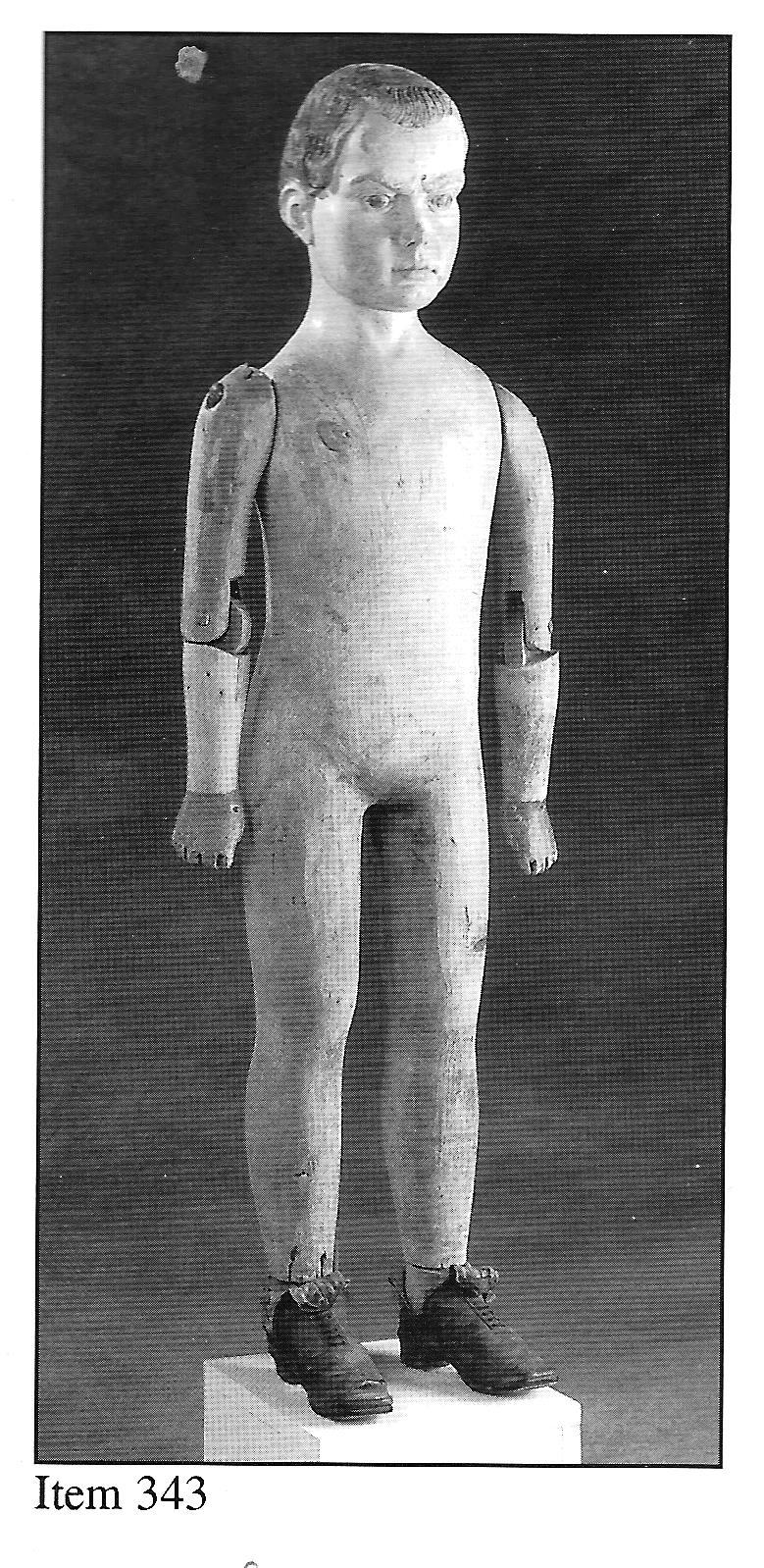
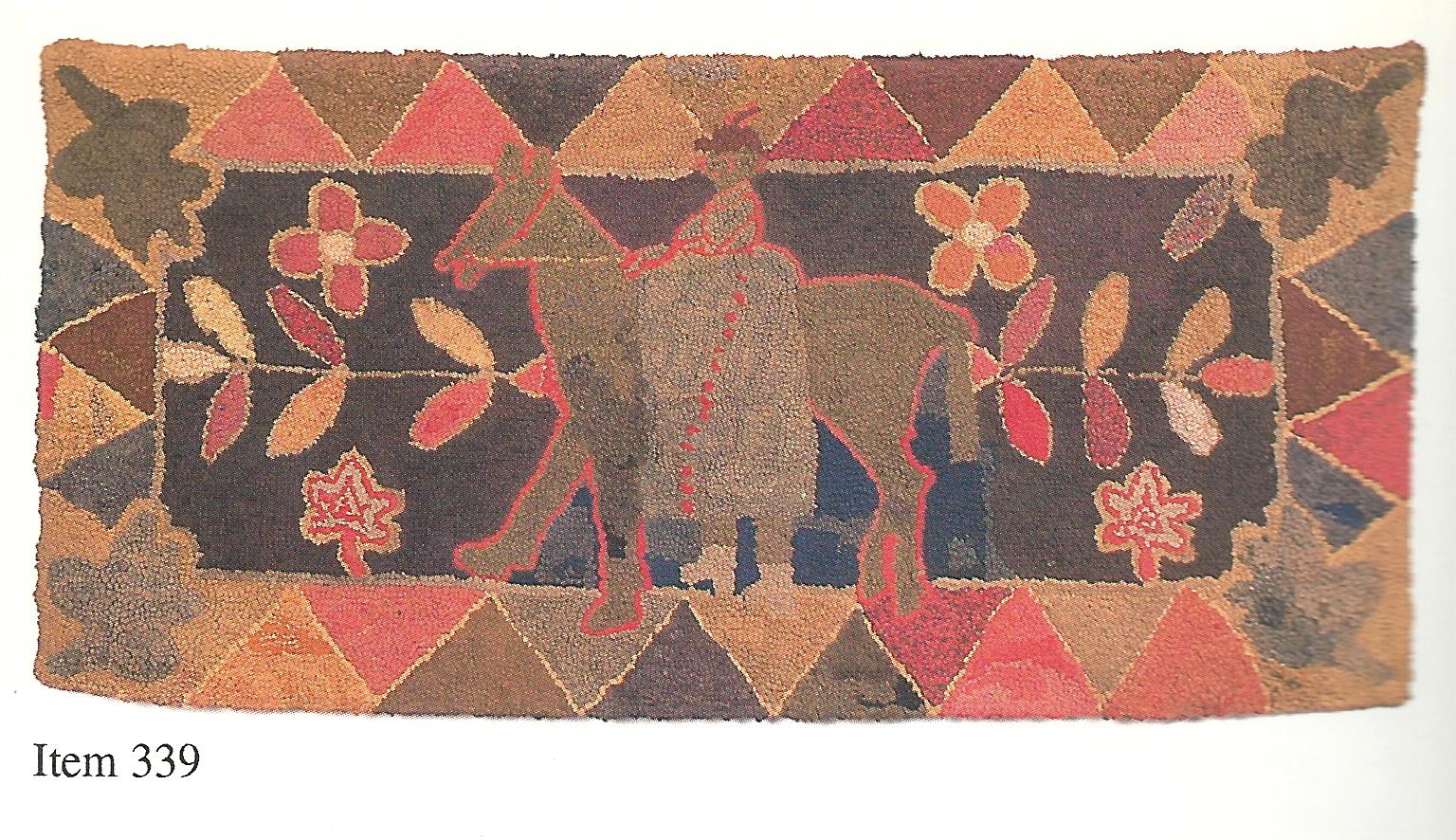
Then we hit #343, a carved figure of a youth, polychromed and articulated, mid 19th century. Found in Nova Scotia.  A few jaws dropped when it realized $9,000. Some of the furniture was strong. A painted and paneled Wilno box (#357) went for $6,500. A hooked rug of a woman on horseback (#339) realized $3,400.  A continuous Windsor armchair (#353) saw $2,750.
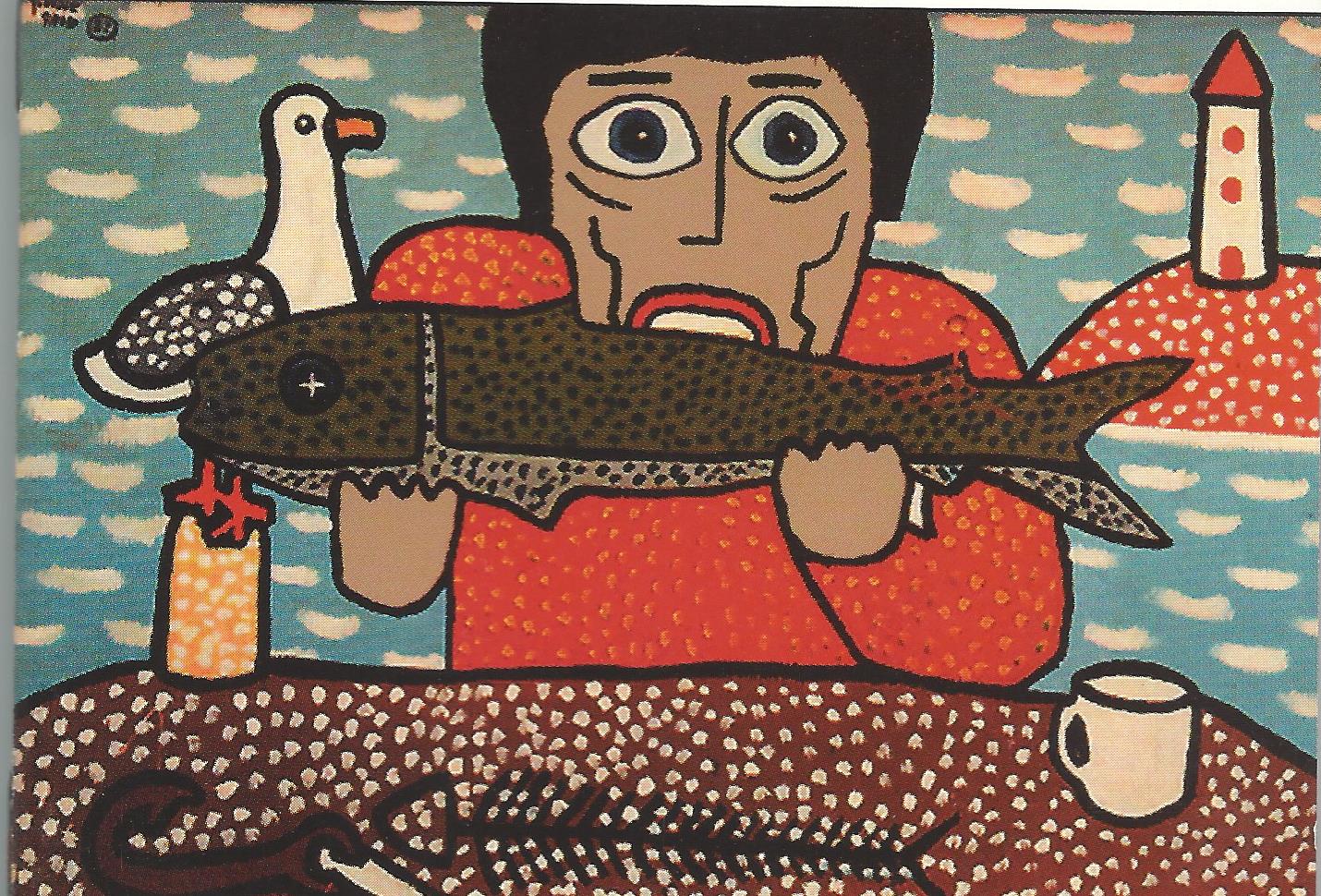
And so it progressed, slowly. Very slowly.   Chris Huntington’s dialogue although informative and entertaining initially, eventually started to draw things out to the point where most were wishing for a more conventional, let’s get it done style of auctioneering.  Eventually, item # 384 arrived.  A large 205 x 143 cm painting described as a fisherman’s village by the legendary Lorne Reid (1954-1992). Our second most coveted item after the Boutilier hawk, and we won it at $850.  A lot more than we had hoped to pay, but it was ours.   We owned it for several years and loved it in spite of the fact  it was not an “easy’ subject to live with. What appears to be a starving man staring at a fish skeleton is not all that cheerful. There is a bigger story there. One which I will go into another time.
After a couple of more small purchases we packed it in and left for home, about 4 in the afternoon if I remember correctly. There was still about another 100 items to be offered, but we had spent a whack of money, bought a lot of stuff, and were grateful for the experience.  I still wake up occasionally thinking about that mechanical hawk.  What a thing that is.  I wish it were mine.

Collecting Japanese Biscuit Barrels

Are some people born collectors and others not?  I tend to think so.  I love to surround myself with beautiful  objects, and if I was asked to name what I collect I would generalize and say art,  but I am not a collector at heart.  I have never made a conscious decision to collect any one thing in particular, and then motivated myself to seek only that to build a collection.   My wife Jeanine is a true collector.  She’s wired that way. 

When we first started attending auctions, seeking to buy some inexpensive but interesting furnishings for our new home, Jeanine decided to collect enamelware, focusing on blue and white.  Over about a six year period this was her focus.  What drove her to get out early in the morning to go to the yards sales, shops and auctions. In the early 80’s we even planed a one week, two-lane blacktop holiday, where we drove across the Eastern United States looking for unusual blue and white pieces to add to her growing collection.   It was great fun, and exciting when we would encounter something special, and it provided us an excellent excuse for just getting out there and experiencing other places, and people. This was before we had a credit card.  We just took a chunk of money, drove wherever the wind took us in an easterly direction and when we were approximately half through the pile, we turned around and headed back home.  At least that was the concept.  When we hit the half way mark we were getting pretty close to the Eastern Seaboard so we decided to keep going to put a toe in the sea, and then drive directly home.  As it happened we popped into an Antique store on the coast in Maine as our last stop before the retreat,  and met a friendly, and trusting gentleman who had a big sign above his desk “Ask me about my motel”, so I said “o.k. I’ll bite, what about your hotel?” “Well you should stay there.  It’s right on the beach and it’s clean and inexpensive.”  “Sounds great, but we’re almost out of money so we will have to check it out next time.”  “Do you have a cheque?” Well yes, but would you want to accept an out of country cheque?”  “Why not? I can tell you are decent people.”  So we wrote a cheque for a couple more night’s accommodation.  He even tacked on a bit extra for some spending money.  We had a wonderful time there.  I remember it as a golden time, walking along the coast, and enjoying the beach with the then (probably) four year old Cassandra.  Eating clam strips in a little joint down on the beach.  Not a care in the world.  Then we packed up, said our good-byes to our new friend, and drove straight home in a marathon 20 hour drive. 

The natural evolution of collecting is to initially to buy widely, and of various conditions.  As a collection develops and you’ve got all the common stuff it takes longer to come across the rare  things and eventually the space allotted for your collection fills, and then if you are truly motivated to collect, you might move on to find something else interesting, and start the process all over again.

“Belleek” pattern Japanese biscuit barrel

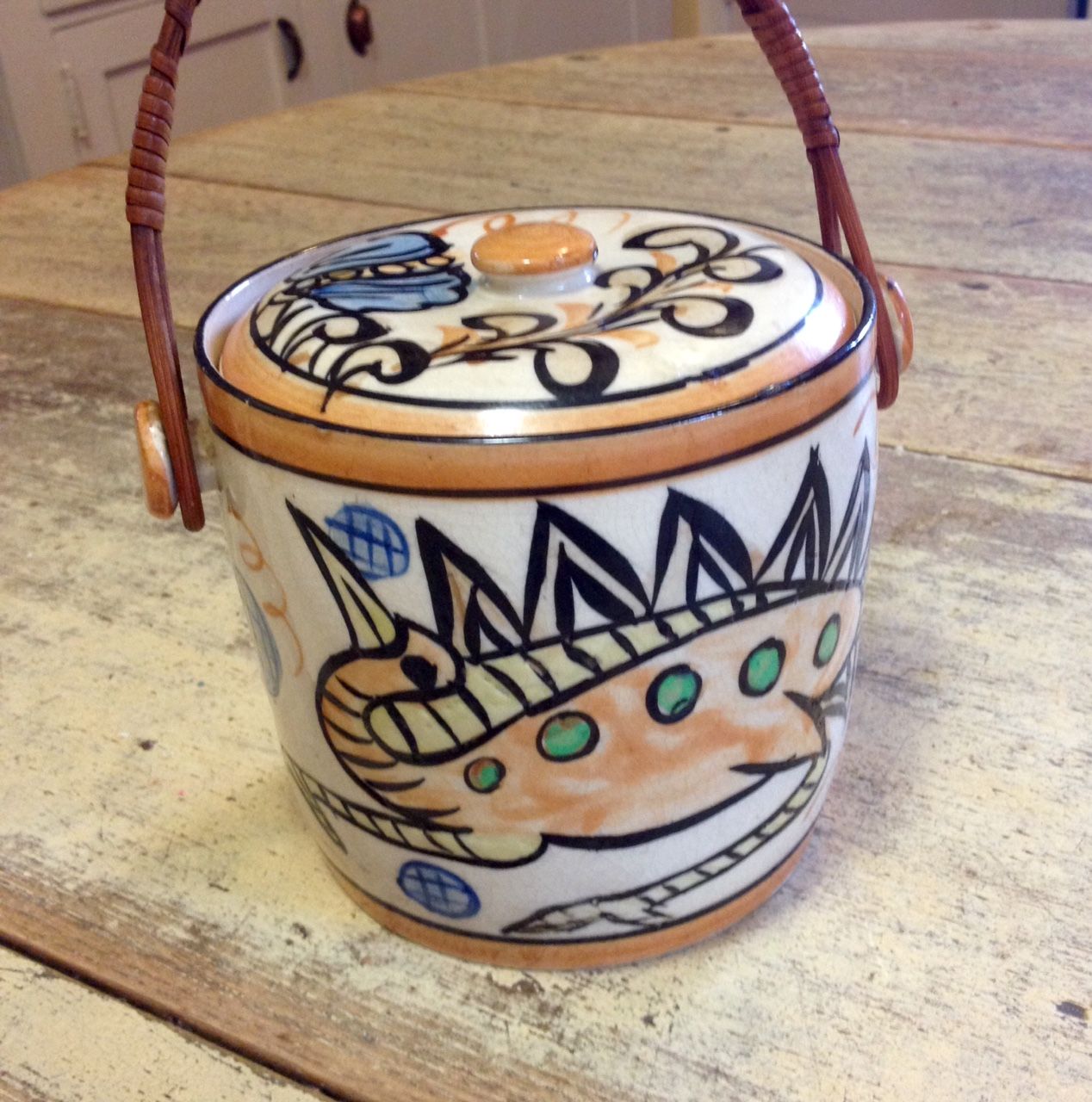
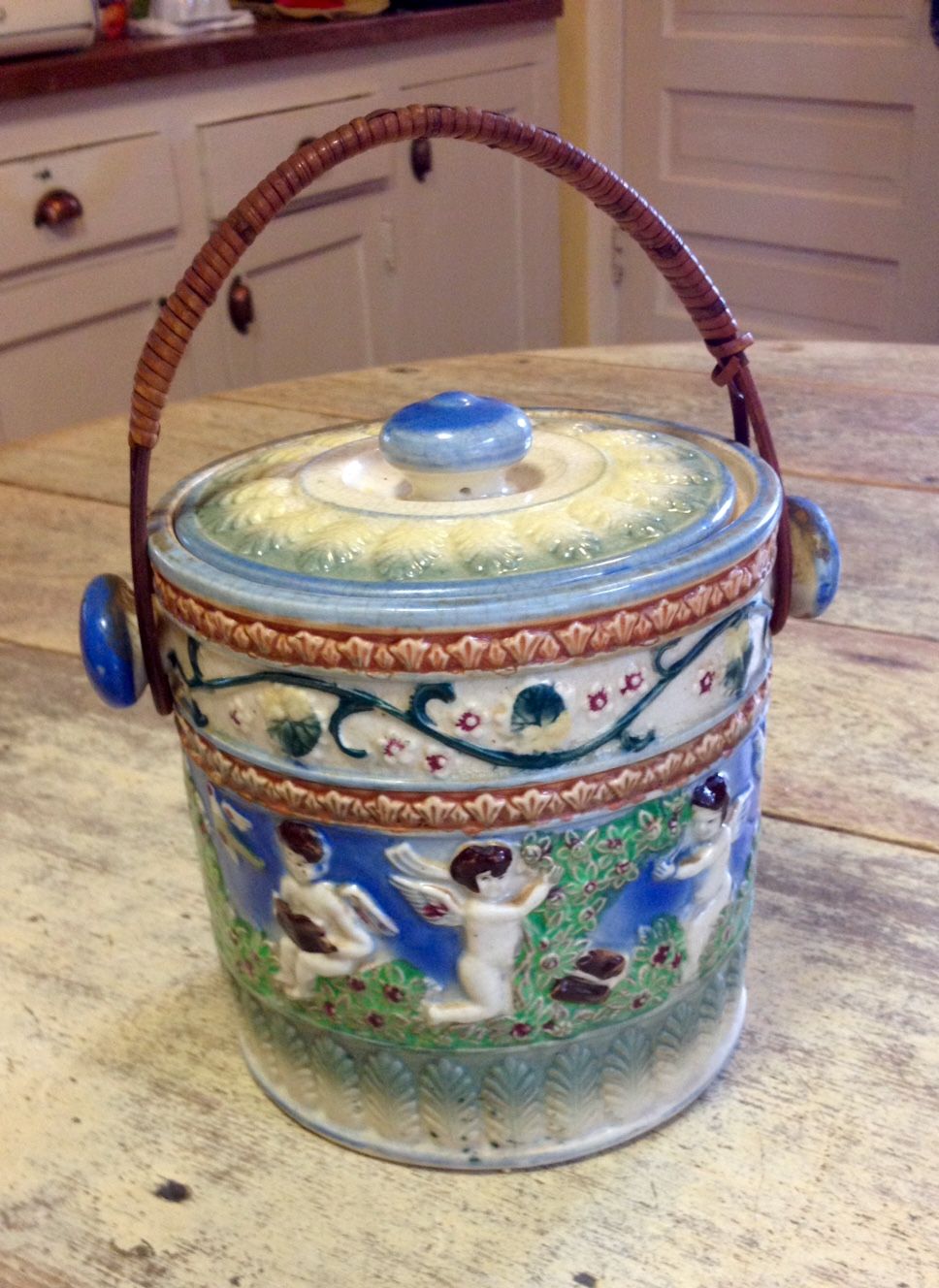
This happened to Jeanine after about six years of collecting the blue and white enamel.  One day she decided that was it, she had enough.  She would sell off the enamelware,  and start again. Her next collection would be ceramic Japanese biscuit barrels. What interested her was that after WW2 the Japanese began to produce the then popular biscuit barrel inexpensively in many different styles, often imitating established pottery forms of Europe, and England along with some of their own culture.  They were not too large and fun to see gathered together in a hanging cupboard. Also, she was aware there were lots of them out there, and they were inexpensive to buy.  She set her objective at collecting 100 barrels of different styles.  It took her 20 years to accomplish this, but when she hit about 135 barrels about the year 2000 that was it.   We now have about twenty of her favourites, and the rest have found new homes.

Donatello pattern. First barrel bought from Marcel Gosselin

Her first buy was from our old friend, the Quebec picker, Marcel Gosselin.  This “Donatello” themed pot which she bought for five dollars.   She went on to usually pay from $25 to $45 for most.  The highest she paid was $145 for an elaborate, larger pot of Chinese design.  That was towards the end of her collecting about 2000. Then as before, one day she made the decision that that was it.  No more biscuit barrels.   We talked about photographing all one hundred pieces before she sold the collection with the idea of releasing a little coffee table book on the subject, but like so many good ideas, it came and went.  Still, we had great fun making the collection, and looking at them for all those years.

Japanese design with rows and rows of tiny faces

For the Birds

As I have mentioned before in this blog, my wife Jeanine collects folk art carved birds.  Our kitchen is full of them.  I miss them when we are away.

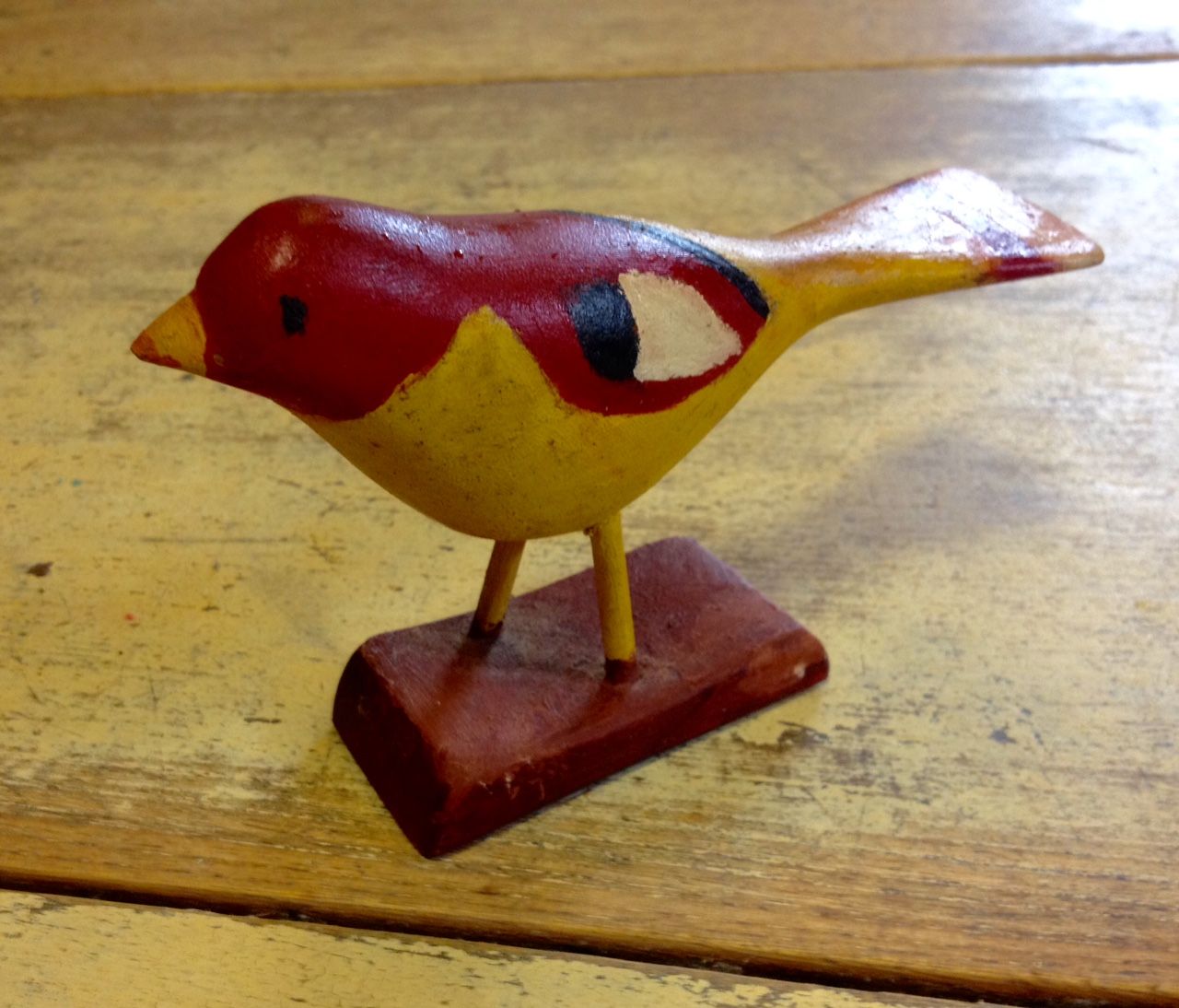
Birds, for the most part are a pleasant and relaxing part of our natural environment.  Except of course when they are dive bombing you for being too close to their nest, and then they’re not so relaxing.  Otherwise, we enjoy watching them fly, and chirp, and hop around the back yard looking for bugs. They are entertaining.  I suggest that this is the reason that it is one of the most commonly carved species, and often the first carving an artist will undertake.  Birds makes for an interesting collection because there are so many approaches and attitudes to the subject.  Some strive for accuracy.  Others a stylized approach.  Some are abstracted, while others are barely recognizable.  I tend to admire skill and craftsmanship, but it’s the crazy and primitive ones that turn my crank.  After my morning coffee I took a look around the room and photographed a few of my favourites .   With some little notations attached.

I hope that you enjoy looking at them.  I do.  Every morning.

sparrows in flight

Jeanine is keen on finding more of these little carved sparrows.  We may because I have the feeling that these although hand carved, were commercially produced and sold in gift shops.  Perhaps a little cottage industry item from Eastern Canada, where we found them.  Or even possibly overseas. If so, I would think Europe or England as opposed to Asian.

Red-winged blackbird by Yvon Cote

a Cote decal. Not used on every carving.

This Cote red-winged blackbird is typical of the Gaspe artist.  I will make him the subject of a future blog, but for now suffice to say that his work is easy to recognize because he used pencil crayons for colour and then lacquered over top, and even when a piece doesn’t have his decal, you can tell it is him by the form, colour, and little wire legs.

Here’s a new addition to the family.  this friendly little Carolina Wren was created by C. Bodley of Toronto.  He was good enough to name and sign it on the bottom.  It’s a good example of a work that looks like the species, but also contains personality.  He also created this wonderful diminutive owl

Owl bu C. Bodley, Toronto

What follows is a bunch of little birds with different approaches, by different artists at different times.  Most of them are from Quebec.  You can see run the gamut in terms of approach.  Although it is perhaps the piece that looks the least like an actual bird, I love the little beige bird by Cadieux.  His name is stamped on the bottom.  I also love the little blue bird which looks almost like a cartoon.  it is made very carefully. Those wings are thin wood, not metal.

Which one of these do you like the most?

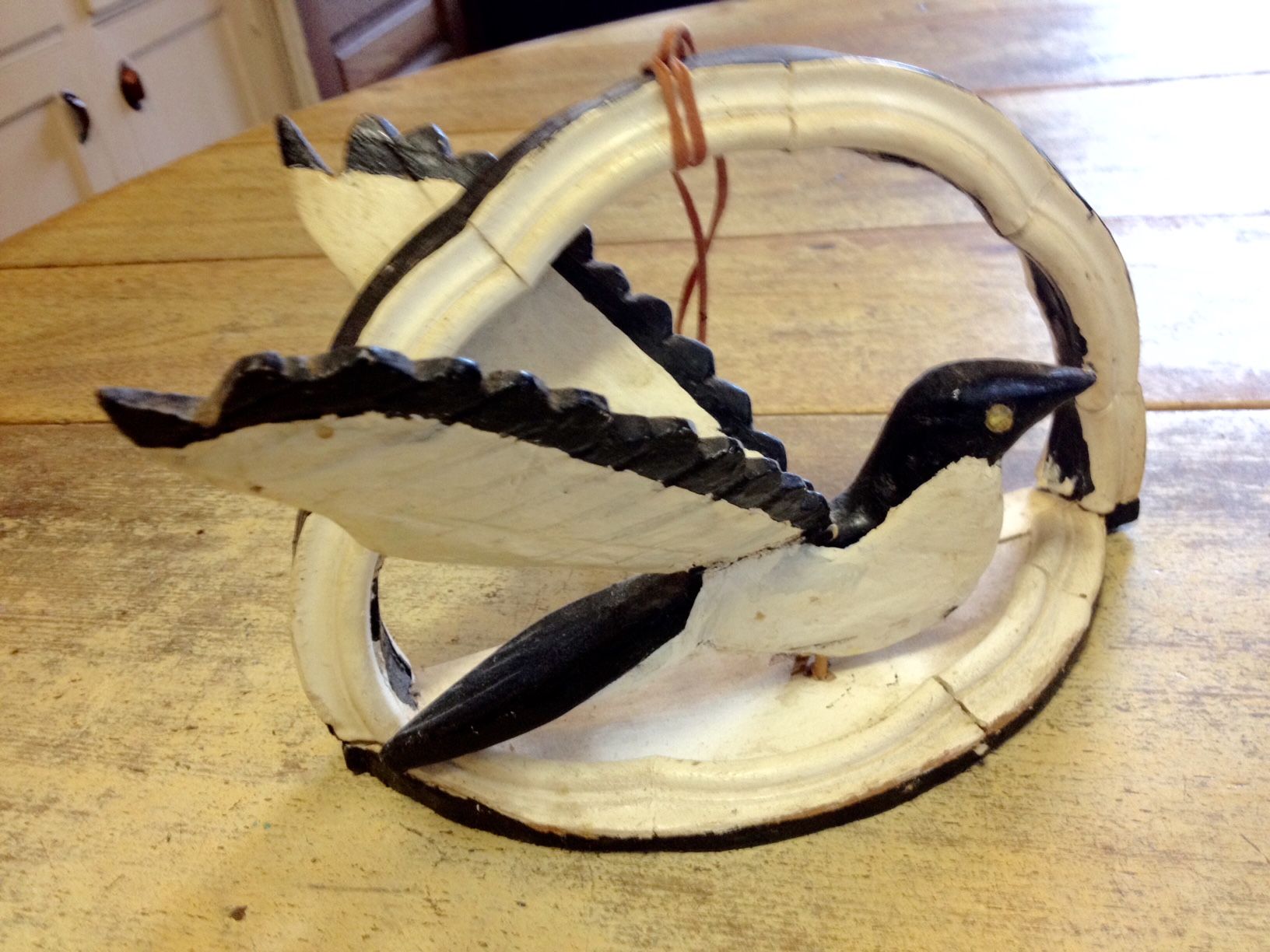
Someone even decided to make a little bird using wicker. This little fellow somehow comes across as looking quite mad.  And last but not least we have this hanging black and white bird on a perch.  Interesting construction, and can anyone figure out why his wings are on backwards?   Could this really be intentional?  Perhaps dyslectic?  Go figure.

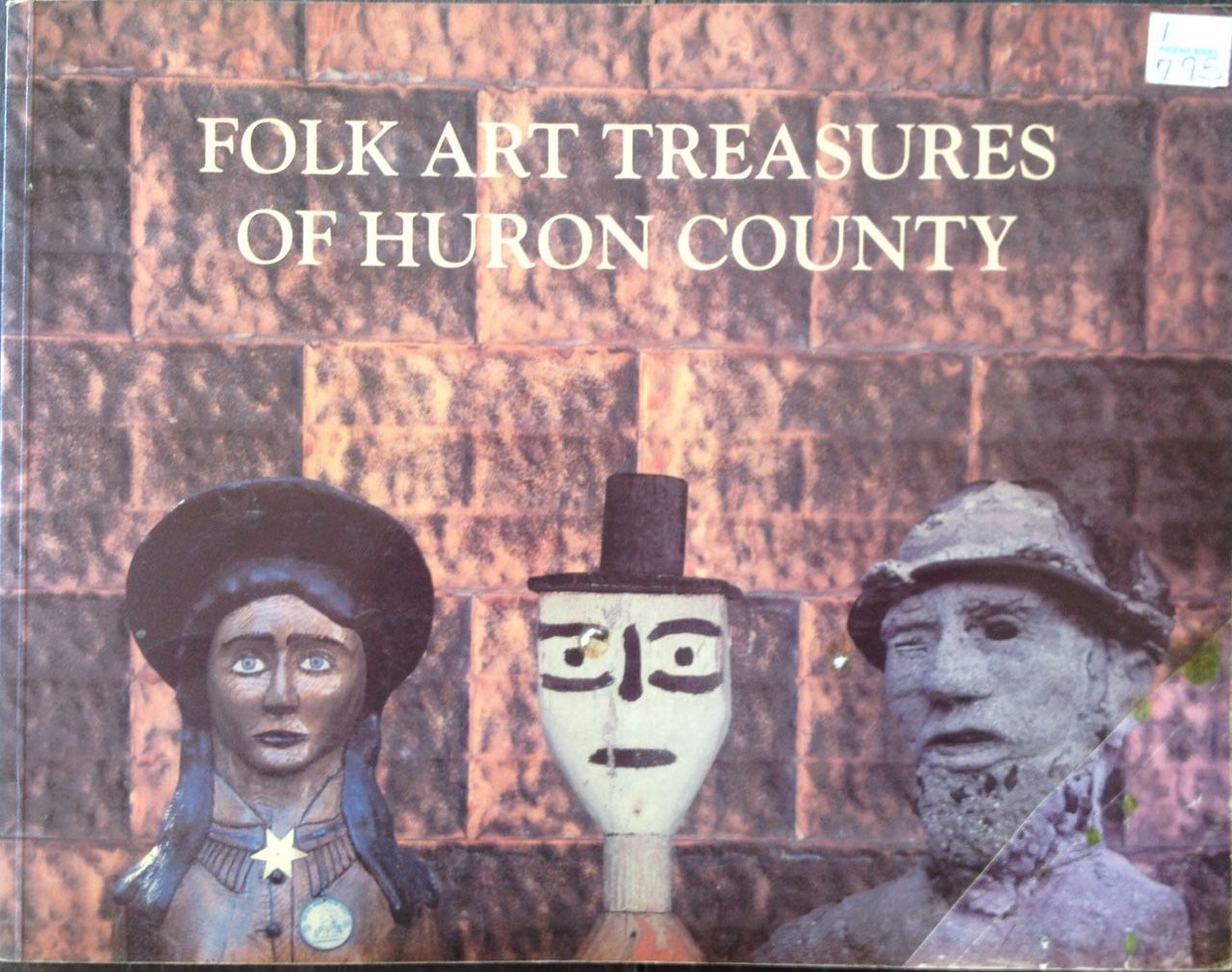
Folk Art Treasures of Huron County

It is a significant, and useful contribution to the appreciation of folk art, when an inspired and knowledgeable individual or individuals  put in the enormous effort necessary to survey and document the folk art and artists of a region. It doesn’t happen all that often.  Especially outside of Nova Scotia where folk art has become established, and is promoted as a significant part of the cultural mosaic. Read, tourist dollars. Follow the money.

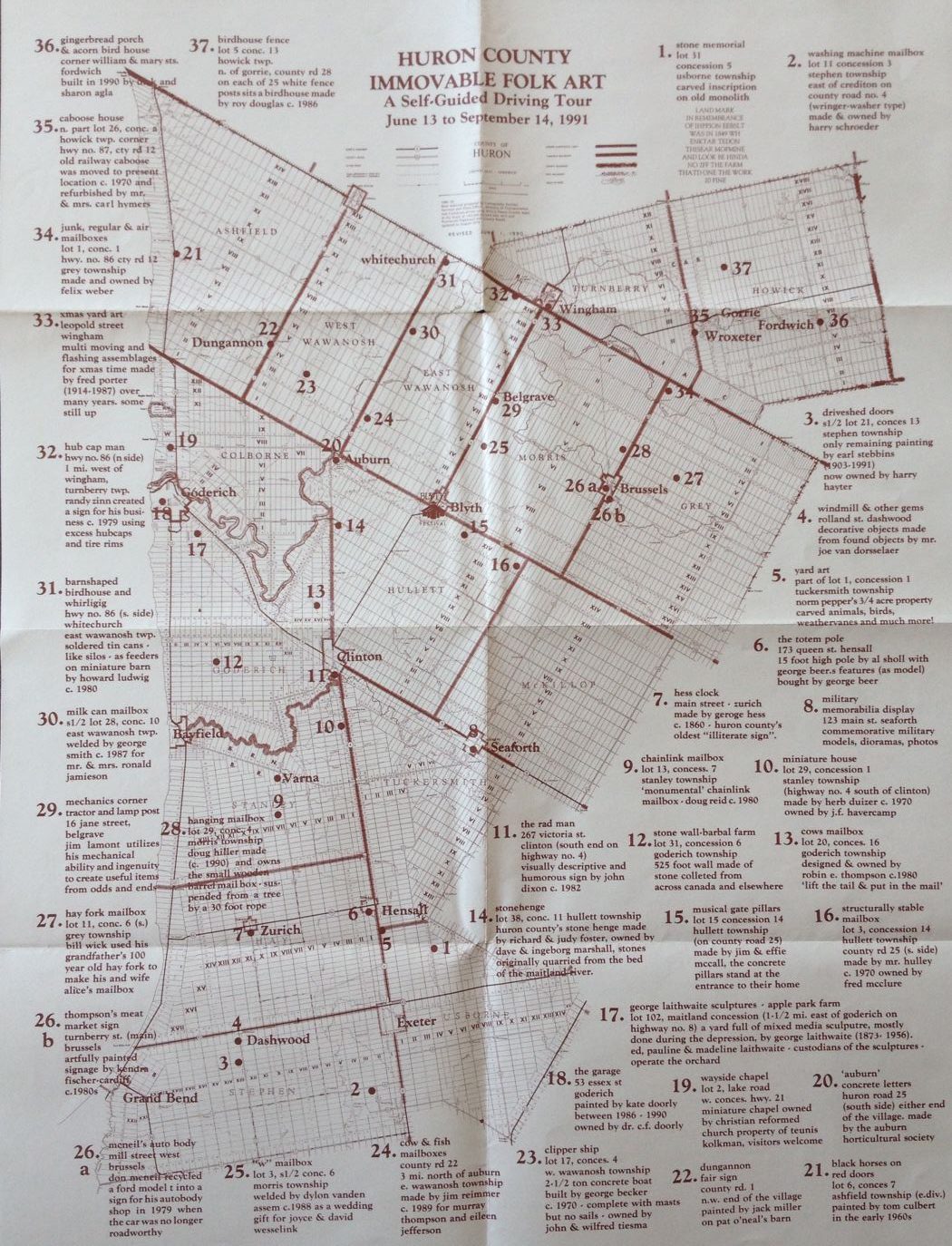
So I was delighted a few years back to find in a used book store, a copy of the catalogue for the “Folk Art Treasures of Huron County” Exhibition, which took place in 1991 as a part of that county’s sesquicentennial celebrations.  The event had three components;  Contemporary  Folk Art at the Blyth Festival Gallery, coordinated by Bev Walker , Historical Folk Art at the Huron County Museum, coordinated by director Claus Breede , and as a third component  documentation and a map of the Immovable Folk Art of Huron County, coordinated by John Rutledge.  You can imagine it was a monumental task to pull all this together, but this group did an excellent job.  In the acknowledgements coordinator  Bev Walker thanks over 25 people for their contributions. She also thanks the Folk and Native Section of the Ontario Arts Council for generous financial support.  I hope the province can still find a few bucks for such things, what with the deficit and overspending, and all.

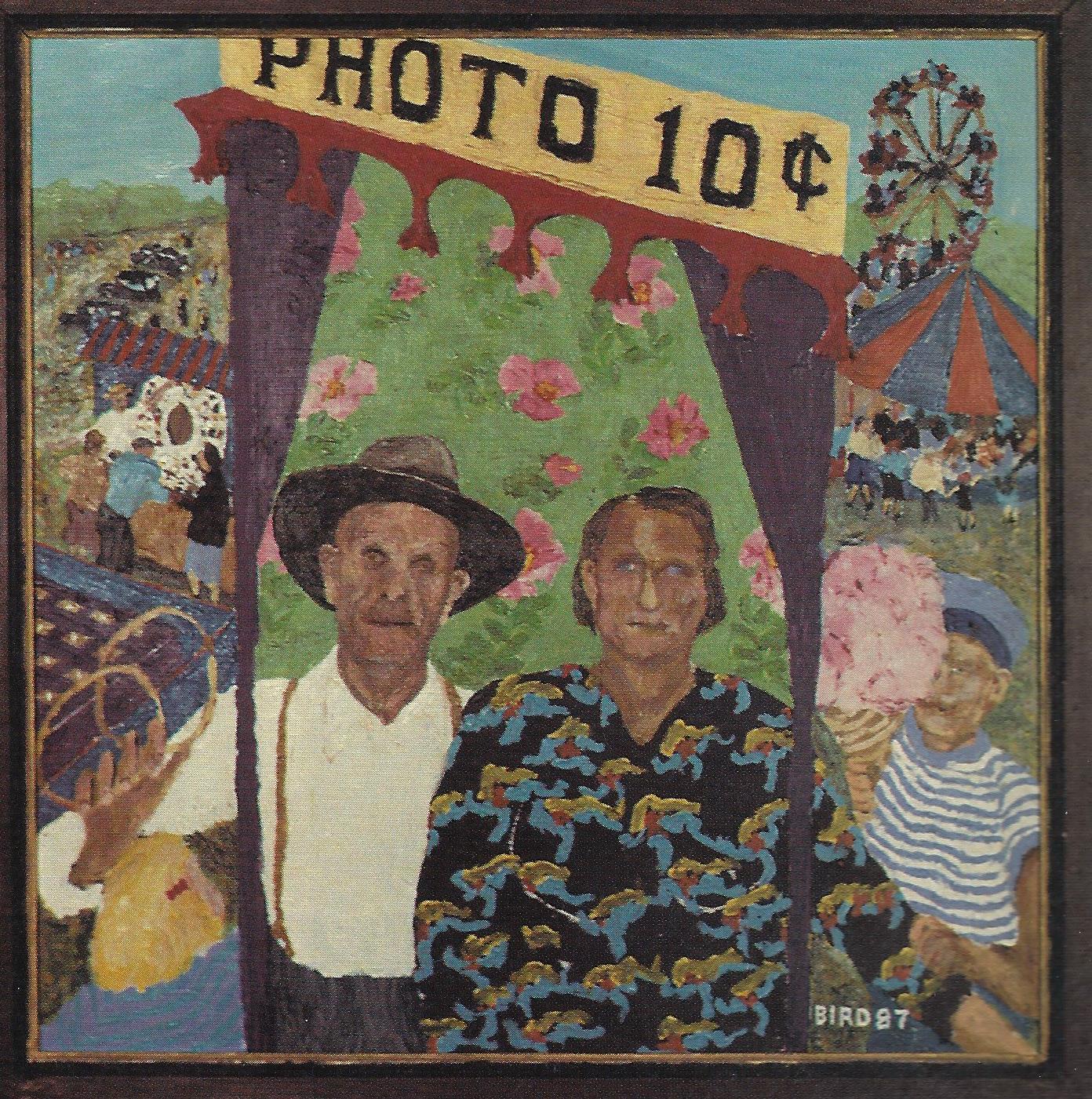
Mom and Dad at the Russell Fair
by Ray Bird

The Painter
by Bud Oke

The contemporary section along with several examples of the work, has three pages of artist’s bio’s  which is a great reference tool. I have bought many pieces by Bud Oke over the years and always appreciated his particular humor and talent, so I was delighted to know his story and see his picture.  I think Ray Bird’s “Mom and Dad at the Russell Fair” is somewhat of a masterpiece and I would love to see more by this artist.  His address is listed as RR#2 Brussels so he shouldn’t be that hard to find, but it also states he was born in 1929 so he’s 88 if he’s still kickin’. Could well be for that matter, and maybe painting better than ever. I’m pretty certain that Stuart Taylor, born in 1908 isn’t available for comment, but my goodness isn’t his Annie Oakley just the best? Yikes!

Annie Oakley
by Stuart Taylor

The historical folk art section of the catalogue  is also full of wonderful things dating back to the 1850’s. Of particular interest  are many working “models” depicting the lifestyle and technology of an earlier generation by Herbert J. Neill.  These “gems” are in the permanent collection of the museum, and so still available to be seen today.  It’s on my list.

Butter Churning
by J. Herbert Neill

However, I’ve got to say that of all these wonderful things Janis and Peter Bisback’s early 20th century weathervane really pushes all my buttons. Happy face on one side.  Sad on the other.   Peter and Janis still have a big barn full of wonderful antiques in Huron County, and are serious collectors. Worth a visit when you are in those parts.

For me, perhaps the most interesting and unusual part of this publication is the third section “Immovable Folk Art”. For the most part, we take outdoor folk art for granted.  Look at the picture of Tom Culbert’s Black Horses on Red Doors. If you drove by there every day it would pretty much look the same, but go away for twenty years, and you may come back to bare wood. Huron County winters are harsh.

Black horses on Red Doors
painted on his barn by Tom Culbert

You can see that Mother Nature has already erased about 40% of the paint.  In the photo notes it says that he painted the doors first in the 1960’s “even before I married my wife”, and has repainted them about five times. Remember this was 1991.  Is Tom still around and willing to put on a fresh coat?  Of course for many of us the wear is an integral part of the appeal.  That’s another reason photo documentation is so important.  Things fade away.  It’s either that, or you manage to buy  them from Tom and have a room big enough to display them in, and then of course you are completely taking them out of their original context.

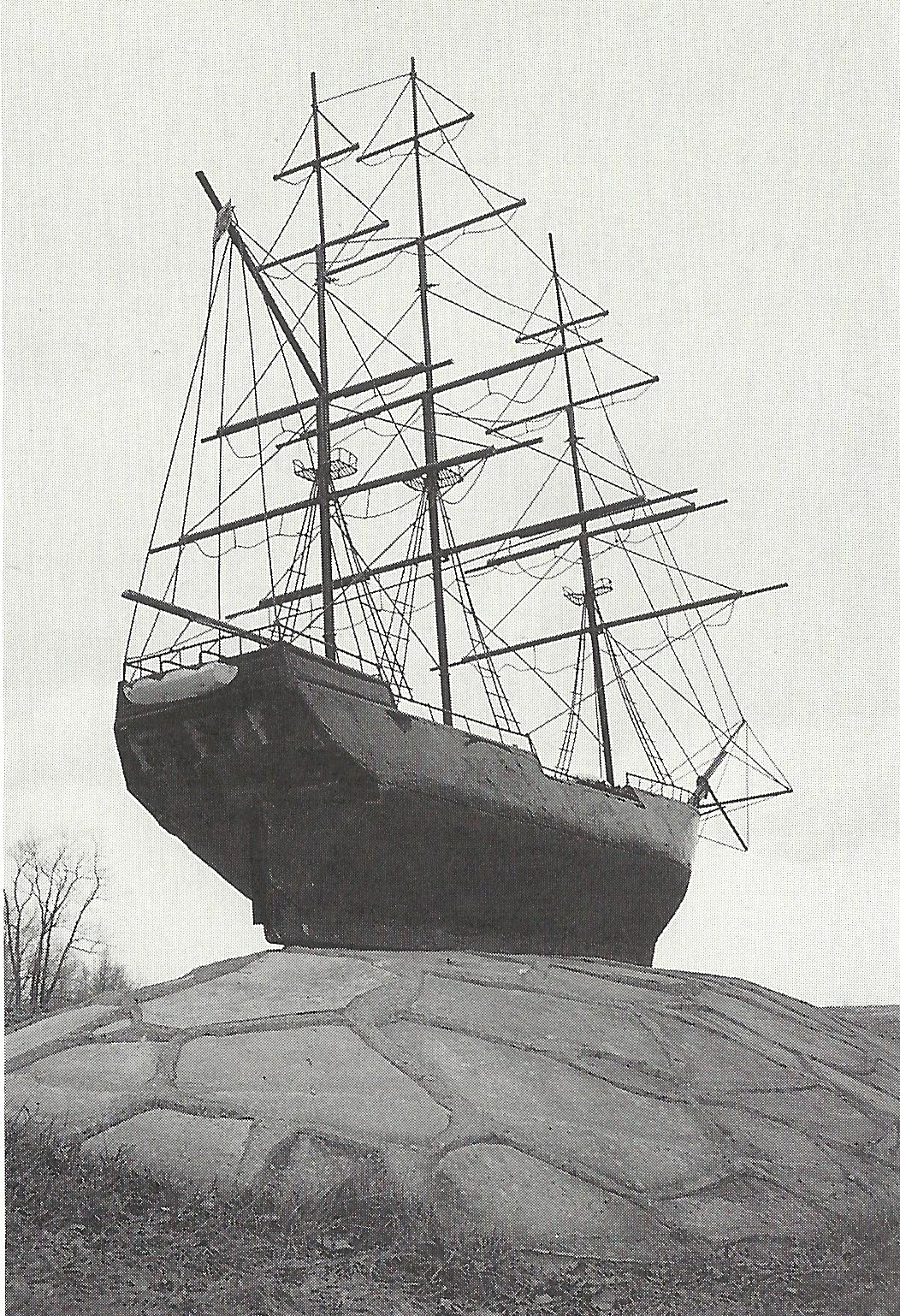
Clipper ship
concrete sculpture by George Becker

Just look at that 2 ½ ton concrete clipper ship built by George Becker in the 1970’s, and owned by John and Wilfred Tiesma.  It stands at the end of their farm laneway, permanently dry-docked atop a fieldstone mound.   (12’x 3’ x 15’)  You don’t expect to see that when driving down a country lane.  It’s on the map along with 35 other points of interest.  And then, of course, inevitably we come to the cement work of farmer George Laithwaite (1873-1956). The Laithwaite Apple Park Farm near Goderich has, for three generations fascinated visitors with it’s many sculptures fashioned from cement, metal, fieldstone, and found materials, made mostly during the depression.   It’s still open to this day.  For the serious folk art devotee it is Mecca.  Admission is free and there is a farm market.

Do I hear “Road Trip”?

Man and Donkey
by George Laithwaite

Our Encounter with the Golden Dog

Jeanine’s interest in, and knowledge of French pottery grew over the years as she bought and sold it at the shows and on e-bay.   She was mostly dealing in Quimper, as that was a hot ticket item at that time, but she was interested in all the pottery producing regions of France.

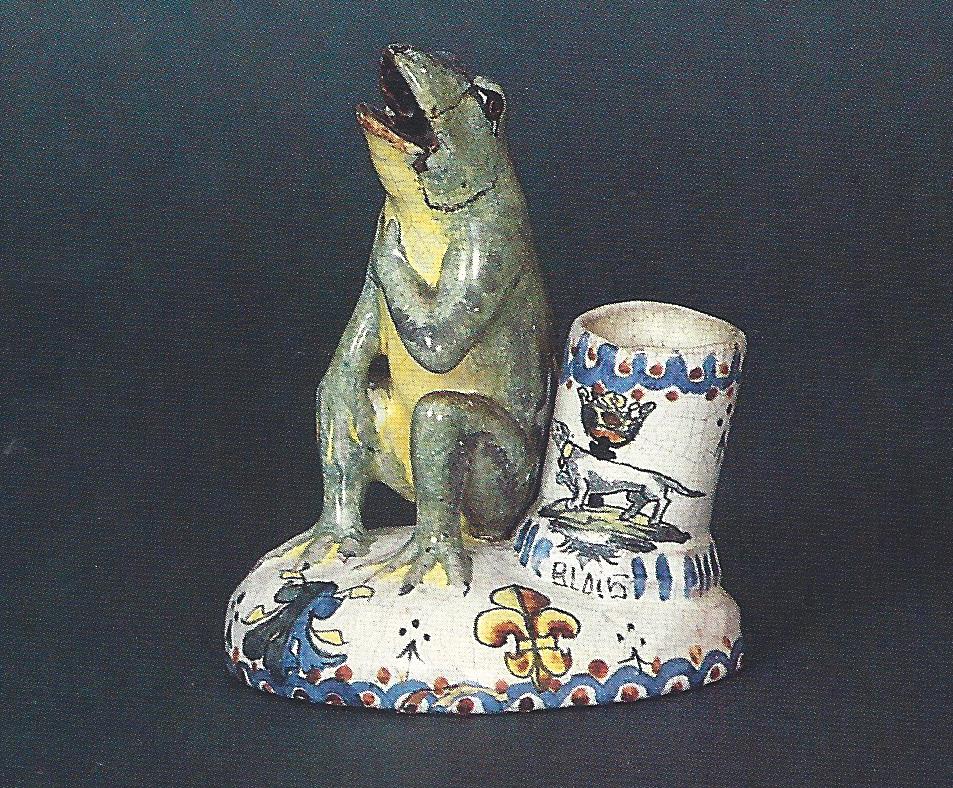
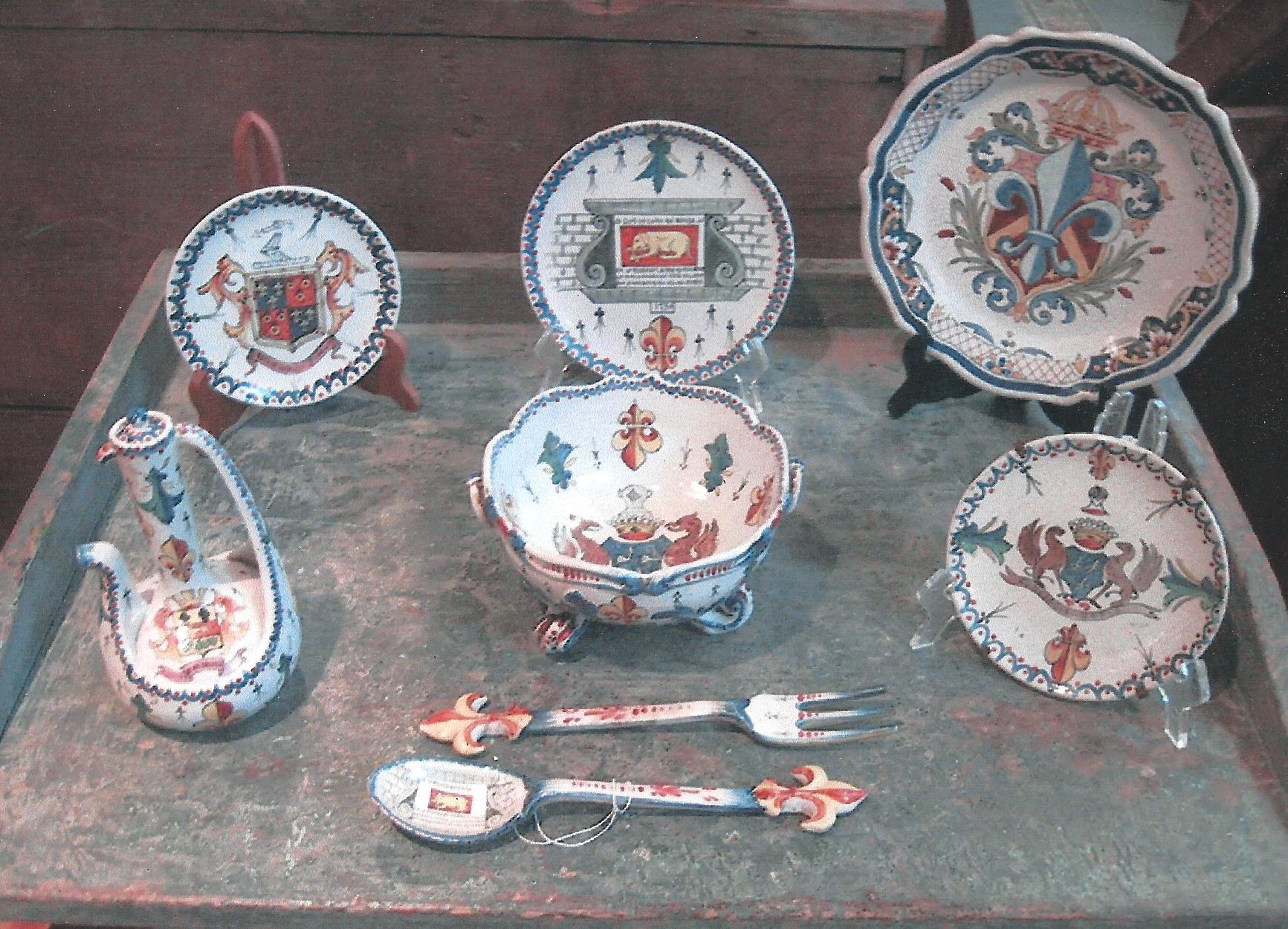
In our Quebec travels  she learned of a French pottery that was made specifically for the Quebec market with Quebec themes , marked on the bottom – C A.  It was quite possibly brought over for the 300th anniversary of Quebec in 1908, and most likely made by Alcide Chaumeil who operated out of Paris, but the jury is still out.  Many pieces include crests and mottos such as “Je me Souviens”, and some even have representations of the “Golden Dog” which is a very popular image in Quebec.

The golden dog is an image of a yellow dog lying down with a bone in it’s paws. The verse under the picture is as follows  “Je Suis un chien qui ronge lo.  En le roneant je prend mon repos. Un tems viendra qui n’est ps venu, que je mordray qui m’aura mordu.”  In English, “I am a dog who chews the bone.  While chewing I take my rest. A time will come which is not yet come, when I will bite the one who has bitten me.”

You can see the original plaque today over the main door of the Quebec General Post Office.  It had been moved there when it’s original residence was torn down. This was the 1736 residence of a  Dr. Roussell.  There are plenty of theories, the most popular being that it is likely referring to disputes and threats of revenge between the doctor and certain town officials, but you can see why it has a certain resonance with all Quebecers. In fact the original statue of the golden dog, circa 1650,  resides in Penzenas in southern France on the garden gate of a M. Delbousquet’s estate. It turns out Roussell originally came from this area, and probably he duplicated it as best he could recall as a simple remembrance of his native land.  This might explain why the words on the Canadian plaque are somewhat different than the original. It is most likely is a case of poor memory.

The factory also produced decorative items featuring emblems of the royal chateaus of the Loire valley for the tourist trade, and busts of royal figures, etc.

Years passed and in spite of our constant search, we found only a couple of C A pieces, and they were not of the Quebec theme.  We started to think that we would only see them in pictures.  Then one day we got a lead from a fellow dealer.  He knew of a lady in Kingston who had several pieces of the Quebec themed CA pottery she wanted to sell, and he was only interested in her Canadiana.  Great lead.  As it happened we would be going through Kingston in a couple of weeks, on our way to do the Eastman Quebec show, and wouldn’t it be great to turn up at one of Quebec’s premier shows with some extremely rare Quebec themed pottery. 

We made the call, and the very gracious lady on the other end of the line said she would be happy to accommodate us.  She sounded interesting. Her name was “Bunny”.  We arrived at her place on time and went straight into the dining room where, sure enough, the table was covered with several pieces of C A pottery.  Large serving bowls and plates with emblems and crests, salad servers, and there among them a plate with the famous “Golden Dog”.  There was also a nice little selection of Quimper and other French pottery, but of course our eyes were stuck on the golden dog.  “So Bunny it works best if you can just tell us if you have a figure in mind, and we will see if we can agree.”  Bunny thought for a couple of minutes and explained that she had bought most of the pieces years ago for not much money, but that she watches the Antiques Road Show so she knows these things have gone up, and then she hit Jeanine with what she thought was a big figure.  Jeanine knew she was low because she was unaware of the extra value of the rare pieces so she “talked her up” by $500.   Bunny was delighted, and we were happy because we would do well, and hadn’t stolen from her.  We went on to sell the entire collection within 15 minutes of the show opening to a collector who was over the top happy to have it.  Happy ending all around.

some of the C A pottery we brought to the Eastman, Quebec show

Fond remembrances of participating in L’ Exposition et Vente d’Antiquités d’Eastman

In the late nineties, it was common knowledge that the two finest country antique shows in Quebec were the North Hatley show held in July, and The Eastman show which ran in late September.  The two towns are situated about 30 kms apart in the beautiful Eastern townships region,  and so you would think that many of the same people would attend both shows, but the reality is these shows reflect the “two solitudes” of Quebec, with the North Hatley show being attended mostly by local, English-speaking home and cottage owners, while Eastman is predominantly attended by local Francophones.   In those days at least, not many of the English dealers who participated in North Hatley would consider doing Eastman. They believed that unless you were recognizably French Quebecois with good language skills you would be overlooked.  We heard this over and over for a few years before we decided to test the theory.  I get by fairly well with my high school French, and of course Jeanine being from France, speaks the language beautifully.  The thing is although neither of us were Quebecois,  we determined that we could overcome this by just being welcoming, open, and good natured.  We also liked the town and would go through from time to time to visit a good shop there,  Antiquities Rosalie.  A family place where we often found good folk art and early smalls. 

Antiquities Rosalie

We knew also that the mayor there,  Mr. Pierre Riverin was one of the biggest collectors of Quebec folk art in the country.  He had “made” our show in North Hatley the previous year and suggested that we come to Eastman.   So we contacted the show promoters and were happy when they welcomed us to come, and gave us a space in the main salon which was in the basement of the church at that time.  This original space only held 15 dealers and as this was 1999 it was the first year that the show had been expanded to a second salon in a “Golden Years” club a couple of blocks away, bringing the total to 30 dealers.  Of course people checked out both locations.

Unloading through the back door into the basement we definitely felt like the “new kids’ at school, but everyone was friendly and helpful and it didn’t take long to set up and feel quite at home.   We discovered that Tom Devolpe,  a dealer friend of ours from Montreal was doing the show as well, and we were staying at the same motel so we suggested that after setting up he come to our room for a glass of wine and a snack before going to the dealer welcome night, being held that evening in the restaurant of the same motel.  What a nice idea to have all the dealers get together for dinner before the show.  Dealers love to be fed. 

Tom DeVolpe and me having a glass on another occasion

We stopped in a local depanneur, or convenience store to pick up a bottle of red and some cheese and bread to share with Tom in the room.  This is one of the wonderful things about this region.  Even the smallest local stores have a good selection of wine and cheese, not to mention pates.  We bought a great baguette, and a soft ripened cow cheese from France  called Chaource which we had never encountered but which immediately became one of our favorites.  I remember that it was 40% off because it was quite ripe, but this of course made it even more delicious.  We should have had to pay more because it was perfect.  It could have been that we were just really hungry from setting up and skipping lunch, but that snack of fresh baguette, Chaource, and a few olives  with Tom in the motel room remains one of my favorite all time eating experiences. 

I recall we were a little tipsy walking over to the restaurant for our 7 p.m. seating.  When we arrived we were taken directly upstairs to a private room just large enough to hold the 60 or so people participating in the show. We were all assigned a table and presented with the menu, and a program. A program of all things.  We sat next to our old friend Alan Chauvette who owned a pickers barn near Victoriaville.  It was his first year as well. 

The meal was excellent, and surprisingly we still had a bit of appetite after all that bread and cheese.  The place was soon hopping, and quite noisy with all those ramped up dealers.   Then came desert, and along with it a few friendly greetings and encouragements from the promoters, followed by a sing along.  Yes. I didn’t see that one coming. There in the program were the words and tune to follow for three or four special antique dealers songs.  Everybody now, let’s sing,  “Nous sommes les Antiquaires”  set to the tune  of  “Les Miserable “ or some such thing.  I forget exactly but it was hilarious, and good natured, and friendly, and everybody sang along. 

This was followed by the announcement of who had won the “best booth” award which was a prize of a free ad in a local trade magazine were you could announce your honor I suppose.   Being newbies we had no expectation of winning, and it was no surprise when a local couple won who not only had a beautifully set up booth, but also wore (get this) period costumes.  I looked over to Alan, and said “ah that’s it Alan, next year, –  Costumes!”  We just about fell out of chairs.  The festivities and merriment continued well into the night, but we soon made our good-nights and left to get a good night’s sleep. 

The show was great. People were friendly and interested, and sales were brisk.   Contrary to the fears of our fellow Anglophone dealers we were made to feel most welcome and accepted.  We went back for another four or five years until we changed policy and only did shows close to home.  It’s still going on today but has been moved to a larger facility “La Grillade” where there are 50 dealers in one space.  Well worth a trip to this region, especially in the fall. 

us setting up in Eastman

The last known works by Rosario Gautier

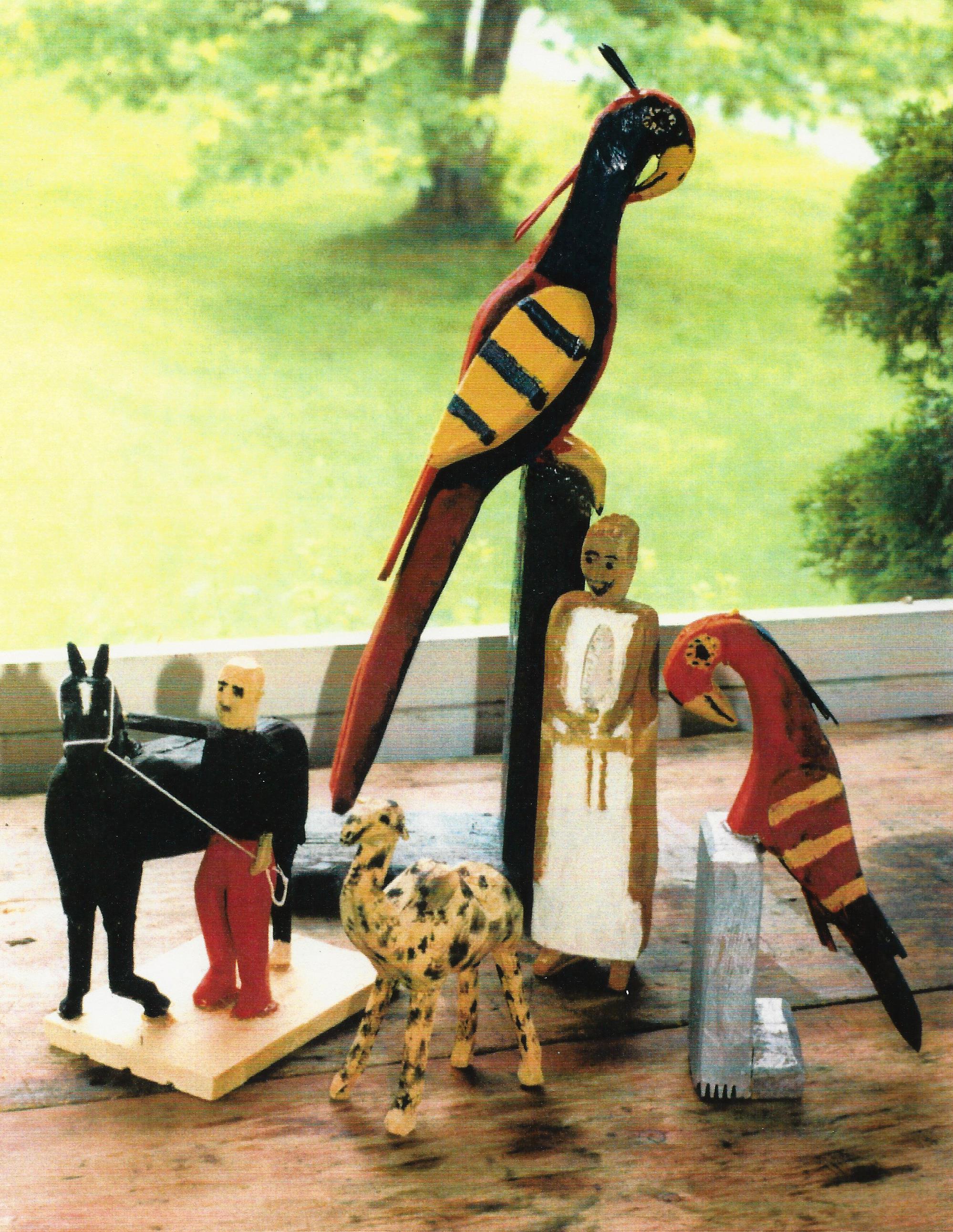
This handsome fellow lives in our living room.  He is a favorite of ours, and we have come to find out that he was made by Rosario Gautier, late of St. Charles de Bourget, Lac St. Jean Quebec,.  We didn’t know who made it when we bought him about 25 years ago,  and it didn’t matter so much because we loved the piece, but it was satisfying to eventually put a name on it.

Over the years we have found and bought several pieces by the same hand.  The chunky, colorful style is unique and easily recognizable, but all we encountered were unsigned, save for a few initialed “RG”.  Not a lot to go on.  Then one day, some picker, I can’t recall who, said ”Oh, yes that’s Rosario Gautier from Lac St. Jean.  He’s been carving for years.   Now at least we had a name and place to ask about.

The next big break  came in Quebec city when walking back late one night to our hotel after a particularly memorable meal and lots of good wine with friends who are lucky enough to live there.  We passed in front of a closed antique shop and there in the street light was a photo in the window of Mr. Gautier, along with several of his pieces, and a short hand written bio.  We were able to find a pen and paper and copy out the bio, and take this slightly blurry picture through the glass.  We were up and out in the morning and never got back there.

Here’s what we were able to record about him that night. “Rosario Gautier was born and lived all his life at St. Charles de Bourget, Lac St. Jean, Quebec.  Father of a large family (12 children of whom 9 are still living), he was a farmer and a blacksmith in logging camps. He started carving after retiring in 1971, and produced a large body of work. Most of his pieces are in the medium size range, but he also produced life sized animals, as well as an eight foot crucifix. The muse de la Civilization du Quebec owns 350 of his pieces, and he is represented in many major collections in Canada and the Unites States.”

By this time we had bought many pieces of his work.  We kept some, and sold most to Quebec collectors.  All the while we love his funky, choppy versions of birds and animals.  All of them rough, and not self-conscious, but also showing a fineness and understanding of form.

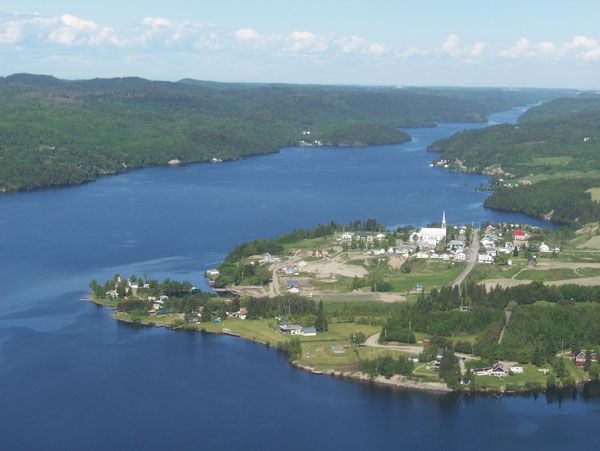
We were in the habit those days to try to meet as many folk artists as we could in our travels, but as much as we admired Mr. Gautier’s work and would love to have met him, we were unwilling to make the 3 hour drive north of Quebec city, on spec.  Not even knowing at this point if he was still alive.  I google mapped St. Charles de Bourget just now, and it appears to be a charming little village of 690 souls set on a beautiful northern lake, but it is well on the way to nowhere.  With very few villages en route,  it would mean three hours of looking at trees, and then if we didn’t connect, three more hours of trees coming back.  We didn’t feel like risking it.

We continued to see and buy his work from time to time, then in the mid-nineties we bought the Mongeau collection, and it included about forty small pieces that Mrs. Mongeau described to us as Mr. Gautier’s last works,  which he made just before passing away at the age of 80 in 1994.  I’ve included pictures of some of this work here.  I love the directness of this work, and even though you can see it is not as accomplished as some of his earlier pieces like our 3 ½’ long bull,  it contains a mighty spirit.

I’d still like to make it up that way just to see if I could find that eight foot crucifix.  Even if it turned out to be fruitless, it’s close to Saguenay which from the pictures seems like a pretty interesting place to check out.  I love Quebec.  Quebec J’taime.  Maybe this fall.

Discovering the stash

Most people are happy enough to keep their money in the bank but some folks, be it because they have lived through a time of bank failures, or shortages such as the war; or just because they have a general mistrust of institutions, and prefer to keep their money in their sock:  Or hidden in a cupboard, or buried in the back yard, etc.  People can be very imaginative when it comes to squirreling away money.

We live in Norfolk county, where if you ask around, you will hear lots of stories of lost and found money. This is perhaps due to the large contingent of Belgian, Dutch, and other European farmers who immigrated here to develop the tobacco industry. A lot of these people had experienced unstable financial times. Or maybe it’s the same everywhere.

Friends who bought a local farm decided to wash and put back the existing curtains, only to find that when they opened the washing machine to add softener, the drum was full of curtains and floating money.  The old couple had sewn hundreds of dollars into the hem of the curtains.  They had died without telling anyone.  Thus it was just dumb luck which averted their fortune being thrown into the dumpster.  I know a family that spent weeks digging up the back yard when they realized that dear old dad, before the Alzheimer’s had set in, had been burying money in canning jars back there over the years.   It makes you wonder how much money is swept away and forgotten.  The problem with secrets is that they are quite often buried with their creators.

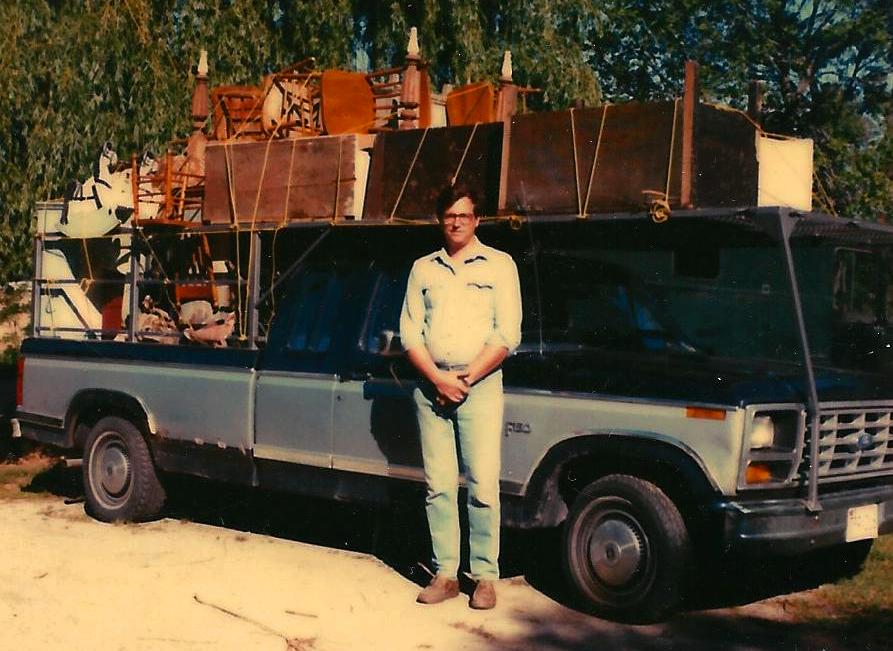
It was on a late fall trip to the pickers barns in Quebec in the early nineties that I had my brush with dumb luck.  I was solo on a quick two day, there and back run to pick up more stock for the then active Harbourfront Antique market in Toronto.  During this period I would often leave our house at 4 a.m. make the ten hour drive to Victoriaville; then see three or four pickers that afternoon and evening before crashing.  In the morning I would make a few more stops before heading home about noon, which meant I would arrive home  about 2 or 3 a.m. if all went well.

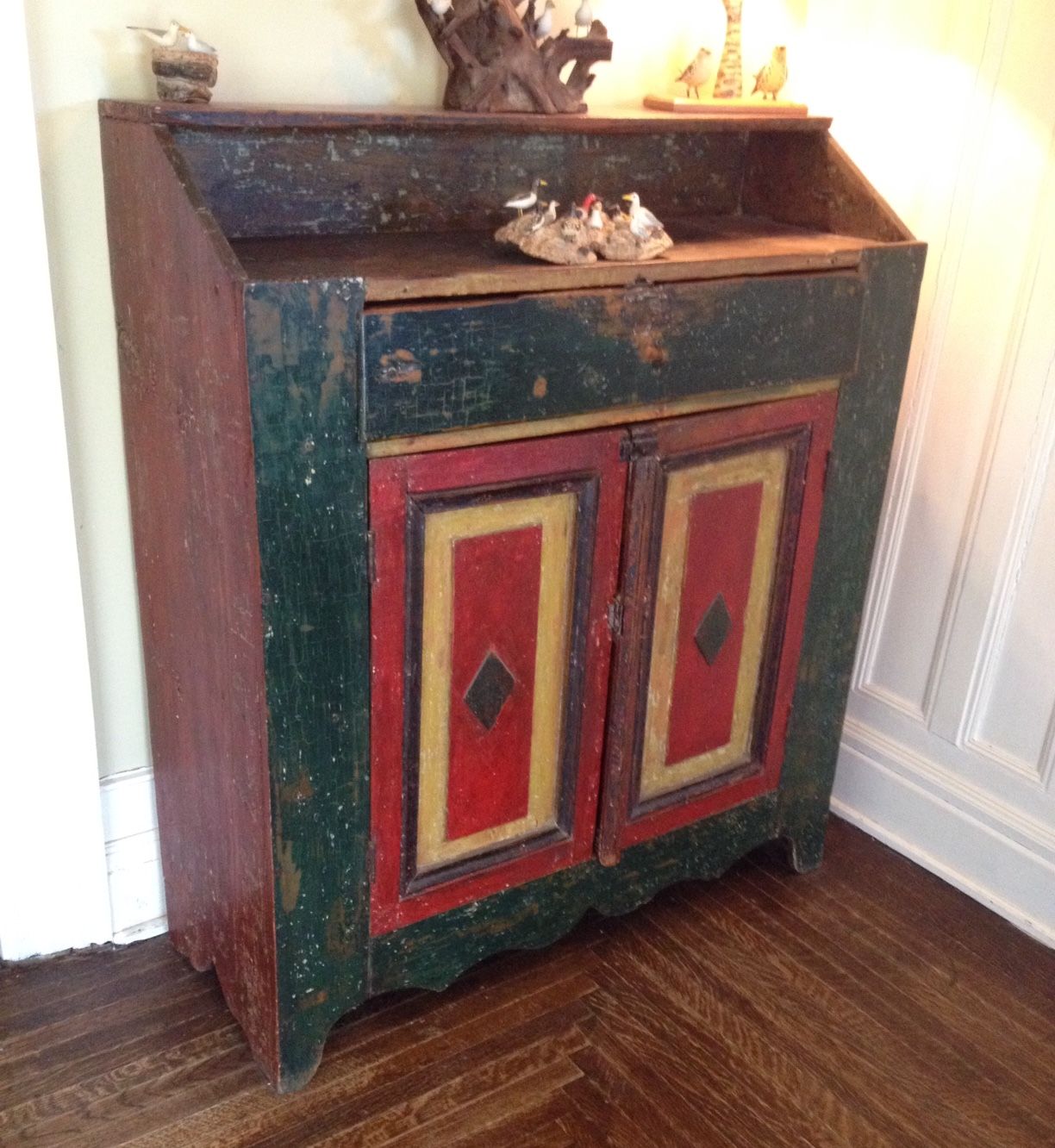
On this particular trip I ran into some particularly nice western furniture at the barn of Alan Chauvette.  It turns out that the rumors were true.  One of the local pickers had family in Manitoba, and in spite of not speaking much English, he had returned home with a huge load of western pieces.  Many interesting  Ukrainian and Dukhobor pieces as well as furniture from early French  settler’s homes.  I bought five or six excellent cupboards, and chests,  feeling happy to have arrived at the right moment to have a crack at it.  I also spent a lot of money. More than I had budgeted.  Jeanine has always kept the books, (thank goodness as I am a disaster), and my method was to simply spend all the money I had, and write a couple of cheques if necessary.  I didn’t keep a running balance, but had an intuitive sense of when to stop.  Well, I threw that sense right out the window this time, for the opportunity to buy some good Western pieces. I knew I was pushing it.  We kept a tight operating budget in those days, so if we didn’t want to dip into savings  a big buying trip meant I really had to have a good Sunday at the market.   I wasn’t sure how, but I knew it would work out.

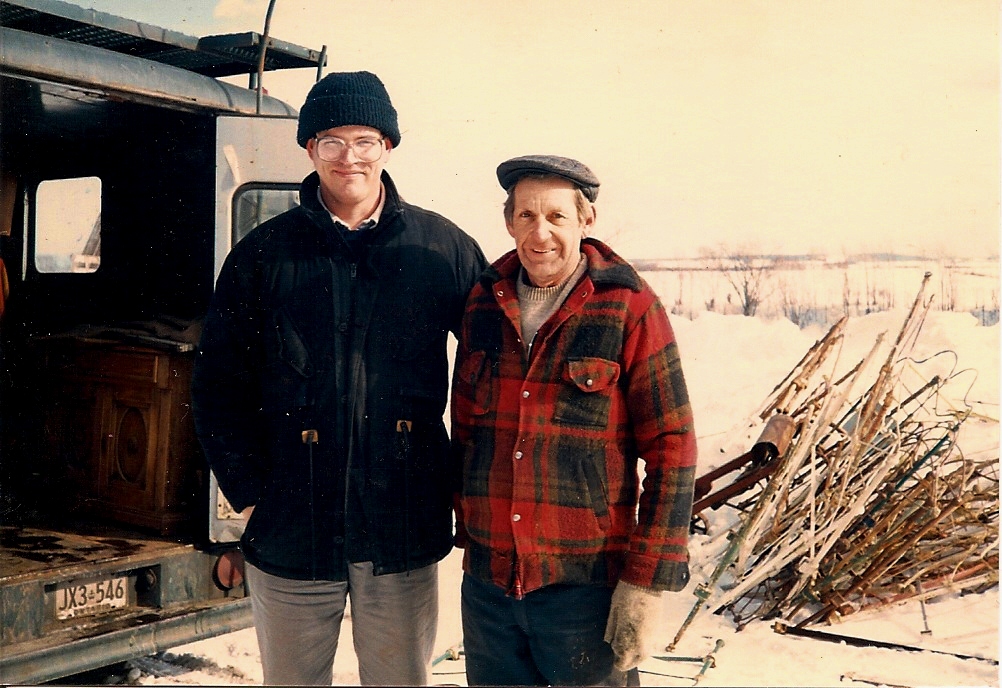
Phil with Marcel Gosselin

I was feeling pretty satiated when I arrived at picker Marcel Gosselin’s barn about 10 a.m. as a last stop before returning home.  I was still picking up a half dozen stoneware wash sets from him every trip, because they were still popular at the market and he was still finding lots of them. He was also my source for Aime Desmeulle’s folk art, which was selling well at the time.  As I finished filling in the last remaining little spaces in the load with smalls, I was about to write the cheque when Marcel piped in “Are you sure that’s all Phil? I’ll sell you that small cottage chest for $175.  You know you’ll get about $400 for it.”  It was a tidy, little 4 drawer pine cottage chest from Nova Scotia which were very popular at the time.  I looked at my full truck and thought about the cheque book.  “Thanks for the offer Marcel, but look, I don’t have room for it.”  The load was already well above my racks. “ Look there Phil, on the right side of your tailgate.  I can put it on its side and tie it on right up there.”  Sure enough, I could see he was right. “O.K. Marcel, throw it on and give me the total.”

I got home very late, and went straight to bed.    Next morning, going into the kitchen for coffee, there sat Jeanine looking at the cheque book, and looking worried.   “I understand this was a great opportunity, but it’s going to have to be one heck of a good market on Sunday, or we’re going to have to dip into the savings to cover ourselves.”

By the time we got all the wonderful pieces upstairs we were feeling good about it, even if it meant cutting it close.   We still have a wonderful four colour Ukrainian  sideboard from that load that I fell in love with while scraping it down.  We had a good dinner,  and I decided to go upstairs to look over the stuff one more time before hitting the sack.  I was excited by the pieces, but also feeling concerned about so completely blowing the budget. I continued to open the cupboards to inspect the interiors, and  when I finally came to the little pine chest I had bought from Marcel, I opened the top drawer to see how well it travelled in and out. What’s this?   I was amazed to see a small plastic wallet lying there in the middle of the drawer.  How did that get there?  It wasn’t there when I looked at it in Quebec.  Then I remembered that we had put the drawer on it’s side to fit it into the load, and sure enough, when I felt up inside under the top, someone had built a little open shelf up there.  The wallet was full of crisp, old issue Canadian cash.  $1,300 in all.   I couldn’t believe the luck.  I could easily imagine that had I continued to carry it upright I would have sold it  full of cash as it were, and maybe even then it would go into a home upright,  and never be discovered.

Jeanine was having one last coffee before going to bed.  Yes, she can do that. She looked puzzled when I handed her the little wallet.  “ I know you are concerned that I spent so much, and I thought this may help”.  It took her awhile to believe my story, and our good fortune.

When I saw Marcel a week later, he was surprised when I shoved a folded hundred in his shirt pocket.  “What’s this for?”

“Never mind.  Just take it and don’t ask any questions.”

Nova Scotia or bust

One summer, back in the late nineties we decided to take a quick trip eastward combining some antique picking and vacation activities as a fun time together with our daughter Cassandra before she left high school to go to university.  The objective was to have no specific plan, and wander eastward as we saw fit buying along the way, with the ultimate goal of reaching Nova Scotia.  Even if we didn’t have the time on this trip to explore further once we got there. We put about $4,000 in an envelope for purchases, packed out bags and food hamper into a full size cargo van we borrowed from our son Brodie, leaving him our pick-up to use while we were gone.  We were not looking for furniture on this trip, and felt it safer to leave our small sized purchases locked up inside a van at night.  We got a good, early start and made it to our regular stomping grounds around Victoriaville in time to do a quick circuit of the picker’s barns there before settling in for the night at our regular spot, the Motel Marie -Dan in St. Eulalie.  We didn’t buy much, wanting to save our money for buying in the previously untraveled regions to the east.

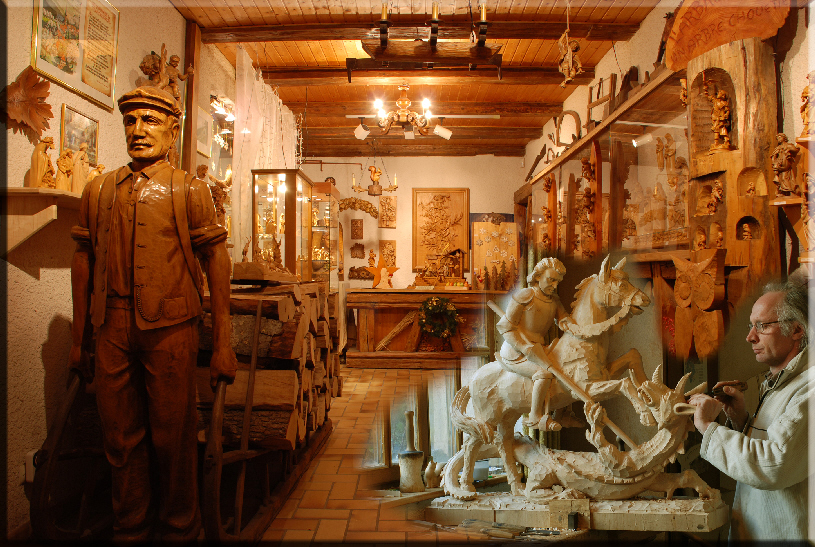
Day two, after a hearty breakfast we shot down #20 expressway past Quebec city until the village of St. Jean Port Jolie.  This pleasant little village on the banks of the St. Lawrence river is the home of the Bourgault brothers, who founded the “École de sculpture de Saint-Jean-Port-Joli” in 1940 with the support of the Quebec government.  The carvings became very popular with tourists and locals alike, and still today the village is chock a block with wood carvers.  To be honest although we greatly respect this form of carving, we were hoping to find  a unique folk artist more towards the lunatic fringe of the spectrum who might be hanging out there.   We had a great time looking at the museum and several shops but didn’t find what we were looking for.

After a nice lunch we made our way along the coast on the two lane Hwy # 132 past Riviere-du-Loup  as far as Trois Pistoles, a trip which would ordinarily take about an hour, but in our case took over four due to several stops at yard sales, markets, and shops. We hadn’t expected it, but we found a lot of wonderful stuff and by the time we stopped for a coffee in Trois Pistoles the cargo area of the van was almost full, and our envelope was over half empty.  We had a little conference, and thinking of Nova Scotia decided that instead of going further into the Gaspe we would turn back to Riviere-du-Loup, hang a left on Hwy #85 which becomes Hwy#2 as soon as you cross over into New Brunswick  and on a good day with steady driving will get you to Amherst, Nova Scotia in about eight and a half hours.  Our goal was to sleep in New Brunswick.

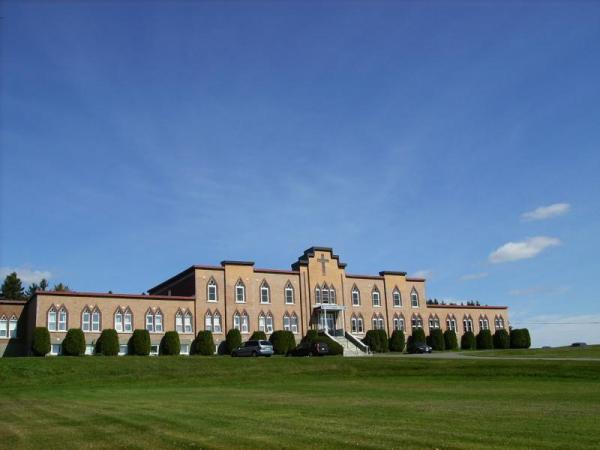
It was dark and raining by the time we had made our way past the endless forests of this part of Quebec and then we hit the construction.  On a 1 to 10 scale of “hairy” driving this was a solid eight. Pounding rain, mud, and lots of starting and stopping. We white knuckled it for about another hour and finally made it to Grand Falls, New Brunswick.  It was pushing ten o’clock, and we really needed to stop.  Turns out there was a convention in town and we were turned away at every motel, and feeling quite desperate before we got the advice that the only room we could get would be at a bed and breakfast in a recently converted old nunnery a few miles out of town.  We’re not big B and B fans but great.  We’ll take any port in this storm, and after a call ahead to confirm they had a room, we went off with the little hand drawn map we were provided.

The storm grew stronger, and the thunder and lightning more brutal, as we wound our way up into the surrounding hills, until there in a flash of lightning worthy of Alfred Hitchcock, the huge, old, Victorian Gothic Institution appeared, with a giant cross above the entrance;  and we drove up the hill and pulled into a parking space, wondering what we had gotten ourselves in to.

I can’t recall, but I’m sure we were greeted by a perfectly nice night attendant, although in my imagination he was someone akin to Igor.  We were lead down a long, dark, corridor to a pair of rooms which seemed to remain untouched from their former life.  I remember the institutional green walls and old steel beds.  They were small, and basic, but a blessing in our situation.  In bed, with the lights out, and the still frequent flashes of lightning and thunder I began to hear people moaning in the distance. It kinda freaked me out, but I had no desire to investigate.  I put the pillow over my ears and did my best to fall asleep.  It was a long night.

Next morning, we met Cassandra in the canteen, and after coffee and hot chocolate decided to get the heck out of there.  “Did you hear all that moaning” Cassandra said.  “It really freaked me out”.  “  “Me two.”  “Me three” said Jeanine.  We saw the caretaker on the way out, and he explained that it had become a B and B, slash old people’s home, and that some of the old dears were restless.  The place didn’t look all that spooky in the daylight.
In town, we sat in a little mom and pop restaurant, finishing breakfast and discussing our plan.  We had learned that the construction which we had only experienced about an hour of, continued for several more hours ahead as they were making the highway into a divided four lane.  Desperately need by this point especially with all the summer tourists.  We sat there for a while discussing our progress, and what lay ahead.  We were grateful for the use of Brodie’s van, but it was noisy and fairly uncomfortable.  We realized we had a full day of crappy driving ahead just to reach Nova Scotia, and then we would only have a couple of days to look around before heading back.  Then our conversation turned to how much we loved Quebec City, and we could be there by late afternoon if we turned back.  It was an easy decision for us.  We called our favorite, cheap hotel in old Quebec, Le Manoir des Remparts and made a reservation for three nights.   We had a wonderful time, and felt happy and relaxed on the twelve hour drive home.  Resolving to make it to Nova Scotia another time.  Perhaps, looking into air fares.

Rain or Shine

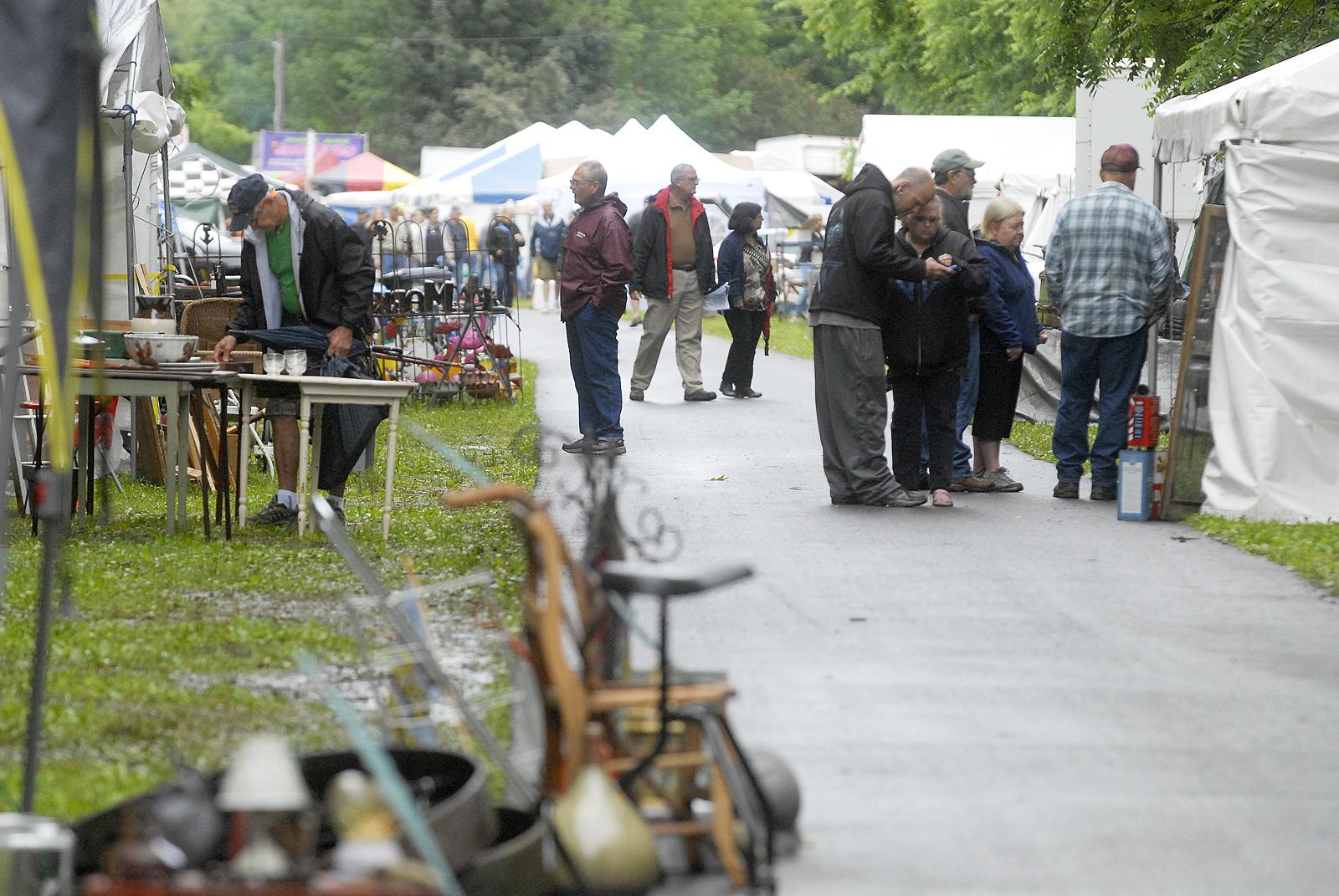
It’s Friday May 5th , and I’m looking out the window at a constant, cold rain, with a forecast for two more solid days of rain to come, and I am feeling  grateful that I am no longer doing outdoor antique shows.  It’s a younger person’s game. Here in Ontario there is an outdoor antique show occurring almost every weekend from now through the end of July, then only a couple of shows in the heat of summer, and again almost every weekend through the fall until the beginning of October.   We used to do a lot of them, and in every contract you would read the phrase “show will take place rain or shine”.  Of course this is a necessity for the promoters because the venues must be paid for well in advance, and all the promotion has gone out, and rescheduling is just not an option.    It is understandable, but can be a dilemma for the dealers if the forecast is for rain.  If you don’t show you are out your contract money and you will not be looked upon favorably by the promoters who rely on dealers to turn up so as not to disillusion the clients whatever the circumstance.  Besides, a bit of rain does not discourage the more serious collectors from getting out so you can have a pretty decent show in any case.  Not always.

I remember the Odessa (near Kingston, Ont.) show in the early eighties where I first encountered a gentleman selling a 10’ x 20’ tent made up of metal poles and corner fittings and a big blue tarp that you bungeed tightly over the frame. It was selling for about $300.    There was nothing much available otherwise except smaller garden tents at Canadian tire, and I had already experienced a few days of standing in the pouring rain at shows so I went for it.  This was before shows offered tent rentals, which for a price will be set up and ready for you when you arrive.  Even when these rentals became available the price was somewhat prohibitive.   My new tent took about a half hour to set up and required quite a lot of swearing and pinched fingers before it stood ready for use, but it was worth it not only for the shelter from potential rain, but just as importantly for the shade it provided on a hot, sunny day.  It was the half hour taking it down at the end of a long day which sometimes wore thin, but overall it was worth the effort.

These makeshift tents worked quite well against sun and gentle rain, but became a real menace on wilder, windy days.  One memorable occasion occurred in the late eighties at a show held in a conservation area near Collinwood, Ontario.  I had arrived Friday afternoon because it was a four hour drive from my home and the show was Saturday only.  The forecast was for heavy winds and rain, and I was doing it alone and on the cheap in case of poor sales due to the weather, so I decided to sleep in my van to save the cost of the motel.   I felt uneasy as I arrived late in the afternoon because I could feel that something big was coming.  The pressure had dropped and the wind was already picking up so I decided to play it safe and not set up that evening.  Most dealers who had arrived were all set up and doing a little preshow business so it was hard to not join in.  I took out the tent and a few large pieces of furniture so I would have room to sleep in the van.  I tied the furniture together and secured a tarp over the pile before calling it a day and having a few beers with some friends to pass the time and make sleeping a bit easier.  It became very humid about 1 a.m. and I had a restless,  too hot, intermittent sleep until about 4 a.m. when all hell broke loose.  The wind came in like a locomotive and amid the crashes of thunder, and flashes of lightening I could hear the occasional thumps of furniture hitting the ground, and crashes as tables of glass and china, flipped and sometimes flew a few feet away from their original resting place.  You could hear some people shouting and see their flash lights flashing around as they tried to save their set up.  I just hunkered down and did my best to rest until sunrise.

When I woke up with the sun the worst of the high winds had passed but the steady rain which would last the entirety of the day was upon us.  I put on my raincoat and ventured out the back door of my van.  It looked like a war zone.  Many tents that had been set up and tarped, had been forced  loose from the ropes staking them down, and had flown like kites for several feet before landing in a pile of tarp and metal that looked like some kind of abstract metal sculpture or bomb site.  There were big cupboards being lifted off the ground with smashed doors and trim.  There were tables upturned over piles of broken smalls.  There were paintings obviously soaked beyond repair. It was devastating. Some people were just standing there crying.  Others were struggling to accept what had happened and doing their best to undo the damage.  It was truly heartbreaking.  Many dealers live fairly close to the bone and for some the loss was substantial. 

I helped a few people set their cupboards back upright and extended my sympathies to many, and then  cleaned myself up in the washroom, got myself a large coffee, and went back to my van to assess the situation.  I was happy that I played it safe and had waited, but now I was faced with the decision to either set up my tent and display in the pouring rain, and hope that a few brave souls would face the elements and maybe buy a few things, or perhaps it was just better to accept the loss, pack it in and head home.  Either way it looked likely the show was going to be a wash and I would lose my investment in the rent and transportation. But I had signed a contract, and I was already there so  I decided on a compromise and set up a smaller version of the tent which allowed me to bring the tarp down over the sides.   I brought out some sturdy, country furniture which would not be harmed by rain, and a few smalls that would not blow away, and left the more delicate things packed.  Attendance was way down of course, but from the couple of hundred people who showed up, I managed to connect with a few keen collectors who bought regularly from me, and was quite happy when five o’clock closing rolled around, to have sold enough to cover my costs and have a couple of bucks to take home.

Sometimes I think  people look at dealers at an outdoor antique show and think “that looks easy”, but let me tell you that is not the case.  Aside from the enormous amount of work it takes to prepare, set-up, sell, and then tear down a display on a pleasant day , it’s nothing compared to the hardship you might endure in the times when the weather decides to rear up and do a number on you.