First, we take Manhattan – part two

newy6We had outrun the snow storm, and arrived at the Puck building in Soho before the morning rush.  Although it was two hours before the designated set up time of 8 am, Jeanine and I had already had a morning coffee and a lovely smoked salmon sandwich on rye.  One thing you had to say about this promoter is that he really fed you well, knowing that dealers think with their stomachs.  None of the crew that would help dealers unload would be there for two hours, but we hadn’t slept and were running on nervous energy. Anxious to get at it and set up, so that we could get to the hotel and sleep.  We had rejected the idea of a nap.  So, nothing to do but drive the truck up to the nearest door to our booth and start lugging.  There was no traffic so this was a snap.newy2

We pulled up the door of the cube van and became intimidated for a moment by the size of the load.  We had a good-sized booth and wanted to do well, so we were loaded for bear.  Just then as we were stretching out our muscles in anticipation of the task ahead we spotted a young, black guy, in a black hoody sliding up the sidewalk.  He stopped as he reached us, smiled, and said “Can you use a hand”.   “Well, if your offering, we could actually. I’ll be glad to compensate you”. Without a beat. “Let’s get started. I’m Leroy.  Where are we going with this stuff”?  “Right in here, Leroy.  I’m Phil and this is Jeanine.” A little bow and a handshake. “Nice to meet you both. So what I’d suggest Phil is that Jeanine stays at the booth, you bring the small stuff to me off the truck, and I’ll look after the middle. The big stuff we’ll have to do together. ”Sounds great Leroy. Let’s get at her.” He was a wonderful helper, remaining positive and up-beat the whole time. Full of suggestions; “Well I think you should put that cupboard over there Jeanine”.  It was actually fun.  Within an hour and a bit everything was in front of our booth and we were already half set up.  We thanked Leroy, and asked if he might come back on Sunday night at 6 when the show was over to help us reload. “Well that depends. I’ll try, but I can’t promise.  No problem Leroy, so let’s see” We’ll call it an hour and a half, so how about 30 bucks? Does that sound fair?”  “Oh no Phil.  You’re in the big city now you know.  Everything costs more.  I think you’ll have to do better.”  He was right, of course. My Scottish nature had made me offer him a country wage.  “Alright Leroy, let’s make it $50.”  That’s right, Phil. Now you’ve got it. Now you’re in a New York state of mind.”  Leroy shook our hands, wished us a great show, and headed off in the same direction he was going before. Sometimes help arrives when you need it.newy1
By the time I had taken the truck to the parking lot ($125 dollars there for the weekend.  Now I know what you mean Leroy.) , and we had finished setting up, we were totally pooched.  It had started to snow heavily about 10 a.m. so in the cab on the way over to the hotel later that afternoon we were becoming concerned as to whether anyone would be able to make it to the show the following morning.  We were too tired to care much at that point.  All we could think of was a shower and a bed.

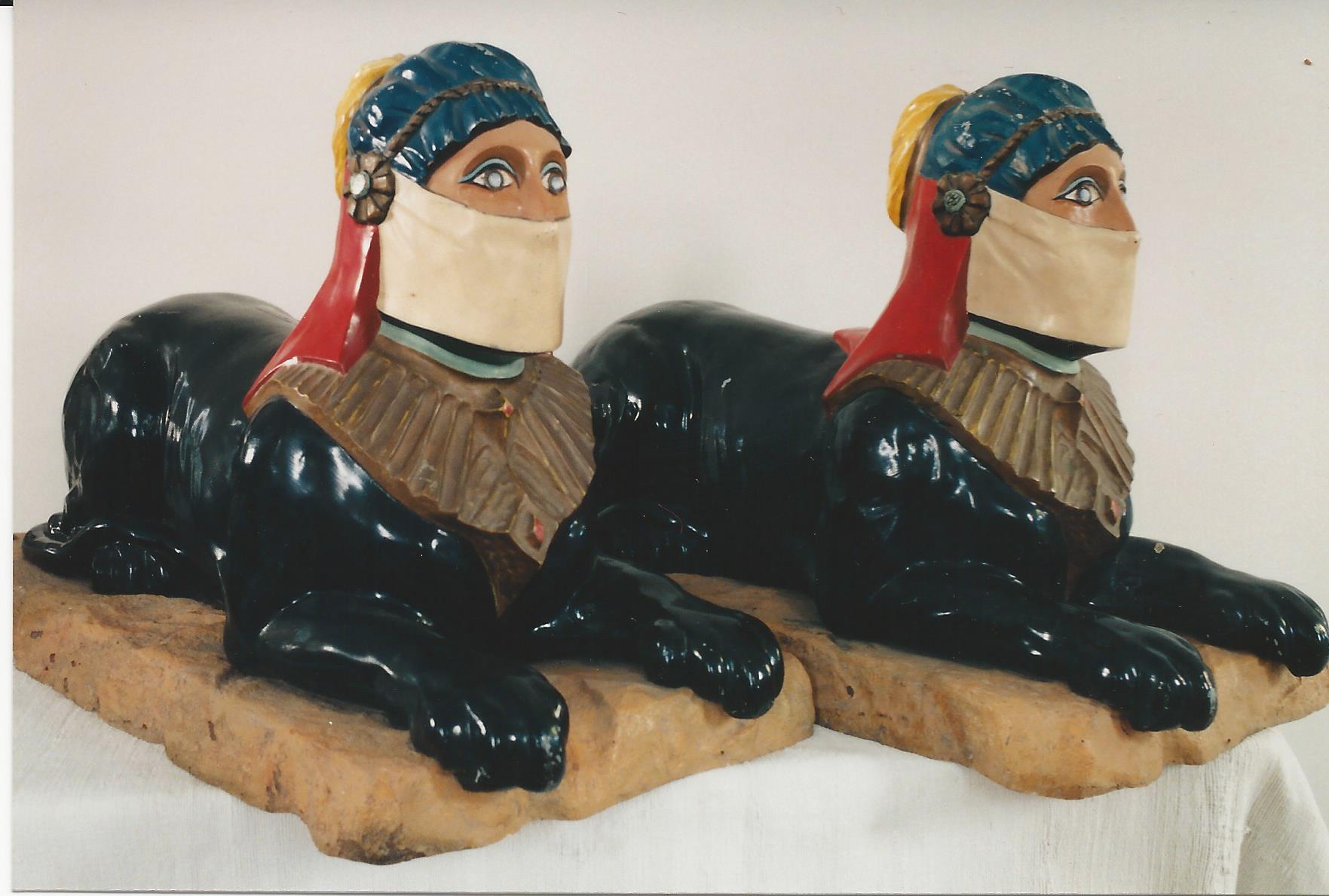
We arose to snow covered streets, but nothing that would stop a dedicated antique show lover.   At 9 am when we arrived at the show there was already a small line of people waiting.  By the ten o’clock opening, there was maybe 60 to 80 who rushed in.  Not a Bowmanville opening night crowd, but serious shoppers none the less.  The first person to approach us was an interior designer from Brooklyn who could barely contain herself with excitement over the sphinx’s.  She asked for the dealer discount which we provided and she immediately said yes and gave us $100 down, pleading with us not to sell them to anyone else while she went to a cash machine to come up with the rest.  We reassured her that with the deposit they were hers, no matter how much extra someone might offer.  I can’t imagine reneging on a deal once money has changed hands, but I suppose there may be some who can justify it to themselves. Somehow.  It wasn’t a problem in any case because although others did admire them, everyone respected the sold tags, and she was back within the hour with the cash and a van to take them.  Several more sales followed over the next two days despite the relatively low attendance.  At least those who came were keen, and decisive.  What surprised us most was the high number of people who knew about Canadian folk art.  Many people would recognize a Charlie Tanner, or Edmund Chatigny, and everyone seemed to know who Maud Lewis was.  We were told by several people that they had gone to Nova Scotia on a field trip arranged by the Museum of Folk Art.  We were in high spirits at dinner on Saturday evening when we met our friends who live in Manhattan.  We had delicious Japanese food that was still quite a novelty to us, in a place our friends frequented.  A couple of glasses of sake and we really started to feel the buzz of the city.

Sunday was cold and blustery, but we did a bit more business and knew that we would go home with considerably less stock and more money, which is of course the point of the exercise.

Leroy was a no show at pack-up, and the gang of young Russian thugs the promoter hired to help load just about gave me a heart attack with their careless and at times downright brutal loading techniques.  At one point I was having to catch boxes full of delicate items thrown at me from the back door of the truck.  Hair raising stuff, and they looked like they might kill you if you complained. Still, we were packed in about an hour and heading down the West Side highway, heading to the George Washington bridge   as the sun set, and the street lights came on. The icing on the cake is when I heard the immediately recognizable first chords of waw waw guitar and the golden voice of Isaac Hayes utter the first lines of “Shaft”.  A song I had always heard as quintessential New York.  It was a magic moment we had there heading down the West Side Highway listening to Shaft.  A perfect moment.newy3

First, we take Manhattan – part one, getting there

newy1In the early nineties one of Canada’s top promoters of high end antique shows bravely decided to take a swing at the big apple.  He decided to piggy back on the excitement around the annual January Antique Week in Manhattan where at the time there was about a dozen shows taking place in the area over two weeks. He managed to rent the well-known Puck Building in Soho, and he advertised widely. He even organized a free shuttle bus to run between the Puck building and the Winter Antique Show held at the Park Avenue Armory, and a couple of other of the big venue shows.  His full-page ad proclaimed “the Canadians are invading New York….”  I forget the exact wording, but the gist of it was we were there to kick American ass.  It didn’t appeal to my humble Canadian nature, and I don’t think it appealed all that much to the American dealers either who stayed away in droves, but I must admit it was a gutsy move.

Things started to unwind a bit before they even got started, when a couple of the established big guns of the Canadian Antique scene decided it was too risky, or the costs were too high, or whatever, and refused to participate.  The promoter had promised folk art, and had asked me to come along, but I too thought it was too large an investment on a first time show and passed.  It was a week before the show when I received the call stating that I was desperately needed in New York, and I could name what it would take for me to come.  Well, I thought about the success of the two Outsider Art Fairs that I had recently participated in, and how I liked and respected this promoter and what he was attempting, so with a nod from Jeanine I let him make me an offer I could not refuse.  It was still a risk, but we love New York, and the thought of selling there was very exciting.  We also had a lot of interesting “gear “(stuff for sale) at the time, including a pair of fiberglass Sphinx that had once graced the entrance of the Bill Lynch Circus which was big out of Nova Scotia in the forties.  We thought they were magnificent but had not been able to get any interest at two or three fall shows in Canada.  We thought they might be appreciated in New York so we put a bold price on them, figuring if we didn’t sell too well otherwise, the sale of “the girls” would help out the bottom line.newy4

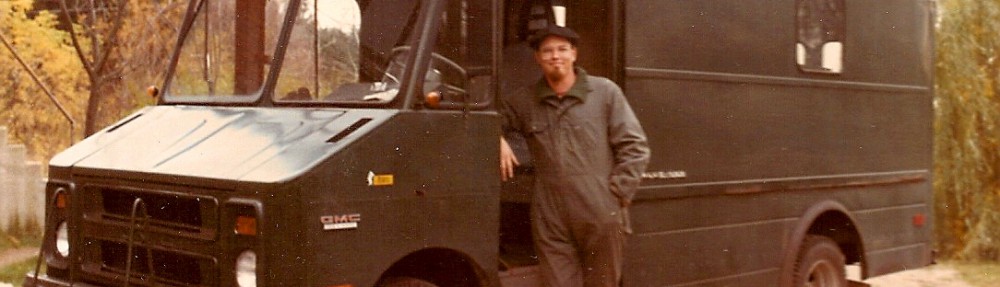
I remember that set up was from 8 a.m on Friday January 24, 1992, but you could arrive anytime provided you were set up for the 10 a.m. opening on Saturday.  Our truck was old and open backed, and they were forecasting a lot of snow coming so we decided to rent a cube van.  In for a penny. In for a pound. Logistically we decided to pick up the truck on Thursday at 5 p.m. which I talked the rental company into counting as being picked up the next morning, saving us a day’s rental.  They knew they were going to make good money in the kilometer charges and I was a regular. The concept was to load the truck which we knew would only take a couple of hours as everything was packed and ready. Then we would leisurely have our dinner, take showers, and catch an early night, so we could leave about six the next morning.  On a good day this would put us in Manhattan about 6 in the evening, and we would be able to unload and set up in the evening and hopefully get to the hotel about 9 or 10.  We did not know how long it may take to clear customs, but we did know that we could take all night to set up if we wanted to, and we did not want the expense of another night in New York and another day’s truck rental.

But here’s how the best laid plans can fail in January.  You guessed it.  The weather.  All day Thursday as I waited for the 5 p.m. pick up of the rental the weather reports became more and more alarming about the huge snow storm which was making its way across the mid-west U.S. on line to arrive at our place about sunrise.  Just as we would be leaving.  This was a biggy.  A no kidding, you are going to get nailed snow event.  About two in the afternoon when we stopped for lunch I looked to Jeanine and said.  “I think we have to try to outrun this baby.  We should pack and go right away and at least get through customs and a bit down the road and then pull into a hotel for the night.  At least if we can get out of the Buffalo area it shouldn’t be so bad.  We cannot afford to not make it there in time. We have too much riding on it.”  Jeanine found this a hard pill to swallow but soon saw the logic.  So right after lunch I called the rental place, put on my sweetest voice and talked them into letting us have the truck then. We hurriedly packed the truck with the help of our worker Albert and our son Brodie who was called into duty, and so by 5 in the afternoon we were on our way.

I remember that it was beginning to snow lightly as we entered the customs warehouse in Buffalo.  We sat in a cold little room over-illuminated with a weird green fluorescent light alongside a dozen or so actual truckers. We were all trying to stay warm sipping lousy vending machine coffee, and making small talk as we waited for our number to be called. All the while conscious of the increasing snow floating gently down outside the tiny window.  This was the scene for about 45 minutes which felt like 45 hours when you can see and feel the coming storm.  When we pulled onto the interstate I said to Jeanine, “let’s just go down the road a way to get a little distance in tonight.  I’m feeling awake and every mile we cover, makes one less mile tomorrow under much worse conditions.  I gassed up the beast, and we headed down the line. newy5

The snow was getting thick on the road and the road reports were not encouraging but we kept on.  Then after about an hour the snow started to lessen, and we realized we were becoming slightly ahead of the storm.  We got some coffee at a service center and I looked over to Jeanine who before the stop had begun starting to snooze, and suggested “Look.  I’m feeling o.k. there’s some good tunes on the radio, and the road is clear.  I say, let’s just keep going until the snow comes, or I am too tired, or something stops us.  Surprisingly, she agreed.  What a trouper.  She even stayed awake for the most part engaging in any, and all conversation we could muster as to keep me from sleep.  The hours and miles passed.  The snow started up again, very lightly at first.  Reports on the radio suggested that Buffalo was already virtually closed due to heavy snowfall.  The giant storm was arriving a little ahead of schedule, and it was breathing down our back.  We kept going, not stopping again until about two hours before New York when we stopped at a service center for a half hour nap, and another round of coffee.  I hated to stop but I was at my limit.  Surprisingly that half hour of shut eye was all I needed to wake up and complete the journey.

The snow began to come down heavily then, and I remember that it became very blustery and slippery just as we crossed over the George Washington bridge into Manhattan, and the truck did a little slide to the left just to let us know what we were dealing with.  It was about 6 a.m. and there was no traffic so we pulled right up to the Puck building, realizing at that hour we could unload from the street rather than having to bring everything in from the loading dock.  We looked inside the locked doors and were delighted to see that some people were already there starting to put down carpet and set up drapes.  There was some good strong coffee and some nice snacks set out, and within an hour we had refreshed ourselves, and then they allowed us to begin unloading.  And that’s when we met Leroy. But I will save Leroy for next week and the continuation of the story.  What mattered then, and it was all that mattered then is that we had arrived safely before the storm.newy2

Our times at The North Hatley Antique and Folk Art Show

northhat3

a giant moose head that came along for the ride.

When, in about 1986 we decided to expand our show calendar beyond the weekly Toronto Harbourfront Market and the spring and fall Christie shows, we decided that we would like to include the North Hatley Antique and Folk Art Show, held annually in early July in the beautiful Eastern Townships region of Quebec. Known as Canada’s oldest antique show, it also had and still has a deserved reputation for presenting top quality antique and folk art to an exclusive and appreciative clientele.  North Hatley is a picturesque charmer of a small town on the banks of Lake Massawippi, and a playground to the affluent and powerful of Montreal and surrounding areas. The show, put on by the local Recreational Society is held in the old curling club with about fifteen dealers set up where the ice would be, and another 6 or so set up in the onlooking lounge.  For the years we attended, until his death in 2007 it was run by the legendary Sam Pollock, who among many other things was the manager of the Montreal Canadians for 14 years, during which they won the Stanley Cup nine times.  As you can imagine, Sam ran a tight ship. Every year he, and his loyal fellow volunteers would do everything from planning and preparing, to set up, and everything else involved in running a top notch show right down to the  making of the delicious home-made egg salad sandwiches at the lunch bar. They may have been up in years, but those ladies knew their way around a good egg salad sandwich. northhat4

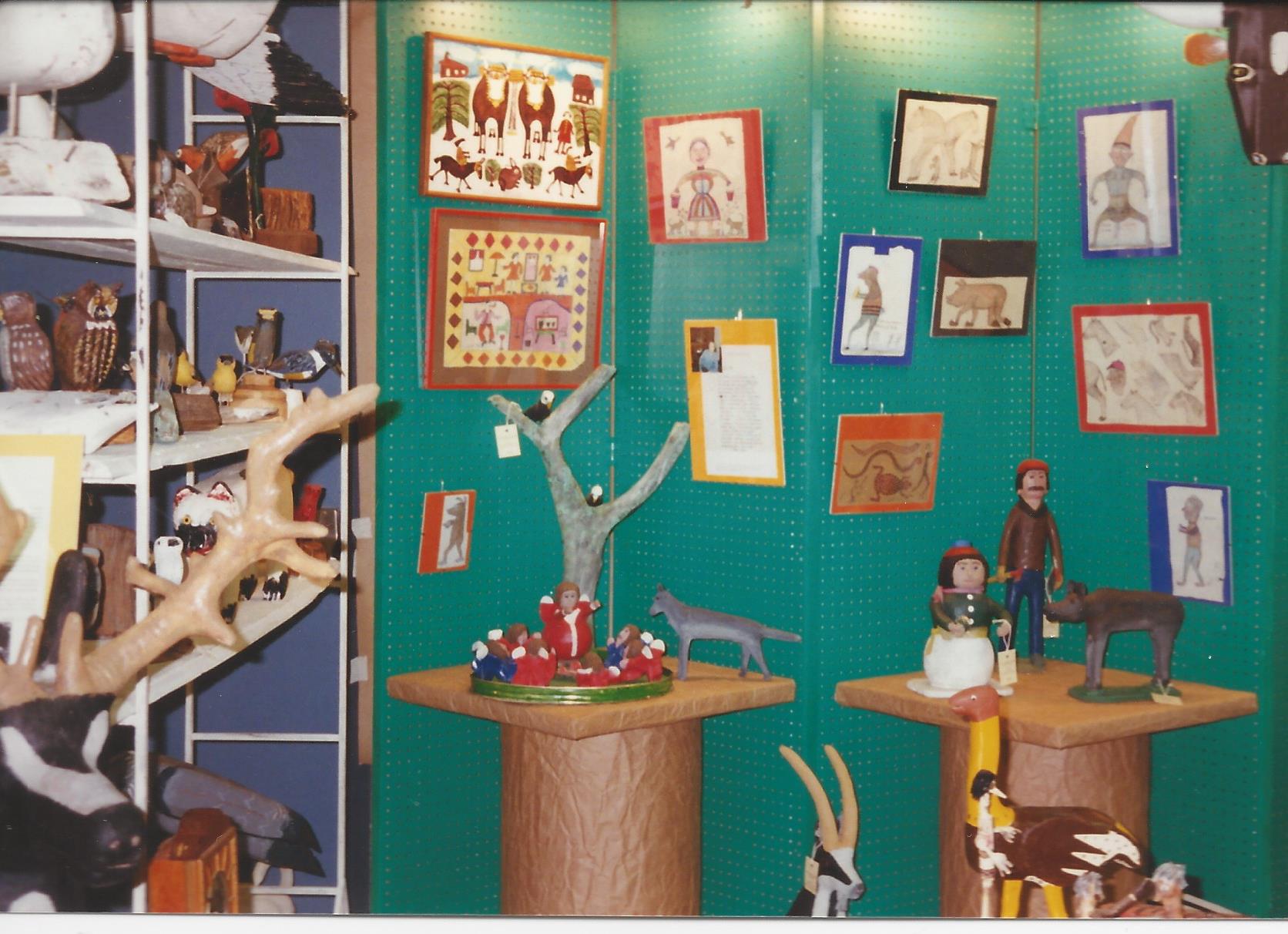
In those days, it was not easy to get invited to do the show.  We were lucky to have friends like Peter Baker and Gerry Marks who had been doing the show for years to recommend us.  The first year we had a tiny 10’ x 10’ booth wedged into a corner of the lounge area, which was mostly dedicated to book, pottery, and silver sellers, with the furniture dealers all being in the main room.  We didn’t mind because being an unknown in terms of results, the rent was cheaper and we came with a smaller truck. We focused mainly on folk art, which was what the promoters wanted from us because it was becoming increasingly popular with this crowd. It went very well, and we had a great time to boot.  Good sales, lovely people, and a stunning area to explore.

An interesting feature of the show is the gala Friday night opening.  From 6:30 to 9:00 on the Friday night a $30 ticket buys you first crack at the stuff, and all the delicious hors-d’oeuvres, and wine you want. Lovely young waiters and waitresses passing amongst the crowd with trays. The experienced dealers warned us that opening night it is packed, and it may seem that all they do is talk to each other, and glance over your stuff.  It is a big social event after all.  But not to despair because when they see something they like they are in a good and competitive mood to buy.  Also, they may go home and discuss it, and come back Saturday morning to buy.  It worked out pretty much just like that.  A few sales Friday night, then good sales all day Saturday, and even a few more on Sunday.

We kept the same booth for a couple of years and then moved to a bigger one in the same room when it became available. Then one year when I was doing the show by myself; I can’t remember when exactly, it must have been the late nineties, Sam came up to me and asked me if I would be interested in taking over a large room upstairs they had for the same price.  He pitched “You can spread out the art and make it like a gallery.  I think you can do well up there.”  I knew the space.  It was a big space, about 20’ x 30’ with two front facing windows which brought in a lot of natural light.  It must have been used for meetings.

my "gallery"  at the North Hatley show

my “gallery”
at the North Hatley show

“Well, yes Sam the space is great, but not to mention that everything has to go up and down the fire escape, I will be on my own up there, apart from the show. It might get pretty lonely”.  “Ah, but don’t forget Phil, that’s where the woman’s washroom is.  All the ladies will pass by eventually, and they’ll drag their husband’s up”.  I thought about it for a minute and decided he was probably right.  It just might work, and if it did the price was right. So I agreed, and started to haul everything up the steep fire escape that led directly to the room. A big task, but much easier than dragging everything through the inside.  It took the whole afternoon to set up, but in the end it looked like a gallery. I even had a table and chairs in front of the window where I could sit and do business, or read the paper in slow times. Not to mention eating egg salad sandwiches. So close. So tasty. So affordable.  I put up a little sign with an arrow pointing up at the base of the inside staircase announcing “Folk Art Upstairs”. I hoped that somebody might see it.

looking into my "gallery" from the hall

looking into my “gallery”
from the hall

6:30 arrived and at first I wondered if I had made a horrible mistake because I could hear the people coming in, chatting and having fun for a full thirty minutes before anyone showed their face.  But then it started.   The first lady poked her nose in, and was surprised to find me and my offerings.  Fortunately she was a folk art enthusiast and went directly to several pieces of carvers she recognized.   She bought three things right then and there, and I was off to the races.  It was out of the way, but when the folk art people found me, they really connected, and would not only buy, but go down and drag their friends up.   I met several people that year that became long -time friends and customers.  It was already a great show by Saturday at noon and then Pierre Riverin walked in.  I’d heard about the “collecting” mayor of the town of Eastman for several years but we had never crossed paths. We talked for over an hour, he bought several pieces, and it was the beginning of a wonderful friendship.  It is a rare and precious moment when you find yourself in the right place, at the right time, with the right stuff.   Even with all the effort of getting everything up and down those stairs, it was worth it many times over. I had a wonderful show and I was happy up there.  I repeated this for a few more years before the hauling up and down began to outweigh the benefit, so when a bigger booth on the main floor became available I grabbed it.

myself and Tom DeVolpi enjoying a beverage

myself and Tom DeVolpi enjoying a beverage

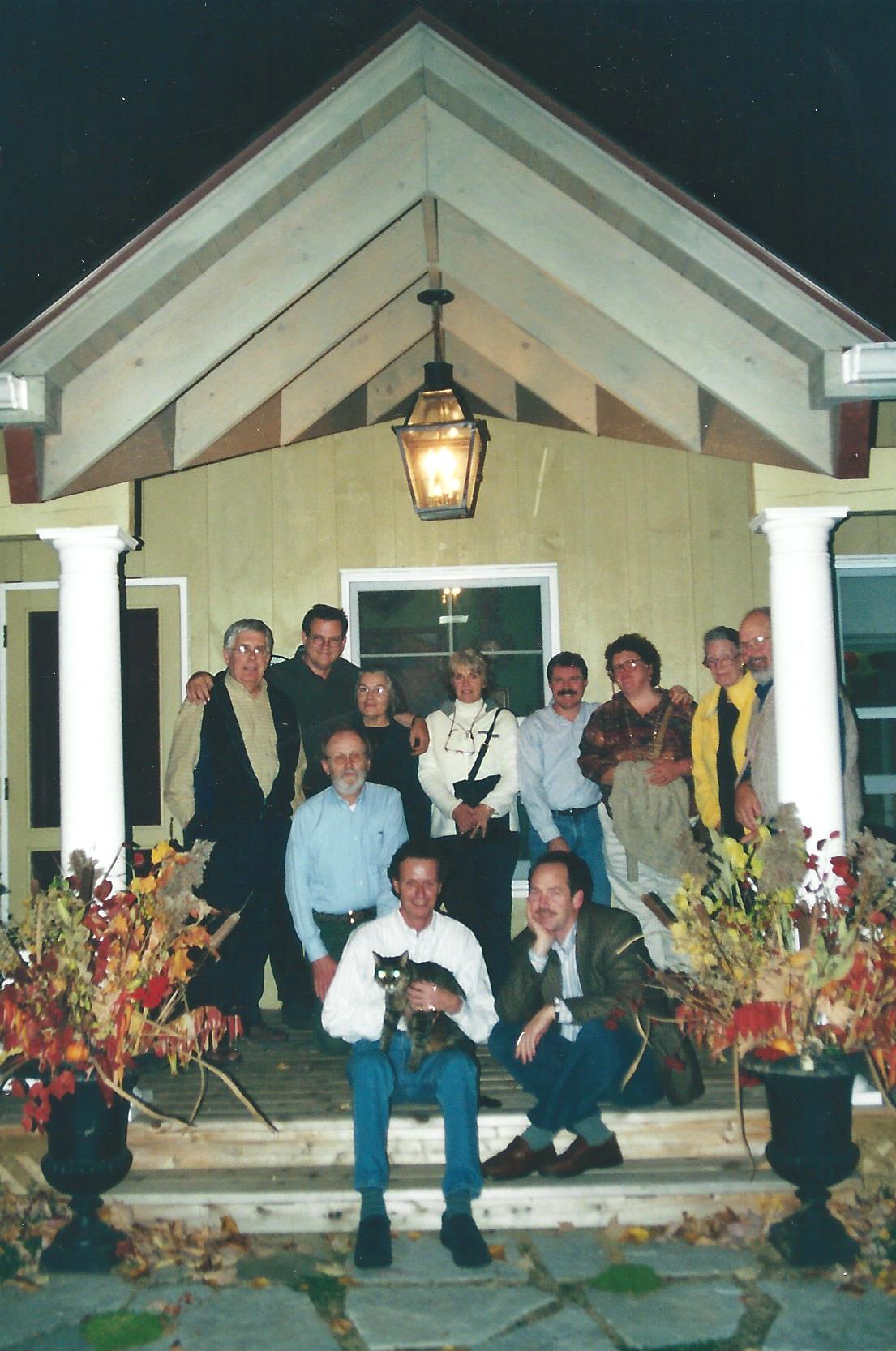
Over the years we got to know several of the Quebec dealers, designers, and collectors who frequent this unique annual show.  For a time many of us participating dealers would get together on Saturday night and enjoy the evening together at some wonderful local Inn or restaurant.  There are several to choose from.  Then through our friend Tom De Volpi, and our friends Jim and Ilona Fleming, we were invited to an annual Saturday night dealer’s dinner held at the nearby summer home of a lovely Montreal designer named Valery.  It was always a wonderful, warm get together, not to mention a delicious dinner; and we were grateful for her hospitality and the chance to spend some happy time with our fellows.

Eventually, as in all stories, the pages turn, and times change, and so it was that by 2008, (I remember it because, although still a good show, it just didn’t feel the same without Sam being there), along with slumping sales, we reached the point and age where we just couldn’t justify the ten hour drive to and from home, and all the work that doing the show entailed.  Mind you this was part of a larger retreat from doing shows altogether.  We truly don’t miss the work, but we do miss the people.  They were some very good times.

the "gang"  at Valerie and Henri's

the “gang”
at Valerie and Henri’s

Looking back at over twenty years at the Christie Antique Show

Me (looking really heavy), and Jeanine  in our booth, mid nineties

Me (looking really heavy), and Jeanine in our booth, mid nineties

The Christie Antique show is coming up on Saturday, September 10th at the Christie conservation area near Hamilton, Ontario.  It is Canada’s largest outdoor antique show and draws thousands of people to both the spring and fall shows.  It was started in 1988 by Jeff and Wendy Gadsden in partnership with John Forbes, and a few others investing.  I remember everyone getting excited about the prospect of a new outdoor show in the Golden Triangle area.  At the time the Flamborough Antique show held nearby, also in the spring and fall by promoter Bill Hogan was the only large outdoor show, and it was uncertain how this new show would stack up.  We liked the fact that it was a one-day show held on Saturday so we didn’t need to miss the Harbourfront market in Toronto on Sunday which was still going strong. Also, Christie is an hour away from our home so we didn’t have to factor in staying overnight at a motel.

From the beginning the Gadsden’s and Hogan ran a tight ship.  There was active vetting and anyone foolish enough to try to pass off a reproduction or junky piece would be certain to be brought to task and made to remove the offending item, or in some extreme cases be thrown out altogether from future shows.  Older folk art was o.k., but mass produced, contemporary folk art was not; especially if misrepresented.  I remember one spring show when Jeff made the dealer next to me return the money to a customer, and accept back an Aime Desmeulles horse that the gentleman had bought for a large sum because he was told it was old and rare. He was not happy when someone had told him the truth, and so he went to the promoter’s office to complain.  There was no tolerance for early packing, no matter what the weather conditions.   You could be sure that everything would be on display right up until closing time at five. Load in and load out was carefully supervised.   It was in every sense a well-run show and collectors and dealers alike loved it.

Something is amusing Jeanine.

Something is amusing Jeanine.

Many dealers would come the night before to set up their tents, and then settle in for the night so they would be ready for the morning rush.  This continues to be the case.  You could not unpack your stock, so in the evening there was a fair amount of partying and card playing going on.  Not to mention a fair amount of subtle trading and purchasing; everyone being very careful not to be caught as this was forbidden. You were allowed to unpack starting at 6 a.m. and so those two hours before the field was open to the public at 8 was crucial.  Typically, you would do a lot of dealer business during this period quite often selling many of your nicer pieces as they came off the truck.  Clay Benson and others would race around buying, following up leads given to them on their walky-talkies by scouts also combing the fields.  The negotiation was accomplished quickly and when a deal was reached it would be completed later in the day when things had calmed down.  I loved to buy at the show but I would always stay in the booth during this critical period because I was most interested in selling, and the type of thing I buy was esoteric enough that it would still be there later on.   It felt great when on occasion you had sold enough to consider it a successful show before the public had even entered the field.  This was the hay day, and everyone was tuned up for it.

Like everyone else, we had our fans.  Early on, there was not a lot of folk art on the field so folk art collectors made our booth one of their first stops.  These “keeners” were also in a hurry to buy and move on, but many of them would circle back later for a visit.  Things were typically busy until about ten, when it would slow down enough that Jeanine could handle the flow, and I would take off for a couple of hours to comb the field, coming back about every twenty minutes to unload purchases, and check how things were going.  I could tell by the expression on Jeanine’s face as she saw me approached with my treasures if I had some “splaning” to do, as Ricky Ricardo used to say.  I loved it on the occasions when I would quickly sell again something she would flatly tell me that “you’ll be taking that piece to your grave with you”.  But then again she was often right, and we mostly agreed.  She would take her turn after lunch, and it was my turn to hold down the fort, and offer comments on her purchases.  We didn’t have any cell phones or walky-talkies at this point which was just as well.  There’s nothing worse in my opinion than trying to explain and convince another of the relative merits of a piece, talking on your phone in someone’s booth while they look expectantly on. It takes the fun out of it.

For the first several years we had a spot right in the middle of a row in broad sunlight.  It was awfully hot until we purchased a tent to provide shade and shelter.  As helpful and necessary as it was, the first twenty minutes in the morning setting up the wretched thing, and the last twenty minutes at the end of the day packing it, where my least favourite parts of the day. Some swearing was involved as you would inevitably at some point pinch your skin putting the stupid thing together. When Marjorie Larmond quit doing the show in the late nineties she was nice enough to bequeath her spot under a big shade tree to us.  Jeff went along with her wishes, and so after that we had a lovely spot at the back of the booth, in the shade to set up our picnic lunch.  These lunches started out innocently enough, but being French Jeanine kept upping the ante until it became quite a production with tablecloths, a range of excellent cheeses, beverages, etc.  Many friends got in on this, and it became a very pleasant way to spend the slow time after two, until it was time to start wrapping up the business and beginning to pack at five.  We tried to keep it subtle and behind the truck and we made sure that someone was always on duty up front should someone wish assistance. Still some people would give us some very odd looks.  This reminded me a bit of the shows in France where at mid-day, everyone sets the table, and puts out their lunches and bottles of wine and you carry on regardless.  The French have their priorities straight.chri4

We happen to agree with a no packing before show end policy so although we would have our boxes and packaging ready we would wait for the announcement that it was over and it was o.k. to start.  It usually would take a couple of hours at a leisurely pace to pack up and leave.  We were always exhausted, but most often happy and satisfied with our day.  There is a Chinese place we like called “the China King” going into Brantford where we would stop and eat before heading home.  I don’t think Chinese food ever tastes better than at the end of a long, arduous day which also provides the satisfaction of good visits, exciting purchases, and if lucky, lots of sales and a full wallet.

We did our last Christie in 2010 which as it happens is also the last year the Gadsden’s ran it.  Anyone who has attended regularly over the years will tell you Christie has changed dramatically, especially in these last few years.  To everything, turn, turn, turn; so let’s not get maudlin about it.  There’s still plenty of wonderful stuff turning up on the field, and many good dealers.  Look harder and filter out the stuff that grinds on your collector sensibilities.  You just might find something to cherish, and you’re likely to enjoy yourself.  Quite possibly snag a nice lunch.  We’ll see you there.chri2

“living the dream”, a church full of great stuff in the middle of nowhere

int5

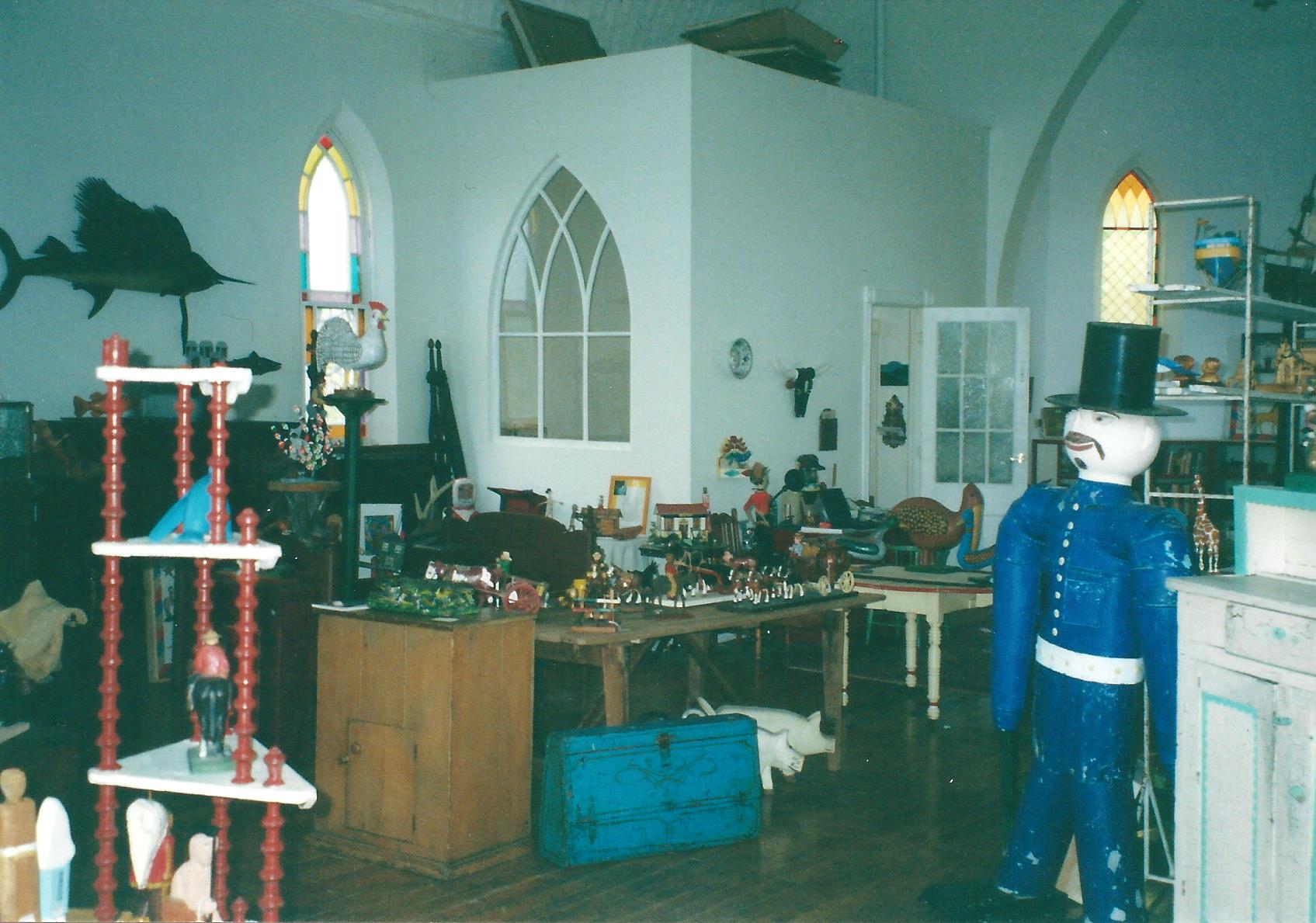
later on when most of the furniture was gone and it was largely folk art

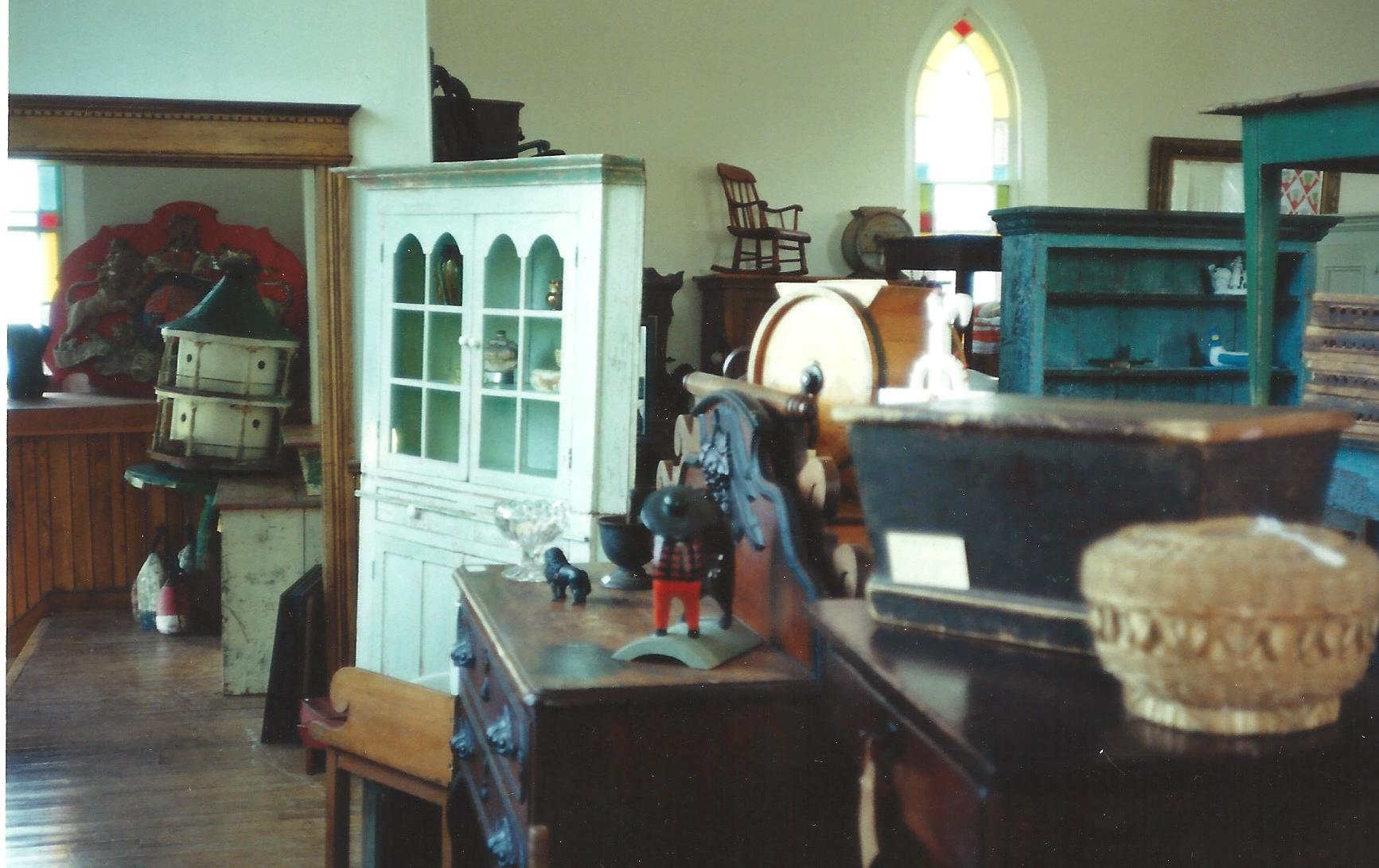
I can remember standing in the partially dilapidated main hall of the old Wyecombe Methodist church for the first time, and thinking “this would make a fabulous antique store.”  It’s 1981 and Jeanine has read a classified ad in the London Free Press about a church for sale in Norfolk County for $21,000.  We decided to take a ride in the country and have a look just for the fun of it. Seemed harmless enough.  Well damned if we didn’t fall in love with the vaulted, 28’ patterned tin ceiling, and surrounding 14’ Gothic windows.  We loved the size, exposure and location of the place and saw the potential; and so in spite of all our friends and family advice against it, we bought the dream.  Thus along with our new alternative life style we began several years of hard labor renovating and maintaining the joint.  We soon discovered why these church halls are typically taken on by a community, and not individuals.  Everything is large scale.  Thirty gallons of paint rather than four.  We loved the challenge. We could see the phoenix rising from the ashes.int6

As life demands, simultaneous to the renovation we began to buy and sell antiques, to meet our needs, and so our main concern was to sell every weekend at the Toronto Harbourfront market. We didn’t think many would find us in the outback and we were happy with the income from the market.  But it wasn’t long before dealers and other customers started to make the trip out to see what we had at home.  At first it was more of a warehouse than a show room, but over the years we refined and added showcases, and shelving and by about 1990 it was usually quite full and fairly organized.  Of course everything had to be dragged up and down the wide, front steps, but we were young and stupid; and didn’t care.  Like many of us at that time who found themselves being full-time antique dealers, it was the alternative lifestyle thing that attracted us. It was more out of an aesthetic interest than any well thought out business plan that the sales room of Old Church Trading came about.  That and the natural tendency for things to pile up as you continue in this business, and thus the need to find some place to keep them.int4

In the fall of 1996 a Quebec dealer friend of ours started to bring huge loads of mediocre stuff to a Guelph auction every other week, and proposed that he also bring along some good things for us to sell for him. Things were changing in Quebec.  We had the room, and had done good business together over the years so we said yes.  It was great.  He kept bringing us wonderful things.  Not a lot at a time, but excellent quality.  We loved to see him pull in.  It was like Christmas.

Our Harbourfront days were now behind us, but with some good dealer trade and with a schedule of about twelve shows a year we continued to go through a lot of stock.  People who had not been by for a while often commented that it was amazing how much the stock kept changing.  That, and it just kept getting fuller.  Cupboards were now in rows and stacked one on top of the other.  I felt proud that it was looking like a Quebec picker’s barn. I loved to stand at the front of the big room and look over the variety of interesting things.  Although visitors were few and sometimes far between, those who made the trip usually were serious and went home with something, or often with lots of things.  We really didn’t advertise all that much, or encourage passing trade.  There was a small sign at the road but that was all.  Most who came were people we knew from shows.  Or people who learned about us through them.  I guess we could have pushed harder, but we like staying a bit out of the way.  Mysterious and a bit aloof.  Not in a “pearls before swine sort of way”, but just by saying “here it is.  We think it’s great.  If you think it’s great and want to take it home, we are happy to help you carry it out. Otherwise, we hope you had a nice time and it was worth the drive.”  You could be that cocky back then.int3

Late in 1997 our Quebec pal’s arrangement with the auction house ended and he stopped coming, so we bought about half the stock we had, and sent the rest home with him.  The market was changing, and so were we.  We were becoming more interested in the folk art, and although I loved the furniture, my back was just about pooched, and the furniture market was slowing, so we decided to downsize and focus on smalls. Oh how dismissive a young me and my colleagues had been watching the “smalls” dealers bringing in their boxes, and now I was one of them.  Less and less furniture came up those stairs.int2

Our daughter Cassandra had left for Queens a few years earlier, so by the year 2000 we started to think about ourselves in the not too distant future being old, and a bit crazy, rambling around the church in old patched sweaters, so we decided that a move into town and a new scene was the next project.  It took us three years to wind down the church and move on to Port Dover, and don’t get me wrong.  We’re happy we did.  But for a while there we were living our dream.  A great shop, in the middle of nowhere, which almost nobody knows about.   Looking back, I can see that it was almost like building a folly.int1

Nobody wants to tell a mother that her baby is ugly

I got a call the other day from a local woman who was interested in having me do an appraisal.   The lady, who was elderly and spoke very politely, told me that she was downsizing and it was time for her to let go of a special item that she had inherited from her grandmother.  Something she cherished but had no further use for.  An item that reportedly her Grandmother had turned down an offer of $3000 some years ago. “Sounds interesting.  What do you have?”.  “Well it’s a collection of playbills and related records collected from all over the world.”

 Playbills and related records that she turned down $3000 for. Hmmm. I began to imagine that perhaps she was a regular theater goer and had built up a collection from plays she had seen. Perhaps it included rare autographed pictures of past stars, or was so comprehensive in nature that someone would offer such a sum.  If this was the case, I would suggest to her that she get in touch with someone who would be more familiar with such an item.  Someone like Ed Locke for instance who deals in nostalgia.  My imagination kicked in and I started to get a bit excited.

“O.K. Mam, you may have something here.  Is the portfolio handy, so that you can give me more details?”  “Yes, I will go and get it.  ”Grandma was very meticulous. It’s always been kept in a dry closet and it is in perfect condition.” More reason to be encouraged.  A few moments passed and she was back.  “As I said, this was her prized possession and she once turned down $3000 once from a person who was very interested in acquiring it.”  Evidently, I thought.  That’s a lot of money to offer for a collection way back when. I was now imagining letters from the authors and composers, perhaps some personal photographs.  The excitement was mounting.  She had the book in front of her.wgm4

“So please describe it for me.”  “Well it is in a box and there are over a dozen records, and a booklet that tells you all about each piece of music.”  What! I thought it was a personal collection. This doesn’t sound good.   She went on and my heart sank, “The title on the cover is Webster’s Basic Library of the World’s Greatest music.”  All the records and the book are in excellent condition.  “But Mam, what about the playbills?  I thought we were talking about something your grandmother has collected, but what you are describing is a commercial product.” “Oh well I haven’t looked at it for years and I guess I remembered incorrectly as there are no playbills.  However, it is full there of information on every piece of music.”  wgm6

I was on-line as we spoke so I googled Webster’s Basic library of the World’s Greatest music, and up popped a dozen examples.  E-Bay listings, and otherwise.  I went to the first E-Bay listing.  So there are 24 records, correct?  The first record is Bach, the next four Beethoven.   The sleeves have several pages of documentation included of the recordings called “The Listener’s Guide to Album 1” then in Volume 2 “The Listener’s Guide to Album 2″…and so on.  “Yes, that’s exactly right.”  That’s it exactly.  wgm5

“Ah, and this boxed set was released in 1958” It states here that there were several editions produced over a few decades, and you say you have volumes one and two.”  “Yes, that’s what I have.”  And there is no additional material.   No collected photos or playbills, or anything else.”  “That is correct.”  “Well, then I’m afraid I have some bad news for you Mam because the copy I am looking at here on E-Bay which is in excellent condition just like yours, is being offered for $62.99 plus shipping.”  The mood turned suddenly ugly.  “Well that just can’t be.  You don’t know what you are talking about.  My Grandmother was nobody’s fool and she turned down $3,000 back then so it has to be worth a lot more now.”  “I’m sorry to give you this news, but unless there is something else with that box of records, what I am looking at right now in front of me suggests your Grandmother should have taken the $3,000 when she had the chance.”  “No.  that’s just wrong. It’s worth at least $3,000, and you can’t fool me.”  I tried to reassure her that I had no interest in trying to fool her, or in acquiring her grandmother’s treasure.  I was simply trying to let her know that as it so often happens in families, myths get started and can easily be perpetuated until someone comes along and bursts the bubble.  Nobody likes to have their hopes dashed, and having to do so in all honesty is the worst part of the job, but the truth must come out eventually.  I apologized once more, wished her luck, and hung up the phone.wgm4


YOUR TRUCK IS ON FIRE!!!

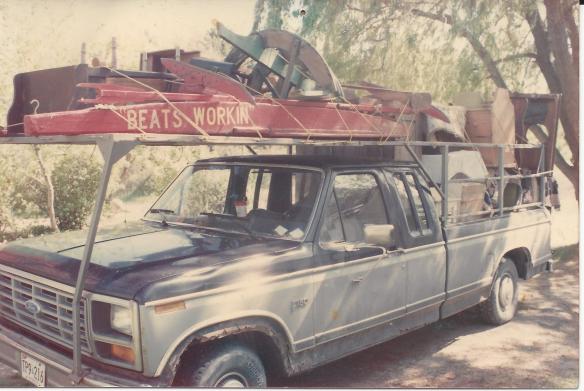
truckIt had been a successful Odessa show.   On Saturday at opening we had just arrived due to a flat en route , and were bringing things off the truck as people came in.  Turns out people get excited by getting first crack at things, and several pieces were selling as they hit the ground.  The mood was jovial and spirited.  Dan Ackroyd and his wife came by and they were attracted to a two piece painted cupboard that they could see glimpses of on the still tied down load.  She told him to stay there until it was unloaded while she went on down the line, and he was good enough to suggest helping me unload rather than just standing there watching me.  Nice guy.  It turned out not to be the cupboard for them, but regular Toronto customers bought it right after, so this combined with other sales indicated a strong start.  It’s a great feeling to sell enough in the first hour that you have “made your table” as the expression goes, and you can relax a little knowing that even if nothing else sells you have had a good show.  It didn’t happen that often even then in the heyday of the nineties.
The day continued to go well in spite of the sweltering August heat, and we even had a few sales on Sunday. So, when five o’clock closing came, we were happy not to have a lot to load back on, although the Toronto couple needed the cupboard delivered to their home, and I bought a few things in the rough to take home.  By about seven we were loaded and on the 401 heading west.  We checked the radio for traffic and found out that things were moving slowly all the way to Toronto due to an accident and so decided to pull off at Belleville for dinner at a place we like down by the marine.  We felt a bit celebratory, and content to relax, sip wine, and eat seafood while looking out over the boats in the harbor, so by the time we finished our espresso it was probably pushing ten before we were back on the road to complete the five hour (in total) drive.  Feeling good and awake thanks to the espresso.   Of course we were younger then and able to stay up past ten.

So everything was going swimmingly. Traffic was clipping along, the CBC was playing an interesting documentary, the windows were down and the breeze was cool.  We hit Toronto about midnight and I was enjoying the fact that all four express lanes seemed almost empty.  Occasionally a big transport would go whooshing past me in spite us traveling at 120 Km per hour.  I was “in the zone” and enjoying the oddly luminescent mercury vapor lighting and passing cityscape when suddenly there is a pick-up right behind me flashing his lights, and hitting his horn.  “Alright already.  Go by me there’s another three lanes.”   What is with this guy?  Next thing he has pulled up right beside me, and a guy leans out the window and screams “Your truck is on fire!!”  Whaaat?  Looking in the rear view I see flames flaring up into the night off the top of my load and realized he’s right. Yikes! It was several minutes before I could pull off safely, all the while watching the flames get higher due to the combination of plenty of oxygen , and all that dry 100 year old wood.  I jumped out and surveyed the scene.  Indeed, I could see that at least three things were on fire and several blankets had ignited, and of course all this was tightly secured by ropes which are also on fire by this point. The situation looked dire. First things first.  Jeanine was by this point sleeping, and was not at all pleased to be woken up with the news that it was time to abandon ship and run for your life.  We both ran down into the ditch thinking that at any moment the thing may blow just like in the movies.  Then slowly reason supplanted panic, and we realized that the pieces on fire were up on top and we would have to stand there and watch it burn for a long time before it came anywhere near the gas tank.  Let alone heat up the steel of the truck bed enough to ignite anything, so we got busy and started untying things as fast as we could, throwing the burning blankets and ropes into the ditch and stomping them out.  My kingdom for a fire extinguisher.  I have always carried one thereafter, and so there’s a cautionary tale for you.  Other than gloves, all we had to fight the fire was a couple of large bottles of water which we saved to pour right on the burning wood parts of the furniture that had ignited. We unloaded and stomped and smothered for about fifteen minutes which seemed an eternity and before you knew it, the flames were out. The fire was mostly in the blankets as it turns out, and we quickly assessed that only three pieces of furniture were seriously damaged.  Unfortunately, one of them was the sold and paid for cupboard to be delivered to Toronto.  We sat in the ditch for several minutes making sure all the fire was out, as the traffic roared by quite oblivious to our drama.  Nobody stopped and the half expected police never showed up.  We settled our nerves, and tried to figure out how such a thing could happen.  Our best guess was that a trucker had thrown out a lit cigarette and it had landed in among the blankets.  A close call, but half an hour later we were reloaded and back on the road heading home, feeling grateful that things had not gotten worse.  The insurance paid for some of the damage.  Giving us the money we had paid for the cupboard before restoring it, and not the amount we had just sold it for.  However, something is better than nothing.  The hard part of course was phoning our good clients in Toronto and having to inform than that their beloved cupboard had met a deathly fate on the road home and we were tearing up their cheque.  Very nice folks, they were quite understanding although they didn’t entirely believe that we hadn’t sold the cupboard for more money and then made up the story, so they accepted our invitation to come out and see for themselves.  They were quite reassured when they saw it and marveled that the fire had not spread further to destroy more of the load.  We felt the same.  We were able to come up with another cupboard for them, and no one got hurt so I guess you can say that all’s well that ends well. Still, I would advise that get yourself a fire extinguisher, especially if you carry furniture on an open truck. The moment may arrive when you would give your left arm to have one, God forbid.

The Toronto Harbourfront Market in its Heyday

Our Harbourfront offerings circa 1983

Our Harbourfront offerings circa 1983

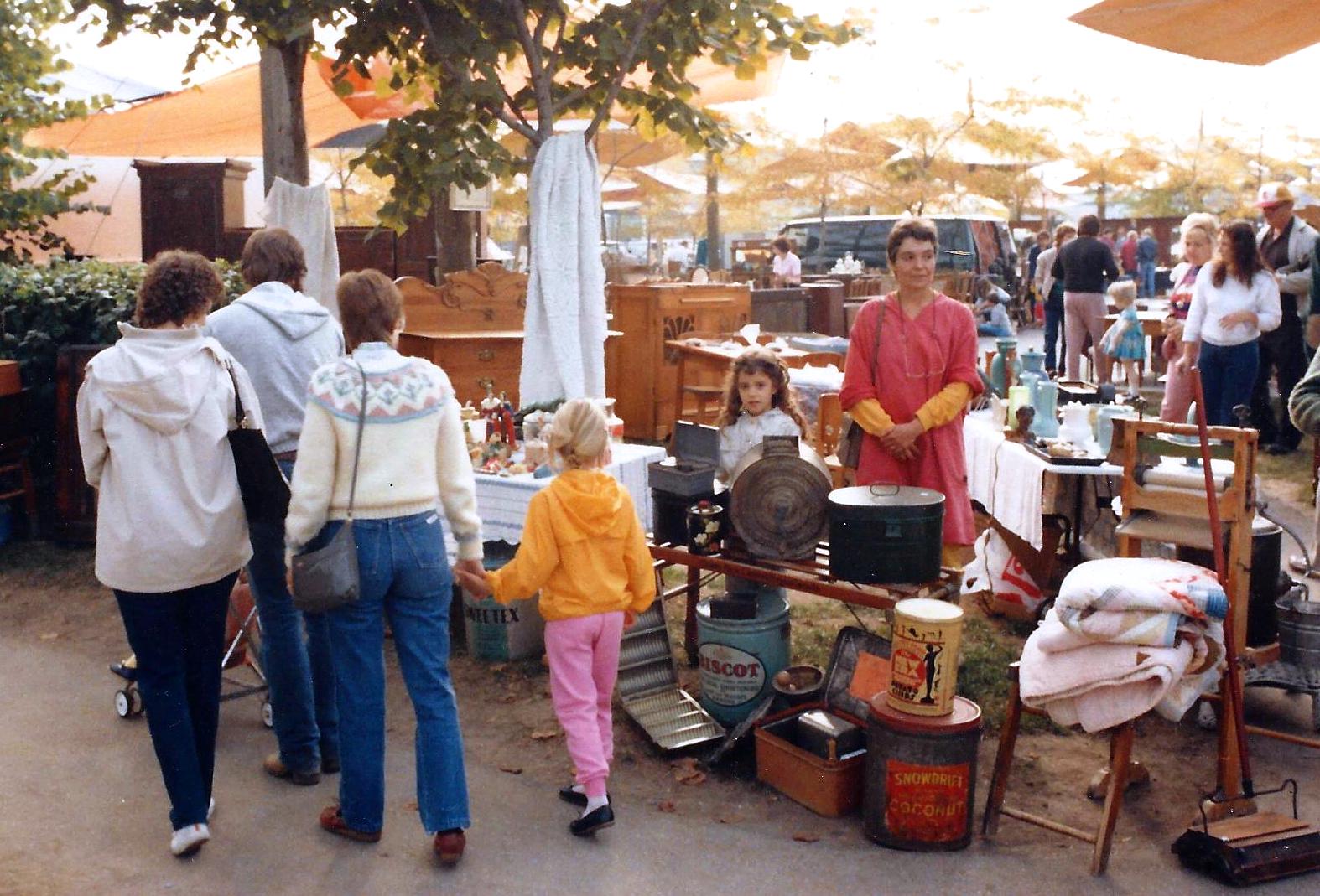
Every Sunday morning from the early 80’s to the late 90’s, the alarm would go off at our house at 4 a.m. The truck would be packed and the load tied down the day before, the lunch would be made and ready in the fridge, and our cloths would be set out. We would hop out of bed, get dressed, grab a coffee and get underway. An hour and a half later we would be pulling in to the Toronto Harbourfront Market, ready for another day of buying and selling. Rain or shine, we would make the journey, full of hope that the furniture and small items that we were offering would meet the approval of someone there.

When we started in the early 80’s the market would be held on about an acre of parkland near the terminal building, with the 100 or so vendors being set up in parking lots and green spaces right alongside the water. In the winter we would go across the road and inside an old one story warehouse. These were the glory days. It’s hard to imagine now just how “hot” the market was. The boomers in general had done well enough that their Toronto houses were paid for and they were madly buying up all the charming little farms and cottages within about a three-hour drive of Toronto. These rural places demanded antiques of course, being sympathetic to the rural environment, and a refreshing contrast to the city digs.

A loaded truck ready to go.

A loaded truck ready to go.

So in these days there was a large number of motivated collectors and dealers arriving about 6 a.m. vying to pick the best of what was being offered as it arrived. It was a thrill to arrive in our open pick-up truck, and have people run along beside us, racing up to the window to ask the price of the pieces they could see tied to the load. Often they would just say “yes, I’ll take it” even before it was unloaded, because they knew the competition was right behind them. It would happen occasionally that by the time we arrived at our spot, most of the furniture which could be seen was sold. Sometimes we had completely sold out by noon, but would still have to stay until five as to not create a disruption. We had our regular dealers whom we got to know would buy certain items without hesitation if the price was reasonable. You had to pay close attention. Sometimes two or three dealers would be right there as a piece was coming off and you had to be very conscious of who asked about the piece first, and who was next in line. It was easy with two people selling, under this kind of pressure to even sell the same piece to two different people. Tempers would flare. It was not always easy to sort out, and have everyone be happy with the results. It didn’t happen often, but it was difficult to avoid altogether.

Then by the mid-nineties, the Harbourfront development had other plans for the summertime parkland, and the wintertime warehouse, and so they built a brand new market at 390 Queen’s Quay W. As so often is the case, these new quarters under new management meant higher rents and lower sales. It continued to deteriorate until it was not profitable for us by the late nineties, and it eventually closed in early 2003.

Our friend, and avid collector Rod Brook used to say that he wanted to produce a book which presented exclusively all the incredible pieces that had been bought by collectors at the Harbourfront market during those glory years. Sadly, he died before he could accomplish this, but I’ll bet if someone took up the cause it would be an amazing document. For a while there it felt like it would never end, but then like everything else in life, it did.

harbour3-1

loading the truck for another Harbourfront Sunday.

Let’s visit a French antique market

FullSizeRender (2)The first Sunday of every month, there is an antique market in the town of Soumoulou, 10 km from the city of Pau in the South West of France. It goes from 8 am until 6 pm, and on average has about 100 dealers in attendance. Twice a year, in the spring and fall they have a large show which brings in about another 100 dealers. In this it is roughly equivalent to the Aberfoyle antique market held near Guelph, Ontario. Because my wife Jeanine is from this area, we have been visiting this market from time to time over the past thirty years, and like Aberfoyle we have seen changes. Primarily, a rise in interest and prices until about 2008, followed by a precipitous fall. There is still good attendance and sales taking place, but the packages being carried are smaller and fewer in number.
Still, it is a wonderful way for a person of my persuasion to spend a morning and so it was with great excitement that I woke, had breakfast, and got everyone underway, determined to get first dibs on anything special that may arrive. You’ve got to be on your toes. I remember a few years back being very disappointed missing out on a 100 years old terra cotta bust of an aristocratic French gentleman because I was still trying to figure out the exchange while a more astute dealer stepped in and bought it. Another time I almost cried because I was a few seconds behind a man from Provence in committing to what remains in my mind the most beautiful wrought iron butterfly panel which had graced the entrance of an old restaurant. IN A GADDA DA VIDA baby, indeed.

IMG_1285

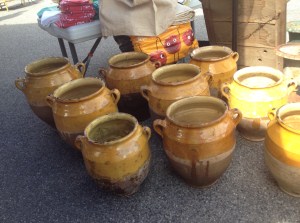
Pictured here are confit pots. They are a local redware which are glazed on the inside, and part way down the outside. They were used to preserve cooked duck in goose fat before the days of refrigeration. As long as the pieces did not touch each other they would keep for about three years like this, getting more tasty all the while. To my mind Duck confit is one of the most delicious things you will encounter on this earth. Be sure to try it, if you get the opportunity. Today, these beautiful pots are used mostly as patio pots.  At one point about twenty years ago you would do well to find one available because they enjoyed such popularity in the States that all of them seemed to end up there. These were offered from 45 to 65 Euros. Hard to transport or I would have been tempted. For the scores of them that we have carted back over the years , we have kept only a few for ourselves.

FullSizeRender (4)

These little birch-bark storage boxes were very tempting ranging from 35 to 45 Euros each. The dealer said he bought them in Biarritz, and thought them to be local, but I was uncertain as I have never seen other examples here. Lovely patina and in excellent condition. Looking at the picture I wish I had bought them.  I find I never regret the things I buy, only the things I pass on.


FullSizeRender (5)I have brought back several of these wine bottle drying racks over the years. People made and bottled their own wine here so the bottles would be cleaned out and dried to be reused.
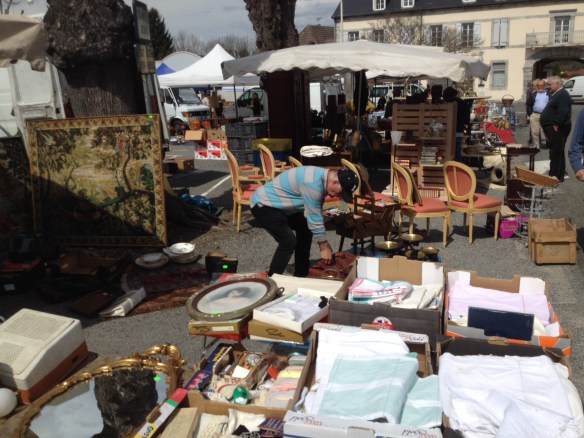
I love the exchanges here between dealers and potential customers. It’s a more in your face, and no bars held. I overheard a woman who was negotiating the purchase of a vase say, “what, did you wake up in the middle of the night after dreaming that price”. The dealer laughed and a deal was made. We had a wonderful morning looking at everything. Most of it very different than the things offered at home, and we managed to find a half a dozen things that we could fit in out suitcases and bring back as gifts. There’s nothing I enjoy more that an antique market on a crisp spring morning. You never know what you will find.


IMG_1275

Towards determining age in unmarked Collectibles -Brass Model “A” Sedan

6" long.  Marked Canada

6″ long. Marked Canada

Recently I noticed this molded brass car listed in the Saturday, January, 9th Plato Antique and Vintage Auction simply as “Brass Model “A” sedan car, 6″ long, marked Canada”. and realized I know something about it’s manufacture, and that it illustrates an interesting problem when trying to  determine the age of a small production, unmarked (in terms of manufacturer) Collectible.  Plato Auctions wisely did not suggest an age, but rather provided honestly all they could determine about the object.  That being said I don’t believe they are brass, but rather some kind of bronze-like alloy.  In any case, I  have seen this car and some other similar, (but different) models many times over my forty-five years, or so, of noticing such things, and every time it makes me feel nostalgic.   The reason being, is that I know that at least some of them were manufactured by my father, Charles Ross in Dresden Ontario, in the 1960’s.  What is interesting (hopefully) besides the story which I will tell is that at shows, and in articles I have seen them dated over a quite a wide span of time, and with various provenance;  and yes it is likely that some were produced before the ones my father produced in the 1960’s, as you will see.  Here’s what I remember about this time, and how my father came to make model cars.

My father owned and operated the weekly Dresden News, and monthly farm papers, Voice of the Lambton, Kent, and Essex Farmer.  All at the time were produced by the old letterpress method, which involved melting and remelting lead to feed into the Linotype machines which produced the copy type for the paper.  Those machines are an amazing story in themselves, but I will endeavor to stay on topic. The fact that my father had the technology to melt metals is what’s key.

As I recollect I was about ten when my father rather excitedly told me that we were going to drive the hour or so to Corunna, Ontario to buy something that I would be interested in.  I loved any drive along the St. Clair river so I was ready, and willing to come along.  One fine summer morning my father, mother, and myself pilled into the old Ford, and set out along road 33 which followed along the St Clair river.  I remember we stopped at a favorite little lunch spot in Port Lambton for a sandwich,  before arriving at the newspaper office in Coruna early in the afternoon.  My father was fairly secretive about his business, and suggested that my mother and me have a walk down to watch the boats pass along the river for a half hour or so while he conducted his business.  By this point I was wondering what I might possibly find interesting in a newspaper shop, but I could tell something was making my father excited, so I was too.

Upon returning, my father met us by the car and flung open the back of the station wagon with a big “ta da”, and there to my delight was a dozen or so Brass and painted black model “T” and model “A” cars and trucks all looking somewhat like the one above.  Also in the trunk were three or four crates which I later found out contained the molds used to manufacture the various models.  How he heard about them, or why he decided to buy them I do not know, but I remember that after that the newspaper office window was filled with cars and trucks,  and that before long people started to come in and purchase them, and of course I had a blast playing with them.

I know he had some arrangements to place them with local tourist attractions such as Uncle Tom’s Cabin which is on the outskirts of Dresden, and at other spots throughout the three counties that he used to travel on newspaper business.  I also remember his employees making them when they were not otherwise busy working on the newspapers, but I really have no idea how many he made, or for that matter, how many had been made in Corunna before him, or even where the molds came from in the first place.

The thing is, to look at them it is easy to imagine, because of the relative crudity of the manufacturing that they were made at the time of the cars they represent, and  for all I know perhaps that’s when they started.   But I do know that many of these were made as recently as the 1960’s.  You would be hard pressed to determine exactly when within  that  approximately forty year span such a car was produced.  Does a 1960 car have equivalent value to an identical one made in 1920?  Considering the exact same method and quality of materials were used, I suppose so.  And I think reflecting on this suggests that with certain types of small output, cottage industry type manufacturing, we shouldn’t get too hung up in the numbers.  And that establishing provenance is always tricky, and sometimes an “educated” guess at best.  And most importantly that in the end this ambiguity  doesn’t take away at all from the beauty of these toys from a simpler time.