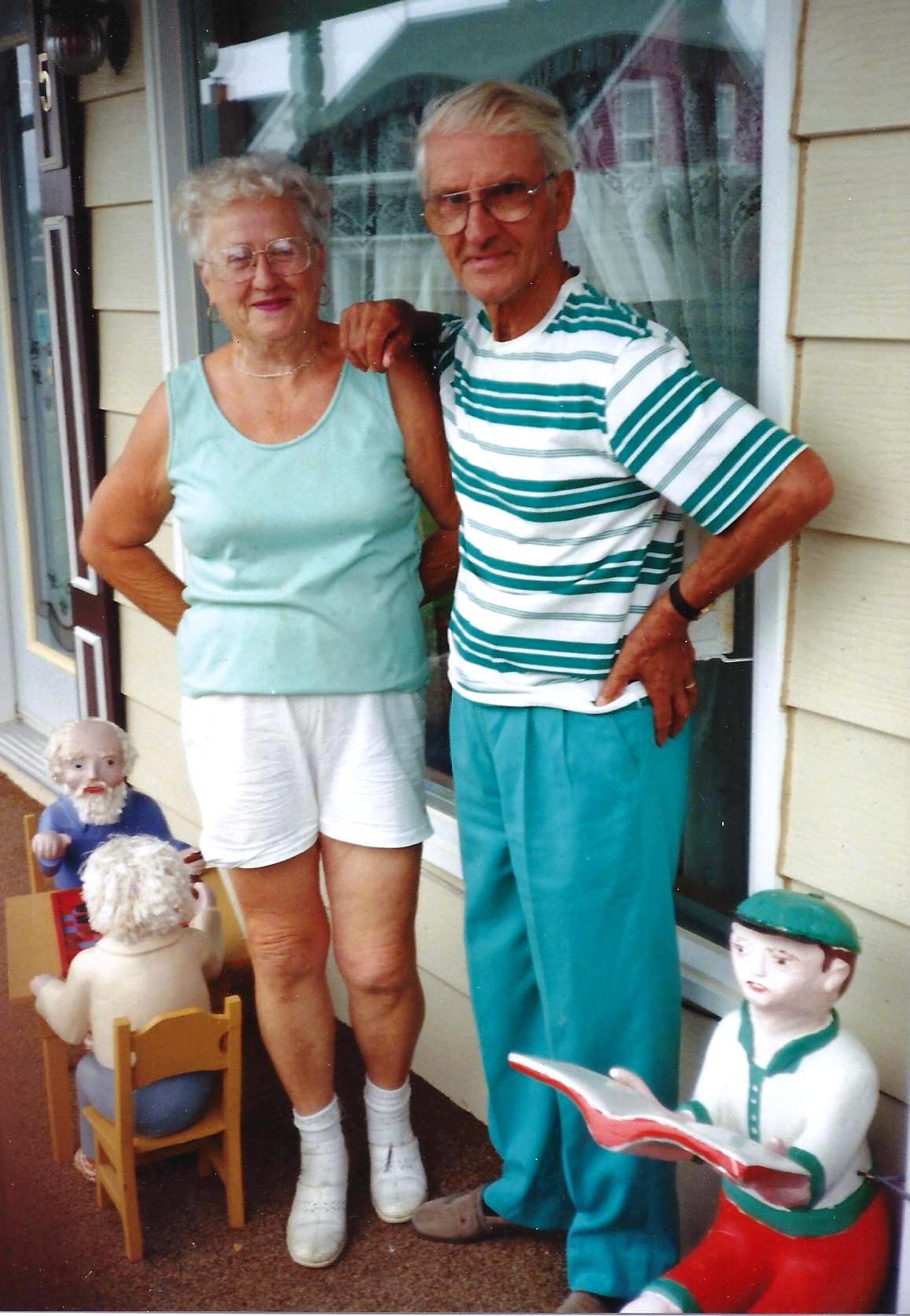
Madam Tessier, and her brother

OLYMPUS DIGITAL CAMERA

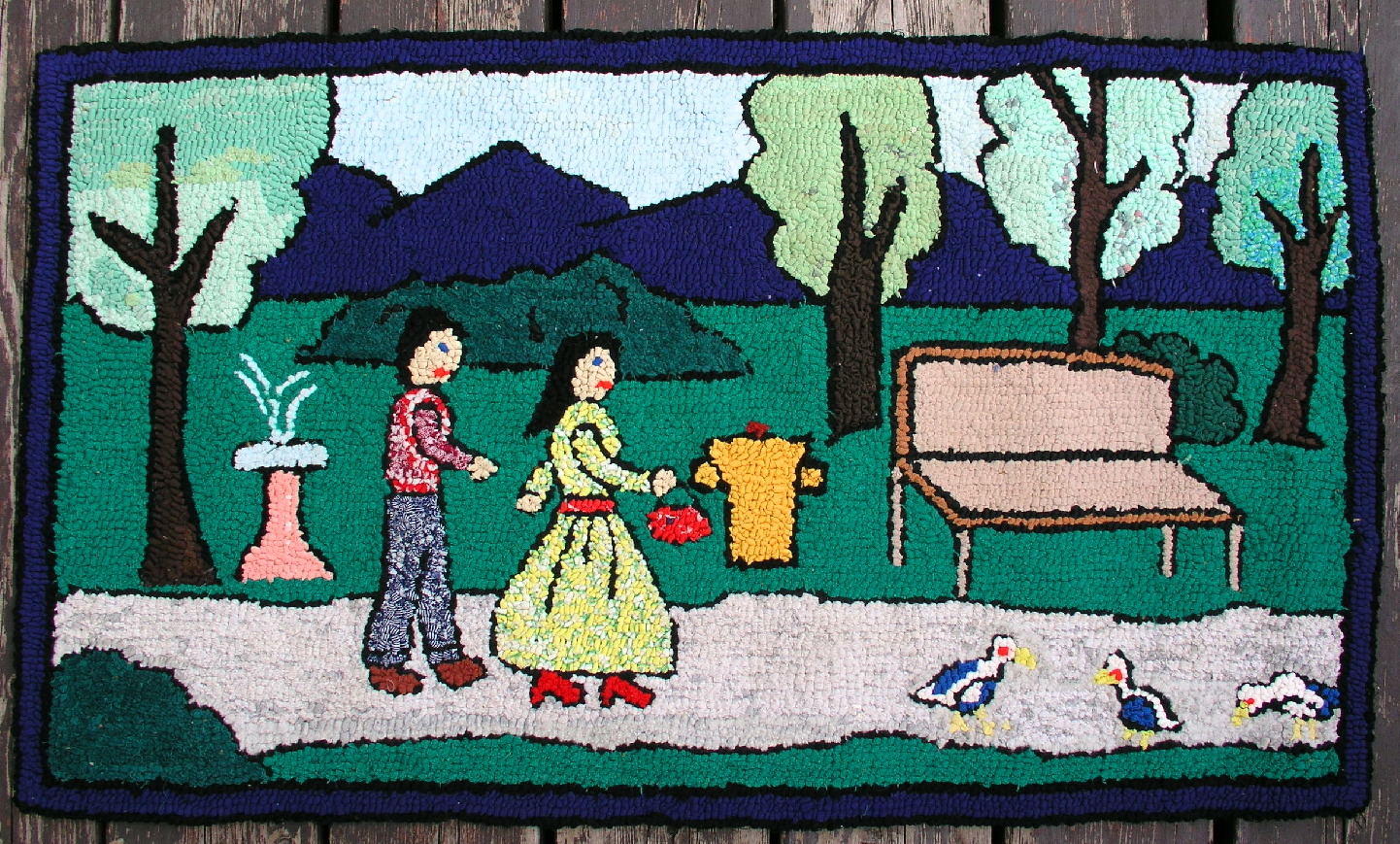
walking in the park

In the late 1980’s when we were antique shopping in Quebec on a regular basis, we would follow up on leads for new sources that were offered to us by other dealers.  We were told about a great shop in the town of Deschambault, which is on Rt. 138 on the north shore of the St. Lawrence river between Trois Rivieres and Quebec city.  Rte. 138 was a popular tourist route back in the heyday of motoring vacations in the fifties and the sixties, but traffic dropped dramatically when the auto-route 40 opened and people’s attitude changed, and they started to just want to get from point A to B as quickly as possible.  There wasn’t much of the old “motoring” culture left along the route, but it was a gorgeous drive and every so often you would spot a handmade sign in front of a little roadside shack indicating “Souvenirs”.   Naturally we would stop and check it out.  You never know when and where you may find the next great folk artist or crafts-person. Most of these shops were a disappointment however in that they contained the St. Jean-Port-Jolie style tourist carvings, and the typical plastic commercial schlock, but once in a while we would find some crazy, old guy making something interesting, or in this case of this story, a great source of charming, original designed hand hooked rugs.
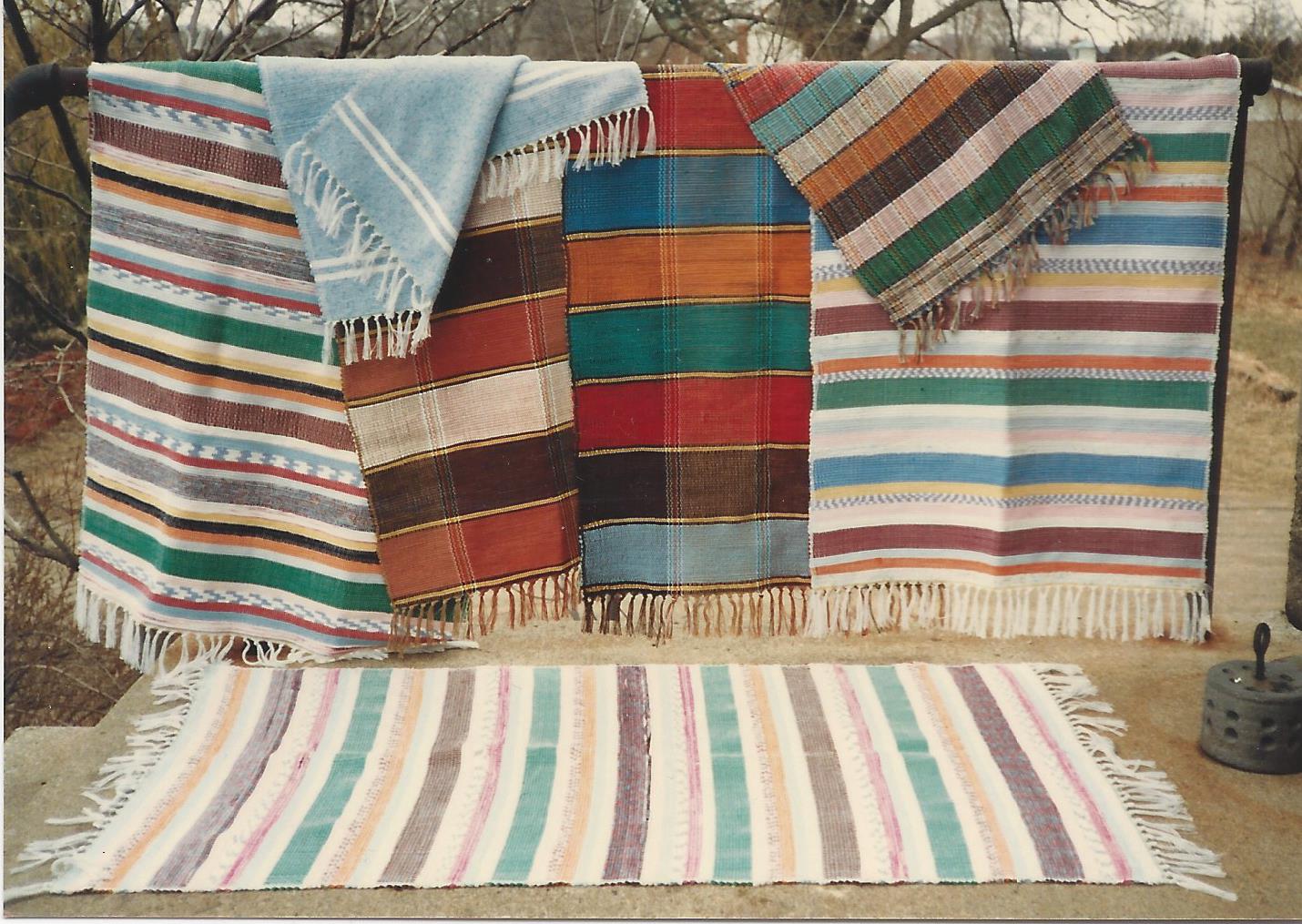
woven runners and mats

woven runners and mats

It was a fine summer morning as we rounded the bend just a few klicks from our destination of Deschambault, when we noticed several signs around an old frame house indicating “Souvenirs” “Quebec textiles”, “hand hooked rugs”, etc.  These signs had a charm all their own so we were hopeful that we may be on to something.  We went through the door indicated as “shop”, and entered into a long thin room which had an end to end run of long, thin, fabric cutting style tables, stacked with dozens of different varieties of hooked rugs and woven runners, and mats.  The back wall was covered with examples of rugs, and behind the tables stood a lovely looking elderly woman looking every bit the Victorian lady with piled up hair and white powder makeup.  Right out of central casting.  She had a radiant smile and seemed truly delighted to meet us.  She told us her name was Madam Tessier and all the textiles on sale where either made by her, or one of her three or four rug hooking neighbors.
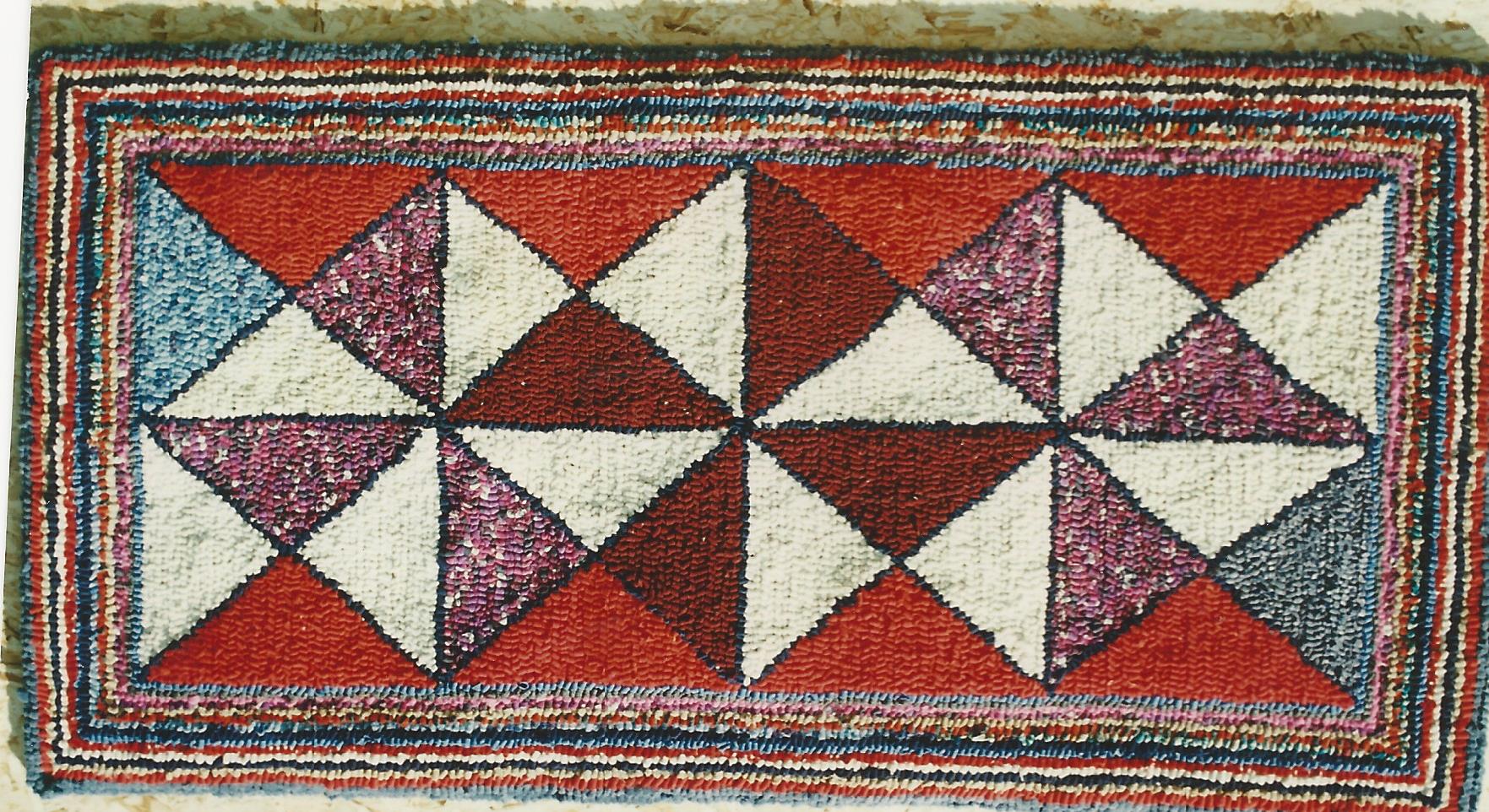
a geometric

a geometric

Our attention moved from her to the rugs, and we were immediately taken with the charming original subjects, the vibrant colors, and the workmanship.  The expected florals and geometrics were interesting, but what caught our attention were the many depictions of rural Quebec life.  Scenes of bringing in the ducks at night, of workers stopping in the field to observe the “angelus” or moment of prayer at 6 pm, a sugaring scene in early spring, a farmer about to feed the animals, and so on.  There were also riffs on classic themes like a beaver on a log, a maple leaf. As well there were tables full of multi coloured runners. Rainbows in fabric everywhere you looked.  The prices were very reasonable considering the amount of work that went into them, and you could see that they were well made, and would wear well.  She was surprised and delighted when instead of choosing one or two, we bought a dozen or so.  We explained who we were and that we were buying for resale, and that if they should sell as we thought they would we would soon be back for more.  And so it was. They went like hotcakes and within a month we were back buying about twice as many as before.  Madam Tessier grew to look forward to us pulling up.

farmer and his yellow wagon

farmer and his yellow wagon

tesrug7

farmer in the yard

After a few visits she asked us into the adjacent house for tea.  She explained that she had lived there all her life with her brother, but that he had recently passed away so she was now there on her own.  She said she didn’t mind because she had many friends in the village and was never alone for very long. It was lovely to sit in her kitchen and have tea and listen to her story.  It took me several minutes before I noticed something peculiar about the walls.  As I looked more closely at the tongue and groove wood grained boards which ran from floor to ceiling, I realized that they were not wood paneling at all, but rather a hand painted facsimile.  I couldn’t believe it.  The whole room had been meticulously grain painted by hand.  Every groove and the wood grain was done free hand, one at time. Then I realized that where there was a painting on the wall, that the painting had been done in the same hand right on the wall with a painted frame around it, as it should be. Amazing.  Can you imagine how long it would take to do something like that?  I had to ask her.  “oh that.  Yes, that was my brother’s project later in life.  He volunteered to paint the place but then he got the idea of the wood grain so it took him several years.”  He completed many rooms before he died.”  You could see she was proud of her brother’s accomplishment.
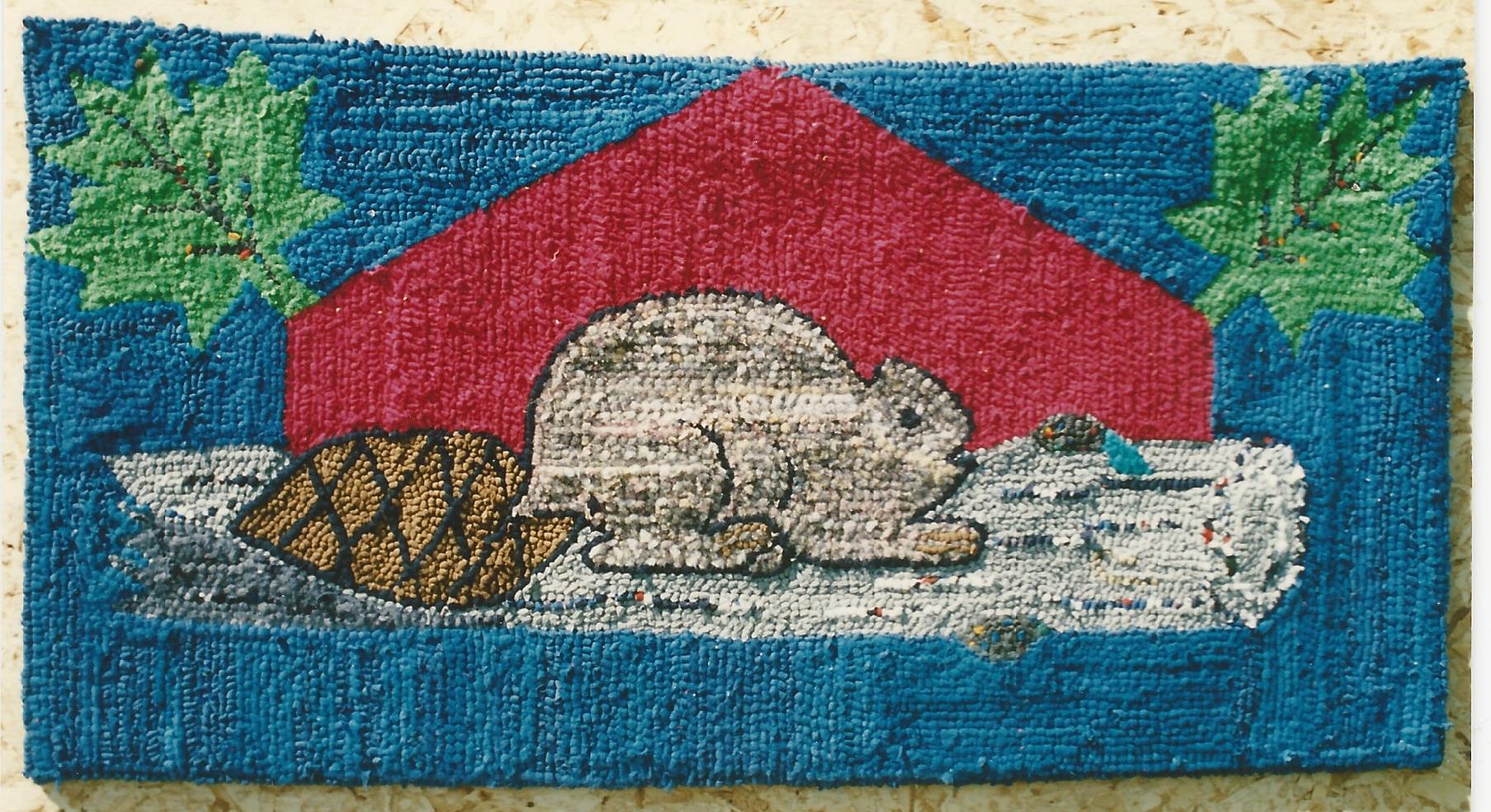
beaver on a log

beaver on a log

It’s funny what sticks with you in life.  Sitting in that room, drinking tea with Madam Tessier and coming to the realization that the entire room I was sitting in was faux painted freehand by her brother remains as vivid in my memory today as the day it occurred.  I’d imagine that the conclusion of a psychiatrist would be obsessive/ compulsive behavior, but to me it felt like an act of a deep dedication to the concept of beauty and love of environment, not to mention persistence.  I had a deep feeling of warmth come over me, and I knew I was in the presence of true inspiration.   Madam Tessier there smiling benevolently with her white powder make up and piled up Victorian hair.
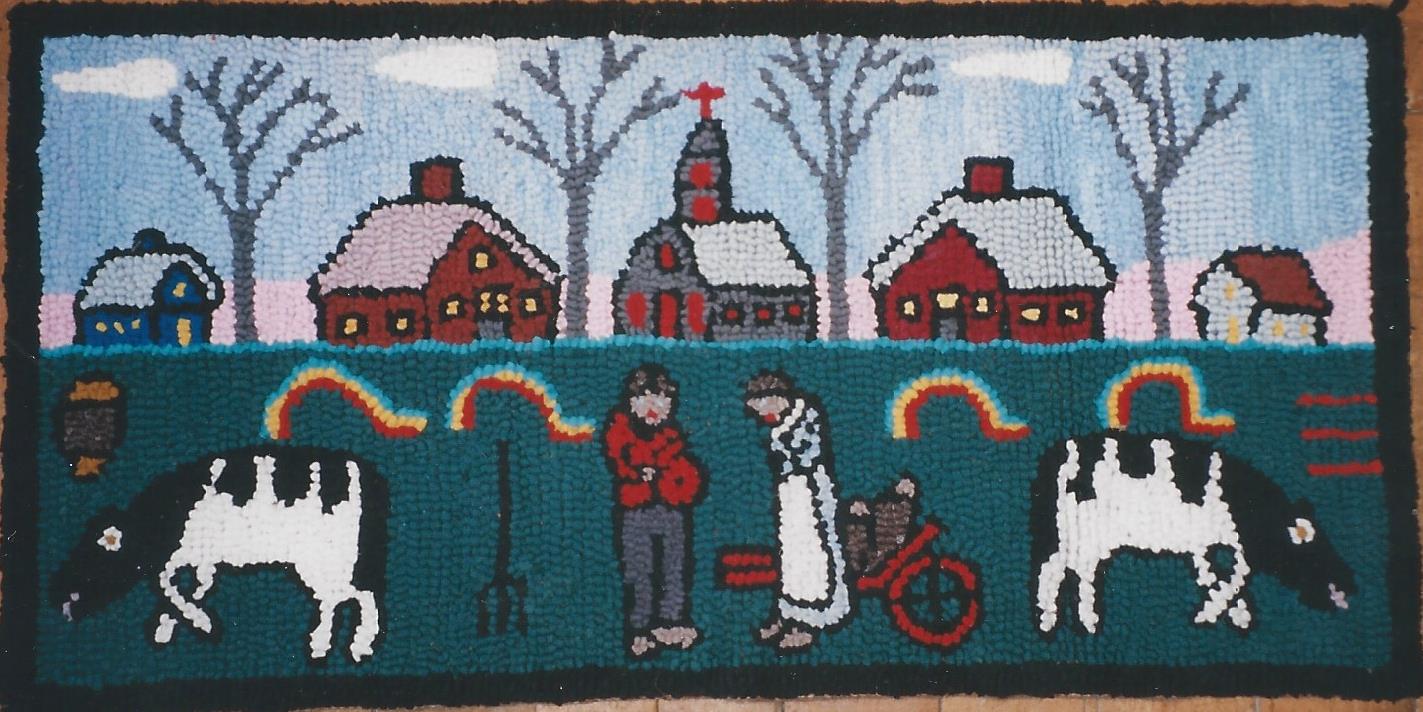
farmers pausing to pray the Angelus

farmers pausing to pray – the Angelus

Our times at The North Hatley Antique and Folk Art Show

northhat3

a giant moose head that came along for the ride.

When, in about 1986 we decided to expand our show calendar beyond the weekly Toronto Harbourfront Market and the spring and fall Christie shows, we decided that we would like to include the North Hatley Antique and Folk Art Show, held annually in early July in the beautiful Eastern Townships region of Quebec. Known as Canada’s oldest antique show, it also had and still has a deserved reputation for presenting top quality antique and folk art to an exclusive and appreciative clientele.  North Hatley is a picturesque charmer of a small town on the banks of Lake Massawippi, and a playground to the affluent and powerful of Montreal and surrounding areas. The show, put on by the local Recreational Society is held in the old curling club with about fifteen dealers set up where the ice would be, and another 6 or so set up in the onlooking lounge.  For the years we attended, until his death in 2007 it was run by the legendary Sam Pollock, who among many other things was the manager of the Montreal Canadians for 14 years, during which they won the Stanley Cup nine times.  As you can imagine, Sam ran a tight ship. Every year he, and his loyal fellow volunteers would do everything from planning and preparing, to set up, and everything else involved in running a top notch show right down to the  making of the delicious home-made egg salad sandwiches at the lunch bar. They may have been up in years, but those ladies knew their way around a good egg salad sandwich. northhat4

In those days, it was not easy to get invited to do the show.  We were lucky to have friends like Peter Baker and Gerry Marks who had been doing the show for years to recommend us.  The first year we had a tiny 10’ x 10’ booth wedged into a corner of the lounge area, which was mostly dedicated to book, pottery, and silver sellers, with the furniture dealers all being in the main room.  We didn’t mind because being an unknown in terms of results, the rent was cheaper and we came with a smaller truck. We focused mainly on folk art, which was what the promoters wanted from us because it was becoming increasingly popular with this crowd. It went very well, and we had a great time to boot.  Good sales, lovely people, and a stunning area to explore.

An interesting feature of the show is the gala Friday night opening.  From 6:30 to 9:00 on the Friday night a $30 ticket buys you first crack at the stuff, and all the delicious hors-d’oeuvres, and wine you want. Lovely young waiters and waitresses passing amongst the crowd with trays. The experienced dealers warned us that opening night it is packed, and it may seem that all they do is talk to each other, and glance over your stuff.  It is a big social event after all.  But not to despair because when they see something they like they are in a good and competitive mood to buy.  Also, they may go home and discuss it, and come back Saturday morning to buy.  It worked out pretty much just like that.  A few sales Friday night, then good sales all day Saturday, and even a few more on Sunday.

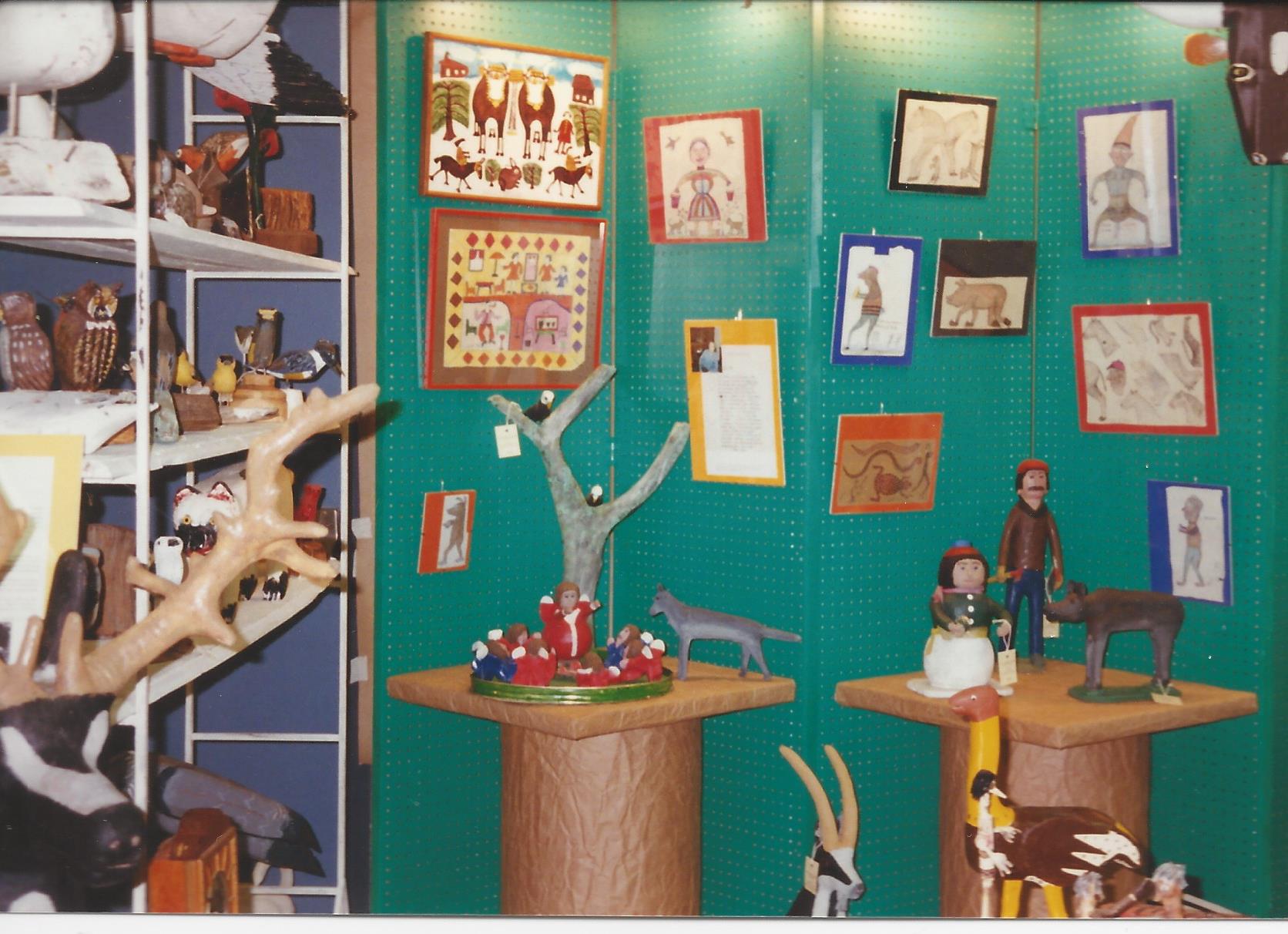
We kept the same booth for a couple of years and then moved to a bigger one in the same room when it became available. Then one year when I was doing the show by myself; I can’t remember when exactly, it must have been the late nineties, Sam came up to me and asked me if I would be interested in taking over a large room upstairs they had for the same price.  He pitched “You can spread out the art and make it like a gallery.  I think you can do well up there.”  I knew the space.  It was a big space, about 20’ x 30’ with two front facing windows which brought in a lot of natural light.  It must have been used for meetings.

my "gallery"  at the North Hatley show

my “gallery”
at the North Hatley show

“Well, yes Sam the space is great, but not to mention that everything has to go up and down the fire escape, I will be on my own up there, apart from the show. It might get pretty lonely”.  “Ah, but don’t forget Phil, that’s where the woman’s washroom is.  All the ladies will pass by eventually, and they’ll drag their husband’s up”.  I thought about it for a minute and decided he was probably right.  It just might work, and if it did the price was right. So I agreed, and started to haul everything up the steep fire escape that led directly to the room. A big task, but much easier than dragging everything through the inside.  It took the whole afternoon to set up, but in the end it looked like a gallery. I even had a table and chairs in front of the window where I could sit and do business, or read the paper in slow times. Not to mention eating egg salad sandwiches. So close. So tasty. So affordable.  I put up a little sign with an arrow pointing up at the base of the inside staircase announcing “Folk Art Upstairs”. I hoped that somebody might see it.

looking into my "gallery" from the hall

looking into my “gallery”
from the hall

6:30 arrived and at first I wondered if I had made a horrible mistake because I could hear the people coming in, chatting and having fun for a full thirty minutes before anyone showed their face.  But then it started.   The first lady poked her nose in, and was surprised to find me and my offerings.  Fortunately she was a folk art enthusiast and went directly to several pieces of carvers she recognized.   She bought three things right then and there, and I was off to the races.  It was out of the way, but when the folk art people found me, they really connected, and would not only buy, but go down and drag their friends up.   I met several people that year that became long -time friends and customers.  It was already a great show by Saturday at noon and then Pierre Riverin walked in.  I’d heard about the “collecting” mayor of the town of Eastman for several years but we had never crossed paths. We talked for over an hour, he bought several pieces, and it was the beginning of a wonderful friendship.  It is a rare and precious moment when you find yourself in the right place, at the right time, with the right stuff.   Even with all the effort of getting everything up and down those stairs, it was worth it many times over. I had a wonderful show and I was happy up there.  I repeated this for a few more years before the hauling up and down began to outweigh the benefit, so when a bigger booth on the main floor became available I grabbed it.

myself and Tom DeVolpi enjoying a beverage

myself and Tom DeVolpi enjoying a beverage

Over the years we got to know several of the Quebec dealers, designers, and collectors who frequent this unique annual show.  For a time many of us participating dealers would get together on Saturday night and enjoy the evening together at some wonderful local Inn or restaurant.  There are several to choose from.  Then through our friend Tom De Volpi, and our friends Jim and Ilona Fleming, we were invited to an annual Saturday night dealer’s dinner held at the nearby summer home of a lovely Montreal designer named Valery.  It was always a wonderful, warm get together, not to mention a delicious dinner; and we were grateful for her hospitality and the chance to spend some happy time with our fellows.

Eventually, as in all stories, the pages turn, and times change, and so it was that by 2008, (I remember it because, although still a good show, it just didn’t feel the same without Sam being there), along with slumping sales, we reached the point and age where we just couldn’t justify the ten hour drive to and from home, and all the work that doing the show entailed.  Mind you this was part of a larger retreat from doing shows altogether.  We truly don’t miss the work, but we do miss the people.  They were some very good times.

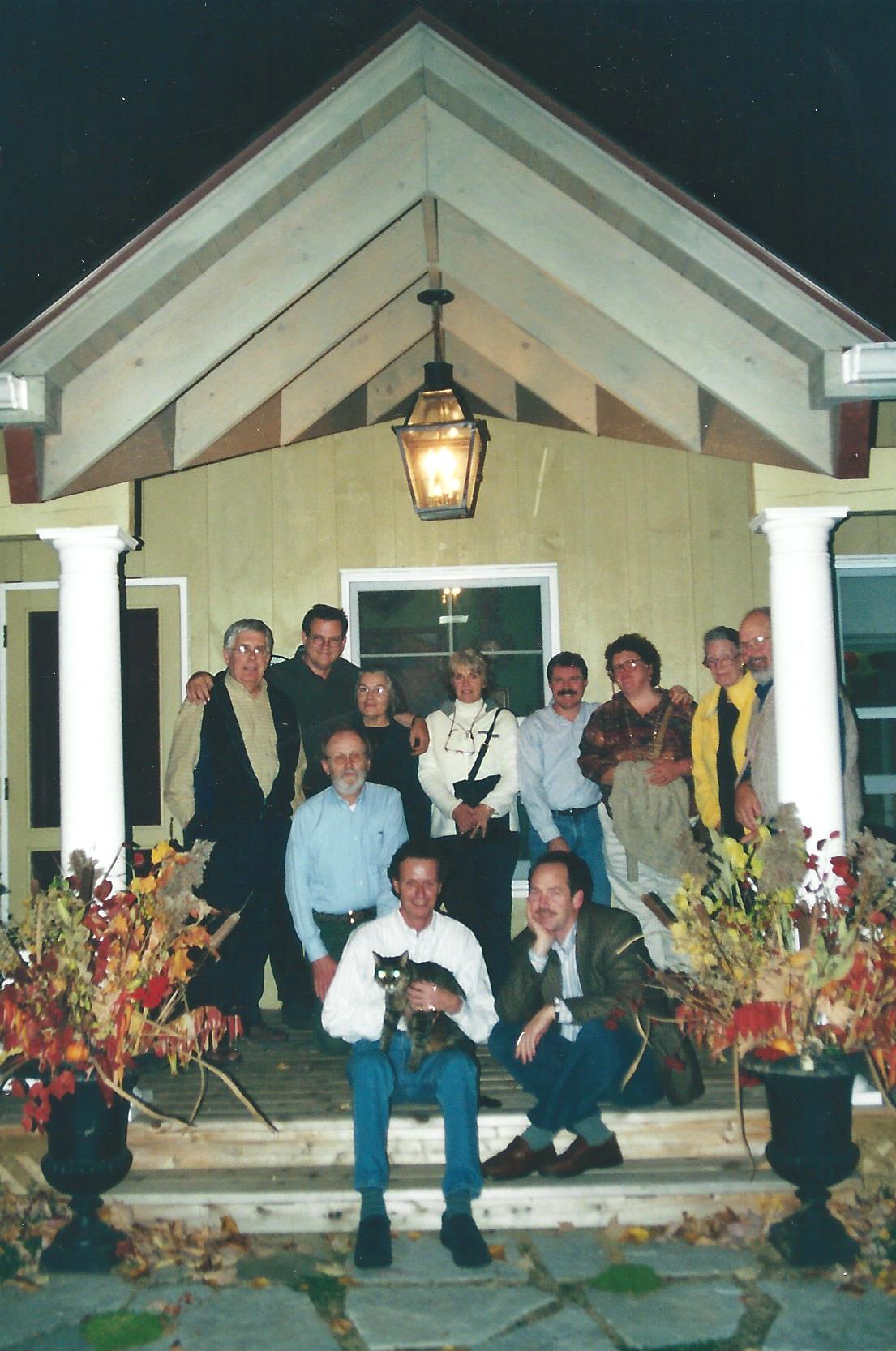
the "gang"  at Valerie and Henri's

the “gang”
at Valerie and Henri’s

Buying my “wreck” from Kojak

A loaded truck ready to go.

A loaded truck ready to go.

Kojak’s barn was located on the outskirts of Victoriaville.  You may be acquainted with Kojak from my previous blog “discovering the picker’s barns around Victoriaville”.  Jean (Kojak) Deshaies was thus nicknamed because he was bald and had a rough voice.  He also had a disarmingly direct way of expressing himself which reminded me of the t.v. detective.  Across the road from Kojak was an Esso station with a good little roadside restaurant.  All the pickers used to gather there about 7 am to have breakfast and exchange tips and gossip.  It was a good place to be to find out what had come in, and what was going on.

One particular summer morning Jeanine and I arrived to find an unusually high level of

excitement amongst the natives.  It was 7 am and the boys were drinking brandy, giving high fives, and generally celebrating.  What’s up?  Kojak who seemed to be the center of attention answered, “have a brandy on me.  We’re celebrating the delivery of my new truck.  There she is out front.  Isn’t she a beauty.”  Sure enough a massive, brand new, chrome covered, custom painted one ton, four door Chevy sat glistening in the sun.   “It’s a little early for us for Brandy, but congratulations Jean, that’s a real beauty.”   We took our place at our usual table and ordered breakfast.

This was at a time when I was becoming known as a “regular”, and the boys liked me in spite of my beat up old pickup with the simple bolted together oak board rack.  Actually, I could tell that they laughed a bit behind my back as theirs was an “express my macho through my big truck culture.”  That and the big roll of cash which they would pull out of their pants is what made them impressive to their clients and each other.  They could not imagine why someone would come from so far which such a small potential for hauling things back.  The first time I tried to tie down a load, they stopped me and taught me how to do it properly.  Making a loop at one end of the rope and then pulling the other end through and pulling hard to cinch with a reef knot and the load was in place.  I was getting pretty good at piling the stuff up a little past the height of the cab and onto the lowered tailgate to maximize my load.

So we were enjoying the laughter and light heartedness of the moment, along with some bacon and eggs, when Kojak slid onto the bench next to us.   “Hey Phil, you should buy mon wreck.”  Pause. “Buy your wreck” ???  It was first thing in the morning and I was struggling to find meaning in Jean’s “Franglaise”.  Perhaps the shot of brandy would have helped.  “Yea, mon wreck.  Mon wreck from my old truck.  It didn’t fit the new truck because my last truck had the small back space like yours so I had a new one made. But it would work great for you, and then you would have a real rig for hauling a decent load.”  The fog lifted.  “Well what are you asking for it?”  At this Jean looked me directly in the face and held up five fingers.  Let’s see; another puzzler.  I knew that it could have originally cost $5,000 because it was beautifully made with a deck over the cab which had a metal mesh walking surface that came right out to the front bumper, and handy sailboat type rope tie downs all along the sides.  But it seemed too high, so I ventured, “how much Jean?”  “Five hundred.”  “Give me five hundred and we can go to the welder’s place right after breakfast and he will put it on for you. That’s included in the price”.  I looked at Jeanine.  She gave me a wink, and so I said “Sure. Sounds good”.  Thanks Jean.  We’ll go for it.”  Jean’s big smile displayed his satisfaction with this.  His old rack was sold and he knew I could buy a lot more from him with this new equipment.  It was a good investment on his part.

We finished our breakfasts and followed Jean about five clicks out of town to the home and shop of his welder buddy.  Jean had called ahead so by the time we arrived he had it suspended up above the bay ready for us to drive in.  Twenty minutes later our old oak rack was on the burn pile, and our new front to back rack was bolted into place along the sides and on to the front bumper.  The old truck dropped about two inches under the new weight, but it drove fine, and we were off on the hunt with oodles of more space for purchases.  The rack survived two new trucks and served me well for the rest of my time hauling big loads out of Quebec.  I was happy that we had been there for breakfast the day Kojak’s new truck had arrived.

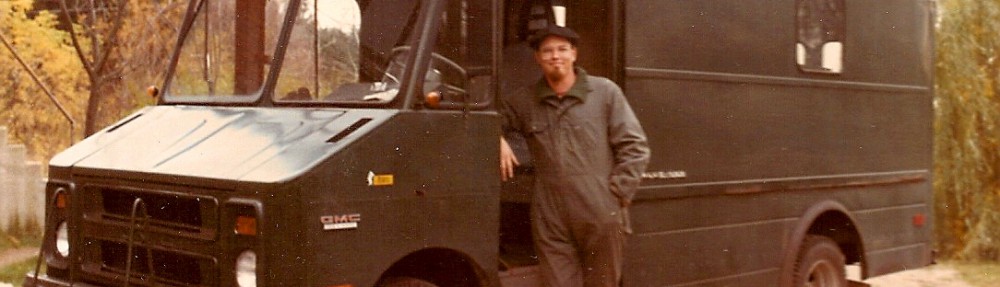
My new metal rack bought from Kojak.

My new metal rack bought from Kojak.

The “spontaneous” vision of Quebec carver Andre Laporte

Andre's Montreal Canadien goalie

Andre’s Montreal Canadien goalie

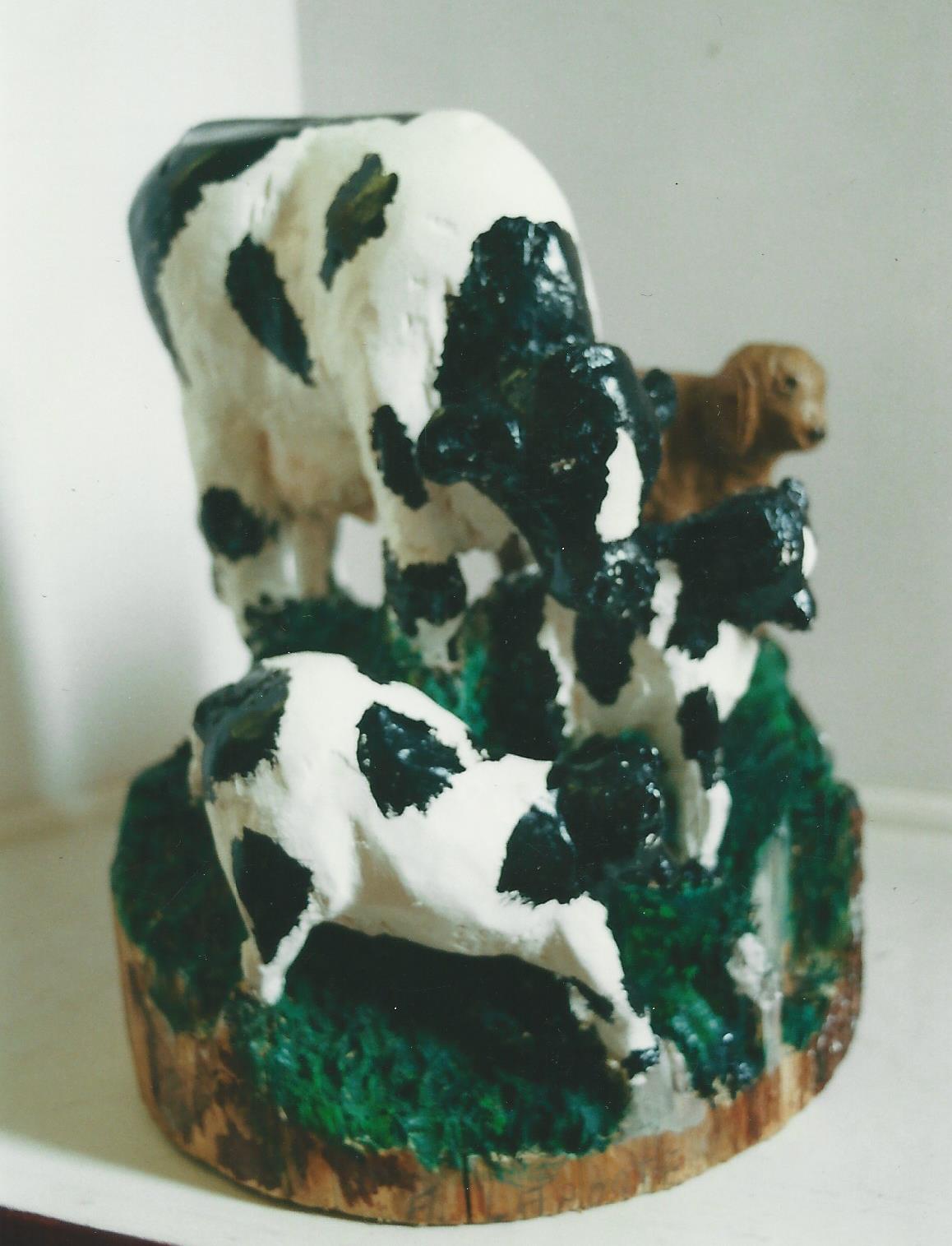
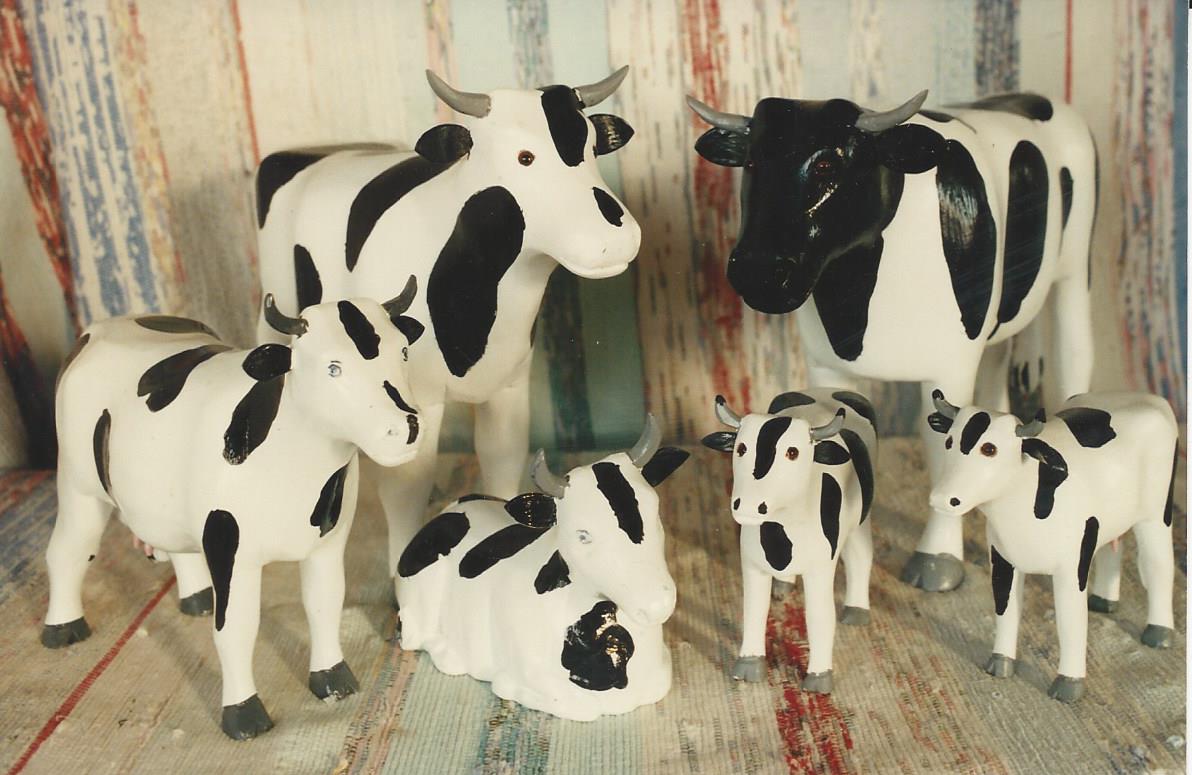
About 30 years ago we were rooting around in Alain Chauvette’s pickers barn near Victoriaville Quebec when we happened upon a wonderful carving of a Montreal Canadien goalie.  A serious dude with a square head and a look of determination which would intimidate even the most veteran opponent.  We loved it and bought it for our own collection.  I’m looking at him right now and I’m still impressed with the expressiveness of his rough cut features, and the immediacy of the carving.  Problem was, he wasn’t signed.  We asked Alain if he knew the carver, and he did not so we had to be content to have found this one great piece by an unknown carver with the possibility of never knowing the maker, or seeing other work by him.  Then about six months later we found a carving that was obviously made by the same hands of a group of four cows, carved all in one piece in the round.  The same roughness and directness as the goalie.  This time it had the signature A Laporte on the bottom.  The picker still did not know the carver, but at least we had a name to go on.

a group of cows by Andre Laporte

a group of cows by Andre Laporte

So fast forward about fifteen years later.  We have found and bought another half dozen pieces by Mr. Laporte, all with the same strength and spontaneity of our goalie.  Still no one knew, or admitted to knowing anything about the artist.  Remember that any picker is extremely reluctant to put you in touch with a carver because then you buy from the artist and not them, so it is counterproductive.  Still, we were happy just to find the pieces and realize that the artist was most likely still active.

Andre sits on his front bench with his first carving

Then came that lucky day when by going through the phone book in La Prairie, and we found and met the carver Leo Fournier.  We were enjoying our conversation with Leo when his wife came into the room and said “Leo, Andre Laporte just phoned and I told him I would have you phone him back after you are finished here.” Eureka!  “Would your friend Andre Laporte be a carver by any chance?”  Why yes he is, a carver and an antique picker.  He lives a few miles from here in the town of Verdun.” “Would you mind giving us his phone number”. “Not at all.  I’m sure he would be happy to meet you”.  So before we left Leo called Andre back, gave him the scoop and put us on the phone.  It was late in the day, so we made arrangements to arrive at his place at 9 the next morning.  After getting directions Andre said “No one has ever wanted to meet me before.  I don’t have a lot of work to show you so I hope you are not disappointed. “.  “Not to worry Andre, we love your work and will be delighted just to meet you , and if you have anything to show us, that’s good too.

Next morning after a hearty breakfast we arrived at Andre’s little house by the railway tracks precisely at 9, and there was Andre waiting on a bench by his front door.  You could see he was both excited and a little anxious. After exchanging greetings, we went inside and met his wife Lucie.  The place was small but filled with nice things including several of Andre’s carvings which were brought out and put on the dining room table.

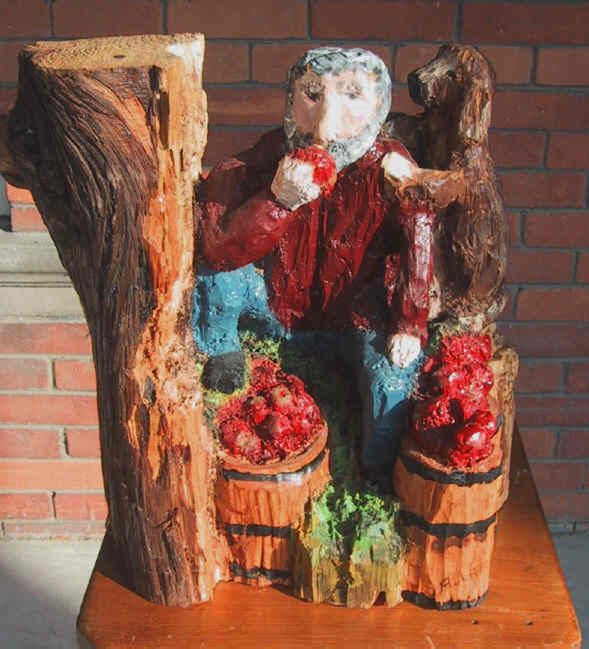
A man enjoys an apple while his faithful dog looks on

A man enjoys an apple while his faithful dog looks on

Leo had briefed him on who we were and he was excited to think that we would be interested in him.  “So you actually like my work?”.  Why yes, we like it a lot. You have a unique style and energy which we find very attractive.”  “The other pickers who come by tell me my works too rough and nobody will want it, but that’s the only way I can work. “You see this horse there.”  We focused our attention on a very strong and expressive work horse. “That was my first carving.  They took down some hydro poles about seven years ago and left them across the street.  I cut up one of them into various sized “stumps”, and brought them home to burn, but then I started to look at them and after a while I saw this horse inside one of the stumps.  I thought about it for a long time, and then one day in 1984 I  just started chipping away at it, and after about ten hours this horse had emerged. That was it.  I was hooked. That’s the way I’ve worked ever since.  I see the form in the log, and then I carve, until I get it all out”.  I don’t glue pieces together or sand them more than I have to.  I like them rough and close to the way I see them in my head.” I can only work when I see the piece in the wood first, and then I can’t stop working until it is finished.  At this point Lucie jumps in.  “that’s right.  Once Andre starts to carve I know I’ve lost him until he is finished.  I drew the line when one night he put an old quilt on our bed and started to carve right there.”

Andre's bust of Quebec strongman Louis Cyr

Andre’s bust of Quebec strongman Louis Cyr

Andre represents what it is to be a natural, instinctive carver.  With no training or even having much experience of other work, his work is truly inspired and highly individual. His work deals with what is the pure essentials of his subject.  There is always a sense of vitality and movement.

We bought several pieces that day including his first carving of the horse which remains in our collection.  We continued to go by Andre’s place a couple of times a year for the many years that we continued to travel to Quebec, buying most of his output each time.  Even after we stopped going we would talk on the phone occasionally and he would describe what he had been working on.  Often we would send him a cheque and he would mail us pieces sight unseen.  Andre and Lucie have a hard life.  He was born in Verdun on May 20th, 1948 and has lived there all his life.  He has barely eked out a living being an antique picker of the door knocker variety.  For a while things went well for him when collector Pierre Laplante was buying almost everything he picked, but then they had a falling out and that stopped.  Andre and Lucie have three daughters and one grandchild.

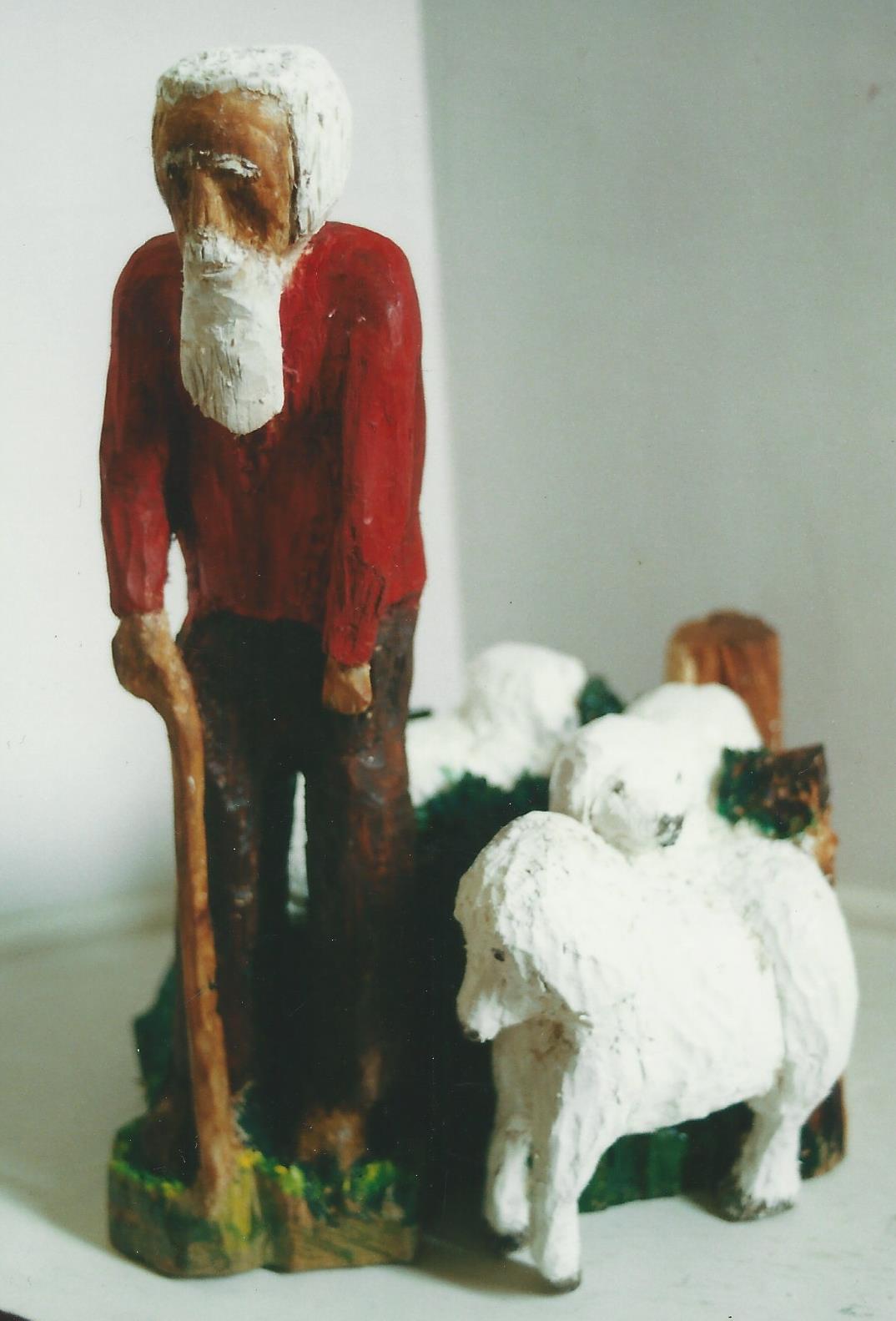
an old man and his sheep by Andre Laporte

an old man and his sheep by Andre Laporte

A few years ago I called to see how he and Lucie were doing and he informed me that sadly one of their daughters had been in a terrible car accident was grievously injured, and that now he had to take her every day to the hospital for treatment. There was never enough money in what Andre does to make a happy and secure life, and I’m sure that without the love and support of Lucie and his family he would not be able to survive. The last time I called was in 2007 when our mutual friend Leo Fournier died. We had a great chat about Leo.  How he was his own man, and Andre laughed and summarized it like this “I have always admired Leo.  He lived exactly as he wanted to, and never cared what anybody thought. He loved to drink and he died drunk.  It couldn’t have been better for him”.  I don’t know how things have gone for Leo since.  I should phone him.  That last time we spoke he said he hadn’t made any new work in a couple of years and he was still mainly preoccupied with helping his daughter to get back to a happy and productive life.  He and Lucie are the salt of the earth.  I really hope that things are getting easier for them.  He has real talent that in a better world would be enough to provide him and his family with a happy and secure life. Unfortunately, it rarely works out like that for artists in the world we live in today.

Andre surrounded by his creations

Andre surrounded by his creations

The manufactured “folk art” of Pierre et Claire Inc.

the cover of our mail order brochure

the cover of our mail order brochure

Last Saturday at Christie in anticipation of this article, I looked to see how many animals I could find which were manufactured by this small Quebec company.  Although it was too hot to cover the entire field, I did manage about ½ of it, and in that area I found five.  I noted that we as Old Church Trading had painted three of the five.  This gives you an idea of the scope of production of this company.

Rene Beaudoin was one of the original, and possibly the most successful of the Quebec pickers which started up in the 1960’s in the Victoriaville region of Quebec.  There were several small farms in the region, and everyone seemed inclined to keep all the old furniture and accessories as it was replaced in the barns, basements, and attics on the property.  The popularization of antiques brought in part by Expo 67 signaled the start of the antique picking industry, and Rene, although reportedly not able to read or write, had a keen understanding of business and quickly became the main man, hiring several men to go out and knock on doors, and they fetched all and everything available, bringing it back daily to his large farm near Defoy.  After becoming enormously successful in the antique trade, in 1978 he decided to create a small manufacturing business, employing some of the wonderfully talented wood workers of the region to create high quality reproductions of antiques, and copies of wood carvings which were prevalent in the area.  In 1983 his daughter Claire, who is married to Pierre Trudel, bought the company from Rene, and thus Pierre et Claire Inc. was formed.

unfinished order arriving from Pierre et Claire

unfinished order arriving from Pierre et Claire

The company exists to this day at its original location of 1197 Rue Principale, St. Anne Du Sault (Defoy), Quebec, and continues to manufacture reproductions of antiques and animal carvings with about five full time employees.  When we discovered them back in the early 80’s we decided to set up a mail order business for the animals which we called Old Church Trading.  We advertised in Harrowsmith magazine in Canada, and Country Home magazine in the States.  We offered many different animals both in the sanded, unfinished state that we bought them in, and varnished or painted which we did ourselves. We sold hundreds of them both through mail order, and at the Harbourfront market in Toronto, which we attended every Sunday.  At the time it seemed everyone wanted a nice pine, carved goose or swan to sit on their harvest table or cupboard.

various cow models

various cow models

We would stop in every other week or so and fill out our orders, going through the bins of carvings and picking out the nicest ducks, geese, swans, loons, roosters, and other animals.  We were always interested to see what new models they would come up with.  Penguins, buffalo, bears etc. would appear.  The prices were always reasonable.  I recall the standard size goose would cost about $16 each.  Although there was some variation in quality, (sometimes they would have large knots, or be slightly malformed) overall they were very nicely done.  Initially, all the models were cut out from solid pine, but sometimes these pieces would crack with time, especially if they were not adequately finished, so eventually they started to offer laminated models at a slightly higher price.  This solved the cracking problem, but didn’t look as nice and natural in varnish.  Of course they were the best ones to buy for painting.

inside the factory. Note the pile of geese in the background

inside the factory. Note the pile of geese in the background

As far as I know this small company was, and is the only North American company to “manufacture” folk art type carvings.   Although by the fact that they are manufactured and mass produced they cannot truly be considered as folk art.  And yet you cannot really call them reproductions either because in many cases they are an original design.  For folk art collectors it is important to know of these carvings, and be able to spot them.   They are fine for decoration when bought at the right price, but should not be confused with “real” folk art, which are items of individual expression, and not mass produced.  Although we must also acknowledge that many folk artists, Maud Lewis springs to mind, would repeat favored images over and over again, it is quite different than banging out 100’s of identical ducks using templates and modern wood working tools.   Ironically, I think their market has been effected when the Chinese started to reproduce copies of their work.  I’ve seen lots of these too.

the very popular rooster, and hen with our paint jobs

the very popular rooster, and hen with our paint jobs

note how this is modeled after the Black Horse Beer display

note how this is modeled after the Black Horse Beer display

Pierre et Claire continue to be in business, and have a web site at www.pierreetclaireinc.com, but it is in French only, and does not show many of their available carvings.

Our painted versions of Pierre et Claire animals

Our painted versions of Pierre et Claire animals

Meeting Aime Demeules , folk artist from St. Paul-de-la-Croix, Quebec

aime6

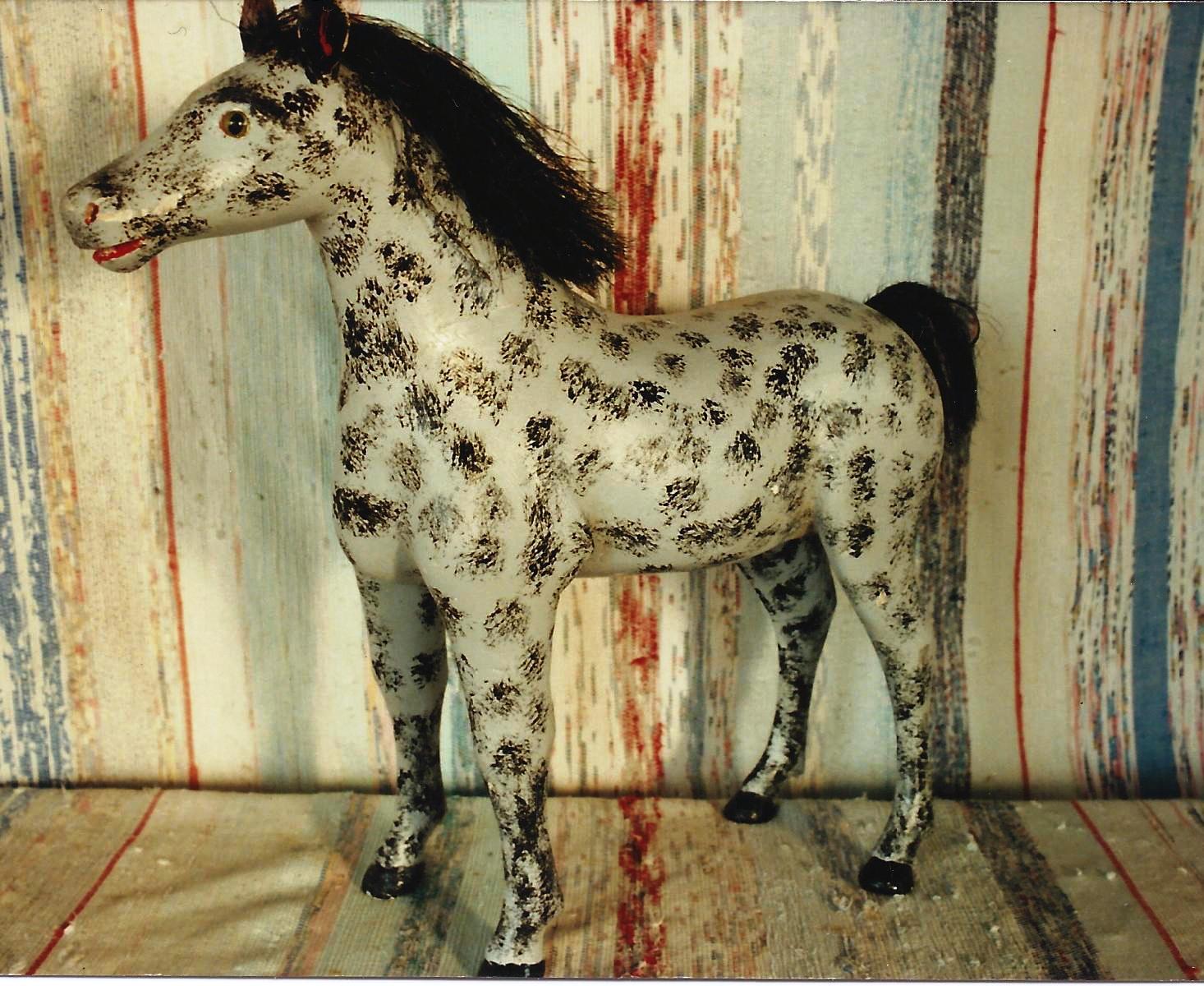
Speckled horse by Aime Desmeules

In an earlier post I recall our meeting Felicien Levesque in the early nineties while touring the Bas -St. -Laurent region of Quebec.  Well, the very next day we rose early and made the half hour drive From Cacouna to St Paul de-la-Croix, knowing it was the hometown of the well-know carver Aime Desmeules.  We had been buying his animals for years from Victoriaville picker Marcel Gosselin, and we had always wanted to meet him.  It was not hard to get directions to his house in this small town of 367 people, and we were soon pulling in to the driveway of a neatly kept, small ranch style home.

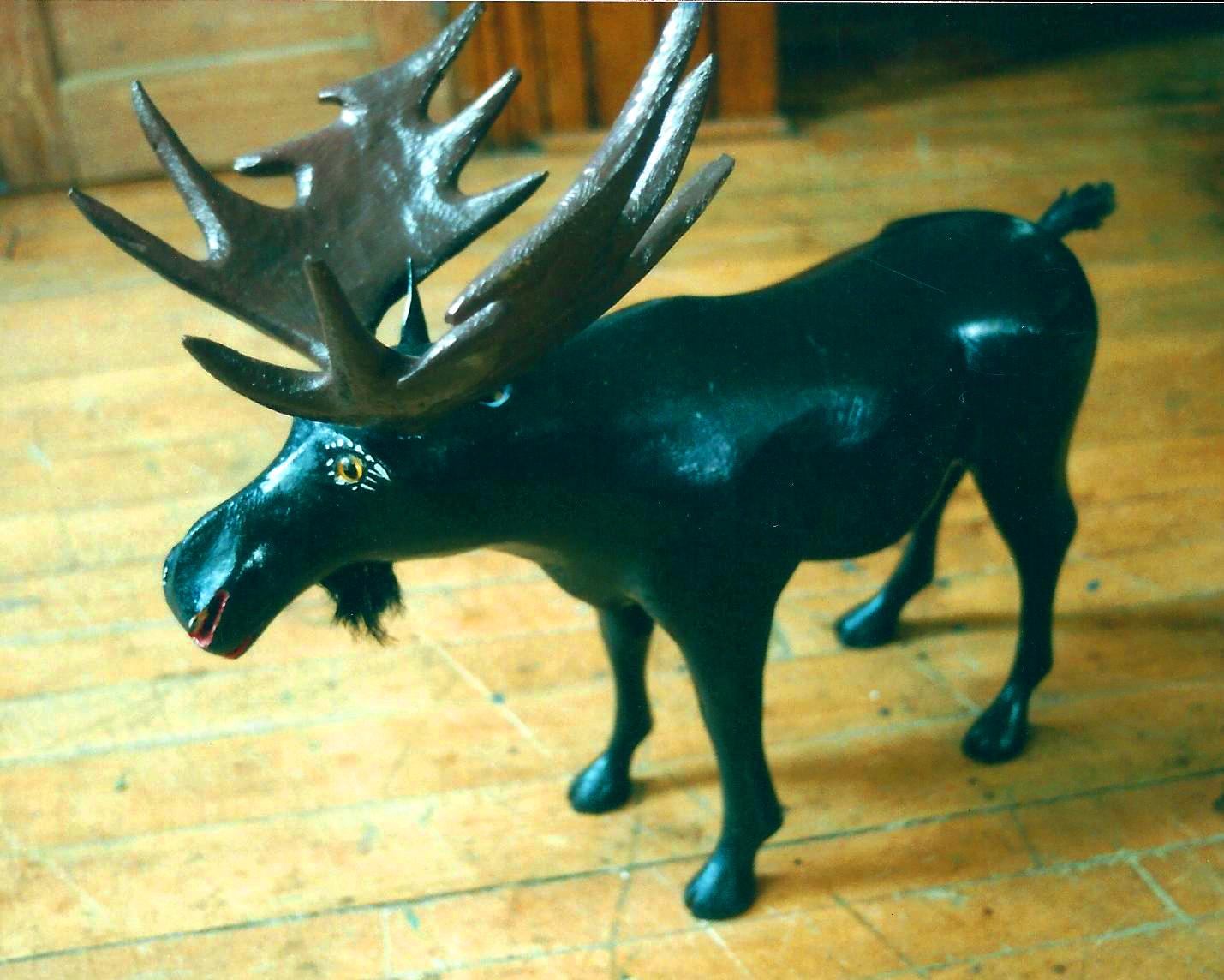
moose by Aime Desmeules

moose by Aime Desmeules

Jeanine and I rang the bell, and were soon greeted by a puzzled looking older lady we took to be his wife.   We explained that we had come from Ontario and being big fans of Mr Desmeule’s work, we had made the trek to their home with the hopes of meeting him.  “Oh no, that will not be possible.  He doesn’t like to meet new people, and he has no work for sale in any case. No, I’m afraid you’ve wasted your time.”Just as she was about to slam the door in our faces, Jeanine added sweetly, “Well we don’t mind if there is no work for sale,  but please we have come a long way and we would be very grateful just to have the opportunity to make his acquaintance.”  She looked us up and down.  Long pause. “Very well, he’s not here right now as he is fetching wood, but I suppose if you come back in an hour he may be willing to talk to you.”  Whew, nice work Jeanine.  “Great, thanks, we’ll be back.”  So we went into town and had a delicious big breakfast, and lingered over our coffee to fill in the time.

Aime and his wife Marie-Jeanne at their home in 1993

Aime and his wife Marie-Jeanne at their home in 1993

One hour later we were greeted at the door by Aime.  Surprisingly, he was as friendly as can be, and invited us in to his work shop which was fairly full of finished carvings.  “Pardon us for saying, but your wife gave us the impression that you had no work for sale, so I suppose these pieces are commissioned.”  He Laughed.  “No these pieces are for sale, it’s just that when you arrived unexpectedly with your accents, she was worried that you may be from the tax department.”  I was starting to think that this would be the standard greeting we could expect arriving unannounced at Quebec carver’s homes, and upon reflection, I understand where they are coming from.

The next hour was pleasantly filled by Aime telling us the story of how he was 64 years old before he took up carving and at that time he was taught by his father to create the various animals in his father’s repertoire to be precisely like his father’s work.  It was only after his father’s death in 1986 at 95 years of age that Aime developed a few new animals of his own, along with some pieces depicting people such as the blacksmith shown here.

"Blacksmith" by Aime Desmeules

“Blacksmith” by Aime Desmeules

Mrs. Demeules joined us after awhile and expressed that she was sorry for the rude greeting, but that she could see now that we were truly fans and not inspectors, and she was happy that we came.  We bought a lot of his work, about twenty pieces or so, and we spent a pleasant morning getting to know each other, before loading up and heading out of town.

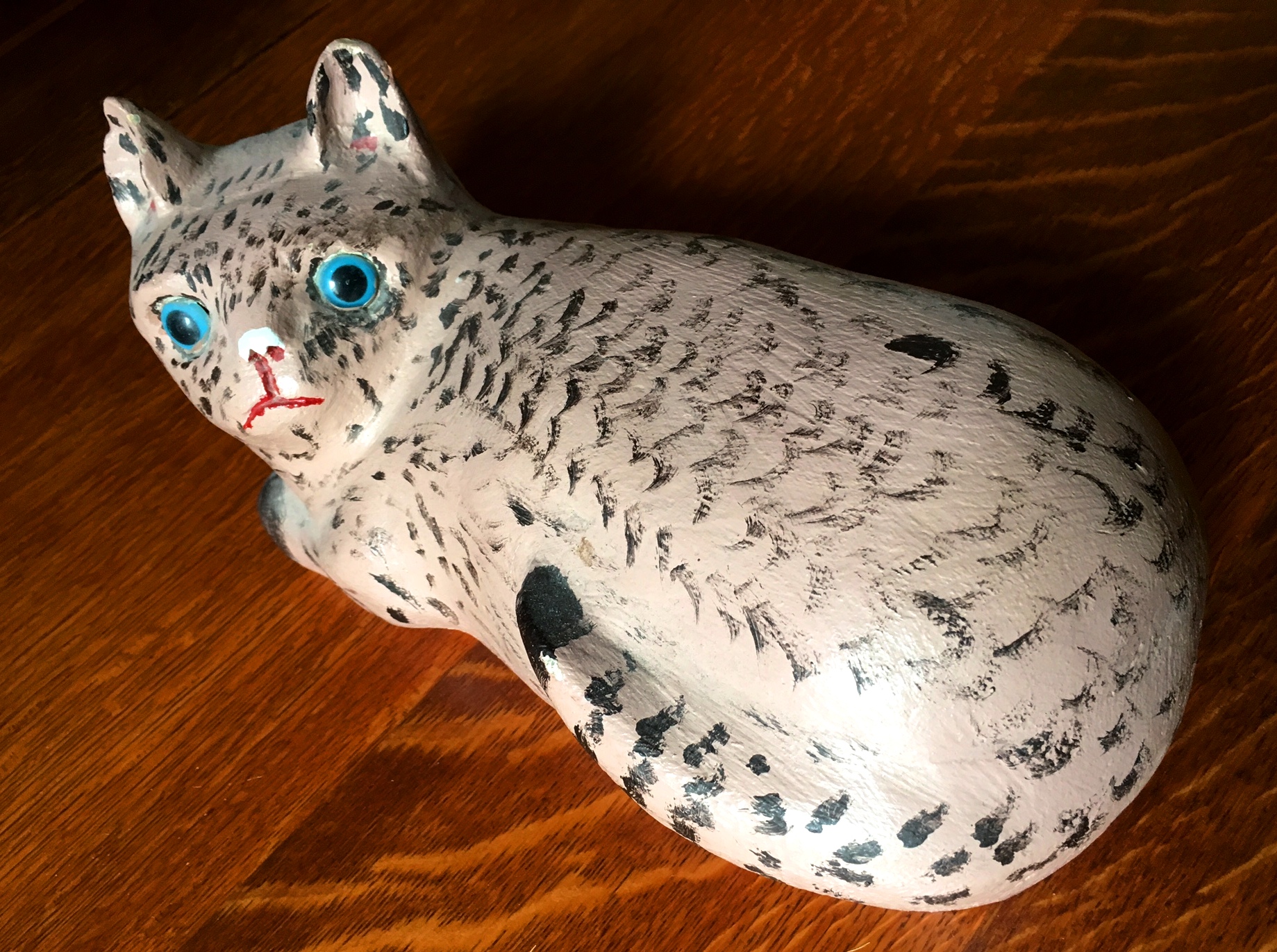
What I find interesting about Aime, is how he was content, to the point of taking pride in creating exact copies of his father’s work.  He even signed the pieces with a stylized “A” “D” with the “A” looking very much like a “G” as his father had signed.  It is quite difficult to distinguish the father’s work from the son’s, and you are pretty much dependent on patina and provenance. My understanding is that George quit working in the early 70’s, but then Aime only lived on until 1997.

Aime's signature on cat

Aime’s signature on cat

aimecat

I

f you consider other carving families, such as Damase Richard and his son Wilfred; although there is a similarity to their work, when you study them closely you can see quite a few differences which make them easy to distinguish.   When considering father and son carvers, Aime and George’s bond seems unique.

"brown Cow" by Aime Desmeules

“brown Cow” by Aime Desmeules