Unknown's avatar

About shadflyguy

Owner/ operator of Shadfly Antiques.

Finding Lajeunesse

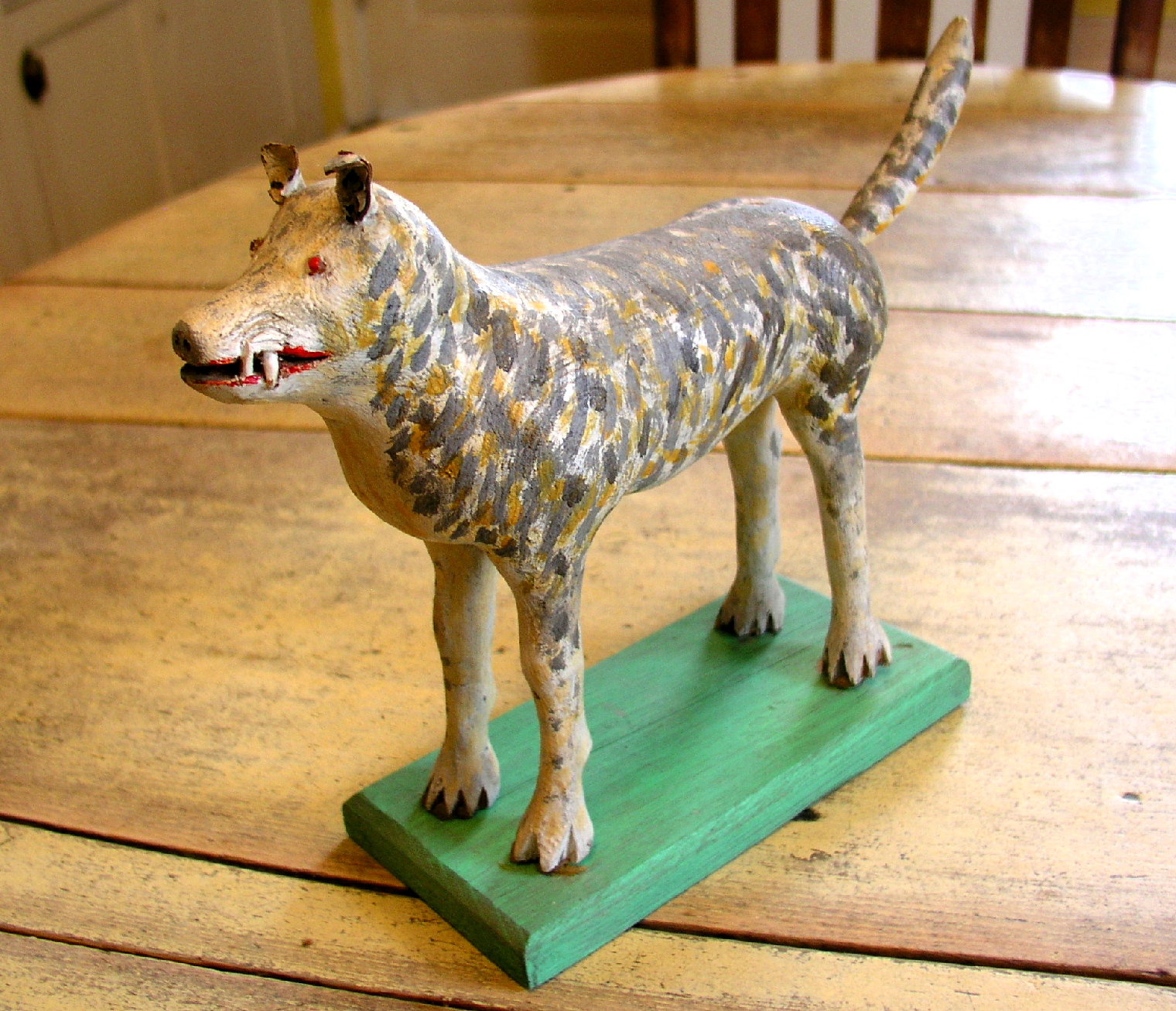
“Chien Mechant”

You know how sometimes when you meet a person you feel a real connection to their inner spirit, and recognize in them something which represents basic goodness and beauty?  Something rare and special.  Well that’s the way I feel about having met Henri Lajeunesse, and I am grateful for having had the experience.

Over the ten plus years of regular buying trips to Quebec we would very occasionally run across a signed work of Mr. Lajeunesse,  and we began to covet them and seek them out because we really connected with his expressiveness and vision.  Although we asked everyone we knew, we could never find out much about him. Not in books or from other collectors. Then one day we bought the piece above, “Chien Mechant” or “mean dog” as it was titled in pencil along the base. I say “was” because unfortunately one day an overzealous housekeeper scrubbed the words off while cleaning it.   There’s a cautionary tale for you.

showing the bottom of “Chien Mechant”

So it happened that one day shortly after buying the piece, in a rare mood of domesticity, and in preparation of Jeanine’s imminent  return home from visiting her mother in France,  I was cleaning, and I happened to turn the piece over.  There it was.  Not only his signature but his address and phone number.  Well Hallelujah.  As it happened we were just about  to go on a  Quebec buying trip so we figured what the heck , lets give him a call.  Jeanine dialed he number, not expecting much; but suddenly Henri Lajeunesse was on the line.  After establishing that he was the Henri Lajeunesse we sought, Jeanine told him of our love of his work and our imminent trip, and asked if it might be alright to drop by on him.   “Of course, I’d be delighted”.  When should we come?. “Oh anytime is fine, I am always here.”  We are coming on the fifth, and perhaps we should call that morning to check that you will be in?  “It’s not necessary.  Just come anytime, but I’ll expect you on the fifth.”  

We stayed overnight in Montreal on the fourth, and then in the morning,after breakfast we headed out on the two and a half hour drive north east to the village of St. Melanie.  When we arrived at 611 Chemin du Lac Sud, we looked at each other and laughed because of course he was going to be home; he lived in a retirement lodge.

Bluebird

Bluebird

The front desk soon confirmed that he was waiting for us in his room.  We were taken there and sure enough after knocking, the attendant opened the door and there he was sitting in his rocking chair surrounded with pieces of his work on every available surface. We counted over forty carvings.  Mostly birds, animals, and people, and all of a small or medium size.  What a wonder to behold.  His eyes lit up as he explained that in anticipation of our visit he had his son bring everything he had left in storage, and also his carving tools, because now that someone was showing interest again, he felt he had a few more carvings in him, which he wanted to explore.  We had a lovely talk about his life, and work.  He and his wife had eleven kids, he had spent his entire life in St. Melanie, etc.  While he spoke my eyes kept scanning the room, taking in all that was before me.  Wonderful examples of different periods of his work.  We noted that the little bluebird above was his most recent piece and there is an obvious difference between this later piece and the earlier pieces like the leopards below.
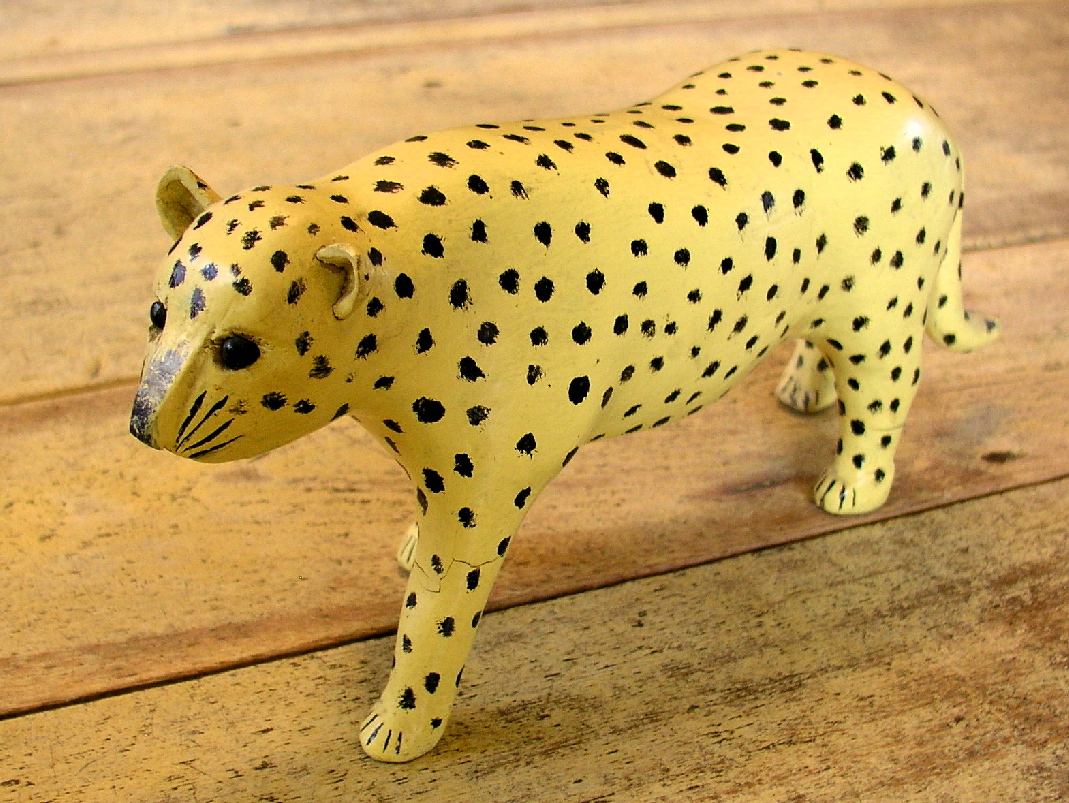
an earlier leopard

He exuded  warmth and humility while answering our many questions, and telling us a few of his life’s stories.  Then eventually , almost timidly, he suggested that we could buy a piece if we wanted something to remember our visit by.  “well of course Mr. Lajeuness, . Could you please tell us your prices.”. He went around the room quoting prices from memory.  Everything was from about $15 to $65 dollars.  Then he offered,  “So is there a piece you think you might like to have?”. Jeanine and I threw each other a knowing glance, and said  “Well actually , we’d like to take all of them”.  The depth of his smile cannot be described as we started a list of the pieces and their prices. Soon I was heading out to the truck where we had prepared ourselves for a possible happy outcome by bringing many cardboard boxes and.0

paper.

another example of a leopard. This one bought from Jean Lacasse many years later.

another example of a leopard. This one bought from Jean Lacasse many years later.

He told us that many of his fellow housemates had suggested that he would be lucky to sell even one piece, so we shared in his delight observing the dropped jaws and wide eyes of the residents in the lobby as we hauled out  box after box of carvings.  Eventually, we shook hands and told him we would try to get back for a visit in a year or so, but  sadly soon after his family contacted us to inform us of his passing.  Eventually his daughter sent us a multi-page biography  in which we learned that legendary collector dealer Nettie Sharpe was a regular visitor in his productive years, and I find it strange considering this, and the excellent quality of his work, and the uniqueness of his vision that so little has been written about him.  The only major publication where I can find any mention is “Les Paradis du Monde, L’art populaire du Quebec” by Pascale Galipeau which includes a full page photo of his carving of Maurice Duplessis on page 111.

Maurice Duplessis, circa 1970

Maurice Duplessis,
circa 1970

footnote:

“Chien Mechant” is the French warning for “Beware of dog” as you would see on a sign.

“Lajeunesse” is the French word for “youth”

Participating in the “picks” of the Victoriaville Antique Centers

Antiquite Michel Prince

Antiquite Michel Prince

In an earlier post I talk about our bi-weekly trips to the Victoriaville region of Quebec where we would buy a truckload of antiques in the rough over a two or three day period and then race home to sell the stuff the following Sunday at the Harbourfront Antique Market in Toronto.  We did this regularly for a ten year period starting in the mid 80’s.  We very soon got to know and like the people we dealt with there, and early on gained their respect by never going to the Tuesday night auction in St. Hyacinth and bidding against them.   They would ask if we were going and we would always say that “no this is your territory, and we are happy to buy the stuff from you tomorrow.”   The fact is  they were fair with  their mark ups, and if you did attend they would do their best to dissuade you from ever coming back by continuing to bid you up until you paid way too much for any item you bid on. This policy and the fact that we would always negotiate by simply asking what the best they could do on a piece assured that they considered us “a class act”  as they would say, and probably saved us a lot of money in the long run.

We regularly arrived on Tuesday afternoon about 3 p.m, having left home at 4 am to get us past Toronto before the rush hour, and giving us enough time on arrival to have a look around before hitting the sack at the nearby motel. Then we would be up and at em’ by 8 a.m. because that was typically when a “pick” would take place at one or the other antique centers.

a friendly American buyer whom we saw regularly at the picks

By 7 am everyone would gather outside the entrance to the warehouse where beforehand the staff would set out all the newly arrived, unseen  items in neat rows. Not only the things purchased at the auction, but also items brought  in by pickers who independently picked the country side for the Antique Centers.  It was always exciting to see what had arrived.  Nothing had prices.  Us buyers would circulate around sipping coffee and deciding what we would attempt to buy, and figuring out how much we could spend for it.  Lots of private negotiations would be quietly going on. “O.K.  I’m only after the clock shelf so let me get that and you can have the bucket bench” . Kind of like the nonsense that goes on before an auction.

The way it worked, and probably still does for that matter, is that at 8 am everyone would pick a number out of a hat.  Enough numbers in the hat to cover everyone in attendance. Then whoever had lucky number one would go around with the seller and would have three chances to pick one item.  This was done very quietly so no one else could hear.  If you loved a wall shelf, but the price was too high for you, you could move on to your second choice, and if there was no deal there, you could move on to your third item.  Buy it or not, it was then number two’s turn, etc.  So considering that 90% of the stock was quite ordinary, it was important to get a good number or you didn’t stand a chance at getting one of the typically five or six things that were truly special and sought after. It worked well for the seller because if an item had been rejected a few times he could lower the price a little and see if that worked.  It was tougher on the buyer because you knew if you didn’t go for the price, the guy behind you probably would.  There was ways quite a bit of tension in the air.

I would always pick a number even if there was nothing that I was particularly interested in because if you drew a good number (especially number one) there was a good chance that someone was mosey quietly up to you and offer to buy it from you.  This happened to me a couple of times actually.  Typically the offer was a hundred bucks.  So  you made sure that you looked interested, and held your cards close to your chest.

After the best items were taken, everyone would disperse, breaking off into small groups where discussions of possible resale would take place. The seller would go around with a chalk and price the remaining items and the staff would start to bring them inside to be added to the stock there. It was a fine way to begin a day of antique buying.

anyone for a bathtub?

anyone for a bathtub?


Meeting Quebec folk artist Felicien Levesque


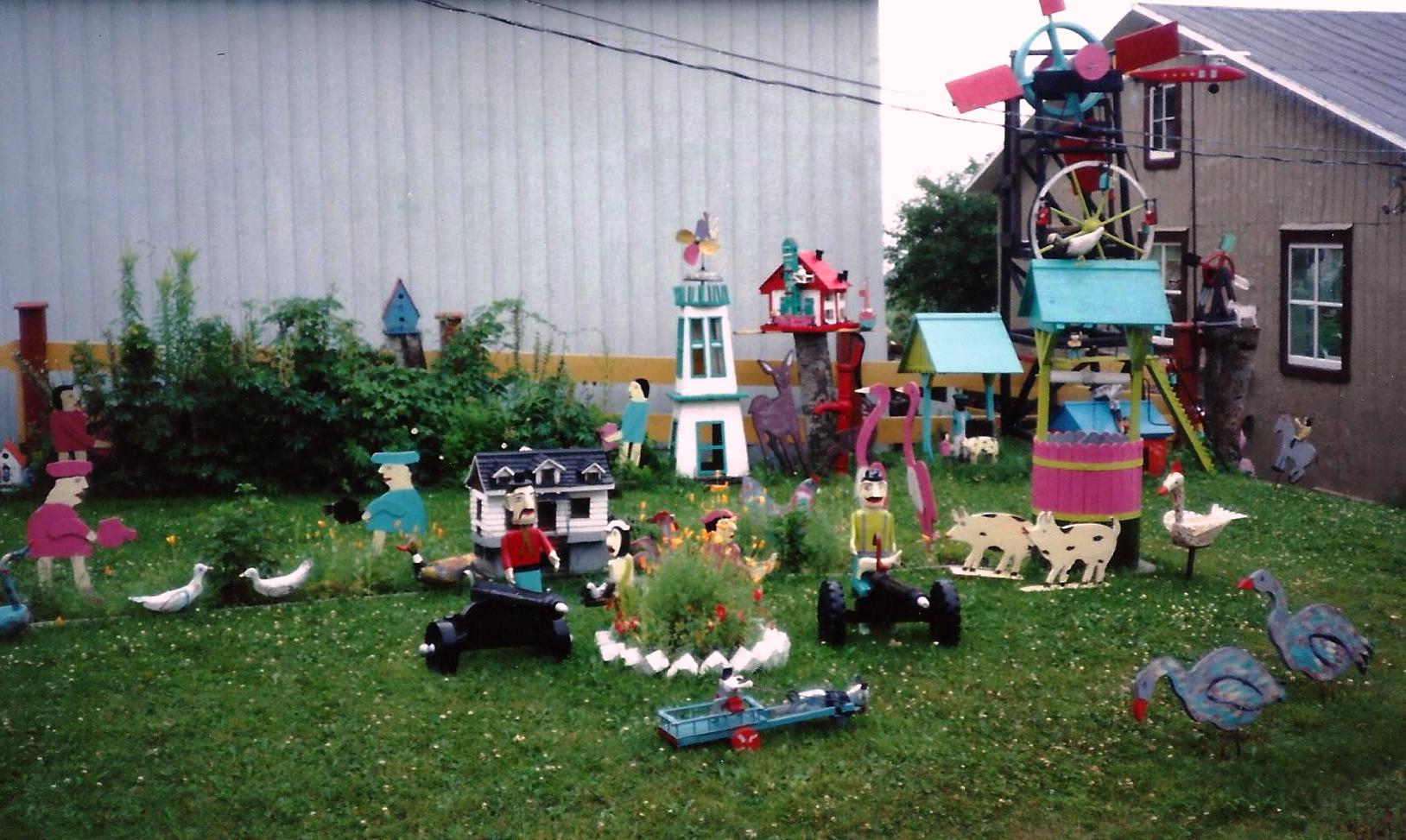
Leveques yard

part of Leveque’s yard showing his workshop at right.

In the early nineties as a result of doing many shows in Quebec, we got chummy with Riviere de Loup dealers Bertrand and Joanne Gaudreau.  Bertrand worked cutting wood all winter, and in the summer they ran a wonderful shop in a big red barn situated next to the La Malbaie/ Riviere de Loup ferry terminal on the St. Lawrence river.  Perhaps it’s still there. It’s been years since we were up that way. They always had interesting things and good prices so one summer trip, (I think it was 1993) we took them up on their offer to come visit them when we were out their way.

They knew of our passion for folk art , and were generous enough people to tell us where several of our favorite artists around that area lived.  This is rare among dealers as most are determined to guard their sources, but  the Gaudreaus realized we were a long way from home and would not be passing by very often, and they were all too happy to help us.  After going through their barn and buying a dozen or so great things we went off not far down the highway to where Felicien Levesque lived. He had always been one of our favorites for his whimsical, “outsider” style and we were delighted at the prospect of meeting him.  When we pulled in to the yard covered with folk art we knew we had found the place.  It was a classic old wooden Quebec house with a big porch and there was an impressively large  workshop in the back.   We pulled in and after taking the above shot we marched up to the back door and knocked.  After several moments, a middle aged woman opened the door  a crack, and directly asked us what our business was there.  We replied in French that we understood that this was the home of Felicien Levesque, and that we were folk art collector/dealers from Ontario who wished to make Mr. Levesque’s acquaintance, and possibly buy some folk art.  ” Oh no, I’m sorry, Mr Levesque sees no one and none of the folk art is for sale.  Thank you.  Goodbye”.  Slam.  We looked at the closed door for a moment considering if there was any point in knocking again and trying to persuade her, but it was pretty obvious we were not going to be received so we left and went to have lunch with Bertrand and Joanne in their beautiful home down the road.

leveque1

Felicien Leveque

Over lunch we relayed our sad tale and Bertrand laughed and said ” Oh that’s Felicien’s daughter and they are all a little freaked out right now, because the Quebec museum was by last week, and bought all the folk art on his yard (about twice what is pictured above) for $20,000.  When she heard your English accent she probably thought you were from the tax department or something.  I’ll go with you after lunch.”

When we arrived with Bertrand, and after a short explanation, he left and we were immediately invited in and brought into a classic old Quebec kitchen.  Walls and ceiling completely paneled  in white tongue and groove pine, chairs and buffets along the walls, big harvest table in the middle of the room, and a single bare bulb hanging down over the table.  Around the edge of the room sat Madame Levesque, their daughter, her husband, and their two kids.  They all sat  quietly at first  and looked on as we answered numerous questions from Mr. Levesque’s daughter about where we lived, what it was like there,  what type of house we had, what is Toronto like, etc.  It felt like we were on display as exotic curiosities, and soon everyone joined in asking us everything about our life in far off Ontario.  We were told that Felicien always took a nap after lunch and would join us shortly.  Sure enough after about twenty minutes he appeared rubbing his eyes and looking curiously at the new arrivals. It didn’t take him long to get up to speed and he proved to be very friendly and outspoken,  telling us a quick version of the story of his life, how he had one of the finest workshops in the region, and how he had just recently sold his work to the Quebec Museum and that they were mounting a show of his work.  He was very proud of the recognition and we could see it meant a lot to him.  So over a cup of coffee the time passed pleasantly and we eventually explained that being big fans of his work, we would love to see his workshop and any work that he could show us; and that if it were possible we would love to be able to purchase something from him.

lev3Hi daughter jumped in “Oh nothing is for sale, as I told you”.  Followed immediately by Felicien saying “Don’t listen to her  It’s my work and I am the one who decides”.  A cold stare, an awkward moment, and we were off to the workshop.

For someone who made such crazy things, he had an amazingly organized and well equipped workshop. We noticed several pieces about in various stages of completion, and after more talk about his technique and approach, he lead us off to his storage room.

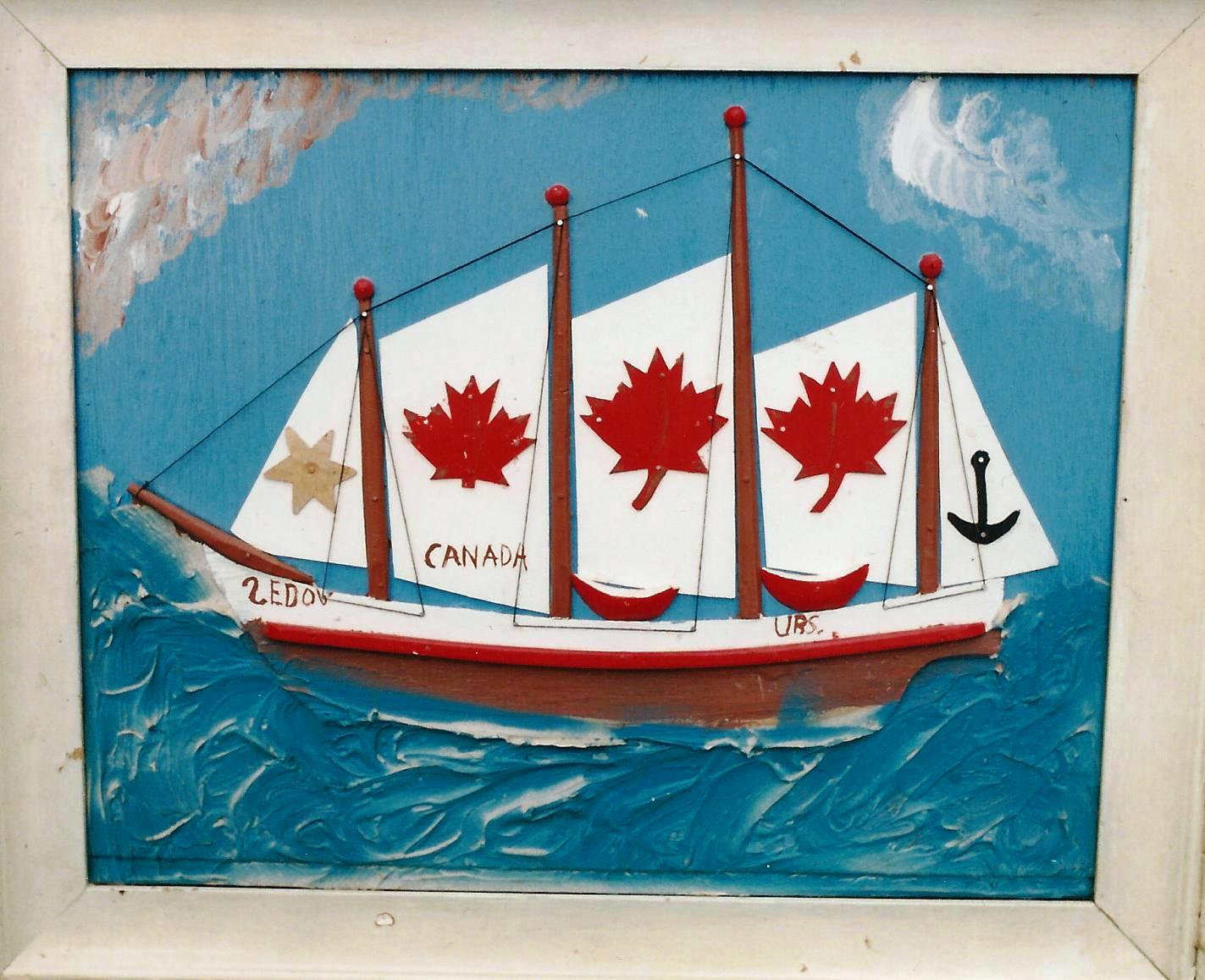
Framed plaster relief painting of a Canadian boat

Framed plaster relief painting of a Canadian boat

Wow.  It felt like we were entering King Tut’s tomb. The whole room was floor to ceiling shelves covered in every type of folk art imaginable. Hundreds of small bird’s, people and animals, dozens of  paintings and mid size constructions, and a few large pieces like the “sinking of the Titanic” pictured below.  We stood amazed and dumbstruck for a moment, and then I sheepishly asked ” so would we be able to by a couple of pieces?  Is anything for sale?.  He promptly answered “It’s all for sale”.  Visible flinch from the daughter.  “Oh, o.k. that’s great, so for instance how much do you want for this boat painting”  Leveque says “$50, while simultaneously  his daughter says $125. Oh, rats. What to do now?  I look back and forth at them.  He flashes a grimaced smile at his daughter and tells her to go in the house.  She looks annoyed but says nothing and leaves. We felt a combination of regret for the hurt feelings of the daughter but a  greater relief that Felicien was now completely in charge of the situation.  We put together a big pile of folk art, 50 or so pieces, which Felicien recorded in crayon on the back of an old cereal box.  We counted out the cash and started packing our purchases and putting them in the truck.  Not wanting to be a part of any further negotiations between himself and his daughter we left shortly thereafter, waving good-bye to Felicien who stood smiling in the middle of his recently sold yard  We were feeling lucky that we had met him at the peak of his game,  and before he relinquished control of his work to his family.  He died a couple of years later and we never did make it back that way.  Here is a link to his biography  .http://www.folkartcanada.ca/Que_FL.html

lev2


Recalling the time we bought an entire store full of N.S. folk art – Turtle Cove


work by Leo and Bradford Naugler

work by Leo and Bradford Naugler

Arguably , the public became aware and interested in Canadian contemporary folk art with the publication of the Museum of Man book “From the Heart” in 1983.  Since that time as is the case with popular culture, the interest in folk art has waxed and waned.   I have experienced many such reversals in the thirty plus years I have been collecting and selling. Things were good in the mid 1990’s.  It was a time when we would take a dozen newly discovered Barbara Clark Fleming paintings to the Muskoka show and sell them all within the first hour, leaving us wishing we had brought a dozen more.  Meanwhile Bernard Riordin, as Director of the Nova Scotia Art Gallery was pushing hard to have the Maritime folk art scene recognized, and established as the important cultural property which it is. There was a lot of media attention.  New collectors were becoming passionate.  Those were heady times.

It came to pass that in 1996 a creative, and forward thinking Toronto woman of some position, thought it was the perfect time to open an upscale contemporary folk art gallery in the posh Hazelton Lanes shopping district in Toronto.  So she took a boat load of money down to Nova Scotia, had a ball, and made a lot of folk artists very happy by buying up their work,  and arranging to have it shipped to Toronto.

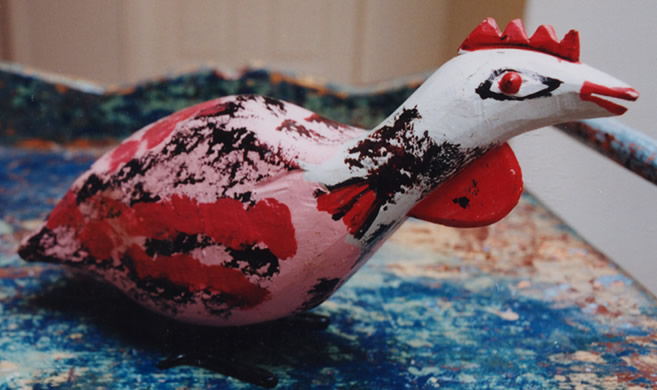
Rooster by Bradford Naugler

Rooster by Bradford Naugler

The name of the gallery was “Turtle Cove” and it occupied a large, second floor space in the Hazelton Lanes Complex.  It was a first rate effort.  Upscale fittings, museum lighting, beautifully created vignettes; the whole nine yards.  You’ve got to love people who follow their heart, and realize their dream so completely. Unfortunately, unlike the concept “if you build it, they will come” presented in the popular movie “Field of Dreams”,  things don’t always work out that way in real life. I think it took only a month or two before our brave entrepreneur realized that her sales projections had been highly over optimistic, and she decided to cut her loses and get out.  That’s when I got the call.

At the time, and to this day my main interest lies in older folk art, or at least shall I say in folk art that was not made so clearly with an eye to the market.  But then again I am all for contemporary artists making a living, and I admire the work of many contemporary Maritime artists such as Eddie Mandaggio, the Naugler Brothers, Garnet McPhail, etc. who were all well represented here. Also to be frank,  the price she quoted was interesting, so I made the trip to Toronto.

tc4

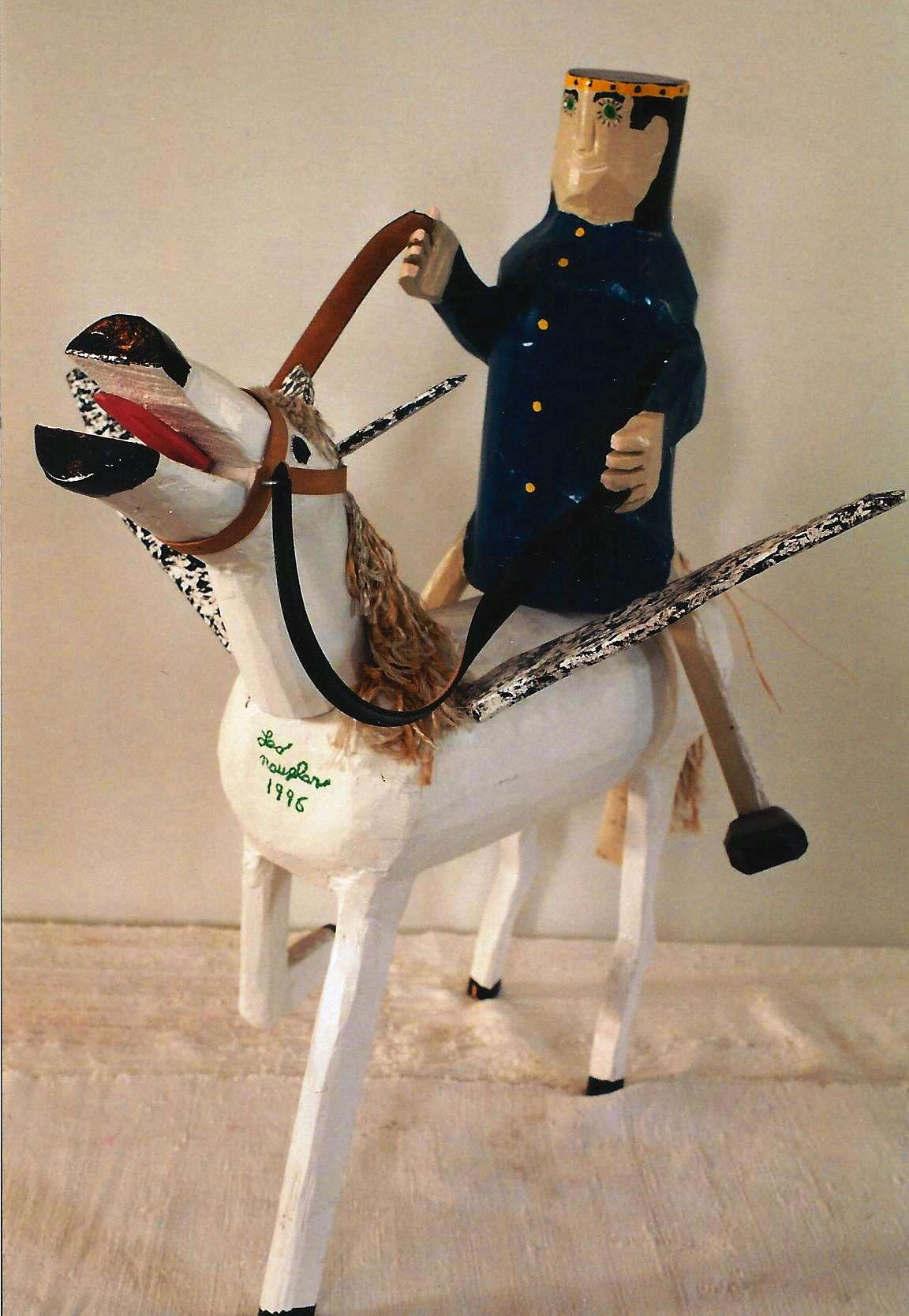
“Pegasus” and rider by Leo Naugler

Immediately upon entering the gallery I felt sorry to think that such a wonderful effort, so carefully and lovingly realized, had been unable to sustain, and that even before many had learned of it’s existence, it would be taken apart and dispersed as if it had never happened.  Ah well,  we all know how tough it is to make a go of it in retail, especially when it is a limited market, and the overheads must have been (I can only imagine) astronomical.

It was an easy negotiation   I did not argue with the proprietor’s suggestion that I pay her half of what she paid the artists.  She kept good books. There was a huge amount of stuff, including hundreds of smaller pieces which I recognized would sell easily. Of a bit more concern was the number of  big pieces such as the Pegasus with Rider by Leo Naugler pictured here; and most interestingly, but also representing the biggest unknown was some rare original furniture made by Leo and Bradford Naugler. I don’t know if she inspired or commissioned these pieces but they struck me as being important and rare, although not necessarily easy to sell. Among these pieces I think the best is an iconic “hockey chair” by Bradford Naugler.

tc6

Hockey Chair by Bradford Naugler

It is interesting to note that reportedly Bernard Riordin has recently proclaimed Bradford Naugler “the most important living Nova Scotia folk artist”,  and that this chair has again recently sold to a keen Nova Scotia collector for several thousands of dollars. It is complex, and worth considering how occasionally a particular object made by an artist is chosen by an expert as an iconic example of his or her work , and representative of a time and place;  thus becoming cherished and immortalized. People who understand this process sometimes become curators, and thus proponents of respecting and supporting our cultural heritage.  It’s important work.  It’s not always easy to understand.

It took me three full pick up truck loads to clear everything out.  As always, I was filled with concern verging on regret when signing the big cheque,  and thus taking on the responsibility of relocating such a vast amount of contemporary folk art to new homes. Happily, because of the heated market at the time, it all disappeared quite quickly,  and it worked out beautifully.  We still enjoy a couple of pieces which we put aside at the time,  and it’s satisfying  to think I was able to take all that work and find good homes for it.  Also it feels good  that the vision and enterprise of a folk art lover who “put her money where her heart is” was not in the end, in vain.

"porcupine" by Garnet McPhail

“porcupine”
by Garnet McPhail

Roger Raymond, Quebec carver of cigar store Indians

rr3By the mid 1980’s along with our antique business, we supplemented our income by  setting up a mail order business selling the carvings of Pierre and Claire Trudel, who we discovered had a workshop of about a dozen talented woodworkers making several lines of reproduction antique furniture, as well as copies of various decoys, and other Quebec folk art.  An average duck decoy would sell unfinished for about $15, and we would sell them finished for about $45. This commercial operation also carried a cigar store Indian which I knew was carved by a nearby artist.  I would come by every other week and buy about 50 or so carvings, including 4 or 5 Indians.

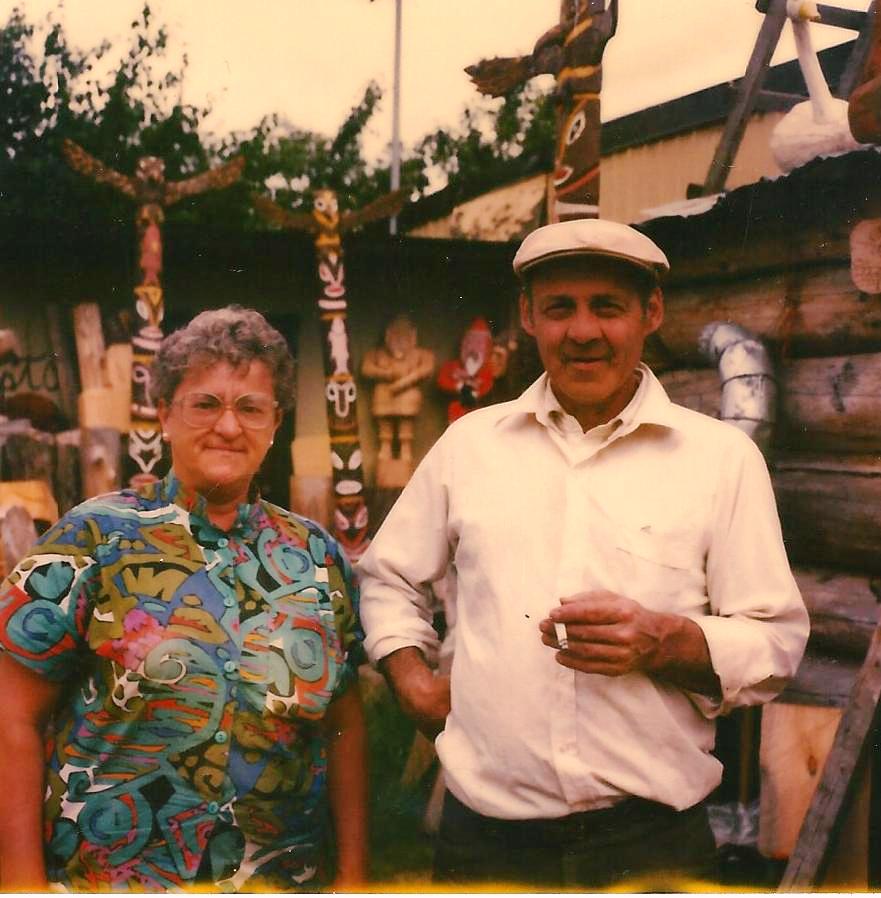
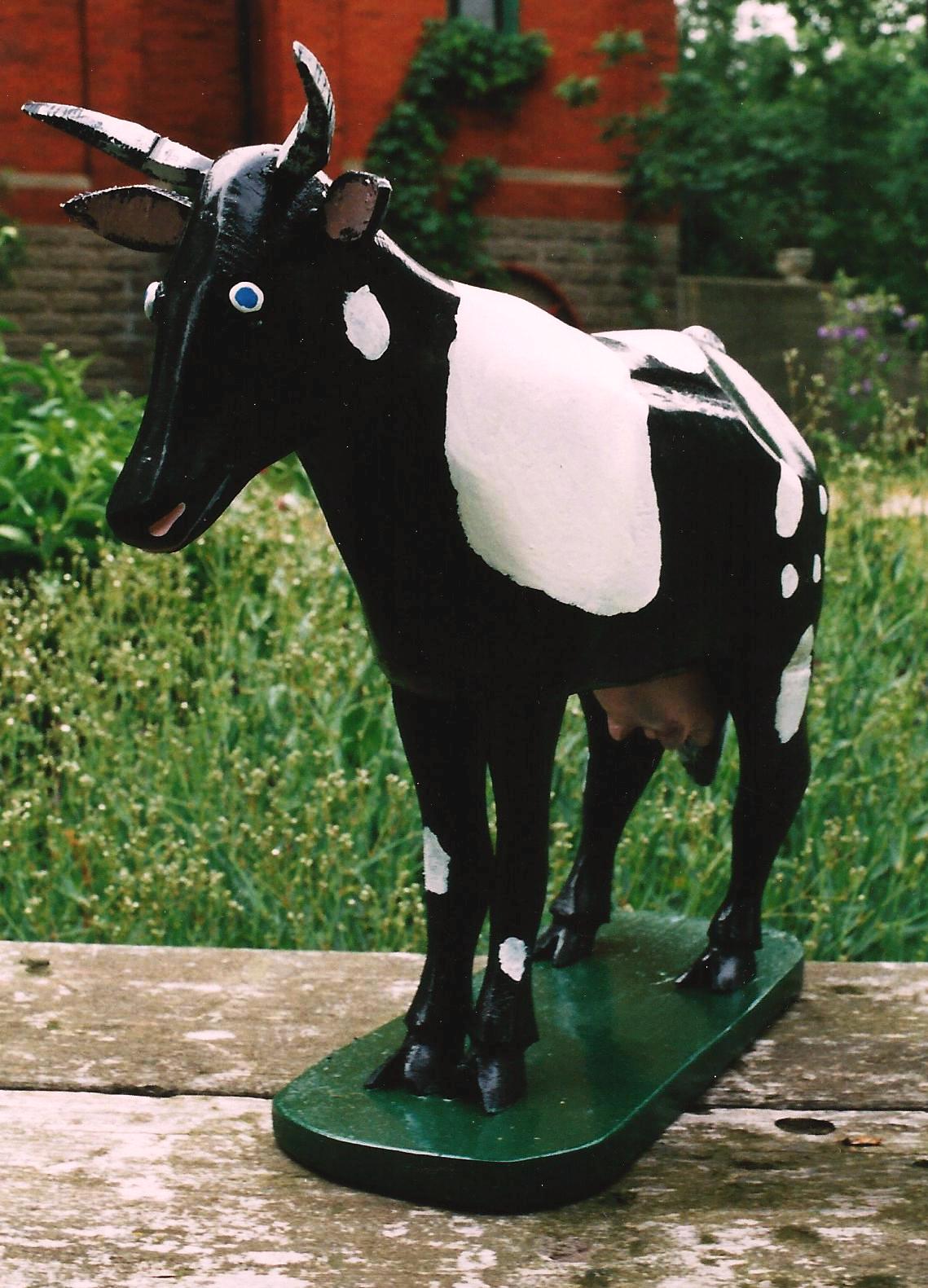
One day when I arrived Pierre said, “well I’m just going now to pick up the Indians, would you like to come along.”  “Well, of course I would”, and so off we went a few kilometers away to a town called St Eulalie (you gotta love those Quebec saints). We pulled in to a modest house and workshop along the river at the edge of town.  I could tell by the many totems, and stacks of wood that this was the place. rr2Roger was a jolly fellow who immediately launched into a funny story in a thick Patois.  I couldn’t understand a word, but I could tell it was funny because both he and Pierre were laughing so hard.  I joined in.  We had a great time.  I couldn’t help but notice that Roger was standing ankle deep in wood chips, and lighting a hand rolled cigarette with one hand, hot ashes falling to the ground.  I also noted that Roger carved a lot more than cigar store Indians. Cows, pigs, bears,fish, beavers, frogs, etc. They all had humor and a wonderful original style. I was buying enough from Pierre that he didn’t mind me buying some of Roger’s carvings, which I did happily that day, and every trip I made thereafter. rr1One day I arrived to find the entire yard covered with dinosaurs.  Apparently Roger had watched Jurassic Park with his grandchildren and was inspired.  Another time I was greeted by a giant mother giraffe, with a feeding baby underneath. The mother was too big for my truck but the baby came home with me.  Roger and his wife were always extremely welcoming and quick with the funny story,  and I always enjoyed the exchange, although I have to admit that in spite of my reasonable abilities in French,  I never got more than about 20% of what he was telling me. It didn’t matter.  We always had a wonderful time.

I did come to find out that he is of Mi’kmaq heritage, and that he loves to fish and hunt with bow and arrow, and that he is a warm and loving husband, father and grandfather, who has a God given talent for making his own unique version of Quebec carving.  He told me that when he was young he was taken on as an apprentice by a cigar store Indian maker, and that he had made hundreds, perhaps thousands over the fifty years or so that he was active  By the late 1990’s he was doing less and less carving, and more and more fishing and hunting, and I had also quit making the trip so often. In 2005 I dropped in on the Raymond’s for old time’s sake and Madam Raymond said that Roger was down at the river fishing.  As I drove away from the house I saw Roger standing in the middle of the stream casting, and he turned and saw me, but as we were too far apart to have conversation over the babble of the water, we just waved at each other, and he gave me his winning smile, and that is how I remember him.  As far as I know he’s still kicking. rr6

rr5rr7

Canadian Contemporary Folk Art Festival -part 2

digby ferry

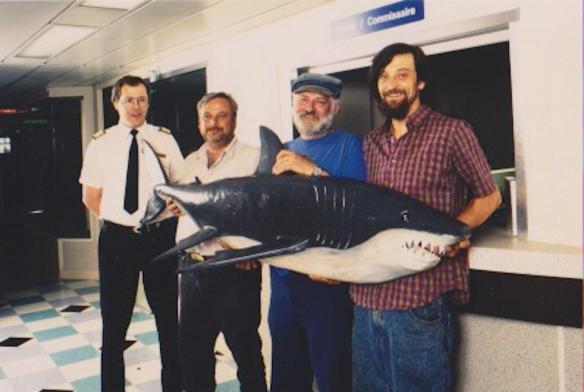
June 1994. Stephen Outhouse (middle with cap), Mark Robichaud (right), and David Stephens standing with the purser on the Digby ferry – on our way to Paris! We had this shark – a carving by Stephen – mounted to the top of the the truck cab.
I received this photo and note from Nova Scotia artist David Stephens shortly after last weeks post was published. Thanks David for permitting me to post it here. It’s a long drive from Nova Scotia for a one day show. This illustrates the dedication of all involved to this unique folk art event.
In looking over my support material, I came across some interesting definitions of folk art in the initial correspondence from promoter Michael Hennigan.  I include them here to add to the dialogue which we as collectors and enthusiasts continue to have on what constitutes folk art; and what of this art is worthy of study and preservation.
“The working definition of folk art for this show is: “the personal or naive expression of untutored creators”.  You will note that this definition deviates from those presented by folklorists and material culturalists which tend to emphasize context and tradition over aesthetics and individuality.  Rather it adheres to the connoisseurs or Art Historian’s definition with emphasis on form, line, and color.”
“I am trying to avoid ethnically based arts and crafts such as knife making, canoe building, basketry, newly made fish and duck decoys, or any mass produced craft lacking creative inspiration.  For the purposes of this show, Craft involves head and hand, while art involves head, and hand and heart.”
“I am also avoiding highly commercialized or slick assembly line work, or neo-folk art.  Which is defined as work made by self taught artists who get their ideas from seeing folk art elsewhere such as in books or museums. For purposes of the show such art is not folk art, but rather is about folk art.”
“Also, I am avoiding faux naif art, which is defined as art produced in a naif style by fine artists. Finally I am avoiding amateur or so called “Sunday” painting, as difficult as it may occasionally be to distinguish such art from folk art.  Folk Craft is also not allowed.  Folk craft is the folksy, cutesy pie, overly sentimentalized stuff seen at craft shows.”
With the inclusion of contemporary folk art at such distinguished shows as Cabin Fever, coming up February 6 and 7, 2016 in Kingston, Ontario, and the Bowmanville show which every year is on Good Friday, we have an opportunity to compare the work presented there to these definitions. I think that you will find that for the most part these shows rise to these standards.  I wish I could say the same for the field shows, but perhaps they will be inspired to improve as the knowledge of what constitutes folk art is understood by more and more people.   Here’s hoping.
I went through my photos and found a picture of one of the dinosaurs we brought to the show.  Imagine being greeted by two of these 9′ monsters.
dinosaur

9′ dinosaur by Roger Raymond

Canadian Contemporary Folk Art Festival- remembering a significant, one time, folk art happening

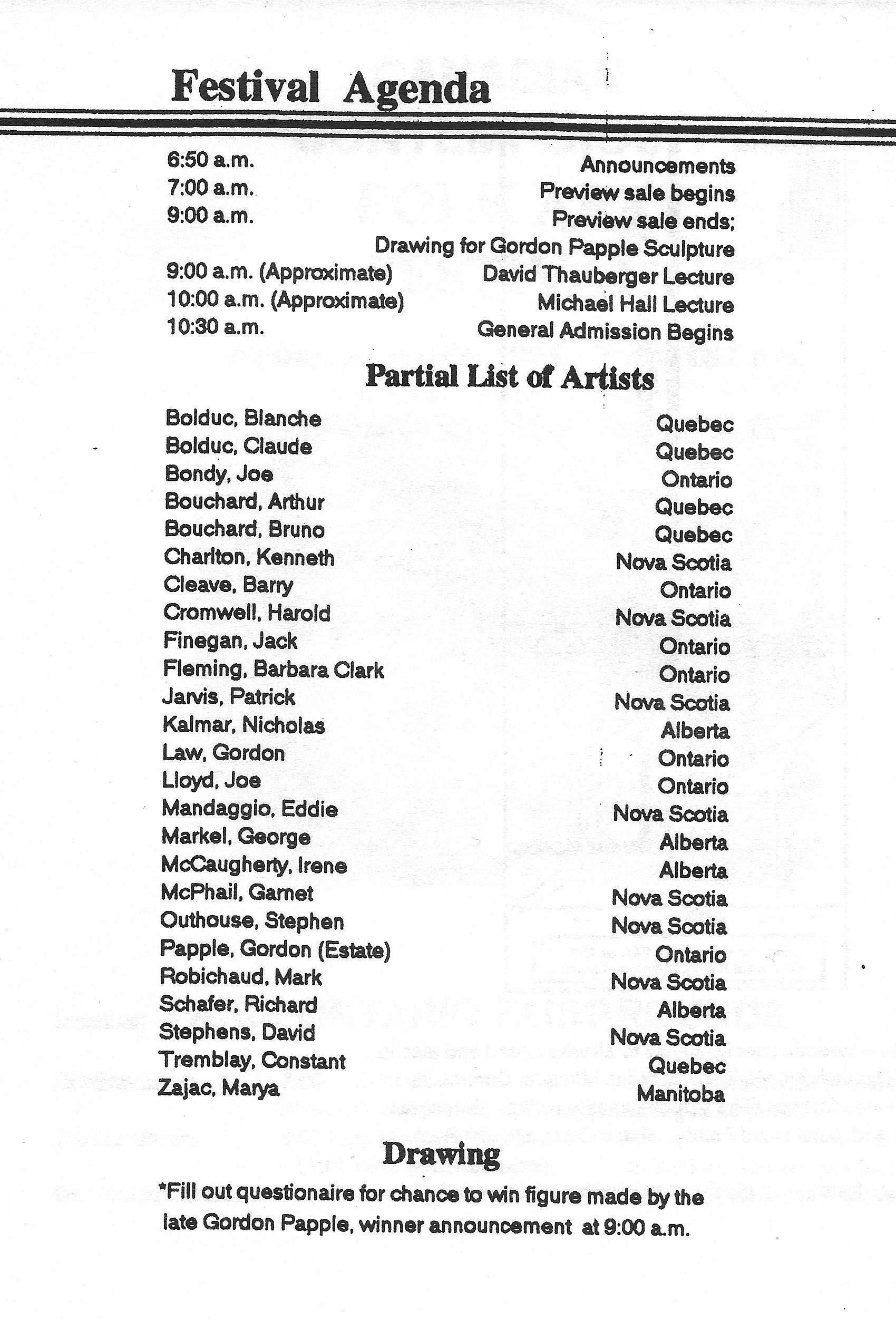
CCFAFposterBack on Sunday, June 26, 1994,  my wife Jeanine and I as Old Church Trading participated in an ambitious, extensive, and ultimately one time special event that was, and remains the largest and most exciting folk art festival ever to take place in Ontario, if not all of Canada.  Acknowledging here the annual Nova Scotia Folk Art Festival.  It included 2 lectures, displays by a half a dozen folk art dealers, and the work of about 25 Contemporary Canadian Folk Artists, many who were in attendance. It all took place  on one glorious summer day from 7 a.m. until 7 p.m. at the Paris Ontario fairgrounds. It was an extraordinary opportunity for collectors, dealers, and folk artists to interact and network and to honor and support Canadian Folk Artists.  I remain enormously  grateful for having been included in this great event; and we sold a lot of folk art too.

The whole thing was conceived, organized, executed and financed by Canadian Folk Art collectors Michael and Peggy Hennigan, of Grosse Pointe, Michigan, and it was a giant undertaking.  Not only for the set-up, and extensive promotion associated with a first time show, but also for organizing and paying for many artists to come from as far away as Alberta, and Nova Scotia. Many folk artists chipped in to help get the word out.  I remember Michael’s gratitude to Joe Lloyd of Brantford who made up and distributed signs. We brought 25 of our best pieces by Ewald Rentz, Edmond Chatigny, Aime, Desmeules, Jacob Roth, and others, and were particularity happy to bring along two recently acquired six foot tall dinosaurs created by Quebec folk artist, Roger Raymond.  They looked fantastic gracing each side of the entrance walk.  Looking back it felt like it was over in a flash, but at the time it was a long day of exciting exchanges, sales, connecting with new (to us) artists, and last but not least, education.  We met and started to carry the work of Woodstock area artist Barbara Clark-Fleming, and I was delighted with the opportunity to meet and hang out with the likes of Joe Lloyd, Garnet McPhail, Stephen Outhouse, and Mark Robichaud, not to mention all of those passionate collectors.

It was well attended  for a first time event.  A few hundred people as I recall, and most of those being driven and engaged;  but it was less than anticipated, and less than required for the Hennigans to consider doing it again when weighed against the enormous workload, and expense. No one could blame them, as they certainly gave it their all, and none of this diminishes the fact that this event lives on in the memories of those involved as a unique and exciting day for collectors, dealers and artists alike, and a prime example of just how rich, fun, and informative a folk art festival can be.

I am reproducing the program here, and next Friday I will post a further look at some exciting and defining ideas about folk art brought about by this event.  I am even going to look through my old photos and see if I can find a shot of those dragons.  No promises  I’ll do my best.

CCFAF3CCFAF2

Towards determining age in unmarked Collectibles -Brass Model “A” Sedan

6" long.  Marked Canada

6″ long. Marked Canada

Recently I noticed this molded brass car listed in the Saturday, January, 9th Plato Antique and Vintage Auction simply as “Brass Model “A” sedan car, 6″ long, marked Canada”. and realized I know something about it’s manufacture, and that it illustrates an interesting problem when trying to  determine the age of a small production, unmarked (in terms of manufacturer) Collectible.  Plato Auctions wisely did not suggest an age, but rather provided honestly all they could determine about the object.  That being said I don’t believe they are brass, but rather some kind of bronze-like alloy.  In any case, I  have seen this car and some other similar, (but different) models many times over my forty-five years, or so, of noticing such things, and every time it makes me feel nostalgic.   The reason being, is that I know that at least some of them were manufactured by my father, Charles Ross in Dresden Ontario, in the 1960’s.  What is interesting (hopefully) besides the story which I will tell is that at shows, and in articles I have seen them dated over a quite a wide span of time, and with various provenance;  and yes it is likely that some were produced before the ones my father produced in the 1960’s, as you will see.  Here’s what I remember about this time, and how my father came to make model cars.

My father owned and operated the weekly Dresden News, and monthly farm papers, Voice of the Lambton, Kent, and Essex Farmer.  All at the time were produced by the old letterpress method, which involved melting and remelting lead to feed into the Linotype machines which produced the copy type for the paper.  Those machines are an amazing story in themselves, but I will endeavor to stay on topic. The fact that my father had the technology to melt metals is what’s key.

As I recollect I was about ten when my father rather excitedly told me that we were going to drive the hour or so to Corunna, Ontario to buy something that I would be interested in.  I loved any drive along the St. Clair river so I was ready, and willing to come along.  One fine summer morning my father, mother, and myself pilled into the old Ford, and set out along road 33 which followed along the St Clair river.  I remember we stopped at a favorite little lunch spot in Port Lambton for a sandwich,  before arriving at the newspaper office in Coruna early in the afternoon.  My father was fairly secretive about his business, and suggested that my mother and me have a walk down to watch the boats pass along the river for a half hour or so while he conducted his business.  By this point I was wondering what I might possibly find interesting in a newspaper shop, but I could tell something was making my father excited, so I was too.

Upon returning, my father met us by the car and flung open the back of the station wagon with a big “ta da”, and there to my delight was a dozen or so Brass and painted black model “T” and model “A” cars and trucks all looking somewhat like the one above.  Also in the trunk were three or four crates which I later found out contained the molds used to manufacture the various models.  How he heard about them, or why he decided to buy them I do not know, but I remember that after that the newspaper office window was filled with cars and trucks,  and that before long people started to come in and purchase them, and of course I had a blast playing with them.

I know he had some arrangements to place them with local tourist attractions such as Uncle Tom’s Cabin which is on the outskirts of Dresden, and at other spots throughout the three counties that he used to travel on newspaper business.  I also remember his employees making them when they were not otherwise busy working on the newspapers, but I really have no idea how many he made, or for that matter, how many had been made in Corunna before him, or even where the molds came from in the first place.

The thing is, to look at them it is easy to imagine, because of the relative crudity of the manufacturing that they were made at the time of the cars they represent, and  for all I know perhaps that’s when they started.   But I do know that many of these were made as recently as the 1960’s.  You would be hard pressed to determine exactly when within  that  approximately forty year span such a car was produced.  Does a 1960 car have equivalent value to an identical one made in 1920?  Considering the exact same method and quality of materials were used, I suppose so.  And I think reflecting on this suggests that with certain types of small output, cottage industry type manufacturing, we shouldn’t get too hung up in the numbers.  And that establishing provenance is always tricky, and sometimes an “educated” guess at best.  And most importantly that in the end this ambiguity  doesn’t take away at all from the beauty of these toys from a simpler time.


“Time seemed to fly by” – the work of Wallace Murdoch

murbookIn reading the excellent report by Larry Thompson in the latest Canadian Antique and Vintage Magazine  of Tim Potter’s auction of the collection of the late Ken Murphy, I was happy to see that several of the pieces by Wallace Murdoch which I had sold to Ken drew strong prices.  This in spite of the fact that nobody seemed to know much about him.  It occurred to me therefore that it may be of interest to those who bought the works and more generally to those of us interested in Canadian folk art for me to tell the story of buying the collection and what I came to find out about Mr.  Murdoch.

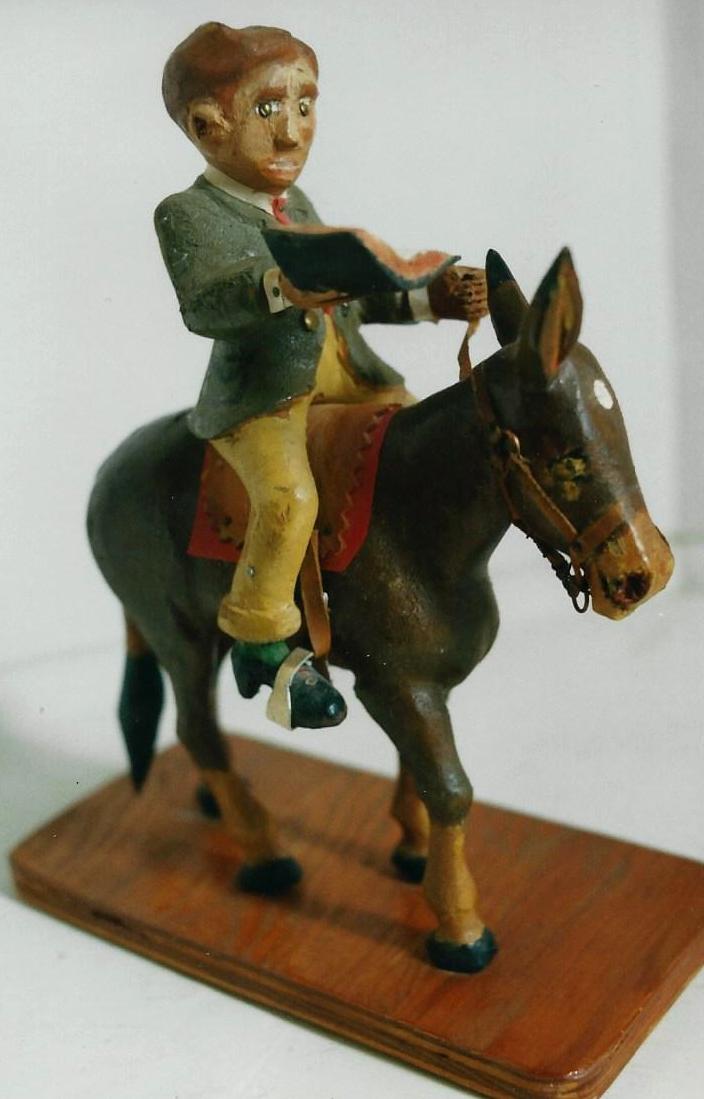
It was May of 2000 when dealer and show promoter John Forbes called me and told me that I should get on up to his Guelph home to see a collection of folk art he had just acquired.  “Yup, I’ll be right over”‘.  Jeanine and I went the next afternoon to see him and there on the harvest table was about 30 pieces of excellent carving, mostly centered around horses. We were duly impressed and quickly came up with a figure we could both live with.  John didn’t have or at least wasn’t sharing much information about the artist. Only that he had carved in the sixties, had lived in Shanty Bay, had died recently, and that a picker had bought all the works available from the family. No matter.  The work was strong and beautifully rendered and we were happy to have it all.

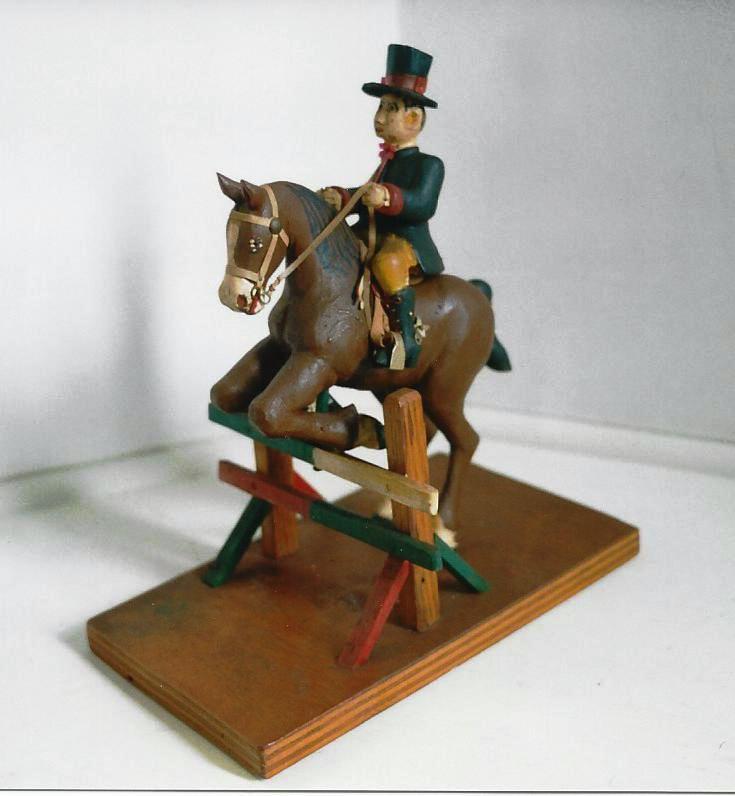
Then I did some nosing around and found out that the picker in question was Bob Creighton whom I knew, but when asked Bob was holding his cards close to his chest and added nothing, presumably so he could go back to see if he could find others.  So I decided to take a trip up to Shanty Bay which is near Orillia, Ontario to see what I could find out.  I went into an antique store there and the woman informed me that Wallace’s sister was still the post master in nearby Guthrie, so I went there, and sure enough found her working.  She was pleased to provide me with the details of Wallace Murdoch’s life and the copy of a 1966 Toronto Star article..  Equestrian jumper

Wallace Manson Murdoch was born April 24, 1893 in Bobcaygeon, Ontario. Before he was a year old his family moved to South River.  In March 1917 he married Myrtle Boyd.  They moved to the Barrie area in 1927, and then to Shanty Bay in 1930.  Here he stayed for the rest of his life.

He had a service station and auto repair shop.  Then he had the idea to start a school bus service which he did initially with horse and wagon, and then continued to operate this business for another 27 years.  Wallace and Myrtle had two son’s and five daughters.  In 1959 Wallace had a severe heart attack and was forced to retire and was forbidden to do any heavy work.  He found it difficult to just sit around so he started carving.  At first he just drew horses on plywood and cut them out.  Then he advanced to carving the complete forms out of blocks of white pine. Then he moved on to adding harness and sleighs, wagons, carts, and stage coaches.  He often fashioned his own knives to fit his needs.

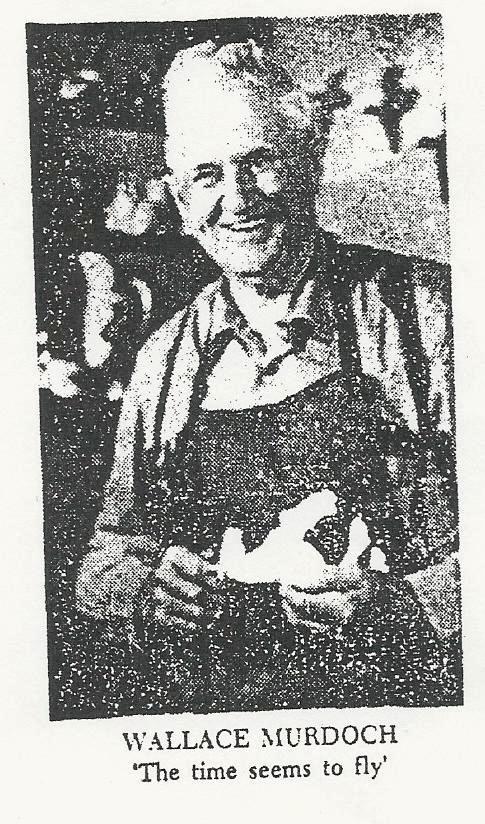
Wallace Murdoch

Wallace Murdoch

In the Oct 1, 1966 article, Dean Hughes points out that Wallace, although surrounded by hundreds of carvings, mostly horses that he had accomplished over the last six years, was reluctant to sell his work.  And since Murdoch obviously didn’t do it for money, what did he get out of it?

“I seem to leave a little of myself in everything I carve.  The time just seems to fly by.  It takes me about fourteen hours to carve a horse and I love every minute of it – from the minute I get up in the morning until I go to bed. And I get to love these horses I carve so much that I don’t like to part with them. Wallace Murdoch died November 3rd, 1966

Antique Surfaces – getting down to the original finish.

chemical strip to original colour

chemical strip to original colour

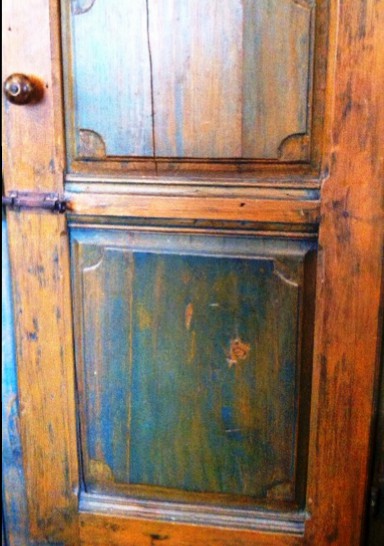
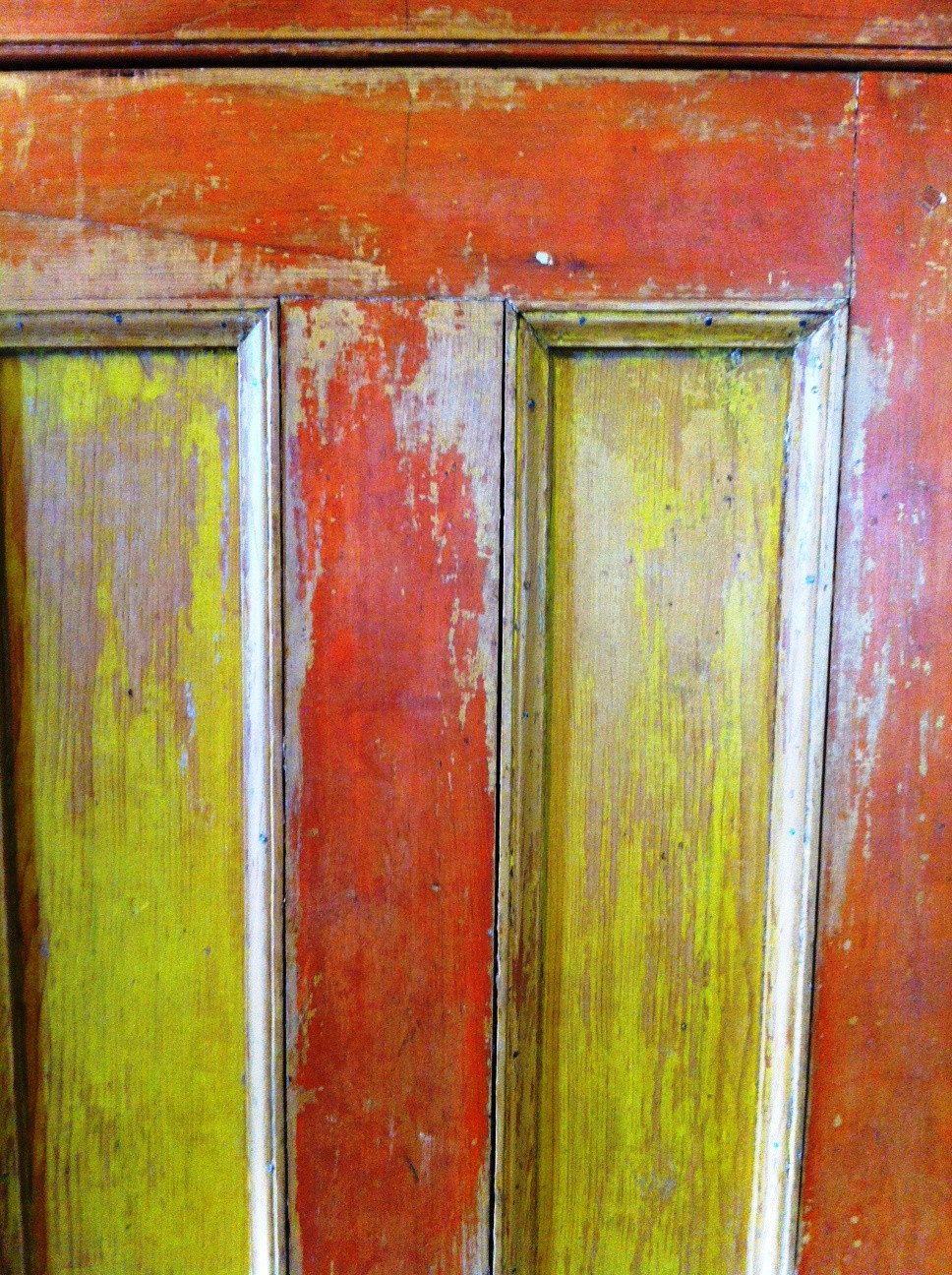
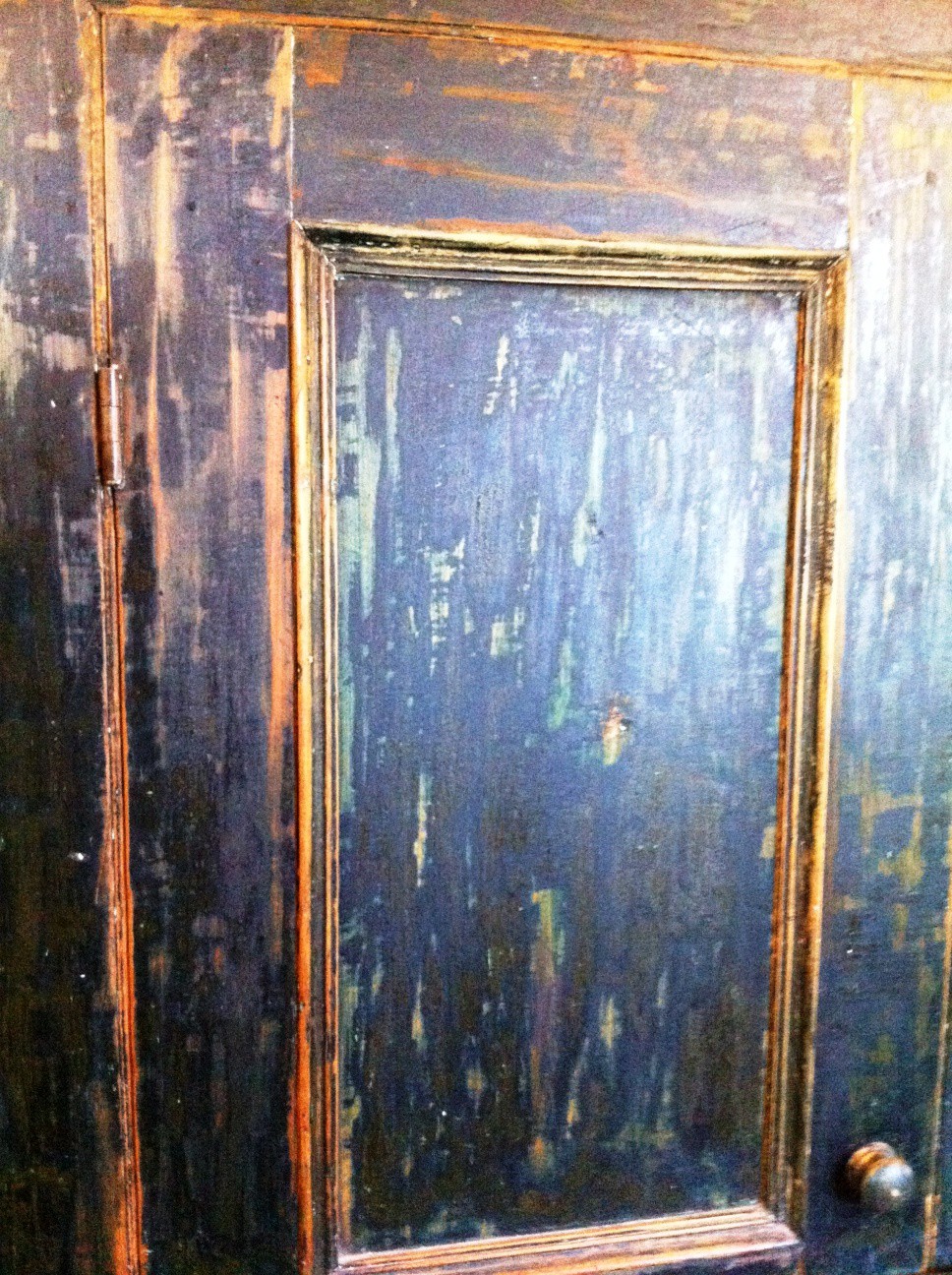
Often, if a piece has a great original paint which has been over-painted one or more times over the years, a dealer/collector will choose to attempt to take off the layers of over-paint to arrive at the original. This can be an “iffy’ proposition, and it is a good idea to first carefully examine the piece to make sure that there are no replaced parts for instance which would not have the original paint on it.  There is basically two ways to “take down” a piece. Either using a chemical stripper  to “pop” off the upper coats of paint, or by dry scraping.  Depending on what paints are used one or the other may work better, but in most cases if you take the time, dry scraping will leave you with more of the  original surface. With big emphasis on taking your time.  Sometimes though if the original coat is in good condition, and especially if it is a milk paint which is not effected by stripper, and if you have very good and consistent timing and are quick with a scrapper, you can get the over-paints to pop clean, and you are left with a good surface colour.   On this piece you can see that they were not too concerned with retaining the original colour as they were either in a hurry, or wanted a balance of the paint and wood colour combined.  This was a popular look back forty or so years ago and is a bit of a shame in my opinion.

Below are two examples of dry scrapped surfaces

dry scraped carefully by a master refinisher

dry scraped carefully by a master re-finisher

 This is an example of the work of the late Allan Clareman, who in my opinion was the best you’ll find at this process.  He practiced law until an inheritance allowed him to do what he truly loved to do full time, which was to take over-paint off antique furniture.  He worked meticulously with tiny sharpened dental tools, and a jeweler’s loop attached to his glasses so that he could see exactly what he was doing.  This cupboard took him over a month but you can look as carefully as you are able and you will not see one blade mark. It cost over $1,000, but was a bargain considering the time involved, and how beautiful it turned out. It was worth every penny of it.

This cupboard on the other hand is an example of hasty, crude work.

dry scraped quickly and by a non professional

dry scraped quickly and by a non professional

It still retains a lot of colour, but you can see all kinds of gouges and scratches caused by working too quickly with the knife or scrapper over uneven surfaces.  A local dealer here used to swear that using a piece of broken glass was best, but the work he did didn’t support his theory. Concentration,and patience is the key, no matter which method you use.

I have done a lot of this type of work over the years, and it can be very relaxing and rewarding as long as you don’t become concerned about the passing of time.

In future posts I will provide a few tips on how to go about it.  For now consider these surfaces and look at other examples to try and determine the method used, and the degree of expertise.