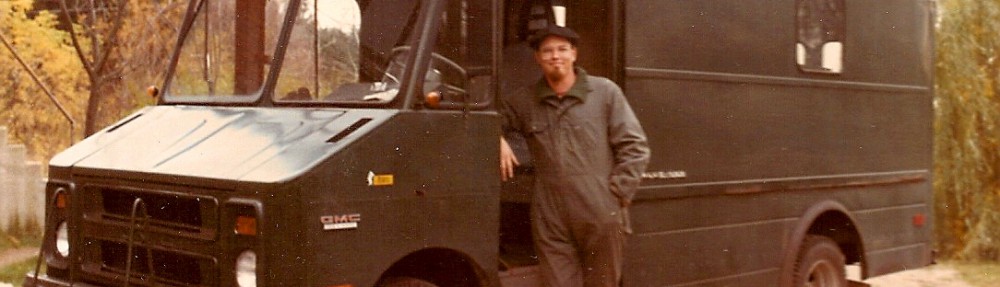
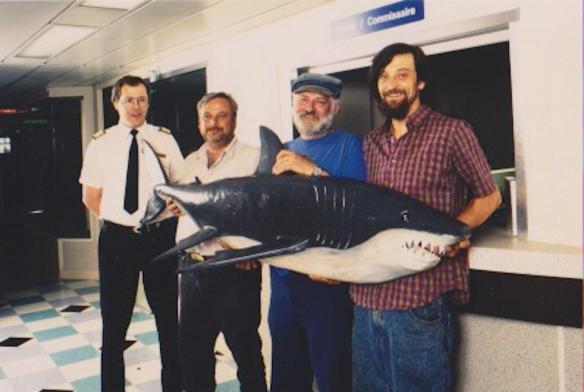
June 1994. Stephen Outhouse (middle with cap), Mark Robichaud (right), and David Stephens standing with the purser on the Digby ferry – on our way to Paris! We had this shark – a carving by Stephen – mounted to the top of the the truck cab.
I received this photo and note from Nova Scotia artist David Stephens shortly after last weeks post was published. Thanks David for permitting me to post it here. It’s a long drive from Nova Scotia for a one day show. This illustrates the dedication of all involved to this unique folk art event.
In looking over my support material, I came across some interesting definitions of folk art in the initial correspondence from promoter Michael Hennigan. I include them here to add to the dialogue which we as collectors and enthusiasts continue to have on what constitutes folk art; and what of this art is worthy of study and preservation.
“The working definition of folk art for this show is: “the personal or naive expression of untutored creators”. You will note that this definition deviates from those presented by folklorists and material culturalists which tend to emphasize context and tradition over aesthetics and individuality. Rather it adheres to the connoisseurs or Art Historian’s definition with emphasis on form, line, and color.”
“I am trying to avoid ethnically based arts and crafts such as knife making, canoe building, basketry, newly made fish and duck decoys, or any mass produced craft lacking creative inspiration. For the purposes of this show, Craft involves head and hand, while art involves head, and hand and heart.”
“I am also avoiding highly commercialized or slick assembly line work, or neo-folk art. Which is defined as work made by self taught artists who get their ideas from seeing folk art elsewhere such as in books or museums. For purposes of the show such art is not folk art, but rather is about folk art.”
“Also, I am avoiding faux naif art, which is defined as art produced in a naif style by fine artists. Finally I am avoiding amateur or so called “Sunday” painting, as difficult as it may occasionally be to distinguish such art from folk art. Folk Craft is also not allowed. Folk craft is the folksy, cutesy pie, overly sentimentalized stuff seen at craft shows.”
With the inclusion of contemporary folk art at such distinguished shows as Cabin Fever, coming up February 6 and 7, 2016 in Kingston, Ontario, and the Bowmanville show which every year is on Good Friday, we have an opportunity to compare the work presented there to these definitions. I think that you will find that for the most part these shows rise to these standards. I wish I could say the same for the field shows, but perhaps they will be inspired to improve as the knowledge of what constitutes folk art is understood by more and more people. Here’s hoping.
I went through my photos and found a picture of one of the dinosaurs we brought to the show. Imagine being greeted by two of these 9′ monsters.
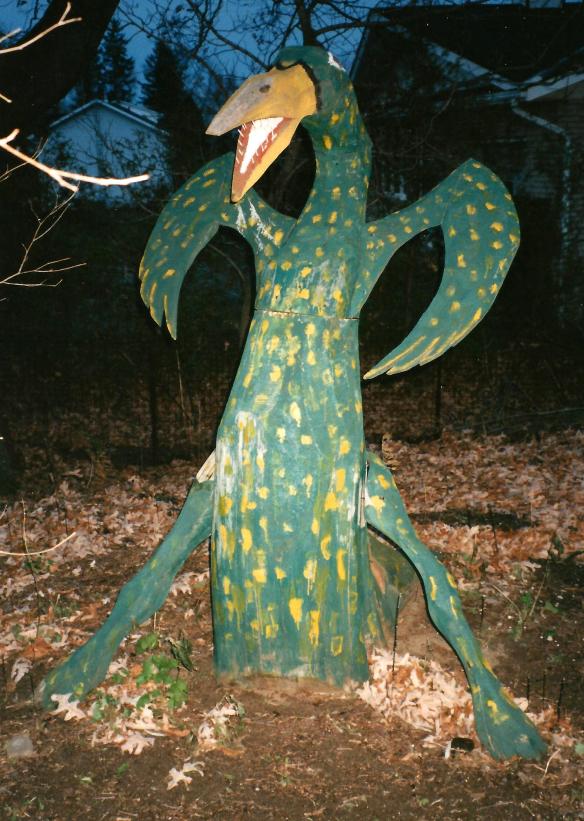
9′ dinosaur by Roger Raymond



 shadflyguy