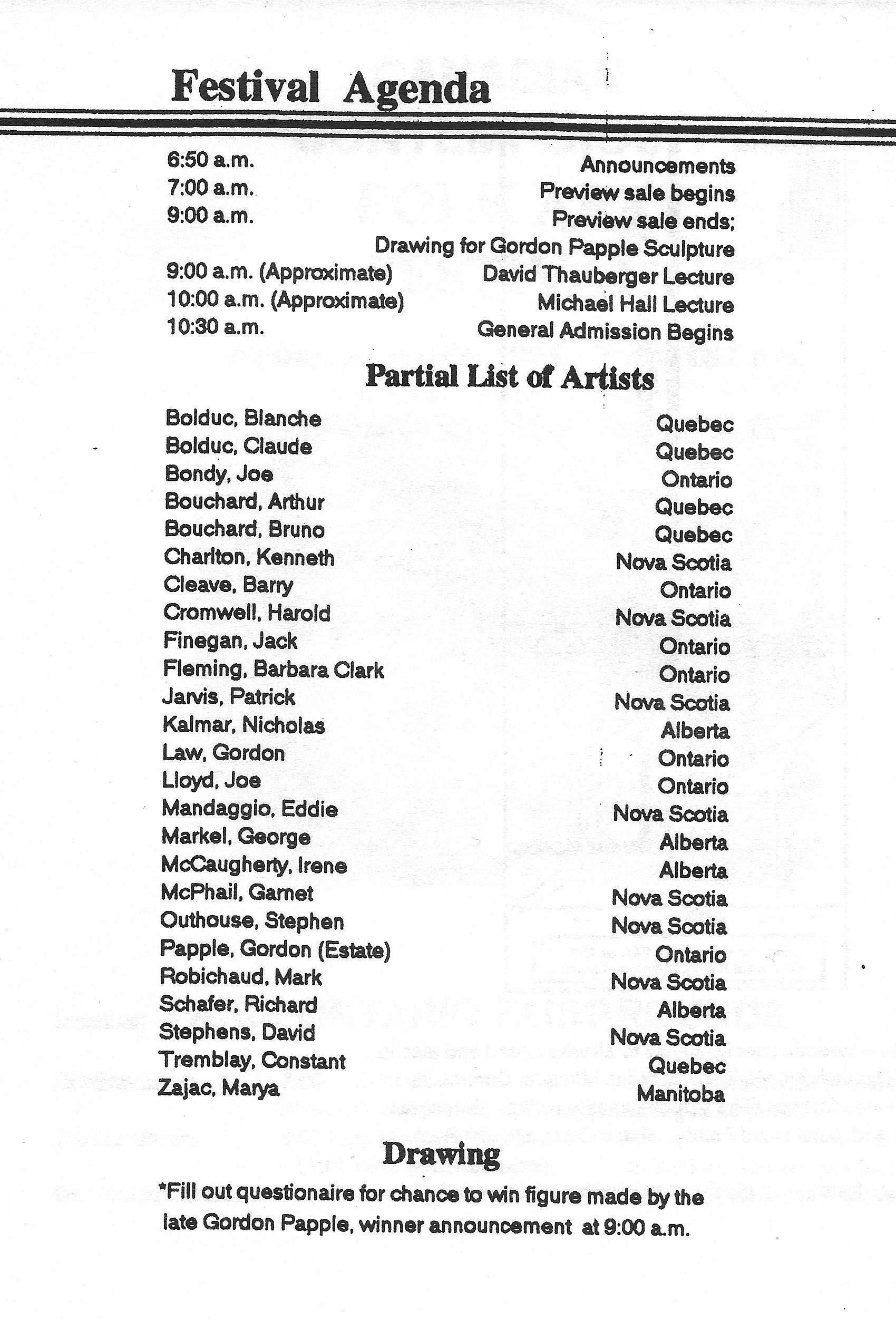
 Back on Sunday, June 26, 1994, my wife Jeanine and I as Old Church Trading participated in an ambitious, extensive, and ultimately one time special event that was, and remains the largest and most exciting folk art festival ever to take place in Ontario, if not all of Canada. Acknowledging here the annual Nova Scotia Folk Art Festival. It included 2 lectures, displays by a half a dozen folk art dealers, and the work of about 25 Contemporary Canadian Folk Artists, many who were in attendance. It all took place on one glorious summer day from 7 a.m. until 7 p.m. at the Paris Ontario fairgrounds. It was an extraordinary opportunity for collectors, dealers, and folk artists to interact and network and to honor and support Canadian Folk Artists. I remain enormously grateful for having been included in this great event; and we sold a lot of folk art too.
The whole thing was conceived, organized, executed and financed by Canadian Folk Art collectors Michael and Peggy Hennigan, of Grosse Pointe, Michigan, and it was a giant undertaking. Not only for the set-up, and extensive promotion associated with a first time show, but also for organizing and paying for many artists to come from as far away as Alberta, and Nova Scotia. Many folk artists chipped in to help get the word out. I remember Michael’s gratitude to Joe Lloyd of Brantford who made up and distributed signs. We brought 25 of our best pieces by Ewald Rentz, Edmond Chatigny, Aime, Desmeules, Jacob Roth, and others, and were particularity happy to bring along two recently acquired six foot tall dinosaurs created by Quebec folk artist, Roger Raymond. They looked fantastic gracing each side of the entrance walk. Looking back it felt like it was over in a flash, but at the time it was a long day of exciting exchanges, sales, connecting with new (to us) artists, and last but not least, education. We met and started to carry the work of Woodstock area artist Barbara Clark-Fleming, and I was delighted with the opportunity to meet and hang out with the likes of Joe Lloyd, Garnet McPhail, Stephen Outhouse, and Mark Robichaud, not to mention all of those passionate collectors.
It was well attended for a first time event. A few hundred people as I recall, and most of those being driven and engaged; but it was less than anticipated, and less than required for the Hennigans to consider doing it again when weighed against the enormous workload, and expense. No one could blame them, as they certainly gave it their all, and none of this diminishes the fact that this event lives on in the memories of those involved as a unique and exciting day for collectors, dealers and artists alike, and a prime example of just how rich, fun, and informative a folk art festival can be.
I am reproducing the program here, and next Friday I will post a further look at some exciting and defining ideas about folk art brought about by this event. I am even going to look through my old photos and see if I can find a shot of those dragons. No promises I’ll do my best.


 shadflyguy