Albert Hoto – 1953 Toronto newspaper article

Jack Knife Sculpture is authentic Canadian Folk Art: – Wins CNE Prize


DUNNVILLE (Special) – Sincere expressions of artistic talent may often flower off the beaten track and it is in this way that what many feel is a genuine contribution to Canadian folk art has been made in the Stromness   a few miles south and east of Dunnville.

In this quiet hamlet off the main routes of travel J.A.Hoto a retired farmer has created in the past three years a gallery wood carvings that may stand in their own right any comparisons with the best of the more celebrated French Canadian art.

Colored with an unerring eye and a bright and refreshing taste, and carved with an unselfconscious feeling for animal and human form, the little figures have an almost irresistible appeal to young and old.

Using only a bone handled jack knife and a hand coping saw Mr. Hoto, who has never had any formal art education, has peopled a miniature world with diminutive representations of rural life

Mr. Hoto who calls his creative impulse merely a hobby has been a farmer all his life in the township of Sherbrooke  in which he lives now. He recalls that as a youth he was talented with a jack- knife and at sketching, but when he took up the profession of farming he laid his artistic gift to one side  for lack of time.

With his retirement five years ago this thoughts turned once more to the interest of his youth butit was not until three years ago that he once more took up wood carving.

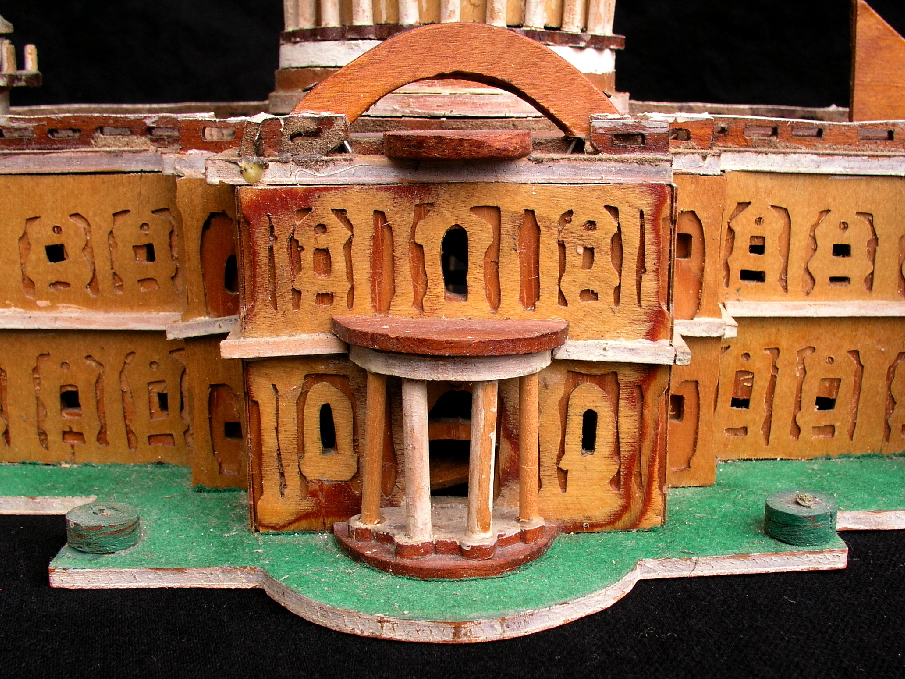
Since that time he has completed a collection of carved figures, animal and human, that include a stagecoach and train, a racing Roman chariot being pulled at a gallop by a span of four dabbled horses and a tableau of 40 native Canadian birds in their exact colours and stances.

Partial recognition of his talent was received by Mr. Hoto at this year’s CNE when he took the exhibitions second prize in the hobby class for the three dimensional representation of a brewery wagon pulled by a team of six horses.

The work is complete with miniature barrels ready for delivery and a driver sawing at the reins as he controls the team.  The work was completed during spare moments in about a month’s time.

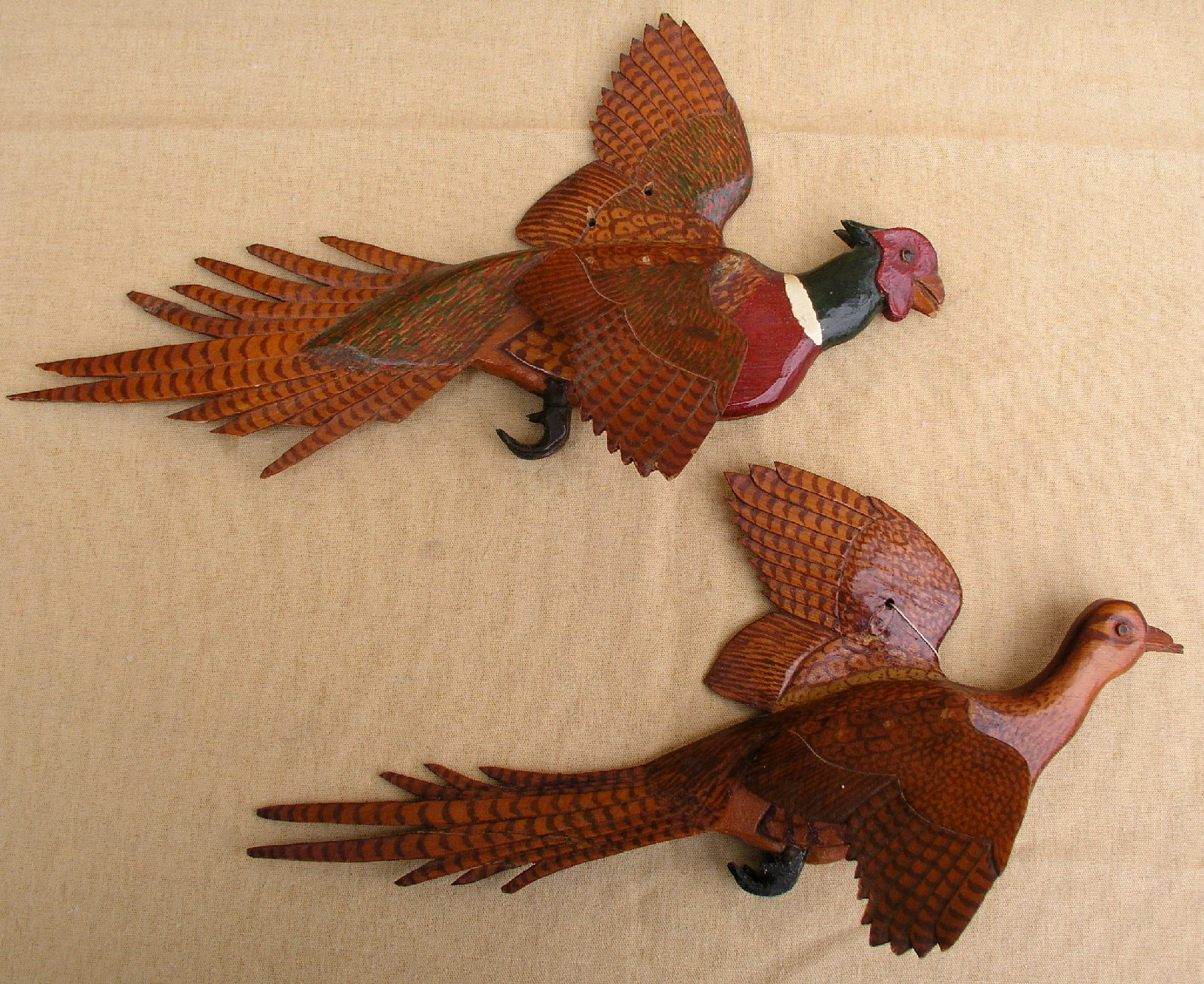
A specialty of Mr Hoto’s are carvings of game birds in flight. These include Canada geese, pheasant and ducks colored naturally and carved with an amazing feeling for movement.

Many of these are to be seen in the homes of district people . U.S. tourists have been quick to recognize the originality of Mr. Hoto’s carvings and have purchased many of the plaques.

The larger groups which consist of wagons and horses in action plyus human figures and an occasional dog running pell-mell alongside are not offered for sale.

These, Mr. Hoto wishes to keep, but he will sometimes offer to carve a replica of any of his smaller works for those who appear interested.

Mr. Hoto’s workshop is a tiny room in a neat little shed in which there is barely room for himself and his current projects.

Here surrounded by animal pictures clipped from illustrated newspapers  and magazines he creates his models of the life he has glimpsed about him on the farm and local towns and villages.

The front portion of a garage facing the village street is wired off and in glass cases made by himself many carvings are displayed.

Asked where he gets his ideas for carvings, Mr Hoto only smiled and observed they just came to him. Some he stated were suggested by cronies. Their influence he indicated had encouraged him to tackle his Exhibition exhibit.

His farm experience he said had given him his eye for carving the various gates of horses and the outlines of livestock.

This ability enables him to cut the living outline of a horse or cow out of a blank piece of paper in 60 seconds with no model or preliminary sketch to assist him.

“It’s not practice” Mr. Hoto observed. ”it’s  just a gift.”

John Albert Hoto – Creative Ability of an Unusual Nature

I was recently surprised and delighted when a picker from the Niagara Peninsula brought me in 8 small wood carvings by Albert Hoto . I very occasionally run across work from this highly skilled carver from Stromness, Ontario, and I’m delighted when I do because in my opinion he is a “top drawer”  Canadian folk artist. I would suggest he deserves this classification not only for his artistry and skill, but also his dedication to the work.  He kept at it out there in his workshop.  Producing thousands of finely detailed and original carvings of horses, farm scenes, wild birds, domestic and farm animals,etc.,  He was a natural, working his magic with his only a few tools;  a jackknife, a coping saw, and a great deal of patience.   He is well documented and illustrated in books such as the Price’s ’twas ever thus, and many others .

Within a month of my posting the pieces on the Shadfly website, I was contacted by Mr. Hoto’s grand daughter, Mrs. Ruth Marr.  She was friendly and helpful, and I am thankful that her interest is such that she made the effort to come to the shop to allow me to copy clippings and to tell me about her grandfather,  I enjoyed the articles and photos and I am happy to pass this information on.   What follows is a short biography based on Ruth’s information and an unnamed local clipping from 1956.  Also, I have reproduced in it’s entirety, a clipping from an unnamed  Toronto newspaper from 1953, the year his carving of a brewery wagon drawn by a six horse team won second prize for at the Canadian National Exhibition.  I chose to use a quote from an attached  photo caption from this article for the title.

John Albert Hoto

( July 2, 1886 -December 17, 1979)

Albert, as he was known, Hoto was born on the family farm in Stromness Station, south of the Welland canal near Dunnville, Ontario.  He had three brothers and two sisters.  He lived and worked on the farm until he married Florence Geneva Spellman on November 21, 1908.  They bought a farm nearby in Sherbrooke, Ontario.  They worked the farm and raised three daughters, Dorothy, Marjorie, and Gladys .  In 1948 Albert  retired and sold the farm. They built a home in Stromness along the feeder canal that runs between the Welland canal and the Grand River.

After working hard on the farm for so many years Albert found retirement difficult.  In 1950 he decided to take up the slack hours with wood carving.  He picked up his jack knife and set at it.  “I just couldn’t sit back in a rocking chair when I retired” he said”I had to keep doing something”.

In 1953, three years after starting , he received wide praise and attention when he won second prize for his carving of a brewery wagon at the C.N.E.  Soon he hung a white sign with neatly painted black letters in front of his small showroom stating only “Ornamental Woodcarving”.  He was prolific and sales were brisk.  This trend continued  as his reputation spread.  He won more prizes in some important  competitions such as the International Hobby Show in Toronto in 1956.  “My work is pretty well distributed’ he noted. He sold carvings to people from the area who would visit him at his workshop during summer months.  Eventually his work was bought by serious collectors from across Canada and the United States .

Using only a bone handled jack knife and a coping saw, and without any formal artistic education he created  a miniature world with diminutive  representations  of rural life.  He carved with an unselfconscious feeling for animal and human form.  He stated that his farm experience had given him an eye carving the various gates of horses and the outlines of live stock. Alongside his farm carvings, his specialty  became the carvings of game birds in flight. These are renowned for their natural colouring and amazing feeling of movement.

Mr. Hoto denied that it took great patience to produce the intricate works. “If you are doing something that you like” he explained” it is never work.” I don’t feel that it takes too much patience for me. I like the work, and the time seems to go easily”.

Mr. Hoto continued to work and sell his carvings from his home workshop until his death at age 93 in 1979.

Finding Value in Folk Art


Occasionally I will have a Maud Lewis painting displayed for sale in my shop, and it is sometimes interesting to get people’s reactions to a $6,000 painting that at first glance looks like their 12 year old niece painted it.  A “my goodness will you look at that”, and some covered up snickering pretty well expresses their complete disbelief that something so simple could possibly be worth so much money.  I occasionally will give a brief description of the circumstances of her simple Nova Scotia life, and add fuel to the fire by informing them that in her lifetime she sold them for twelve to fifteen dollars from her tiny little house by the side of the road.  I then suggest that it is probably simplest to think in terms of supply and demand.  The supply of these paintings has stopped since her death in 1970, and there are many more people wanting them than there are paintings available.  This of course skirts the main issue of their confusion as to how anything like this could be desirable in the first place. To answer this you have to go a lot farther.

Charlie Tanner, Mother and Child

Beauty is in the eye of the beholder, and for some people, and I include myself in this group, great value is placed in anything that is produced by man or woman that manages to capture, or in some way manifest beauty.  I do not mean “pretty picture” beauty here.  I mean beauty as in creations that manage to be a celebration of existence, or a connection to the greater truth.  Something that has energy.   This energy can be found occasionally in the works of trained and untrained artists alike.  The real value in truly great works of art is in experiencing them, and in doing so to be educated and transformed by them.  Understanding beauty is our salvation.  Money really just confuses the issue.   So in relative terms, $4 million for a Tom Thompson and $6,000 for a Maude Lewis:  the Lewis is still cheap.

Finding Folk Art

What is folk art.  Any precise definition of art is by nature a slippery process and open to question.  “Folk art” is a term applied to such diverse things as a finely crafted, highly organized Mennonite fracture drawing which expresses the collective manifestation of an ethically based decorative tradition, and yet is also applied to the highly individualistic outpouring of any untrained painter, sculptor or other practitioner.

Folk art is usually one step beyond the mundane.  Not just a container to bring water to the mouth for survival (cupped hands for example), but instead a cup lovingly fashioned to bring pleasure or attract notice even when it is not being used, such as an intricately carved canoe cup.

On another level we can simply say that folk art is the art of the ordinary people.  It is sometimes called primitive art or the people’s art because by definition the artist has not been academically trained.

Folk art is made for one or more of three reasons: to share beliefs and traditions, to make some useful object beautiful, or to express one’s feelings.

Folk art, by definition has been produced and appreciated since cavemen and women started smearing blood and feces on cave walls, but the academic study and appreciation of folk art is a relatively new thing.  An English writer named William John Thomas first coined the phrase “folk lore” in 1848.  At the time most anthropologists considered folklore as worthless peasant creations.  They were more interested in studying artifacts such as weapons, tools and such.   It was through popularized folk tales such as the Brothers Grimm books that peasant traditions and art forms began to become interesting to the intellectual  class.

I would argue that folk art did not show up on the radar of fine art institutions until around the turn of the century in Paris, when Pablo and the boys flipped out over the African art they saw for the first time, and started producing what today is called modern art.  This led to a wider acceptance of all forms of art.  Folk art has become increasingly more popular and studied in Canada, really since Expo 67 gave us a greater appreciation of who we are.

Carved cane attributed to Chief Beaver sells for $17,500

Several eyebrows were raised when the hammer came down at $17,500 plus10% buyer’s premium, plus tax on a carved cane at the October 1st Jim Anderson auction in Jarvis this past October 1st.  Lot 101 was described in the catalogue as an “exuberant and imaginative work attributed to James Beaver. This technically proficient piece features a carved beaver as the hand piece of the cane, well carved in an early style”.  Dealer chat beforehand suggested that it should come down around the $4-6,000 mark if it was anonymous.  Anyone’s guess with the attribution to Beaver.  We were all surprised by the outcome. It was however no surprise that it went to a dedicated collector of his work who is known to have collected over thirteen paintings by the artist.

Known as “The Six Nations Artist”, Chief Beaver travelled the Grand River from Caledonia to Brantford in the 1890’s, painting houses and business buildings for a living. During his life span from 1846 to 1925 he lived at Beaver’s Corners near Ohsweken on the Six Nations Reserve. A gifted man of many talents, he was known as a carpenter, a wood-carver, a juggler and a showman, as well as a painter.

On stage, he was “Uncle Beaver” as he travelled across Canada and the United States with road shows, carnivals and medicine men. Today some homes on the Reserve still retain samples of his woodworking and fine carpentry skills.

Jim Beaver and his wife, Lydia (Bay) from a Mohawk Reserve in Quebec, raised three sons and four daughters. Granddaughter AIta Doxtador remembered being impressed by a concert her grandfather put on in Christ Church at Beaver’s Corners and the canvas backdrops he painted for the occasion. She also remembered seeing him seated in front of his easel. Because he couldn’t read or write, he once asked her to write TITANIC on a paper for his painting of a ship.

I currently have a Beaver painting of flamingoes which is one of his more generic Victorian scenes that he would have sold from door to door.  You can view it on my shadflyantiques.com website; and there are examples of his furniture, at the Chiefswood Museum near Oshweken, and other examples of his painting and carvings at the excellent Woodland Cultural Center in Brantford.

“Open all hailing frequencies”

So oddly, I start this blog space with a rather faded reference to “treky” days  when in fact this is going to be a blog about the life, and times, and observations of Shadflyguy –  humble servant, and seeker of the authentic and beautiful in things produced by past and in some cases of present people.

Come and enjoy with me a nice cup of tea or coffee, or espresso as the case may be, and I will attempt to explain why for the past thirty years I have occupied my waking moments finding, selling, and researching Canadian antiques and folk art, when in my “previous” life I was trained and fully employed making high tech slide extravaganzas, as were “all the rage” then at places like Expo 67, and Ontario Place.

I am going to attempt over time to transfer to this site the four giant drawers I have full of photographs, notes, and background information on some of the Canadian folk artists I have met.  This  in some kind of orderly fashion so as they may be useful to those seeking this previously unpublished material.  I am also going to attempt  to relay some of the juicier “picker’s stories” I have heard in my travels because they are fun.  I may even illuminate some old time dealers tricks, and things to watch out for when buying antiques.  If I really get rolling I may even start to document my furniture restoring techniques. Although I am concerned about the possibility of someone ruining dear Grandma’s rocker and holding me personally responsible…. hmmm.  You can see I am thinking about categories, and ramifications.  I think I may have the hang of this but do I have the chops.  We’ll see.

Right up front I want to thank my daughter Cassandra for leading the horse to water.   O.K. Welcome aboard, and let’s get at ‘er and post this puppy before I loose my nerve.

cheers,

Shadflyguy