Folk art arrives at the door – The Barbara Browne Collection

BBrown5

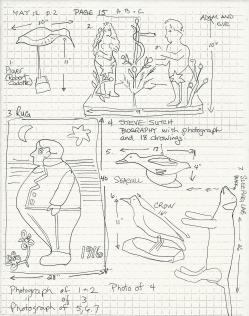
drawing by Liz Barrett-Milner

It was a sunny, August day in 1995, and we had just finished our lunch when there came a knock on the back door.  We weren’t expecting anyone, and it was rare for anyone to visit without calling ahead.  This, because we were so often on the road that our friends knew to give us the heads up before coming by.  We opened to find a small elderly lady standing there with a big smile and a portfolio under her arm.  “Are you the folks who buy folk art?”  “Well yes, we have been known to do so.  How can we help you?” “My name is Barbara Browne, and I live down the road in Port Rowan, and I have a collection of folk art which I would like to sell.”  “Come right in and tell us about it.”

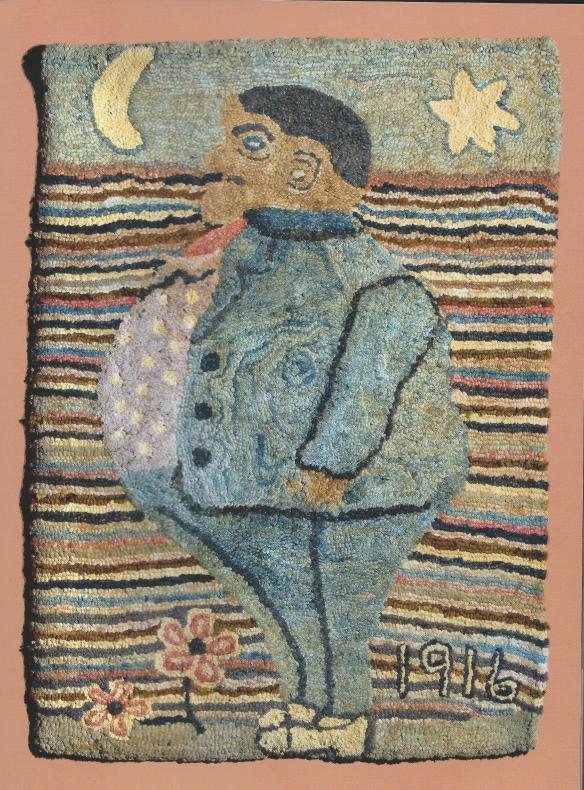
She explained that she was an artist who had collected Canadian folk art for the past twenty years, and she was about to buy a smaller house in Simcoe, and thus needed to downsize, and recoup her investment to help with the purchase.  “What is the nature of your collection?”  She reached into her portfolio and produced a twenty-page booklet of meticulously hand drawn illustrations of folk art with dimensions, which we later learned were produced for her by her niece, well-know Norfolk artist Liz Barrett-Milner.  “It’s all in here.  There are 185 pieces all told, and I am only interested in sell the whole thing.  No picking and choosing.”  There was some mind blowing stuff, including works by Nova Scotia artists Charlie Atkinson, Charlie Tanner, and Everett Lewis; as well as many Ontario artists such as Clarence Webster, Joe Lloyd, Steve Sutch, and Robert McCairns.  Most pieces were smaller in nature, but there was also a big wall-mounted cow’s head, a couple of 8’ totem poles, a full size deer, and last but not least, the best folk art hooked rug I had ever set eyes on, depicting a fat man and dated 1916.
BBrown2

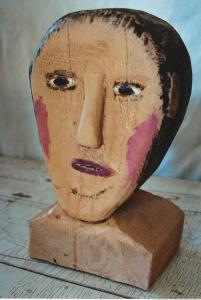
head by Robert McCairns

“We won’t beat around the bush.  It’s all of interest, but of course it depends on your expectations” She then produced an itemized price list of what she felt would be current list prices.  “I understand you need to make money, so this is what I think it is worth, and I would therefore expect half”.  “In principle that sounds fair so let us go over it and get back to you.”

What followed was four or five meetings at her house where we viewed the items and discussed the prices.  It became a bit complicated as each time we arrived we she had decided that there were a few more items that she felt she needed to keep, but it came to pass that we arrived at a final list and a final price, and so a date was set to complete the deal and pick up the pieces.

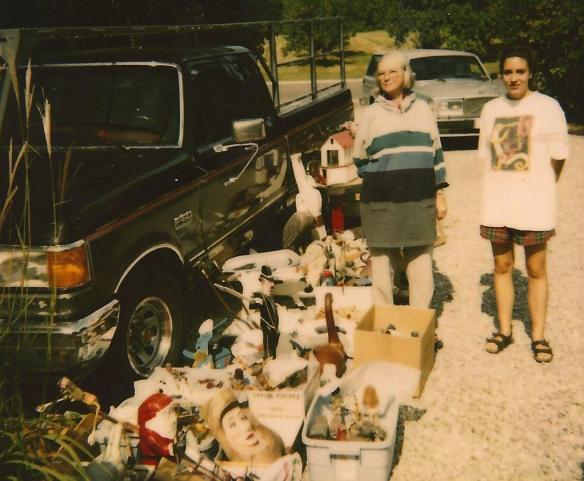
On that day, she informed us that she didn’t want to be there as we removed the pieces as it would be sad for her, so she wanted to go for a walk and return when we were finished.  We weren’t at all comfortable with this, but agreed on the condition that we would line up the pieces outside by the truck, and she would review the load before we left, and that’s how we did it.
BBrown1

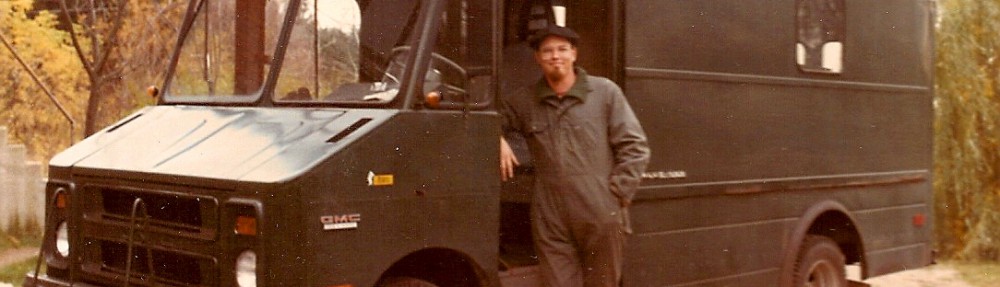
Barbara Browne and Cassandra by the truck

Barbara was an excellent artist in herself, and continued to be a friend and inspiration until her death several years later.  The collection sold well, and the fat man rug was featured prominently in the John Fleming/ Michael Rowan book on Canadian folk art.
fatmanrug

the fat man rug

Finding Lajeunesse

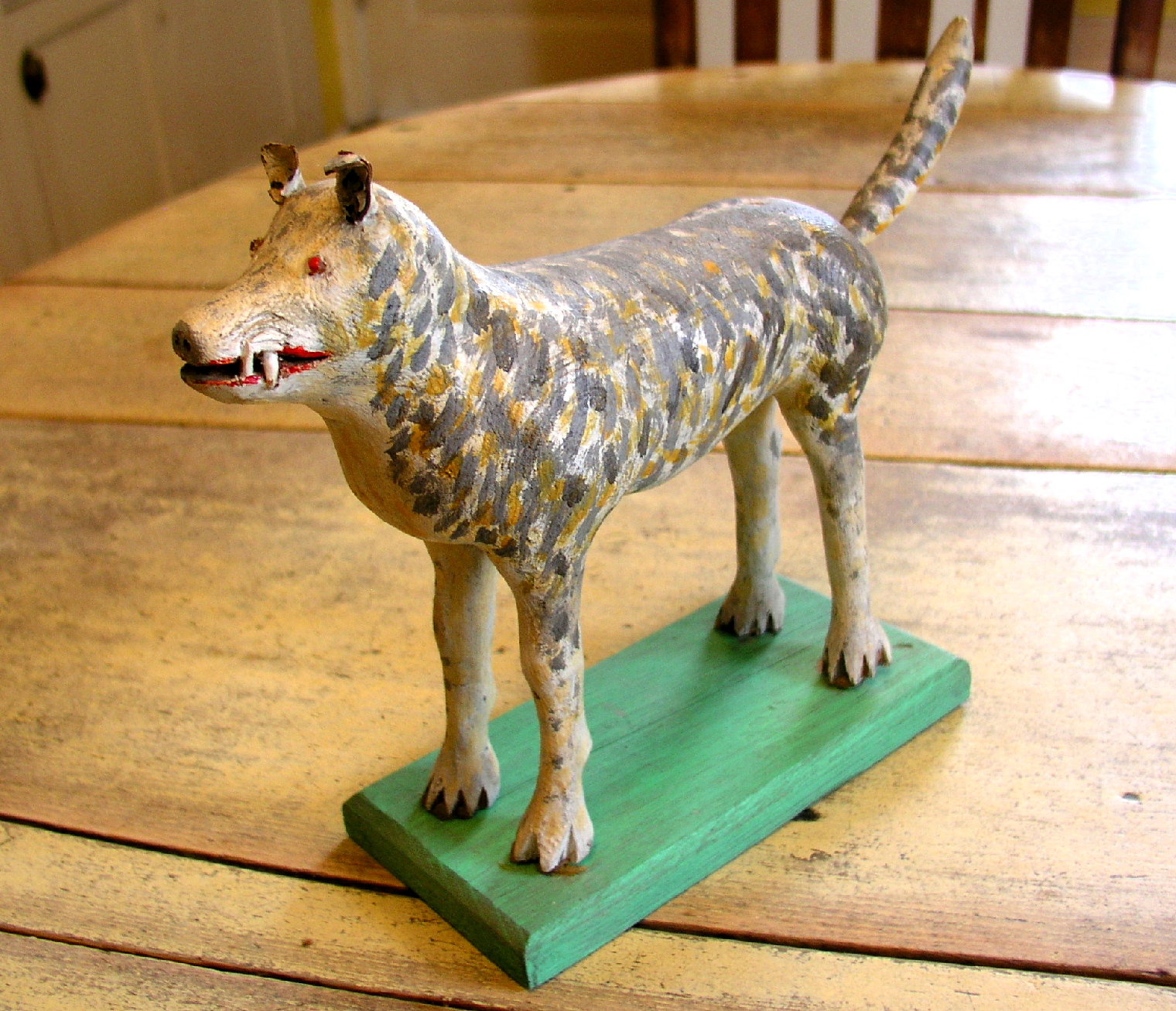
“Chien Mechant”

You know how sometimes when you meet a person you feel a real connection to their inner spirit, and recognize in them something which represents basic goodness and beauty?  Something rare and special.  Well that’s the way I feel about having met Henri Lajeunesse, and I am grateful for having had the experience.

Over the ten plus years of regular buying trips to Quebec we would very occasionally run across a signed work of Mr. Lajeunesse,  and we began to covet them and seek them out because we really connected with his expressiveness and vision.  Although we asked everyone we knew, we could never find out much about him. Not in books or from other collectors. Then one day we bought the piece above, “Chien Mechant” or “mean dog” as it was titled in pencil along the base. I say “was” because unfortunately one day an overzealous housekeeper scrubbed the words off while cleaning it.   There’s a cautionary tale for you.

showing the bottom of “Chien Mechant”

So it happened that one day shortly after buying the piece, in a rare mood of domesticity, and in preparation of Jeanine’s imminent  return home from visiting her mother in France,  I was cleaning, and I happened to turn the piece over.  There it was.  Not only his signature but his address and phone number.  Well Hallelujah.  As it happened we were just about  to go on a  Quebec buying trip so we figured what the heck , lets give him a call.  Jeanine dialed he number, not expecting much; but suddenly Henri Lajeunesse was on the line.  After establishing that he was the Henri Lajeunesse we sought, Jeanine told him of our love of his work and our imminent trip, and asked if it might be alright to drop by on him.   “Of course, I’d be delighted”.  When should we come?. “Oh anytime is fine, I am always here.”  We are coming on the fifth, and perhaps we should call that morning to check that you will be in?  “It’s not necessary.  Just come anytime, but I’ll expect you on the fifth.”  

We stayed overnight in Montreal on the fourth, and then in the morning,after breakfast we headed out on the two and a half hour drive north east to the village of St. Melanie.  When we arrived at 611 Chemin du Lac Sud, we looked at each other and laughed because of course he was going to be home; he lived in a retirement lodge.

Bluebird

Bluebird

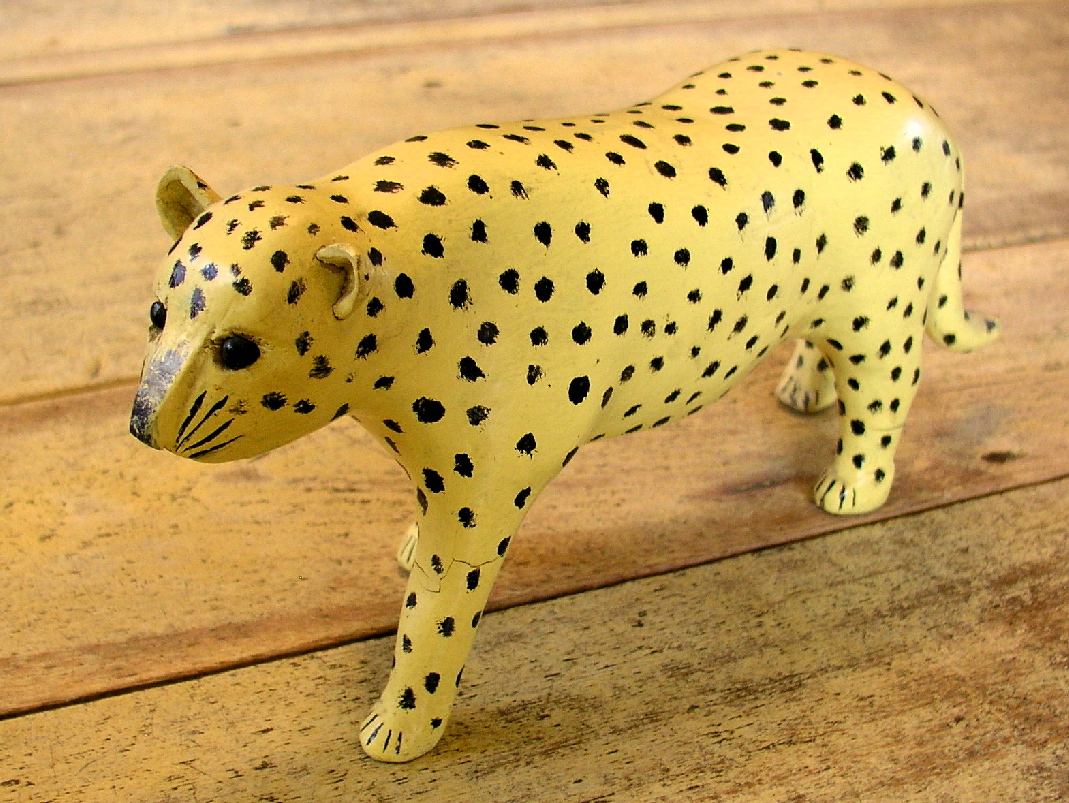
The front desk soon confirmed that he was waiting for us in his room.  We were taken there and sure enough after knocking, the attendant opened the door and there he was sitting in his rocking chair surrounded with pieces of his work on every available surface. We counted over forty carvings.  Mostly birds, animals, and people, and all of a small or medium size.  What a wonder to behold.  His eyes lit up as he explained that in anticipation of our visit he had his son bring everything he had left in storage, and also his carving tools, because now that someone was showing interest again, he felt he had a few more carvings in him, which he wanted to explore.  We had a lovely talk about his life, and work.  He and his wife had eleven kids, he had spent his entire life in St. Melanie, etc.  While he spoke my eyes kept scanning the room, taking in all that was before me.  Wonderful examples of different periods of his work.  We noted that the little bluebird above was his most recent piece and there is an obvious difference between this later piece and the earlier pieces like the leopards below.

an earlier leopard

He exuded  warmth and humility while answering our many questions, and telling us a few of his life’s stories.  Then eventually , almost timidly, he suggested that we could buy a piece if we wanted something to remember our visit by.  “well of course Mr. Lajeuness, . Could you please tell us your prices.”. He went around the room quoting prices from memory.  Everything was from about $15 to $65 dollars.  Then he offered,  “So is there a piece you think you might like to have?”. Jeanine and I threw each other a knowing glance, and said  “Well actually , we’d like to take all of them”.  The depth of his smile cannot be described as we started a list of the pieces and their prices. Soon I was heading out to the truck where we had prepared ourselves for a possible happy outcome by bringing many cardboard boxes and.0

paper.

another example of a leopard. This one bought from Jean Lacasse many years later.

another example of a leopard. This one bought from Jean Lacasse many years later.

He told us that many of his fellow housemates had suggested that he would be lucky to sell even one piece, so we shared in his delight observing the dropped jaws and wide eyes of the residents in the lobby as we hauled out  box after box of carvings.  Eventually, we shook hands and told him we would try to get back for a visit in a year or so, but  sadly soon after his family contacted us to inform us of his passing.  Eventually his daughter sent us a multi-page biography  in which we learned that legendary collector dealer Nettie Sharpe was a regular visitor in his productive years, and I find it strange considering this, and the excellent quality of his work, and the uniqueness of his vision that so little has been written about him.  The only major publication where I can find any mention is “Les Paradis du Monde, L’art populaire du Quebec” by Pascale Galipeau which includes a full page photo of his carving of Maurice Duplessis on page 111.

Maurice Duplessis, circa 1970

Maurice Duplessis,
circa 1970

footnote:

“Chien Mechant” is the French warning for “Beware of dog” as you would see on a sign.

“Lajeunesse” is the French word for “youth”

Canadian Contemporary Folk Art Festival -part 2

digby ferry

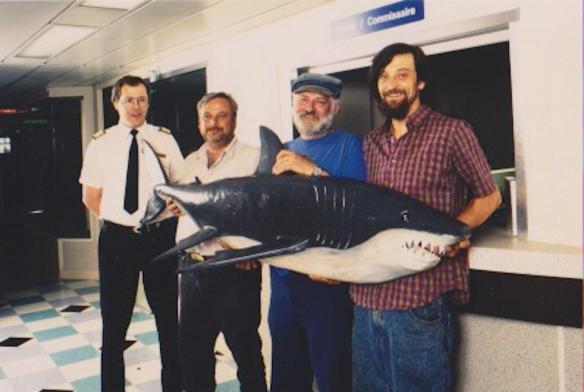
June 1994. Stephen Outhouse (middle with cap), Mark Robichaud (right), and David Stephens standing with the purser on the Digby ferry – on our way to Paris! We had this shark – a carving by Stephen – mounted to the top of the the truck cab.
I received this photo and note from Nova Scotia artist David Stephens shortly after last weeks post was published. Thanks David for permitting me to post it here. It’s a long drive from Nova Scotia for a one day show. This illustrates the dedication of all involved to this unique folk art event.
In looking over my support material, I came across some interesting definitions of folk art in the initial correspondence from promoter Michael Hennigan.  I include them here to add to the dialogue which we as collectors and enthusiasts continue to have on what constitutes folk art; and what of this art is worthy of study and preservation.
“The working definition of folk art for this show is: “the personal or naive expression of untutored creators”.  You will note that this definition deviates from those presented by folklorists and material culturalists which tend to emphasize context and tradition over aesthetics and individuality.  Rather it adheres to the connoisseurs or Art Historian’s definition with emphasis on form, line, and color.”
“I am trying to avoid ethnically based arts and crafts such as knife making, canoe building, basketry, newly made fish and duck decoys, or any mass produced craft lacking creative inspiration.  For the purposes of this show, Craft involves head and hand, while art involves head, and hand and heart.”
“I am also avoiding highly commercialized or slick assembly line work, or neo-folk art.  Which is defined as work made by self taught artists who get their ideas from seeing folk art elsewhere such as in books or museums. For purposes of the show such art is not folk art, but rather is about folk art.”
“Also, I am avoiding faux naif art, which is defined as art produced in a naif style by fine artists. Finally I am avoiding amateur or so called “Sunday” painting, as difficult as it may occasionally be to distinguish such art from folk art.  Folk Craft is also not allowed.  Folk craft is the folksy, cutesy pie, overly sentimentalized stuff seen at craft shows.”
With the inclusion of contemporary folk art at such distinguished shows as Cabin Fever, coming up February 6 and 7, 2016 in Kingston, Ontario, and the Bowmanville show which every year is on Good Friday, we have an opportunity to compare the work presented there to these definitions. I think that you will find that for the most part these shows rise to these standards.  I wish I could say the same for the field shows, but perhaps they will be inspired to improve as the knowledge of what constitutes folk art is understood by more and more people.   Here’s hoping.
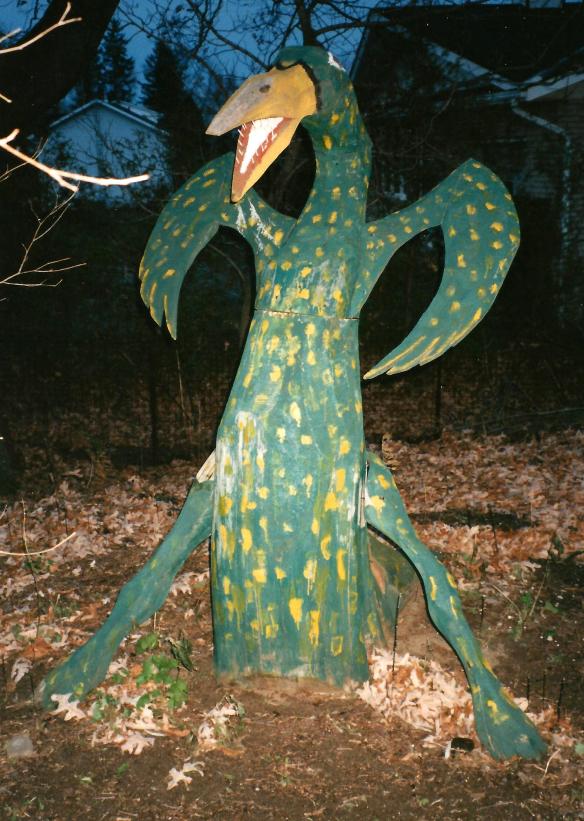
I went through my photos and found a picture of one of the dinosaurs we brought to the show.  Imagine being greeted by two of these 9′ monsters.
dinosaur

9′ dinosaur by Roger Raymond

Canadian Contemporary Folk Art Festival- remembering a significant, one time, folk art happening

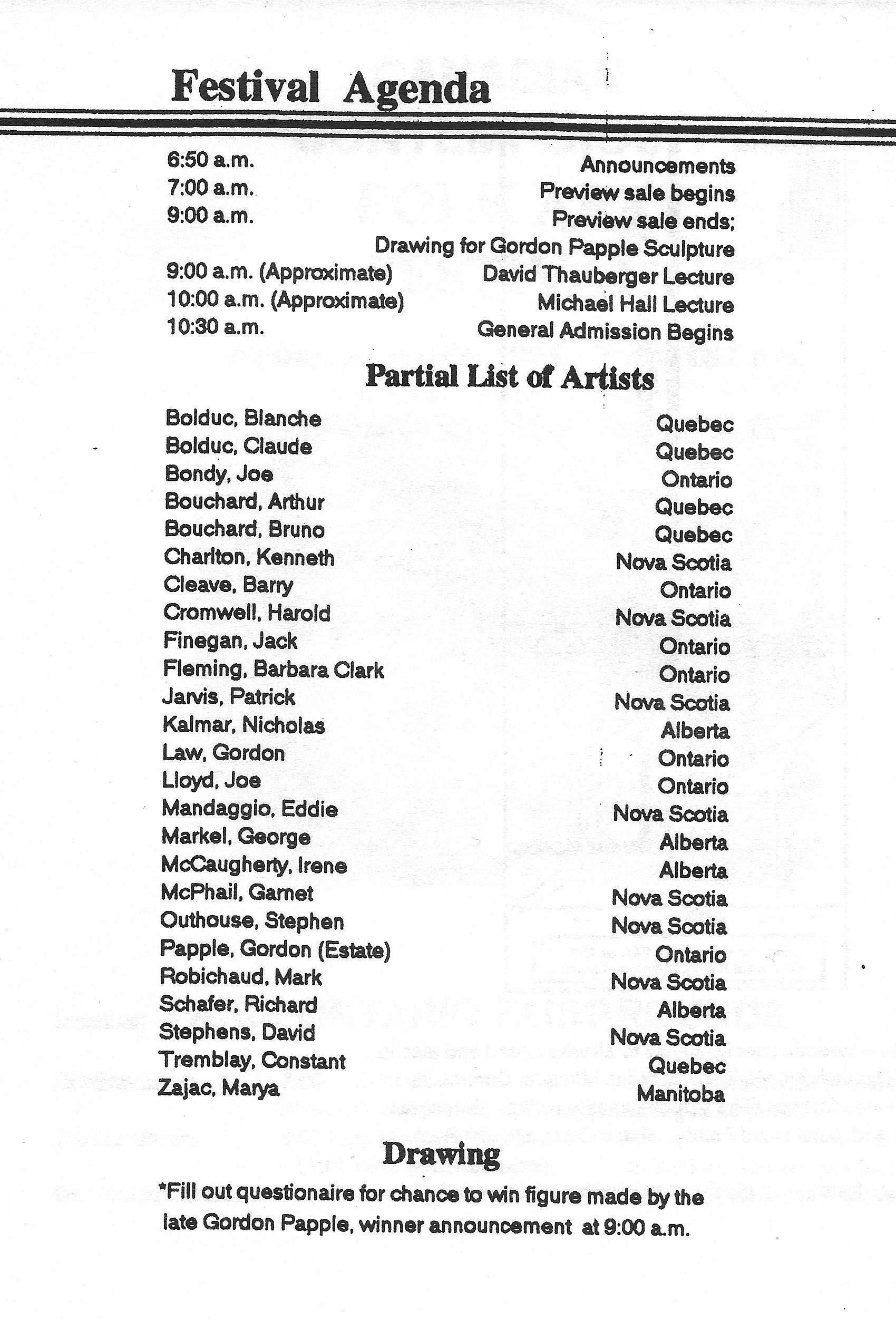
CCFAFposterBack on Sunday, June 26, 1994,  my wife Jeanine and I as Old Church Trading participated in an ambitious, extensive, and ultimately one time special event that was, and remains the largest and most exciting folk art festival ever to take place in Ontario, if not all of Canada.  Acknowledging here the annual Nova Scotia Folk Art Festival.  It included 2 lectures, displays by a half a dozen folk art dealers, and the work of about 25 Contemporary Canadian Folk Artists, many who were in attendance. It all took place  on one glorious summer day from 7 a.m. until 7 p.m. at the Paris Ontario fairgrounds. It was an extraordinary opportunity for collectors, dealers, and folk artists to interact and network and to honor and support Canadian Folk Artists.  I remain enormously  grateful for having been included in this great event; and we sold a lot of folk art too.

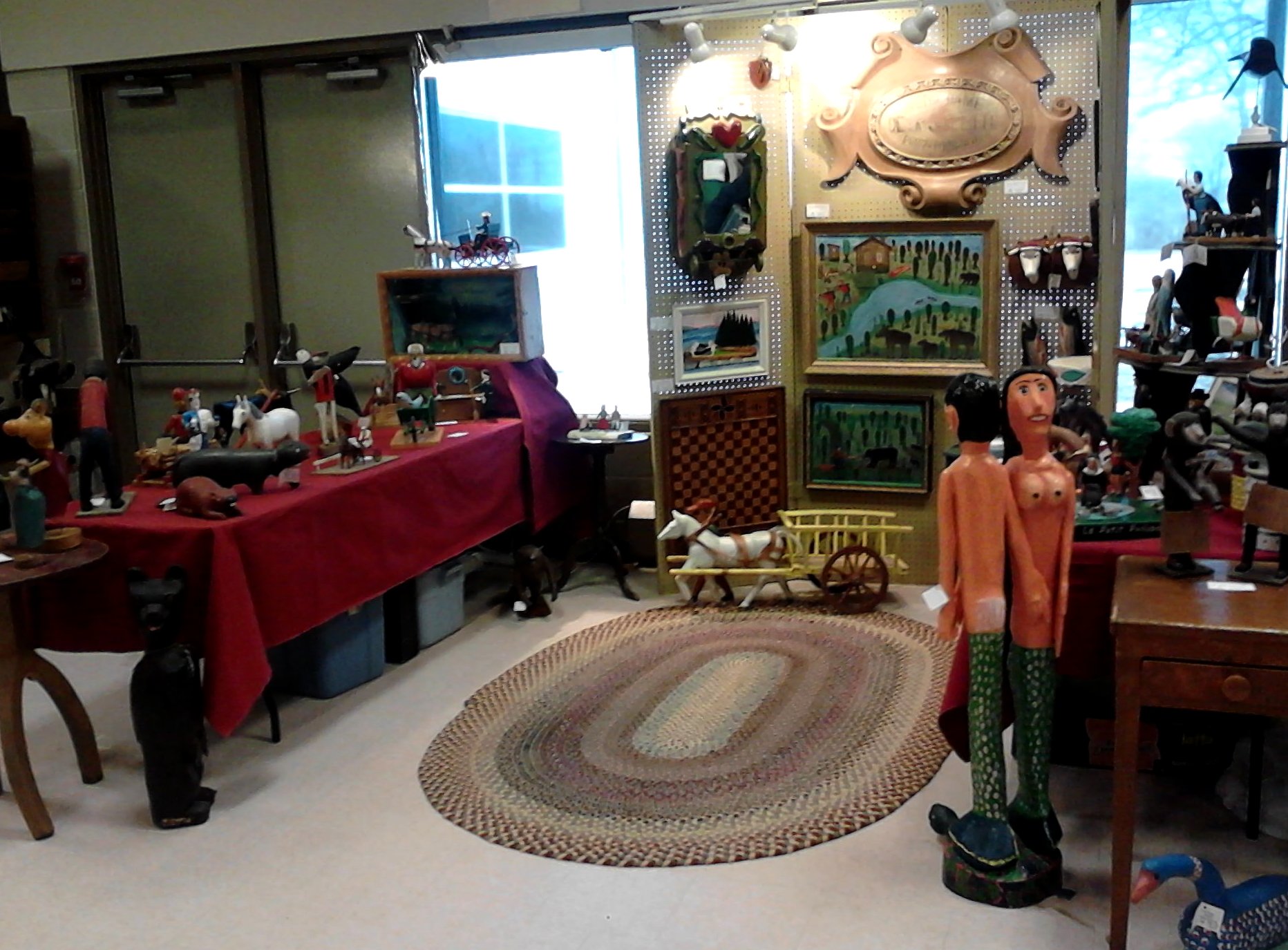
The whole thing was conceived, organized, executed and financed by Canadian Folk Art collectors Michael and Peggy Hennigan, of Grosse Pointe, Michigan, and it was a giant undertaking.  Not only for the set-up, and extensive promotion associated with a first time show, but also for organizing and paying for many artists to come from as far away as Alberta, and Nova Scotia. Many folk artists chipped in to help get the word out.  I remember Michael’s gratitude to Joe Lloyd of Brantford who made up and distributed signs. We brought 25 of our best pieces by Ewald Rentz, Edmond Chatigny, Aime, Desmeules, Jacob Roth, and others, and were particularity happy to bring along two recently acquired six foot tall dinosaurs created by Quebec folk artist, Roger Raymond.  They looked fantastic gracing each side of the entrance walk.  Looking back it felt like it was over in a flash, but at the time it was a long day of exciting exchanges, sales, connecting with new (to us) artists, and last but not least, education.  We met and started to carry the work of Woodstock area artist Barbara Clark-Fleming, and I was delighted with the opportunity to meet and hang out with the likes of Joe Lloyd, Garnet McPhail, Stephen Outhouse, and Mark Robichaud, not to mention all of those passionate collectors.

It was well attended  for a first time event.  A few hundred people as I recall, and most of those being driven and engaged;  but it was less than anticipated, and less than required for the Hennigans to consider doing it again when weighed against the enormous workload, and expense. No one could blame them, as they certainly gave it their all, and none of this diminishes the fact that this event lives on in the memories of those involved as a unique and exciting day for collectors, dealers and artists alike, and a prime example of just how rich, fun, and informative a folk art festival can be.

I am reproducing the program here, and next Friday I will post a further look at some exciting and defining ideas about folk art brought about by this event.  I am even going to look through my old photos and see if I can find a shot of those dragons.  No promises  I’ll do my best.

CCFAF3CCFAF2

Thoughts and observations on the 2013 Bowmanville Antique Show

bow13shadThis is a picture of my booth at the 40th Edition of the Bowmanville Antique show. which was held Good Friday, March 29, and Saturday March 30th.  As you can see I went heavy on the folk art and light on furniture.  I love antique furniture, but I just don’t have the back for it anymore. If you want to see a slew of good pictures of the show please follow this link –  http://www.facebook.com/groups/126697675589/ to Adrian Tinline’s Canadiana Antiques facebook page.  If you are unfamiliar, this also serves to introduce you to this lively and informative forum.  Join, if you will.

This year Bowmanville was, as always a beautiful show, full of exceptional works of antique and folk art, and early handmade Canadian furniture and accessories.  All 24 exhibitors took special care to select and present their. best wares.  Many dealers put aside special pieces all year to present them here for the first time.

The show started humbly in 1973 when picker and collector extraordinaire Rob Lambert decided to invite the best dealers in the field of Canadiana to hold an annual spring show near his home in Bowmanville, Ontario.  In those early days dealers set up their offerings in their rooms at the Flying Dutchman hotel. When the starting bell rang, people would run (quite literally) from room to room to get ahead of their rivals, and purchase the treasures presented.  It was wild and hectic, with occasional  incidents of pushing and near fisticuffs. People were passionate about their collections back then.  It quickly gained the reputation of being “the” Canadiana show and it’s numbers and reputation grew from year to year.

Eventually the show moved to the G.B. Rickard Recreation Complex where it has continued to be held until present day.  For the past several years it has been expertly run  by Bill and Linda Dobson.  They have worked hard to maintain it’s tradition as a high quality, vetted show.  The vetting process is carried out before the show by a group of experts who go from booth to booth checking everything out for authenticity, quality, and accuracy of presentation.  Any repros, rebuilds, or items not meeting the criteria of the show are removed at this time.

I’ve been doing the show for about twenty years.  I’ve always been happy to do it, but I’ve also always fretted about doing well.  It all happens so fast. The bulk of the business is done within the first two hours of the show, People line up well ahead of time.  From time to time people even camp outside the door overnight to be first in line. With so many beautiful items competing for attention, you have to be ready to rumble when they come running through the door at  6 pm. Chances are that by eight o’clock you will have sold the bulk of what you are going to sell. You are on your feet and on your toes  selling, wrapping, and doing the math during those first two hours and then everyone clears out. By  9 pm you are either happy or concerned, but at least there is a good meal waiting for you.  Bill and Linda have always had wine and beer and food ready to bring out as the show closes, and for the last couple of years Mary Jo Field has been producing absolutely fabulous meals that in themselves are good enough reason to book the show.

Although many come to see the show on Saturday the atmosphere is considerably more relaxed. This is fine because  it allows you an opportunity to see the show, and chat with other dealers. Many of who I now see only once a year at this show. These chats often result in a few more sales or swaps.  Then it’s all over at 4, and within a couple of hours you’re packed and on your way home, either feeling great, or not so great, or disappointed.  It’s that kind of show.  Some people will always do well, and some people not so well.

I’d say that for the past couple of years, like everywhere else, sales have been slower, but there are positive signs too,  Prices are noticeably more reasonable, and interesting pieces, priced right do sell. It’s also great to see the show now includes three young dealers, Ben Lennox, Adrian Tinline, and Fairfield’s Antiques.  All had excellent booths, and added to the excitement with their enthusiasm and knowledge.  I also find it encouraging to see more young faces in the crowd, attendance figures are up over last year.

Here’s hoping that the Bowmanville show will continue to be a great place to see and buy the best in early Canadian antiques and folk art  for at least another forty years.

My happy time with Mr. Joly’s whirligig

Gig on display at the church

Gig on display at the church

It was 1984 when I crossed paths with this whirligig; during the period when I was going to the picker’s barns of the Victoriaville area of Quebec every other week.  The drill was to leave home at 4 a.m., drive the ten hours, buy a truckload of furniture as quickly as possible, and get on home.  It was in late November, and I remember the trip well because the temperature dropped quickly, and the Drummondville bridge froze up before the roadway.  When I hit the bridge,  I did a perfect 360 pirouette the entire length, coming back on course and continuing as though nothing had happened; frazzled but undeterred.  Soon, the snow had come on so strong that for moments which seemed like eternity, I became completely lost, with no sense of direction within a big white cloud. All you can do when this happens is to slow down and listen for when the tires hit the gravel, thinking the whole time that a transport will come out of nowhere and drive right through you. Nasty. This was followed by long periods of the dreaded “hypno” snow, which is when the big fluffy flakes swirl over and over in spiral patterns until you think you’re going to loose it.  Tough sledding.

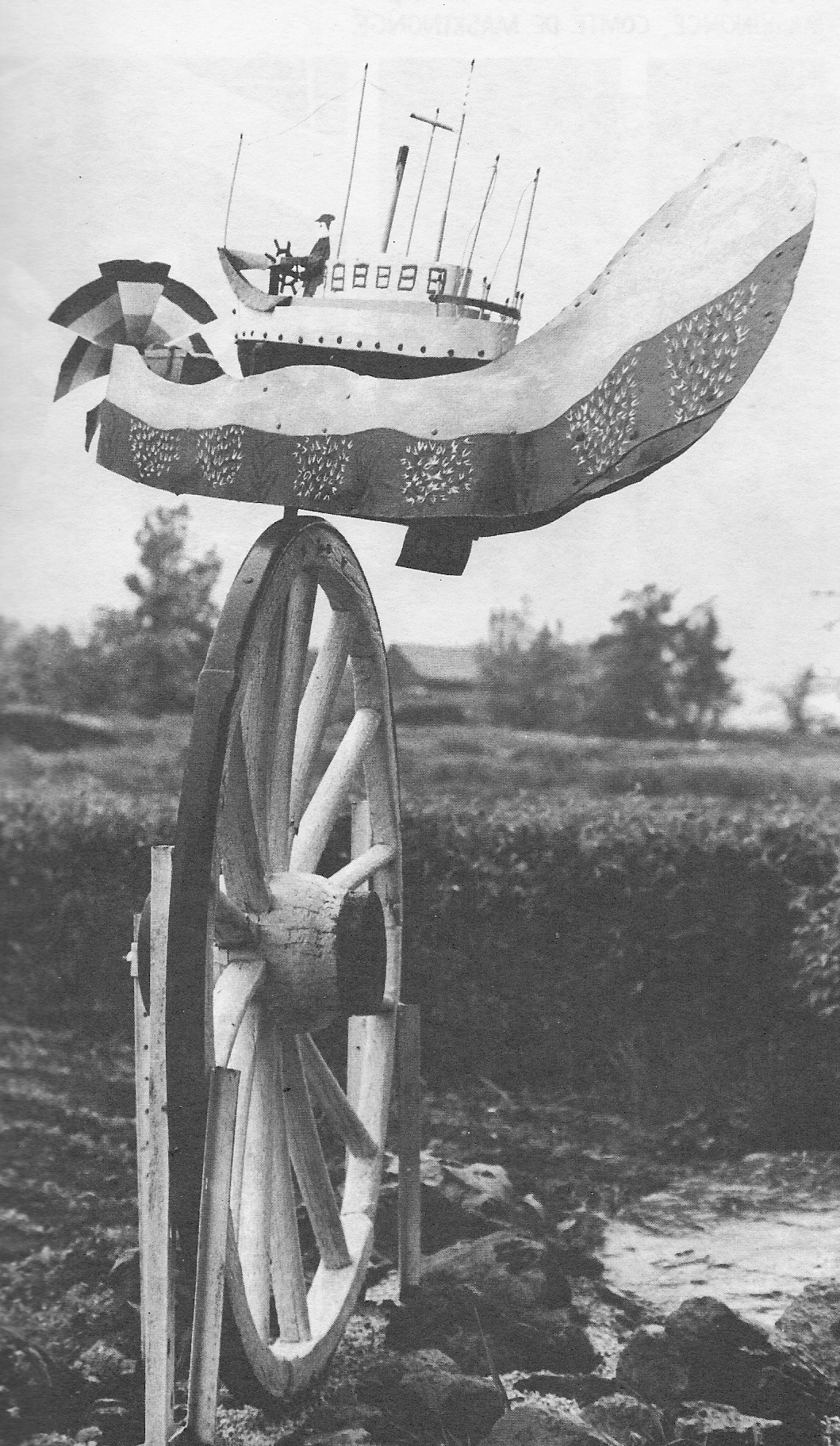
An hour later, when I finally arrived at Paul Prince’s place near Defoy it was dark and snowing hard, but I was just so damn happy to be alive.  The lights were on but Paul had gone home.  I was about to leave when a picker I knew named Jimmy pulled in behind me. A great guy, and a legendary  picker, he had been at it since he was a teenager.  On this night he was on his way home from picking around Montreal, and he was really excited by something “special” he wanted to show me. Jimmy was never a guy to suppress his enthusiasm.  Under the yard light, there in the back of his truck I could just make out  this funky metal rocking boat gig in vivid paint. All 4 feet in length of it. I got excited too. When he showed me how the window cranking mechanism from an old Ford  provided the gears for the rocking up and down of the boat, and the turning of the steering wheel I was a goner.

I had to think hard and fast because it was a lot of money, but a really cool thing; and I knew if I didn’t go for it, Paul, or the next guy would.  “O.K. Jimmy here you go, but put it on my back seat so it doesn’t get smashed by the furniture”. “I’m doing you a favour by selling you this.  You’re gonna make good money”.  “Ya right, if I wait 25 years”.  At this point Jimmy punched me in the arm and laughed, and the transaction was complete. I was delighted, but I had that slightly sick feeling I get when I stretch beyond my comfort range to acquire something special.  I loved it, but I could have bought 4 or 5 cupboards for the same money, and at that point cupboards were selling well, at a good profit. Oh,what the hey. You’ve got to trust your instincts, and great things don’t come along every day.

The next day was snowy and cold, and I filled the truck quickly, thinking all day of the money spent, and wondering whether Jeanine would share my enthusiasm.  I arrived home about 2 in the morning, so I left everything in the truck and went straight to bed. The next morning, over coffee, Jeanine asked me about the trip. I replied,  “Oh good overall, but  pretty intense”. I told her about the bridge incident, etc. and then casually mentioned that I bought something special that I hoped she would lke. I find it better to give confession right away, as delaying only adds to the suffering.  “Well, go get it, and let’s see what you’ve done”. The moment of truth had arrived.  Happily she loved it too, and we decided there and then to keep it for a good long time so we could appreciate it everyday.  “Too bad we don’t know who made it”.

Fast forward to the next summer and we are enjoying a weekend in Quebec, our favourite North American city.  We had heard of a bookstore where it was possible to buy a rare book, Les Patenteux du Quebec,  which we knew to be the “bible” of Quebec folk art, .

page 19 of "les Patenteux du Quebec"

page 19 of “les Patenteux du Quebec”

Published in 1978, it is the work of three young Quebec women who spent  a summer or so traveling all over Quebec documenting, and recording the stories of every Quebec folk artist they could trace.  We found the shop and bought the book, and when we cracked it open, it opened to page 19, and behold there was our whirligig. With a picture of it in it’s original location, and statement by the artist.  Extraordinary.   jolygig1

page18

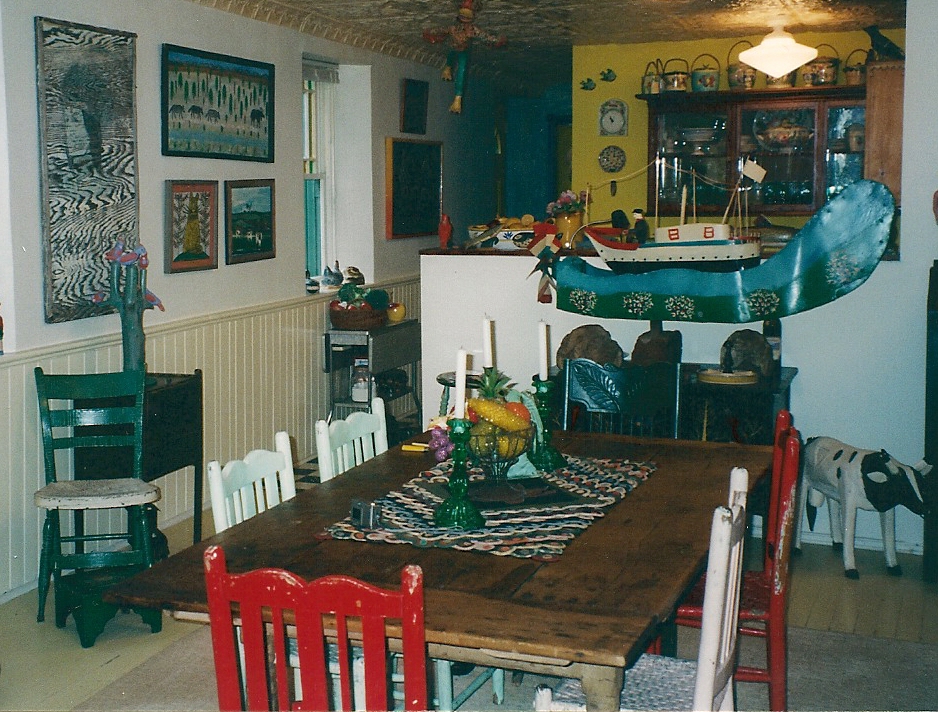
We placed the piece on a low cupboard in front of the low wall which separated our kitchen from dining area, and there it sat for the next twenty years or so.  We never offered it for sale but we had various offers over the years.  The best was when a friend  was returning to live in Italy, and he offered us his recent model Jeep in exchange. We thought about that one quite seriously, but refused figuring that the Jeep would rust out and be finished in a few years, where as the gig would just keep on going.

When we moved from the church to our current residence in  Port Dover in 2003,  we found it difficult to find the right place to display it. We considered mounting it high on a shelf above our front bay window, but that posed a risk of falling and crowning someone.  It moved from place to place being a bit in the way, and ended up sitting on a ledge behind the couch, which is when we more or less forgot about it. I still noticed it, but it no longer “engaged” me, if you catch my drift. Jeanine felt the same. So it came to pass that last year in a mood of downsizing we decided that although we had really enjoyed owning the piece, it was time to pass it along.  My friend, and serious collector Dr. Martin Osler had always coveted it,  and had asked for first refusal, so I gave him a call. Because we can both be convoluted at times, and because there was no particular hurry,  it took just about a full year to complete the transaction, but it now sits proudly on a high cupboard in the back of Marty’s office.  A striking location in an important collection, and I am happy because I can visit it occasionally. Here is a photo of Marty, and his friend, contemporary artist  Alex Cameron admiring the gig in it’s new home.

Marty and Alex enjoying his newest acquisition.

Marty and Alex enjoying his newest acquisition.

For me, after thirty years as a full time dealer I consider that I truly don’t own, or need to own anything.  My job is to find it, to recognize it, and then to be a good custodian until I have found it a decent home, where it will be loved and preserved.  It’s kind of liberating, actually.

Finding “Beauty in the Beast” at the Dufferin Museum

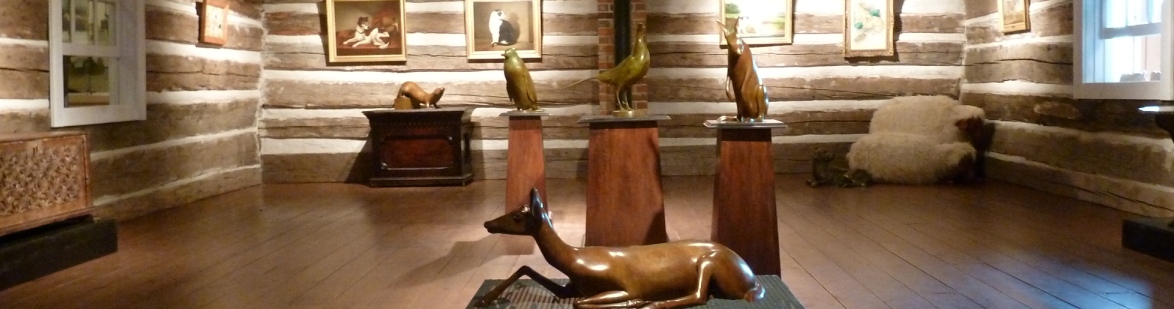
Interior of old Orange meeting hall houses Victorian English paintings and the contemporary bronzes of Adrian Sorrell (RCA) 1932-2001.

I had been looking forward since it’s April opening to seeing the exhibition  “Beauty In The Beast – Animals as Objects & Art”, and last Tuesday I finally made the roughly 100 km drive northwest of Toronto to the Dufferin Museum to see it. I was expecting to be impressed, but to put it mildly, I was blown away. More succinctly, I’d have to say absolutely gobsmacked.  It is an outstanding display of  all things animal, and I drank it in for over two hours before finally succumbing to “visual overload”. I left knowing that I would have to make a return trip to further take it all in before the closing date of December 22.

Initially I was struck by how beautifully the impressively large barn-like structure of the museum blends in with the surrounding rolling farm country.  Inside it is open and airy, and includes three full sized historic structures -a log cabin, an Orange Lodge meeting hall, and a railway flagging station.  The current exhibit is on display throughout. There are animals everywhere you look.

And who doesn’t love looking at animals?  After looking at ourselves, it is possibly our next favourite subject in art.  It goes back to the first caveman drawings.  I image the order was, himself, his wife, and then the animal he hunted, and depended on for his very sustenance.  Landscapes came later.  What’s amazing here is how the literally thousands of depictions cover almost every type of relationship we have with animals, and while viewing it, at times I was surprised  by an almost primal emotional response which welled up from deep within.  Animal effigies and Inuit carvings next to pastoral scenes of cows, horses and sheep, childhood memories of fantastic creatures and portraits of the family pet.  The iconic and the mundane.  Animals feared and animals worshiped.  Animals past such as an American 1880 copper grasshopper weather vane, an Egyptian brass cat, dated 200-210 B.C., 2nd century BC, 3rd and 4th century Netsuke carvings from Japan. These along side present depictions of animals by several contemporary Canadian sculptors include Marina Fricke, E. B. Cox, Clifford Neil and Calgary’s Gary Williams who produces brilliant large Majolica pottery pieces.

Gary Williams, contemporary Majolica swan

Plus, and these alone are worth the price of admission, there are 5 stunning bronzes by the brilliant English sculptor  Adrian Sorrell, shown in the photo up top.

And there is a lot of great, funky, funny folk art, past and present, which is guaranteed to make you, (and your kids if you’ve got them), smile. You just can’t help yourself when you look at the rusty tin covered cow by Contemporary Quebec artist, Patrick Amiot. Well, actually Mssr. Amiot now lives near San Francisco (I googled him), but you can see why we want to continue to claim him.

Cow by Patrick Amiot

Folk art fans will see many of their favourites including a few stunning miniatures by the master, William Loney (1878-1956) of Prince Edward County.  They are in a charming, glass 6 sided gazebo which was brought in to house the  miniatures. You can lose yourself there for a long stretch, Ill tell you. There is some fantastic animal related furniture as well, and a tree of life quilt which is to die for.  It just doesn’t stop.

“A lady sheep, Isabella Brandt, Ruben’s much loved first wife”, oil on canvas by Canadian Lindee Climo.

And I could go on at length about the contemporary art.  Surreal dream-scapes by  Gilles Genest, with titles like “Kangaroo’s picnic”, and “Full moon, white cats and hydrangea”. Also fascinating is  the exquisite work of Nova Scotia’s, Lindee Climo who paints animals in the style of the Old Renaissance Masters.

So how can I best express how strongly I feel that this is a first class, once in a lifetime,  drop everything to rush out and see exhibition?  I think I just did.  Go see it.

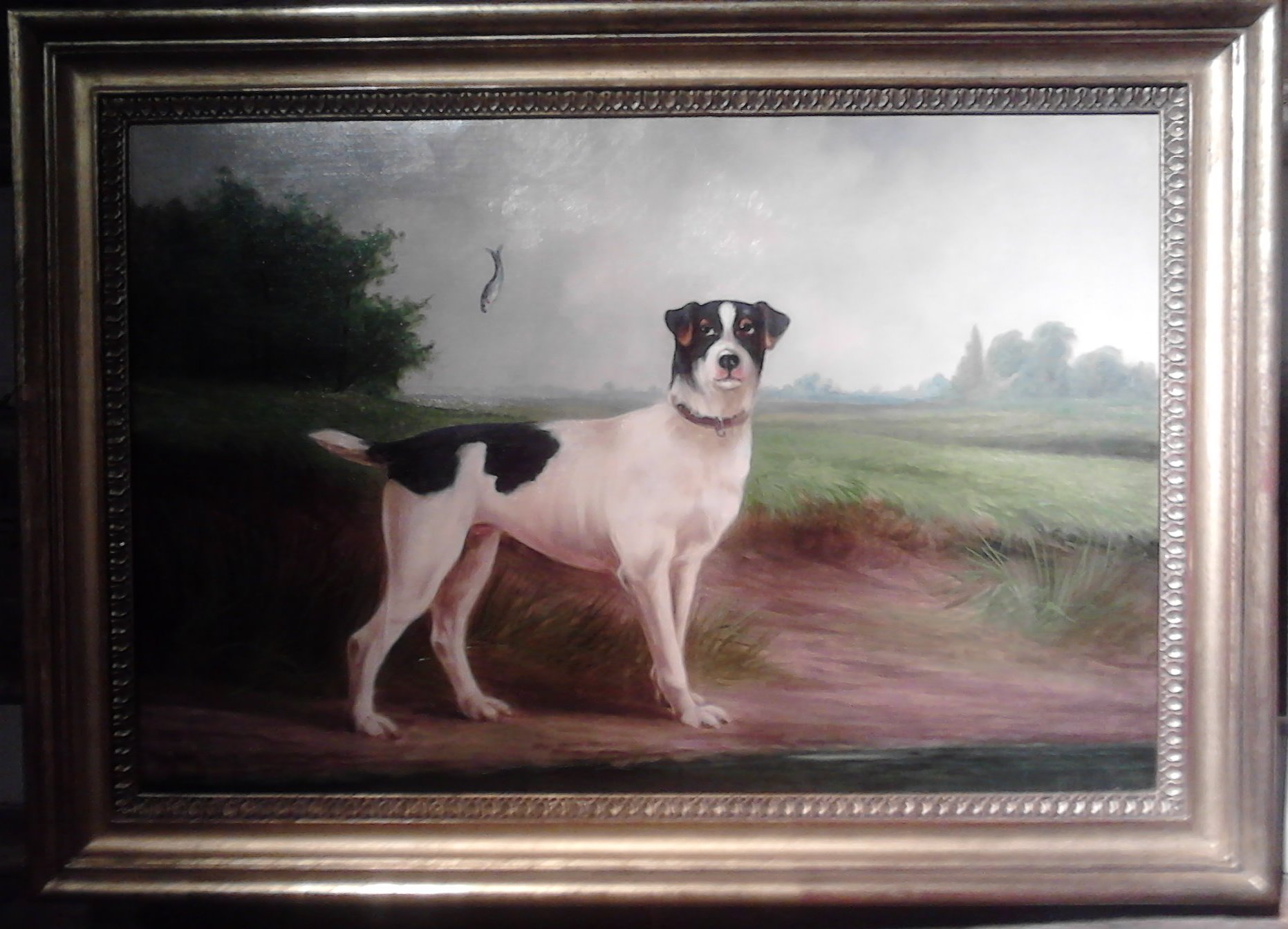
“Terrier and Leaping Trout” , oil on canvas by Wylan Young, England,1902

Here’s a link to the museum site – http://www.dufferinmuseum.com/

39th Annual Bowmanville show

the dealers circulating just before opening

This past Good Friday, April 6th, it was my pleasure to participate in the 39th annual Bowmanville Antiques and Folk Art show;  the long standing pinnacle of Canadian antique shows for early, collector-quality furniture, accessories, and folk art.  It is held every Good Friday and following Saturday at the G.B. Rickard Recreation Complex in Bowmanville, Ontario. It is a vetted show of 28 invited top dealers and represents the best of what’s out there.

It is always interesting and worthwhile but  to be honest for a dealer it is also always a bit of a wind up.  You work on your booth for weeks, seeking out and saving only the best items to present to the elite of the Canadian collectors who wait eagerly for the six o’clock opening so that they can rush in and nab that special something before a rival gets a chance.  Within two hours of the opening this crowd has either bought enough of your offerings that you are happy, or they have passed you by, and you are aware that you will be there until 9 that evening, and then from ten until four on the Saturday with a greatly diminished chance of anything moving.  I have been doing the show for over 20 years and twas always thus,  but lately with the stalled economy it has become more of a risk.  This year because I sold 11 of 24 drawings from the scrap book of a turn of the century young Niagara Peninsula woman, and a few other items I was alright, but I repacked my big ticket items at the end of the show and I noticed that it was the same for most of my colleagues.  I looked back over my books and although always profitable, the last year I had a gang buster show was 2009.  Fits right in with the general economy doesn’t it, and although Bill Dobson is a terrific guy and promotes and runs the show well, it does not seem to attract many new collectors.  Some feel that having it at every year at Easter which often coincides with Pass Over is an obstacle.  I think that a more important factor is that in recent years many large collections are being offered for auction around the same time of year. This year on May 19th Tim Potter is offering the important collection of Rod and Aggie Brook, and when you go to his site (http://www.timpotter.com/auctions/051912.html) and see the quality of what’s being offered you can see why some people were waiting.

It’s a rapidly changing, big ol’ digital world out there, and we live in hope that through exposure and promotion more people will be brought to recognize the authentic and will begin to seek out the beauty of the handmade antique item. Bowmanville is an institution, and you would be hard pressed to find a better show to increase your knowledge and  see beautiful things. Please come out and support it next year, which will be the 40th year.

I am happy to note that this year eight Collectivator dealers participated. They are  Barry Ezrin, Croydon House, Land and Ross, Martin Osler, Pollikers, Portobello Road, Shadfly, and Shaun Markey.  I include pictures here.  Thanks to Ben Lennox for some of the photos, and my sincere apology to Marty Osler  whose booth photo did not turn out. I hope to get a shot from a friend and add it.   In the meantime, I  am including a nice shot of the back of Marty’s head which shows off his trendy new short cropped hair.  Looking good Marty.

Croyden House

Barry Ezrin

Portobello Road / Ben Lennox

Land and Ross

Shaun Markey

Polliker

Shadfly

The back of Marty Osler’s head. Looking good.

Folk art in Cyberspace

It is interesting to consider how the development of the World Wide Web has affected the work of the untrained artist.  Like all artists, folk artists reflect the world they see around them, and have always been affected by the media.  An example is in the work of Ewald Rentz who liked watching Sesame Street on t.v., and so produced sculptures of many of the main characters.   But internet access does not have the same effect as watching television.  Television focuses our attention, sometimes helping to create cultural icons such as Kermit the Frog.  The internet spreads our attention, giving us access to a much wider, but therefore more unfocused body of information.   Things go “viral” and disappear within days, being replaced by the next “flash in the pan”.  But more importantly the web also provides an interested individual the possibility to easily research any given subject.

It is reasonable to assume that most modern folk artists will at some point use the internet to look at the work of other folk artists.  Previously this information would have been available only to those who had access to reference books, or could travel to an exhibition or sale.  Overall this means that if they are so inclined, artists are being more influenced by each other, and if their motivation is to sell more folk art, they will look at and emulate what’s selling.  This encourages fashion or trends which might be considered a negative. However, to a large extent ‘twas ever thus.  Artists have always looked at each other’s work, and if they like what they see, they will consciously or unconsciously emulate it.  The more interesting affect therefore is on the potential for an artist to develop an audience or market for his or her work from their home by creating a web site, and/ or joining a communal web site specializing in their type of work.  This has the potential to encourage and support many who would otherwise never be discovered.  A real God send to those who live in remote places.  Of course it isn’t as simple as throwing up a few pictures up and waiting for the phone to ring.  One still has to promote and be reliable in transactions, etc., but the potential is now much greater for a talented individual to  be discovered by  their audience, and thus support their output.