Unknown's avatar

About shadflyguy

Owner/ operator of Shadfly Antiques.

39th Annual Bowmanville show

the dealers circulating just before opening

This past Good Friday, April 6th, it was my pleasure to participate in the 39th annual Bowmanville Antiques and Folk Art show;  the long standing pinnacle of Canadian antique shows for early, collector-quality furniture, accessories, and folk art.  It is held every Good Friday and following Saturday at the G.B. Rickard Recreation Complex in Bowmanville, Ontario. It is a vetted show of 28 invited top dealers and represents the best of what’s out there.

It is always interesting and worthwhile but  to be honest for a dealer it is also always a bit of a wind up.  You work on your booth for weeks, seeking out and saving only the best items to present to the elite of the Canadian collectors who wait eagerly for the six o’clock opening so that they can rush in and nab that special something before a rival gets a chance.  Within two hours of the opening this crowd has either bought enough of your offerings that you are happy, or they have passed you by, and you are aware that you will be there until 9 that evening, and then from ten until four on the Saturday with a greatly diminished chance of anything moving.  I have been doing the show for over 20 years and twas always thus,  but lately with the stalled economy it has become more of a risk.  This year because I sold 11 of 24 drawings from the scrap book of a turn of the century young Niagara Peninsula woman, and a few other items I was alright, but I repacked my big ticket items at the end of the show and I noticed that it was the same for most of my colleagues.  I looked back over my books and although always profitable, the last year I had a gang buster show was 2009.  Fits right in with the general economy doesn’t it, and although Bill Dobson is a terrific guy and promotes and runs the show well, it does not seem to attract many new collectors.  Some feel that having it at every year at Easter which often coincides with Pass Over is an obstacle.  I think that a more important factor is that in recent years many large collections are being offered for auction around the same time of year. This year on May 19th Tim Potter is offering the important collection of Rod and Aggie Brook, and when you go to his site (http://www.timpotter.com/auctions/051912.html) and see the quality of what’s being offered you can see why some people were waiting.

It’s a rapidly changing, big ol’ digital world out there, and we live in hope that through exposure and promotion more people will be brought to recognize the authentic and will begin to seek out the beauty of the handmade antique item. Bowmanville is an institution, and you would be hard pressed to find a better show to increase your knowledge and  see beautiful things. Please come out and support it next year, which will be the 40th year.

I am happy to note that this year eight Collectivator dealers participated. They are  Barry Ezrin, Croydon House, Land and Ross, Martin Osler, Pollikers, Portobello Road, Shadfly, and Shaun Markey.  I include pictures here.  Thanks to Ben Lennox for some of the photos, and my sincere apology to Marty Osler  whose booth photo did not turn out. I hope to get a shot from a friend and add it.   In the meantime, I  am including a nice shot of the back of Marty’s head which shows off his trendy new short cropped hair.  Looking good Marty.

Croyden House

Barry Ezrin

Portobello Road / Ben Lennox

Land and Ross

Shaun Markey

Polliker

Shadfly

The back of Marty Osler’s head. Looking good.
Discovering the picker’s barns around Victoriaville

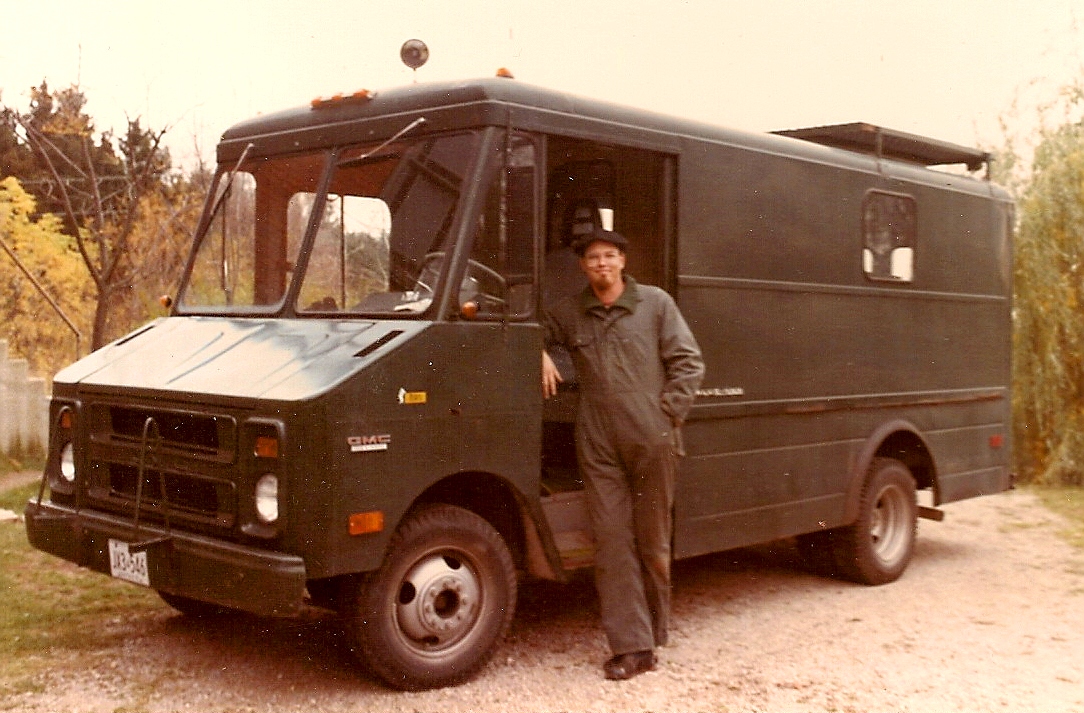
Our old Bell van which served us well for several years.

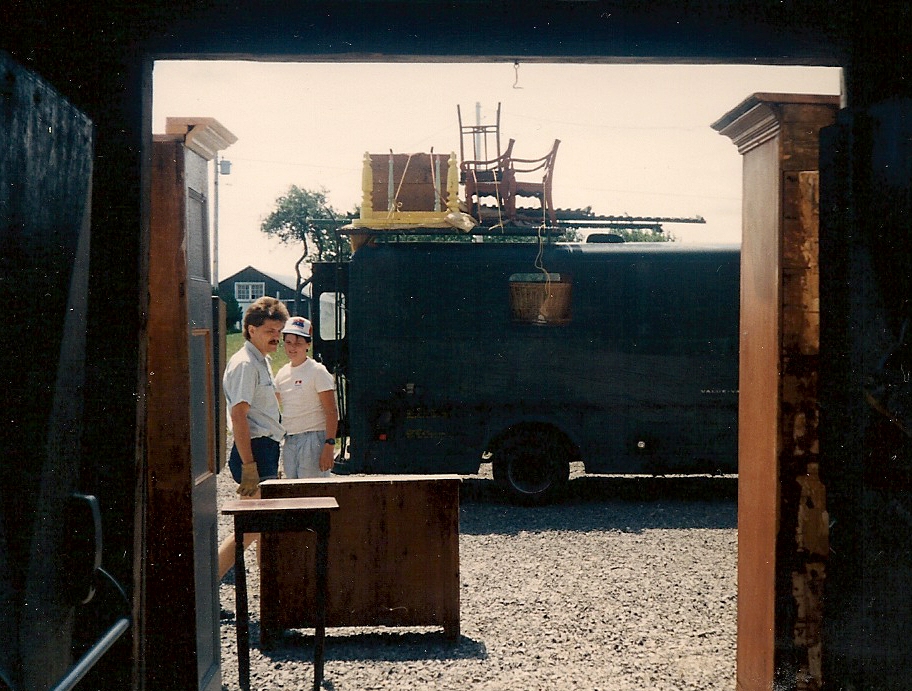
To continue were I left off in my last entry, after visiting Marcel Gosselin we went on to a large picker’s barn we had noticed on the way into Victoriaville which is where we met Jean (Kojak) Deshaies.  As we arrived , the place was buzzing with activity as several pickers clamored for the attention of a completely bald man; pointing at, and demanding prices of items still being unloaded from his pickup truck. Not being used to this type of “pressure’ buying we went inside and started to peruse the rows of furniture and items there.  Nothing was priced.  We made note of several things of interest, and waited.  After several minutes the bald man came in and approached us introducing himself in a distinctive, low raspy voice as Kojak, and stated simply “how can I help you”. I was slightly taken aback by the intensity of his voice, abrupt manner, powerful short build, and the fact  that he had absolutely no facial hair including eyebrows. He seemed slightly hostile. We explained that we were dealers from Ontario, and that this was our first trip to Quebec.  He immediately broke into a big smile and grabbed my hand and gave it a firm shake, and after introductions asked us what we found interesting.  As we pointed out several pieces of early furniture, rugs, carvings, etc, he would offer a short description and then bark out the prices.  As we said yes to an item, a young helper would grab the piece and haul it off to a place by the entrance where he started to make a pile.  Kojak wrote the prices on a scrap of paper.  He warmed with every item chosen and before long would sometimes follow up the price quoted with a second lower price he called “prix d’ami” or friend’s price.   After covering the first floor he took us upstairs to an equally large space covered with inexpensive lesser, or incomplete furniture and items.  We found many more things there and again they were taken out as soon as we chose them.

By the time we came downstairs I was quite shocked by the large pile we had accumulated.  I expressed my concern that I might not have enough cash for everything , but he said not to worry because a cheque would be fine.  I was surprised at this sign of trust but he joked that he knew I would be back, and besides if the cheque was not good he would soon be at my door to collect, and I wouldn’t want that to happen. He told us that he and a few of the other local dealers were just back from New York city were they had marched unannounced into the office of a downtown lawyer who had bought several items in the area with bad cheques, and had not answered their calls.  “we just waked into his office, grabbed him by the neck and told him we wanted our stuff back.  We didn’t have to do more.  He took us right to the warehouse.  We were back home ten hours later.”  This was the code he explained. If you had trouble covering a cheque it was fine as long as you were up front about it, and made it right. No problem.  Getting all that stuff into my truck was another thing but we managed.

Jeanine looking for fabrics in Michel Prince's basement.

Even though we had very little room left we felt we had to go on to Defoy to see the other picker’s barns there.  We stopped in at the three Boudin brothers barns which were almost side by side along the main route.  Rene, the oldest brother we had read about was off drinking in a nearby town when we arrived so we did not meet him this trip, but we managed to pick up a few smalls in his brother’s places.  Then we called a number we had for a new picker named Michel Prince who was still operating out of the basement of his house.  We were surprised when his wife said he was not yet home but to come anyway.  We did, and were delighted by the warmth and friendly manner of Pierrette, who tended to us while her little children ran in and out of the furniture piles.  Soon Michel arrived and enthusiastically showed us the things that he had picked that day.  It was all quite magical and exciting.  We bought a lot of hooked rugs and fabrics because there was little room left for anything else. Our money was spent, our truck was full,  and it was time to make the twelve hour trip back home.

A full truck. Even the top rack was loaded. Time to go home.

Remembering Marcel Gosselin, our first picking in Quebec

By the winter of 1982, we had been going to the Harbourfront Antique market every Sunday for about a year, and were making a pretty good income on sales of things we had bought at local auctions and garage sales. Then one day, I read in the excellent and entertaining “bible” of Antique dealing “The Furniture Doctor” by George Grotz (get yourself a copy. That’s how we got started) that the village of Defoy, Quebec was mecca for the antique picker.  To quote  “there’s a wonderful secret wholesale place up in the province of Quebec. At least the dealers who know about it try to keep it a secret.  It’s the tiny town of Defoy. Only a gravel road from the main highway, but about a half a mile down there is the wonderful “antiques dump” of Rene Boudin and his freres. And here under enormous sheds you will find literally acres of antique furniture, chests, and tables piled three to five pieces high”.  The book had been out quite awhile so there was no telling if this situation still existed, so I asked the old guys at the market if they knew of such a place and I got several reports of it’s glory days, followed by “of course that was years ago and  nobody goes anymore.  That being said they also all encouraged me to give it a go, and gave me “leads”as to who may still be active.  We gathered up our courage, our baby,  and what cash we had, and set off.

Wow, did that first twelve hour drive felt like an eternity.  We even stayed overnight near Belleville because we had left so late in the day, but it was a tired crew who pulled in late afternoon to a tiny motel in Victoriaville, Quebec.  Very clean, but odd little room.  I remember all the furniture had thick plastic thumb-tacked over the surfaces. In any case, our first move was to look up the name Marcel Gosselin in the phone book because he was one of our most promising leads.  To our delight he was listed, and he answered and told us where and how to come the next morning.  It wasn’t hard to find because it was only a couple of clicks out of town, and he had his name painted boldly on the barn. Marcel greeted us warmly ( I noticed he was wearing two pairs of pants one on top of the other), and proceeded to lead us to his main barn.  There, behind the red and white cross doors was the biggest pile of dinning chairs I had ever seen.  About thirty feet across it reached to the top of the barn.  (I’ve got a picture somewhere, I’ll post it if it turn’s up). Through the hatchwork of legs I could see tantalizing glimpses of a cupboard and some chests. Then he took us upstairs where in a loft he had sorted hundreds of chairs in sets of four, six, or more. Some were painted and some varnished. It was $45 each for simple painted chairs, $65 each for nicer pressbacks and/or varnished. We got a couple of sets knowing we would get about $150-$250 each for these when refinished., Next I asked him about that cupboard I had seen in the giant pile downstairs.  He told me all about it including the age, condition and reasonable price of $250 and told me he would extricate it and have it ready for my next trip if I wanted it. I said I did, and then he didn’t even want a deposit. “That’s not the way we do it down here.  Your word is good enough, until it isn’t”  This in the half French, half English all the dealers speak down there which I like to call “Franglais”.  I liked him immediately and knew he was a man I would enjoy doing business with. Next he took us to the garage attached to his 100 year old frame house.  The downstairs was filled with every kind of “smalls” including small boxes, glassware, pottery, antique clothing, folk art, etc, etc; and the tiny, about to collapse, upstairs loft was filled with hundreds of pottery washsets. There were some beauties, and this was a hot item at the time in Toronto.  Prices ranged from $45-$75 per set.  We bought  about 8 sets of the nicest knowing we would get between $145 to $375 back home.  This was getting truly exciting.  We noticed for the first time various folk art pieces.  These were rare in Ontario.  We didn’t know if anybody would wanted them, but we knew we really liked them, so we bought several, feeling we would just keep them if they proved unpopular.

Jeanine finds a Aime Desmeule horse in the pile.

Jeanine really impressed Marcel because as he pointed out “she can speak either entirely in French, or entirely in English” , so he invited us in to the house to meet his mother.  She was a lovely old lady who immediately offered us tea.  As we sat and talked anything that we offered comment on, such as the beautiful antique carving of a work horse displayed prominently on the mantle, would either become available and Marcel would give you a price, or unavailable which was sadly the case with the carving.

We spent a terrific four hours or so with Marcel that first day and pulled away from his place, ecstatic with half our money spent, and  half the truck full of interesting, excellent quality, and reasonably priced stuff, not to mention the overwhelming sense of warmth, excitement and wonderment of that first glimpse into a Quebec picker’s life.  We were hooked, and we knew it was the first of many, many more trips to see Marcel.

Folk art in Cyberspace

It is interesting to consider how the development of the World Wide Web has affected the work of the untrained artist.  Like all artists, folk artists reflect the world they see around them, and have always been affected by the media.  An example is in the work of Ewald Rentz who liked watching Sesame Street on t.v., and so produced sculptures of many of the main characters.   But internet access does not have the same effect as watching television.  Television focuses our attention, sometimes helping to create cultural icons such as Kermit the Frog.  The internet spreads our attention, giving us access to a much wider, but therefore more unfocused body of information.   Things go “viral” and disappear within days, being replaced by the next “flash in the pan”.  But more importantly the web also provides an interested individual the possibility to easily research any given subject.

It is reasonable to assume that most modern folk artists will at some point use the internet to look at the work of other folk artists.  Previously this information would have been available only to those who had access to reference books, or could travel to an exhibition or sale.  Overall this means that if they are so inclined, artists are being more influenced by each other, and if their motivation is to sell more folk art, they will look at and emulate what’s selling.  This encourages fashion or trends which might be considered a negative. However, to a large extent ‘twas ever thus.  Artists have always looked at each other’s work, and if they like what they see, they will consciously or unconsciously emulate it.  The more interesting affect therefore is on the potential for an artist to develop an audience or market for his or her work from their home by creating a web site, and/ or joining a communal web site specializing in their type of work.  This has the potential to encourage and support many who would otherwise never be discovered.  A real God send to those who live in remote places.  Of course it isn’t as simple as throwing up a few pictures up and waiting for the phone to ring.  One still has to promote and be reliable in transactions, etc., but the potential is now much greater for a talented individual to  be discovered by  their audience, and thus support their output.

Albert Hoto – 1953 Toronto newspaper article

Jack Knife Sculpture is authentic Canadian Folk Art: – Wins CNE Prize


DUNNVILLE (Special) – Sincere expressions of artistic talent may often flower off the beaten track and it is in this way that what many feel is a genuine contribution to Canadian folk art has been made in the Stromness   a few miles south and east of Dunnville.

In this quiet hamlet off the main routes of travel J.A.Hoto a retired farmer has created in the past three years a gallery wood carvings that may stand in their own right any comparisons with the best of the more celebrated French Canadian art.

Colored with an unerring eye and a bright and refreshing taste, and carved with an unselfconscious feeling for animal and human form, the little figures have an almost irresistible appeal to young and old.

Using only a bone handled jack knife and a hand coping saw Mr. Hoto, who has never had any formal art education, has peopled a miniature world with diminutive representations of rural life

Mr. Hoto who calls his creative impulse merely a hobby has been a farmer all his life in the township of Sherbrooke  in which he lives now. He recalls that as a youth he was talented with a jack- knife and at sketching, but when he took up the profession of farming he laid his artistic gift to one side  for lack of time.

With his retirement five years ago this thoughts turned once more to the interest of his youth butit was not until three years ago that he once more took up wood carving.

Since that time he has completed a collection of carved figures, animal and human, that include a stagecoach and train, a racing Roman chariot being pulled at a gallop by a span of four dabbled horses and a tableau of 40 native Canadian birds in their exact colours and stances.

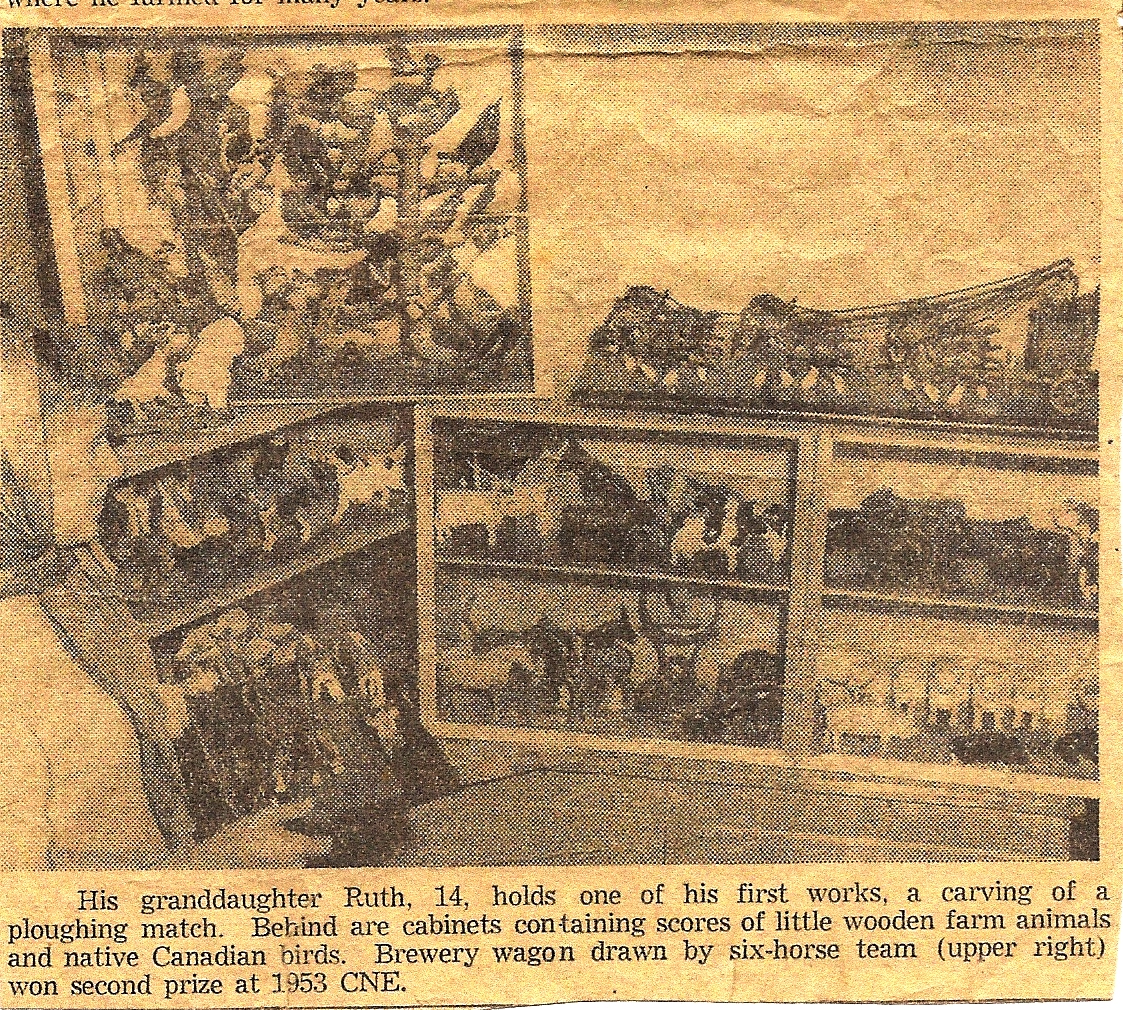
Partial recognition of his talent was received by Mr. Hoto at this year’s CNE when he took the exhibitions second prize in the hobby class for the three dimensional representation of a brewery wagon pulled by a team of six horses.

The work is complete with miniature barrels ready for delivery and a driver sawing at the reins as he controls the team.  The work was completed during spare moments in about a month’s time.

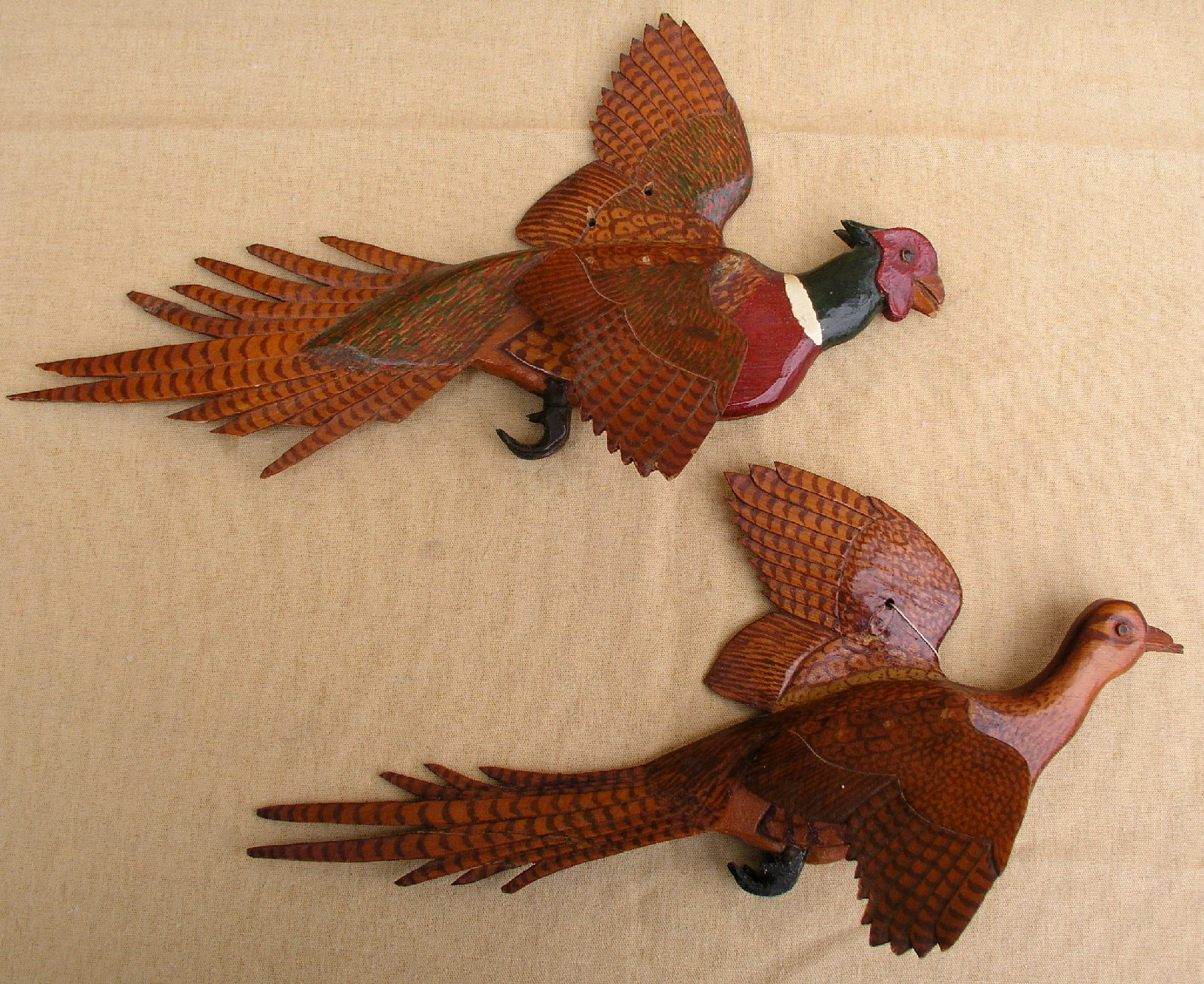
A specialty of Mr Hoto’s are carvings of game birds in flight. These include Canada geese, pheasant and ducks colored naturally and carved with an amazing feeling for movement.

Many of these are to be seen in the homes of district people . U.S. tourists have been quick to recognize the originality of Mr. Hoto’s carvings and have purchased many of the plaques.

The larger groups which consist of wagons and horses in action plyus human figures and an occasional dog running pell-mell alongside are not offered for sale.

These, Mr. Hoto wishes to keep, but he will sometimes offer to carve a replica of any of his smaller works for those who appear interested.

Mr. Hoto’s workshop is a tiny room in a neat little shed in which there is barely room for himself and his current projects.

Here surrounded by animal pictures clipped from illustrated newspapers  and magazines he creates his models of the life he has glimpsed about him on the farm and local towns and villages.

The front portion of a garage facing the village street is wired off and in glass cases made by himself many carvings are displayed.

Asked where he gets his ideas for carvings, Mr Hoto only smiled and observed they just came to him. Some he stated were suggested by cronies. Their influence he indicated had encouraged him to tackle his Exhibition exhibit.

His farm experience he said had given him his eye for carving the various gates of horses and the outlines of livestock.

This ability enables him to cut the living outline of a horse or cow out of a blank piece of paper in 60 seconds with no model or preliminary sketch to assist him.

“It’s not practice” Mr. Hoto observed. ”it’s  just a gift.”

John Albert Hoto – Creative Ability of an Unusual Nature

I was recently surprised and delighted when a picker from the Niagara Peninsula brought me in 8 small wood carvings by Albert Hoto . I very occasionally run across work from this highly skilled carver from Stromness, Ontario, and I’m delighted when I do because in my opinion he is a “top drawer”  Canadian folk artist. I would suggest he deserves this classification not only for his artistry and skill, but also his dedication to the work.  He kept at it out there in his workshop.  Producing thousands of finely detailed and original carvings of horses, farm scenes, wild birds, domestic and farm animals,etc.,  He was a natural, working his magic with his only a few tools;  a jackknife, a coping saw, and a great deal of patience.   He is well documented and illustrated in books such as the Price’s ’twas ever thus, and many others .

Within a month of my posting the pieces on the Shadfly website, I was contacted by Mr. Hoto’s grand daughter, Mrs. Ruth Marr.  She was friendly and helpful, and I am thankful that her interest is such that she made the effort to come to the shop to allow me to copy clippings and to tell me about her grandfather,  I enjoyed the articles and photos and I am happy to pass this information on.   What follows is a short biography based on Ruth’s information and an unnamed local clipping from 1956.  Also, I have reproduced in it’s entirety, a clipping from an unnamed  Toronto newspaper from 1953, the year his carving of a brewery wagon drawn by a six horse team won second prize for at the Canadian National Exhibition.  I chose to use a quote from an attached  photo caption from this article for the title.

John Albert Hoto

( July 2, 1886 -December 17, 1979)

Albert, as he was known, Hoto was born on the family farm in Stromness Station, south of the Welland canal near Dunnville, Ontario.  He had three brothers and two sisters.  He lived and worked on the farm until he married Florence Geneva Spellman on November 21, 1908.  They bought a farm nearby in Sherbrooke, Ontario.  They worked the farm and raised three daughters, Dorothy, Marjorie, and Gladys .  In 1948 Albert  retired and sold the farm. They built a home in Stromness along the feeder canal that runs between the Welland canal and the Grand River.

After working hard on the farm for so many years Albert found retirement difficult.  In 1950 he decided to take up the slack hours with wood carving.  He picked up his jack knife and set at it.  “I just couldn’t sit back in a rocking chair when I retired” he said”I had to keep doing something”.

In 1953, three years after starting , he received wide praise and attention when he won second prize for his carving of a brewery wagon at the C.N.E.  Soon he hung a white sign with neatly painted black letters in front of his small showroom stating only “Ornamental Woodcarving”.  He was prolific and sales were brisk.  This trend continued  as his reputation spread.  He won more prizes in some important  competitions such as the International Hobby Show in Toronto in 1956.  “My work is pretty well distributed’ he noted. He sold carvings to people from the area who would visit him at his workshop during summer months.  Eventually his work was bought by serious collectors from across Canada and the United States .

Using only a bone handled jack knife and a coping saw, and without any formal artistic education he created  a miniature world with diminutive  representations  of rural life.  He carved with an unselfconscious feeling for animal and human form.  He stated that his farm experience had given him an eye carving the various gates of horses and the outlines of live stock. Alongside his farm carvings, his specialty  became the carvings of game birds in flight. These are renowned for their natural colouring and amazing feeling of movement.

Mr. Hoto denied that it took great patience to produce the intricate works. “If you are doing something that you like” he explained” it is never work.” I don’t feel that it takes too much patience for me. I like the work, and the time seems to go easily”.

Mr. Hoto continued to work and sell his carvings from his home workshop until his death at age 93 in 1979.

Finding Value in Folk Art


Occasionally I will have a Maud Lewis painting displayed for sale in my shop, and it is sometimes interesting to get people’s reactions to a $6,000 painting that at first glance looks like their 12 year old niece painted it.  A “my goodness will you look at that”, and some covered up snickering pretty well expresses their complete disbelief that something so simple could possibly be worth so much money.  I occasionally will give a brief description of the circumstances of her simple Nova Scotia life, and add fuel to the fire by informing them that in her lifetime she sold them for twelve to fifteen dollars from her tiny little house by the side of the road.  I then suggest that it is probably simplest to think in terms of supply and demand.  The supply of these paintings has stopped since her death in 1970, and there are many more people wanting them than there are paintings available.  This of course skirts the main issue of their confusion as to how anything like this could be desirable in the first place. To answer this you have to go a lot farther.

Charlie Tanner, Mother and Child

Beauty is in the eye of the beholder, and for some people, and I include myself in this group, great value is placed in anything that is produced by man or woman that manages to capture, or in some way manifest beauty.  I do not mean “pretty picture” beauty here.  I mean beauty as in creations that manage to be a celebration of existence, or a connection to the greater truth.  Something that has energy.   This energy can be found occasionally in the works of trained and untrained artists alike.  The real value in truly great works of art is in experiencing them, and in doing so to be educated and transformed by them.  Understanding beauty is our salvation.  Money really just confuses the issue.   So in relative terms, $4 million for a Tom Thompson and $6,000 for a Maude Lewis:  the Lewis is still cheap.

Finding Folk Art

What is folk art.  Any precise definition of art is by nature a slippery process and open to question.  “Folk art” is a term applied to such diverse things as a finely crafted, highly organized Mennonite fracture drawing which expresses the collective manifestation of an ethically based decorative tradition, and yet is also applied to the highly individualistic outpouring of any untrained painter, sculptor or other practitioner.

Folk art is usually one step beyond the mundane.  Not just a container to bring water to the mouth for survival (cupped hands for example), but instead a cup lovingly fashioned to bring pleasure or attract notice even when it is not being used, such as an intricately carved canoe cup.

On another level we can simply say that folk art is the art of the ordinary people.  It is sometimes called primitive art or the people’s art because by definition the artist has not been academically trained.

Folk art is made for one or more of three reasons: to share beliefs and traditions, to make some useful object beautiful, or to express one’s feelings.

Folk art, by definition has been produced and appreciated since cavemen and women started smearing blood and feces on cave walls, but the academic study and appreciation of folk art is a relatively new thing.  An English writer named William John Thomas first coined the phrase “folk lore” in 1848.  At the time most anthropologists considered folklore as worthless peasant creations.  They were more interested in studying artifacts such as weapons, tools and such.   It was through popularized folk tales such as the Brothers Grimm books that peasant traditions and art forms began to become interesting to the intellectual  class.

I would argue that folk art did not show up on the radar of fine art institutions until around the turn of the century in Paris, when Pablo and the boys flipped out over the African art they saw for the first time, and started producing what today is called modern art.  This led to a wider acceptance of all forms of art.  Folk art has become increasingly more popular and studied in Canada, really since Expo 67 gave us a greater appreciation of who we are.

Carved cane attributed to Chief Beaver sells for $17,500

Several eyebrows were raised when the hammer came down at $17,500 plus10% buyer’s premium, plus tax on a carved cane at the October 1st Jim Anderson auction in Jarvis this past October 1st.  Lot 101 was described in the catalogue as an “exuberant and imaginative work attributed to James Beaver. This technically proficient piece features a carved beaver as the hand piece of the cane, well carved in an early style”.  Dealer chat beforehand suggested that it should come down around the $4-6,000 mark if it was anonymous.  Anyone’s guess with the attribution to Beaver.  We were all surprised by the outcome. It was however no surprise that it went to a dedicated collector of his work who is known to have collected over thirteen paintings by the artist.

Known as “The Six Nations Artist”, Chief Beaver travelled the Grand River from Caledonia to Brantford in the 1890’s, painting houses and business buildings for a living. During his life span from 1846 to 1925 he lived at Beaver’s Corners near Ohsweken on the Six Nations Reserve. A gifted man of many talents, he was known as a carpenter, a wood-carver, a juggler and a showman, as well as a painter.

On stage, he was “Uncle Beaver” as he travelled across Canada and the United States with road shows, carnivals and medicine men. Today some homes on the Reserve still retain samples of his woodworking and fine carpentry skills.

Jim Beaver and his wife, Lydia (Bay) from a Mohawk Reserve in Quebec, raised three sons and four daughters. Granddaughter AIta Doxtador remembered being impressed by a concert her grandfather put on in Christ Church at Beaver’s Corners and the canvas backdrops he painted for the occasion. She also remembered seeing him seated in front of his easel. Because he couldn’t read or write, he once asked her to write TITANIC on a paper for his painting of a ship.

I currently have a Beaver painting of flamingoes which is one of his more generic Victorian scenes that he would have sold from door to door.  You can view it on my shadflyantiques.com website; and there are examples of his furniture, at the Chiefswood Museum near Oshweken, and other examples of his painting and carvings at the excellent Woodland Cultural Center in Brantford.