Unknown's avatar

About shadflyguy

Owner/ operator of Shadfly Antiques.

Considering antique surfaces – an introduction

In the open market we encounter antiques with many different types of surface.  Original painted surface, original varnish, rubbed oil surface, dry surface, waxed surface, refinished, dry scraped to original finish, chemically stripped to original finish, over-painted, and re-painted. By learning about these different processes,  when considering an antique we can greater appreciate whether the surface is original to the piece, and/or what has happened to it over the years. Over this series of articles I will show how to recognize these various finishes, and will suggest the aesthetic considerations I apply to each. Initially we understand that very few pieces remain untouched.  It is most common that at some point over the years Ma pointed at her kitchen cupboard and said to Pa ” let’s freshen this up with some of that newfangled oil paint that we bought at the hardware store”,  or later, “lets take off the six coats of paint on this dresser with furniture stripper and then we can see the original cherry wood.”  Altering the original finish is sometimes an improvement, but more often a shame.  That being said the finish on older pieces are most often altered long ago, so then you need to decide whether to live with it the way it is our alter it again to improve it. There has been much discussion amongst collectors over the comparative value of original surface over refinished surface, and it is easy to oversimplify the equation.  Lets take a look at this circa 1860 Nova Scotia tilt-top table to open the discussion.
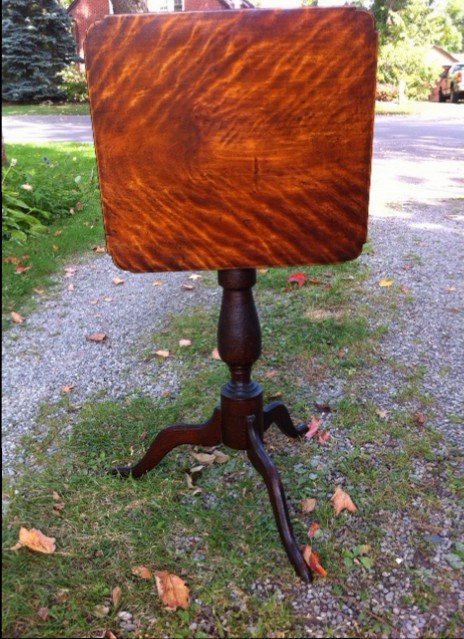
flame birch tilt-top table from Nova Scotia

flame birch tilt-top table from Nova Scotia

You can see that the top looks lighter than the base. That is because at some point (I would think about thirty years ago) someone has decided to “clean” the top a bit so that it is possible to see the pattern of the flame birch.  In the close up of the base  you can see that the (presumably) original varnish has darkened and crackled with age.  Untouched, you would not be able to see the patterned wood of the top, and so the owner of this table made the decision to thin down the varnish on the top only.

On the Roadshow, the boys would be rightfully quick to point out that the piece has lost value, but you can also see that for a true lover of wood it would be a shame not to be able to see the pattern as you would have when the piece was made.  In reality, pieces made with figured wood such as flame birch, or bird’s eye maple do not lose much value having undergone a quality refinishing because many collectors want to see the wood.  Consider how you would prefer to see this table.
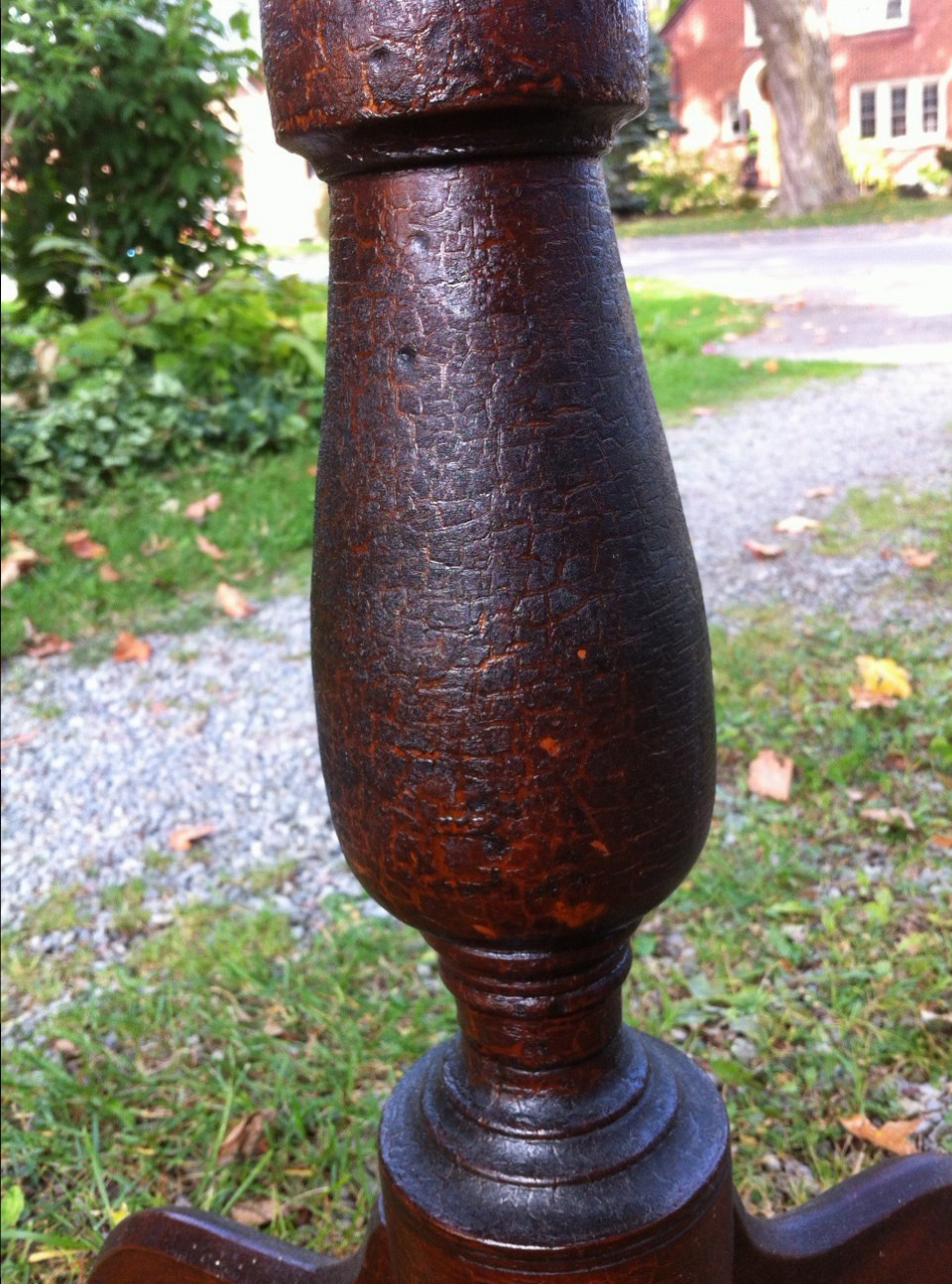
untouched surface on the base

untouched surface on the base

For me, if a piece retains a good original finish, I always want to leave it alone, even in a case such as this.  But I recognize that many would prefer the piece in it’s current state, and that some would even prefer that the whole piece be taken down to the wood and resurfaced, and that too is a valid opinion.  To be clear then, if you are lucky enough to find a piece with a good original finish, my advise is to leave it alone, but once a finish has been altered it’s fair game to change it again if it is for the better.
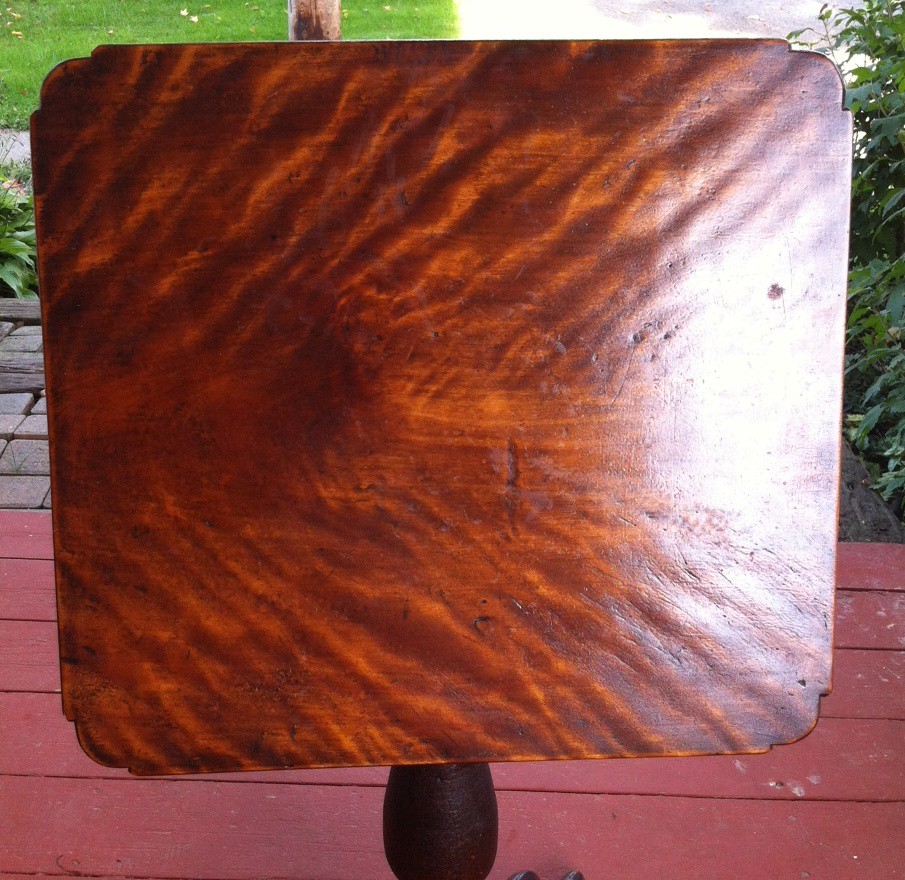
refinished flame birch top

refinished flame birch top

You can see that the top has not been stripped right down to the wood, but rather was taken down slowly and carefully to retain much of it’s original colour.  This process was very popular with collectors of figured wood in the seventies and eighties when much of this furniture hit the market.  It  suggests how many dealt with the conflicting values of leaving things alone to show their age and the changes inherent in the aging  process, and the desire to see things as they would have looked when they were new.
An inspiring visit

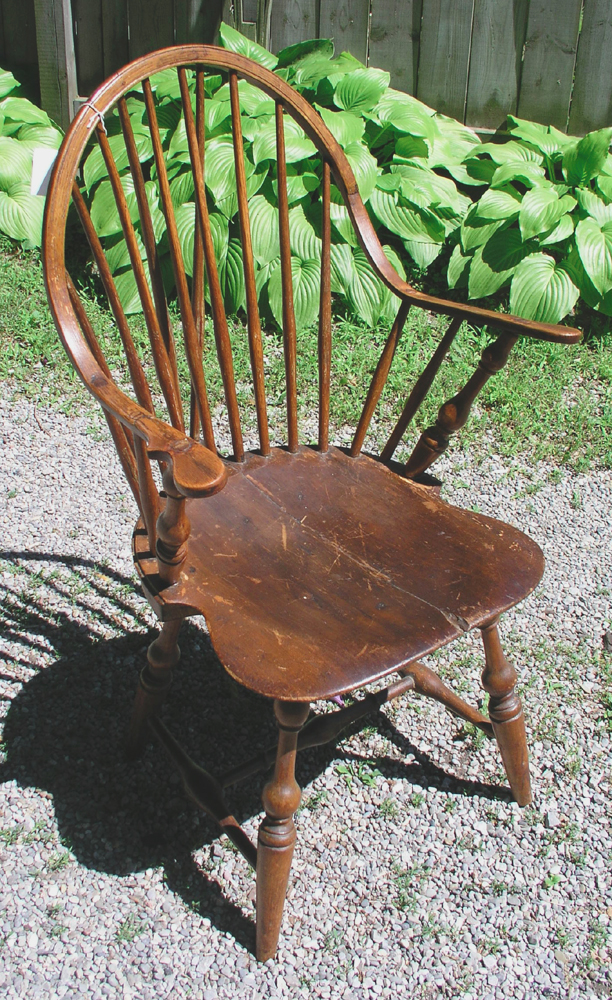
windchairOver the past few weeks of summer I have been encouraged by the number of younger people coming into the shop and not only having a look around but on some occasions making what appears to be there first serious antique purchase. The other day a couple who seemed just short of thirty came by, and I was surprised when the fellow said to his partner This is one of those tramp art boxes I have been talking about”,   Then he went on to give a pretty good summary of the genre.(look it up) Even better, he bought it.

But this story is about another type of encouragement, and a big reason why I continue in this business after arguably being a full time antique dealer for thirty years may seem punishment enough for most people. 

Last week I received a phone call on this continuous arm Windsor chair which had long been listed on my Collectivator site.  The gentleman phoning told me his name was Ray and that he was a collector of early chairs, and he proceeded to ask me a couple of intelligent questions about the chair.  “Is it a two board seat or a cracked one board seat”  “Cracked one board”.  “Has it been cut down” . “Nope, full legs and no rot”.  “Are there any replaced parts or repairs”.  “No replaced parts but it’s been re-glued”, and I proceeded to describe the primitive, early repair to the seat which involved a couple of thin boards with beveled edges glued and screwed underneath”   Ray said it sounded interesting and worth the drive from his home which is near Windsor, Ontario, and a three hour drive.  “Are you there Friday afternoon?”  “Yes Friday eleven to five”.  “Good, if it’s a decent day I’ll be there about two”. 

Sure enough,  right about two Ray came into the shop and went directly to the chair.  I noticed that Ray is a well dressed mature gentleman, with gold framed aviator glasses, and an I Phone in a leather pocket strapped to his belt.  We exchanged greetings and talked a bit about his trip etc, and then we settled into to the serious business of checking the chair out. Flipping it this way and that and turning it upside down.  All the while I was telling Ray what I knew of the provenance, and repair history.  I told him all I knew, which is that it most recently belonged to a buddy of mine who had bought it about twenty years ago from Ron O’Hara, who was an excellent dealer/collector from Saint Mary’s. Ron had bought it in the states several years earlier.  I eckoned it to be pre 1800, but not by much.  Maybe New York State or Connecticut. Definitely American.  “Hmmm,  nice chair”, says Ray, I’m going to have a look around.”  He checked out several items and then focused on a nice little salt box with a wagon wheel motif on the back piece. “O.K., what’s your best price on the chair and wall box?”  I gave him a decent discount because I liked him.  “That’s fair.  Done”.  At which point he pulled out his wallet and it was cash on the barrel head.  Now I really liked him.

We continued to chat. “How long have you been collecting early chairs?”  “I bought a log house on two acres of land ten years ago and I thought I’d died, and gone to heaven.  I restored it myself.  It took me two years to tear out the inside paneling and re-chinked the logs.  I found evidence that it existed in 1820 but I suspect that  it may be a bit older.  I really like to buy only items that fit the house’s time frame.  I have several Windsors, but this is my first continuous arm.  I’m delighted”  Would you like to see a photo of my house?” at which point he pulls out the I Phone.  “Cool looking place Ray, and to think that you did all that work yourself”.  “Well I was a lot younger then, remember it was ten years ago.”  And this is where I realized that although it can rightfully be seen as a pushy question, Ray was dying for me to ask  ” So how old where you then Ray?”  “Eighty”. “Wow really,  man if I live to be ninety I want to be you Ray. That’s amazing, I would have put you as a healthy 70.”  “thanks”.

He smiled, and said “would you like to know more about your chair, which is now mine?”  “”You bet”. He then pulled out his book on American WIndsor chairs and flipped to the page were the exact chair was illustrated.  “It was made by Ebenezer Turner in Connecticut in 1780.  I’ve checked all the measurements.  It’s a match” .

I am so inspired and grateful for having had the opportunity to meet Ray, a ninety year old with the intelligence and life force to get in his car and drive three hours each direction to buy a chair he was obviously delighted to add to his collection and to his home.  This is what it is all about my friends? Being ninety and being that much alive.  Keeping your mind active with a serious interest in collecting will do that for you.

“Would you like a coffee Ray”   “No, I’ve got to get home.  I’ll be back one day when I’ve got some more money”  he said with a wink.


The Shadfly Customer Appreciation BBQ and Sale

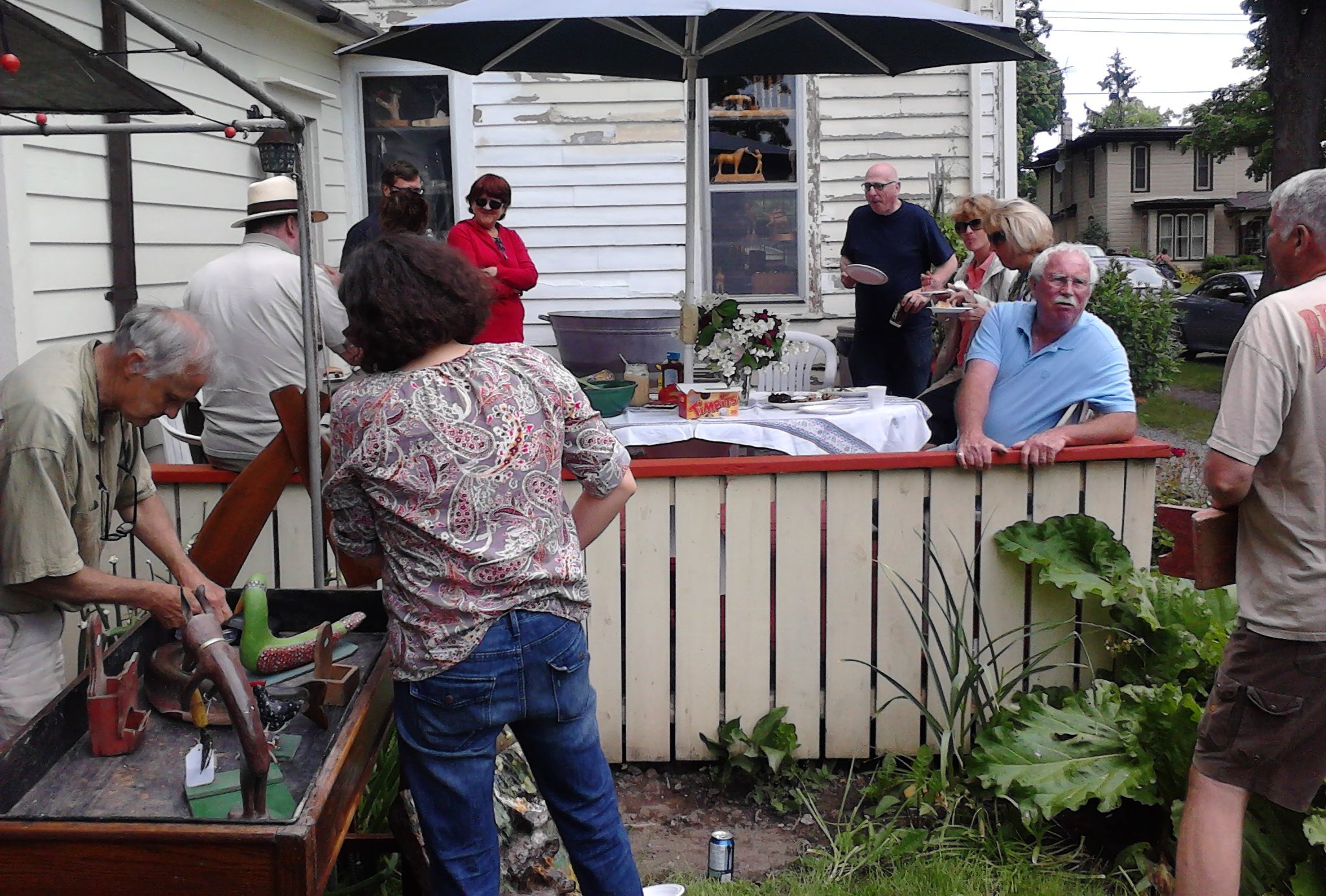
a beautiful day and a good turn out

a beautiful day and a good turn out

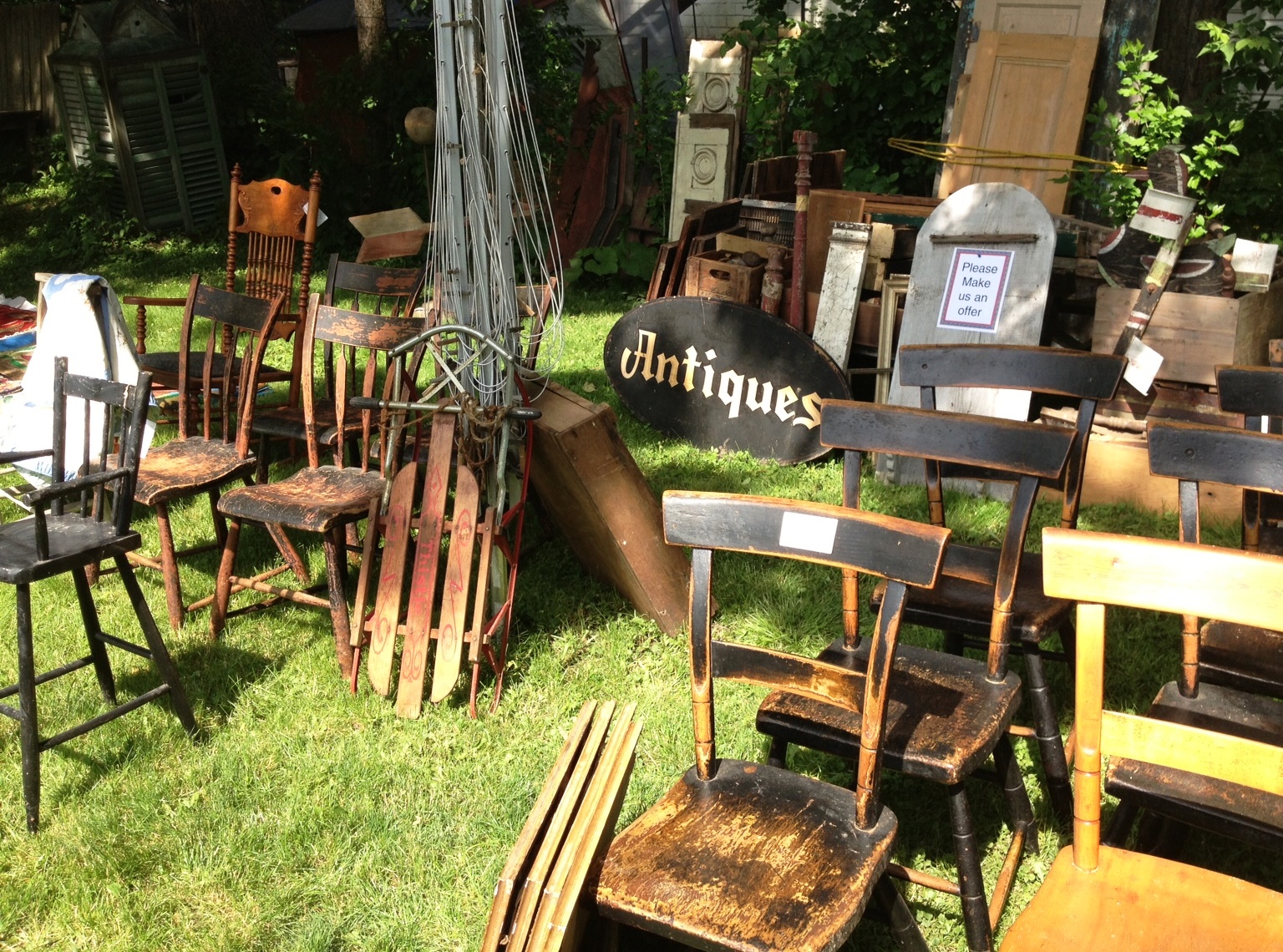
It happens to all collectors and dealers.  You go about your business, buying job lots, or whole collections to obtain some great pieces, and along with the “great” comes the “not so great”, but the “good enough” to  be put aside in your overflow area, be it basement or barn for future consideration.  Then along comes the day when you can no longer move in those places and that’s when it’s time to download.  Seriously, do not even consider renting more storage space because you will just fill it up in no time. So you can either take the stuff to the auction, or have a yard sale, or a bonfire.  My experience with auctions suggests that although they do provide finality, with this type of stock you are looking at maybe 5 cents on the dollar.  I could never burn even lousy furniture so why not have a yard sale?  And why not combine it with a customer appreciation BBQ.  Since we no longer do field shows, we have been missing those opportunities to have friendly negotiations and casual exchanges.  Plus customer Good Will is a valuable commodity which must be nurtured. .

We picked Saturday and Sunday June 15,16, and we put an ad in the Upper Canadian, the local paper, and posted the dates on-line.  No turning back now.  Naturally, we were hoping for a successful day, but reckoned that even if the sale was a wash (torrential rain anyone) it would at least provide us with the motivation to clear out the clutter, and that alone was worth it.

Well  happily it turned out much better than that,  it was a beautiful weekend,  we were well organized with lots of help from family and friends, and gratefully a lot of people came.  The feeling was very positive, we had a great time, and most importantly we moved out a lot of stuff,  When the price is “right”, the stuff really flies.

We are very grateful to everyone who worked hard to pull it off. Everyone worked on set  up and tear down. Jeanine and Pat Hall took care of food. Out daughter Cassandra was head of sales.  Her husband Anson cooked the sausages and did a lot of running around.  My amigos John Hall, Marty Osler, and John Ingram were all on hand to haggle, and charm.  Everyone had a wonderful time.  It lifted our spirits that so many who came were local, and everyone seemed to want to buy something.

In the end, yes it was a lot of work, but it really paid off.  Next time, and considering we can’t stop buying there probably will be a next time, It will be a one day event, not two, and maybe in the spring or fall instead of June. But otherwise, let the good times roll.  If you would like to see more photos please go to the Shadfly Antique Facebook page.

ysporchstuff3

It’s Coq-a-leeky Time

houseleekHooray .It’s coq-a-leeky time. For the past several years my friend House and I go out to our secret spot in a nearby woods and harvest wild leeks.  They grow three quarters of the way down a steep hill so the element of danger grows stronger every year with aging limbs.  Let me tell you, it’s damn hard using a shovel on a steep hill when you can’t balance on one leg.  Jeanine’s advice as I was leaving “try not to fall down the hill”  Exactly.  I had my cell phone with me but realized that if either of us went down there would be no immediate rescue. We made a pact to leave the fallen man behind and press on should disaster strike.  The soil was wet this year, so it was an easier job digging them out.  It only took us about an hour to fill our recyclable shopping bags.

When we had successfully dragged ourselves back up the incline we paused to sit on a fallen tree and observe the moment.  We discussed as we always do how it would be great to build a camping platform at this spot and retreat here when our “other” worlds became too much.  The annual pipe dream. As the sun filtered through the trees we watched the dogs for awhile as they ran around with noses to the ground.  Then, as every year we validated the ritual as something important to us that we will repeat faithfully for as long as we are able. Pause. Time to make our way back through the difficult new growth.

It takes Jeanine a long time to clean the leeks, and take off the little hairy  bits on the ends,  but she doesn’t seem to mind.  We both know what’s coming.  That night we make our version of Coq-a-leeky soup, a perennial spring favourite of many cultures including the Scottish.  We get a pot of chicken broth simmering and drop in about 8 full cloves of garlic, and a couple of cut up potatoes. We let  that simmer until the potatoes are quite soft ( about 15 min).  Next we throw in the chopped up wild leeks (use everything) and give it about another 10 minutes.  A little pepper, or soya if want to give it an Asian flavour.  But not so much as to cover the subtle flavor of the leeks. No oil or fat is involved and we love the flavor.  Most importantly, it is an amazing spring tonic.  I notice I have  better energy the next morning.  Jeanine talks about how in France it is common for people to do a “cure” from time to time.  Short of an absolute fast which can be debilitating and potentially dangerous, they simply restrict themselves  for a few days to eating small amounts of only one simple, nutritious thing .  Some use fruit, others fish or vegetable stock, etc. Currently it is not the only thing we are eating so it can’t be considered a full cure, but we have been predominantly eating just the leek soup since, and will continue until it’s gone. By the way, we wrap the cleaned leeks in paper towels and store them in the crisper.  There are a lot of other creative and delicious ways to cook these little treasures.  I recommend trying to get your hands on some while they’re in season.  It’s worth the effort.

Tod and his 1941 one ton tow truck

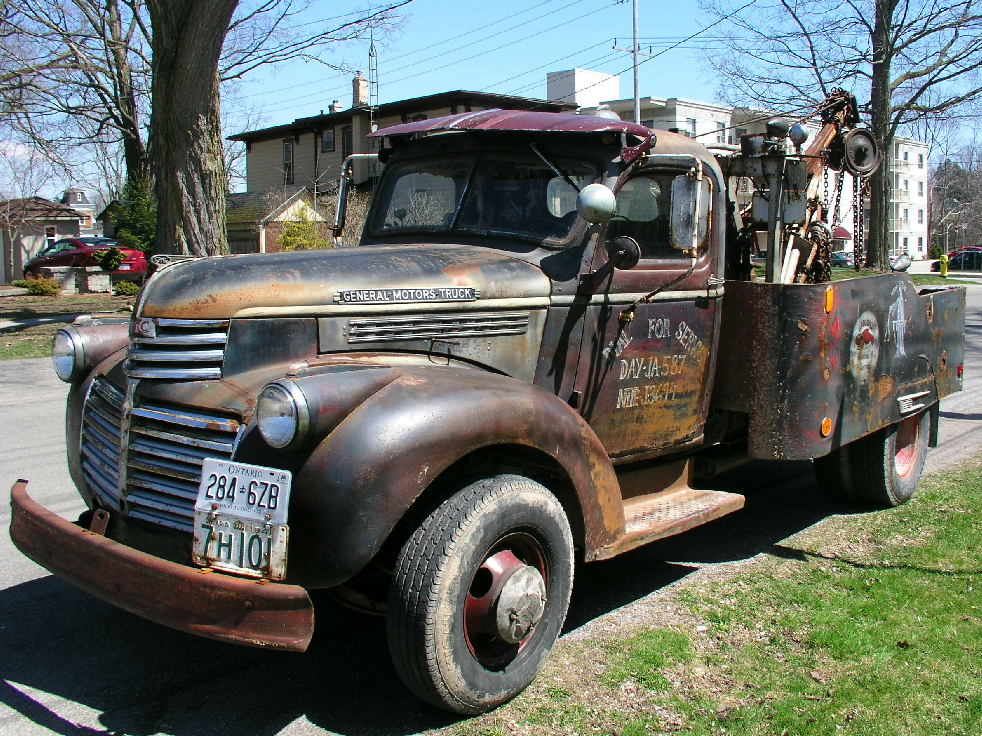
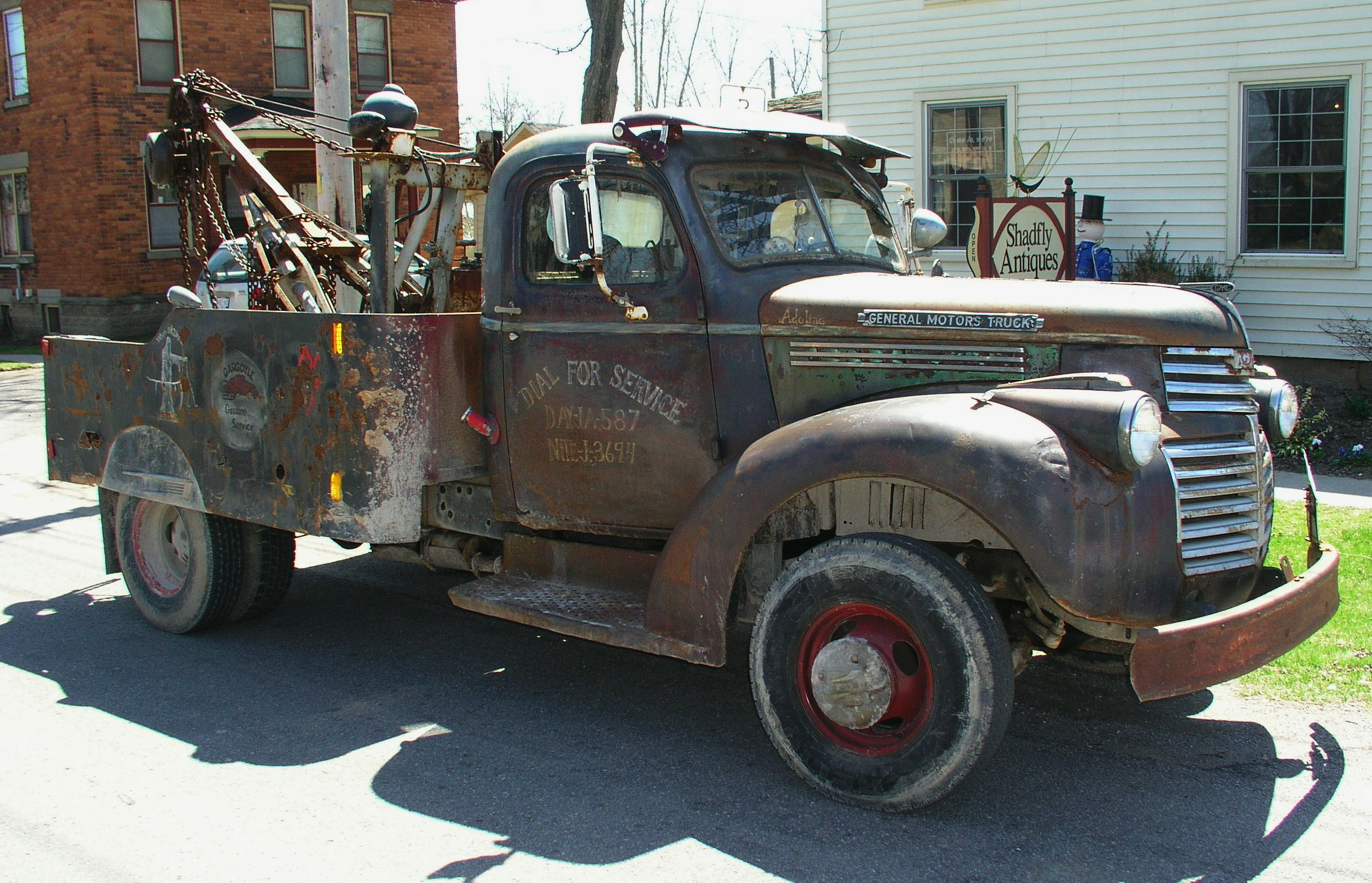
look what pulled up front

look what pulled up front

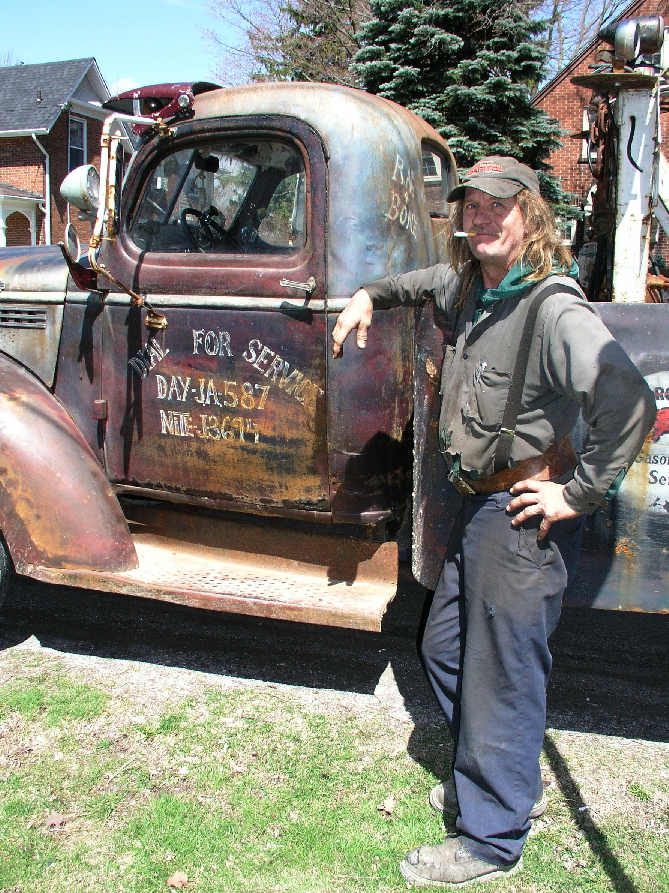
One of things I love about living in Port Dover is that there is no lack of authentic characters.  It’s a beautiful sunny day and I was working out back in the garden when I heard the door buzzer go.  When I came around the corner I saw this parked right out in front of Shadfly, facing the wrong way,  right in front of the no parking sign. Hmmm,  I went inside to greet the owner.  I found a pleasant man with his young daughter quietly studying a hand made merry go round which had come from nearby Haldimand county made from an old chicken feeder.  “That’s my neck of the woods” the man offered.  “Oh, so you are a local” I replied. “That’s a pretty sweet old truck you’ve got going there. Could you tell me about it.” We exchanged names and pleasantries, and Tod went on to say,
OLYMPUS DIGITAL CAMERA“Glad to.  It’s a 1941 Chev one ton which I have built onto a 1978 chassis. It’s got the original 1978 350 V8 in it. It took me a year and a half to put it together, which was as fast as I could go because I needed it for my scrap metal business  It’s a working truck you see. I use it every day and drive it everywhere. . It weighs 8,000 lbs, and I put 17 leaf springs in her on both sides so I know she can lift anything.  I had one of those car carrier type rigs before but the government demands so many damn permits for those things now that it’s just too much bother and expense to have one.  I work alone and there’s so many guys in the metal business now that I have to keep my costs low.OLYMPUS DIGITAL CAMERA”  “Look inside, I’ve got a lot of Lana Turner pin ups in there.  She was the real thing”

I had brought my camera over to take some photos for the Collectivator site so I asked if he minded if I took a few shots. Tod was happy to comply for as you can see, he’s proud of his truck. Why wouldn’t he be.

When asked, he told me that he collects car related things such as old oil cans and such.  Turns out he has a big barn full of such items which he has collected from “back in the time when you could buy things for not much money”,  I suggested he may have quite a valuable collection by now.  He told me that occasionally people have wanted to buy from him but he always refuses, and he has turned down a visit from the Canadian Pickers show guys a couple of times.  OLYMPUS DIGITAL CAMERA“I’m obviously not into it for the money .  I put a greater value in the delight of just having these things around me.”  A man after my own heart.  As he drove off in spite of the fact that I had nothing to sell him, I couldn’t help but feel richer for the experience.  Another day in Dover.  OLYMPUS DIGITAL CAMERAOLYMPUS DIGITAL CAMERA

Antiques I love, and why I love them – wire basket

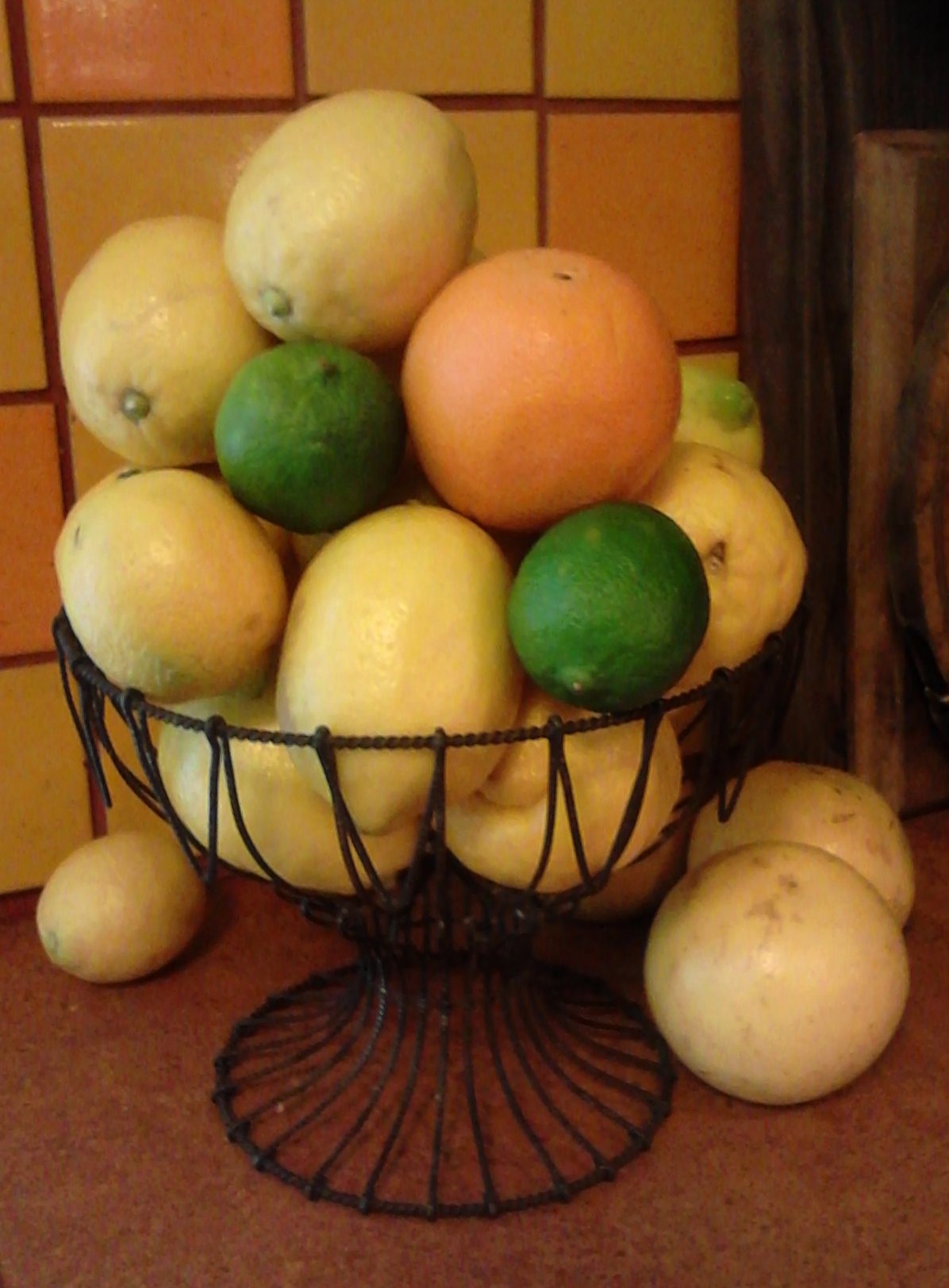
wibask1As you can see we love citrus. What I also want you to see is that I love the wire basket that the fruit sits in, and around.

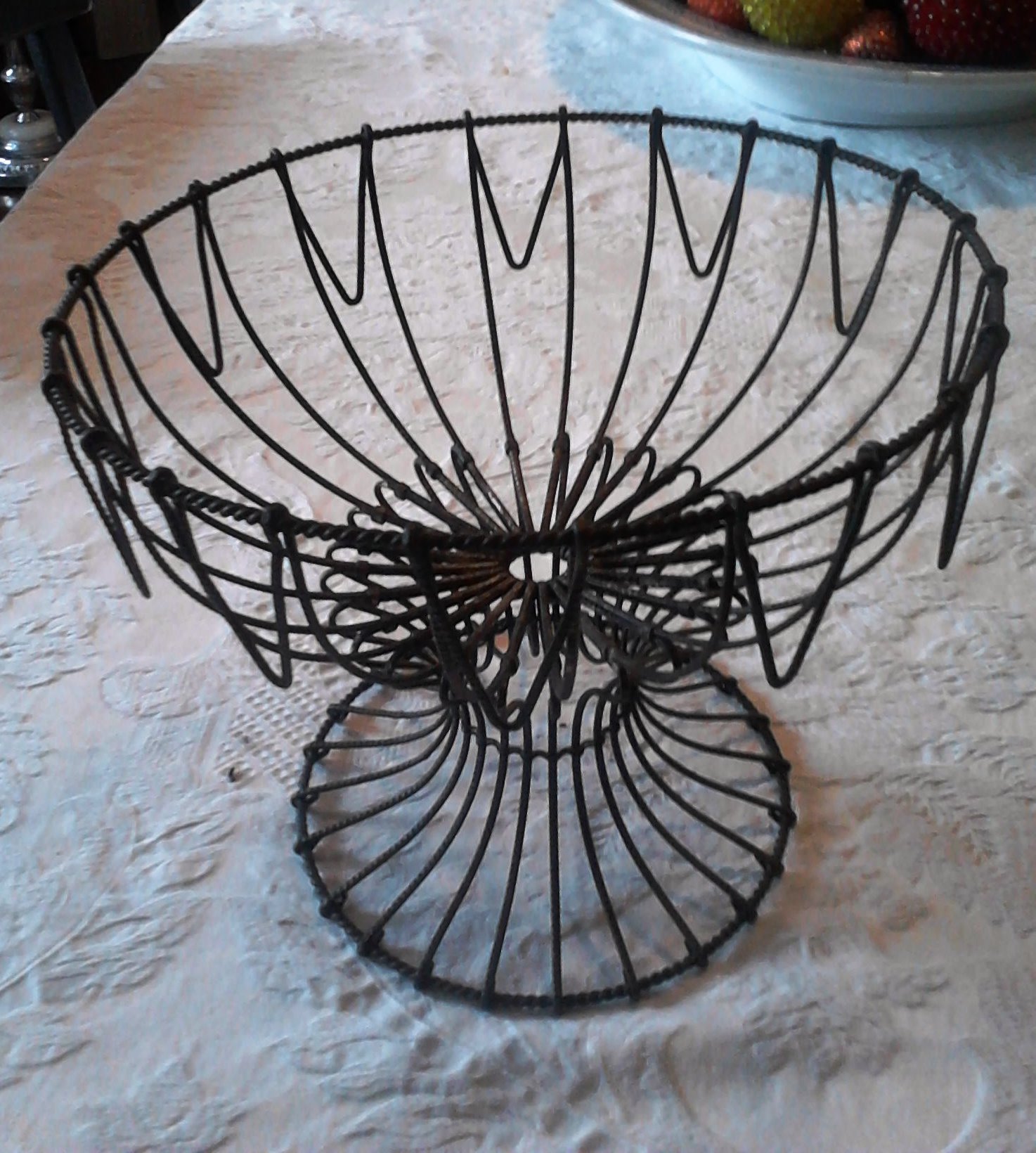
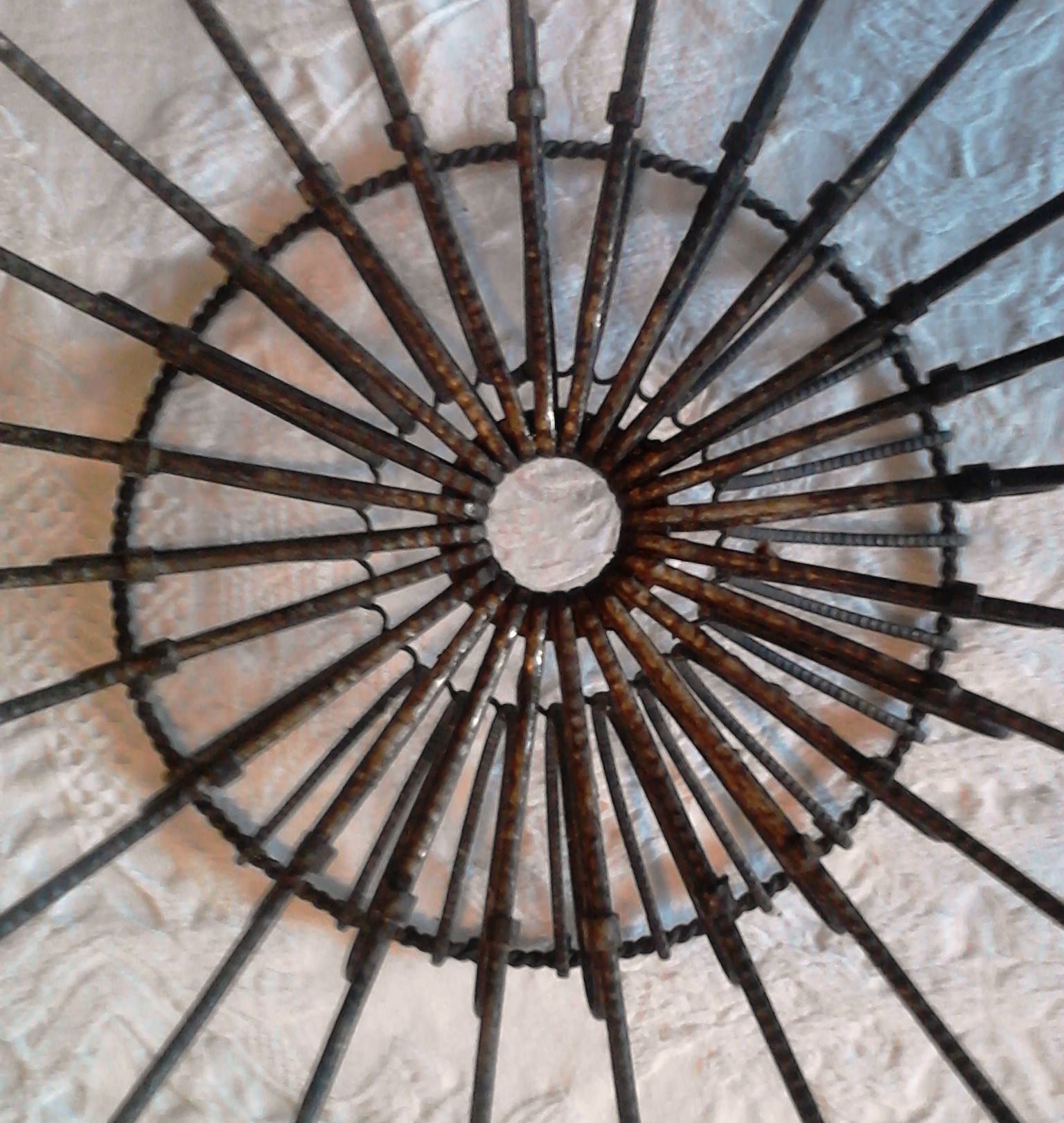
This basket is hand made from the mid 1800’s, and it delights me every time I look at it. Look at the detail photos and marvel at the workmanship and design.  From the bumpy texture of the wire itself, to the delicate little folds that hold the pieces in place, it is a marvel.

We bought it about 30 years ago from Peter Baker at a show we were both participating in at the St. Jacobs arena.  This had once been a mighty show but had stopped for a couple of years, and this was the first year they had tried to revive it.  Unfortunately, it didn’t happen.  The crowds, or lack there of allowed us plenty of time to chat amongst ourselves.  Jeanine took a bead on this basket the moment Peter set it out, but it was in the second day of the show, when there was absolutely nothing happening that she opened the subject of the basket, and her possible interest in purchasing.  Peter who is always a pleasant fellow did his best to facilitate the deal, but Jeanine played it cool. It was late in the third and gratefully final day that they came to an arrangement.

Quite often I will look at this basket, and admire again the beauty of the form, and the integrity of the craftsmanship, and I am grateful that Peter and Jeanine were able to come to an arrangement.

wibask5 wibask2 wibask3 wibask4

Thoughts and observations on the 2013 Bowmanville Antique Show

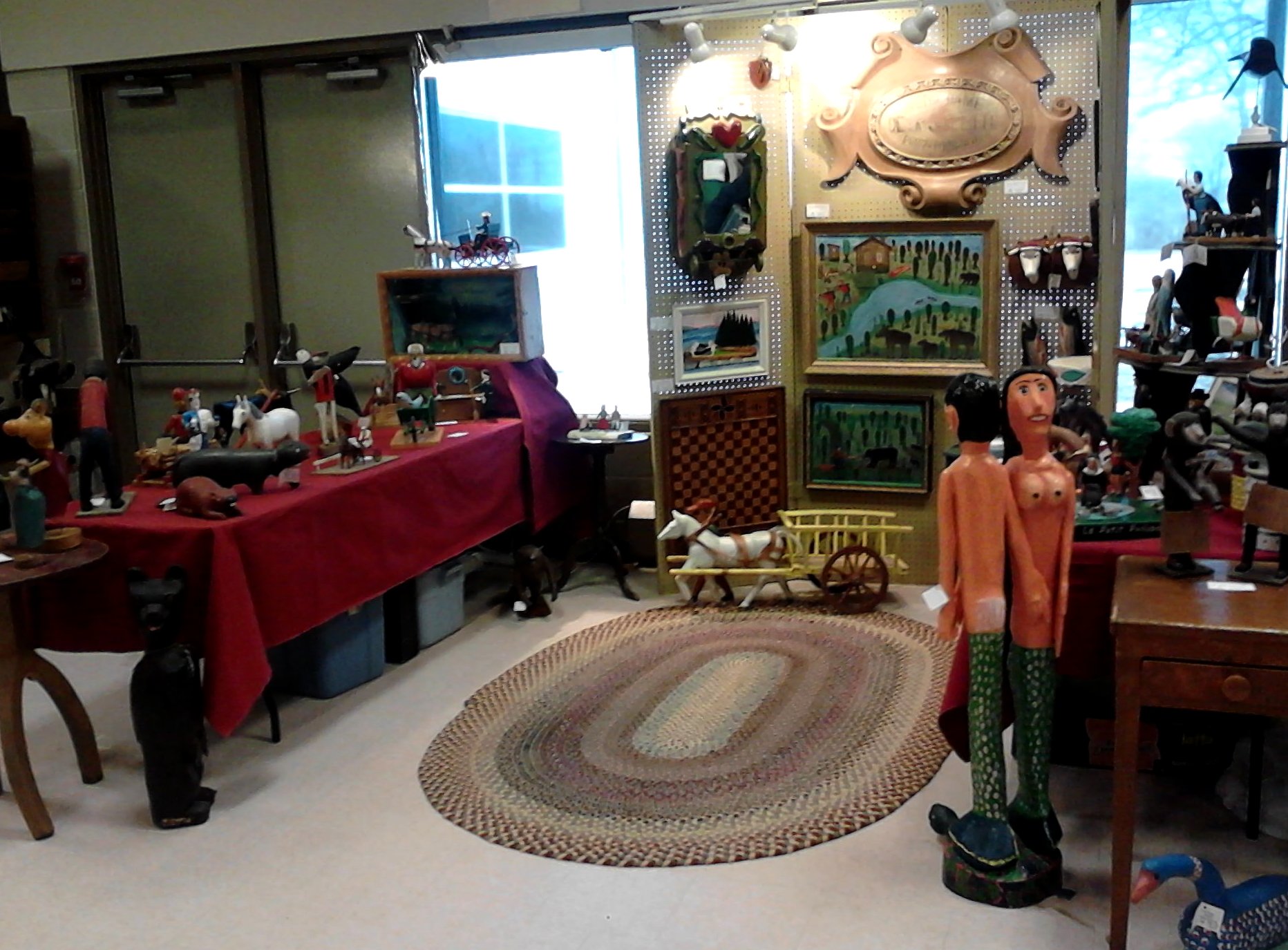
bow13shadThis is a picture of my booth at the 40th Edition of the Bowmanville Antique show. which was held Good Friday, March 29, and Saturday March 30th.  As you can see I went heavy on the folk art and light on furniture.  I love antique furniture, but I just don’t have the back for it anymore. If you want to see a slew of good pictures of the show please follow this link –  http://www.facebook.com/groups/126697675589/ to Adrian Tinline’s Canadiana Antiques facebook page.  If you are unfamiliar, this also serves to introduce you to this lively and informative forum.  Join, if you will.

This year Bowmanville was, as always a beautiful show, full of exceptional works of antique and folk art, and early handmade Canadian furniture and accessories.  All 24 exhibitors took special care to select and present their. best wares.  Many dealers put aside special pieces all year to present them here for the first time.

The show started humbly in 1973 when picker and collector extraordinaire Rob Lambert decided to invite the best dealers in the field of Canadiana to hold an annual spring show near his home in Bowmanville, Ontario.  In those early days dealers set up their offerings in their rooms at the Flying Dutchman hotel. When the starting bell rang, people would run (quite literally) from room to room to get ahead of their rivals, and purchase the treasures presented.  It was wild and hectic, with occasional  incidents of pushing and near fisticuffs. People were passionate about their collections back then.  It quickly gained the reputation of being “the” Canadiana show and it’s numbers and reputation grew from year to year.

Eventually the show moved to the G.B. Rickard Recreation Complex where it has continued to be held until present day.  For the past several years it has been expertly run  by Bill and Linda Dobson.  They have worked hard to maintain it’s tradition as a high quality, vetted show.  The vetting process is carried out before the show by a group of experts who go from booth to booth checking everything out for authenticity, quality, and accuracy of presentation.  Any repros, rebuilds, or items not meeting the criteria of the show are removed at this time.

I’ve been doing the show for about twenty years.  I’ve always been happy to do it, but I’ve also always fretted about doing well.  It all happens so fast. The bulk of the business is done within the first two hours of the show, People line up well ahead of time.  From time to time people even camp outside the door overnight to be first in line. With so many beautiful items competing for attention, you have to be ready to rumble when they come running through the door at  6 pm. Chances are that by eight o’clock you will have sold the bulk of what you are going to sell. You are on your feet and on your toes  selling, wrapping, and doing the math during those first two hours and then everyone clears out. By  9 pm you are either happy or concerned, but at least there is a good meal waiting for you.  Bill and Linda have always had wine and beer and food ready to bring out as the show closes, and for the last couple of years Mary Jo Field has been producing absolutely fabulous meals that in themselves are good enough reason to book the show.

Although many come to see the show on Saturday the atmosphere is considerably more relaxed. This is fine because  it allows you an opportunity to see the show, and chat with other dealers. Many of who I now see only once a year at this show. These chats often result in a few more sales or swaps.  Then it’s all over at 4, and within a couple of hours you’re packed and on your way home, either feeling great, or not so great, or disappointed.  It’s that kind of show.  Some people will always do well, and some people not so well.

I’d say that for the past couple of years, like everywhere else, sales have been slower, but there are positive signs too,  Prices are noticeably more reasonable, and interesting pieces, priced right do sell. It’s also great to see the show now includes three young dealers, Ben Lennox, Adrian Tinline, and Fairfield’s Antiques.  All had excellent booths, and added to the excitement with their enthusiasm and knowledge.  I also find it encouraging to see more young faces in the crowd, attendance figures are up over last year.

Here’s hoping that the Bowmanville show will continue to be a great place to see and buy the best in early Canadian antiques and folk art  for at least another forty years.

My happy time with Mr. Joly’s whirligig

Gig on display at the church

Gig on display at the church

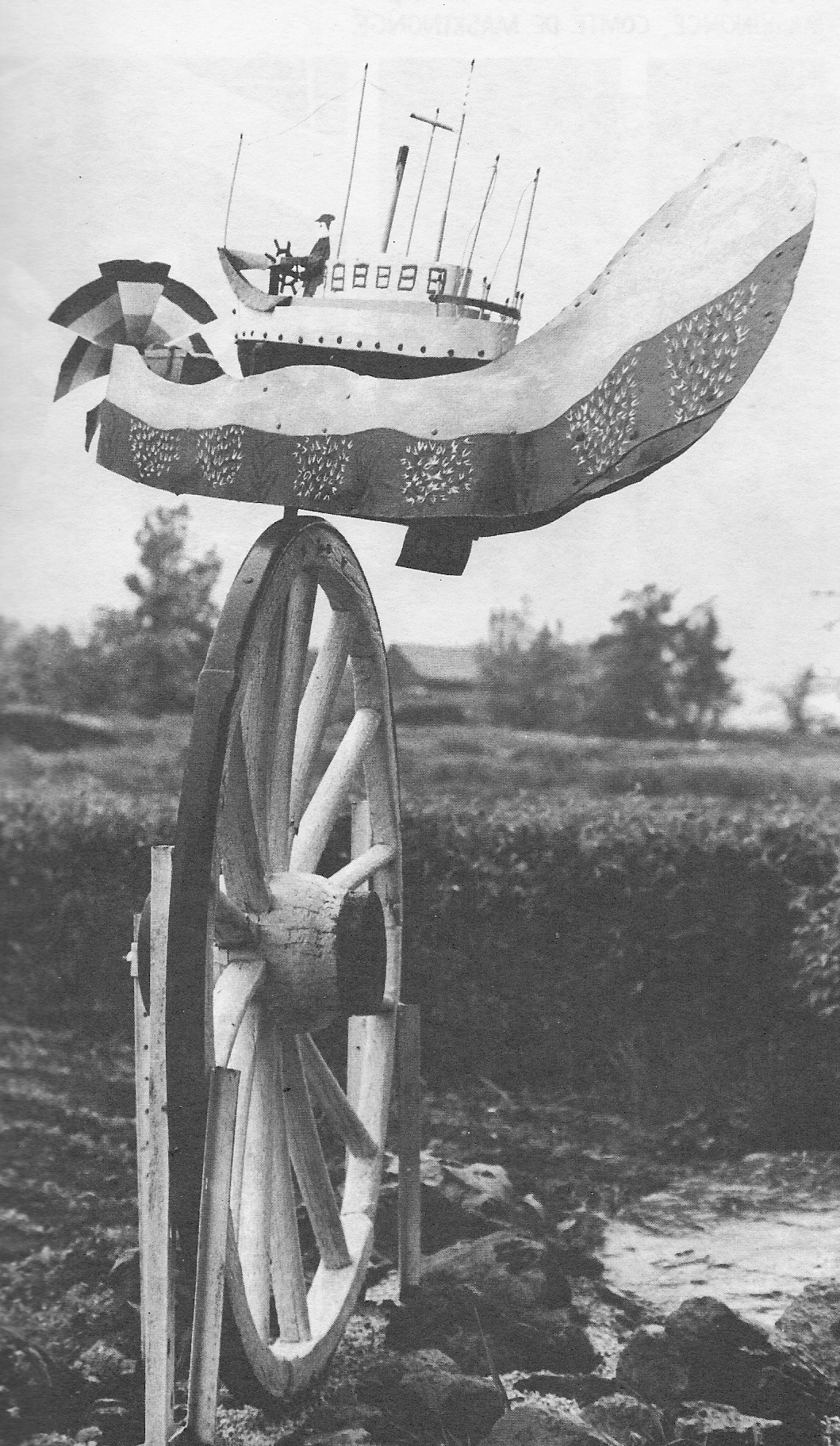
It was 1984 when I crossed paths with this whirligig; during the period when I was going to the picker’s barns of the Victoriaville area of Quebec every other week.  The drill was to leave home at 4 a.m., drive the ten hours, buy a truckload of furniture as quickly as possible, and get on home.  It was in late November, and I remember the trip well because the temperature dropped quickly, and the Drummondville bridge froze up before the roadway.  When I hit the bridge,  I did a perfect 360 pirouette the entire length, coming back on course and continuing as though nothing had happened; frazzled but undeterred.  Soon, the snow had come on so strong that for moments which seemed like eternity, I became completely lost, with no sense of direction within a big white cloud. All you can do when this happens is to slow down and listen for when the tires hit the gravel, thinking the whole time that a transport will come out of nowhere and drive right through you. Nasty. This was followed by long periods of the dreaded “hypno” snow, which is when the big fluffy flakes swirl over and over in spiral patterns until you think you’re going to loose it.  Tough sledding.

An hour later, when I finally arrived at Paul Prince’s place near Defoy it was dark and snowing hard, but I was just so damn happy to be alive.  The lights were on but Paul had gone home.  I was about to leave when a picker I knew named Jimmy pulled in behind me. A great guy, and a legendary  picker, he had been at it since he was a teenager.  On this night he was on his way home from picking around Montreal, and he was really excited by something “special” he wanted to show me. Jimmy was never a guy to suppress his enthusiasm.  Under the yard light, there in the back of his truck I could just make out  this funky metal rocking boat gig in vivid paint. All 4 feet in length of it. I got excited too. When he showed me how the window cranking mechanism from an old Ford  provided the gears for the rocking up and down of the boat, and the turning of the steering wheel I was a goner.

I had to think hard and fast because it was a lot of money, but a really cool thing; and I knew if I didn’t go for it, Paul, or the next guy would.  “O.K. Jimmy here you go, but put it on my back seat so it doesn’t get smashed by the furniture”. “I’m doing you a favour by selling you this.  You’re gonna make good money”.  “Ya right, if I wait 25 years”.  At this point Jimmy punched me in the arm and laughed, and the transaction was complete. I was delighted, but I had that slightly sick feeling I get when I stretch beyond my comfort range to acquire something special.  I loved it, but I could have bought 4 or 5 cupboards for the same money, and at that point cupboards were selling well, at a good profit. Oh,what the hey. You’ve got to trust your instincts, and great things don’t come along every day.

The next day was snowy and cold, and I filled the truck quickly, thinking all day of the money spent, and wondering whether Jeanine would share my enthusiasm.  I arrived home about 2 in the morning, so I left everything in the truck and went straight to bed. The next morning, over coffee, Jeanine asked me about the trip. I replied,  “Oh good overall, but  pretty intense”. I told her about the bridge incident, etc. and then casually mentioned that I bought something special that I hoped she would lke. I find it better to give confession right away, as delaying only adds to the suffering.  “Well, go get it, and let’s see what you’ve done”. The moment of truth had arrived.  Happily she loved it too, and we decided there and then to keep it for a good long time so we could appreciate it everyday.  “Too bad we don’t know who made it”.

Fast forward to the next summer and we are enjoying a weekend in Quebec, our favourite North American city.  We had heard of a bookstore where it was possible to buy a rare book, Les Patenteux du Quebec,  which we knew to be the “bible” of Quebec folk art, .

page 19 of "les Patenteux du Quebec"

page 19 of “les Patenteux du Quebec”

Published in 1978, it is the work of three young Quebec women who spent  a summer or so traveling all over Quebec documenting, and recording the stories of every Quebec folk artist they could trace.  We found the shop and bought the book, and when we cracked it open, it opened to page 19, and behold there was our whirligig. With a picture of it in it’s original location, and statement by the artist.  Extraordinary.   jolygig1

page18

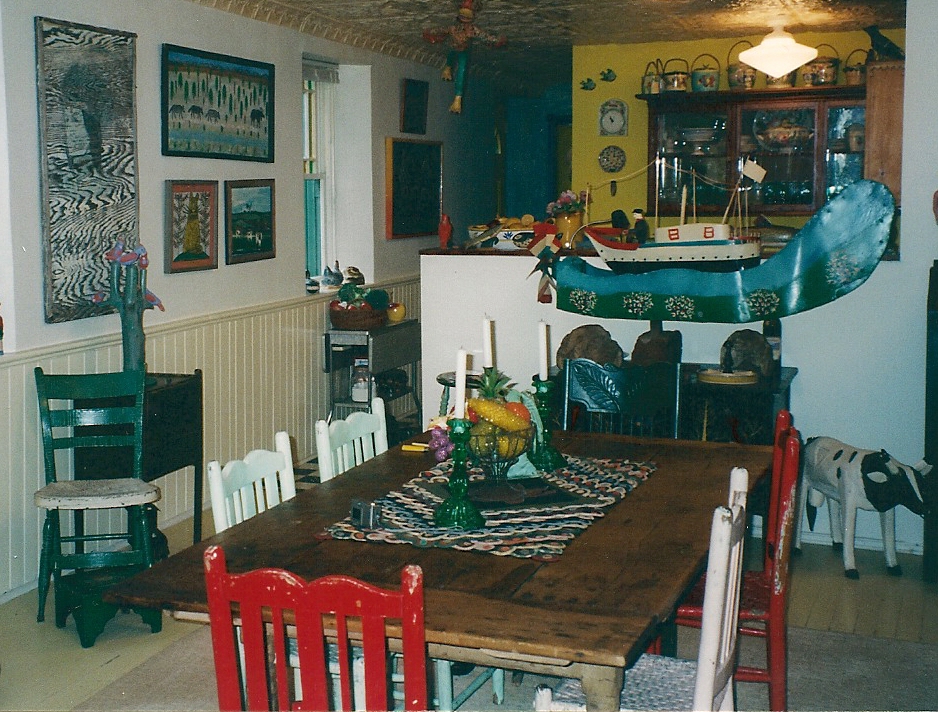
We placed the piece on a low cupboard in front of the low wall which separated our kitchen from dining area, and there it sat for the next twenty years or so.  We never offered it for sale but we had various offers over the years.  The best was when a friend  was returning to live in Italy, and he offered us his recent model Jeep in exchange. We thought about that one quite seriously, but refused figuring that the Jeep would rust out and be finished in a few years, where as the gig would just keep on going.

When we moved from the church to our current residence in  Port Dover in 2003,  we found it difficult to find the right place to display it. We considered mounting it high on a shelf above our front bay window, but that posed a risk of falling and crowning someone.  It moved from place to place being a bit in the way, and ended up sitting on a ledge behind the couch, which is when we more or less forgot about it. I still noticed it, but it no longer “engaged” me, if you catch my drift. Jeanine felt the same. So it came to pass that last year in a mood of downsizing we decided that although we had really enjoyed owning the piece, it was time to pass it along.  My friend, and serious collector Dr. Martin Osler had always coveted it,  and had asked for first refusal, so I gave him a call. Because we can both be convoluted at times, and because there was no particular hurry,  it took just about a full year to complete the transaction, but it now sits proudly on a high cupboard in the back of Marty’s office.  A striking location in an important collection, and I am happy because I can visit it occasionally. Here is a photo of Marty, and his friend, contemporary artist  Alex Cameron admiring the gig in it’s new home.

Marty and Alex enjoying his newest acquisition.

Marty and Alex enjoying his newest acquisition.

For me, after thirty years as a full time dealer I consider that I truly don’t own, or need to own anything.  My job is to find it, to recognize it, and then to be a good custodian until I have found it a decent home, where it will be loved and preserved.  It’s kind of liberating, actually.

What to do with a dirty, old cupboard – Part 1. Give it a bath

grcup1 Recently, I was asked my opinion on how to best “gentrify” this quite dirty old cupboard owned by Collectivator dealer Dana Hergott, of the Ojiibik collections. I’ve cleaned hundreds of cupboards over the past thirty five years so I thought this info might be of wider interest . I asked Dana if she would mind me including her photos, questions and results  while conveying the information here, and she generously agreed, so over this, and a couple more entries I will make my suggestions for the restoration of this fine old piece, report on her progress doing the work, and eventually show the finished result.

Dana’s question,  I’m going to send along pictures of that cupboard and would like your opinion on stripping it. (yes/no).  If needs a really good scrubbing so it looks dirty in the photos….also one of the legs is rotted off…

My response,   My gut feeling is to go with what you’ve got. Actually that’s my default position unless it is obvious that there’s something better underneath, or it’s just so ugly the way it is that it must be changed. Also, one can never be sure what one will encounter under the top paint, and there can be some very unpleasant surprises. I find the green quite attractive actually, and it’s got a nice “crackle” going on between the green and the light grey underneath. Poor thing.  It does needs some help, doesn’t it. The feet, the cut off side trim, not to mention the upside down right door, all need fixing, but not to worry.  The first stage is easy enough.

Clean it thoroughly using Murphy’s oil soap (or other)  Inside and out. If the top or other parts are quite raw, with paint missing try not to get these areas too wet, using damp, soapy rags followed by damp clean rags. This so as not to raise the grain on the raw wood.  Otherwise, wherever  there is a good layer of paint,  and especially if it is filthy, you can work much wetter, even using a hose outside on a warm sunny day. Power washers are tempting, but they can really screw up the surface if you are not very careful and use them on there most gentle settings. Of course in this Canadian winter  the best one can hope for is a warm, well lit, garage, or the like, so you have to work drier. Now, you have to do what you have to do to get it clean but try not to over scrub or clean too thoroughly, and importantly try not to let it stay wet for too long.  Have lots of dry rags (old towels are great) around to wipe it down as you go. Keeping a fan or heater blowing on it helps too.  I find it best to clean the inside first , paying mind not to let drips stand too long on the bottom boards or doors.  Then clean one section at a time starting on the top and working down.  Always conscious of wiping down the drips.

On very greasy surfaces it may be necessary to mix a little T.S.P. (tri sodium phosphate) with the soap and warm water.  But this mixture is to be used only where necessary,  and sparingly,  followed with the straight soap and water rinse.  A strong TSP solution has the potential to leave lighter bleached out marks where it runs down a surface, so be careful how you use it.

If possible it’s best to soldier on and clean it all in one session so it all dries at the same time . But if it’s too much work, then split the two sessions between inside and outside.   Remember, the trick is to clean it all to about the same amount.  Where the paint is good, you can initially get it quite soapy.   Clean a whole section at a time with rags, sponge or a soft bristle brush to the point  were it is uniformly “quite” clean”.  Not “super” clean. On the really grungy spots you can Use those green, plastic scratchy pads, but go gently. Follow this with a rag clean up and damp cloth rinse.  Keep going over it with dry rags as it dries.  When it’s dry buff the surface a bit and your done this first stage.

I’ll follow soon with “Part two – Fix it”, but for now I need to go down and make supper.  We take turns depending on who feels like doing it. Tonight I do.  Good luck with it and let me know how it goes.

Finding “Beauty in the Beast” at the Dufferin Museum

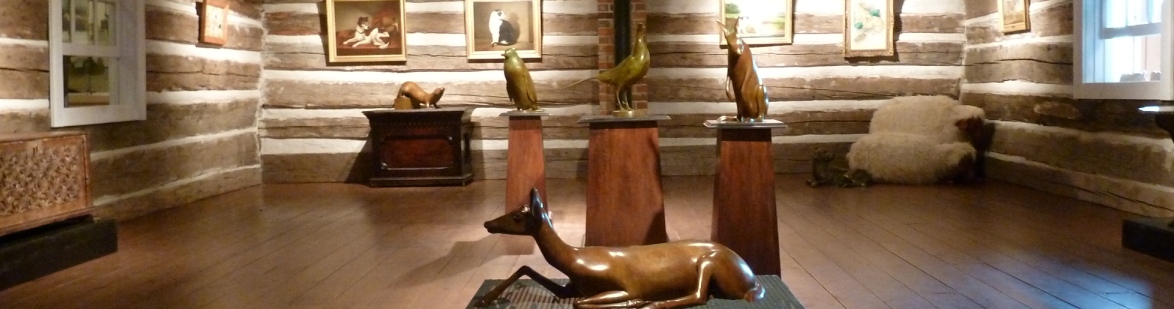
Interior of old Orange meeting hall houses Victorian English paintings and the contemporary bronzes of Adrian Sorrell (RCA) 1932-2001.

I had been looking forward since it’s April opening to seeing the exhibition  “Beauty In The Beast – Animals as Objects & Art”, and last Tuesday I finally made the roughly 100 km drive northwest of Toronto to the Dufferin Museum to see it. I was expecting to be impressed, but to put it mildly, I was blown away. More succinctly, I’d have to say absolutely gobsmacked.  It is an outstanding display of  all things animal, and I drank it in for over two hours before finally succumbing to “visual overload”. I left knowing that I would have to make a return trip to further take it all in before the closing date of December 22.

Initially I was struck by how beautifully the impressively large barn-like structure of the museum blends in with the surrounding rolling farm country.  Inside it is open and airy, and includes three full sized historic structures -a log cabin, an Orange Lodge meeting hall, and a railway flagging station.  The current exhibit is on display throughout. There are animals everywhere you look.

And who doesn’t love looking at animals?  After looking at ourselves, it is possibly our next favourite subject in art.  It goes back to the first caveman drawings.  I image the order was, himself, his wife, and then the animal he hunted, and depended on for his very sustenance.  Landscapes came later.  What’s amazing here is how the literally thousands of depictions cover almost every type of relationship we have with animals, and while viewing it, at times I was surprised  by an almost primal emotional response which welled up from deep within.  Animal effigies and Inuit carvings next to pastoral scenes of cows, horses and sheep, childhood memories of fantastic creatures and portraits of the family pet.  The iconic and the mundane.  Animals feared and animals worshiped.  Animals past such as an American 1880 copper grasshopper weather vane, an Egyptian brass cat, dated 200-210 B.C., 2nd century BC, 3rd and 4th century Netsuke carvings from Japan. These along side present depictions of animals by several contemporary Canadian sculptors include Marina Fricke, E. B. Cox, Clifford Neil and Calgary’s Gary Williams who produces brilliant large Majolica pottery pieces.

Gary Williams, contemporary Majolica swan

Plus, and these alone are worth the price of admission, there are 5 stunning bronzes by the brilliant English sculptor  Adrian Sorrell, shown in the photo up top.

And there is a lot of great, funky, funny folk art, past and present, which is guaranteed to make you, (and your kids if you’ve got them), smile. You just can’t help yourself when you look at the rusty tin covered cow by Contemporary Quebec artist, Patrick Amiot. Well, actually Mssr. Amiot now lives near San Francisco (I googled him), but you can see why we want to continue to claim him.

Cow by Patrick Amiot

Folk art fans will see many of their favourites including a few stunning miniatures by the master, William Loney (1878-1956) of Prince Edward County.  They are in a charming, glass 6 sided gazebo which was brought in to house the  miniatures. You can lose yourself there for a long stretch, Ill tell you. There is some fantastic animal related furniture as well, and a tree of life quilt which is to die for.  It just doesn’t stop.

“A lady sheep, Isabella Brandt, Ruben’s much loved first wife”, oil on canvas by Canadian Lindee Climo.

And I could go on at length about the contemporary art.  Surreal dream-scapes by  Gilles Genest, with titles like “Kangaroo’s picnic”, and “Full moon, white cats and hydrangea”. Also fascinating is  the exquisite work of Nova Scotia’s, Lindee Climo who paints animals in the style of the Old Renaissance Masters.

So how can I best express how strongly I feel that this is a first class, once in a lifetime,  drop everything to rush out and see exhibition?  I think I just did.  Go see it.

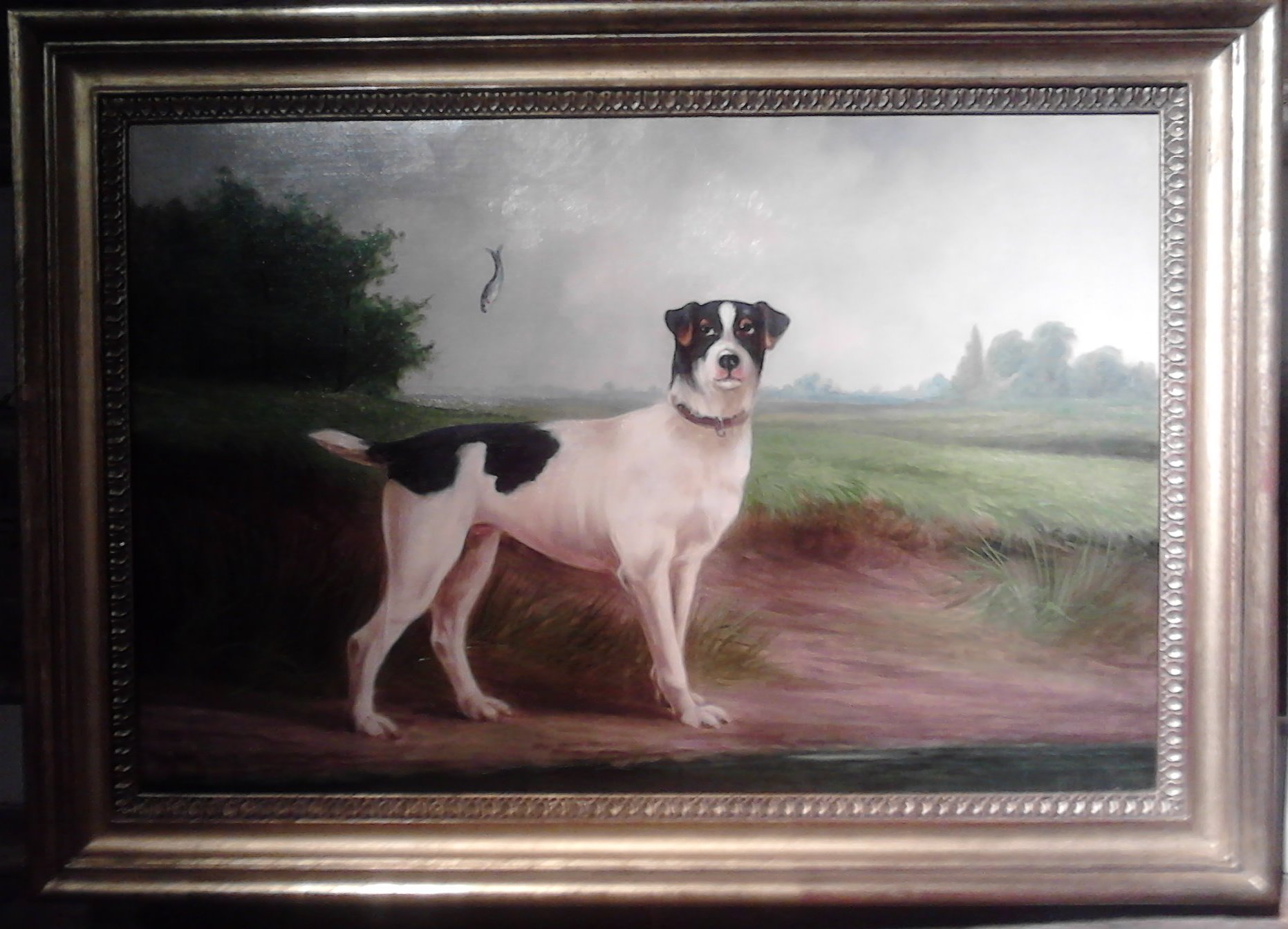
“Terrier and Leaping Trout” , oil on canvas by Wylan Young, England,1902

Here’s a link to the museum site – http://www.dufferinmuseum.com/