Antique Surfaces – getting down to the original finish.

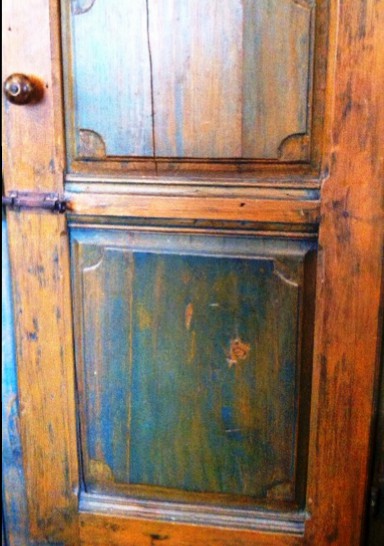
chemical strip to original colour

chemical strip to original colour

Often, if a piece has a great original paint which has been over-painted one or more times over the years, a dealer/collector will choose to attempt to take off the layers of over-paint to arrive at the original. This can be an “iffy’ proposition, and it is a good idea to first carefully examine the piece to make sure that there are no replaced parts for instance which would not have the original paint on it.  There is basically two ways to “take down” a piece. Either using a chemical stripper  to “pop” off the upper coats of paint, or by dry scraping.  Depending on what paints are used one or the other may work better, but in most cases if you take the time, dry scraping will leave you with more of the  original surface. With big emphasis on taking your time.  Sometimes though if the original coat is in good condition, and especially if it is a milk paint which is not effected by stripper, and if you have very good and consistent timing and are quick with a scrapper, you can get the over-paints to pop clean, and you are left with a good surface colour.   On this piece you can see that they were not too concerned with retaining the original colour as they were either in a hurry, or wanted a balance of the paint and wood colour combined.  This was a popular look back forty or so years ago and is a bit of a shame in my opinion.

Below are two examples of dry scrapped surfaces

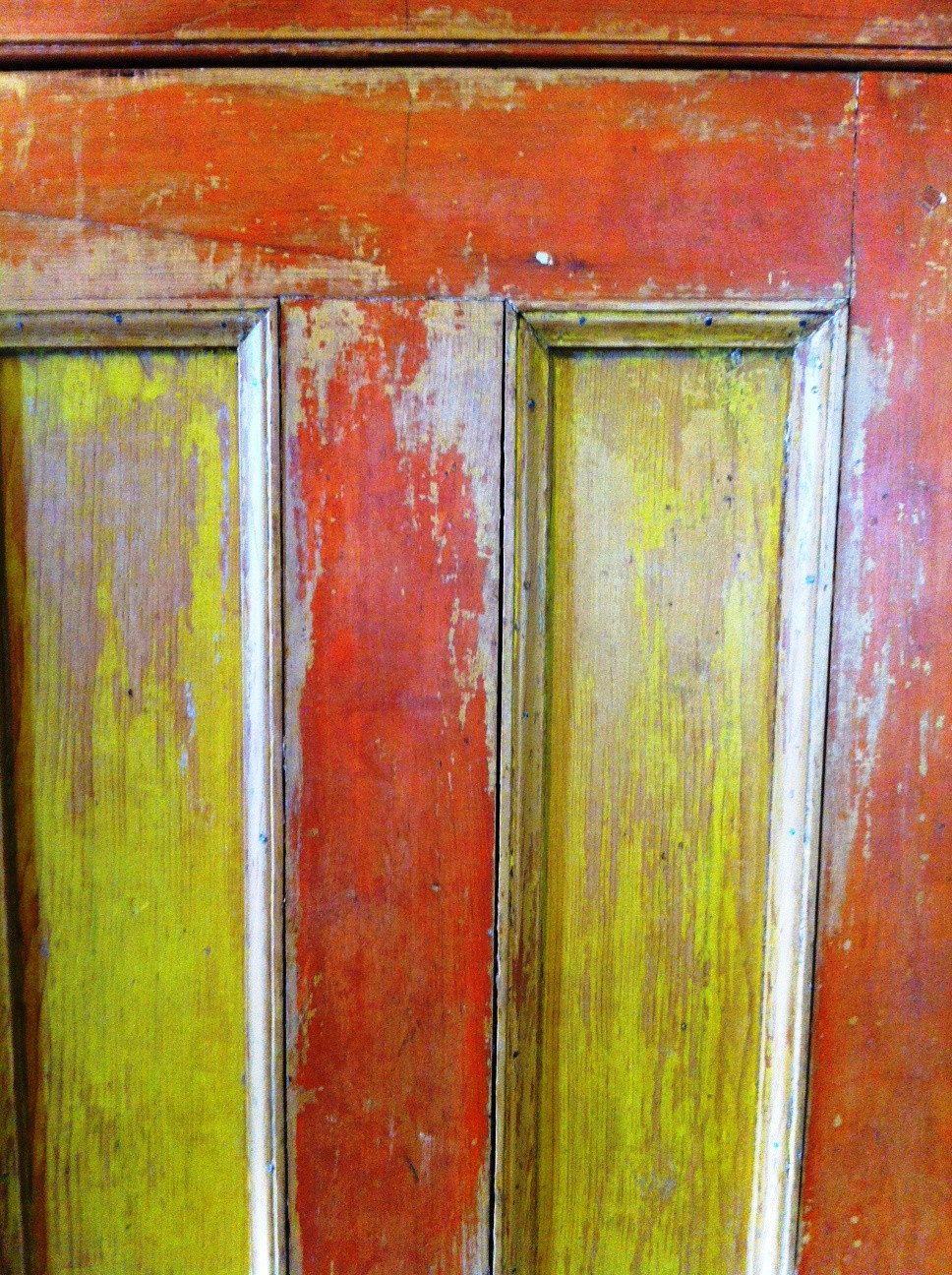
dry scraped carefully by a master refinisher

dry scraped carefully by a master re-finisher

 This is an example of the work of the late Allan Clareman, who in my opinion was the best you’ll find at this process.  He practiced law until an inheritance allowed him to do what he truly loved to do full time, which was to take over-paint off antique furniture.  He worked meticulously with tiny sharpened dental tools, and a jeweler’s loop attached to his glasses so that he could see exactly what he was doing.  This cupboard took him over a month but you can look as carefully as you are able and you will not see one blade mark. It cost over $1,000, but was a bargain considering the time involved, and how beautiful it turned out. It was worth every penny of it.

This cupboard on the other hand is an example of hasty, crude work.

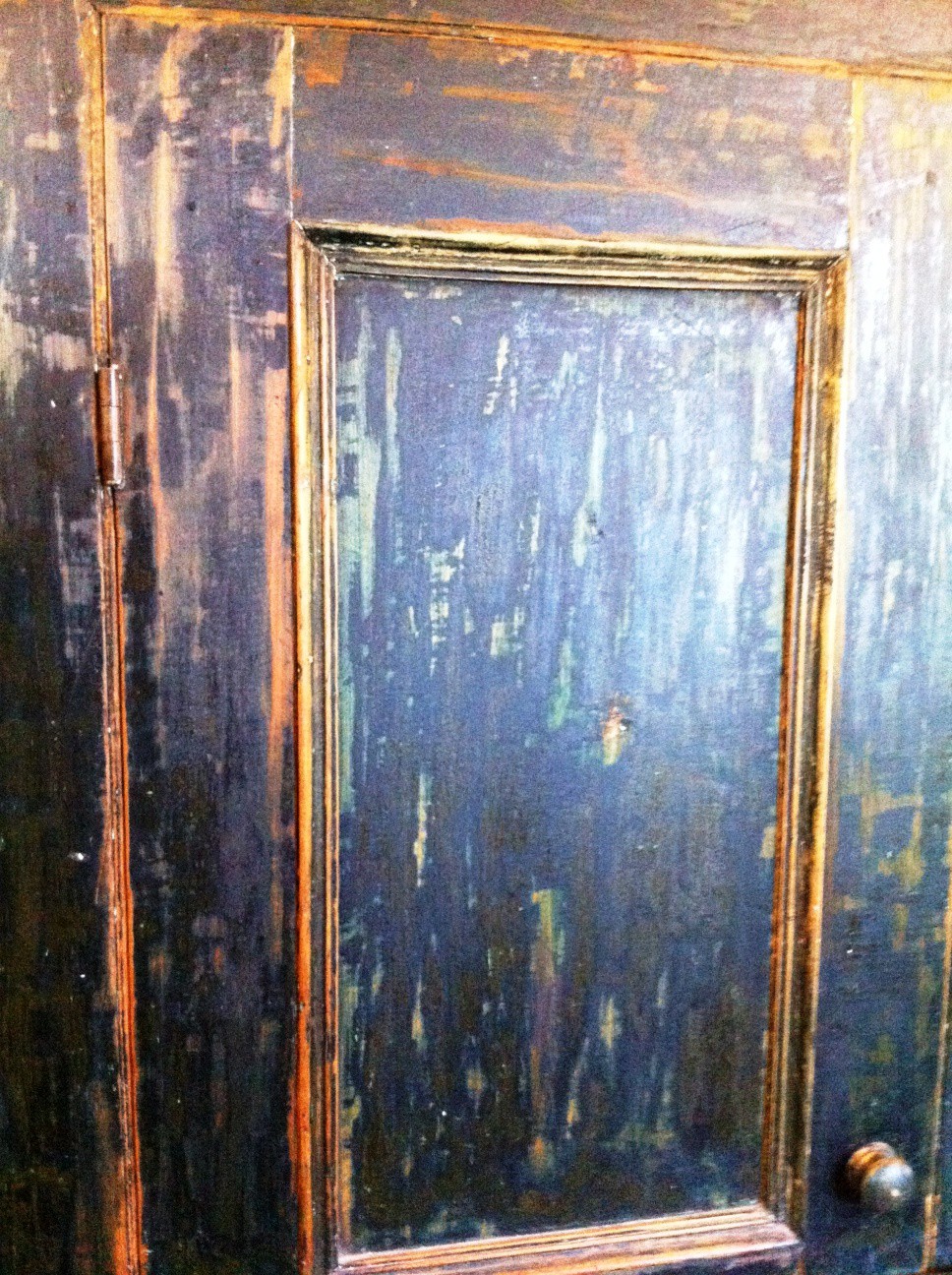
dry scraped quickly and by a non professional

dry scraped quickly and by a non professional

It still retains a lot of colour, but you can see all kinds of gouges and scratches caused by working too quickly with the knife or scrapper over uneven surfaces.  A local dealer here used to swear that using a piece of broken glass was best, but the work he did didn’t support his theory. Concentration,and patience is the key, no matter which method you use.

I have done a lot of this type of work over the years, and it can be very relaxing and rewarding as long as you don’t become concerned about the passing of time.

In future posts I will provide a few tips on how to go about it.  For now consider these surfaces and look at other examples to try and determine the method used, and the degree of expertise.


Considering antique surfaces – an introduction

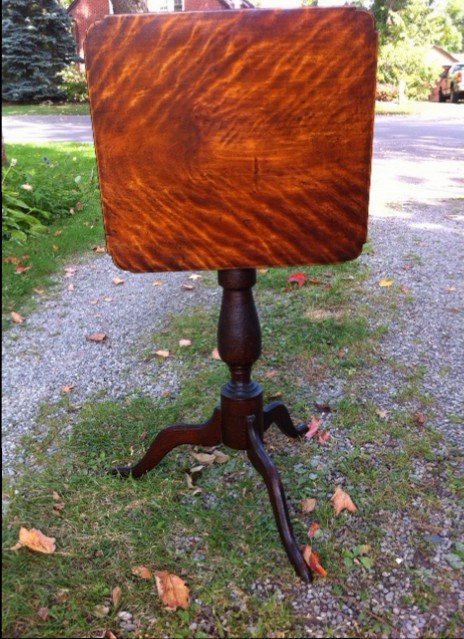
In the open market we encounter antiques with many different types of surface.  Original painted surface, original varnish, rubbed oil surface, dry surface, waxed surface, refinished, dry scraped to original finish, chemically stripped to original finish, over-painted, and re-painted. By learning about these different processes,  when considering an antique we can greater appreciate whether the surface is original to the piece, and/or what has happened to it over the years. Over this series of articles I will show how to recognize these various finishes, and will suggest the aesthetic considerations I apply to each. Initially we understand that very few pieces remain untouched.  It is most common that at some point over the years Ma pointed at her kitchen cupboard and said to Pa ” let’s freshen this up with some of that newfangled oil paint that we bought at the hardware store”,  or later, “lets take off the six coats of paint on this dresser with furniture stripper and then we can see the original cherry wood.”  Altering the original finish is sometimes an improvement, but more often a shame.  That being said the finish on older pieces are most often altered long ago, so then you need to decide whether to live with it the way it is our alter it again to improve it. There has been much discussion amongst collectors over the comparative value of original surface over refinished surface, and it is easy to oversimplify the equation.  Lets take a look at this circa 1860 Nova Scotia tilt-top table to open the discussion.

flame birch tilt-top table from Nova Scotia

flame birch tilt-top table from Nova Scotia

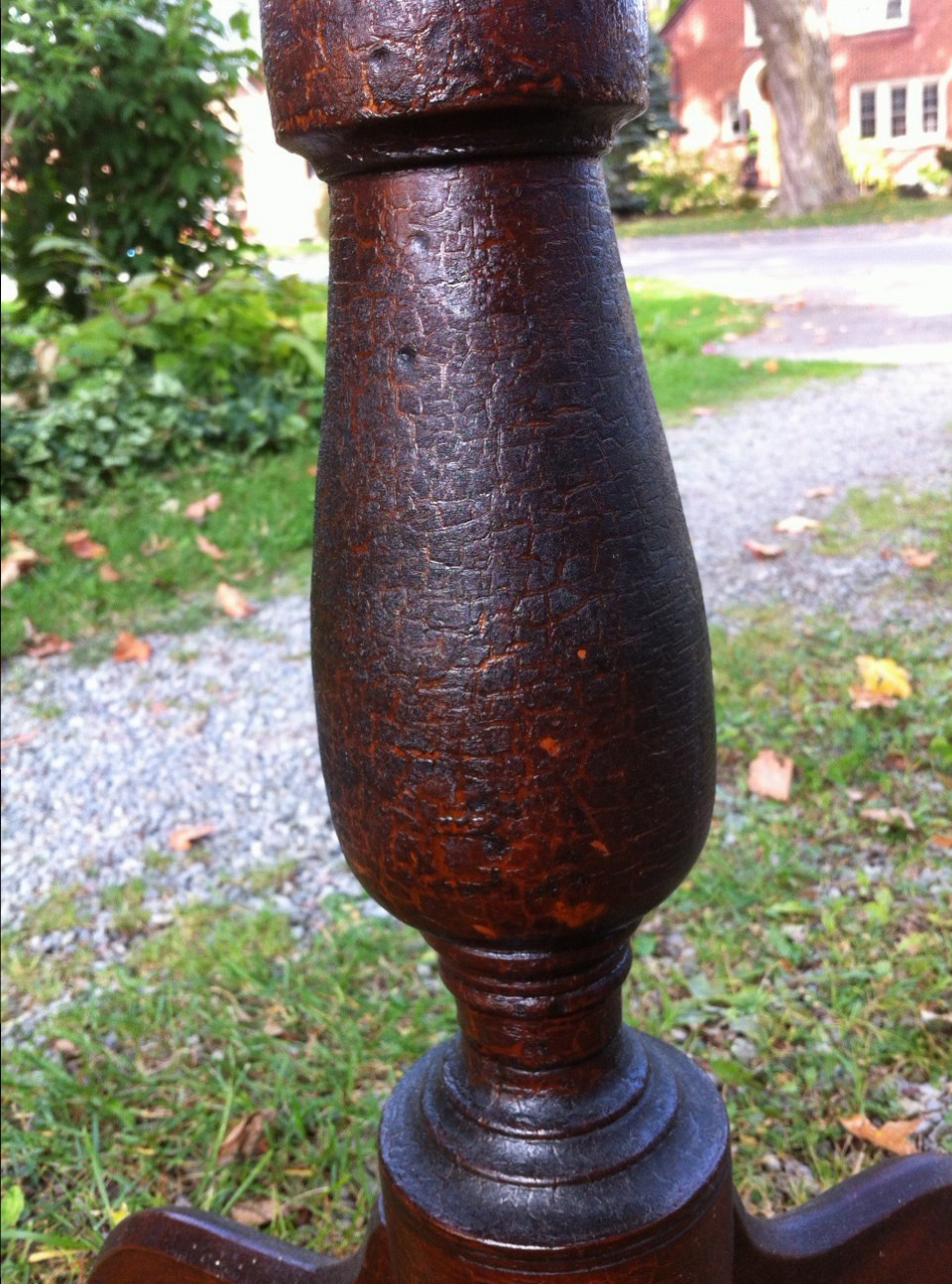
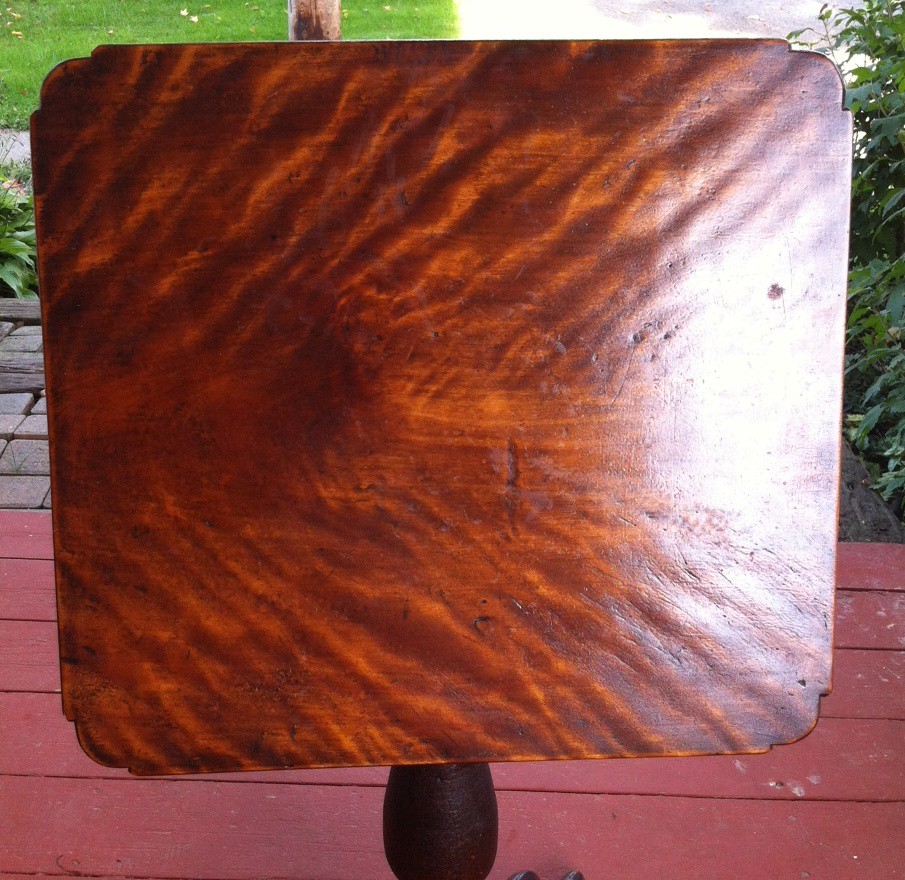
You can see that the top looks lighter than the base. That is because at some point (I would think about thirty years ago) someone has decided to “clean” the top a bit so that it is possible to see the pattern of the flame birch.  In the close up of the base  you can see that the (presumably) original varnish has darkened and crackled with age.  Untouched, you would not be able to see the patterned wood of the top, and so the owner of this table made the decision to thin down the varnish on the top only.

On the Roadshow, the boys would be rightfully quick to point out that the piece has lost value, but you can also see that for a true lover of wood it would be a shame not to be able to see the pattern as you would have when the piece was made.  In reality, pieces made with figured wood such as flame birch, or bird’s eye maple do not lose much value having undergone a quality refinishing because many collectors want to see the wood.  Consider how you would prefer to see this table.

untouched surface on the base

untouched surface on the base

For me, if a piece retains a good original finish, I always want to leave it alone, even in a case such as this.  But I recognize that many would prefer the piece in it’s current state, and that some would even prefer that the whole piece be taken down to the wood and resurfaced, and that too is a valid opinion.  To be clear then, if you are lucky enough to find a piece with a good original finish, my advise is to leave it alone, but once a finish has been altered it’s fair game to change it again if it is for the better.

refinished flame birch top

refinished flame birch top

You can see that the top has not been stripped right down to the wood, but rather was taken down slowly and carefully to retain much of it’s original colour.  This process was very popular with collectors of figured wood in the seventies and eighties when much of this furniture hit the market.  It  suggests how many dealt with the conflicting values of leaving things alone to show their age and the changes inherent in the aging  process, and the desire to see things as they would have looked when they were new.

An inspiring visit

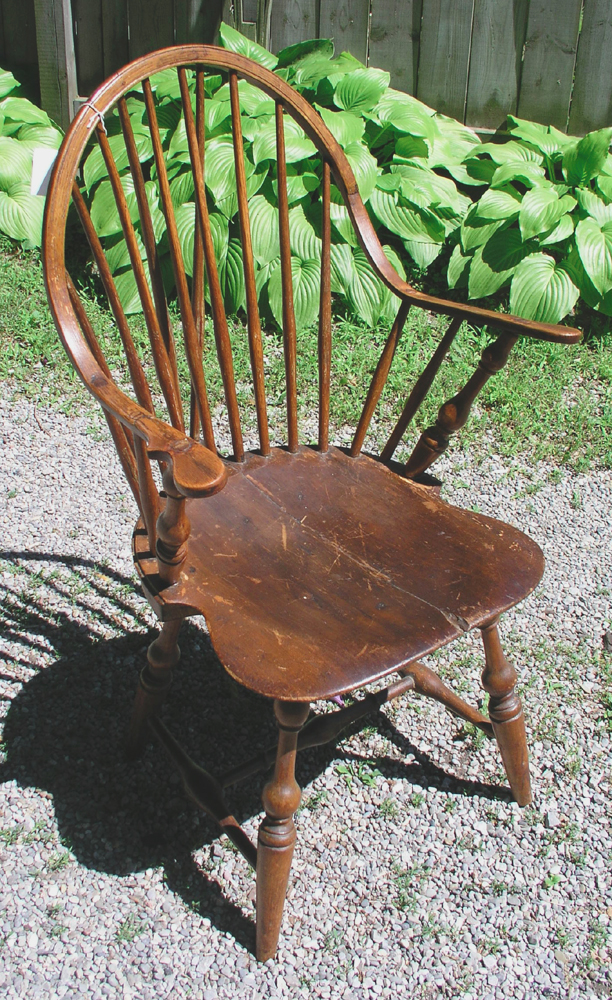
windchairOver the past few weeks of summer I have been encouraged by the number of younger people coming into the shop and not only having a look around but on some occasions making what appears to be there first serious antique purchase. The other day a couple who seemed just short of thirty came by, and I was surprised when the fellow said to his partner This is one of those tramp art boxes I have been talking about”,   Then he went on to give a pretty good summary of the genre.(look it up) Even better, he bought it.

But this story is about another type of encouragement, and a big reason why I continue in this business after arguably being a full time antique dealer for thirty years may seem punishment enough for most people. 

Last week I received a phone call on this continuous arm Windsor chair which had long been listed on my Collectivator site.  The gentleman phoning told me his name was Ray and that he was a collector of early chairs, and he proceeded to ask me a couple of intelligent questions about the chair.  “Is it a two board seat or a cracked one board seat”  “Cracked one board”.  “Has it been cut down” . “Nope, full legs and no rot”.  “Are there any replaced parts or repairs”.  “No replaced parts but it’s been re-glued”, and I proceeded to describe the primitive, early repair to the seat which involved a couple of thin boards with beveled edges glued and screwed underneath”   Ray said it sounded interesting and worth the drive from his home which is near Windsor, Ontario, and a three hour drive.  “Are you there Friday afternoon?”  “Yes Friday eleven to five”.  “Good, if it’s a decent day I’ll be there about two”. 

Sure enough,  right about two Ray came into the shop and went directly to the chair.  I noticed that Ray is a well dressed mature gentleman, with gold framed aviator glasses, and an I Phone in a leather pocket strapped to his belt.  We exchanged greetings and talked a bit about his trip etc, and then we settled into to the serious business of checking the chair out. Flipping it this way and that and turning it upside down.  All the while I was telling Ray what I knew of the provenance, and repair history.  I told him all I knew, which is that it most recently belonged to a buddy of mine who had bought it about twenty years ago from Ron O’Hara, who was an excellent dealer/collector from Saint Mary’s. Ron had bought it in the states several years earlier.  I eckoned it to be pre 1800, but not by much.  Maybe New York State or Connecticut. Definitely American.  “Hmmm,  nice chair”, says Ray, I’m going to have a look around.”  He checked out several items and then focused on a nice little salt box with a wagon wheel motif on the back piece. “O.K., what’s your best price on the chair and wall box?”  I gave him a decent discount because I liked him.  “That’s fair.  Done”.  At which point he pulled out his wallet and it was cash on the barrel head.  Now I really liked him.

We continued to chat. “How long have you been collecting early chairs?”  “I bought a log house on two acres of land ten years ago and I thought I’d died, and gone to heaven.  I restored it myself.  It took me two years to tear out the inside paneling and re-chinked the logs.  I found evidence that it existed in 1820 but I suspect that  it may be a bit older.  I really like to buy only items that fit the house’s time frame.  I have several Windsors, but this is my first continuous arm.  I’m delighted”  Would you like to see a photo of my house?” at which point he pulls out the I Phone.  “Cool looking place Ray, and to think that you did all that work yourself”.  “Well I was a lot younger then, remember it was ten years ago.”  And this is where I realized that although it can rightfully be seen as a pushy question, Ray was dying for me to ask  ” So how old where you then Ray?”  “Eighty”. “Wow really,  man if I live to be ninety I want to be you Ray. That’s amazing, I would have put you as a healthy 70.”  “thanks”.

He smiled, and said “would you like to know more about your chair, which is now mine?”  “”You bet”. He then pulled out his book on American WIndsor chairs and flipped to the page were the exact chair was illustrated.  “It was made by Ebenezer Turner in Connecticut in 1780.  I’ve checked all the measurements.  It’s a match” .

I am so inspired and grateful for having had the opportunity to meet Ray, a ninety year old with the intelligence and life force to get in his car and drive three hours each direction to buy a chair he was obviously delighted to add to his collection and to his home.  This is what it is all about my friends? Being ninety and being that much alive.  Keeping your mind active with a serious interest in collecting will do that for you.

“Would you like a coffee Ray”   “No, I’ve got to get home.  I’ll be back one day when I’ve got some more money”  he said with a wink.


Thoughts and observations on the 2013 Bowmanville Antique Show

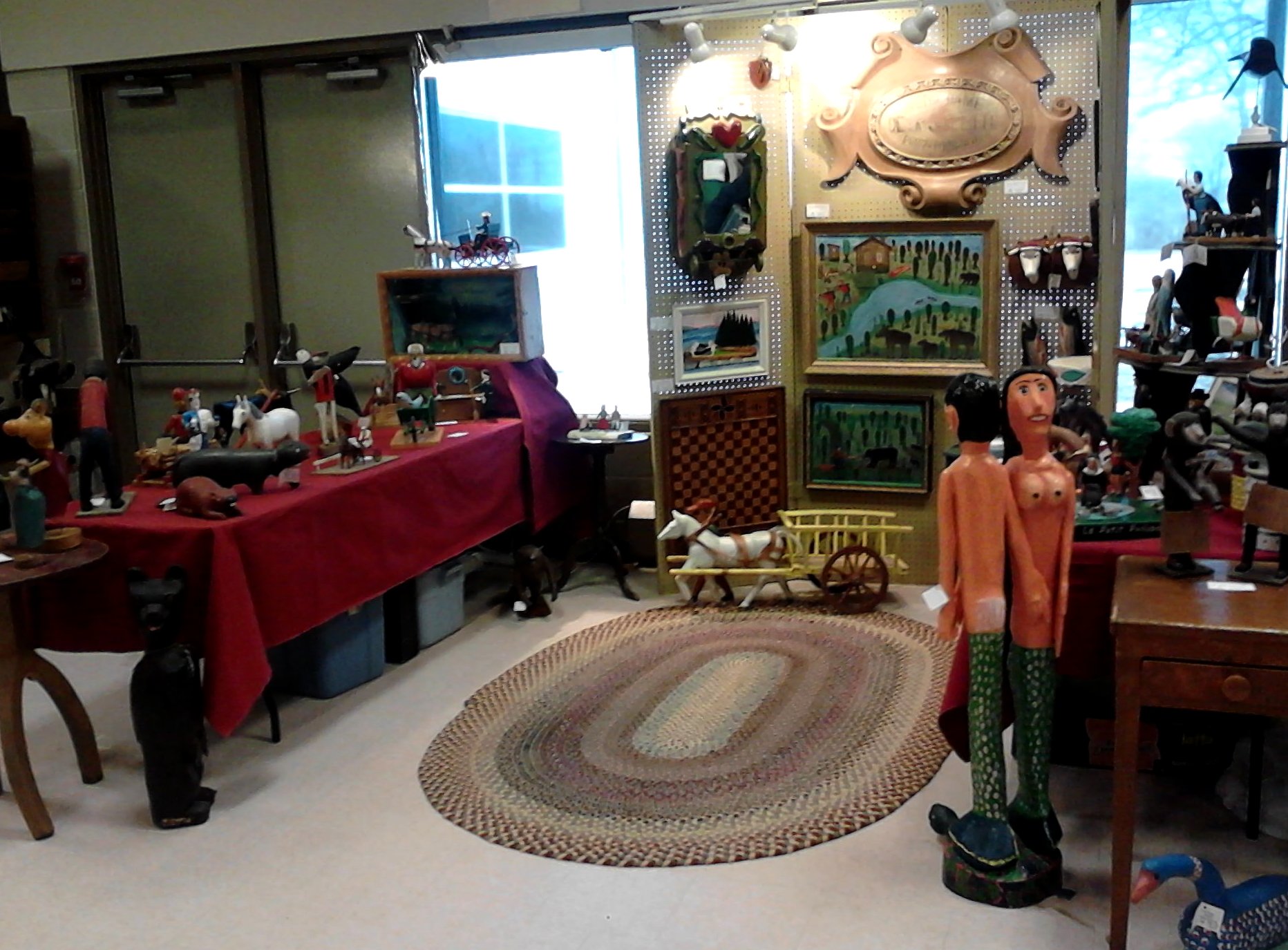
bow13shadThis is a picture of my booth at the 40th Edition of the Bowmanville Antique show. which was held Good Friday, March 29, and Saturday March 30th.  As you can see I went heavy on the folk art and light on furniture.  I love antique furniture, but I just don’t have the back for it anymore. If you want to see a slew of good pictures of the show please follow this link –  http://www.facebook.com/groups/126697675589/ to Adrian Tinline’s Canadiana Antiques facebook page.  If you are unfamiliar, this also serves to introduce you to this lively and informative forum.  Join, if you will.

This year Bowmanville was, as always a beautiful show, full of exceptional works of antique and folk art, and early handmade Canadian furniture and accessories.  All 24 exhibitors took special care to select and present their. best wares.  Many dealers put aside special pieces all year to present them here for the first time.

The show started humbly in 1973 when picker and collector extraordinaire Rob Lambert decided to invite the best dealers in the field of Canadiana to hold an annual spring show near his home in Bowmanville, Ontario.  In those early days dealers set up their offerings in their rooms at the Flying Dutchman hotel. When the starting bell rang, people would run (quite literally) from room to room to get ahead of their rivals, and purchase the treasures presented.  It was wild and hectic, with occasional  incidents of pushing and near fisticuffs. People were passionate about their collections back then.  It quickly gained the reputation of being “the” Canadiana show and it’s numbers and reputation grew from year to year.

Eventually the show moved to the G.B. Rickard Recreation Complex where it has continued to be held until present day.  For the past several years it has been expertly run  by Bill and Linda Dobson.  They have worked hard to maintain it’s tradition as a high quality, vetted show.  The vetting process is carried out before the show by a group of experts who go from booth to booth checking everything out for authenticity, quality, and accuracy of presentation.  Any repros, rebuilds, or items not meeting the criteria of the show are removed at this time.

I’ve been doing the show for about twenty years.  I’ve always been happy to do it, but I’ve also always fretted about doing well.  It all happens so fast. The bulk of the business is done within the first two hours of the show, People line up well ahead of time.  From time to time people even camp outside the door overnight to be first in line. With so many beautiful items competing for attention, you have to be ready to rumble when they come running through the door at  6 pm. Chances are that by eight o’clock you will have sold the bulk of what you are going to sell. You are on your feet and on your toes  selling, wrapping, and doing the math during those first two hours and then everyone clears out. By  9 pm you are either happy or concerned, but at least there is a good meal waiting for you.  Bill and Linda have always had wine and beer and food ready to bring out as the show closes, and for the last couple of years Mary Jo Field has been producing absolutely fabulous meals that in themselves are good enough reason to book the show.

Although many come to see the show on Saturday the atmosphere is considerably more relaxed. This is fine because  it allows you an opportunity to see the show, and chat with other dealers. Many of who I now see only once a year at this show. These chats often result in a few more sales or swaps.  Then it’s all over at 4, and within a couple of hours you’re packed and on your way home, either feeling great, or not so great, or disappointed.  It’s that kind of show.  Some people will always do well, and some people not so well.

I’d say that for the past couple of years, like everywhere else, sales have been slower, but there are positive signs too,  Prices are noticeably more reasonable, and interesting pieces, priced right do sell. It’s also great to see the show now includes three young dealers, Ben Lennox, Adrian Tinline, and Fairfield’s Antiques.  All had excellent booths, and added to the excitement with their enthusiasm and knowledge.  I also find it encouraging to see more young faces in the crowd, attendance figures are up over last year.

Here’s hoping that the Bowmanville show will continue to be a great place to see and buy the best in early Canadian antiques and folk art  for at least another forty years.

My happy time with Mr. Joly’s whirligig

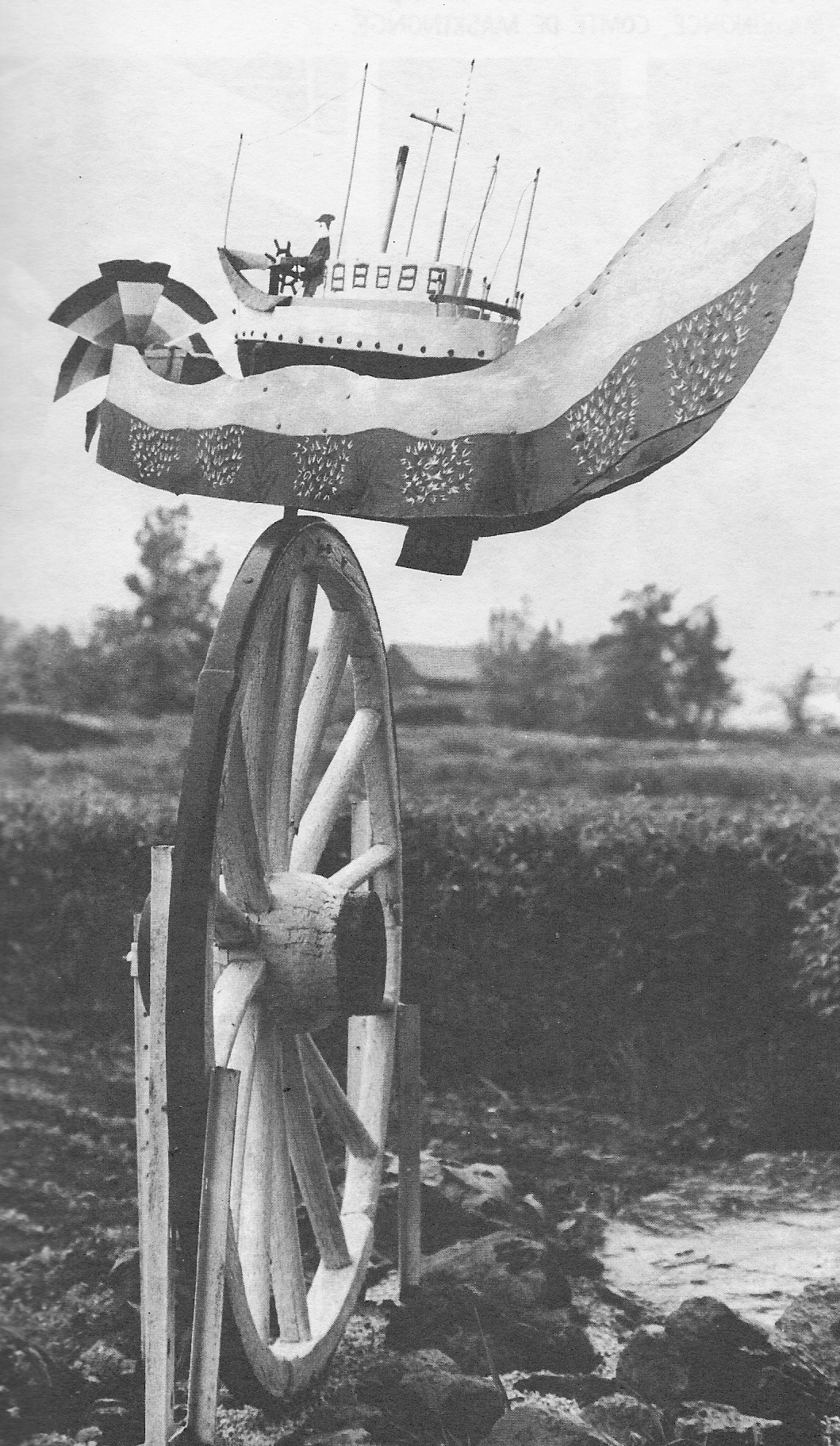
Gig on display at the church

Gig on display at the church

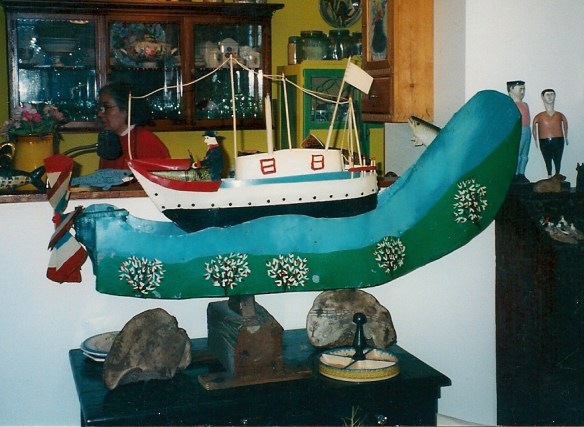
It was 1984 when I crossed paths with this whirligig; during the period when I was going to the picker’s barns of the Victoriaville area of Quebec every other week.  The drill was to leave home at 4 a.m., drive the ten hours, buy a truckload of furniture as quickly as possible, and get on home.  It was in late November, and I remember the trip well because the temperature dropped quickly, and the Drummondville bridge froze up before the roadway.  When I hit the bridge,  I did a perfect 360 pirouette the entire length, coming back on course and continuing as though nothing had happened; frazzled but undeterred.  Soon, the snow had come on so strong that for moments which seemed like eternity, I became completely lost, with no sense of direction within a big white cloud. All you can do when this happens is to slow down and listen for when the tires hit the gravel, thinking the whole time that a transport will come out of nowhere and drive right through you. Nasty. This was followed by long periods of the dreaded “hypno” snow, which is when the big fluffy flakes swirl over and over in spiral patterns until you think you’re going to loose it.  Tough sledding.

An hour later, when I finally arrived at Paul Prince’s place near Defoy it was dark and snowing hard, but I was just so damn happy to be alive.  The lights were on but Paul had gone home.  I was about to leave when a picker I knew named Jimmy pulled in behind me. A great guy, and a legendary  picker, he had been at it since he was a teenager.  On this night he was on his way home from picking around Montreal, and he was really excited by something “special” he wanted to show me. Jimmy was never a guy to suppress his enthusiasm.  Under the yard light, there in the back of his truck I could just make out  this funky metal rocking boat gig in vivid paint. All 4 feet in length of it. I got excited too. When he showed me how the window cranking mechanism from an old Ford  provided the gears for the rocking up and down of the boat, and the turning of the steering wheel I was a goner.

I had to think hard and fast because it was a lot of money, but a really cool thing; and I knew if I didn’t go for it, Paul, or the next guy would.  “O.K. Jimmy here you go, but put it on my back seat so it doesn’t get smashed by the furniture”. “I’m doing you a favour by selling you this.  You’re gonna make good money”.  “Ya right, if I wait 25 years”.  At this point Jimmy punched me in the arm and laughed, and the transaction was complete. I was delighted, but I had that slightly sick feeling I get when I stretch beyond my comfort range to acquire something special.  I loved it, but I could have bought 4 or 5 cupboards for the same money, and at that point cupboards were selling well, at a good profit. Oh,what the hey. You’ve got to trust your instincts, and great things don’t come along every day.

The next day was snowy and cold, and I filled the truck quickly, thinking all day of the money spent, and wondering whether Jeanine would share my enthusiasm.  I arrived home about 2 in the morning, so I left everything in the truck and went straight to bed. The next morning, over coffee, Jeanine asked me about the trip. I replied,  “Oh good overall, but  pretty intense”. I told her about the bridge incident, etc. and then casually mentioned that I bought something special that I hoped she would lke. I find it better to give confession right away, as delaying only adds to the suffering.  “Well, go get it, and let’s see what you’ve done”. The moment of truth had arrived.  Happily she loved it too, and we decided there and then to keep it for a good long time so we could appreciate it everyday.  “Too bad we don’t know who made it”.

Fast forward to the next summer and we are enjoying a weekend in Quebec, our favourite North American city.  We had heard of a bookstore where it was possible to buy a rare book, Les Patenteux du Quebec,  which we knew to be the “bible” of Quebec folk art, .

page 19 of "les Patenteux du Quebec"

page 19 of “les Patenteux du Quebec”

Published in 1978, it is the work of three young Quebec women who spent  a summer or so traveling all over Quebec documenting, and recording the stories of every Quebec folk artist they could trace.  We found the shop and bought the book, and when we cracked it open, it opened to page 19, and behold there was our whirligig. With a picture of it in it’s original location, and statement by the artist.  Extraordinary.   jolygig1
page18

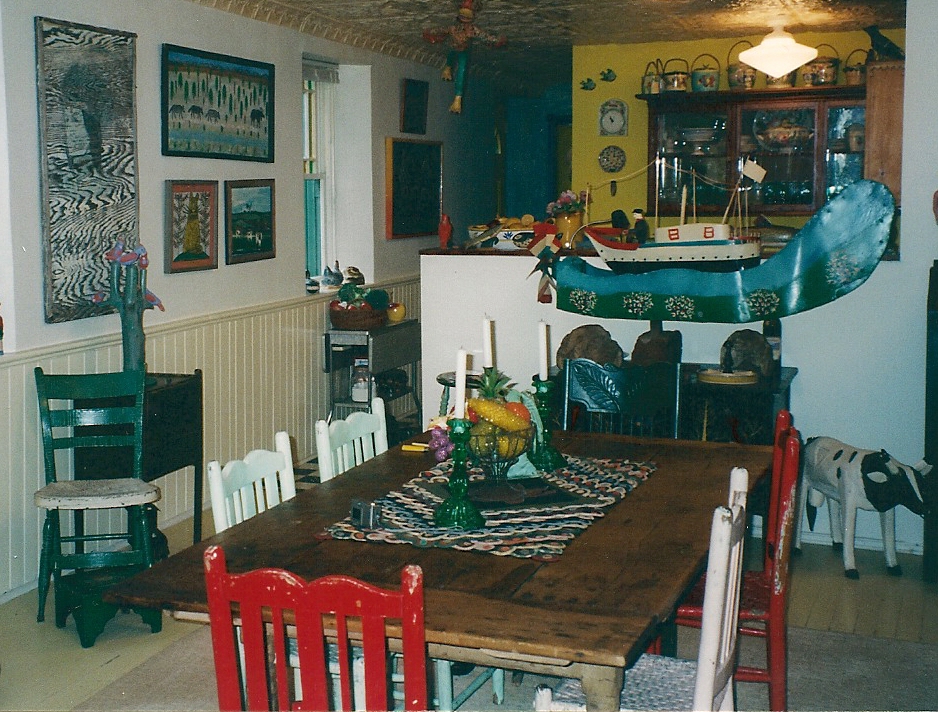
We placed the piece on a low cupboard in front of the low wall which separated our kitchen from dining area, and there it sat for the next twenty years or so.  We never offered it for sale but we had various offers over the years.  The best was when a friend  was returning to live in Italy, and he offered us his recent model Jeep in exchange. We thought about that one quite seriously, but refused figuring that the Jeep would rust out and be finished in a few years, where as the gig would just keep on going.

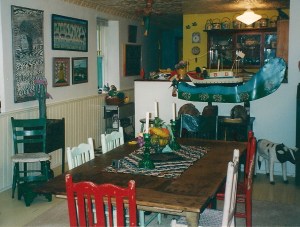
When we moved from the church to our current residence in  Port Dover in 2003,  we found it difficult to find the right place to display it. We considered mounting it high on a shelf above our front bay window, but that posed a risk of falling and crowning someone.  It moved from place to place being a bit in the way, and ended up sitting on a ledge behind the couch, which is when we more or less forgot about it. I still noticed it, but it no longer “engaged” me, if you catch my drift. Jeanine felt the same. So it came to pass that last year in a mood of downsizing we decided that although we had really enjoyed owning the piece, it was time to pass it along.  My friend, and serious collector Dr. Martin Osler had always coveted it,  and had asked for first refusal, so I gave him a call. Because we can both be convoluted at times, and because there was no particular hurry,  it took just about a full year to complete the transaction, but it now sits proudly on a high cupboard in the back of Marty’s office.  A striking location in an important collection, and I am happy because I can visit it occasionally. Here is a photo of Marty, and his friend, contemporary artist  Alex Cameron admiring the gig in it’s new home.

Marty and Alex enjoying his newest acquisition.

Marty and Alex enjoying his newest acquisition.

For me, after thirty years as a full time dealer I consider that I truly don’t own, or need to own anything.  My job is to find it, to recognize it, and then to be a good custodian until I have found it a decent home, where it will be loved and preserved.  It’s kind of liberating, actually.
Finding “Beauty in the Beast” at the Dufferin Museum

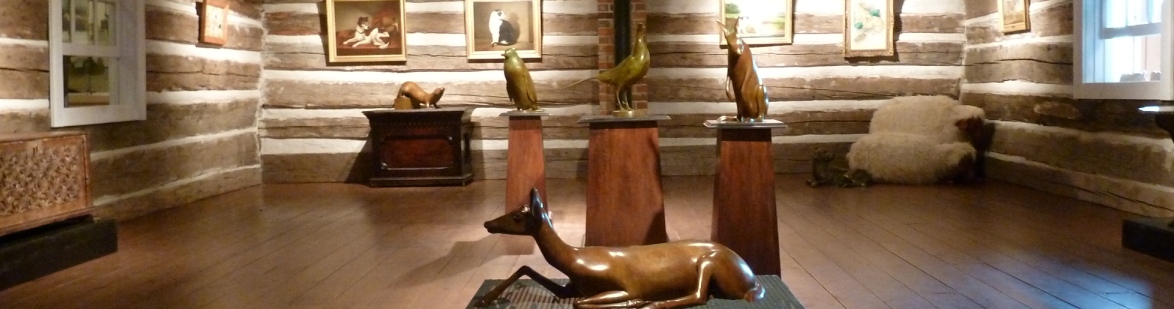
Interior of old Orange meeting hall houses Victorian English paintings and the contemporary bronzes of Adrian Sorrell (RCA) 1932-2001.

I had been looking forward since it’s April opening to seeing the exhibition  “Beauty In The Beast – Animals as Objects & Art”, and last Tuesday I finally made the roughly 100 km drive northwest of Toronto to the Dufferin Museum to see it. I was expecting to be impressed, but to put it mildly, I was blown away. More succinctly, I’d have to say absolutely gobsmacked.  It is an outstanding display of  all things animal, and I drank it in for over two hours before finally succumbing to “visual overload”. I left knowing that I would have to make a return trip to further take it all in before the closing date of December 22.

Initially I was struck by how beautifully the impressively large barn-like structure of the museum blends in with the surrounding rolling farm country.  Inside it is open and airy, and includes three full sized historic structures -a log cabin, an Orange Lodge meeting hall, and a railway flagging station.  The current exhibit is on display throughout. There are animals everywhere you look.

And who doesn’t love looking at animals?  After looking at ourselves, it is possibly our next favourite subject in art.  It goes back to the first caveman drawings.  I image the order was, himself, his wife, and then the animal he hunted, and depended on for his very sustenance.  Landscapes came later.  What’s amazing here is how the literally thousands of depictions cover almost every type of relationship we have with animals, and while viewing it, at times I was surprised  by an almost primal emotional response which welled up from deep within.  Animal effigies and Inuit carvings next to pastoral scenes of cows, horses and sheep, childhood memories of fantastic creatures and portraits of the family pet.  The iconic and the mundane.  Animals feared and animals worshiped.  Animals past such as an American 1880 copper grasshopper weather vane, an Egyptian brass cat, dated 200-210 B.C., 2nd century BC, 3rd and 4th century Netsuke carvings from Japan. These along side present depictions of animals by several contemporary Canadian sculptors include Marina Fricke, E. B. Cox, Clifford Neil and Calgary’s Gary Williams who produces brilliant large Majolica pottery pieces.

Gary Williams, contemporary Majolica swan

Plus, and these alone are worth the price of admission, there are 5 stunning bronzes by the brilliant English sculptor  Adrian Sorrell, shown in the photo up top.

And there is a lot of great, funky, funny folk art, past and present, which is guaranteed to make you, (and your kids if you’ve got them), smile. You just can’t help yourself when you look at the rusty tin covered cow by Contemporary Quebec artist, Patrick Amiot. Well, actually Mssr. Amiot now lives near San Francisco (I googled him), but you can see why we want to continue to claim him.

Cow by Patrick Amiot

Folk art fans will see many of their favourites including a few stunning miniatures by the master, William Loney (1878-1956) of Prince Edward County.  They are in a charming, glass 6 sided gazebo which was brought in to house the  miniatures. You can lose yourself there for a long stretch, Ill tell you. There is some fantastic animal related furniture as well, and a tree of life quilt which is to die for.  It just doesn’t stop.

“A lady sheep, Isabella Brandt, Ruben’s much loved first wife”, oil on canvas by Canadian Lindee Climo.

And I could go on at length about the contemporary art.  Surreal dream-scapes by  Gilles Genest, with titles like “Kangaroo’s picnic”, and “Full moon, white cats and hydrangea”. Also fascinating is  the exquisite work of Nova Scotia’s, Lindee Climo who paints animals in the style of the Old Renaissance Masters.

So how can I best express how strongly I feel that this is a first class, once in a lifetime,  drop everything to rush out and see exhibition?  I think I just did.  Go see it.

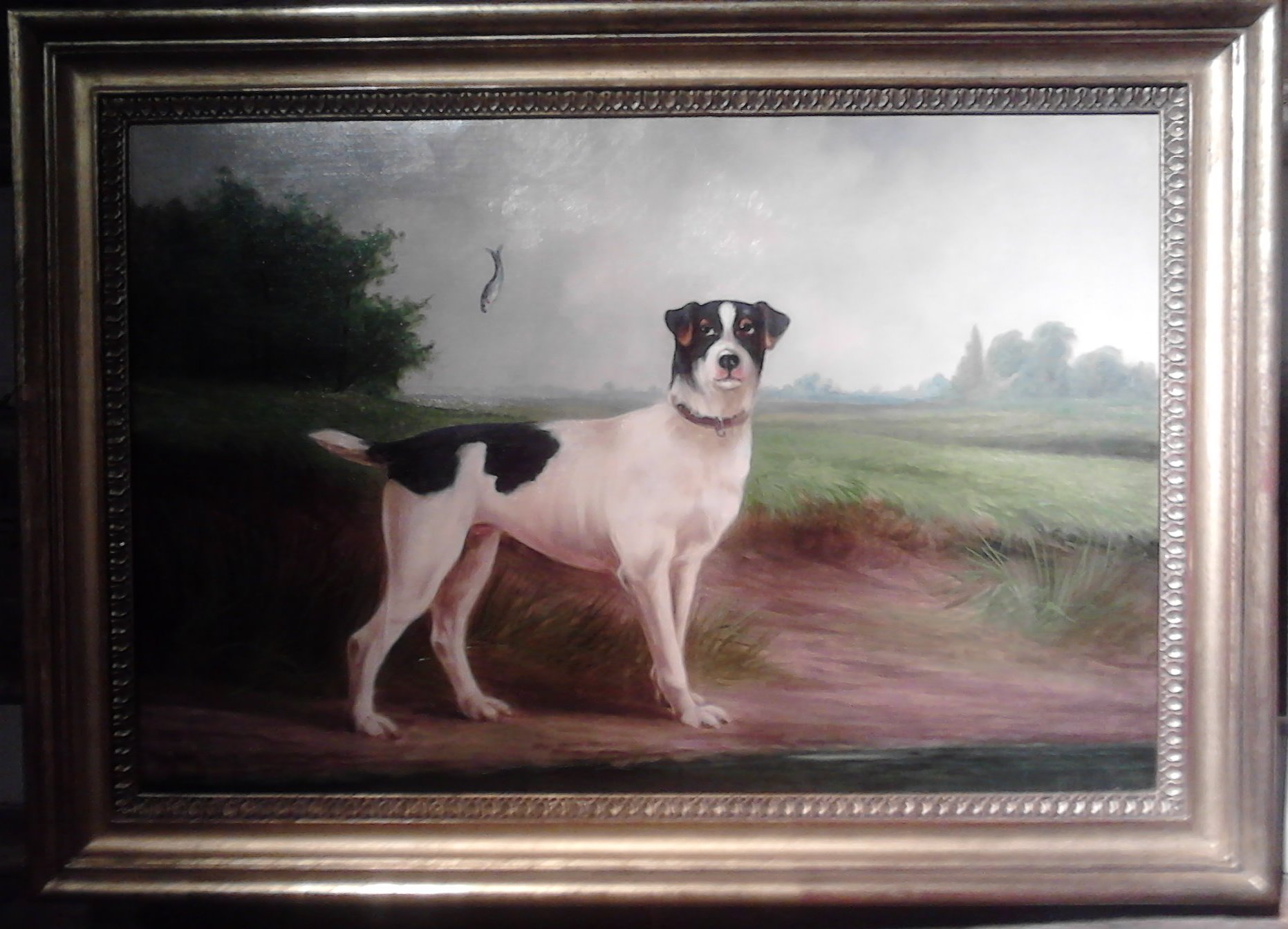
“Terrier and Leaping Trout” , oil on canvas by Wylan Young, England,1902

Here’s a link to the museum site – http://www.dufferinmuseum.com/

39th Annual Bowmanville show

the dealers circulating just before opening

This past Good Friday, April 6th, it was my pleasure to participate in the 39th annual Bowmanville Antiques and Folk Art show;  the long standing pinnacle of Canadian antique shows for early, collector-quality furniture, accessories, and folk art.  It is held every Good Friday and following Saturday at the G.B. Rickard Recreation Complex in Bowmanville, Ontario. It is a vetted show of 28 invited top dealers and represents the best of what’s out there.

It is always interesting and worthwhile but  to be honest for a dealer it is also always a bit of a wind up.  You work on your booth for weeks, seeking out and saving only the best items to present to the elite of the Canadian collectors who wait eagerly for the six o’clock opening so that they can rush in and nab that special something before a rival gets a chance.  Within two hours of the opening this crowd has either bought enough of your offerings that you are happy, or they have passed you by, and you are aware that you will be there until 9 that evening, and then from ten until four on the Saturday with a greatly diminished chance of anything moving.  I have been doing the show for over 20 years and twas always thus,  but lately with the stalled economy it has become more of a risk.  This year because I sold 11 of 24 drawings from the scrap book of a turn of the century young Niagara Peninsula woman, and a few other items I was alright, but I repacked my big ticket items at the end of the show and I noticed that it was the same for most of my colleagues.  I looked back over my books and although always profitable, the last year I had a gang buster show was 2009.  Fits right in with the general economy doesn’t it, and although Bill Dobson is a terrific guy and promotes and runs the show well, it does not seem to attract many new collectors.  Some feel that having it at every year at Easter which often coincides with Pass Over is an obstacle.  I think that a more important factor is that in recent years many large collections are being offered for auction around the same time of year. This year on May 19th Tim Potter is offering the important collection of Rod and Aggie Brook, and when you go to his site (http://www.timpotter.com/auctions/051912.html) and see the quality of what’s being offered you can see why some people were waiting.

It’s a rapidly changing, big ol’ digital world out there, and we live in hope that through exposure and promotion more people will be brought to recognize the authentic and will begin to seek out the beauty of the handmade antique item. Bowmanville is an institution, and you would be hard pressed to find a better show to increase your knowledge and  see beautiful things. Please come out and support it next year, which will be the 40th year.

I am happy to note that this year eight Collectivator dealers participated. They are  Barry Ezrin, Croydon House, Land and Ross, Martin Osler, Pollikers, Portobello Road, Shadfly, and Shaun Markey.  I include pictures here.  Thanks to Ben Lennox for some of the photos, and my sincere apology to Marty Osler  whose booth photo did not turn out. I hope to get a shot from a friend and add it.   In the meantime, I  am including a nice shot of the back of Marty’s head which shows off his trendy new short cropped hair.  Looking good Marty.

Croyden House

Barry Ezrin

Portobello Road / Ben Lennox

Land and Ross

Shaun Markey

Polliker

Shadfly

The back of Marty Osler’s head. Looking good.

Discovering the picker’s barns around Victoriaville

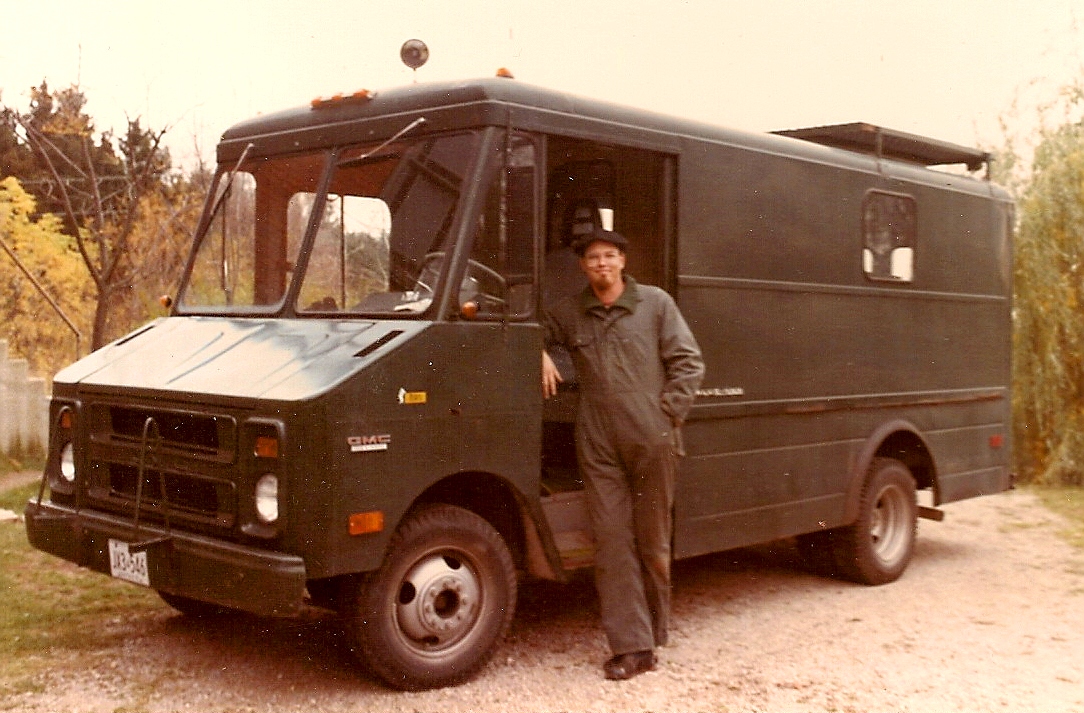
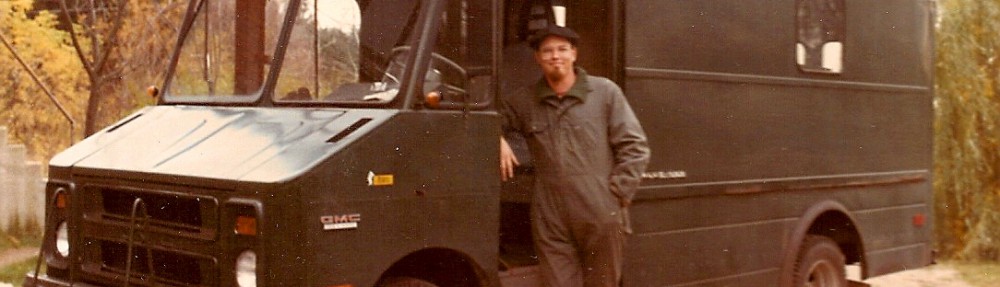
Our old Bell van which served us well for several years.

To continue were I left off in my last entry, after visiting Marcel Gosselin we went on to a large picker’s barn we had noticed on the way into Victoriaville which is where we met Jean (Kojak) Deshaies.  As we arrived , the place was buzzing with activity as several pickers clamored for the attention of a completely bald man; pointing at, and demanding prices of items still being unloaded from his pickup truck. Not being used to this type of “pressure’ buying we went inside and started to peruse the rows of furniture and items there.  Nothing was priced.  We made note of several things of interest, and waited.  After several minutes the bald man came in and approached us introducing himself in a distinctive, low raspy voice as Kojak, and stated simply “how can I help you”. I was slightly taken aback by the intensity of his voice, abrupt manner, powerful short build, and the fact  that he had absolutely no facial hair including eyebrows. He seemed slightly hostile. We explained that we were dealers from Ontario, and that this was our first trip to Quebec.  He immediately broke into a big smile and grabbed my hand and gave it a firm shake, and after introductions asked us what we found interesting.  As we pointed out several pieces of early furniture, rugs, carvings, etc, he would offer a short description and then bark out the prices.  As we said yes to an item, a young helper would grab the piece and haul it off to a place by the entrance where he started to make a pile.  Kojak wrote the prices on a scrap of paper.  He warmed with every item chosen and before long would sometimes follow up the price quoted with a second lower price he called “prix d’ami” or friend’s price.   After covering the first floor he took us upstairs to an equally large space covered with inexpensive lesser, or incomplete furniture and items.  We found many more things there and again they were taken out as soon as we chose them.

By the time we came downstairs I was quite shocked by the large pile we had accumulated.  I expressed my concern that I might not have enough cash for everything , but he said not to worry because a cheque would be fine.  I was surprised at this sign of trust but he joked that he knew I would be back, and besides if the cheque was not good he would soon be at my door to collect, and I wouldn’t want that to happen. He told us that he and a few of the other local dealers were just back from New York city were they had marched unannounced into the office of a downtown lawyer who had bought several items in the area with bad cheques, and had not answered their calls.  “we just waked into his office, grabbed him by the neck and told him we wanted our stuff back.  We didn’t have to do more.  He took us right to the warehouse.  We were back home ten hours later.”  This was the code he explained. If you had trouble covering a cheque it was fine as long as you were up front about it, and made it right. No problem.  Getting all that stuff into my truck was another thing but we managed.

Jeanine looking for fabrics in Michel Prince's basement.

Even though we had very little room left we felt we had to go on to Defoy to see the other picker’s barns there.  We stopped in at the three Boudin brothers barns which were almost side by side along the main route.  Rene, the oldest brother we had read about was off drinking in a nearby town when we arrived so we did not meet him this trip, but we managed to pick up a few smalls in his brother’s places.  Then we called a number we had for a new picker named Michel Prince who was still operating out of the basement of his house.  We were surprised when his wife said he was not yet home but to come anyway.  We did, and were delighted by the warmth and friendly manner of Pierrette, who tended to us while her little children ran in and out of the furniture piles.  Soon Michel arrived and enthusiastically showed us the things that he had picked that day.  It was all quite magical and exciting.  We bought a lot of hooked rugs and fabrics because there was little room left for anything else. Our money was spent, our truck was full,  and it was time to make the twelve hour trip back home.

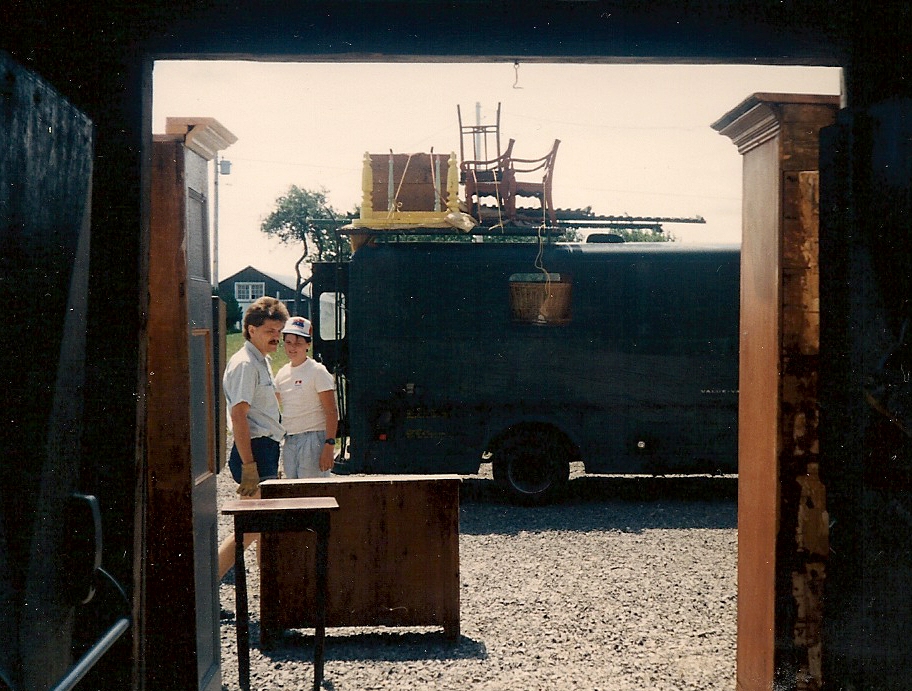
A full truck. Even the top rack was loaded. Time to go home.

Remembering Marcel Gosselin, our first picking in Quebec

By the winter of 1982, we had been going to the Harbourfront Antique market every Sunday for about a year, and were making a pretty good income on sales of things we had bought at local auctions and garage sales. Then one day, I read in the excellent and entertaining “bible” of Antique dealing “The Furniture Doctor” by George Grotz (get yourself a copy. That’s how we got started) that the village of Defoy, Quebec was mecca for the antique picker.  To quote  “there’s a wonderful secret wholesale place up in the province of Quebec. At least the dealers who know about it try to keep it a secret.  It’s the tiny town of Defoy. Only a gravel road from the main highway, but about a half a mile down there is the wonderful “antiques dump” of Rene Boudin and his freres. And here under enormous sheds you will find literally acres of antique furniture, chests, and tables piled three to five pieces high”.  The book had been out quite awhile so there was no telling if this situation still existed, so I asked the old guys at the market if they knew of such a place and I got several reports of it’s glory days, followed by “of course that was years ago and  nobody goes anymore.  That being said they also all encouraged me to give it a go, and gave me “leads”as to who may still be active.  We gathered up our courage, our baby,  and what cash we had, and set off.

Wow, did that first twelve hour drive felt like an eternity.  We even stayed overnight near Belleville because we had left so late in the day, but it was a tired crew who pulled in late afternoon to a tiny motel in Victoriaville, Quebec.  Very clean, but odd little room.  I remember all the furniture had thick plastic thumb-tacked over the surfaces. In any case, our first move was to look up the name Marcel Gosselin in the phone book because he was one of our most promising leads.  To our delight he was listed, and he answered and told us where and how to come the next morning.  It wasn’t hard to find because it was only a couple of clicks out of town, and he had his name painted boldly on the barn. Marcel greeted us warmly ( I noticed he was wearing two pairs of pants one on top of the other), and proceeded to lead us to his main barn.  There, behind the red and white cross doors was the biggest pile of dinning chairs I had ever seen.  About thirty feet across it reached to the top of the barn.  (I’ve got a picture somewhere, I’ll post it if it turn’s up). Through the hatchwork of legs I could see tantalizing glimpses of a cupboard and some chests. Then he took us upstairs where in a loft he had sorted hundreds of chairs in sets of four, six, or more. Some were painted and some varnished. It was $45 each for simple painted chairs, $65 each for nicer pressbacks and/or varnished. We got a couple of sets knowing we would get about $150-$250 each for these when refinished., Next I asked him about that cupboard I had seen in the giant pile downstairs.  He told me all about it including the age, condition and reasonable price of $250 and told me he would extricate it and have it ready for my next trip if I wanted it. I said I did, and then he didn’t even want a deposit. “That’s not the way we do it down here.  Your word is good enough, until it isn’t”  This in the half French, half English all the dealers speak down there which I like to call “Franglais”.  I liked him immediately and knew he was a man I would enjoy doing business with. Next he took us to the garage attached to his 100 year old frame house.  The downstairs was filled with every kind of “smalls” including small boxes, glassware, pottery, antique clothing, folk art, etc, etc; and the tiny, about to collapse, upstairs loft was filled with hundreds of pottery washsets. There were some beauties, and this was a hot item at the time in Toronto.  Prices ranged from $45-$75 per set.  We bought  about 8 sets of the nicest knowing we would get between $145 to $375 back home.  This was getting truly exciting.  We noticed for the first time various folk art pieces.  These were rare in Ontario.  We didn’t know if anybody would wanted them, but we knew we really liked them, so we bought several, feeling we would just keep them if they proved unpopular.

Jeanine finds a Aime Desmeule horse in the pile.

Jeanine really impressed Marcel because as he pointed out “she can speak either entirely in French, or entirely in English” , so he invited us in to the house to meet his mother.  She was a lovely old lady who immediately offered us tea.  As we sat and talked anything that we offered comment on, such as the beautiful antique carving of a work horse displayed prominently on the mantle, would either become available and Marcel would give you a price, or unavailable which was sadly the case with the carving.

We spent a terrific four hours or so with Marcel that first day and pulled away from his place, ecstatic with half our money spent, and  half the truck full of interesting, excellent quality, and reasonably priced stuff, not to mention the overwhelming sense of warmth, excitement and wonderment of that first glimpse into a Quebec picker’s life.  We were hooked, and we knew it was the first of many, many more trips to see Marcel.

“Open all hailing frequencies”

So oddly, I start this blog space with a rather faded reference to “treky” days  when in fact this is going to be a blog about the life, and times, and observations of Shadflyguy –  humble servant, and seeker of the authentic and beautiful in things produced by past and in some cases of present people.

Come and enjoy with me a nice cup of tea or coffee, or espresso as the case may be, and I will attempt to explain why for the past thirty years I have occupied my waking moments finding, selling, and researching Canadian antiques and folk art, when in my “previous” life I was trained and fully employed making high tech slide extravaganzas, as were “all the rage” then at places like Expo 67, and Ontario Place.

I am going to attempt over time to transfer to this site the four giant drawers I have full of photographs, notes, and background information on some of the Canadian folk artists I have met.  This  in some kind of orderly fashion so as they may be useful to those seeking this previously unpublished material.  I am also going to attempt  to relay some of the juicier “picker’s stories” I have heard in my travels because they are fun.  I may even illuminate some old time dealers tricks, and things to watch out for when buying antiques.  If I really get rolling I may even start to document my furniture restoring techniques. Although I am concerned about the possibility of someone ruining dear Grandma’s rocker and holding me personally responsible…. hmmm.  You can see I am thinking about categories, and ramifications.  I think I may have the hang of this but do I have the chops.  We’ll see.

Right up front I want to thank my daughter Cassandra for leading the horse to water.   O.K. Welcome aboard, and let’s get at ‘er and post this puppy before I loose my nerve.

cheers,

Shadflyguy